Biosphere Reserves in India represent an integrated approach to conserving biodiversity while addressing the developmental needs of local communities. India’s Biosphere Reserve Programme seeks to protect representative ecosystems, genetic resources and ecological processes while promoting sustainable livelihoods, scientific research, environmental education and community participation. India currently has 18 notified Biosphere Reserves, covering approximately 91,425 sq km, of which 13 are included in UNESCO’s World Network of Biosphere Reserves.
Biosphere Reserves in India encompass diverse landscapes, including mountains, forests, deserts, wetlands, coastal areas and islands. Their zonation into core, buffer and transition areas enables conservation to coexist with research, education and sustainable resource use, making Biosphere Reserves in India an important instrument of landscape-level conservation and sustainable development.
Biosphere Reserves in India Overview
India's Biosphere Reserve Programme was developed to complement the protected-area network by conserving representative ecosystems while integrating sustainable livelihoods, research, education and local participation.
- The Indian National Man and Biosphere (MAB) Committee began identifying potential sites in 1979, while the establishment of Biosphere Reserves was approved in 1983.
- India's national Biosphere Reserve Programme was subsequently launched in 1986, broadly following UNESCO's MAB guidelines. The programme seeks to:
- Conserve representative ecosystems and biological diversity.
- Protect genetic resources and ecological processes.
- Promote sustainable economic and human development.
- Encourage participation of local communities.
- Integrate scientific research with traditional knowledge.
- Support environmental education and training.
- India currently has 18 notified Biosphere Reserves covering about 91,425 sq km. Following the addition of the Cold Desert Biosphere Reserve to UNESCO's World Network in September 2025, 13 Biosphere Reserves in India are internationally recognised under UNESCO's World Network of Biosphere Reserves.
Man and the Biosphere (MAB) Programme
UNESCO's Man and the Biosphere (MAB) Programme provides the international framework through which Biosphere Reserves demonstrate conservation, sustainable development, research and cooperation between people and ecosystems.
- The MAB Programme was launched by UNESCO in 1970 as a broad ecological programme linking natural and social sciences with conservation and sustainable resource management.
- The term "Biosphere Reserve" was introduced within the MAB framework in 1971, while the World Network of Biosphere Reserves was formally launched in 1976. The MAB Programme focuses on:
- Understanding interactions between humans and ecosystems.
- Conserving biological and cultural diversity.
- Promoting sustainable development.
- Supporting research, monitoring and environmental education.
- Sharing knowledge and best practices internationally.
- Improving human well-being while maintaining ecological integrity.
- UNESCO's World Network of Biosphere Reserves (WNBR) is therefore different from India's national Biosphere Reserve system – a site can be a nationally designated Biosphere Reserve without being part of UNESCO's WNBR.
Biosphere Reserves in India Declaration Criteria
The criteria for Biosphere Reserve designation emphasise ecological representation, biodiversity significance, sustainable development potential, appropriate zonation and meaningful participation of communities and institutions.
- Under UNESCO's Statutory Framework, an area considered for Biosphere Reserve designation should generally:
- Represent a mosaic of ecological systems characteristic of major biogeographical regions.
- Have substantial significance for biodiversity conservation.
- Provide opportunities to demonstrate sustainable development at a regional scale.
- Have an adequate size and appropriate zonation to perform the three Biosphere Reserve functions.
- Contain a legally constituted core area dedicated to long-term protection.
- Have a clearly identified buffer zone adjoining or surrounding the core.
- Include an outer transition area where sustainable resource-use practices can be promoted.
- Provide mechanisms for participation by government authorities, local communities and other stakeholders.
- Have arrangements for management, research, monitoring, education and training


Biosphere Reserves in India Zonation
The zonation system of Biosphere Reserves in India enables reserves to combine strict biodiversity protection with compatible economic activities, research and sustainable resource use across interconnected ecological and social landscapes.
- Core Zone: The core zone is the most strictly protected part of a biosphere reserve. It is intended for long-term conservation of ecosystems, species and genetic diversity, with activities generally restricted to those compatible with conservation, such as monitoring and non-destructive research.
- Buffer Zone: The buffer zone surrounds or adjoins the core area. Activities compatible with conservation can be undertaken here, including research, environmental education, ecological restoration, recreation and sustainable resource use.
- Transition Zone: The transition zone is the outer area where communities and other stakeholders work towards sustainable management of natural resources and socio-economic development. Agriculture, settlements and other sustainable economic activities may occur here.
Biosphere Reserves in India Map
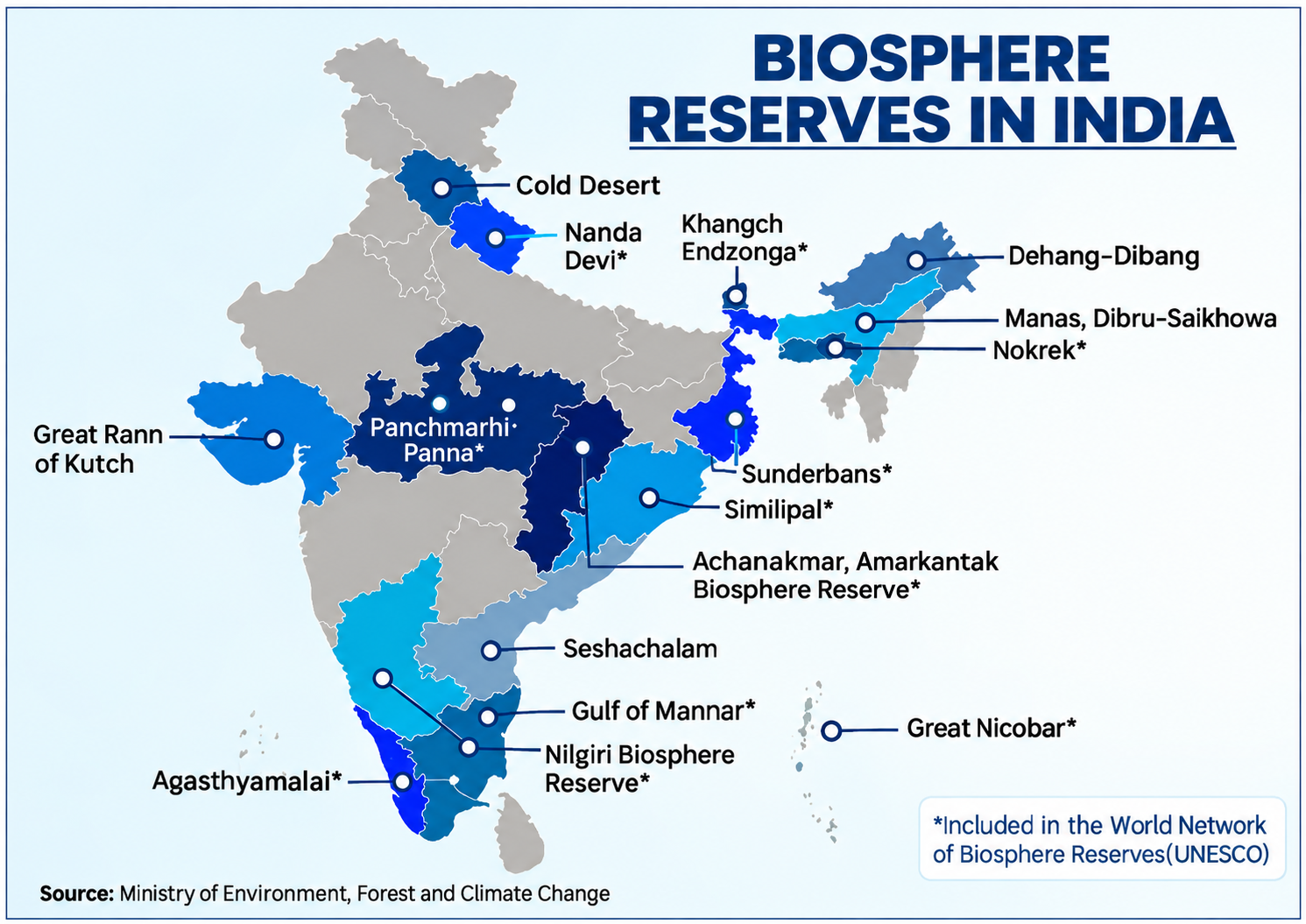
Biosphere Reserves in India List
There are 18 Biosphere Reserves in India which are spread across diverse mountain, forest, desert, coastal, island and wetland ecosystems, collectively covering approximately 91,425 sq km.
1. Nilgiri Biosphere Reserve
- Year of designation: 1986
- State/UT: Tamil Nadu, Kerala, Karnataka
- Key specification: India's first Biosphere Reserve; Western Ghats landscape.
- Hills/Landforms: Nilgiri Hills, Wayanad Hills and Siruvani Hills
- River system: Bhavani, Moyar, Kabini, etc.
- National Parks in the Nilgiri Biosphere Reserve:
- Bandipur National Park
- Nagarhole National Park
- Mudumalai National Park
- Mukurthi National Park
- Silent Valley National Park
- Tiger Reserves in the Nilgiri Biosphere Reserve:
- Bandipur Tiger Reserve
- Nagarhole Tiger Reserve
- Mudumalai Tiger Reserve
- Sathyamangalam Tiger Reserve
- Important Species: Nilgiri Tahr, Lion-tailed Macaque, Royal Bengal Tiger
2. Nanda Devi Biosphere Reserve
- Year of designation: 1988
- State/UT: Uttarakhand
- Key specification: High-altitude Himalayan ecosystem; includes Nanda Devi landscape and Valley of Flowers.
- Hills/Landforms: Nanda Devi Massif, Garhwal Himalayas
- River system: Rishi Ganga, Dhauli Ganga and Alaknanda system
- National Parks in the Nanda Devi Biosphere Reserve:
- Nanda Devi National Park
- Valley of Flowers National Park
- Tiger Reserves in the Nanda Devi Biosphere Reserve: None
- Important Species: Snow Leopard, Himalayan Musk Deer
3. Nokrek Biosphere Reserve
- Year of designation: 1988
- State/UT: Meghalaya
- Key specification: Garo Hills ecosystem; important centre of endemic biodiversity.
- Hills/Landforms: Garo Hills, including Nokrek Peak
- River system: Simsang, Ganol and related Garo Hills rivers
- National Parks in the Nokrek Biosphere Reserve: Nokrek National Park
- Tiger Reserves in the Nokrek Biosphere Reserve: None
- Important Species: Red Panda, Hoolock Gibbon, Asian Elephant
4. Great Nicobar Biosphere Reserve
- Year of designation: 1989
- State/UT: Andaman and Nicobar Islands
- Key specification: Tropical island ecosystem with exceptional terrestrial, coastal and marine biodiversity.
- Hills/Landforms: Mount Thullier and central hill ranges of Great Nicobar
- River system: Galathea River, Alexandra River and other short island streams
- National Parks in the Great Nicobar Biosphere Reserve:
- Campbell Bay National Park
- Galathea National Park
- Tiger Reserves in the Great Nicobar Biosphere Reserve: None
- Important Species: Nicobar Megapode, Dugong, Saltwater Crocodile
5. Gulf of Mannar Biosphere Reserve
- Year of designation: 1989
- State/UT: Tamil Nadu
- Key specification: It is India’s first marine Biosphere Reserve with rich coral, seagrass and coastal ecosystems
- Hills/Landforms: Coastal plains, islands, coral reefs and sand formations
- River system: Coastal waters influenced by rivers including Vaigai and Tamiraparani
- National Parks in the Gulf of Mannar Biosphere Reserve: Gulf of Mannar Marine National Park.
- Tiger Reserves in the Gulf of Mannar Biosphere Reserve: None
- Important Species: Dugong, Olive Ridley Turtle
6. Manas Biosphere Reserve
- Year of designation: 1989
- State/UT: Assam
- Key specification: Eastern Himalayan foothill ecosystem; important riverine grassland and forest landscape.
- Hills/Landforms: Himalayan foothills and Bhabar-Terai landscape
- River system: Manas, Beki, Hakua and related Brahmaputra tributaries
- National Parks in the Manas Biosphere Reserve: Manas National Park
- Tiger Reserves in the Manas Biosphere Reserve: Manas Tiger Reserve
- Important Species: Royal Bengal Tiger, Golden Langur, Pygmy Hog, Wild Water Buffalo
7. Sundarbans Biosphere Reserve
- Year of designation: 1989
- State/UT: West Bengal
- Key specification: World's largest contiguous mangrove ecosystem; deltaic landscape.
- Hills/Landforms: Tidal islands, mudflats, mangrove forests and deltaic plains
- River system: Ganga-Brahmaputra-Meghna delta; major distributaries include Matla, Raimangal and Gosaba
- National Parks in the Sundarbans Biosphere Reserve: Sundarbans National Park
- Tiger Reserves in the Sundarbans Biosphere Reserve: Sundarbans Tiger Reserve
- Important Species: Royal Bengal Tiger
8. Similipal Biosphere Reserve
- Year of designation: 1994
- State/UT: Odisha
- Key specification: Major Eastern Ghats forest ecosystem with high floral and faunal diversity.
- Hills/Landforms: Similipal Hills and Eastern Ghats highlands
- River system: Budhabalanga, Khairi and Salandi river systems
- National Parks in the Similipal Biosphere Reserve: Similipal National Park
- Tiger Reserves in the Similipal Biosphere Reserve: Similipal Tiger Reserve
- Important Species: Royal Bengal Tiger, Asian Elephant, Gaur (Indian Bison)
9. Dibru-Saikhowa Biosphere Reserve
- Year of designation: 1997
- State/UT: Assam
- Key specification: Wetland, riverine and forest ecosystem in the Brahmaputra floodplain
- Hills/Landforms: Predominantly low-lying floodplains and river islands
- River system: Brahmaputra, Dibru and Lohit river systems
- National Parks in the Dibru-Saikhowa Biosphere Reserve: Dibru-Saikhowa National Park
- Tiger Reserves in the Dibru-Saikhowa Biosphere Reserve: None
- Important Species: White-winged Wood Duck, Gangetic River Dolphin, Feral Horse
10. Dehang-Dibang Biosphere Reserve
- Year of designation: 1998
- State/UT: Arunachal Pradesh
- Key specification: Eastern Himalayan high-altitude ecosystem with exceptional mountainous biodiversity.
- Hills/Landforms: Eastern Himalayas, Mishmi Hills and high mountain valleys
- River system: Siang and Dibang river systems
- National Parks in the Dehang-Dibang Biosphere Reserve: Mouling National Park
- Tiger Reserves in the Dehang-Dibang Biosphere Reserve: None
- Important Species: Mishmi Takin, Red Panda, Musk Deer
11. Pachmarhi Biosphere Reserve
- Year of designation: 1999
- State/UT: Madhya Pradesh
- Key specification: Satpura landscape; important central Indian forest ecosystem.
- Hills/Landforms: Satpura Range and Pachmarhi Hills
- River system: Tawa, Denwa and Sonbhadra river systems
- National Parks in the Pachmarhi Biosphere Reserve: Satpura National Park
- Tiger Reserves in the Pachmarhi Biosphere Reserve: Satpura Tiger Reserve
- Important Species: Royal Bengal Tiger, Gaur (Indian bison), Indian Giant Squirrel
12. Khangchendzonga Biosphere Reserve
- Year of designation: 2000
- State/UT: Sikkim
- Key specification: High-altitude Himalayan ecosystem centred around Mount Khangchendzonga.
- Hills/Landforms: Khangchendzonga massif and Eastern Himalayan mountains
- River system: Teesta and Rangeet river systems
- National Parks in the Khangchendzonga Biosphere Reserve: Khangchendzonga National Park
- Tiger Reserves in the Khangchendzonga Biosphere Reserve: None
- Important Species: Snow Leopard, Red Panda, Musk Deer
13. Agasthyamalai Biosphere Reserve
- Year of designation: 2001
- State/UT: Kerala, Tamil Nadu
- Key specification: Southern Western Ghats ecosystem with exceptional plant diversity and high endemism.
- Hills/Landforms: Agasthyamalai Hills and southern Western Ghats
- River system: Tamiraparani, Neyyar and Karamana river systems
- National Parks in the Agasthyamalai Biosphere Reserve:
- The Agasthyamalai Biosphere Reserve does not have any formal national parks; instead, it encompasses three wildlife sanctuaries: Shendurney Wildlife Sanctuary, Peppara Wildlife Sanctuary and Neyyar Wildlife Sanctuary.
- Tiger Reserves in the Agasthyamalai Biosphere Reserve: Kalakkad-Mundanthurai Tiger Reserve (KMTR)
- Important Species: Nilgiri Tahr, Lion-tailed Macaque, Asian Elephant
14. Achanakmar-Amarkantak Biosphere Reserve
- Year of designation: 2005
- State/UT: Madhya Pradesh, Chhattisgarh
- Key specification: Interstate Biosphere Reserve in India; important central Indian forest and watershed landscape.
- Hills/Landforms: Maikal Range and Amarkantak Plateau
- River system: Narmada, Son and Johila river systems
- National Parks in the Achanakmar-Amarkantak Biosphere Reserve: None
- Tiger Reserves in the Achanakmar-Amarkantak Biosphere Reserve: Achanakmar Tiger Reserve.
- Important Species: Four-horned Antelope, Dhole, Leopard
15. Great Rann of Kutch Biosphere Reserve
- Year of designation: 2008
- State/UT: Gujarat
- Key specification: Desert, saline wetland and arid ecosystem.
- Hills/Landforms: Great Rann, saline flats, desert landscape and surrounding arid plains
- River system: Seasonal streams and drainage systems of the Kutch region
- National Parks in the Great Rann of Kutch Biosphere Reserve: None
- Tiger Reserves in the Great Rann of Kutch Biosphere Reserve: None
- Important Species: Indian Wild Ass, Great Indian Bustard, Flamingo
16. Cold Desert Biosphere Reserve
- Year of designation: 2009
- State/UT: Himachal Pradesh
- Key specification: High-altitude trans-Himalayan cold desert ecosystem.
- Hills/Landforms: Trans-Himalayan mountains, Spiti Valley and high-altitude plateaus
- River system: Spiti River, Pin River and Sutlej system
- National Parks in the Cold Desert Biosphere Reserve: Pin Valley National Park
- Tiger Reserves in the Cold Desert Biosphere Reserve: None
- Important Species: Snow Leopard, Himalayan Ibex, Blue Sheep
17. Seshachalam Biosphere Reserve
- Year of designation: 2010
- State/UT: Andhra Pradesh
- Key specification: Eastern Ghats ecosystem; famous for endemic Red Sanders forests
- Hills/Landforms: Seshachalam Hills and Tirumala Hills
- River system: Swarnamukhi and other seasonal streams
- National Parks in the Seshachalam Biosphere Reserve: Sri Venkateswara National Park
- Tiger Reserves in the Seshachalam Biosphere Reserve: None
- Important Species: Red Sanders, Golden Gecko, Slender Loris
18. Panna Biosphere Reserve
- Year of designation: 2011
- State/UT: Madhya Pradesh
- Key specification: Vindhyan landscape with dry deciduous forests, plateaus and riverine ecosystems.
- Hills/Landforms: Vindhyan Range, plateaus, gorges and forested ravines
- River system: Ken River and its tributaries
- National Parks in the Panna Biosphere Reserve: Panna National Park
- Tiger Reserves in the Panna Biosphere Reserve: Panna Tiger Reserve
- Important Species: Royal Bengal Tiger, Chinkara, Sloth Bear
Biosphere Reserves in India Important Facts
- First Biosphere Reserve in India: Nilgiri, designated in 1986.
- Largest Biosphere Reserve in India by area: Great Rann of Kutch, approximately 12,454 sq km, among India's notified Biosphere Reserves in the official list.
- Smallest Biosphere Reserve in India by area: Nokrek, approximately 820 sq km.
- Only high-altitude cold desert Biosphere Reserve in India: Cold Desert, Himachal Pradesh; it covers 7,770 sq km and was added to UNESCO's WNBR in 2025.
Biosphere Reserves in India Under UNESCO MAB
UNESCO recognition places selected Indian Biosphere Reserves within the World Network, enabling international cooperation, knowledge exchange and recognition of their conservation and sustainable-development value. As of September 2026, 13 biosphere reserves in India are included in UNESCO's World Network of Biosphere Reserves (WNBR):
| Biosphere Reserves in India | State/UT | Year designated in India | Year included in WNBR |
|
Nilgiri |
Tamil Nadu, Kerala, Karnataka |
1986 |
2000 |
|
Gulf of Mannar |
Tamil Nadu |
1989 |
2001 |
|
Sundarbans |
West Bengal |
1989 |
2001 |
|
Nanda Devi |
Uttarakhand |
1988 |
2004 |
|
Nokrek |
Meghalaya |
1988 |
2009 |
|
Pachmarhi |
Madhya Pradesh |
1999 |
2009 |
|
Similipal |
Odisha |
1994 |
2009 |
|
Achanakmar-Amarkantak |
Madhya Pradesh, Chhattisgarh |
2005 |
2012 |
|
Great Nicobar |
Andaman & Nicobar Islands |
1989 |
2013 |
|
Agasthyamalai |
Tamil Nadu, Kerala |
2001 |
2016 |
|
Khangchendzonga |
Sikkim |
2000 |
2018 |
|
Panna |
Madhya Pradesh |
2011 |
2020 |
|
Cold Desert |
Himachal Pradesh |
2009 |
2025 |
Biosphere Reserves in India Outside UNESCO's MAB World Network
- Five of India's 18 nationally designated Biosphere Reserves currently remain outside UNESCO's World Network, although they continue to receive national recognition and conservation support. These are:
- Manas – Assam
- Dibru-Saikhowa – Assam
- Dehang-Dibang – Arunachal Pradesh
- Great Rann of Kutch – Gujarat
- Seshachalam – Andhra Pradesh
- Being outside the UNESCO World Network does not mean that these areas lack protection or conservation value. India's National Biosphere Reserve Programme continues to support conservation and management activities in designated reserves.
Biosphere Reserves in India Importance
The importance of biosphere reserves in India lies in their ability to combine biodiversity protection with sustainable livelihoods, scientific research, climate resilience and community participation across large ecological landscapes.
- Biodiversity Conservation: They protect ecosystems, species and genetic diversity across representative landscapes.
- Sustainable Development: They demonstrate ways to reconcile environmental protection with socio-economic development.
- Climate Resilience: Healthy forests, wetlands, mountains, coastal ecosystems and other habitats strengthen ecological resilience.
- Livelihood Security: Sustainable livelihood programmes can reduce communities' dependence on ecologically sensitive core areas.
- Scientific Research: Biosphere Reserves provide field settings for ecological research, monitoring and experimentation.
- Environmental Education: They serve as platforms for awareness, training and environmental education.
- Traditional Knowledge: Their community-oriented approach allows conservation planning to incorporate local knowledge and practices.
- International Cooperation: UNESCO's WNBR facilitates the exchange of knowledge and experiences between Biosphere Reserves around the world
Biosphere Reserves in India Conservation Efforts
India's conservation strategy combines national funding, management plans, protected-area measures, scientific monitoring and community livelihood programmes to strengthen ecological protection within Biosphere Reserve landscapes.
- Centrally Sponsored Scheme: The Biosphere Reserve Division of MoEFCC administers a Centrally Sponsored Scheme for biodiversity conservation under the broader Conservation of Natural Resources and Ecosystems (CNRE) programme.
- It provides financial assistance to States for conservation and development activities. The current funding pattern is 60:40 between Centre and State, and 90:10 for North-Eastern and Himalayan States.
- Management Action Plans: Management Action Plans are used to translate conservation objectives into field-level programmes.
- For example, Madhya Pradesh implements Management Action Plans for Pachmarhi, Panna and Achanakmar-Amarkantak, with monitoring and coordination involving state and district-level institutions
- Community-Based Livelihoods: Conservation programmes increasingly link ecological protection with alternative livelihoods.
- Examples from Madhya Pradesh include Tussar sericulture, fisheries, self-help group activities and livelihood-development programmes, designed to reduce pressure on sensitive ecosystems while improving local incomes.
- Research and Environmental Education: Nature camps, field studies, GIS-based mapping, ecological monitoring and research activities help improve understanding of Biosphere Reserve ecosystems. Such initiatives also create environmental awareness among students and local communities.
- Complementary Conservation Programmes: Biosphere Reserve conservation is complemented by wider national initiatives such as:
- Project Tiger
- Project Elephant
- Green India Mission
- Integrated Development of Wildlife Habitats
- National Biodiversity Action Plan
- Eco-sensitive zones and wildlife corridors
Biosphere Reserves in India Challenges
Despite their integrated conservation model, biosphere reserves face pressures from habitat degradation, competing development demands, limited community participation and difficulties in coordinating multiple institutions.
- Habitat Degradation: Deforestation, fragmentation, infrastructure expansion and unsustainable resource extraction can weaken ecological connectivity and affect species populations.
- Development–Conservation Conflict: Roads, mining, tourism, settlements and other development activities can create conflicts with biodiversity objectives, particularly where human populations depend heavily on natural resources.
- Community Participation: The success of a Biosphere Reserve depends substantially on local participation. Weak involvement of communities can reduce acceptance of conservation measures and limit the effectiveness of sustainable-development initiatives.
- Institutional Coordination: Biosphere Reserves often involve Central ministries, State Forest Departments, district administrations, research institutions, local communities and other stakeholders. Coordinating their responsibilities can be challenging.
- Financial and Capacity Constraints: Effective monitoring, research, habitat restoration and livelihood programmes require sustained financial and technical capacity.
- Climate Change: Changes in temperature, rainfall, extreme events, sea levels and ecosystem conditions can increase pressure on mountain, coastal, island and forest biosphere reserves.
- Tourism Pressure: Poorly managed tourism can increase waste, water demand, infrastructure pressure and disturbance to wildlife and local ecosystems.
Biosphere Reserves in India Way Forward
India can strengthen biosphere reserves by moving towards landscape-level governance, stronger community institutions, scientific monitoring, sustainable livelihoods and better integration of conservation with development planning.
- Strengthen Community Participation: Give local communities a greater role in planning, monitoring and benefit-sharing.
- Promote Sustainable Livelihoods: Expand eco-friendly enterprises, non-timber forest products, responsible ecotourism and community-based businesses.
- Improve Scientific Monitoring: Use GIS, remote sensing, biodiversity databases and long-term ecological monitoring to track ecosystem changes.
- Strengthen Landscape Connectivity: Protect wildlife corridors and ecological linkages between protected areas.
- Integrate Climate Adaptation: Develop location-specific adaptation strategies for Himalayan, coastal, island, desert and forest ecosystems.
- Improve Institutional Coordination: Establish stronger coordination between Central and State agencies, research institutions and local bodies.
- Promote Responsible Tourism: Ensure carrying-capacity-based tourism planning and waste-management systems.
Biosphere Reserves in India UPSC PYQs
Q1. Which of the following are in Agasthyamala Biosphere Reserve? (UPSC Prelims 2019)
a) Neyyar, Peppara and Shendurney Wildlife Sanctuaries; and Kalakad Mundanthurai Tiger Reserve
b) Mudumalai, Sathyamangalam and Wayanad Wildlife Sanctuaries; and Silent Valley National Park
c) Kaundinya, Gundla Brahmeswaram and Papikonda Wildlife Sanctuaries; and Mukurthi National Park
d) Kawal and Sri Venkateswara Wildlife Sanctuaries; and Nagarjunasagar-Srisailam Tiger Reserve
Ans: (a)
Q2. Consider the following pairs: (UPSC Prelims 2013)
- Nokrek biosphere reserve: Garo Hills
- Logtak (Loktak) lake: Bakail Range
- Namdapha national park: Dafla Hills
Which of the above pairs is/are correctly matched?
a) 1 only
b) 2 and 3 only
c) 1, 2 and 3
d) None
Ans: (a)

 Last updated on Oct, 2026
→ UPSC 2027 Notification will be released on 13 January 2027 at upsconline.nic.in.
→ Check Nobel Prize 2026 Winners List here.
→ Download PIB PRiSM Monthly Magazine 2026 here.
→ Check UPSC Monthly Current Affairs Magazine The Recitals here.
→ Check out the latest UPSC Syllabus here.
→ Download UPSC Model Answers for Mains 2026
→ UPSC Mains Question Paper 2026 is out now for Essay & GS Paper 1, 2, 3 & 4.
→ UPSC Calendar 2027 has been released.
→ Enroll in Vajiram & Ravi’s UPSC Mains Test Series 2027 for structured answer writing practice, expert evaluation, and exam-oriented feedback.
→ Join Vajiram & Ravi’s UPSC Mentorship Program 2027 for personalized guidance, strategy planning, and one-to-one support from experienced mentors.
→ Go through the UPSC Mains Previous Year Papers to enhance your preparation.
→ UPSC has released UPSC Toppers List 2025 with the Civil Services final result on its official website.
→ Also check Best UPSC Coaching in India
Biosphere Reserves in India FAQs
Q1. How many biosphere reserves are there in India?+
Q2. Which is the 12th biosphere reserve in India?+
Q3. Which is the smallest biosphere reserve in India?+
Q4. Which is the 13th biosphere reserve in India?+
Q5. Which is India's biggest biosphere reserve?+
Tags: biosphere reserves in india quest UPSC Environment and Ecology Notes