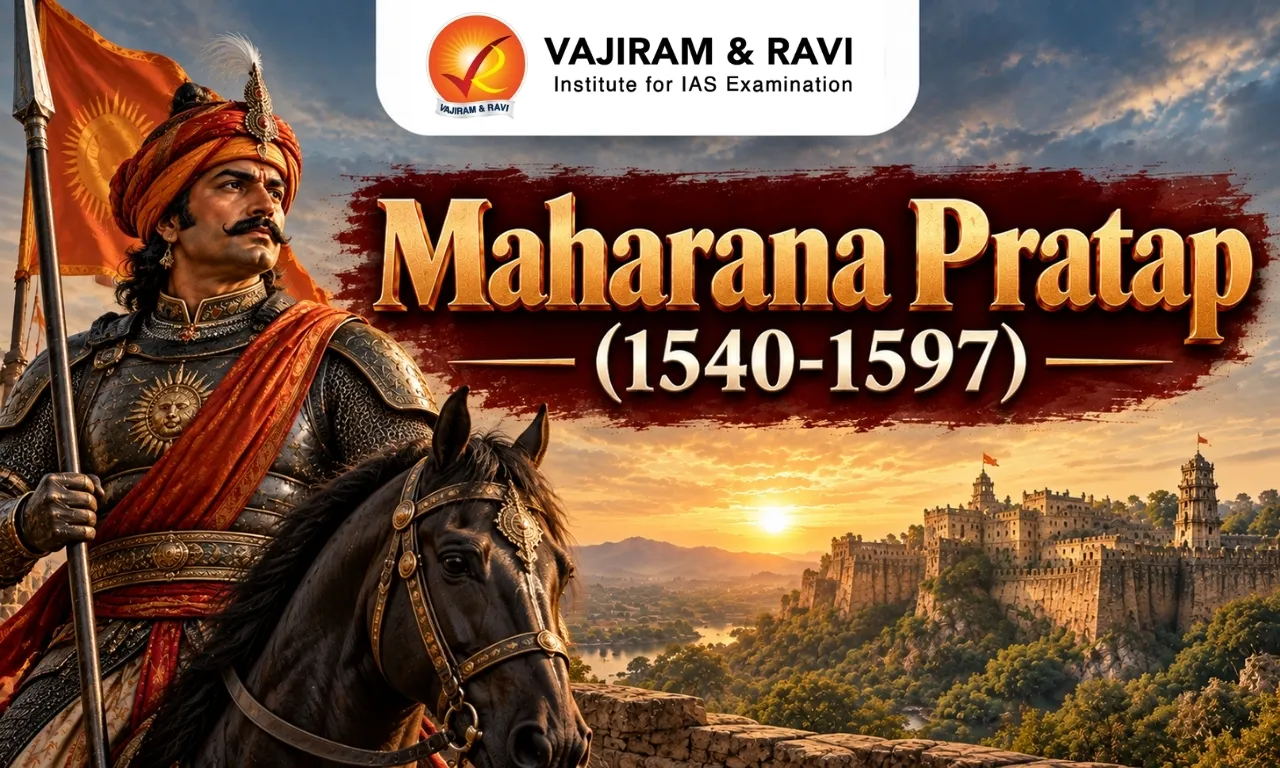
Maharana Pratap, born on 9th May 1542 to Maharana Udai Singh II and Maharani Javantha Bai Songara, is remembered as one of the most valiant and unyielding rulers in Indian history. Belonging to the Sisodia dynasty of Mewar, he was raised with a deep sense of honour, bravery, and commitment to his land.
Despite early hardships and being denied royal privileges, Maharana Pratap emerged as a fearless warrior and a symbol of Rajput pride. During a time when most Rajput rulers had accepted Mughal dominance, Maharana Pratap stood firm in his refusal to submit to Emperor Akbar. His life was marked by relentless resistance, iconic battles, and a deep devotion to art, culture, and Mewar’s independence, leaving behind a legacy that continues to inspire generations.
Maharana Pratap History
Maharana Pratap was born on 9th May 1542 to Maharana Udai Singh II and Maharani Javantha Bai Songara. His birthplace is believed to be Kumbhalgarh Fort. However, some historians suggest that he may have been born at Juni Kacheri near the Pali district.
- Trained as a prince, Maharana Pratap swiftly mastered warfare and weaponry.
- Jealousy among Udai Singh’s queens deprived him of royal privileges, and he was raised near Chittorgarh by his maternal grandfather, Akheraj Sonagar, who later died in battle.
- At the age of 17, Maharana Pratap married Ajabade, the daughter of Rao Ram Rakh Panwar. Soon after their marriage, they were blessed with a son, Amar Singh.
- Udai Singh II died at 42 in Gogunda. Before his death, he named his favourite son Jagmall as successor, bypassing the tradition of primogeniture.
- However, this was opposed by a group of nobles, including Rawat Kistna and the former prince of Gwalior.
- In a coronation at Gogunda, Maharana Pratap was declared the 54th ruler of Mewar in the lineage of the Sisodia dynasty.
- According to the Ain-i-Akbari, Akbar offered Maharana Pratap all of Rajputana in exchange for submission, but Pratap's steadfast refusal became a lasting symbol of Rajput pride and resistance.
- While Akbar conquered territories from Afghanistan to Assam, Mewar under Maharana Pratap remained unconquered.
Conflicts under Maharana Pratap
Maharana Pratap’s reign was defined by his relentless resistance to the Mughal Empire, as he fiercely defended Mewar’s sovereignty and Rajput honour. Two of the most significant battles, Haldighati (1576) and Dewair (1582), highlight his unmatched courage, strategic brilliance, and unwavering commitment to freedom.
Battle of Haldighati
The Battle of Haldighati took place on 18 June 1576 and was a fierce confrontation between Maharana Pratap of Mewar and the Mughal army. The Mughal forces were led by Raja Man Singh I, acting under the command of Mughal Emperor Akbar.
- As compared to the Rajput rulers of the time who chose to ally with the Mughals, Maharana Pratap was not frightened to stand against them.
- Maharana Pratap remained unwavering in his resolve to protect the independence of Mewar. His commitment was shaped by a deep sense of duty to uphold Rajput honour and pride.
- Fought in the narrow, rugged terrain of Haldighati, named after its yellow soil, the battlefield gave a strategic advantage to Maharana Pratap’s smaller force.
- His army of 4,000 cavalry and 3,000 Bhil tribal archers, along with Afghan allies led by Hakim Khan Sur, used guerrilla tactics against the Mughals' 28,000-strong force equipped with artillery, cavalry, infantry, and elephants.
- Though outnumbered and eventually forced to retreat, Maharana Pratap escaped and continued his resistance through guerrilla warfare.
- The Mughals secured a strategic advantage by taking control of the trade route to Gujarat. However, they were unable to capture Mewar or diminish Maharana Pratap’s determination.
- Although the battle was militarily inconclusive, it became a lasting symbol of Rajput bravery and regional resistance.
Battle of Dewair (1582)
Six years after Haldighati, Maharana Pratap launched a decisive counterattack against the Mughals at the Battle of Dewair. After withdrawing to the forested hills of Mewar, Maharana Pratap turned to guerrilla warfare with the support of the Bhil community. His loyal minister Bhamashah provided crucial financial support.
- In a swift eight-hour battle, 32 Mughal outposts were destroyed. More than 30,000 Mughal soldiers retreated, and commanders Sultan Khan and Behlol Khan lost their lives in the battle.
- This devastating loss compelled the Mughals to withdraw in a state of chaos.
- Maharana Pratap regained key territories, Udaipur, Gogunda, and Kumbhalgarh, reaffirming Mewar’s independence.
- British historian James Tod called it the “Marathon of Mewar,” while GN Sharma considered it more significant than Haldighati, as it restored lost ground and proved that Mewar was never conquered, only momentarily silenced.


Art and Culture under Maharana Pratap
Maharana Pratap was a notable patron of art and music, deeply committed to preserving Mewar’s cultural heritage, even during times of hardship.
- Under Maharana Pratap’s leadership, his temporary capital, Chawand, flourished as a lively hub of art and culture.
- Maharana Pratap sheltered and supported many poets, writers, and artisans, fostering creativity in his court.
- The renowned Chawand School of Art was established and flourished under the patronage of Maharana Pratap.
- One of the distinguished members of Maharana Pratap’s court was Ustad Nasiruddin, a celebrated artist and musician.
Maharana Pratap's Death and Aftermath
Maharana Pratap was severely injured during his hunting expedition, which slowly worsened due to infection. The injury became a cause of decline in his health.
- Maharana Pratap eventually passed away on 19th January 1597 at his palace in Chawand.
- His death was widely mourned, with many deeply saddened by the loss.
- Emperor Akbar is said to have experienced deep sorrow, reflecting the great respect Maharana Pratap commanded within the Mughal court.
- After Maharana Pratap’s death, his eldest son Amar Singh I became the ruler of Mewar.
- In tribute to Maharana Pratap’s legacy, Amar Singh maintained Mewar’s independence by persistently opposing the Mughals.

 Last updated on Oct, 2026
→ UPSC 2027 Notification will be released on 13 January 2027 at upsconline.nic.in.
→ Check Nobel Prize 2026 Winners List here.
→ Download PIB PRiSM Monthly Magazine 2026 here.
→ Check UPSC Monthly Current Affairs Magazine The Recitals here.
→ Check out the latest UPSC Syllabus here.
→ Download UPSC Model Answers for Mains 2026
→ UPSC Mains Question Paper 2026 is out now for Essay & GS Paper 1, 2, 3 & 4.
→ UPSC Calendar 2027 has been released.
→ Enroll in Vajiram & Ravi’s UPSC Mains Test Series 2027 for structured answer writing practice, expert evaluation, and exam-oriented feedback.
→ Join Vajiram & Ravi’s UPSC Mentorship Program 2027 for personalized guidance, strategy planning, and one-to-one support from experienced mentors.
→ Go through the UPSC Mains Previous Year Papers to enhance your preparation.
→ UPSC has released UPSC Toppers List 2025 with the Civil Services final result on its official website.
→ Also check Best UPSC Coaching in India
Maharana Pratap FAQs
Q1. Did Akbar defeat Maharana Pratap?+
Q2. Who came first, Shivaji or Maharana Pratap?+
Q3. Who was more stronger, Akbar or Maharana Pratap?+
Q4. What is Maharana Pratap famous for?+
Q5. How powerful was Maharana Pratap?+
Tags: maharana pratap quest UPSC Medieval History Notes