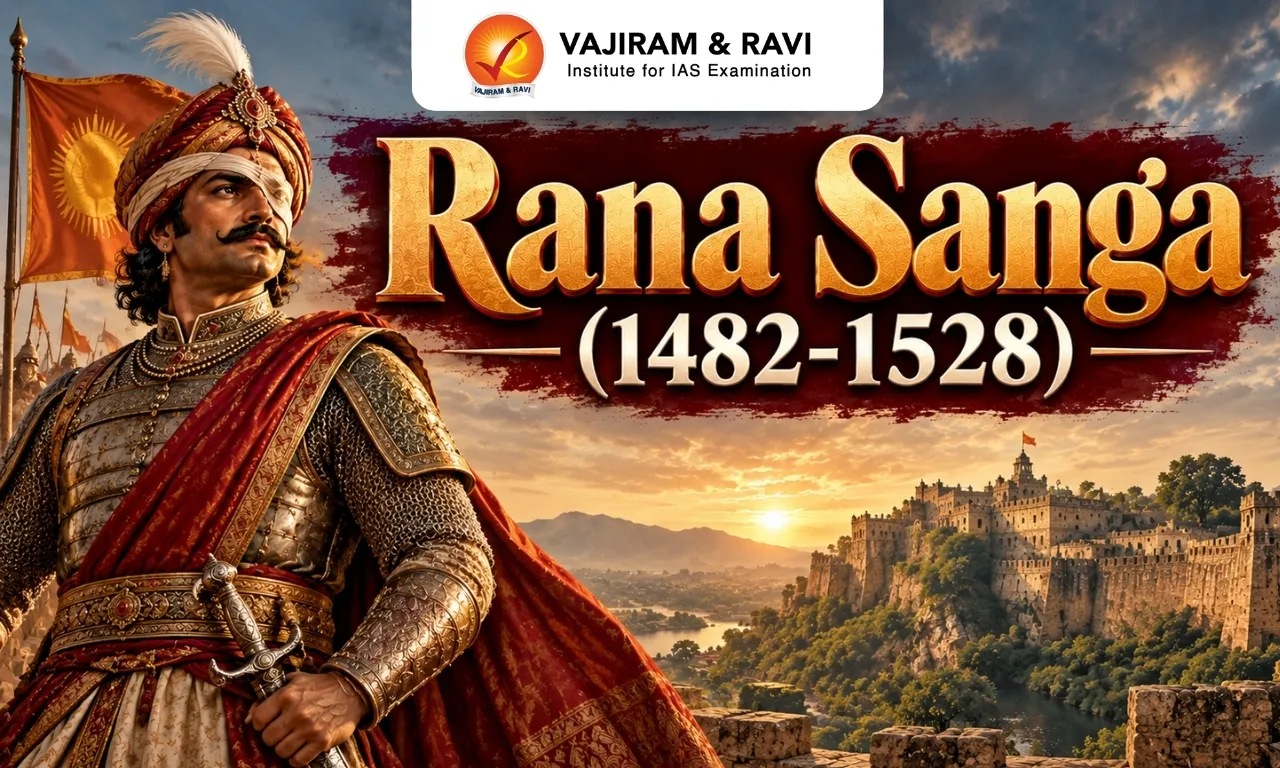
Rana Sanga, also known as Maharana Sangram Singh, was one of the most powerful rulers of Mewar during the early 16th century. A member of the Sisodia Rajput dynasty, he expanded Mewar's influence across large parts of northern India and emerged as a major political and military power in the period immediately before the establishment of Mughal rule in North India.
He is particularly remembered for his conflicts with the Sultans of Malwa, Gujarat and Delhi, his victories over Ibrahim Lodi, and his final confrontation with Babur at the Battle of Khanwa in 1527.
Maharana Sanga History
Rana Sanga, born in 1482 in Ranthambore, was a member of the powerful Sisodia dynasty. His father, Rana Raimal, ruled Mewar, and after he died in 1509, Rana Sanga ascended to the throne.
- Rana Sanga was trained in warfare and administration from a young age, quickly gaining recognition as a skilled warrior and leader.
- Early in his reign, Rana Sanga faced a rebellion led by his brother, which he swiftly crushed to solidify his rule.
- Rana Sanga's main challenge came from the rising Mughal Empire under Babur, who had defeated Ibrahim Lodi in the First Battle of Panipat in 1526 and was expanding into northern India.
- Despite his early victories, Rana Sanga's struggle against Babur and his rivals defined his legacy.
Rana Sanga Mewar Dynasty
Rana Sanga belonged to the Sisodia dynasty of Mewar, a prominent Rajput ruling house. The Mewar ruling line is associated with the broader Guhila/Guhilot tradition, with the Sisodias becoming the dominant ruling branch. During Sanga's reign, Mewar became a major centre of Rajput political power, with Chittorgarh serving as its principal political centre.
Historical Sources for Rana's Life
Rana Sanga's life is documented using a combination of Mughal records, Rajput legends, and later historical studies.
- The Baburnama provides firsthand Mughal opinions on his battles. Persian manuscripts such as Tarikh-i-Firishta and Ain-i-Akbari also mention him.
- Rajput bardic records, such as the Rajprashasti Mahakavyam, and regional inscriptions honour his bravery.
Rana Sanga Physical Features
Rana Sanga is traditionally remembered as a warrior who sustained numerous injuries during his military career.
- Rajasthan government material describes him as having suffered around 80 wounds in different battles and states that he lost the use of one eye, one arm and one leg due to injuries.
- These descriptions have become an important part of the popular historical image of Rana Sanga as a warrior-king who continued fighting despite severe physical injuries.


Rana Sanga Succession Dispute
Rana Sanga's accession was preceded by a succession dispute among the sons of Rana Raimal. His brothers included Prithviraj and Jagmal/Jaymal, and different historical traditions describe a struggle for the Mewar throne.
- Rana Sanga eventually emerged as the successful claimant and consolidated his position as ruler of Mewar.
- This succession struggle was important because it shaped the early phase of Sanga's rule. Once he secured the throne, he shifted his attention towards strengthening Mewar and expanding its political influence.
Rana Sanga Military Conquests
By overthrowing Malwa and the Lodi monarchs, Rana Sanga pursued an expansionist strategy and became a powerful force in northern India. He finally clashed with Babur due to his increasing power, which resulted in the Battle of Khanwa in 1527.
Battle of Khatoli (1517)
Rana Sanga expanded his kingdom by conquering north-eastern Rajasthan, including the Fort of Ranthambore, from the Afghan Lodi dynasty.
- In retaliation, Lodi launched an attack on Mewar, but his forces were overwhelmed by Rana Sanga’s strong Rajput army in the Battle of Khatoli.
- The battle, lasting only 5-6 hours, saw Ibrahim Lodi captured and later released for ransom.
- However, Rana Sanga was severely injured, losing an arm and becoming permanently lame.
Battle of Gagron (1519)
Rana Sanga’s struggle with the Muslim Sultans of North India culminated in the Battle of Gagron, where Khilji and his allies were decisively defeated. Khilji was captured, but in a display of Rajput honour, Rana Sanga treated him with respect, freed him, and restored his kingdom in exchange for one of Khilji’s sons as a hostage.
Battle of Dholpur (1519)
After the defeat at Khatoli, Ibrahim Lodi, humiliated and with weakened forces, regrouped and sought revenge when Rana Sanga’s army was engaged with the Sultan of Malwa and Gujarat.
- Lodi attacked Mewar, but at the Battle of Dholpur, his forces were once again routed by Rana Sanga’s superior Rajput army.
- After this victory, Rana Sanga captured much of modern-day Rajasthan, expanding his kingdom.
Battle of Bayana (1527)
Rana Sanga's most famous conflict was with Babur, the founder of the Mughal Empire in India. After Ibrahim Lodi’s defeat, Babur sought to capture Bayana and Gwalior to block Rana Sanga’s advance toward these strategic locations near Agra.
- In response, a coalition of Rajput rulers from Amber, Jodhpur, Vagad, Gwalior, Bundi, Shekhawati, Raisen, Chanderi, Idar, and others united under Rana Sanga’s leadership.
- They decisively drove Babur’s forces from Bayana and Gwalior, with his mercenaries intimidated by the Rajputs' strength and courage.
Battle of Khanwa (1527)
Rana Sanga viewed Babur’s expansion as a direct threat to his kingdom, prompting him to ally with other Rajput rulers to resist the Mughal advance. In 1527, he led a united Rajput force in the Battle of Khanwa.
- Though the battle began in Rana Sanga’s favour, Babur’s superior artillery and tactics ultimately shifted the momentum.
- Rana Sanga was badly wounded and had to retreat. Although he survived, his injuries left him too weak to continue fighting against the Mughals.
- Babur went on to conquer much of northern India, including Delhi, Agra, and the surrounding areas.
Rana Sanga Administration
Rana Sanga's administration was based largely on the traditional Rajput system of governance, in which the ruler depended heavily on hereditary chiefs, feudatories and allied rulers.
- Feudal Structure: Power was distributed among Rajput chiefs and feudatories who maintained their own territories and supplied troops to the Rana when required.
- Rajput Confederacy: He united around 120 regional Rajput chieftains under a unified banner to create a strong political and military front.
- Control Through Alliances: Rather than relying solely on direct territorial administration, Sanga expanded Mewar's influence through alliances, tributary relationships and intervention in neighbouring states.
- Local Governance: He encouraged self-governance and administrative stability at the local level.
- Tax Reforms: Sanga promoted economic welfare by removing discriminatory levies, such as the Jizya tax in newly conquered areas like Malwa.
Rana Sanga's Army
Rana Sanga's army was regarded as one of the most powerful Rajput troops of its day. It consisted of approximately 80,000 cavalry, 500 war elephants, and a massive army. His warriors were trained in traditional Rajput warfare, which emphasised bravery and close fighting. Though powerful, his men lacked contemporary weaponry, which put them at a significant disadvantage against Babur's gunpowder weapons.
Rana Sanga Economy
Under Rana Sanga, Mewar's economy was essentially agrarian, with rich plains and irrigation systems as the foundation. Agriculture, commercial routes, and allied state tributes all contributed to revenue. Chittorgarh became a commercial hub. However, continual wars depleted resources and undermined stability.
Political Landscape During Rana Sanga's Reign
North India saw political fragmentation during the reign of Rana Sanga. The Delhi Sultanate was in decline, Afghan lords were struggling, and new powers emerged, such as the Mughals. Regional kings included Medini Rai of Malwa, Ibrahim Lodi of Delhi, and Bahadur Shah of Gujarat.
Architecture and Cultural Contribution of Rana Sanga
Rana Sanga, though renowned as a warrior, also made lasting contributions to Mewar’s cultural and architectural legacy.
- Chittorgarh Fort: He strengthened and expanded the fort, enhancing its strategic importance.
- Temples and Stepwells: He promoted the construction of Hindu temples and step-wells, preserving Rajput cultural identity.
- Rajput Art and Traditions: He encouraged Rajput artists and warriors, making Mewar a hub of Rajput heritage.
Rana Sanga's Death and Aftermath
After being severely injured and taken from the Battle of Khanwa, Rana Sanga took an oath to defeat Babur and exiled himself until the goal was achieved.
- He swore not to return to Chittor until he had defeated Babur.
- In 1528, he once again marched to Chanderi to aid Medini Rai, who was under attack by Babur.
- But he fell sick at Kalpi and died in his camp in January 1528. Some accounts say that he was poisoned by some of his nobles who quite rightly thought his renewal of war with Babur was suicidal.
Succession After Rana Sanga
Rana Sanga’s death was followed by the coronation of his son, Ratan Singh II, and the further consolidation of Babur's power in North India. His reign was relatively short, and he was followed by Rana Vikramaditya. The succession after Sanga was marked by political instability, and Mewar's position was considerably weaker than it had been during the height of Sanga's power.

 Last updated on Oct, 2026
→ UPSC 2027 Notification will be released on 13 January 2027 at upsconline.nic.in.
→ Check Nobel Prize 2026 Winners List here.
→ Download PIB PRiSM Monthly Magazine 2026 here.
→ Check UPSC Monthly Current Affairs Magazine The Recitals here.
→ Check out the latest UPSC Syllabus here.
→ Download UPSC Model Answers for Mains 2026
→ UPSC Mains Question Paper 2026 is out now for Essay & GS Paper 1, 2, 3 & 4.
→ UPSC Calendar 2027 has been released.
→ Enroll in Vajiram & Ravi’s UPSC Mains Test Series 2027 for structured answer writing practice, expert evaluation, and exam-oriented feedback.
→ Join Vajiram & Ravi’s UPSC Mentorship Program 2027 for personalized guidance, strategy planning, and one-to-one support from experienced mentors.
→ Go through the UPSC Mains Previous Year Papers to enhance your preparation.
→ UPSC has released UPSC Toppers List 2025 with the Civil Services final result on its official website.
→ Also check Best UPSC Coaching in India
Rana Sanga FAQs
Q1. What caused the death of Rana Sanga?+
Q2. What is Rana Sanga famous for?+
Q3. Did Rana Sanga defeat Babur?+
Q4. Who was Rana Sanga to Maharana Pratap?+
Q5. Was Rana Sanga blind?+
Tags: quest rana sanga UPSC Medieval History Notes