The Deccan Traps are one of the world’s largest continental flood-basalt provinces, formed mainly through extensive fissure-fed volcanic eruptions around 66 million years ago. Spread across west-central India, they consist predominantly of successive basaltic lava flows that created their characteristic step-like landscape. Their geological evolution has shaped regional soils, particularly black cotton soils and lateritic profiles, while supporting diverse forests and biodiversity, especially around the Western Ghats.
The region is also associated with zeolites, agate, chalcedony and other secondary minerals, besides providing important groundwater and construction resources. The Deccan Traps have major significance for understanding volcanism, mass extinction, geoheritage and climate processes, while basalt formations also offer potential for geological CO₂ storage.
Deccan Traps Meaning
The Deccan Traps are a vast succession of mainly tholeiitic basaltic lava flows that form a distinctive step-like landscape across parts of west-central India.
- The term “trap” is derived from the Swedish word trappa, meaning steps, referring to the staircase-like topography produced by successive basaltic lava flows.
- The Deccan Traps constitute a continental flood-basalt province, rather than a single volcano.
- Hundreds of lava flows were produced through fissure-fed eruptions, creating a massive layered volcanic sequence.
Deccan Traps Geological Background and Formation
The geological formation of the Deccan Traps is associated with enormous basaltic eruptions during the Late Cretaceous–Palaeocene transition, coinciding broadly with the Cretaceous–Paleogene boundary and major tectonic changes involving the Indian plate. Major stages of formation are
- Mantle plume activity: A major explanation links Deccan volcanism to a deep mantle plume or hotspot beneath the Indian plate.
- The volcanism has been associated with a plume/hotspot that is now linked to the Réunion region by most geologists.
- Fissure-fed eruptions: Instead of lava emerging from a single central volcanic cone, magma rose through extensive fractures and fissures in the crust.
- Flood-basalt eruptions: Large volumes of low-viscosity basaltic lava spread over extensive areas, covering existing topography and producing repeated horizontal lava sheets.
- Successive lava flows: Individual flows accumulated one above another, producing the thick volcanic pile visible today.
- Rapid geological emplacement: A 2020 geochemical study concluded that more than 90% of the Deccan lavas are considered to have erupted in less than one million years, making the event exceptionally rapid on a geological timescale.
- Later erosion and tectonic modification: Subsequent uplift, erosion, rifting and subsidence removed or buried portions of the original volcanic province. Research on the Western Ghats also links laterite development and drainage patterns to the post-volcanic evolution of the region.


Deccan Traps Distribution in India
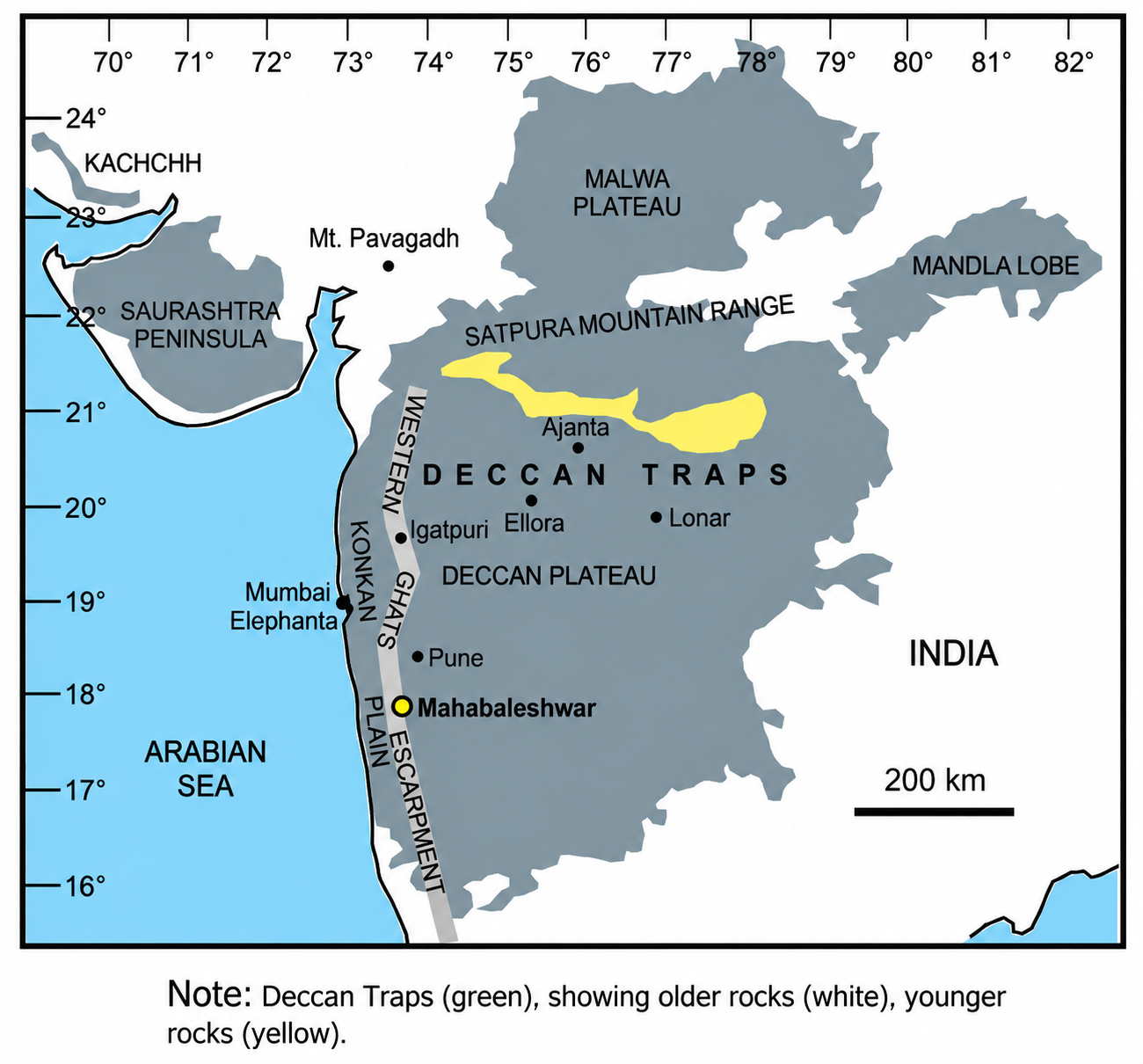
The distribution of the Deccan Traps is concentrated mainly in west-central India, with the thickest and best-exposed sequences occurring around the Western Ghats and adjoining plateau regions.
- The present-day Deccan volcanic province covers approximately 500,000 sq km, while estimates of its original extent are substantially larger because portions were subsequently eroded or submerged. Major areas associated with the Deccan volcanic province include
- Maharashtra
- Madhya Pradesh
- Gujarat
- Karnataka
- Telangana
- Andhra Pradesh
- parts of Rajasthan and other adjoining regions
- The thickness of the basalt varies considerably. The succession exceeds 2,000 metres in parts of the Western Ghats, particularly around Mahabaleshwar, and exceeds 1,000 metres in some eastern parts of the province and becomes much thinner towards the southeastern margin.
Deccan Traps Rock and Mineral Resources
The Deccan Traps are predominantly basaltic, but cavities, fractures, weathered zones and associated geological formations contain several important secondary minerals and rock materials. Major mineral occurrences.
- Zeolites: Deccan basalt cavities are particularly famous for zeolitic minerals such as stilbite, heulandite, apophyllite and scolecite.
- Agate: Vesicular basalt commonly contains agate-filled cavities and geodes.
- Chalcedony: Varieties of silica, including chalcedony and related minerals, occur in cavities and veins.
- Quartz: Quartz crystals can occur within amygdales and geodes associated with basaltic formations.
- Calcite: Calcite is among the secondary minerals associated with vesicular basalt.
- Apophyllite: The Deccan region is particularly well known internationally for attractive apophyllite specimens.
- Iron- and magnesium-bearing minerals: Basalt contains minerals such as pyroxenes, plagioclase and iron-bearing phases that influence its weathering and soil-forming properties.
- Construction resources: Basalt from the Deccan region also has practical importance as building stone, road metal, aggregates, crushed stone and other construction materials.
Deccan Traps and Soil Formation
The weathering of basalt has played an important role in the formation of several soil types across the Deccan region, especially the characteristic black soils associated with basaltic terrain.
- Black cotton soil: Basalt weathering contributes to the development of black soil, commonly known as regur soil, particularly across parts of the Deccan Plateau. Its important characteristics include:
- High clay content;
- Considerable moisture-retention capacity;
- Swelling and shrinking behaviour;
- Development of deep cracks during dry periods; and
- Suitability for crops such as cotton;
- The mineral composition of basalt and its subsequent weathering influence the chemical and physical properties of these soils.
- Lateritic soils: In areas receiving heavy rainfall, especially along the Western Ghats, intense weathering and leaching of basalt can contribute to the formation of lateritic profiles.
- UNESCO identifies laterite development over Deccan lavas at Panchgani and laterite caps over lava flows around Mahabaleshwar.
- Other soils: Depending on climate, relief, drainage and degree of weathering, Deccan basaltic terrain can also support;
- red-brown soils;
- shallow coarse soils;
- lateritic soils; and
- alluvial deposits in valleys and lower-lying areas;
- red-brown and lateritic soils in some portions of the Deccan volcanic terrain and black cotton soils in lower areas.
Deccan Traps Forests and Biodiversity
The Deccan Traps provide the geological foundation for landscapes that support diverse forest ecosystems, particularly where the volcanic terrain intersects the Western Ghats biodiversity hotspot.
- Flora: The Deccan Traps, particularly around the Mahabaleshwar–Panchgani region and adjoining Western Ghats, support diverse plant communities, including several endemic and regionally significant species.
- Karvi – a flowering shrub characteristic of the Western Ghats.
- Recurved-fruited Dicoelospermum – a regionally significant plant associated with the Western Ghats.
- Ceylon Cotton – a tree species found in the region.
- Common Indian Mistletoe – a parasitic flowering plant occurring on trees.
- Indian Grass species – grasses adapted to the plateau landscape.
- Indian Carpetweed – a small herb found in dry and rocky habitats.
- Polyzygus – a regionally significant herbaceous plant.
- Cooke's Grass – a grass species associated with the Western Ghats.
- Fauna: The Deccan Traps, adjoining the Western Ghats, support a diverse range of mammals, birds, reptiles, amphibians and insects.
- Indian Leopard – an important carnivore found in forested and hilly areas.
- Sloth Bear – occurs in forest and rocky habitats of the region.
- Wild Boar – commonly associated with forest and scrub ecosystems.
- Indian Giant Squirrel – an important arboreal mammal of the Western Ghats.
- Langurs – occur across forested landscapes and feed mainly on leaves, fruits and other plant material.
- Civets – nocturnal mammals associated with forest ecosystems.
- Mongooses – small carnivorous mammals found in forest and scrub habitats.
- Western Ghats Amphibians – the region supports several endemic frogs and other amphibians.
- Reptiles – snakes, lizards and other reptiles occur across the rocky and forested terrain.
- Birds – the forests support a wide variety of resident and endemic bird species.
- Butterflies – the diverse vegetation and favourable climate support numerous butterfly species.
Deccan Traps Importance
The importance of the Deccan Traps extends from geological science and natural resources to agriculture, biodiversity, water resources, tourism and climate research.
- Geological significance: The Deccan Traps constitute one of the world's major continental flood-basalt provinces and provide an exceptional record of large-scale volcanism.
- Lonar Crater: The Lonar impact crater in Maharashtra was formed in basaltic terrain of the Deccan Traps and is significant for studies of impact geology, geomorphology and basaltic rocks.
- Understanding mass extinction: The timing of Deccan volcanism around the Cretaceous-Paleogene (K–Pg) boundary makes it important for studying the environmental changes associated with the end-Cretaceous mass extinction.
- Agricultural importance: Basalt weathering has contributed to the formation of extensive black-soil regions that support agriculture, particularly cotton and other crops.
- Groundwater resources: Fractures, weathered zones and contacts between different lava flows can provide groundwater pathways and storage, making Deccan basalt important in hydrogeological studies.
- Biodiversity conservation: The intersection of Deccan volcanic landscapes with the Western Ghats creates important habitats containing high biodiversity and endemic species.
- Geoheritage and tourism: Mahabaleshwar and Panchgani provide exceptionally accessible exposures of Deccan lava flows and have considerable geotourism and educational value.
- Cultural heritage: The basaltic landscape has also supported historically significant rock-cut architecture, including the Ajanta and Ellora caves.
- Carbon dioxide storage potential: Basaltic rocks have potential for mineral trapping of CO₂, because reactions between injected CO₂, water and basaltic minerals can convert carbon into stable carbonate minerals.
- The CCUS report: A NITI Aayog CCUS assessment estimated the theoretical CO₂ storage capacity of the Deccan Volcanic Province at 94–243.5 Gt under one methodology and 304.88 Gt under another methodology; these are theoretical estimates subject to geological and methodological assumptions.
- It also states that further studies and pilot projects are needed to better understand storage mechanisms and develop industrial-scale sequestration frameworks
Deccan Traps as a Geoheritage Site
The geoheritage significance of the Deccan Traps is increasingly recognised because the region preserves an exceptional record of ancient flood-basalt volcanism and associated geological processes.
- In August 2025, India submitted “Deccan Traps at Panchgani and Mahabaleshwar” to UNESCO's Tentative List. The nomination highlights its geological significance as a major flood-basalt province and its biodiversity value within the Western Ghats.
- The Deccan Traps are recognised by the International Union of Geological Sciences as an IUGS Geological Heritage Site for their significance in volcanology, igneous and metamorphic petrology, geochemistry, geochronology, geophysics and palaeontology.
- The Mahabaleshwar–Panchgani landscape is particularly significant because it preserves.
- thick sequences of lava flows;
- red bole layers;
- basaltic structures;
- lateritic caps;
- Western Ghats escarpments;
- deep gorges and valleys; and
- evidence of long-term weathering and erosion.
Deccan Traps and Climate Change
The relationship between the Deccan Traps and climate change is important at both geological and contemporary scales because volcanism influenced ancient atmospheric conditions, while basalt today offers potential pathways for carbon storage.
- Ancient volcanic emissions: Deccan eruptions released substantial quantities of volcanic gases, including CO₂ and SO₂, potentially contributing to climatic and environmental disturbances.
- Weathering and carbon cycle: Long-term weathering of basalt consumes CO₂ through chemical reactions and contributes to the geological carbon cycle.
- Basalt-based carbon storage: The Deccan Volcanic Province (DVP) has been assessed for its potential to store CO₂ through geological and mineral-trapping processes. The uploaded material estimates a theoretical DVP storage range of approximately 94–304.88 Gt CO₂, subject to the underlying assumptions and methodology.
- Need for pilot projects: The uploaded material specifically indicates that further studies and pilot tests are required to understand basalt storage mechanisms and develop industrial-scale sequestration infrastructure.
Deccan Traps Challenges
The conservation challenges arise from both natural geomorphic processes and growing human pressure on geological and ecological landscapes.
- Quarrying and rock extraction: Removal of basalt for construction material can damage scientifically valuable exposures and geological features.
- Unregulated quarrying and mineral extraction: Extraction of basalt, secondary minerals and decorative stones can damage geological exposures and geoheritage.
- Urbanisation: Expansion of settlements and infrastructure can cover or modify important geological exposures.
- Tourism pressure: Mahabaleshwar and Panchgani attract large numbers of visitors, creating pressure on land, water, vegetation and waste-management systems.
- Road and infrastructure construction: Excavation and slope modification can disturb geological exposures and increase erosion.
- Forest degradation: Conversion or fragmentation of natural habitats can reduce the ecological value of basaltic landscapes.
- Soil erosion: Intense rainfall on steep Western Ghats slopes can accelerate erosion of weathered basalt and lateritic surfaces.
- Landslides: Heavy rainfall, slope modification and geological discontinuities can increase slope instability.
- Groundwater stress: Excessive extraction can affect groundwater availability in basaltic aquifers.
- Climate change: Changes in rainfall intensity, temperature and extreme events can alter erosion, weathering, groundwater recharge and ecosystem conditions.
- Weak geoheritage awareness: Geological sites can be overlooked because conservation policies often focus more strongly on biological or cultural heritage.
Deccan Traps Way Forward
Conservation of the Deccan Traps requires an integrated approach that protects geological exposures while maintaining biodiversity, livelihoods, tourism and scientific research.
- Identify and map geoheritage sites: Important lava sections, red boles, laterite surfaces, mineral localities and geomorphic features should be systematically documented.
- Strengthen legal protection: Particularly valuable geological exposures should receive appropriate geoheritage or protected-site status.
- Regulate quarrying: Mining and quarrying should be restricted around scientifically important geological exposures.
- Develop geological parks: Selected sites can be developed as geoparks with interpretation centres, trails, museums and educational facilities.
- Promote responsible geotourism: Tourism infrastructure should follow carrying-capacity principles and minimise damage to geological and ecological features.
- Conserve surrounding forests: Geological conservation should be integrated with Western Ghats biodiversity conservation.
- Improve groundwater management: Hydrogeological mapping of basaltic aquifers can support sustainable groundwater extraction and recharge.
- Strengthen scientific research: Continued research in volcanology, geochemistry, geochronology, palaeomagnetism, groundwater and CO₂ mineralisation can improve understanding of the province.
- Develop climate-resilient management: Erosion, landslides, extreme rainfall and changing hydrological conditions should be incorporated into regional planning.
- Increase public awareness: Schools, universities, tourism institutions and local communities can be involved in geoheritage education.
Western Ghats Conservation Framework Relevant to the Deccan Landscape
The Western Ghats Ecology Expert Panel (WGEEP/Gadgil Committee) and the High Level Working Group (HLWG/Kasturirangan Committee) are relevant to the Western Ghats portions of the Deccan landscape.
- WGEEP/Gadgil Committee: The WGEEP was constituted to identify ecologically sensitive areas and recommend measures for conservation, protection and rejuvenation of the Western Ghats.
- Its recommendations covered sectors including mining, tourism, land use, infrastructure, water resources, agriculture and power.
- HLWG/Kasturirangan Committee: The Kasturirangan-led HLWG subsequently examined the WGEEP recommendations and proposed an approach focused on protecting the Western Ghats' natural landscapes while considering sustainable development and local livelihoods.
- The HLWG recommended identifying about 37% of the Western Ghats as Ecologically Sensitive Area and proposed restrictions including no new mining of major minerals, quarrying or sand mining in the ESA, along with restrictions on certain high-impact projects.
Deccan Traps UPSC PYQs
Q1. Discuss the natural resource potentials of the Deccan Traps. (UPSC Mains 2022)
Q2. The black cotton soil of India has been formed due to the weathering of: (UPSC Prelims 2021)
a) Brown forest soil
b) Fissure volcanic rock
c) Granite and schist
d) Shale and limestone
Ans: (b)

 Last updated on Sep, 2026
→ UPSC 2027 Notification will be released on 13 January 2027 at upsconline.nic.in.
→ Asian Games 2026 are being held in Aichi-Nagoya, Japan, from 19 September to 4 October.
→ Check out the latest UPSC Syllabus here.
→ Download UPSC Model Answers for Mains 2026
→ UPSC Mains Question Paper 2026 is out now for Essay & GS Paper 1, 2, 3 & 4.
→ UPSC Calendar 2027 has been released.
→ Enroll in Vajiram & Ravi’s UPSC Mains Test Series 2027 for structured answer writing practice, expert evaluation, and exam-oriented feedback.
→ Join Vajiram & Ravi’s UPSC Mentorship Program 2027 for personalized guidance, strategy planning, and one-to-one support from experienced mentors.
→ Go through the UPSC Mains Previous Year Papers to enhance your preparation.
→ UPSC has released UPSC Toppers List 2025 with the Civil Services final result on its official website.
→ Also check Best UPSC Coaching in India
Decaan Traps FAQs
Q1. Are Deccan Traps still active?+
Q2. Did the Deccan Traps cause dinosaur extinction?+
Q3. Which volcanic eruption caused the Deccan Traps?+
Q4. When were the Deccan Traps formed?+
Q5. What type of soil is found in the Deccan Traps region?+
Tags: deccan traps quest UPSC Geography Notes