The Shunga Dynasty, also known as the Sunga Dynasty, was a post-Mauryan power in northern India. Its rule marked a period of political transition in which regional kingdoms gained greater importance. The Sungas are associated with the revival of Brahmanical traditions, while Buddhist establishments and artistic activity, along with Sanskrit literary traditions, reflect the cultural activity of this period.
The Sunga dynasty gradually weakened due to succession disputes, territorial pressures, and the rise of regional powers. The later Sungas lost political influence, and the dynasty was eventually replaced by the Kanva Dynasty.
Sunga Dynasty Background
The Shunga Dynasty emerged in the 2nd century BCE after the decline of Mauryan Empire authority. After Ashoka’s reign, Mauryan authority gradually weakened, and regional political centres gained greater independence. Pushyamitra’s seizure of power ended the Mauryan ruling line in Magadha but did not restore control over the entire former empire.
- The transition from Mauryan to Shunga rule marked an important phase in ancient Indian history. The Shunga period witnessed the emergence of regional powers and a gradual reduction in the extent of imperial control.
- Information about the Shungas comes from literary works such as the Harshacharita, Divyavadana and Malavikagnimitram, along with inscriptions, coins and archaeological evidence. These sources differ in their purposes and historical reliability.
Shunga Dynasty Founder
The Sunga Dynasty was founded by Pushyamitra Shunga. He served as the commander-in-chief, or Senapati, under Brihadratha, the last Mauryan ruler. According to Banabhatta's Harshacharita, Pushyamitra killed Brihadratha during a military parade and subsequently established his own rule.
Shunga Dynasty Time Period
The Shunga Dynasty ruled approximately from 185 BCE to 73 BCE, lasting nearly 112 years. Its rule ended with Devabhuti, the last Sunga ruler, after which the Kanva Dynasty succeeded it and established its authority in Magadha.
Shunga Dynasty Capital
Pataliputra, near modern Patna in Bihar, was the principal capital of the Shunga Dynasty. Its location in the middle Gangetic region connected the dynasty with the political heartland of the former Mauryan Empire. Vidisha, in present-day Madhya Pradesh, was another important administrative and political centre.
Sunga Dynasty Rulers
The Sunga Dynasty was ruled by a succession of kings after the decline of Mauryan authority. Traditional accounts identify ten Shunga rulers. Pushyamitra and Agnimitra are the best-known early kings, while information about most later rulers is fragmentary.
Pushyamitra
Pushyamitra Shunga was the founder of the Shunga Dynasty. Pushyamitra's reign is generally dated to approximately 185–149 BCE. His major achievements included the following:
- Establishment of the Dynasty: He ended Mauryan rule in Magadha and founded the Shunga Dynasty.
- Military Campaigns: He faced challenges from Indo-Greek powers and other regional rulers.
- Ashvamedha Sacrifices: The Ayodhya inscription of Dhanadeva associates Pushyamitra with two Ashvamedha sacrifices, which were important Vedic royal rituals.
- Support for Brahmanical Traditions: His reign is associated with renewed royal patronage of Vedic rituals.
- Cultural Developments: The period witnessed important developments in Sanskrit scholarship and Buddhist monumental art.
Agnimitra
Agnimitra was the son and successor of Pushyamitra Shunga. He is best known through Kalidasa's Sanskrit play Malavikagnimitram, which portrays events associated with his court and a conflict involving Vidarbha.
Vasumitra
He is remembered for his reported victory over the Yavanas (Indo-Greeks) near the Sindhu River, mentioned in literary traditions.
Bhagabhadra
Bhagabhadra is associated with the famous Heliodorus pillar at Besnagar, near Vidisha. The inscription records Heliodorus as an envoy of the Indo-Greek ruler Antialcidas and identifies him as a devotee of Vasudeva. It is an important source for studying diplomatic relations, religious devotion and cultural interactions in ancient India.
Devabhuti: Shunga Dynasty Last Ruler
Devabhuti is traditionally regarded as the last ruler of the Sunga Dynasty. According to Banabhatta's Harshacharita, he was killed by his minister Vasudeva Kanva, who established the Kanva Dynasty around 73 BCE. This political transition marked the end of Shunga rule in Magadha.


Sunga Dynasty Map and Extent
The Sunga Empire was considerably smaller than the Mauryan Empire and was mainly concentrated in northern and central India. Its political influence varied over time, with Magadha, Madhya Pradesh and parts of the Gangetic plain forming important areas of Sunga power.
- Core Region: Magadha and the middle Gangetic plain, with Pataliputra as an important political centre.
- Western Region: Vidisha became a major Sunga centre and an important base of political and cultural activity.
- Central India: Sunga influence extended across parts of present-day Madhya Pradesh, reflected by archaeological and inscriptional evidence.
- Northern Region: The Sunga dynasty exercised influence over parts of the Gangetic region, although its control was not as extensive or centralised as that of the Mauryas.
Shunga Dynasty Administration
The Sunga administration broadly continued some political practices of the Mauryan period, but the empire was less centrally integrated than the Mauryan state. Power was concentrated around the king and important regional centres.
- Centralised Monarchy: The king was the principal authority, with administration supported by a Mantriparishad (council of ministers). Patanjali's Mahabhashya refers to the king's council, indicating its role in governance.
- Regional Administration: The Sunga state controlled a smaller territory than the Mauryan Empire, with important centres such as Pataliputra, Vidisha and Ayodhya. The evidence suggests that political authority was exercised through important regional centres rather than through the highly elaborate Mauryan administrative structure.
- Military Organisation: The Sungas maintained a strong army to deal with external threats, particularly Indo-Greek incursions. Literary sources mention Greek attacks on Saketa and Madhyamika, while Malavikagnimitram refers to Vasumitra's victory over the Yavanas.
- Diplomatic Relations: The Heliodorus Pillar at Besnagar indicates diplomatic interaction between the Sunga court and the Indo-Greek Kingdom. Heliodorus served as an ambassador of Antialcidas, the Indo-Greek ruler, at the court of Bhagabhadra.
Shunga Dynasty Economy
The Sunga economy was supported by agriculture, crafts, internal trade, and long-distance commercial networks. Urban centres and guild-based activities remained important during the post-Mauryan period, while coinage facilitated economic transactions.
- Agriculture: Agriculture remained the main economic activity, supported by settled cultivation in the fertile Gangetic and central Indian regions.
- Trade and Commerce: Internal and long-distance trade expanded through routes connecting northern India with western and central regions, linking major urban centres.
- Guilds (Shrenis): Merchant and artisan guilds played an important role in organising production and commerce. They also acted as institutions for economic cooperation and sometimes made donations to religious establishments.
- Coinage: Punch-marked coins and cast/copper coins continued in circulation, while regional coinages facilitated commercial transactions during the post-Mauryan period.
- Craft Production: Pottery, metalworking, textiles and other crafts supported both local consumption and trade, particularly in urban settlements.
- Urban Centres: Cities such as Pataliputra, Vidisha and Mathura functioned as important centres of trade, craft production and cultural exchange.
Shunga Dynasty Religion
The Shunga Dynasty is associated with renewed royal support for Brahmanical traditions. Pushyamitra’s performance of the Ashvamedha sacrifice is an important example of the connection between Vedic ritual and political sovereignty.
- Brahmanism: The Sungas promoted Brahmanical traditions and Vedic rituals. Pushyamitra is associated with the performance of two Ashvamedha sacrifices, reflecting the renewed importance of Vedic rituals.
- Buddhism: Buddhist activity continued during the Sunga dynasty, with important sites such as Bharhut and Sanchi receiving renovation and architectural additions. This evidence complicates claims of a systematic anti-Buddhist policy.
- Vaishnavism: Bhagavata/Vaishnava worship gained prominence during this period. The Heliodorus Pillar at Besnagar records Heliodorus describing himself as a Bhagavata and worshipper of Vasudeva.
- Religious Debate: Buddhist texts accuse Pushyamitra of persecuting Buddhists, but the archaeological evidence of continued activity at Bharhut and Sanchi makes the extent of such persecution historically debated.
Shunga Dynasty Society
The Sunga period witnessed a strengthening of Brahmanical social institutions, alongside the continued presence of Buddhist and other religious communities. Society was organised around varna and occupational groups, while urban centres and trade supported diverse social groups.
- Social Stratification: Sunga period society witnessed greater emphasis on Brahmanical social institutions, with Brahmanas enjoying an important position. The period also saw the emergence of new social groups and castes through changing social relationships.
- Inter-Caste Relations: Anuloma and Pratiloma marriages indicated interaction between different social groups and the emergence of mixed social categories.
- Emergence of New Castes: Groups formed through intermarriage and changing occupational or social identities contributed to a more complex caste structure during the post-Mauryan period.
- Regional Communities: The incorporation of smaller republican communities (Ganas) into expanding kingdoms contributed to the formation of new social groups, while some communities continued to follow their own professions, customs, and traditions.
- Religious Diversity: Although the Sunga rulers are described as patrons of Brahmanism, Buddhism and Jainism also continued, indicating that the social and religious environment was not exclusively Brahmanical.
- Cultural Life: The period witnessed renewed interest in Sanskrit learning, with Patanjali's Mahabhashya representing an important development in Sanskrit intellectual activity.
Shunga Dynasty Art and Architecture
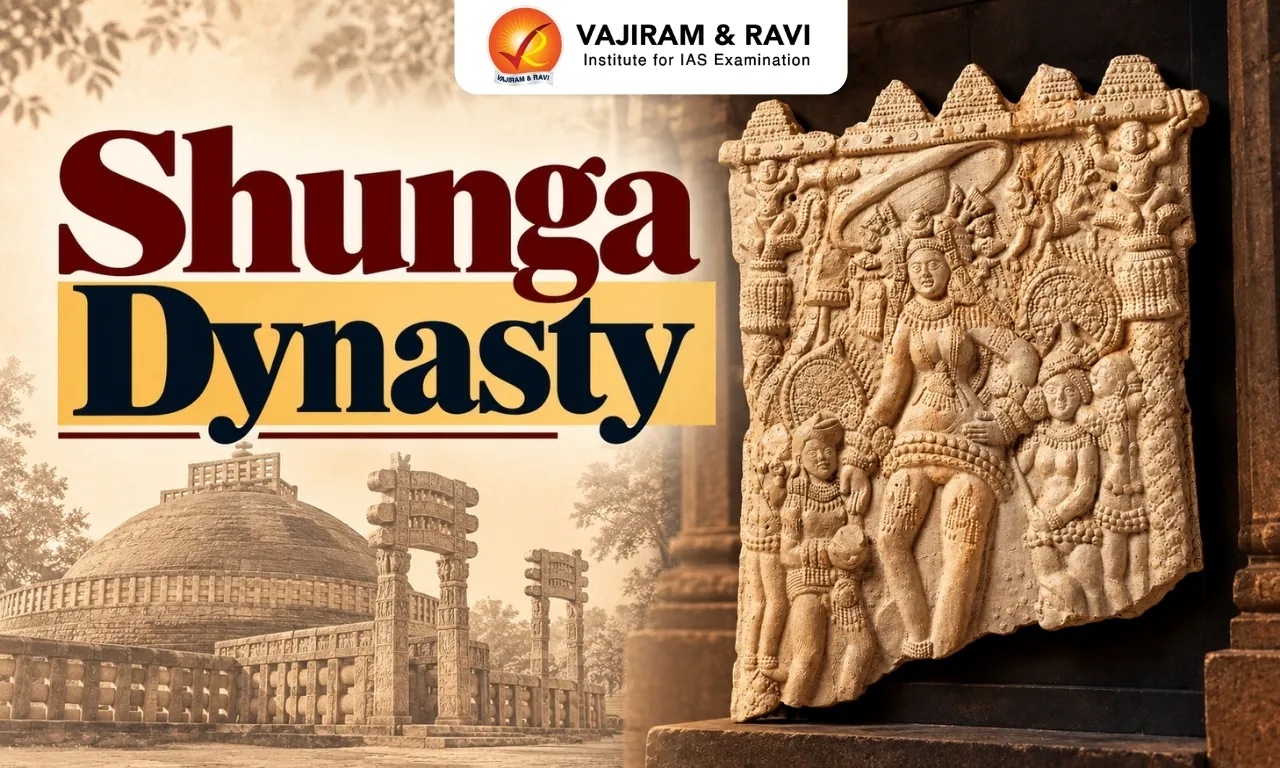
The Sunga period marked an important phase in the development of early Indian art and Buddhist architecture. Stone railings, gateways, sculptural decoration, and narrative reliefs became prominent, particularly at Bharhut and Sanchi.
- Bharhut Stupa: The Bharhut Stupa received major additions during the Shunga dynasty, especially its stone railing and sculptural panels depicting Jataka stories, Buddhist symbols, and scenes from contemporary life.
- Sanchi Stupa: The original brick stupa was enlarged and encased in stone, while the surrounding railing was developed during the Sunga period. The famous toranas (gateways) were added later, mainly under the Satavahanas.
- Aniconic Buddhist Art: Buddha was generally represented through symbols such as the Bodhi tree, empty throne, footprints, and Dharmachakra, rather than through a human image.
- Yaksha-Yakshi Figures: Sculptures of Yakshas and Yakshis became prominent, combining religious symbolism with elaborate representations of nature and fertility.
Shunga Dynasty Literature
The Sunga period witnessed developments in Sanskrit grammar, Brahmanical literature and Buddhist literary traditions. Patanjali’s Mahabhashya, a major commentary on Panini’s grammar, is the most important literary work associated with this period and also provides incidental information about contemporary society and politics.
- Kalidasa’s Malavikagnimitram, though composed much later, describes the Sunga ruler Agnimitra and provides literary evidence about the dynasty.
Shunga Dynasty Decline
The Shunga Dynasty gradually weakened after the later rulers, as its political authority became increasingly limited and regional powers gained greater prominence. The dynasty finally came to an end around 73 BCE.
- End of the Dynasty: The last ruler, Devabhuti, was overthrown by his minister Vasudeva Kanva, who established the Kanva Dynasty around 73 BCE, bringing Sunga rule to an end.
- Territorial Fragmentation: Sunga control became increasingly restricted to core territories, while regional powers asserted greater independence.
- Rise of Regional Powers: The growing strength of Indo-Greek and other regional powers created political pressure on the declining Shunga empire.

 Last updated on Oct, 2026
→ UPSC 2027 Notification will be released on 13 January 2027 at upsconline.nic.in.
→ Check Nobel Prize 2026 Winners List here.
→ Download PIB PRiSM Monthly Magazine 2026 here.
→ Check UPSC Monthly Current Affairs Magazine The Recitals here.
→ Check out the latest UPSC Syllabus here.
→ Download UPSC Model Answers for Mains 2026
→ UPSC Mains Question Paper 2026 is out now for Essay & GS Paper 1, 2, 3 & 4.
→ UPSC Calendar 2027 has been released.
→ Enroll in Vajiram & Ravi’s UPSC Mains Test Series 2027 for structured answer writing practice, expert evaluation, and exam-oriented feedback.
→ Join Vajiram & Ravi’s UPSC Mentorship Program 2027 for personalized guidance, strategy planning, and one-to-one support from experienced mentors.
→ Go through the UPSC Mains Previous Year Papers to enhance your preparation.
→ UPSC has released UPSC Toppers List 2025 with the Civil Services final result on its official website.
→ Also check Best UPSC Coaching in India
Shunga Dynasty FAQs
Q1. Who defeated the Shunga dynasty?+
Q2. Who was the founder of the Shunga dynasty?+
Q3. Was Pushyamitra Shunga a Hindu?+
Q4. Who killed the last Shunga ruler?+
Q5. Who is powerful, Chandragupta Maurya or Ashoka?+
Tags: quest shunga dynasty upsc ancient history notes