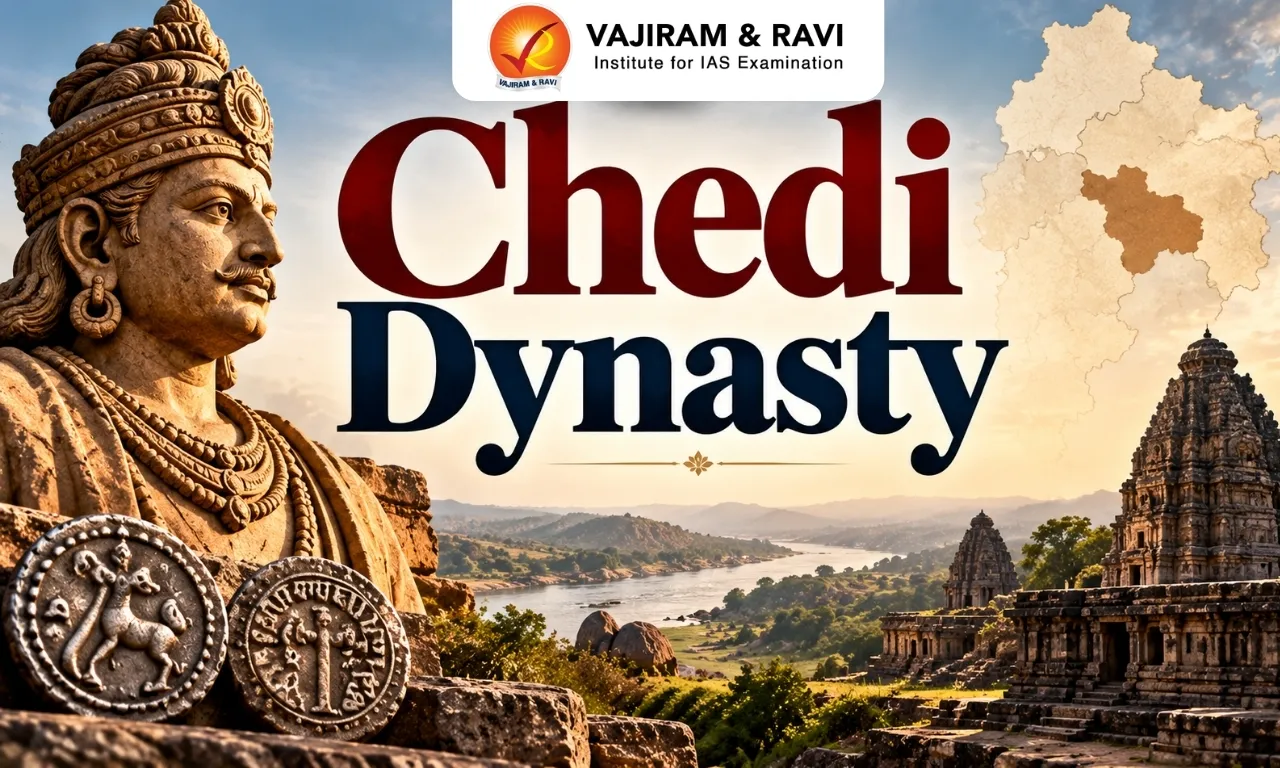
The Chedi Dynasty of Kalinga, commonly associated with the Mahameghavahana ruling family, emerged as an important regional power after the decline of the Mauryan Empire. Its best-known ruler, Kharavela, is remembered for military campaigns, public works, support for Jainism, and patronage of rock-cut architecture in present-day Odisha.
The principal source for the dynasty is the Hathigumpha inscription at Udayagiri near Bhubaneswar. It describes Kharavela’s early life and achievements through his thirteenth regnal year. However, damaged passages and disputed readings mean that the dynasty’s exact chronology and territorial extent remain uncertain.
Chedi Dynasty Origin and Foundation
The Chedi Dynasty rose in Kalinga during the Post-Mauryan period. Kalinga had been conquered by Ashoka in the third century BCE, but the weakening of Mauryan authority subsequently created opportunities for regional rulers to establish independent power.
- The dynasty is also described as Cheti, Chetavamsa, or Mahameghavahana in historical accounts.
- The Government of Odisha’s historical account associates the restoration of Kalinga’s independence in the early first century BCE with the Chedi chief Mahameghavahana.
Chedi Dynasty Founder
Mahameghavahana is generally regarded as the founder of the Chedi–Mahameghavahana dynasty of Kalinga, which emerged around the 1st century BCE. He is considered the progenitor of the family, while Kharavela, the dynasty’s most prominent ruler, belonged to its third generation.
Chedi Dynasty Time Period
The Chedi Dynasty belongs to the post-Mauryan period, but its precise dates are disputed. Kharavela is variously placed in the second or first century BCE, depending on interpretations of inscriptions, palaeography, and references to contemporary rulers.
Chedi Dynasty Capital
Kalinganagara, also written as Kalinganagari, was Kharavela’s capital. The Hathigumpha inscription records that he repaired its gates, fortifications, and buildings after storm damage during the first year of his reign.
Chedi Dynasty Rulers
The Chedi–Mahameghavahana dynasty of Kalinga is mainly known through the Hathigumpha inscription of Kharavela.
- Mahameghavahana: He is regarded as the founder of the Chedi–Mahameghavahana line. He is generally placed before Kharavela, though details of his reign are limited.
- Chetaraja: Mentioned in the genealogical tradition associated with Kharavela and generally identified as his father or immediate predecessor.
- Kharavela: The most prominent ruler, he reigned about the 1st century BCE and is remembered by the Hathigumpha inscription, which details his accomplishments, military conquests, and administrative duties. He followed Jainism and encouraged Jain religious traditions, as evidenced by the Hathigumpha inscription, which opens with the Jain Namokar Mantra.
- Kudepasiri: Kharavela's son Kudepasiri followed him, and his name appears in the Mancapuri Cave inscription, showing that the dynasty continued.


Chedi Dynasty Geographical Extent
The dynasty was centred in Kalinga, broadly corresponding to present-day Odisha, with its political and cultural activities concentrated around the region of Kalinganagara and the Udayagiri–Khandagiri area. Kharavela's campaigns, however, indicate that his political and military activities extended beyond the core territory.
Chedi Dynasty Contemporary Powers
The Chedi rulers of Kalinga were part of the politically fragmented post-Mauryan period, when regional powers such as the Satavahanas and Shungas were expanding their influence.
- Satavahana Era: The Satavahanas were a major contemporary power in the Deccan. The Hathigumpha inscription records Kharavela's expedition towards the western region against Satakarni, indicating political interaction between Kalinga and the Satavahana sphere.
- Shunga Dynasty: The Shunga kingdom in northern India, particularly Magadha, was another important contemporary power. Kharavela's inscription refers to his advance towards Magadha, showing the continuing political importance of the region.
- Yavana/Indo-Greek powers: The Hathigumpha inscription also mentions a Yavana ruler, reflecting Kharavela's interaction with political forces from northwestern India. The exact identification of this ruler remains debated.
Chedi Dynasty Administration
The Chedi–Mahameghavahana administration is mainly a monarchical system with a developed administrative and military apparatus known from the Hathigumpha inscription of Kharavela and other inscriptions from Udayagiri–Khandagiri.
- Monarchy: Kharavela exercised central authority as Maharaja, while the inscription presents him as a ruler responsible for law, public welfare, and protection of the kingdom.
- Officials: Udayagiri inscriptions mention officials such as Mahamātras, Nagara-akhadamsa (city administrator), and Kamma/Cula-kamma, indicating an organised administrative machinery.
- Military Organisation: The state maintained a large army comprising infantry, cavalry, elephants, and chariots, which supported both defence and Kharavela's military campaigns.
- Public Works: Kharavela undertook the repair of fortifications at Kalinganagari, renovation of an ancient aqueduct, construction of gardens and excavation of caves.
- Revenue Policy: The Hathigumpha record mentions remission of taxes for both urban and rural populations during Kharavela's sixth regnal year, suggesting that taxation was an important component of state finance.
Chedi Dynasty Religion
The Chedi–Mahameghavahana rulers showed strong support for Jainism, particularly during the reign of Kharavela. At the same time, the religious environment of Kalinga remained diverse, with different traditions receiving space and patronage.
- Jainism: Jainism received significant royal patronage, with support extended to monks, religious establishments, and the preservation of Jain traditions.
- The Udayagiri–Khandagiri caves served as important centres for Jain ascetics.
- Their numerous chambers, inscriptions, and artistic features reflect the growth of Jain monastic activity in Kalinga.
- Kharavela is traditionally described as a Jain by birth, and his religious affiliation is reflected in the Hathigumpha inscription, which offers salutations to the Arhats and Siddhas.
- Religious Coexistence: The broader cultural setting of Kalinga accommodated Jain, Brahmanical, and other religious traditions, indicating that Jain royal patronage existed within a plural religious environment.
Chedi Dynasty Art and Architecture
The Chedi–Mahameghavahana period is particularly important for the development of rock-cut architecture and early sculptural traditions in Kalinga. The Udayagiri–Khandagiri complex, along with the Hathigumpha inscription, provides valuable evidence of the artistic, architectural, and cultural activity of the period.
- Rock-cut Architecture: The Udayagiri–Khandagiri caves represent an important early tradition of excavating monastic spaces directly into rock. Several caves were associated with Jain ascetics.
- Rani Gumpha: The double-storeyed Rani Gumpha is notable for its elaborate façades, pillars, courtyards and sculptural decoration. Its panels provide glimpses of royal processions, dancers, musicians and everyday cultural life.
- Hathigumpha Inscription: The Hathigumpha cave contains Kharavela's major inscription, which records his reign and provides important evidence for the political, cultural and religious life of Kalinga.
- Architectural Variety: The Udayagiri–Khandagiri cave complex displays varied forms such as rock-cut cells, verandahs, pillared spaces and apsidal structures, reflecting experimentation in early Kalingan architecture.
Chedi Dynasty Decline
The Chedi–Mahameghavahana dynasty gradually lost political prominence after the period of Kharavela, and the available evidence for its later rulers is limited.
- Post-Kharavela Transition: The absence of equally prominent rulers after Kharavela weakened the dynasty's visibility and political influence.
- Changing Regional Politics: Shifts in the balance of power across Kalinga and the eastern Deccan reduced the dynasty's ability to maintain a wider sphere of influence.

 Last updated on Oct, 2026
→ UPSC 2027 Notification will be released on 13 January 2027 at upsconline.nic.in.
→ Check Nobel Prize 2026 Winners List here.
→ Download PIB PRiSM Monthly Magazine 2026 here.
→ Check UPSC Monthly Current Affairs Magazine The Recitals here.
→ Check out the latest UPSC Syllabus here.
→ Download UPSC Model Answers for Mains 2026
→ UPSC Mains Question Paper 2026 is out now for Essay & GS Paper 1, 2, 3 & 4.
→ UPSC Calendar 2027 has been released.
→ Enroll in Vajiram & Ravi’s UPSC Mains Test Series 2027 for structured answer writing practice, expert evaluation, and exam-oriented feedback.
→ Join Vajiram & Ravi’s UPSC Mentorship Program 2027 for personalized guidance, strategy planning, and one-to-one support from experienced mentors.
→ Go through the UPSC Mains Previous Year Papers to enhance your preparation.
→ UPSC has released UPSC Toppers List 2025 with the Civil Services final result on its official website.
→ Also check Best UPSC Coaching in India
Chedi Dynasty FAQs
Q1. Who founded the Chedi dynasty?+
Q2. Who was the king of Chedi in the Mahabharata?+
Q3. Who was the most famous king of the Chedi dynasty?+
Q4. What was the capital of the Chedi dynasty?+
Q5. Where is Chedi now?+
Tags: chedi dynasty quest upsc ancient history notes