
The Mission for Aatmanirbharta in Pulses is a Government of India initiative designed to increase domestic pulse production, reduce import dependence and improve farmers’ incomes. The Union Cabinet approved the mission on 1 October 2025, with a financial outlay of ₹11,440 crore for six years, from 2025–26 to 2030–31.
The Mission for Aatmanirbharta in Pulses gives particular attention to tur (pigeon pea), urad (black gram) and masoor (lentil), while supporting improvements across the pulses sector. Its strategy combines better seeds, expansion of cultivated area, scientific farming, post-harvest infrastructure and assured procurement arrangements. The mission aims to raise annual production to 350 lakh tonnes by 2030–31, strengthen domestic supply and support India’s long-term goal of self-reliance in pulses.
Mission for Aatmanirbharta in Pulses Need
The need for the mission for Aatmanirbharta in pulses arises from rising domestic demand, import dependence, productivity gaps and the need to provide stable markets and better returns to pulse-growing farmers.
- Rising consumption: Pulses are an important source of plant-based protein, and demand has increased with changing diets, population growth and rising incomes.
- Import dependence: Domestic production has not always kept pace with consumption, requiring imports to bridge the supply gap.
- Farmer income concerns: Uncertain prices and market access can discourage farmers from expanding pulse cultivation.
- Productivity gaps: Limited access to improved seeds, uneven adoption of scientific practices, and pest-related losses can constrain yields.
- Climate-related risks: Drought, irregular rainfall, heat stress and other weather extremes can affect pulse production.
- Limited post-harvest capacity: Insufficient processing, packaging and storage facilities can lead to losses and restrict value addition.
Status of Pulse Production in India 2025-26
India is a major global producer of pulses, which are essential for meeting the country’s nutritional needs, strengthening food security in India, and supporting agricultural livelihoods. Key statistics on pulses in India are as below.
- Production: India’s total pulses output is estimated at 274.09 lakh tonnes for 2025–26, as per the Third Advance Estimates.
- Major producing states: Madhya Pradesh, Maharashtra, Rajasthan, Uttar Pradesh, Gujarat, Andhra Pradesh, Karnataka, Jharkhand, Odisha and West Bengal are among the key contributors to pulse production.
- Major pulses grown: The principal varieties cultivated in India include chickpea (gram), pigeon pea (tur or arhar), mung bean (moong), black gram (urad), lentil (masoor) and peas.
- Export performance: During 2025–26, India exported approximately 10.01 lakh metric tonnes of pulses, valued at US$969.53 million.
- Major export destinations: China, the United Arab Emirates, Bangladesh, the United States and Sri Lanka were among the leading markets for Indian pulses.
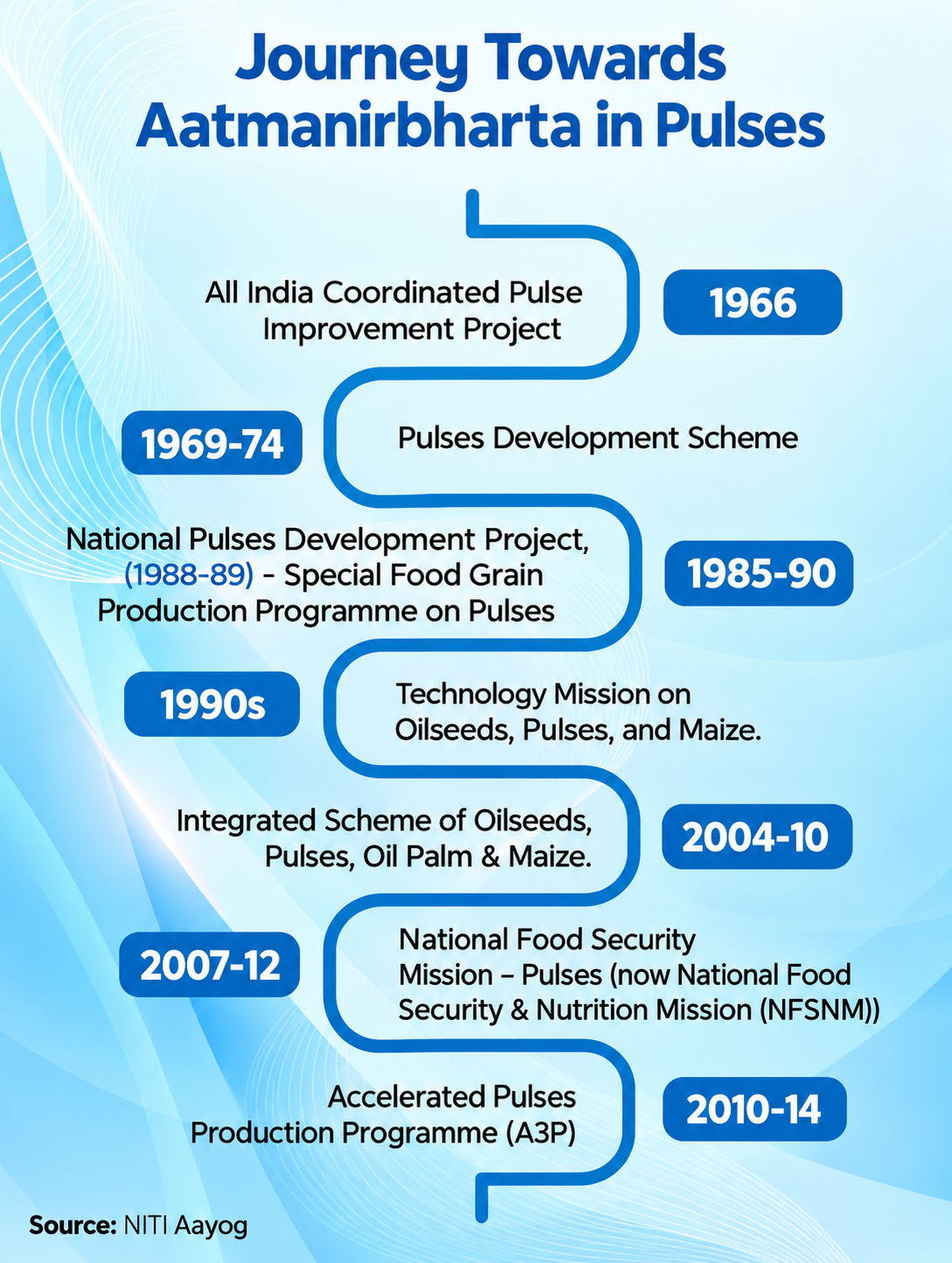
Mission for Aatmanirbharta in Pulses Overview
The Mission for Aatmanirbharta in Pulses is a Centrally Sponsored Scheme that combines production support, improved seed systems, procurement arrangements and post-harvest development to strengthen India's pulse value chain. Key facts about the mission include:
- Approval: 1 October 2025
- Priority crops: Tur, urad and masoor, alongside other pulses
- Infrastructure target: 1,000 pulse processing units over the mission period
- Seed support: Distribution of free seed kits and development of improved pulse varieties.


Mission for Aatmanirbharta in Pulses Objectives
The objectives of the Mission for Aatmanirbharta in Pulses focus on increasing domestic production, improving crop productivity, strengthening seed resilience and ensuring reliable markets for pulse farmers.
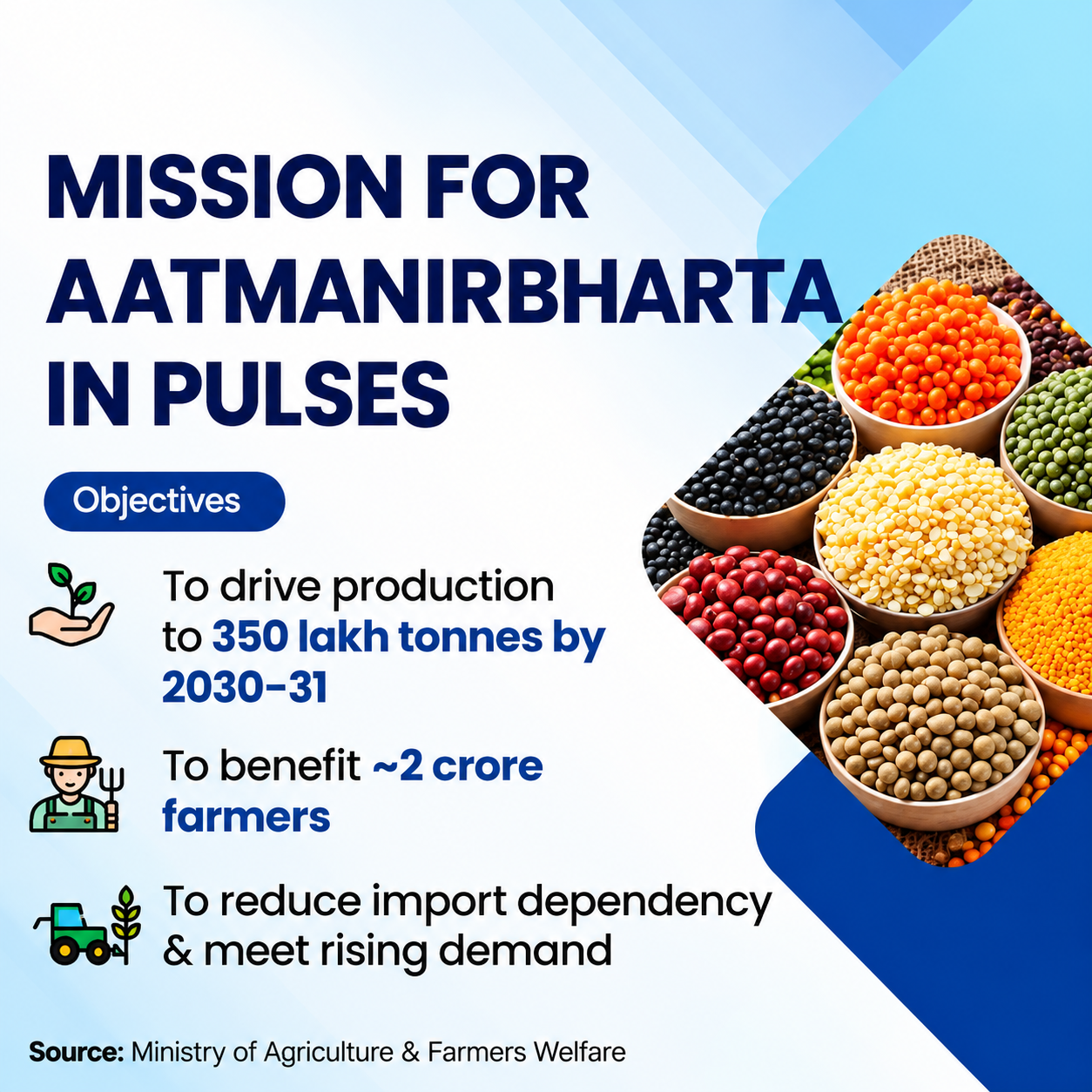
- Increase pulses production: Raise annual production to 350 lakh tonnes by 2030–31 to improve domestic availability.
- Expand cultivated area: Increase the area under pulses to 310 lakh hectares by 2030–31, including through the use of suitable fallow and non-traditional areas.
- Improve crop productivity: Raise average yield to 1,130 kg per hectare by promoting better seeds and improved cultivation practices.
- Develop climate-resilient seeds: Encourage high-yielding, short-duration, pest-resistant and climate-resilient varieties suited to different growing regions.
- Improve post-harvest management: Promote processing, packaging, storage and related technology to reduce losses and enhance value addition.
- Improve nutritional quality: Support efforts to enhance the protein content of pulses.
- Raise farmers’ incomes: Combine productivity improvements with better market access and opportunities for value addition.
Mission for Aatmanirbharta in Pulses Features
The features of the Mission for Aatmanirbharta in Pulses combine financial support, seed development, cluster-based implementation, assured procurement and post-harvest investment within a six-year national programme.
- Six-year implementation: The mission operates from 2025–26 to 2030–31 with a total outlay of ₹11,440 crore.
- Focus on three major pulses: Tur, urad and masoor receive particular attention because of their importance to domestic supply and the mission’s production strategy.
- Improved seed varieties: Support covers the development, multiplication and distribution of improved seeds, including high-yielding and climate-resilient varieties.
- Free seed-kit distribution: Seed kits are intended to encourage pulse cultivation and support expansion into suitable areas.
- Cluster-based approach: Interventions are planned around pulse-growing clusters, allowing support to be adapted to local production conditions.
- Demonstration of improved practices: Front-line demonstrations and cluster front-line demonstrations help farmers learn about improved varieties and cultivation methods.
- Assured procurement: NAFED and NCCF are designated to procure tur, urad and masoor under the Price Support Scheme for the next four years from registered farmers who enter into the required agreements, subject to scheme provisions.
- Processing infrastructure: The mission targets 1,000 processing units, with financial assistance for eligible processing and packaging projects.
- Research and development: Research supports improved varieties, hybrids and technologies suited to productivity and climate challenges.
- Monitoring and coordination: National, state and district-level mechanisms oversee implementation, financial progress and performance.
Mission for Aatmanirbharta in Pulses Implementation Structure
The implementation structure of the Mission for Aatmanirbharta in Pulses distributes planning, funding, execution and monitoring across national, state and district institutions to coordinate agricultural interventions.
- National level: The Department of Agriculture and Farmers Welfare provides overall direction, coordinates implementation and reviews mission progress.
- State level: State Steering Committees on Pulses coordinate departmental participation, approve state action plans and monitor progress.
- District level: District Steering Committees identify local requirements, coordinate field implementation and review progress in selected districts and clusters.
- Research and extension institutions: ICAR institutes, agricultural universities and Krishi Vigyan Kendras support research, seed development, demonstrations and farmer training.
- Procurement agencies: NAFED and NCCF.
- Seed and farmer organisations: Seed corporations, cooperatives, seed hubs and Farmer Producer Organisations can support seed multiplication, distribution and other value-chain activities.
- Financial monitoring: Funds are released according to approved action plans and prescribed procedures, with utilisation reporting and monitoring requirements.
Mission for Aatmanirbharta in Pulses Importance
The importance of the mission for Aatmanirbharta in pulses extends beyond increasing farm output, as it connects food security, farmer welfare, agricultural resilience and domestic value-chain development.
- Food and nutritional security: Greater domestic availability of pulses can improve access to an important source of dietary protein.
- Reduced import dependence: Higher production can help narrow the gap between domestic supply and demand and reduce the need for imports.
- Better farmer returns: Procurement support and improved market access can strengthen confidence among farmers considering pulse cultivation.
- Climate resilience: Improved seed varieties and better cultivation practices can help farmers manage some weather-related and pest-related risks.
- Soil health: Pulses are legumes that can contribute to biological nitrogen fixation and support soil fertility when appropriately integrated into crop rotations.
- Crop diversification: Pulses can provide alternatives in suitable rice-fallow and other underutilised agricultural areas.
- Reduced post-harvest losses: Processing, packaging and storage facilities can improve handling and preserve produce quality.
- Rural employment: Expanding seed production, processing, packaging, and marketing can create additional economic activity in rural areas.
- Value addition: Processing infrastructure can help move the sector beyond the sale of unprocessed produce and support higher-value products.
- Conservation of foreign exchange: If achieved, lower import requirements can reduce expenditure on imported pulses.
Mission for Aatmanirbharta in Pulses Challenges
The challenges of the mission for Aatmanirbharta in pulses include climate variability, uneven productivity, seed-system constraints, market uncertainty and the practical difficulties of implementing interventions across diverse farming regions.
- Climate variability: Rainfall fluctuations, drought, heat stress and extreme weather can disrupt pulse yields and implementation of the mission.
- Yield gaps: Differences in soil conditions, agronomic practices and input availability can limit productivity across states and districts.
- Seed availability and quality: Ensuring timely access to suitable, certified and improved seed varieties remains essential for raising production.
- Farmer adoption: Farmers may be reluctant to change cropping patterns or adopt new varieties if returns, local suitability or market access appear uncertain.
- Market-price fluctuations: Prices can change because of domestic production, imports, international markets and seasonal supply conditions.
- Procurement access: Farmers need awareness, registration and compliance with the relevant conditions to benefit from designated procurement arrangements.
- Infrastructure constraints: Processing and storage facilities require suitable locations, reliable power, skilled operators, market connections and sustained utilisation.
- Coordination across institutions: Effective implementation requires timely cooperation among Central agencies, State departments, research bodies, cooperatives and farmer organisations.
- Regional differences: Cropping calendars, irrigation access, soil characteristics and the suitability of different pulses vary widely across India.
- Measuring outcomes: Progress must be assessed through actual changes in production, yield, farmer returns and import dependence, not simply the number of activities completed.
Mission for Aatmanirbharta in Pulses and Other Government Initiatives to Promote It
Other government initiatives to promote pulses in India complement the mission through price support, agricultural research, seed development, crop diversification and investment in processing and rural infrastructure.
- Price Support Scheme (PSS) under PM-AASHA: Supports procurement of notified pulses at the Minimum Support Price, subject to the scheme’s operational provisions. The Pulses Mission’s designated agencies also undertake procurement of tur, urad and masoor under specified arrangements.
- National Food Security and Nutrition Mission (NFSNM): Its pulses component has been incorporated into the Mission for Aatmanirbharta in Pulses, with applicable committed liabilities handled under the prescribed arrangements.
- Indian Council of Agricultural Research (ICAR): Supports pulse research, improved varieties, agricultural demonstrations and scientific cultivation through its research institutes and extension network.
- Seed hubs and certified seed distribution: Seed hubs, agricultural universities, Krishi Vigyan Kendras and other designated institutions support the production and distribution of improved-quality pulse seeds.
- Pradhan Mantri Krishi Sinchayee Yojana (PMKSY): Supports irrigation-related interventions that can complement pulse cultivation in areas where water management is a key constraint.
- Pradhan Mantri Kisan SAMPADA Yojana (PMKSY – Food Processing): Supports food-processing infrastructure, including pulse-processing projects under relevant components.
- Agricultural extension and farmer training: Front-Line Demonstrations, Cluster Front-Line Demonstrations and training through agricultural institutions help farmers access improved practices and technologies.
Mission for Aatmanirbharta in Pulses UPSC PYQs
Q1. With reference to pulse production in India, consider the following statements: (UPSC Prelims 2020)
- Black gram can be cultivated as both kharif and rabi crop.
- Green gram alone accounts for nearly half of pulse production.
- In the last three decades, while the production of kharif pulses has increased, the production of rabi pulses has decreased.
Which of the statements given above is/are correct?
(a) 1 only
(b) 2 and 3 only
(c) 2 only
(d) 1, 2 and 3
Ans: (a)
Q2. Consider the following crops of India: (UPSC Prelims 2012)
- Cowpea
- Green gram
- Pigeon pea
Which of the above is/are used as pulse, fodder and green manure?
(a) 1 & 2 Only
(b) 2 & 3 Only
(c) 1 & 3 Only
(d) 1,2 & 3
Ans: (d)

 Last updated on Oct, 2026
→ UPSC 2027 Notification will be released on 13 January 2027 at upsconline.nic.in.
→ Check Nobel Prize 2026 Winners List here.
→ Download PIB PRiSM Monthly Magazine 2026 here.
→ Check UPSC Monthly Current Affairs Magazine The Recitals here.
→ Check out the latest UPSC Syllabus here.
→ Download UPSC Model Answers for Mains 2026
→ UPSC Mains Question Paper 2026 is out now for Essay & GS Paper 1, 2, 3 & 4.
→ UPSC Calendar 2027 has been released.
→ Enroll in Vajiram & Ravi’s UPSC Mains Test Series 2027 for structured answer writing practice, expert evaluation, and exam-oriented feedback.
→ Join Vajiram & Ravi’s UPSC Mentorship Program 2027 for personalized guidance, strategy planning, and one-to-one support from experienced mentors.
→ Go through the UPSC Mains Previous Year Papers to enhance your preparation.
→ UPSC has released UPSC Toppers List 2025 with the Civil Services final result on its official website.
→ Also check Best UPSC Coaching in India
Mission for Aatmanirbharta in Pulses FAQs
Q1. Which state is the largest producer of pulses in India?+
Q2. What is the Mission for Aatmanirbharta in Pulses?+
Q3. What is the pulses production target under the Mission for Aatmanirbharta in Pulses?+
Q4. Which are the major pulses grown in India?+
Q5. What is the total pulses production in India in 2025–26?+
Tags: mission for aatmanirbharta in pulses quest UPSC Agriculture Notes