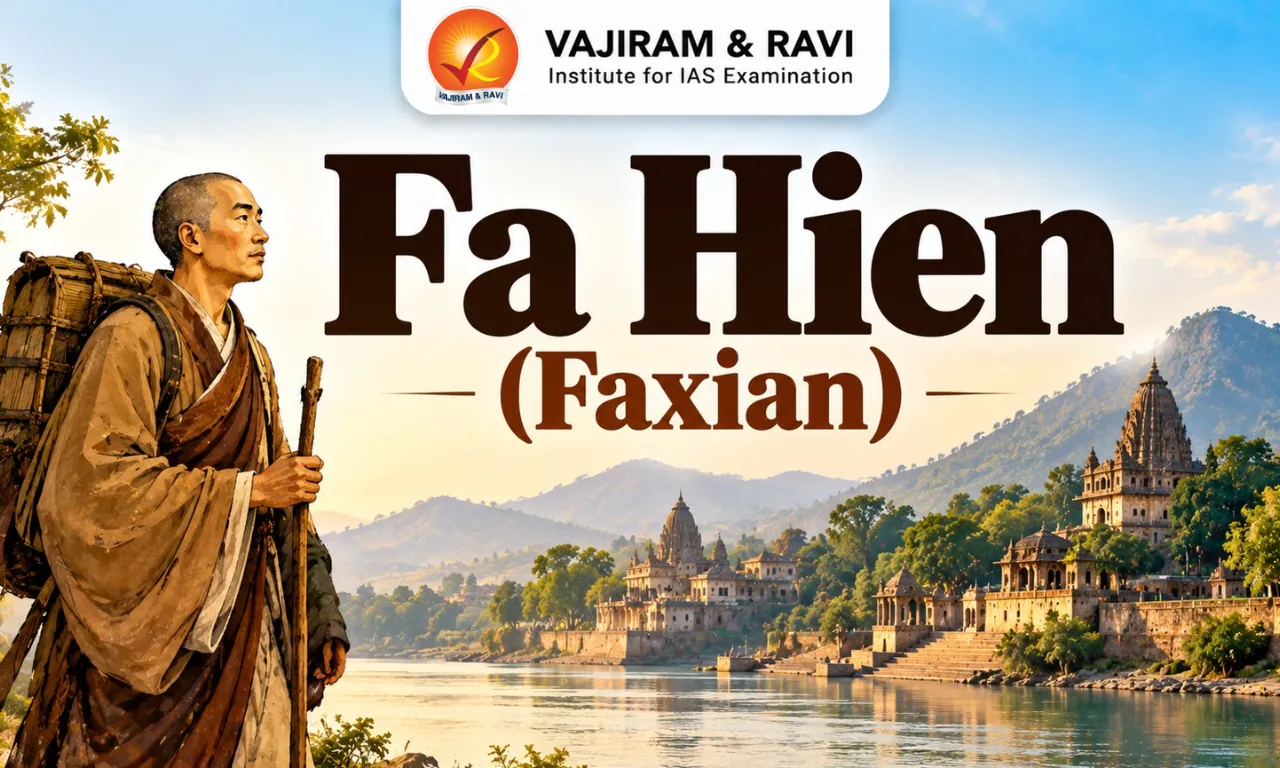
Fa Hien, also known as Faxian or Fa-Hsien, was a Chinese Buddhist monk, pilgrim, and translator who travelled to the Indian subcontinent in the early fifth century CE. His visit coincided with the reign of Gupta ruler Chandragupta II. His main purpose was to collect Buddhist scriptures, particularly texts concerning monastic discipline, known as the Vinaya.
His travelogue, Fo-Kwo-Ki (Foguoji) or A Record of Buddhistic Kingdoms, records his observations. His account describes Gupta-era political, social, religious and economic conditions, including administration, religious tolerance, prosperity, trade, charity and Buddhist institutions. It is an important source for reconstructing Gupta history, though its focus on Buddhism and pilgrimage makes it geographically and thematically selective.
Fa-Hien (Faxian) About
Fa-Hien was one of the famous foreign travellers who visited India. He was a Chinese Buddhist monk who journeyed to India during the early 5th century CE. Unlike an ambassador or court historian, he travelled mainly to study Buddhism, visit sacred places, and obtain religious texts unavailable or incomplete in China. His account provides valuable information on Buddhism, society, administration, and places in Gupta-period India.
Fa Hien Early Life and Background
Fa Hien was born in China, traditionally dated to around 337 CE. He entered the Buddhist monastic order at a young age and became deeply interested in Buddhist teachings and scriptures.
- He was concerned about obtaining complete and reliable versions of Buddhist monastic rules, particularly the Vinaya texts. These texts governed the conduct, discipline and organisation of Buddhist monks and nuns.
- The incomplete or differing versions of Buddhist scriptures available in China motivated him to travel to regions associated with the life of Gautama Buddha.
Fa Hien Visit to India
Fa Hien visited India during the reign of Chandragupta II in the early 5th century CE. He entered India from the northwest and reached Pataliputra, where he stayed for nearly three years, learned Sanskrit, and studied Buddhist texts. Fa Hien's journey continued beyond India.
- He travelled from the northwest frontier to the Ganges valley and then southward to the eastern coastal port of Tamralipti/Tamralipta (Midnapore district, modern-day West Bengal) in the Bay of Bengal.
- He mentions travelling to Simhala (Sri Lanka) via water and then continuing on to Southeast Asia before returning to China. He carried texts related to Buddhist Literature and religious materials that contributed to the study and translation of Buddhism in China.
Purpose of Fa-Hien’s Visit to India
Fa-Hien visited India around 399 CE to study Buddhism and collect authentic Buddhist scriptures, particularly the Vinaya texts containing rules for monastic discipline. He wanted to visit sacred places associated with Gautama Buddha and learn about Buddhist practices in India. His journey aimed to strengthen Buddhist knowledge in China and facilitate the translation and preservation of Buddhist texts.
Places Visited by Fa Hien
Fa-Hien visited several regions associated with Buddhism, learning and urban life. His route included places in present-day Pakistan, India and other parts of Asia. Faxian visited the following places:
- Khotan: Major Buddhist centre on the Central Asian route
- Gandhara and Peshawar: Monasteries, Buddhist relics, and traditions associated with earlier Buddhist patronage
- Taxila region: Buddhist sacred traditions and pilgrimage sites
- Mathura: Monastic communities and an important point in his description of Middle India
- Sankasya and Kannauj: Places associated with Buddhist traditions and regional travel
- Shravasti: Sacred sites connected with the Buddha, including Jetavana
- Kapilavastu and Lumbini: Places associated with the Buddha’s early life and birth
- Kushinagar: Site associated with the Buddha’s final passing
- Vaishali: Important Buddhist sacred and historical centre
- Rajagriha and Bodh Gaya: Places associated with Buddhist teachings and enlightenment
- Sarnath: Site associated with the Buddha’s first sermon
- Pataliputra: Centre for studying Sanskrit and collecting manuscripts
- Tamralipti: Eastern Indian port from which he sailed towards Sri Lanka


Fa-Hien (Faxian) Travel Book
Fa-Hien’s travel book is an important record of his pilgrimage, Buddhist studies and observations of India and other Asian kingdoms.
- Faxian book: His famous travel account is Fo-Kwo-Ki, also known as A Record of Buddhistic Kingdoms or Record of Buddhist Kingdoms. It records his pilgrimage, Buddhist studies and observations of India and other Asian kingdoms.
- It describes his journey, Buddhist scriptures, pilgrimage sites, Buddhist practices, and conditions in India and other Asian kingdoms.
Fa-Hien (Faxian) Accounts of India
Faxian wrote about his travels in Fo-Kuo-Ki ('A Record of Buddhist Kingdoms'). The text makes no reference to King Chandragupta II, who was reigning at the time he arrived, but it does describe the life of Indians. His accounts provide an important foreign perspective on early 5th-century India, particularly the Gupta period, offering valuable insights into its political, social, religious and economic conditions.
Fa Hien on Political and Administrative Conditions
Fa-Hien’s observations provide a broad picture of Gupta administration, highlighting peace, security, light taxation, welfare measures, and relatively mild punishments.
- Emergence of Feudalism: Land grants to priests, temples and later royal officers during the Gupta period contributed to the evolution of feudalism and serfdom. He also mentions that monasteries of Brahmin priests were furnished with houses, fields, and gardens.
- Agricultural Dependence: Fields were reportedly provided with tillers and cattle for cultivation. Cultivators working on royal lands had to surrender a portion of their produce to the royal treasury.
- Decline of Urban Economy: Historians arguing for Indian feudalism cite Fa Hien’s reference to cowries as a common medium of exchange as evidence of declining monetary circulation, trade and urban settlements.
- Transfer of Cultivators: Sixth-century CE inscriptions from Gujarat, central India and Odisha indicate that cultivators could be compelled to remain on granted lands, restricting their mobility and reducing some to semi-serfdom or serfdom.
- Military Decentralisation: Fa Hsien does not recount the numerical strength of the Gupta army. Unlike the Mauryan Empire, Gupta rulers may have depended significantly on samantas (feudatories) for troops, horses and elephants, increasing their reliance on regional chiefs.
Fa-Hien on Social Conditions
Faxian described Gupta-era society as prosperous and peaceful, while recording its food habits, moral values, charitable practices and social conditions.
- Prosperity in Certain Regions: He described people in parts of central India as living comfortably and enjoying relative security. He described people as prosperous, peaceful, liberal, and morally upright.
- Dietary Practices: Vegetarianism was prevalent, with people generally avoiding meat and onions. People avoided alcohol and other intoxicants.
- Charitable Support: Charity and benevolence were important social values; wealthy people donated to temples, monasteries, and Sanghas.
- Condition of Outcastes: He sheds attention on the suffering of untouchables, particularly 'chandalas'. During his stay, the untouchable class as a whole was socially marginalised even further.
- The 'chandalas' may approach a city or market area by striking a piece of wood or sounding a clapper as a warning of their existence, allowing the inhabitants to avoid them.
- If they came into close contact, an upper-caste person would have to undertake a purifying ritual ablution.
Fa Hien on Religious Conditions
Religion forms the central subject of Faxian’s account. He described monasteries, monks, sacred relics, religious processions, pilgrimage sites, and different traditions of Buddhist learning.
- Religious Diversity: Fa-Hien’s account indicates that Buddhism coexisted with other religious traditions. However, he focused mainly on Buddhism because his primary purpose was religious pilgrimage.
- Hinayana Buddhism: He observed Hinayana communities in Gandhara, Udyana, Bannu, Kashmir, Darada, Lob Nor and Kannauj, indicating its geographical spread across Central and South Asia.
- Mahayana Buddhism: Mahayana was also popular. Fa Hien encountered Mahayanist monks at Bhida, Mathura and Pataliputra. At Khotan, he reported that all monks followed Mahayana Buddhism.
- Tantric Influence: During the fifth and sixth centuries CE, Mahayana increasingly came under Tantric influence, eventually contributing to the emergence of Vajrayana Buddhism.
- Patronage and Administration: As trade declined, Buddhist institutions increasingly depended on royal land grants. Nalanda, a major Buddhist learning centre, reportedly received revenue from 200 villages for its maintenance.
Fa Hien on Economic Conditions
Fa-Hien’s observations indicate economic prosperity, flourishing internal and external trade, and the development of maritime activities and important ports.
- He described India as prosperous, with flourishing internal and external trade.
- Maritime trade and sea voyages were developing.
- Important ports included Cambay, Sopara and Baroach on the western coast and Tamralipti on the eastern coast.
- Rest houses and charitable institutions reflected aspects of public welfare and economic prosperity.
Fa-Hien Other Notable Observations
Beyond society and administration, Fa-Hien recorded Buddhist institutions, educational activities, religious processions, monuments, cities and other aspects of everyday life.
- He spent nearly three years at Pataliputra, learning Sanskrit and studying Buddhist texts.
- He recorded the presence of Mahayana and Hinayana Sanghas providing education.
- He observed chariot processions carrying images of Buddha and Bodhisattvas.
- He described Ashoka’s Palace, Lion Capital and Sanchi Stupa.
- He visited Malwa and praised its climate.
- His account provides valuable evidence for reconstructing Gupta-period India and ancient Buddhist traditions.
Faxian Contribution
Fa-Hien’s contribution includes documenting the Gupta Empire and other parts of India and transmitting Buddhist scriptures and knowledge from India to China, influencing the development of East Asian Buddhism.
- Provides an important foreign account for reconstructing Gupta-period Indian history.
- Gives information on religion, society, administration, trade, cities and Buddhist institutions.
- Provides valuable details about Pataliputra, Mathura, Lumbini and other important centres.
- His records preserve information on Buddhist practices, monasteries, stupas and religious traditions.
- His collection and translation of Buddhist scriptures significantly contributed to Chinese and East Asian Buddhism.
Faxian’s Account Limitations
Fa-Hien’s account is valuable but selective because his primary focus was Buddhism and pilgrimage, resulting in limited coverage of political affairs and geographically selective observations.
- Religious Bias: His principal interest was Buddhism. Consequently, his work provides much more detail about Buddhist sites and practices than about other religious traditions or secular institutions.
- Limited Political Information: He does not identify Chandragupta II by name or provide a comprehensive account of Gupta institutions. His work cannot independently establish a complete picture of Gupta governance.
- Regional Limitations: His observations were based on the places he visited. Conditions in these regions cannot automatically be generalised to the entire Indian subcontinent.
- Subjective Observations: As a traveller, he interpreted places and customs through his own cultural and religious background. Some descriptions may reflect personal impressions rather than representative conditions.
Fa-Hien UPSC PYQs
Q1: Assess the importance of the accounts of the Chinese and Arab travellers in the reconstruction of the history of India. (UPSC Mains 2018)

 Last updated on Oct, 2026
→ UPSC 2027 Notification will be released on 13 January 2027 at upsconline.nic.in.
→ Check Nobel Prize 2026 Winners List here.
→ Download PIB PRiSM Monthly Magazine 2026 here.
→ Check UPSC Monthly Current Affairs Magazine The Recitals here.
→ Check out the latest UPSC Syllabus here.
→ Download UPSC Model Answers for Mains 2026
→ UPSC Mains Question Paper 2026 is out now for Essay & GS Paper 1, 2, 3 & 4.
→ UPSC Calendar 2027 has been released.
→ Enroll in Vajiram & Ravi’s UPSC Mains Test Series 2027 for structured answer writing practice, expert evaluation, and exam-oriented feedback.
→ Join Vajiram & Ravi’s UPSC Mentorship Program 2027 for personalized guidance, strategy planning, and one-to-one support from experienced mentors.
→ Go through the UPSC Mains Previous Year Papers to enhance your preparation.
→ UPSC has released UPSC Toppers List 2025 with the Civil Services final result on its official website.
→ Also check Best UPSC Coaching in India
Fa Hien FAQs
Q1. Who was Fa Hien?+
Q2. When did Fa Hien reach India?+
Q3. Which book did Fa Hien write?+
Q4. What did Fa Hien say about India?+
Q5. Who came first, Fa Hien or Hiuen Tsang?+
Tags: fa hien quest upsc ancient history notes