The Kunming-Montreal Global Biodiversity Framework (KMGBF) is an international agreement adopted in December 2022 at the 15th Conference of the Parties to the Convention on Biological Diversity in Montreal, Canada. It aims to halt and reverse biodiversity loss by 2030 and achieve a world living in harmony with nature by 2050.
The Kunming-Montreal Global Biodiversity Framework establishes four long-term goals for 2050 and 23 global targets for 2030, covering ecosystem restoration, species conservation, sustainable resource use, pollution reduction and fair benefit-sharing from genetic resources. It also promotes biodiversity-friendly trade, sustainable agrifood systems and increased conservation finance. UNEP, UNCTAD and FAO support its implementation, while India advances national biodiversity planning, monitoring and conservation efforts to achieve these global commitments.
Kunming-Montreal Global Biodiversity Framework Background
The Kunming-Montreal Global Biodiversity Framework emerged from international efforts to address accelerating biodiversity loss and establish a stronger global plan following the Strategic Plan for Biodiversity 2011–2020.
- The framework was developed under the Convention on Biological Diversity in response to evidence that existing conservation measures were insufficient to prevent widespread ecosystem degradation and species decline.
- The Global Assessment Report of the Intergovernmental Science-Policy Platform on Biodiversity and Ecosystem Services (IPBES) highlighted the scale of the crisis, including the risk of extinction faced by many plant and animal species.
- The framework builds on the achievements and shortcomings of the Strategic Plan for Biodiversity 2011–2020, which included the Aichi Biodiversity Targets.
- It was adopted through CBD COP15 in Montreal, Canada, in December 2022, following a process involving governments, scientific institutions, Indigenous Peoples, local communities and other stakeholders.
- Although associated with Kunming, China, and Montreal, Canada, the framework was formally adopted in Montreal. It is intended to guide implementation of the CBD and its protocols during the 2022–2030 period.
Kunming-Montreal Global Biodiversity Framework Purpose
The Kunming-Montreal Global Biodiversity Framework seeks to mobilise urgent, coordinated and transformative action to stop biodiversity loss and place nature on a path to recovery. The main purposes of the Kunming-Montreal Global Biodiversity Framework are the following:
- Conserve and restore biodiversity: Protect ecosystems, species and genetic diversity while restoring degraded terrestrial, freshwater, coastal and marine habitats.
- Ensure sustainable and equitable use: Promote the sustainable use of biodiversity and ensure fair sharing of benefits arising from genetic resources and associated traditional knowledge.
- Mobilise implementation support: Strengthen biodiversity finance, scientific cooperation, technology transfer and capacity-building, particularly for developing countries.
- Integrate biodiversity into decision-making: Mainstream biodiversity across government policies, economic activities and society, encouraging the participation of Indigenous Peoples, local communities and other stakeholders.


Kunming-Montreal Global Biodiversity Framework and the 2030 Agenda for Sustainable Development
The Kunming-Montreal Global Biodiversity Framework and the 2030 Agenda are interconnected frameworks because biodiversity supports food security, public health, livelihoods, climate resilience and sustainable economic development.
- The 2030 Agenda, adopted by the United Nations in 2015, sets out 17 Sustainable Development Goals (SDGs). The Kunming-Montreal Global Biodiversity Framework complements this agenda by placing biodiversity conservation and sustainable use at the centre of development planning.
- The relationship works both ways. Progress on the SDGs can create the social, economic and institutional conditions needed to achieve the Kunming-Montreal Global Biodiversity Framework, while successful biodiversity conservation helps sustain development over the long term.
- The Kunming-Montreal Global Biodiversity Framework also recognises the links between biological and cultural diversity.
Kunming-Montreal Global Biodiversity Framework Vision for 2050 and Mission for 2030
The Kunming-Montreal Global Biodiversity Framework combines a long-term vision of living in harmony with nature by 2050 with an urgent mission to reverse biodiversity loss during the current decade.
- 2050 Vision: The Kunming-Montreal Global Biodiversity Framework envisages a world where biodiversity is valued, conserved, restored and wisely used, ecosystems continue to provide essential services, and nature supports a healthy planet and human well-being.
- 2030 Mission: The mission of the Kunming-Montreal Global Biodiversity Framework is to take urgent action to halt and reverse biodiversity loss and place nature on a path to recovery for people and the planet.
- This includes conserving and sustainably using biodiversity, ensuring fair and equitable benefit-sharing from genetic resources, and providing the resources needed for implementation.
Kunming-Montreal Global Biodiversity Framework 2050 Goals
The four 2050 goals of the Kunming-Montreal Global Biodiversity Framework address ecosystem integrity, the sustainable use of nature, equitable benefit-sharing and the resources required to implement global biodiversity commitments.
- Goal A - Protect and restore ecosystems and species: Maintain, improve or restore the integrity, connectivity and resilience of ecosystems, while increasing natural ecosystem areas.
- The goal also seeks to halt human-induced extinction of known threatened species, reduce extinction risks and rates, increase native wild species abundance, and preserve genetic diversity.
- Goal B – Ensure sustainable use of biodiversity: Ensure that biodiversity is used and managed sustainably and that nature’s contributions to people, including ecosystem functions and services, are valued, maintained and enhanced.
- Ecosystem services that are deteriorating should be restored to support present and future generations.
- Goal C- Share benefits from genetic resources fairly: Ensure that monetary and non-monetary benefits derived from genetic resources, digital sequence information on genetic resources and associated traditional knowledge are shared fairly and equitably.
- This includes appropriate protection of traditional knowledge and consideration of Indigenous Peoples and local communities.
- Goal D – Secure the means of implementation: Ensure adequate and accessible finance, capacity-building, scientific and technical cooperation, and technology access and transfer.
- The goal aims to progressively close the estimated US$700 billion annual biodiversity finance gap and align financial flows with the framework’s vision and targets.
Kunming-Montreal Global Biodiversity Framework 2030 Targets or KMGBF Targets
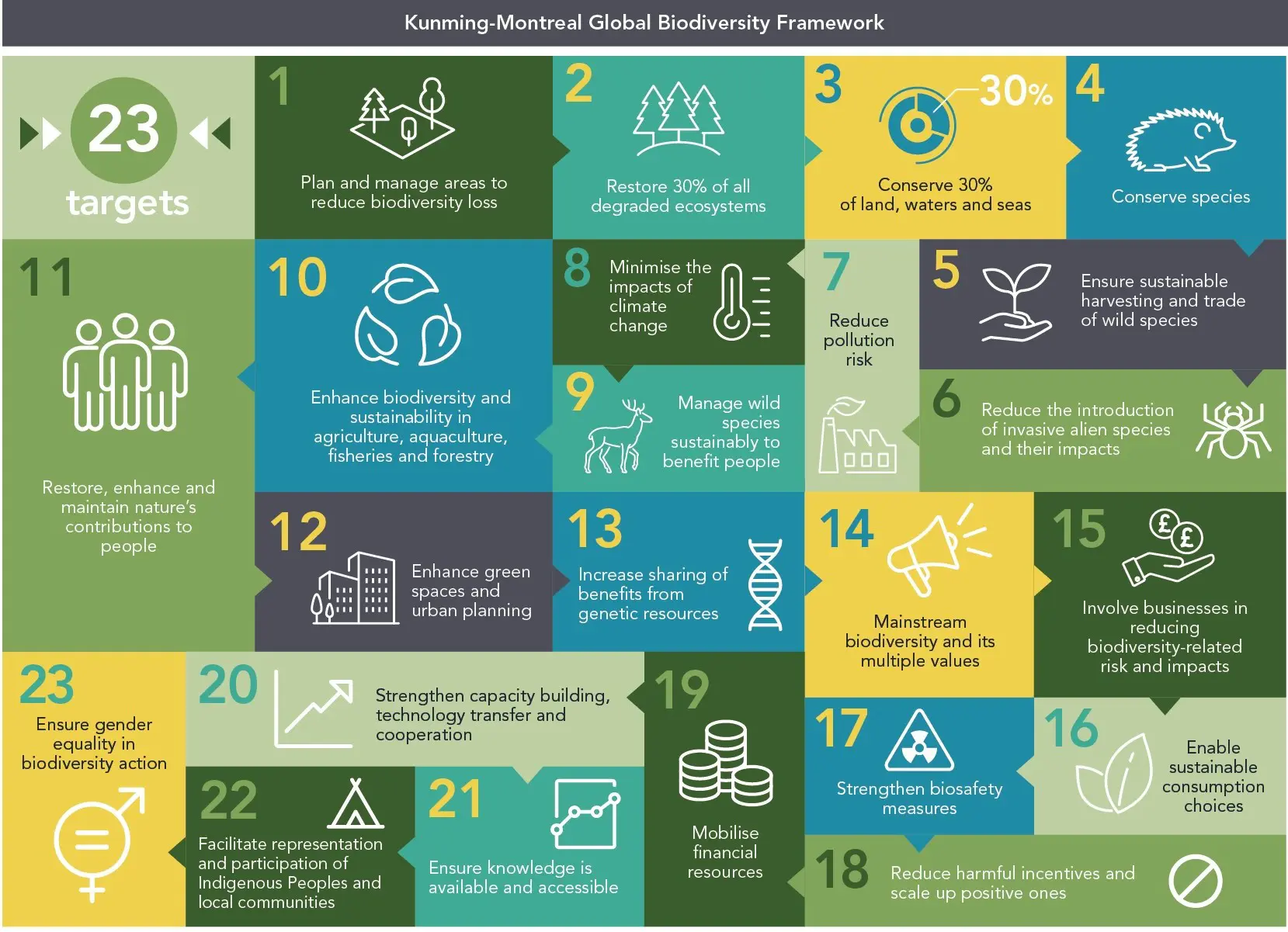
The Kunming-Montreal Global Biodiversity Framework includes 23 action-oriented targets grouped into three broad areas: reducing threats to biodiversity, meeting people’s needs through sustainable use and benefit-sharing, and providing implementation tools.
Reducing Threats to Biodiversity
- Target 1 – Biodiversity-inclusive spatial planning: Ensure participatory, integrated planning for land and sea use so that the loss of areas of high biodiversity importance is brought close to zero by 2030.
- Target 2 - Ecosystem restoration: Place at least 30% of degraded terrestrial, inland water, marine and coastal ecosystems under effective restoration by 2030.
- Target 3 - Conservation of land and sea: Conserve and effectively manage at least 30% of terrestrial and inland water areas, and 30% of marine and coastal areas, through protected areas and other effective area-based conservation measures.
- Target 4 - Species and genetic diversity: Take urgent action to prevent human-induced extinctions of known threatened species, support species recovery and conserve genetic diversity in wild and domesticated species.
- Target 5 - Sustainable use and trade of wild species: Ensure that harvesting and trade of wild species are legal, safe and sustainable, while minimising ecosystem impacts, reducing pathogen spill-over risks, and respecting customary sustainable use by Indigenous Peoples and local communities.
- Target 6 – Invasive alien species: Prevent the introduction and establishment of priority invasive alien species and reduce the rate of introduction and establishment of other known or potential invasive alien species by at least 50% by 2030.
- Target 7 - Pollution reduction: Reduce pollution to levels that are not harmful to biodiversity. This includes cutting excess nutrient losses by at least half, reducing the overall risk from pesticides and highly hazardous chemicals by at least half, and working towards eliminating plastic pollution.
- Target 8 - Climate change and ocean acidification: Minimise climate change and ocean acidification impacts on biodiversity through mitigation, adaptation, disaster-risk reduction and nature-based or ecosystem-based approaches.
Meeting People’s Needs Through Sustainable Use and Benefit-Sharing
- Target 9 - Sustainable management of wild species: Manage wild species sustainably to generate social, economic and environmental benefits, particularly for communities that depend directly on biodiversity.
- Target 10 - Sustainable agriculture, forestry, fisheries and aquaculture: Manage these production systems sustainably and expand biodiversity-friendly approaches, including agroecology and other innovative practices, while supporting food security and ecosystem resilience.
- Target 11 - Nature’s contributions to people: Restore and enhance ecosystem services such as clean air and water, soil health, pollination, climate regulation and protection against natural hazards.
- Target 12 - Urban green and blue spaces: Expand the area, quality and connectivity of green and blue spaces in cities and densely populated areas, supporting biodiversity, health and inclusive urban development.
- Target 13 - Fair and equitable benefit-sharing: Improve access to genetic resources and ensure fair benefit-sharing arising from their use, including digital sequence information and associated traditional knowledge, in line with relevant international arrangements.
Tools and Solutions for Implementation
- Target 14 - Mainstream biodiversity in decision-making: Integrate biodiversity and its values into government policies, planning, regulations, development processes, environmental assessments and relevant public and private financial flows.
- Target 15 - Business responsibility: Encourage and enable businesses, especially large and transnational companies and financial institutions, to assess and disclose their biodiversity-related impacts, dependencies and risks, and promote more sustainable production.
- Target 16 - Sustainable consumption: Help people make sustainable consumption choices and reduce the global footprint of consumption equitably, including by halving global food waste and significantly reducing overconsumption and waste generation.
- Target 17 - Biosafety: Strengthen and implement biosafety measures and appropriate measures for handling biotechnology and distributing its benefits, in accordance with the Convention on Biological Diversity.
- Target 18 - Reform harmful incentives: Identify and reform or phase out incentives and subsidies harmful to biodiversity, with the aim of reducing them by at least US$500 billion per year by 2030, while expanding positive incentives for conservation.
- Target 19 - Mobilise biodiversity finance: Mobilise at least US$200 billion per year from all sources by 2030. This includes increasing international biodiversity finance from developed countries to developing countries to at least US$30 billion annually by 2030.
- Target 20 - Capacity-building and technology: Strengthen technical and scientific cooperation, innovation, research, technology transfer and capacity-building, especially in developing countries.
- Target 21 - Data, knowledge and awareness: Improve access to biodiversity data, information and knowledge for decision-makers and the public, while respecting the rights and consent requirements associated with Indigenous and local knowledge.
- Target 22 - Participation and environmental justice: Ensure inclusive and equitable participation in biodiversity decisions, access to information and justice, and respect for the rights and territories of Indigenous Peoples and local communities, women, young people and other groups.
- Target 23 - Gender equality: Integrate a gender-responsive approach throughout implementation, ensuring that women and girls have equal opportunities, rights and participation in biodiversity-related action and decision-making.
Kunming-Montreal Global Biodiversity Framework and Kunming Biodiversity Fund (KBF)
The Kunming Biodiversity Fund supports developing countries in translating global biodiversity commitments into practical conservation, restoration and policy measures aligned with national biodiversity strategies.
- The Kunming Biodiversity Fund (KBF) was launched in May 2024 in Beijing through cooperation between the Government of China and the United Nations Environment Programme (UNEP).
- It is a financing and cooperation mechanism intended to help developing countries accelerate the implementation of the KMGBF, particularly through their National Biodiversity Strategies and Action Plans (NBSAPs).
- The fund complements existing biodiversity-finance mechanisms, including the Global Biodiversity Framework Fund, and seeks to direct support towards practical implementation at national, subnational and local levels.
Key Features of the KBF
- Financial support: The KBF was established with an initial contribution of 1.5 billion Chinese yuan from China’s Ministry of Ecology and Environment.
- Institutional cooperation: The fund involves UNEP, the Secretariat of the Convention on Biological Diversity and the United Nations Development Programme (UNDP).
- Developing-country focus: It aims to help developing countries strengthen and expand biodiversity conservation and implementation of national strategies.
- Priority areas: These include ecosystem restoration and protection, mainstreaming biodiversity into policies and planning, resource mobilisation, and fair benefit-sharing from genetic resources and digital sequence information.
- Inclusive implementation: It encourages participation by Indigenous Peoples and local communities, women, youth and other stakeholders.
- Project-based assistance: Under UNEP’s 2026 call, proposals are intended to address national or subnational implementation gaps.
- The stated maximum budget is US$500,000 for a single-country project and US$800,000 for a multi-country regional project, with a duration of 12–24 months.
- These are call-specific limits, not universal funding entitlements.
- The second-stage submission deadline for the 2026 call is 15 November 2026.
Kunming-Montreal Global Biodiversity Framework and UNCTAD
UNCTAD contributes to the Kunming-Montreal Global Biodiversity Framework by connecting biodiversity conservation with sustainable trade, biodiversity-based products, responsible value chains and economic opportunities for local communities. Its BioTrade Initiative promotes the collection, production, processing and commercialisation of biodiversity-based goods and services in ways that respect environmental, social and economic sustainability.
UNCTAD Support to the Kunming-Montreal Global Biodiversity Framework
- Promoting sustainable BioTrade: UNCTAD’s BioTrade Principles and Criteria guide businesses and other actors towards biodiversity conservation, sustainable use, fair benefit-sharing and respect for rights.
- Supporting developing countries: Technical assistance and capacity-building help countries develop trade and biodiversity policies that align with the KMGBF.
- Encouraging responsible value chains: Sustainable and traceable trade can help protect biodiversity while generating income and livelihoods for communities.
- Improving biodiversity-related trade data: UNCTAD’s Trade and Biodiversity (TraBio) statistical tool provides information on trade flows and economic indicators for biodiversity-based products.
- Connecting trade with biodiversity targets: Its work is relevant to targets covering wild-species trade, sustainable use, agriculture, benefit-sharing, biodiversity mainstreaming, business responsibility and resource mobilisation.
Kunming-Montreal Global Biodiversity Framework and FAO
The Food and Agriculture Organisation of the United Nations supports the Kunming-Montreal Global Biodiversity Framework by integrating biodiversity conservation into agriculture, forestry, fisheries, aquaculture and wider food systems.
FAO’s Major Contributions
- Mainstreaming biodiversity: FAO supports countries in incorporating biodiversity into agrifood policies and sectoral planning.
- Supporting Target 10: It promotes sustainable management of agricultural, forestry, fisheries and aquaculture areas, including wider use of biodiversity-friendly practices.
- Providing technical guidance: FAO develops standards, guidelines, monitoring tools and policy resources to support implementation.
- Strengthening national implementation: Its expertise can help countries align National Biodiversity Strategies and Action Plans with the KMGBF.
- Supporting monitoring: FAO contributes data and indicators used to assess progress towards several framework targets.
- Protecting food and agricultural biodiversity: Its work includes genetic resources, soil health, pollination, sustainable production and ecosystem resilience.
Kunming-Montreal Global Biodiversity Framework and India
India’s approach to the Kunming-Montreal Global Biodiversity Framework combines its international commitments under the Convention on Biological Diversity with national biodiversity planning, conservation programmes and benefit-sharing arrangements.
- India is a party to the Convention on Biological Diversity and is aligning its national biodiversity planning with the KMGBF.
- Its updated National Biodiversity Strategy and Action Plan (NBSAP) 2024–2030 provides the national framework for translating global targets into domestic priorities and actions.
India’s Seventh National Report on Biodiversity
According to the Ministry of Environment, Forest and Climate Change, India submitted its Seventh National Report (NR-7) to the CBD on 26 February 2026, ahead of the 28 February deadline. The report highlights,
- Assesses progress using 142 national indicators mapped against 23 National Biodiversity Targets.
- It is aligned with India’s updated NBSAP for 2024–2030 and the Kunming-Montreal Global Biodiversity Framework.
- Incorporates coordinated inputs from 33 Central Ministries and Departments, State Governments, statutory authorities, research institutions and other stakeholders.
- Reports that all 23 national biodiversity targets are currently “on track to achieve”, according to the national assessment.
- Highlights a whole-of-government and whole-of-society approach, including biodiversity considerations across infrastructure, agriculture, forestry and coastal policies.
- The “on track” assessment represents India’s reported national progress and should not be interpreted as proof that every target has already been achieved. Actual outcomes will depend on implementation, monitoring and continued action.
Kunming-Montreal Global Biodiversity Framework Challenges
Despite its comprehensive targets, the Kunming-Montreal Global Biodiversity Framework faces financial, institutional, ecological and social challenges that could slow progress towards the 2030 mission and 2050 vision.
- Biodiversity loss continues: Habitat destruction, land- and sea-use change, overexploitation, pollution, invasive alien species and climate change continue to put pressure on ecosystems.
- Funding gaps: Many developing countries lack the predictable and accessible financial resources required for ecosystem restoration, monitoring, enforcement and long-term conservation.
- The framework identifies a biodiversity finance gap of approximately US$700 billion annually.
- Weak implementation and enforcement: National targets may be adopted without adequate staff, technical capacity, enforcement mechanisms or coordination between government departments.
- Conflicts between development and conservation: Infrastructure, mining, agriculture, urbanisation and energy projects can affect ecologically sensitive areas when biodiversity safeguards are inadequate.
- Limited data and monitoring: Incomplete species inventories, inconsistent indicators and gaps in ecological data make it difficult to measure progress and identify emerging threats.
- Unequal access to technology and expertise: Developing countries may lack advanced monitoring systems, scientific infrastructure, technical expertise and resources for restoration.
- Coordination across international frameworks: Biodiversity, climate, trade and development policies may pursue conflicting objectives unless governments align their plans and implementation systems.
Kunming-Montreal Global Biodiversity Framework Way Forward
Effective implementation requires governments and stakeholders to convert global commitments into measurable national actions, supported by finance, scientific evidence, inclusive governance and transparent review.
- Strengthen national biodiversity plans: Align National Biodiversity Strategies and Action Plans with the Kunming-Montreal Global Biodiversity Framework and establish clear responsibilities, measurable indicators and realistic implementation schedules.
- Mobilise adequate finance: Expand domestic conservation budgets, international assistance and responsible private investment, while improving access to funds for local and community-led initiatives.
- Improve biodiversity monitoring: Strengthen species inventories, ecosystem mapping, remote sensing, ecological surveys and open data systems to measure progress reliably.
- Integrate biodiversity into development: Include biodiversity considerations in agriculture, infrastructure, mining, trade, urban planning, public procurement and financial decisions.
- Scale up ecosystem restoration: Prioritise degraded forests, wetlands, grasslands, rivers, mangroves and marine habitats using scientifically appropriate, locally adapted approaches.
- Promote sustainable agrifood systems: Encourage agroecology, sustainable fisheries, responsible forestry, pollinator protection, soil conservation and reduced food waste.
- Strengthen business accountability: Encourage transparent assessment and disclosure of biodiversity dependencies, impacts and risks, particularly in large companies and financial institutions.
- Protect community rights: Ensure meaningful participation by Indigenous Peoples and local communities and respect their rights, traditional knowledge and customary sustainable practices.
- Improve international cooperation: Expand scientific collaboration, technology transfer, capacity-building and cooperation on shared ecosystems and illegal wildlife trade.
- Use financing mechanisms effectively: Strengthen the implementation role of the Kunming Biodiversity Fund and other biodiversity-finance mechanisms, with transparent project selection and evaluation.
- Promote education and public awareness: Integrate biodiversity education into schools, universities, professional training and public campaigns to encourage sustainable behaviour.
- Strengthen accountability: Use national reports, agreed indicators and global reviews to identify gaps, improve policies and track whether commitments are producing real conservation outcomes.

 Last updated on Oct, 2026
→ UPSC 2027 Notification will be released on 13 January 2027 at upsconline.nic.in.
→ Check Nobel Prize 2026 Winners List here.
→ Download PIB PRiSM Monthly Magazine 2026 here.
→ Check UPSC Monthly Current Affairs Magazine The Recitals here.
→ Check out the latest UPSC Syllabus here.
→ Download UPSC Model Answers for Mains 2026
→ UPSC Mains Question Paper 2026 is out now for Essay & GS Paper 1, 2, 3 & 4.
→ UPSC Calendar 2027 has been released.
→ Enroll in Vajiram & Ravi’s UPSC Mains Test Series 2027 for structured answer writing practice, expert evaluation, and exam-oriented feedback.
→ Join Vajiram & Ravi’s UPSC Mentorship Program 2027 for personalized guidance, strategy planning, and one-to-one support from experienced mentors.
→ Go through the UPSC Mains Previous Year Papers to enhance your preparation.
→ UPSC has released UPSC Toppers List 2025 with the Civil Services final result on its official website.
→ Also check Best UPSC Coaching in India
Kunming-Montreal Global Biodiversity Framework FAQs
Q1. What is the Kunming-Montreal Global Biodiversity Framework?+
Q2. When was the Kunming-Montreal Global Biodiversity Framework adopted?+
Q3. What is the main objective of the KMGBF?+
Q4. How many goals and targets does the KMGBF contain?+
Q5. What is the 30×30 target under the KMGBF?+
Tags: kunming-montreal global biodiversity framework quest upsc enviornment and ecology notes