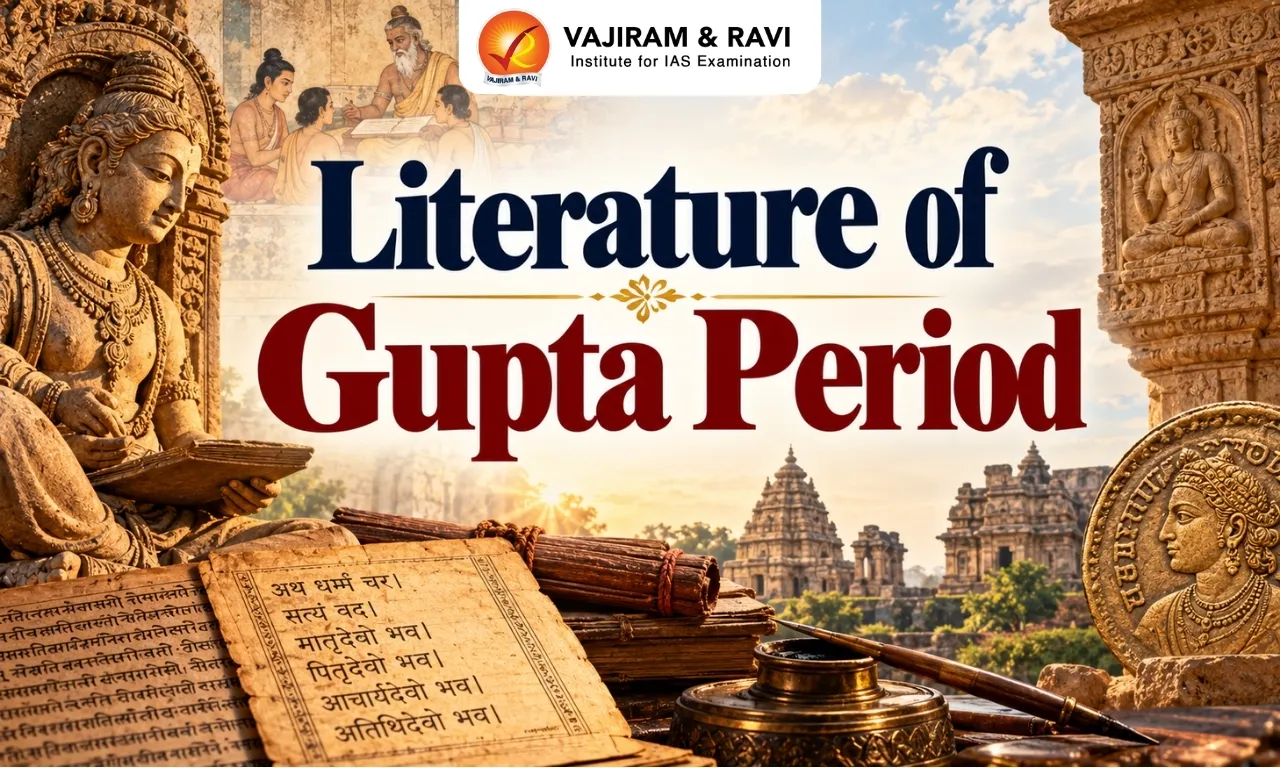
The literature of Gupta Period is celebrated as the Golden Age of Indian literature, marking a time of remarkable cultural and intellectual progress. Under the patronage of enlightened rulers like Chandragupta II and Kumaragupta, Sanskrit literature reached its classical perfection, giving rise to timeless works of poetry, drama, and philosophy.
Eminent scholars such as Kalidasa, Vishakhadatta, and Bhasa enriched Sanskrit with their literary brilliance, while religious texts like the Puranas, Smritis, and refined versions of the Ramayana and Mahabharata deepened India’s spiritual heritage. Alongside this literary flowering, scientific scholars like Aryabhata and Varahamihira advanced knowledge in astronomy and mathematics, making the Gupta era a true milestone in India’s intellectual and literary history.
Literature of Gupta Period Features
The Gupta period is widely considered a golden age in literature due to the significant advancements in Sanskrit literature, which reached a cultural zenith with the flourishing of poetry, drama, and religious texts.
- Flourishing of Sanskrit Literature: The Gupta Dynasty witnessed a remarkable growth of Sanskrit literature. Literary luminaries like Kalidasa, the renowned poet and playwright, produced works of great beauty and sophistication.
- Religious Literature Expanded: The Gupta period also saw the composition and compilation of important literature belonging to various religions.
- Hindu epics such as "Ramayana" and "Mahabharata" were refined and expanded, becoming the seminal texts of Hindu mythology.
- The Puranas, a significant genre of religious literature, were also compiled and developed during this period.
- Buddhist and Jain texts were also expanded during this time.
- Support from the Gupta Empire: The Gupta rulers provided generous patronage to scholars, artists, and intellectuals.
- They supported their work, offered them financial incentives, and provided them with resources and platforms to showcase their talents.
- Such royal patronage created an atmosphere that encouraged creativity and nurtured intellectual endeavors.
- Kings like Chandragupta II and Kumaragupta patronised scholars.
- Education and Universities: The Gupta Empire established renowned learning centres, such as the famous Nalanda and Taxila universities.
- These centers drew scholars and students from all over the Indian subcontinent and distant regions, promoting the exchange of knowledge and ideas.
- Scientific and Technical Writings: The Gupta era also saw a large body of literature dedicated to scientific expediency. Aryabhata and Varahamihira made immense contributions to it.
- Compilation of Epics and Puranas: The great Hindu epics, the Ramayana and the Mahabharata, reached their final, codified forms during this time. The 18 main Puranas (such as the Vishnu Purana and Matsya Purana) were also compiled to preserve myth, genealogy, and religious rituals.
- Rise of Secular and Scientific Literature: Literature expanded beyond religion into grammar (Amarakosha by Amarasimha), statecraft and political drama (Visakhadatta's Mudrarakshasa), love and sociology (Vatsyayana's Kamasutra), and monumental scientific-astronomical texts (Aryabhatta and Varahamihira).
- Bilingual or Multilingual Characters: In dramatic works, speech was divided by social class—royal and upper-class characters spoke Sanskrit, while women, commoners, and lower classes (shudras) spoke Prakrit.
Sanskrit Literature of Gupta Period
Sanskrit literature attained its highest stage of growth and refinement during the Gupta period. The evolution of the Sanskrit language and literature over several centuries and the sincere patronage of the kings led to a rise in the classical level of the Sanskrit language and literature during the Gupta period.
Kalidasa
He was a classical Sanskrit writer. He is considered the greatest poet and dramatist of the Gupta literature. He was a court poet in Chandragupta II's court. His six major works are:
- Abhijnana Shankutalam: A drama composed around the 5th century CE that is generally considered to be the greatest Indian literary work of any period.
- Drawn from ancient legend, the story narrates how King Dushyanta is enchanted by the nymph Shakuntala, later denies her and their son, but is ultimately reunited with them in heaven.
- Vikramorvasiyam: A drama based on the Vedic love story of King Pururavas and celestial nymph Urvashi.
- Malavikagnimitra: It's a five-act Sanskrit drama.
- It revolves around King Agnimitra’s efforts and schemes to win the love of Malavika, a talented dancer he deeply admires.
- Raghuvamsha: Raghuvamsha is a significant Sanskrit epic poem by Kalidasa that details the lineage of the Raghu dynasty, highlighting the qualities of ideal kings and their responsibilities.
- Raghuvamsha is renowned for its vivid descriptions and engaging sub-stories, which lend the poem an episodic and dynamic quality.
- Kumarasambhava: It is an epic poem that tells the story of the courtship of Lord Shiva and Parvati, their marriage, and the birth of their son, Kumara (also known as Kartikeya).
- Meghadutam (The Cloud Messenger): It is a masterpiece of Sanskrit literature that intertwines themes of love, separation, and nature’s transcendent power.
- This poignant tale follows a Yaksha, a celestial being exiled by the god Kubera, who entrusts a passing raincloud with a message for his beloved, who waits for him on Mount Kailasa.
Vishakhadatta
Vishakhadatta wrote political and historical plays. His famous play was ‘Mudrarakshasa’, which literally means “Ring of the Demon”. It's a play about Chandragupta Maurya and Chanakya’s diplomacy. Mudrarakshasa illustrates the astute political tactics employed to outwit and overcome opponents. It also deals with the ascent of Chandragupta Maurya to the throne.
Bhasa
An earlier dramatist, but his works were performed and influential during the Gupta period.
- His major work includes Swapnavasavadattam ("The Dream of Vasavadatta").
- A love story set in a royal background.
- Bhasa’s works inspired later Sanskrit dramatists, including Kalidasa.
Amarasimha (Lexicography)
Amarasimha is recognised in Vyakarana as an influential figure in literature of Gupta period, notable not only for his contributions as a lexicographer but also as a highly regarded grammarian.
- Amarasimha is renowned for his celebrated work Amarakosha, an ancient and comprehensive thesaurus of Sanskrit vocabulary.
- This thesaurus continues to be a priceless reference for Sanskrit scholars and learners, reflecting the linguistic depth and elegance of the Gupta era.
- Amarasimha’s meticulous compilation highlights the linguistic richness of his time and his commitment to preserving the language for future generations.
- He is one of Chandragupta II’s Nine Gems.


Religious Literature of the Gupta Period
The philosophical and religious developments of the Gupta Era had a lasting influence on Indian culture and beyond. The period witnessed the consolidation of Hindu traditions, the continued growth of Buddhism, and the flourishing of Jainism, each contributing to the rich tapestry of Indian philosophical and spiritual thought.
- Hindu Texts: Bhagavata Purana, Vishnu Purana, Shiva Purana, etc., were written and expanded.
- Smritis: Laws of Manu, Yajnavalkya Smriti, etc., were compiled.
- The Narada Smriti was also compiled in this period.
- Buddhist Texts: Among Buddhist texts, the most important were the Jataka Tales, which were compiled in Sanskrit. Buddhist scholars like Asanga and Vasubandhu also wrote Yogachara philosophy books.
- Example: Vasubandhu’s “Abhidharma-kosha” is an important Buddhist text.
- Jain Literature: Jain scholars wrote commentaries on Agamas (Jain scriptures) in the Gupta period. Prakrit and Sanskrit Jain texts were also written in this period.
- Example: Umaswati’s “Tattvartha Sutra” is an important Jain text from this period.
Scientific Literature of the Gupta Period
The Gupta Era’s advancements in science and mathematics had a profound and lasting impact on both Indian and global intellectual traditions.
Aryabhata (Mathematics & Astronomy)
Aryabhata was the earliest among the prominent mathematicians and astronomers of the classical period of Indian science.
- Aryabhatiya: It is a detailed text on mathematics and astronomy.
- It elaborated on concepts such as zero, pi (π), trigonometry, the Earth’s circumference, eclipses, and the motion of planets.
- Khagol-shastra: The part of the Aryabhatiya that deals with astronomy is known as the Khagol-shastra. Khagol was the famous astronomical observatory at Nalanda, where Aryabhatta studied.
- Arya Siddhanta: It focuses on astronomical calculations and provides detailed descriptions of various astronomical instruments, such as
- The gnomon (shanku-yantra)
- A shadow instrument (chhaya-yantra)
- Semicircular and circular angle-measuring devices (dhanur-yantra/chakra-yantra)
- A cylindrical stick called the yastiyantra
- An umbrella-shaped device (chhatra-yantra)
- Bow-shaped as well as cylindrical water clocks.
Varahamihira (Astronomy & Astrology)
Varahamihira, a distinguished astronomer, mathematician, and scholar of the Gupta period literature, is celebrated for his remarkable contributions to astronomy and astrology. His major works include
- Brihat Jataka: It is especially distinguished for its focus on horoscopy, which examines the positions of celestial bodies at the moment of a person’s birth.
- Brihat Samhita: A detailed book on astronomy, astrology, weather, and geography.
- Panchasiddhantika: The text serves as a treatise on mathematical astronomy, summarising five earlier astronomical works: the Surya Siddhanta, Romaka Siddhanta, Paulisa Siddhanta, Vasishtha Siddhanta, and Paitamaha Siddhanta.
- Frequently cited in disciplines like Vastushastra and Ayurveda, Varahamihira also enriched ritual traditions and literary expression through his use of refined poetic meters.
- Varahamihira’s legacy includes the systematic classification of ascetics within the field of astrology. He also made notable advancements in the methods of astronomical calculation.
Literature of Gupta Period Significance
The Gupta period marked an important stage in the growth of Indian literary and intellectual traditions, particularly through the expansion of Sanskrit poetry, drama, religious texts, and scientific works.
- Sanskrit Literature: A remarkable growth of Sanskrit poetry, drama, and scholarly writing, giving the language a lasting place in India’s classical literary tradition.
- Literary Excellence: Kalidasa’s works such as Abhijnanashakuntalam and Meghaduta reflected refined poetry, imagination, and a deep engagement with nature and human emotions.
- Religious Traditions: The Puranas and Smritis helped preserve religious ideas, myths, rituals, and social norms, shaping the development of later Hindu traditions.
- Scientific Knowledge: Texts such as Aryabhata’s Aryabhatiya strengthened India’s contributions to mathematics and astronomy, including the study of planetary movements.
- Cultural Continuity: Gupta-era literary traditions influenced later Indian languages, literature, theatre, art and performing traditions, leaving a lasting cultural legacy.
Literature of Gupta Period UPSC PYQs
Q1: With reference to the scholars/litterateurs of ancient India, consider the following statements: (UPSC Prelims 2020)
- Panini is associated with Pushyamitra
- Amarasimha is associated with Harshavardhana
- Kalidasa is associated with Chandra Gupta II
Which of the statements given above is/are correct?
(a) 1 and 2 only
(b) 2 and 3 only
(c) 3 only
(d) 1, 2 and 3
Ans: (c)

 Last updated on Oct, 2026
→ UPSC 2027 Notification will be released on 13 January 2027 at upsconline.nic.in.
→ Check Nobel Prize 2026 Winners List here.
→ Download PIB PRiSM Monthly Magazine 2026 here.
→ Check UPSC Monthly Current Affairs Magazine The Recitals here.
→ Check out the latest UPSC Syllabus here.
→ Download UPSC Model Answers for Mains 2026
→ UPSC Mains Question Paper 2026 is out now for Essay & GS Paper 1, 2, 3 & 4.
→ UPSC Calendar 2027 has been released.
→ Enroll in Vajiram & Ravi’s UPSC Mains Test Series 2027 for structured answer writing practice, expert evaluation, and exam-oriented feedback.
→ Join Vajiram & Ravi’s UPSC Mentorship Program 2027 for personalized guidance, strategy planning, and one-to-one support from experienced mentors.
→ Go through the UPSC Mains Previous Year Papers to enhance your preparation.
→ UPSC has released UPSC Toppers List 2025 with the Civil Services final result on its official website.
→ Also check Best UPSC Coaching in India
Literature of Gupta Period FAQs
Q1. What are the famous literature books of the Gupta period?+
Q2. What are the literary sources of the Gupta period?+
Q3. Who are two famous literary figures from the Gupta period?+
Q4. Who was the most famous writer of the Gupta period?+
Q5. What are some good books about the Gupta period?+
Tags: literature of gupta period quest UPSC Art and Culture Notes