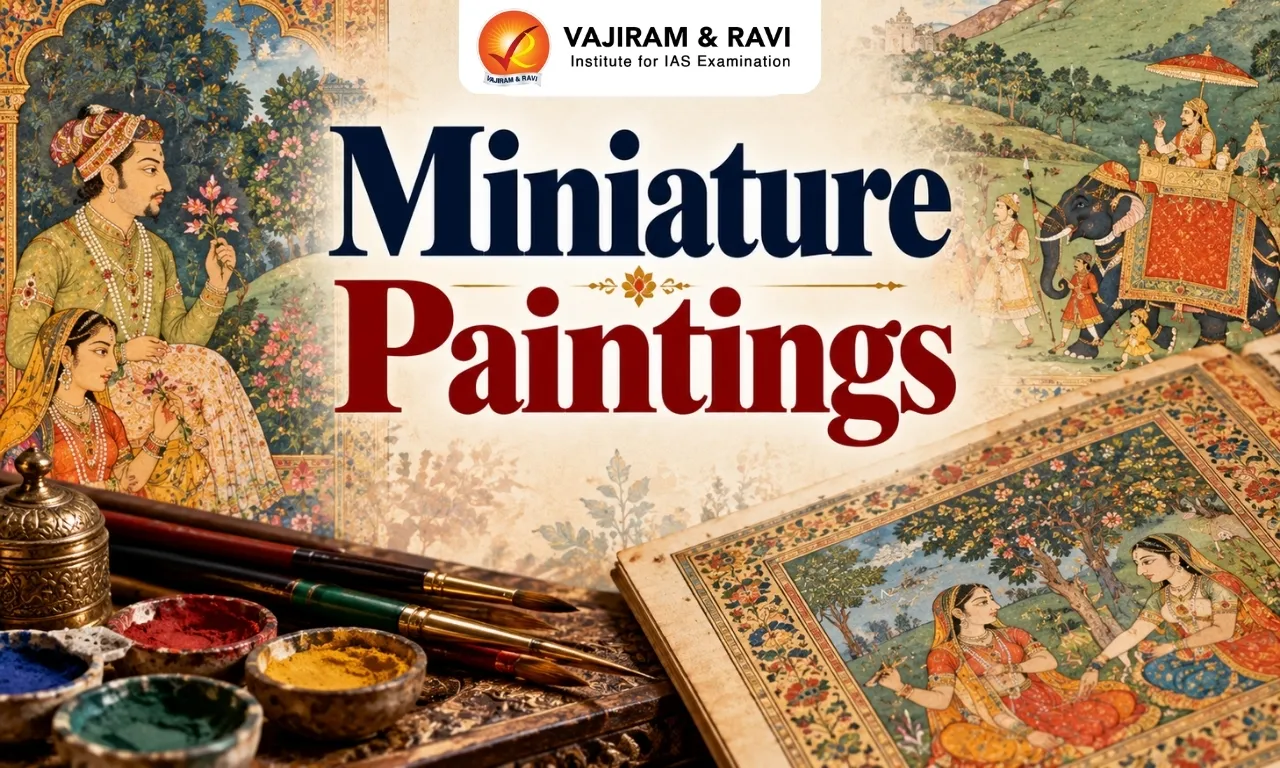
Miniature paintings are finely detailed paintings usually created on a small scale for illustrated manuscripts, albums, or individual viewing. Indian miniature paintings depict religious narratives, royal portraits, court ceremonies, wildlife, music, poetry, and everyday life. Their intricate brushwork and carefully arranged compositions were generally intended for close observation rather than display on large walls.
The evolution of miniature paintings in India reflects exchanges between indigenous traditions, Persian manuscript illustration, royal patronage, and regional cultural practices. Early Buddhist and Jain manuscripts were followed by Sultanate, Mughal, Rajasthani, and Pahari traditions, each developing distinctive subjects and visual styles.
Miniature Paintings of India
Indian miniature paintings form a diverse artistic tradition rather than a single uniform style. Their appearance varies according to the region, period, patron, materials, and purpose of production.
- The first known instances of miniature painting in India are found in the illustrations of Buddhist Literature produced by the Palas in the eastern part of India and Jain texts produced in the western part of India in the eleventh and twelfth centuries A.D.
- During the medieval period, Persian artistic influences contributed to the development of new styles, particularly under the Delhi Sultanate and the Mughal Empire.
- Later, miniature painting flourished in regional courts across Rajasthan, the Himalayan foothills and the Deccan.
- South Indian traditions, including Mysore and Tanjore painting, also developed distinctive approaches to religious and courtly art, although they are not always classified as miniature painting in the narrow technical sense.
Miniature Paintings Features
Indian miniature paintings possess several distinctive characteristics that differentiate them from large-scale murals and other painting traditions.
- Size and Scale: Traditionally small (typically no larger than 25 square inches), used as manuscript illustrations or bound in royal albums.
- Finely Detailed Brushwork: Razor-thin lines and minute patterns are painted using specialist brushes made of squirrel or kitten hair, sometimes with a single bristle.
- Natural Pigments: Colours are handmade using minerals, plant extracts, conch shells, lapis lazuli, cinnabar, and pure gold or silver leaf.
- The introduction of the use of ultramarine blue and gold colour in the Western Indian manuscripts is also believed to be due to the influence of Persian painting.
- Facial Profiles: Human figures are typically depicted in a side profile (three-quarters or profile view), with prominent eyes (almond-shaped, bulging, or fish-shaped) and sharp, pointed noses.
- Themes: Many miniature paintings illustrate religious texts and mythological narratives. Common subjects include:
- Episodes from the Ramayana and Mahabharata.
- Stories of Lord Krishna and Radha.
- Buddhist religious narratives.
- Jain teachings and the lives of Tirthankaras.
Miniature Painting Techniques
Artists traditionally painted on palm leaves, handmade paper and other prepared surfaces. Natural pigments derived from minerals, plants and other sources were used to create colours. The process involved preparing the surface, sketching the composition, outlining figures and applying colours in thin layers. Fine brushes made from animal hair helped artists depict facial expressions, jewellery, textiles and landscapes precisely. Gold and silver were sometimes used for decoration. Burnishing techniques provided a smooth finish. These methods varied across the Mughal, Rajput, Pahari and other regional schools.


Miniature Painting Schools
The Miniature painting tradition has been a key form of Indian painting apart from murals, cloth paintings, and paintings on wood. Among miniature paintings, the main schools have been the Deccani, Mughal, Rajasthani, and Pahari. The major traditions discussed in Indian art history include:
| Painting tradition | Principal region | Distinctive identity |
|
Pala |
Bihar and Bengal |
Buddhist manuscript illustrations with flowing lines |
|
Western Indian or Apabhramsa |
Gujarat, Rajasthan, and adjoining areas |
Jain manuscripts, angular figures, and prominent eyes |
|
Sultanate |
Delhi and regional Sultanate centres |
Interaction between Persian and Indian manuscript traditions |
|
Mughal |
Imperial and provincial courts |
Portraiture, historical narratives, and naturalistic observation |
|
Rajasthani |
Rajput courts of Rajasthan |
Devotional, literary, musical, and courtly subjects |
|
Pahari |
Western Himalayan hill kingdoms |
Devotional imagery, expressive figures, and varied regional styles |
Early Miniature Paintings
Early surviving Indian miniature paintings are closely associated with illustrated manuscripts. Their format often depended on the shape of the writing material: long, narrow palm leaves left limited space for illustrations alongside the text.
Eastern Indian Buddhist manuscripts and western Indian Jain manuscripts provide important evidence of these early traditions. They also demonstrate that manuscript painting existed before the establishment of the Mughal imperial workshop.
Pala School of Painting
The Pala School developed in eastern India under the patronage of the Pala rulers, particularly between the eighth and twelfth centuries CE. Its artistic centres were associated with present-day Bihar and Bengal. The school is closely connected with Buddhist monasteries and centres of learning such as Nalanda and Vikramashila. Major features of the Pala School:
- Buddhist religious themes and narratives.
- Illustrations on palm-leaf manuscripts.
- Depictions of the Buddha, Bodhisattvas and Buddhist deities.
- Graceful figures and carefully drawn outlines.
- Use of rich colours and decorative elements.
- Influence on manuscript painting traditions in neighbouring regions.
Apabhramsa School of Painting
The Apabhramsa School, often discussed alongside the Western Indian School, developed in western India and is particularly associated with Jain manuscript illustration. It flourished during the medieval period, especially in regions corresponding to present-day Gujarat and Rajasthan. Major features of the Apabhramsa School:
- Strong association with Jain religious texts.
- Illustrations of the Kalpasutra and Kalakacharya Katha.
- Use of palm leaves in earlier examples and paper in later manuscripts.
- Bold colours, especially red, yellow and blue.
- Stylised human figures and angular facial features.
- Large, prominent eyes and distinctive facial profiles.
- Decorative borders and carefully arranged text.
Delhi Sultanate Miniature Paintings
Miniature paintings during the Delhi Sultanate period developed through interactions between Persian manuscript traditions and existing Indian painting practices. Production took place not only in Delhi but also in regional Sultanate courts.
- An important example is the Nimatnama, or “Book of Delicacies,” associated with the rulers of Mandu in Malwa around 1500.
- The Nimatnama belongs to the regional Malwa Sultanate tradition rather than the Delhi court itself. It illustrates the broader artistic exchanges taking place during the Sultanate era.
Mughal Miniature Paintings
The Mughal painting style evolved as a result of a synthesis of the indigenous Indian style of painting and the Safavid school of Persian painting. It is marked by supple naturalism based on close observation of nature and fine and delicate drawing.
- Akbar: The Mughal School of painting originated in the reign of Akbar in 1560 A.D. Abdul Faza, in the Ain-i-Akbari, has written about the love of Akbar for painting.
- Famous illustrated manuscripts: Akbarnama, the Razmnama, and Anwar-i-suhayli, a book of fables.
- Jahangir School: He patronised Farrukh Beg from Central Asia and improvised the portrait style in Mughal painting. Ustad Mansur was the court painter of Jahangir. A floral border around the paintings has become the main feature of this time.
- Shahjahan School: The painters continued the previous tradition of doing portraits of noblemen, preparing portfolios, and illustrating books. But the colours became more decorative, gold was more frequently used, and showiness replaced feeling in painting.
- Decline of art: In the time of the last Emperor Aurangzeb, the artistic scene disintegrated due to the discontinuation of patronage. After the fall of Mughal rule, painting as art lost its place.
Deccan Miniature Paintings
The Deccan region initially saw the development of its own distinctive painting style, evolving independently from the Mughal tradition. However, later in the 17th and 18th centuries, it was increasingly influenced by the Mughal style. Early paintings from the Deccan are influenced by Ellora murals, Mewar, and Malwa miniature styles.
- Ahmednagar painting: The colours used in the painting are rich and brilliant. The Persian influence can be seen in the high horizon, gold sky, and the landscape.
- Example: ‘Tarif-in-Hussain Shahi manuscript ', portraits of Burhan Nizam Shah II of Ahmednagar.
- Bijapur: In Bijapur, painting flourished under Ali Adil Shah I and Ibrahim II, blending Deccani elements like rich colors, palm trees, and figures with Persian influences such as gold, floral motifs, and arabesques.
- Example: Ragamala paintings, Najum-al-ulum (Stars of Sciences) miniature manuscript.
- Golconda: The earliest paintings identified as Golconda work were painted in the period of Muhammad Quli Qutb Shah (1580-1611). They show dancing girls entertaining the company.
- Gold colour has been lavishly used in painting the architecture, costume, jewellery, and vessels, etc.
- Hyderabad: Painting in Hyderabad started with the foundation of the Asafjahi dynasty in 1724 A.D. Distinctive features are observed in the treatment of the ethnic types, costumes, jewellery, flora, fauna, landscape, and rich colours.
Rajasthani Miniature Paintings
The Rajput paintings flourished from the 15th to 19th centuries, particularly in and around Rajasthan, where various princely states patronised the art. Early paintings come from Malwa, Jaunpur, and Mewar.
- Mewar Kalam: The paintings were influenced by the Mughal school, with themes taken from Hindu epics and texts; the use of dark colours is the striking feature.
- Bundi Kalam: The Hindu and Mughal elements are beautifully blended, featuring Vivid colours and extensive use of gold.
- Kotah Kalam: These paintings show strong Mughal influence, focusing on princess portraits and detailed hunting scenes.
- Bikaner Kalam: Bikaner rulers patronised Mughal painters, featuring pictures of Bikaner court scenes, portraits, and some social events.
- Other schools include Jodhpur Kalam, known for its Direct colours and heroic expression; Kishangarh Kalam, famous for devotional Radha-Krishna themes by Nihal Chand; and Jaipur Kalam artists followed the Mughal style but painted the story of Radha Krishna.
Pahari Miniature Paintings
The Pahari School developed in the Himalayan foothills, particularly in present-day Himachal Pradesh and adjoining regions. It flourished mainly between the seventeenth and nineteenth centuries under the patronage of local rulers. The Pahari tradition includes several regional styles, of which Basholi and Kangra are particularly prominent. Other centres included Guler, Chamba, Mandi, Kullu and Jammu. These paintings are influenced by the Mughal school of painting, but they are different from Mughal painting in treatment, subjects, and colour sense, and are directly linked to the folk base.
- Basohli: After the decline of the Mughal Empire, the artists were given patronage in Basohli. They painted themes based on the books, such as Rasamanjari, Gitagovinda, and Bhagavata Purana, and mainly on the Krishna theme and the portraits of the local kings.
- Guler: Under Raja Dalip Singh of Guler, a style similar to that of Basohli emerged. The dominant feature is that the painting is poetry in colour, with themes based on Krishna, Ragamala, Nayika, and Baramasa paintings.
- Kangra: Flourished under Raja Sansar Chand, with paintings focused on Krishna lila and Radha-Krishna love themes, marked by detailed landscapes and symbolic use of colour.
- Jammu: Under Raja Balwant Singh, the famous painter Nainsukh created great pictures. The drawings of Jammu School are more sensitive; dark colours are used sensibly, and the local atmosphere dominates in this mature style.
- Chamba: The early panels of the doors and paintings have a strong influence of Basohli. But later on this basis, the Chamba painters adopted the treatment of wall paintings in miniatures.
- Tehri Garhwal: The paintings are mostly of the Krishna legend and the Ramayana, retaining the grace of Ouler and the richness of Kangra.
Famous Miniature Paintings of India
Miniature paintings of India are renowned for their intricate details, vibrant colours and artistic excellence. They depict religious stories, royal life, nature and historical events. Famous miniature paintings include the following:
- Bani Thani: A celebrated painting of the Kishangarh School, created by artist Nihal Chand.
- Hamzanama: An illustrated manuscript commissioned by Mughal Emperor Akbar.
- Akbarnama: Depicts the life and achievements of Emperor Akbar.
- Radha and Krishna: Popular devotional themes in the Kangra and other Pahari schools.
- Ragamala Paintings: Illustrate musical modes through artistic compositions.
- Kalpasutra Illustrations: Famous Jain manuscript paintings associated with the Western Indian School.
- Baburnama Illustrations: Depict historical events, plants and animals.
Miniature Paintings Significance
Miniature painting holds deep cultural, historical, and artistic significance across different regions. Its intricate details, vibrant colours, and storytelling make it a unique and meaningful art form.
- Historical Documentation: Many miniature paintings depict historical events and life at the royal court, offering visual insights into the customs, architecture, and social practices of their era.
- Cultural Preservation: Miniature paintings reflect the values, traditions, and lifestyles of different civilizations, thus preserving the cultural heritage of regions like Rajasthan.
- Symbolism and Storytelling: These paintings depict stories from texts like the Ramayana, Mahabharata, and Persian epics, thus conveying moral and philosophical ideas.
- Contemporary Relevance: Miniature painting continues to influence modern artists, with museums and exhibitions preserving and promoting it as a timeless art form.
Miniature Paintings UPSC PYQs
Q1: The well-known painting "Bani Thani" belongs to the (UPSC Prelims 2018)
(a) Bundi school
(b) Jaipur school
(c) Kangra school
(d) Kishangarh school
Ans: (d)

 Last updated on Oct, 2026
→ UPSC 2027 Notification will be released on 13 January 2027 at upsconline.nic.in.
→ Check Nobel Prize 2026 Winners List here.
→ Download PIB PRiSM Monthly Magazine 2026 here.
→ Check UPSC Monthly Current Affairs Magazine The Recitals here.
→ Check out the latest UPSC Syllabus here.
→ Download UPSC Model Answers for Mains 2026
→ UPSC Mains Question Paper 2026 is out now for Essay & GS Paper 1, 2, 3 & 4.
→ UPSC Calendar 2027 has been released.
→ Enroll in Vajiram & Ravi’s UPSC Mains Test Series 2027 for structured answer writing practice, expert evaluation, and exam-oriented feedback.
→ Join Vajiram & Ravi’s UPSC Mentorship Program 2027 for personalized guidance, strategy planning, and one-to-one support from experienced mentors.
→ Go through the UPSC Mains Previous Year Papers to enhance your preparation.
→ UPSC has released UPSC Toppers List 2025 with the Civil Services final result on its official website.
→ Also check Best UPSC Coaching in India
Miniature Paintings FAQs
Q1. What is a miniature painting?+
Q2. Which state is famous for miniature paintings?+
Q3. What are miniature paintings? +
Q4. Who introduced miniature paintings in India?+
Q5. How difficult is miniature painting?+
Tags: miniature paintings quest UPSC Art and Culture Notes