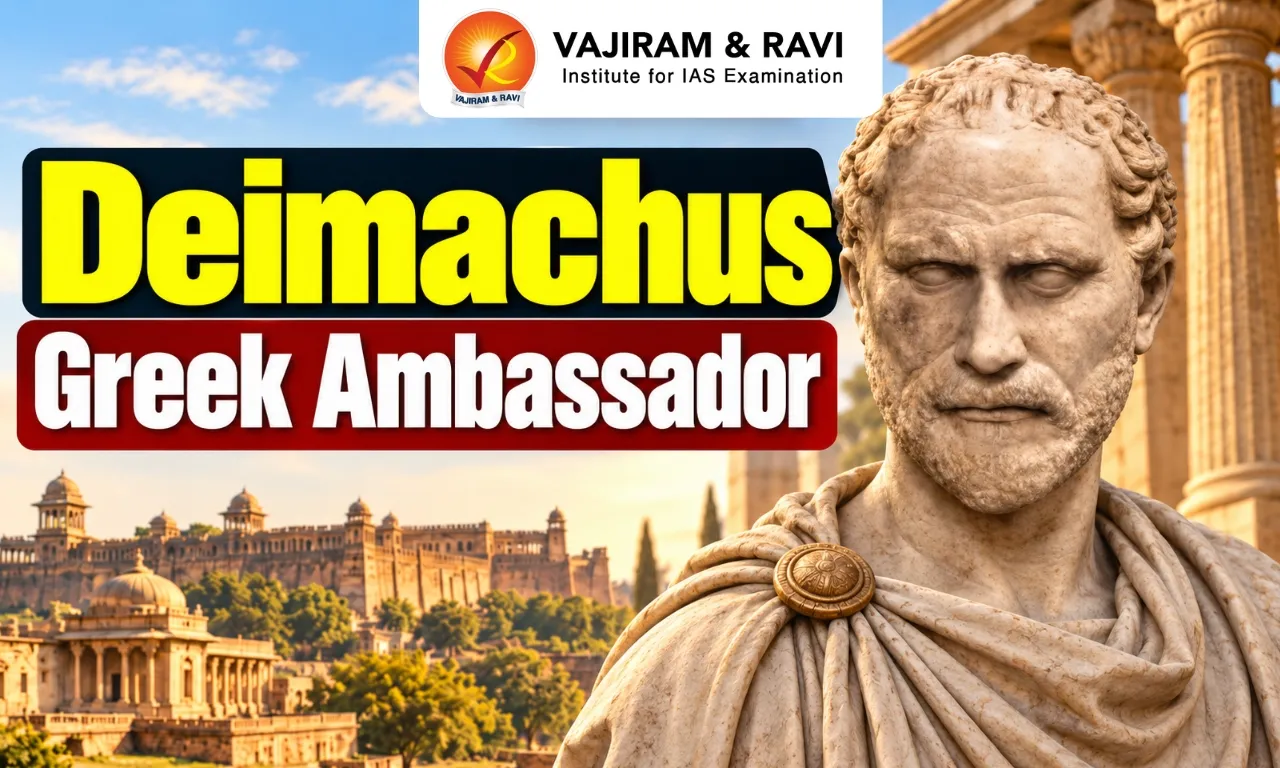
Deimachus was a 3rd-century BCE Greek envoy of the Seleucid Empire who served at the court of Bindusara in Pataliputra. Sent by Antiochus I Soter, he succeeded Megasthenes and contributed to Greek knowledge of Mauryan India, particularly its geography, extent and distances.
Although his original writings are lost, later writers such as Strabo preserved references to his observations. His geographical estimates and descriptions were criticised for inaccuracies and exaggerations, including accounts of mythical peoples and creatures. Nevertheless, Deimachus remains significant for understanding Mauryan-Seleucid relations, Greek geographical ideas about India, and the need to critically assess foreign accounts of ancient India.
Deimachus Greek Ambassador
Daimachus was one of the foreign travellers who visited India in the 3rd century BCE. He was a Greek ambassador associated with the Seleucid Empire, known for his mission to the Mauryan court at Pataliputra during Bindusara’s reign. His lost writings are known through references in later Greek authors, particularly Strabo.
- Diplomatic Role: Deimachus was ambassador of Antiochus I Soter, the Seleucid ruler. Deimachus came to India during the reign of Bindusara.
- Literary Contribution: He reportedly wrote an account of India. References to his work concern India’s geography, extent, distances, and astronomical position. His original writings are lost; information about him survives mainly through later Greek writers, especially Strabo.
Deimachus and Bindusara
Daimachus served as ambassador to Bindusara, the Mauryan Empire ruler and son of Chandragupta Maurya. His mission reflects continued diplomatic contacts between the Mauryan and Seleucid Empires during the 3rd century BCE.
- Diplomatic Mission: According to Strabo, Antiochus I Soter sent Deimachus to Bindusara’s court at Pataliputra.
- Earlier Embassy: Deimachus followed Megasthenes, who had served as ambassador to Chandragupta Maurya on behalf of Seleucus I Nicator.
- Request for Greek Goods: According to a story preserved by Athenaeus and attributed to Hegesander, Bindusara requested sweet wine, dried figs and a Greek sophist from Antiochus. Antiochus reportedly agreed to send the wine and figs but declined to supply the sophist, citing Greek law.
- Another Greek Embassy: Pliny also mentions Dionysius, whom Ptolemy II Philadelphus sent to India, although the passage does not identify the Indian king who received him.


Deimachus as a Source on India
He contributed to ancient Greek geographical knowledge of India, particularly its extent, distances, and geographical position. His original writings are lost, and his observations survive mainly through Strabo’s Geography.
- Geographical Estimates: Strabo discusses Daimachus's calculations concerning India’s size and geographical position.
- Distance to Bactria and Sogdiana: According to Strabo, Daimachus estimated the distance from India's southern extremity to the region of the Bactrians and Sogdians at approximately 30,000 stadia.
- Distance to the Caucasus: Strabo reports that Megasthenes and Deimachus proposed large estimates for the distance from the Southern Sea towards the Caucasus, with Deimachus giving figures exceeding 30,000 stadia in some places.
- Geographical Limitations: Strabo criticised these estimates because they implied that Bactria and neighbouring regions lay beyond the habitable and temperate zone.
- Historical Value: His estimates reflect Greek attempts to map India and understand its relationship with neighbouring regions, although their accuracy remains questionable.
Deimachus Strabo's Criticism
Strabo, the Greek geographer, questioned Deimachus’ reliability, particularly his geographical calculations and astronomical observations. He also criticised the incredible stories associated with Deimachus and Megasthenes in ancient Greek accounts of India.
- Geographical Errors: Strabo challenged Deimachus’ excessive distance estimates, arguing that they led to implausible conclusions about the location of Bactria and surrounding regions.
- Astronomical Criticism: Strabo reports Eratosthenes' criticism of Deimachus's geographical and astronomical reasoning, particularly his claims about India's position relative to the equinoxes and the tropics. The discussion also criticises Megasthenes's statements about the visibility of the Bears and the direction of shadows in India.
- Fabulous Accounts: Strabo criticises Deimachus and Megasthenes for reporting fabulous accounts of extraordinary peoples and creatures. Some stories are attributed to them collectively, while others, such as the gold-digging ants in Strabo's Book XV, are specifically attributed to Megasthenes.
- Historical Assessment: Deimachus remains useful for studying Greek perceptions of India, but his geographical claims and fabulous descriptions must be assessed critically rather than accepted as established facts.
Deimachus and Megasthenes
Both were Greek ambassadors associated with the Mauryan court who contributed to Greek knowledge of India. Their original writings are lost and survive through references in later authors, particularly Strabo.
| Basis | Megasthenes | Deimachus |
|
Greek ruler |
Seleucus I Nicator |
Antiochus I Soter |
|
Mauryan ruler |
Chandragupta Maurya |
Bindusara |
|
Role |
Greek ambassador to Chandragupta’s court |
Greek ambassador to Bindusara’s court |
|
Literary work |
Wrote Indica, known through fragments and quotations |
Reportedly wrote about India; the exact title of his work is uncertain |
|
Main contribution |
Information about Mauryan society, customs, administration and geography |
Reported geographical observations and estimates concerning India |
|
Historical sources |
Later Greek and Roman writers, including Strabo |
Later Greek and Roman writers, particularly Strabo |

 Last updated on Oct, 2026
→ UPSC 2027 Notification will be released on 13 January 2027 at upsconline.nic.in.
→ Check Nobel Prize 2026 Winners List here.
→ Download PIB PRiSM Monthly Magazine 2026 here.
→ Check UPSC Monthly Current Affairs Magazine The Recitals here.
→ Check out the latest UPSC Syllabus here.
→ Download UPSC Model Answers for Mains 2026
→ UPSC Mains Question Paper 2026 is out now for Essay & GS Paper 1, 2, 3 & 4.
→ UPSC Calendar 2027 has been released.
→ Enroll in Vajiram & Ravi’s UPSC Mains Test Series 2027 for structured answer writing practice, expert evaluation, and exam-oriented feedback.
→ Join Vajiram & Ravi’s UPSC Mentorship Program 2027 for personalized guidance, strategy planning, and one-to-one support from experienced mentors.
→ Go through the UPSC Mains Previous Year Papers to enhance your preparation.
→ UPSC has released UPSC Toppers List 2025 with the Civil Services final result on its official website.
→ Also check Best UPSC Coaching in India
Deimachus FAQs
Q1. Who sent Deimachus to India?+
Q2. Who came first, Deimachus or Megasthenes?+
Q3. How do you pronounce the name Deimachus?+
Q4. Did Chandragupta Maurya meet Seleucus?+
Q5. Who gave 500 elephants to Seleucus?+
Tags: deimachus quest upsc ancient history notes