Cyclones are rotating weather systems that form around a low-pressure centre. At the surface, air moves inward and rises, leading to the formation of clouds, strong winds, and heavy rain. The direction of rotation is anticlockwise in the Northern Hemisphere and clockwise in the Southern Hemisphere. There are two main types of cyclones: tropical, which are powered by warm ocean waters and the heat released from water vapour condensing, and temperate or extratropical, which form where air masses of different temperatures meet.
These weather systems can cause a variety of dangers, including strong winds, storm surges, coastal flooding, heavy rain, and landslides. India is particularly vulnerable to cyclones from both the Bay of Bengal and the Arabian Sea, making accurate forecasting and preparedness essential.
Cyclones Meaning
Cyclones are large-scale atmospheric systems where air circulates around a low-pressure area, converging at the surface and rising. This process often results in the formation of clouds and precipitation. Cyclones form when air flows towards a region of lower pressure, and the rotation of the Earth causes the air to spiral, creating a circular motion. Key features of cyclones include:
- Lower atmospheric pressure at the centre compared to surrounding areas.
- The pressure gradient drives air towards low pressure, while the Coriolis effect deflects the moving air and helps organise the circulation.
- Air that moves towards the low-pressure area and rises.
- Rotational movement that spins anticlockwise in the Northern Hemisphere and clockwise in the Southern Hemisphere.
- Formation of clouds and rainfall due to rising moist air cooling and condensing.
- Variable strength, ranging from weak disturbances to severe storms with high winds and heavy rain.
Fujiwara Effect
The Fujiwhara Effect occurs when two nearby tropical cyclones interact, influencing each other’s movement, direction and intensity. It was described by Japanese meteorologist Sakuhei Fujiwhara in 1921.
- Possible outcomes: The cyclones may rotate around a common centre, change tracks, move apart or, in some cases, merge. The stronger cyclone may influence or absorb the weaker one.
- The outcome (changing tracks, repelling, merging, or absorption of the weaker system by the stronger one) depends on the cyclones’ relative strength, size, distance and atmospheric conditions.
- The interaction complicates cyclone-track and landfall predictions, making timely warnings, evacuation planning and disaster preparedness more challenging.
- Example: 1964 Western Pacific (Typhoons Marie and Kathy): two typhoons interacted and eventually merged in the Western Pacific Ocean.
Cyclones Naming System
The Cyclones Naming System assigns unique names to individual tropical cyclones to make it easier to communicate warnings and avoid confusion among the public, meteorologists, and disaster management agencies.
- The World Meteorological Organisation (WMO) coordinates the global framework for tropical cyclone naming.
- Cyclone names are assigned from the pre-approved regional list. They are not chosen afresh by the country affected by each storm.
- The next listed name is used when a subsequent cyclone reaches the required naming intensity.
Cyclone Naming System in the North Indian Ocean
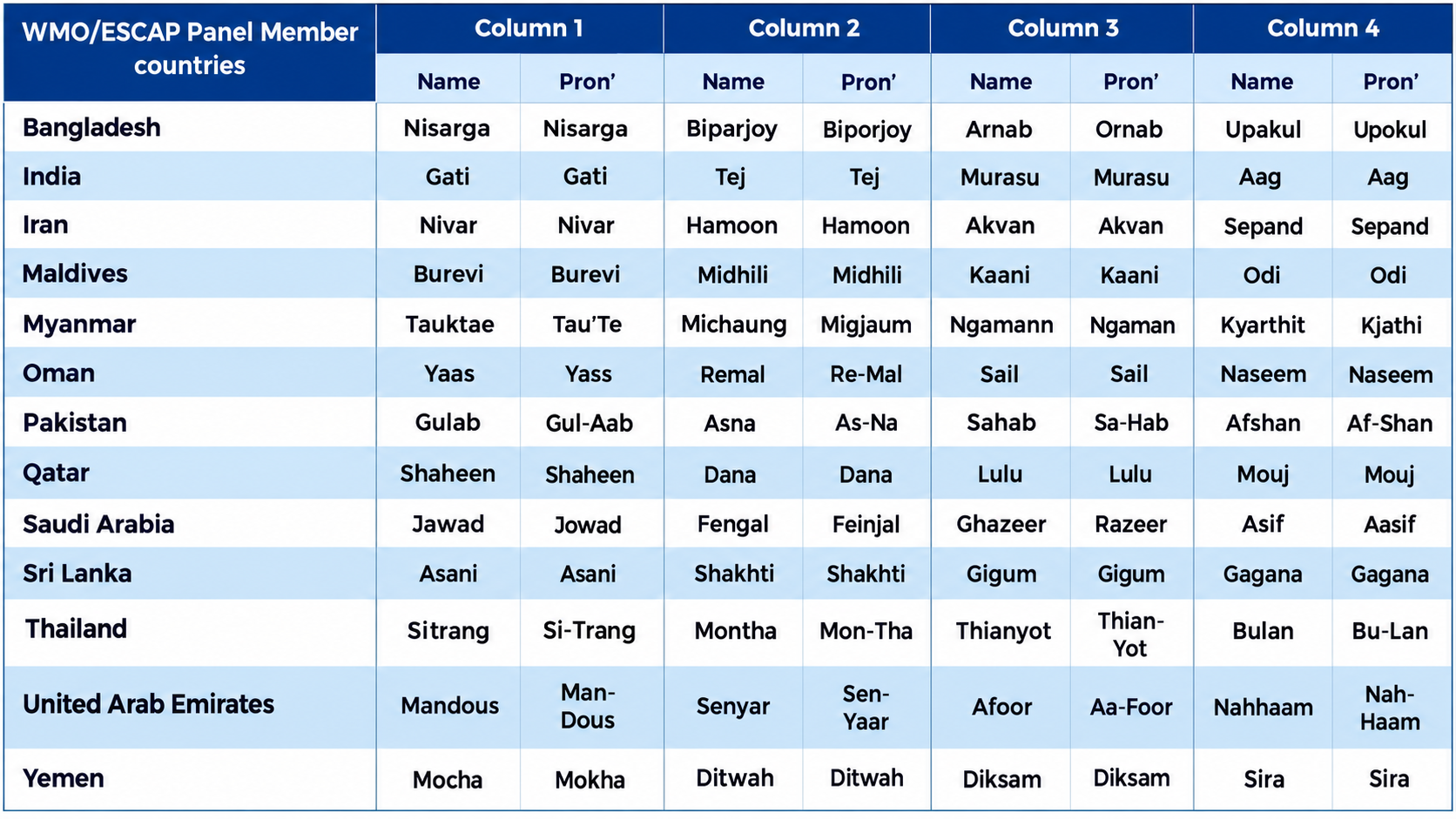
In the North Indian Ocean, the cyclone naming system is managed by the WMO/ESCAP Panel on Tropical Cyclones, covering the Bay of Bengal and the Arabian Sea. This system was introduced in September 2004.
- The WMO/ESCAP Panel on Tropical Cyclones comprises 13 member countries that contribute names to the regional list.
- The 13 members are listed alphabetically. Names are assigned sequentially, column-wise, from the approved regional list.
- The Regional Specialised Meteorological Centre (RSMC), located in New Delhi, is responsible for naming cyclones in the region when they reach the required intensity.
- Once a name has been used, it is not repeated.
- Names are selected based on criteria such as being short, easy to pronounce, culturally appropriate, distinctive, and suitable across languages.
- They should not be offensive or inappropriate.
- The purpose of naming cyclones is to provide quick warning communication, raise public awareness, differentiate simultaneous storms, and maintain records for research.
- Recent Examples: Cyclone Arnab, which affected Andhra Pradesh and Odisha.
- It was named by Bangladesh.
- The previous names were Senyar (named by the UAE) and Ditwah (named by Yemen).
- The next names in the sequence are Murasu (India) and Akvan (Iran).


Cyclones Type Based on Location
Cyclones can be broadly classified into tropical and extratropical systems, with subtropical as an intermediate category, based on where they form.
Tropical cyclones
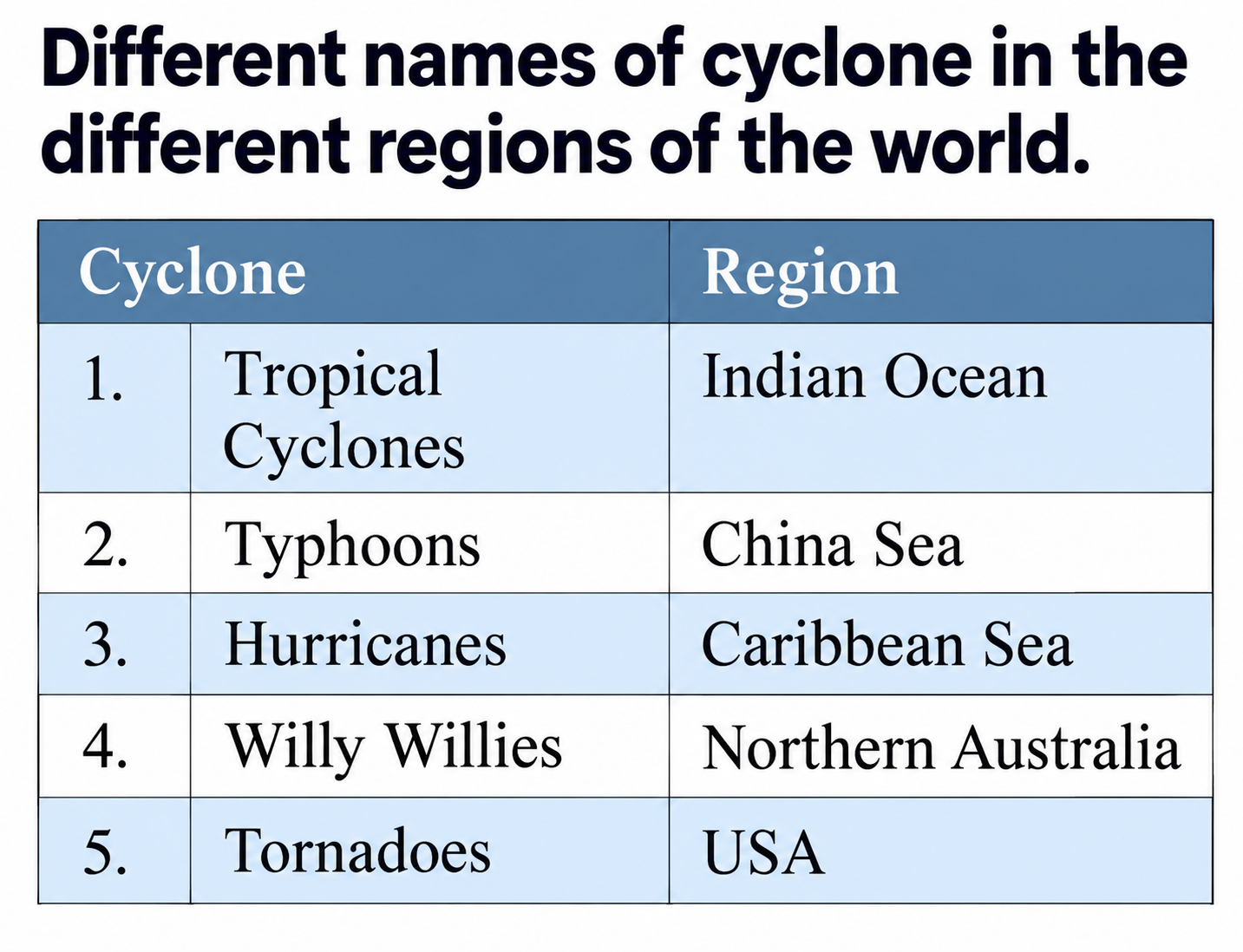
Tropical cyclones form over warm tropical or subtropical oceans. They are typically warm-core systems that derive their energy mainly from ocean heat and the latent heat released when water vapour condenses.
- Location: Typically found in warm tropical and subtropical ocean basins.
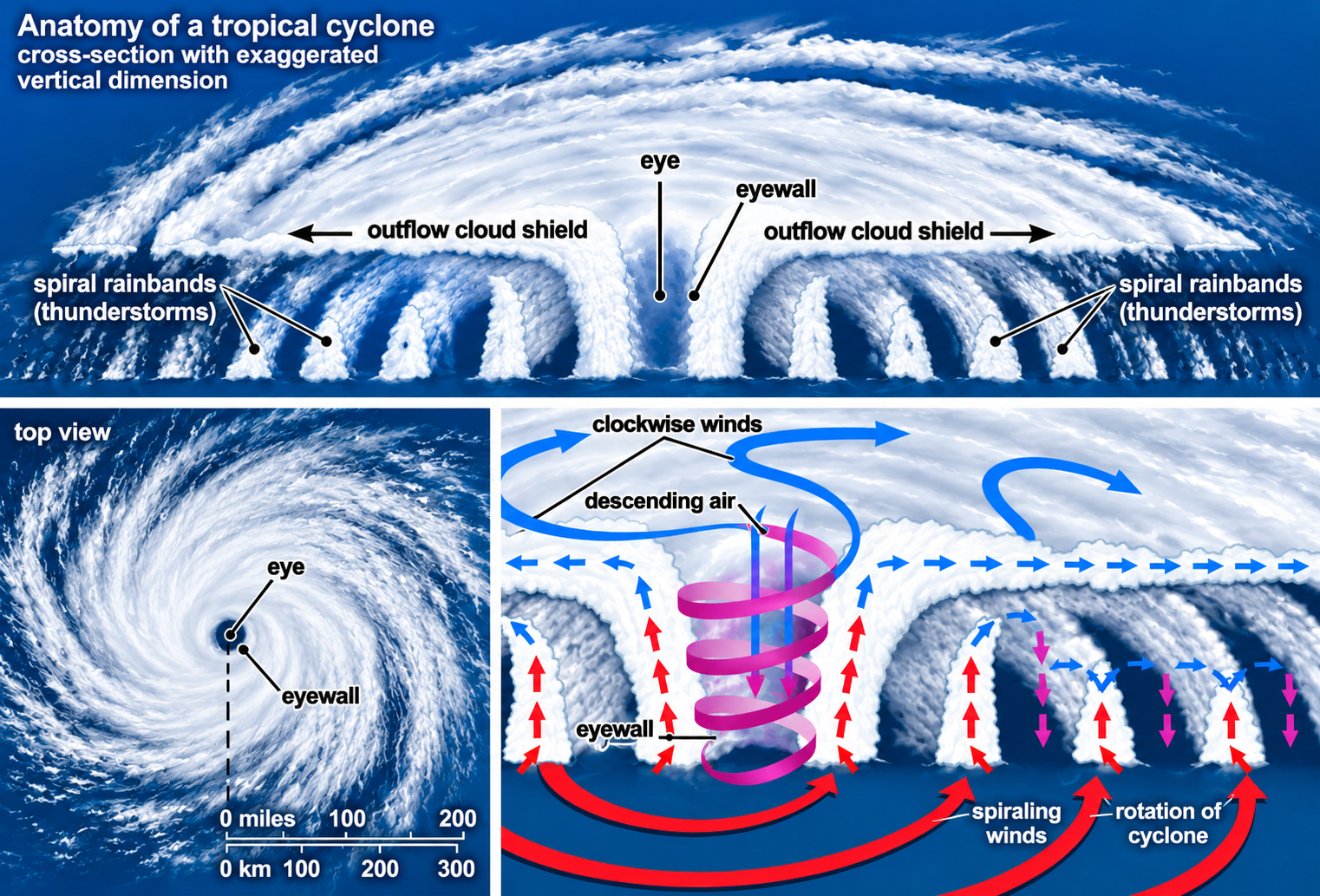
- Structure: Usually have a compact, rotating low-pressure centre. In more mature systems, an eye and eyewall may form.
- Weather: These systems bring strong winds, heavy rainfall, thunderstorms, and near-coastal storm surges that can be extremely destructive.
- Energy source: Their energy comes from the heat and moisture provided by the ocean, along with latent heat released during condensation.
Temperate or extratropical cyclone
Temperate or extratropical cyclones form mainly in the middle latitudes, where air masses with different temperatures meet. They are linked with weather fronts and get a lot of their energy from differences in temperature across horizontal areas.
- Location: They are mostly found in mid-latitudes, especially in areas where there are sharp contrasts between different types of air.
- Structure: These systems usually include both warm and cold fronts; they rarely have a well-defined eye like tropical cyclones.
- Weather: They bring cloud lines, changing wind directions, widespread rain, and weather that changes with the front.
- Movement: They are typically influenced by the main westerly winds and the broader patterns of air movement in the atmosphere.
Subtropical cyclones
Subtropical cyclones have features of both tropical and extratropical storms. They usually form over subtropical seas and can change into either tropical or extratropical systems as their structure and the surrounding weather conditions evolve.
Cyclones Type Based on Speed of the Cyclone
Cyclones are grouped into different categories depending on how fast the winds are blowing. These categories are based on the kind of damage they can cause.
| Cyclone Category | Wind Speed in km/h | Damage Capacity |
|
Low Pressure Area |
Less than 31 |
Negligible / None |
|
Depression (D) |
31-49 |
Negligible/minor localised showers |
|
Deep Depression (DD) |
50-61 |
Minor damage to loose structures, rough seas |
|
Cyclonic Storm (CS) |
62-88 |
Light to moderate damage; thatch roofs damaged, tree branches broken |
|
Severe Cyclonic Storm (SCS) |
89-117 |
Moderate to severe damage; trees uprooted, pucca structures minor damage |
|
Very Severe Cyclonic Storm (VSCS) |
118-166 |
Extensive damage; extensive roof/tree damage, disruption of power/communication |
|
Extremely Severe Cyclonic Storm (ESCS) |
167-221 |
Extensive to catastrophic damage; large structures compromised, major flooding |
|
Super Cyclonic Storm (SuCS) |
More than or equal to 222 |
Total devastation / catastrophic destruction |
 Tropical Cyclones Favourable Conditions
Tropical cyclogenesis requires a combination of warm ocean water, moisture, atmospheric instability, a pre-existing disturbance and favourable wind conditions. The major conditions for tropical cyclone formation are the following:
- Warm ocean water: Sea-surface temperatures of around 27°C or above over a sufficient depth generally provide the heat and moisture needed for development.
- High atmospheric moisture: Moist air in the lower and middle troposphere supports deep convection and reduces the disruption caused by dry-air entrainment.
- Atmospheric instability: Warm, moist air must be able to rise, cool and condense, releasing latent heat that supports further development.
- Sufficient Coriolis force: Earth's rotation helps organise the circulation. Tropical cyclones rarely form close to the equator because the Coriolis force is too weak there.
- Pre-existing low-pressure disturbance: A tropical wave or another organised disturbance supplies initial low-level convergence and cyclonic vorticity.
- Weak vertical wind shear: Limited changes in wind speed and direction with height help maintain vertically aligned convection around the developing centre.
- Upper-level outflow: Air must be able to spread outward at higher levels, helping sustain rising motion and the pressure fall near the surface.
Cyclones Formation Mechanism, or Cyclogenesis
Cyclone formation mechanism, or cyclogenesis, refers to the development and intensification of a cyclonic circulation. The process differs between tropical and temperate cyclones because their primary energy sources are different.
Tropical cyclogenesis
Tropical cyclogenesis is driven mainly by heat and moisture from warm oceans and the latent heat released as water vapour condenses. The process involves positive feedback between surface inflow, convection, latent heat release and falling central pressure. Its development can be explained in the following stages.
- Initial disturbance: A tropical wave or pre-existing low-pressure disturbance creates low-level convergence and organised atmospheric circulation.
- Warm, moist air rises: Air converges towards the disturbance and rises over the warm ocean, producing deep convective clouds and thunderstorms.
- Latent heat is released: Water vapour condenses in rising air, releasing latent heat. This warms the atmospheric core and supports further ascent.
- Central pressure falls: Continued convection and favourable upper-level outflow help remove air from above the system. The pressure gradient strengthens, accelerating near-surface winds.
- Rotation becomes organised: The Coriolis force helps organise the circulation around the low-pressure centre. Increasing convection and wind speeds allow the disturbance to intensify.
- Mature cyclones develop: In sufficiently organised and intense systems, an eye may form, surrounded by an eyewall containing the strongest winds and intense rainfall.
Temperate cyclogenesis
Temperate cyclogenesis is closely associated with the polar front, where relatively warm air and cold polar air meet. A disturbance along this boundary can develop into a wave-like low-pressure system.
- Initial disturbance: A wave develops along the boundary between contrasting air masses.
- Pressure falls: Air circulates around the developing low, and the frontal boundary becomes more organised.
- Warm and cold fronts develop: Warm air advances along the warm front, while colder air pushes forward along the cold front.
- Cyclone intensifies: Rising air, frontal uplift and the temperature contrast between air masses produce widespread cloud, precipitation and changing weather.
- Occlusion and weakening: The faster-moving cold front may overtake the warm front, lifting the warm sector from the surface. As the system loses access to its strongest temperature contrast, it generally weakens.
Reasons for More Cyclones in the Bay of Bengal
Between 1891 and 2025, the Bay of Bengal recorded nearly four times more tropical cyclones than the Arabian Sea. These cyclones are relatively more intense due to favourable conditions like warmer sea temperatures, higher humidity, and conducive wind patterns.
- Geographical features: The Bay of Bengal is shaped like a trough, which makes it more conducive for storms to gain force.
- Warm water: The Bay of Bengal has warmer and higher sea surface temperatures than the Arabian Sea. Warm water provides the necessary energy for cyclones to form and intensify.
- Oceanic conditions: The upper ocean layer in the Bay of Bengal is very shallow, making sea surface temperatures (SST) spike rapidly in response to daily solar heating and monsoonal air fluxes.
- Freshwater Barrier Layer: Massive freshwater inflows from rivers like the Ganga, Brahmaputra, and Godavari create a buoyant, low-salinity layer at the surface (the "barrier layer").
- This strong density and salinity stratification prevents cooler deep water from mixing upward and stops warmer subsurface water from freely turning over.
- Trapped Subsurface Heat: Instead of uniformly releasing heat to the atmosphere, the stratification traps thermal energy in subsurface layers.
- This can delay immediate surface heat release during cooling phases or winter, though high surface temperatures (29°C–31°C) still fuel intense evaporation and tropical cyclones when atmospheric conditions align.
- Arabian Sea Conditions: On the other hand, the lack of constant fresh water in the Arabian Sea helps the warm water to mix with the cool water underneath, reducing the surface temperature.
- Landmass: Lack of landmass between the Pacific Ocean and the Bay of Bengal causes cyclonic winds to move into the coastal areas, causing heavy rainfall.
- Air movement: The absence of air movement from northwestern India towards the Bay of Bengal in the post-monsoon phase is also another reason for the chances of cyclones in the Bay of Bengal.
Cyclones in India
Throughout history, India has experienced some of the deadliest cyclones, each leaving a lasting impact on the affected communities. The following are a few of the recent historically destructive cyclones:
- Cyclone Arnab (2026): A Very Severe Cyclonic Storm that crossed the Andhra Pradesh and Yanam coasts between Bapatla and Visakhapatnam on 28 October 2026, near Narsapur, with sustained winds of 125-135 km/h and gusts up to 150 km/h.
- Cyclone Montha (2025): A Severe Cyclonic Storm that crossed the Andhra Pradesh coast in October 2025, bringing heavy rainfall and flooding risks to Andhra Pradesh and neighbouring regions.
- Cyclone Shakhti (2025): A Severe Cyclonic Storm over the Arabian Sea from 1-7 October 2025. It dissipated over the sea without making landfall, making it an important recent example of a strong Arabian Sea cyclone that did not directly cross the Indian coast.
Other Cyclones
| Cyclone Name (Year) | Most Affected Areas |
|
Fengal (2024) |
Tamil Nadu, Puducherry |
|
Dana (2024) |
Odisha, West Bengal |
|
Remal (2024) |
Coastal West Bengal, Sundarbans, Bangladesh |
|
Asna (2024) |
Gujarat and the Arabian Sea; developed over land before moving over the sea |
|
Michaung (2023) |
Andhra Pradesh, Tamil Nadu (particularly Chennai due to flooding) |
|
Biparjoy (2023) |
Gujarat (Kutch and Saurashtra), parts of Pakistan |
|
Mandous (2022) |
North Tamil Nadu, Puducherry |
|
Tauktae (2021) |
Gujarat, Maharashtra, Goa, Karnataka, Kerala |
|
Yaas (2021) |
Odisha, West Bengal |
|
Amphan (2020) |
West Bengal (Kolkata and Sundarbans), Bangladesh |
|
Nisarga (2020) |
Maharashtra (Alibag, Mumbai region) |
|
Fani (2019) |
Odisha (particularly Puri and adjoining coastal districts) |
|
Gaja (2018) |
Tamil Nadu (particularly the Cauvery delta and Nagapattinam) |
|
Ockhi (2017) |
Kerala, Tamil Nadu, Lakshadweep |
India’s Vulnerability To Cyclones
India is highly vulnerable to natural hazards, particularly cyclones, floods, earthquakes, drought and landslides.
- India's 11,098.81 km-long coastline, extensive low-lying coastal plains, shallow continental shelves in vulnerable regions, and dense coastal settlements increase its exposure to tropical cyclones, storm surges and coastal flooding.
- Its geographical and physical features further intensify associated hazards such as storm tides, high-velocity winds, and heavy rainfall.
- Nearly about 8% of the country’s geographical area of India’s coastline, spanning 84 coastal districts across 13 states and Union Territories, faces recurrent impacts from severe tropical cyclones each year.
- Around 40% of India’s population lives within 100 km of the coastline, making them highly vulnerable to cyclones.
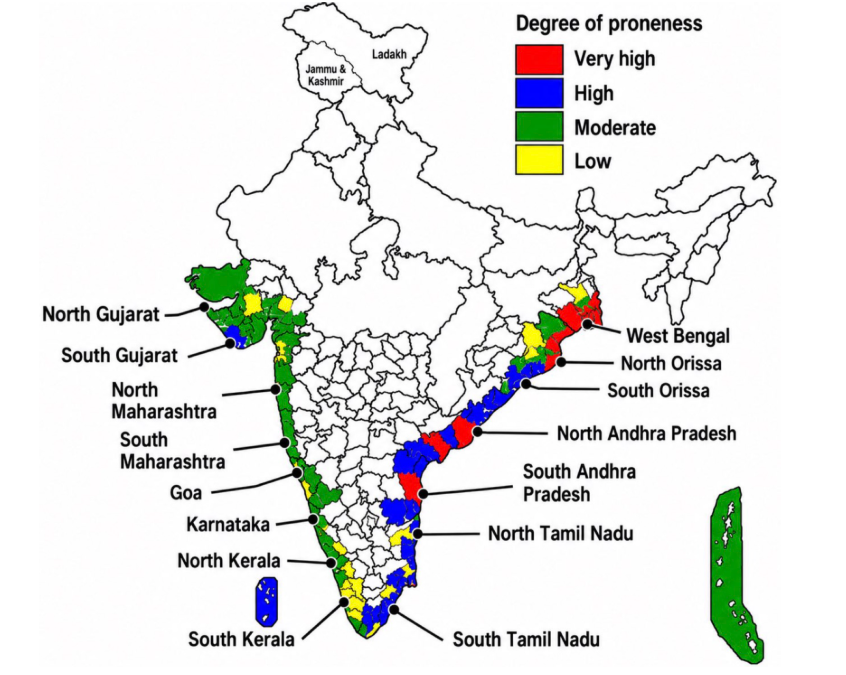
- Though the frequency of Tropical Cyclones (TCs) in the North Indian Ocean (NIO), covering the Bay of Bengal and the Arabian Sea, is the lowest in the world (7% of the global total → 3 to 4 make landfall out of 5 to 6 tropical cyclones annually), their impact on the east coast of India is relatively more devastating due to the storm tidal effect in the area.
- Climate change is a major challenge for developing nations like India, threatening to enhance risks already elevated by high levels of social vulnerability and climate variability.
- Climate change is increasing the risks associated with tropical cyclones through rising sea levels, heavier cyclone-related rainfall and the potential for more intense storms. However, changes in overall cyclone frequency remain uncertain and vary across regions.
Cyclones Impacts and Hazards
Cyclones can devastate coastal and inland areas, presenting various hazards that require comprehensive disaster management strategies. Some of the primary hazards associated include:
- Strong winds: Cyclones are characterised by powerful winds that can cause extensive damage to infrastructure, buildings, and vegetation. High-speed winds can uproot trees, damage power lines, and create hazardous flying debris.
- Storm surges: Cyclones in coastal areas often bring storm surges and abnormal sea level rises. This can result in coastal flooding, submerging low-lying areas, damaging coastal infrastructure, and leading to the displacement of communities.
- Heavy rainfall and flooding: Rainfall associated with tropical cyclones is both beneficial and harmful. Although the rains contribute to the water needs of the areas traversed by the cyclones, the rains are harmful when the amount is so large as to cause flooding.
- Economic loss: Cyclones can devastate crops, including rice, vegetables, and fruits. This can lead to food shortages, loss of income for farmers, and increased food prices.
- According to the State of Global Climate Report (2020), Cyclone Amphan led to economic losses in India of approximately $14 billion.
- Human casualties and injuries: Cyclones pose risks to human life, with the potential for injuries and fatalities due to collapsing structures, flying debris, drowning, or electrocution.
- India faced 40,000 human deaths due to cyclones from 1970 to 2019.
- Landslides: In hilly or mountainous regions, cyclones can trigger landslides due to excessive rainfall and soil saturation. Landslides can bury homes, roads, and communities, causing loss of life and infrastructure damage.
Cyclones UPSC PYQs
Q1: What is the Fujiwhara effect? Explain its impact on the movement and intensity of tropical cyclones. (UPSC Mains 2026)
Q2: Discuss the meaning of colour-coded weather warnings for cyclone prone areas given by India Meteorological Department. (UPSC Mains 2022)
Q3: Tropical cyclones are largely confined to the South China Sea, Bay of Bengal and Gulf of Mexico. Why? (UPSC Mains 2014)
Q4: The recent cyclone on the east coast of India was called “Phailin”. How are the tropical cyclones named across the world? Elaborate. (UPSC Mains 2013)
Q5: Consider the following statements:
- Jet streams occur in the Northern Hemisphere only.
- Only some cyclones develop an eye.
- The temperature inside the eye of a cyclone is nearly 10ºC lesser than that of the surroundings.
Which of the statements given above is/are correct? (UPSC Prelims 2020)
(a) 1 only
(b) 2 and 3 only
(c) 2 only
(d) 1 and 3 only
Ans: (c)

 Last updated on Oct, 2026
→ UPSC 2027 Notification will be released on 13 January 2027 at upsconline.nic.in.
→ Check Nobel Prize 2026 Winners List here.
→ Download PIB PRiSM Monthly Magazine 2026 here.
→ Check UPSC Monthly Current Affairs Magazine The Recitals here.
→ Check out the latest UPSC Syllabus here.
→ Download UPSC Model Answers for Mains 2026
→ UPSC Mains Question Paper 2026 is out now for Essay & GS Paper 1, 2, 3 & 4.
→ UPSC Calendar 2027 has been released.
→ Enroll in Vajiram & Ravi’s UPSC Mains Test Series 2027 for structured answer writing practice, expert evaluation, and exam-oriented feedback.
→ Join Vajiram & Ravi’s UPSC Mentorship Program 2027 for personalized guidance, strategy planning, and one-to-one support from experienced mentors.
→ Go through the UPSC Mains Previous Year Papers to enhance your preparation.
→ UPSC has released UPSC Toppers List 2025 with the Civil Services final result on its official website.
→ Also check Best UPSC Coaching in India
Cyclones FAQs
Q1. What is a cyclone?+
Q2. What are the different names used for cyclones in different regions?+
Q3. What is cyclogenesis?+
Q4. What is the difference between tropical and temperate cyclones?+
Q5. Why do cyclones rarely form near the equator?+
Tags: cyclones quest UPSC Geography Notes