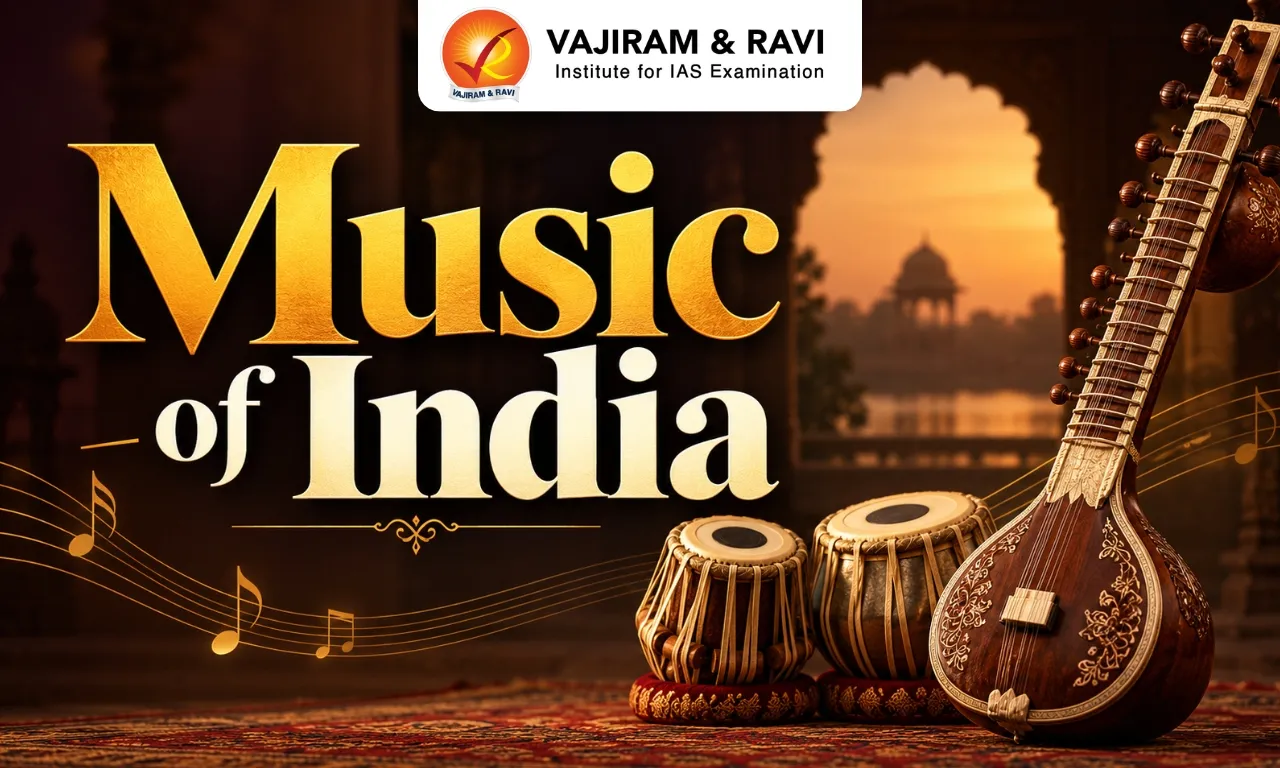
Music of India is an integral part of the country's cultural heritage, reflecting its regional diversity, spiritual traditions, historical developments, and social life. Indian music encompasses classical, folk, tribal, devotional, instrumental, vocal, and popular music traditions that have evolved over thousands of years.
Indian music is known for its rich melodic structures, rhythmic patterns, improvisation, and diverse musical instruments. The two major traditions of Indian classical music are Hindustani classical music, associated primarily with North India, and Carnatic classical music, associated primarily with South India.
Music of India History
The history of music of India is a diverse and evolving tradition rooted in India’s long cultural history, with music closely connected to religion, festivals, social life, and regional traditions. It encompasses Hindustani and Carnatic classical systems, alongside extensive folk, tribal, devotional, and other musical traditions.
- Vedic Period: The roots of Indian music can be traced to the Vedic tradition, particularly the Sama Veda, where verses were arranged for melodic chanting.
- The Natya Shastra, attributed to Bharata Muni, provided an early systematic treatment of music, instruments, and performance.
- Medieval Period: The Bhakti movement expanded devotional music through forms such as bhajans, kirtans, and abhangs. In North India, interaction with Persian and Central Asian traditions contributed to the evolution of Hindustani music.
- Mughal Empire and Regional Courts: Royal courts became important centres of musical patronage and experimentation. Dhrupad gained prominence, while musicians such as Tansen became associated with courtly musical traditions.
- Over time, different gharanas emerged within Hindustani music.
- Modern Period: The 19th and 20th centuries saw music move beyond royal courts into public institutions, music conferences, and educational centres.
- The establishment of the Sangeet Natak Akademi in 1952 marked an important step towards institutional promotion and preservation of Indian music.
Music of India Features
Music of India is a diverse tradition shaped by classical theories, regional cultures, devotional practices, and folk traditions.
- Three Fundamental Elements: Indian classical music rests on three main pillars: Swara (musical note), Raga (melodic framework), and Tala (rhythmic cycle). These work together to structure musical performance.
- Raga-Based Melodic Structure: A raga is a melodic framework built around particular notes, characteristic phrases, and rules governing their use. Different ragas can evoke particular moods and aesthetic experiences.
- Seven Basic Notes: The seven swaras are Sa, Re, Ga, Ma, Pa, Dha, and Ni, collectively called Saptak or Sargam. The Natya Shastra also describes a system of 22 shrutis, representing subtle pitch distinctions.
- Improvisation: Improvisation is an important feature of Indian classical music. Musicians develop melodies and rhythmic patterns within established frameworks, allowing performances to differ even when they follow the same raga or composition.
- Oral Transmission: Indian music has traditionally been transmitted through the guru-shishya parampara, in which students learn directly from experienced teachers. This method helps preserve musical techniques, stylistic details, compositions, and performance traditions.
- Two Major Classical Traditions: Indian classical music is broadly divided into Hindustani music of northern India and Carnatic music of southern India. Hindustani music gives considerable scope to improvisation, while Carnatic music is strongly associated with structured compositions and rhythmic organisation.


Indian Music Basics
Indian music is built on three fundamental elements—Swara, Tala, and Raga—which together give a musical composition its tonal, rhythmic, and melodic character.
- Swara: Swara refers to a musical sound with a distinct identity and meaning within a musical arrangement. The seven basic swaras form the Saptak—Sa, Re, Ga, Ma, Pa, Dha, and Ni.
- Tala: Tala is the rhythmic framework or beat through which rhythm is expressed in a musical composition. Different pulse patterns create variations in tempo, traditionally described as Vilambit (slow), Madhyam (medium), and Drut (fast).
- Raga: Raga is the melodic framework and a distinctive feature of Indian music. It is formed through particular arrangements and combinations of notes and is associated with the expression of particular moods and sentiments.
- Thaat: It is a system used in Hindustani classical music to classify ragas according to their underlying note arrangements.
- Thaats provide a systematic way to study and organise ragas, although a thaat itself is primarily a classificatory scale rather than a complete performing raga.
- Rasa: Rasa refers to the aesthetic emotions evoked in performers and audiences through music. Traditionally, there were eight rasas, later expanded to nine (Navarasa) with the addition of Shanta (tranquillity).
- Samay (Time Theory): In Hindustani classical music, ragas are traditionally associated with specific times of the day. The 24 hours are divided into Poorva Bhaag (12 AM–12 PM), associated with Poorva ragas, and Uttar Bhaag (12 PM–12 AM), associated with Uttar ragas.
- Other Important Musical Terms: Vadi is the most prominent note of a raga, while Samvadi is its secondary prominent note; Aroha and Avaroha refer to ascending and descending note sequences, respectively;
- Alap is the melodic elaboration of a raga, usually without a fixed rhythmic cycle; and Laya denotes tempo, commonly classified as Vilambit (slow), Madhya (medium), and Drut (fast).
Types of Music of India
Indian music encompasses diverse traditions that developed through different historical, regional, religious, and social contexts. It can be broadly grouped into the following forms:
Classical Music of India
Classical Indian music is broadly divided into two major traditions—Hindustani music of North India and Carnatic music of South India. Both are based on concepts such as raga, tala, and swara but developed distinct styles and traditions.
- Hindustani Classical Music: Hindustani music developed mainly in North India and evolved through interaction between ancient Indian traditions, regional cultures, and courtly influences.
- Raga-based: Melodic structures are organised around specific ragas and their characteristic movements.
- Improvisation: Performers develop the raga through forms such as alap, bol-ala, and taan.
- Vocal Forms: Major forms include Dhrupad, Khayal, Thumri, Tappa, and Tarana.
- Gharana Tradition: Distinct schools such as Gwalior, Agra, Jaipur-Atrauli, and Kirana developed different approaches to performance.
- Major Exponents: Tansen, Swami Haridas, Vishnu Digambar Paluskar, Vishnu Narayan Bhatkhande, Bade Ghulam Ali Khan, and Bhimsen Joshi are associated with its development and popularisation.
- Instruments: Sitar, sarod, tabla, sarangi, and shehnai are among the important instruments associated with the tradition.
- Carnatic Classical Music: Carnatic music developed mainly in South India and is closely associated with the musical traditions of Tamil Nadu, Karnataka, Andhra Pradesh, and Kerala.
- Composition-based: Composed works have a central place, particularly the Kriti, while improvisation is also an important feature.
- Melodic System: Music is organised through raga and systematic classifications such as the 72 Melakarta scheme.
- Rhythmic Structure: Complex tala patterns provide the rhythmic foundation for compositions and performances.
- Major Exponents: Purandara Dasa, Tyagaraja, and Muthuswami Dikshitar are among its prominent figures.
- Major Forms: Important forms include Kriti, Varnam, Tillana, and Ragam-Tanam-Pallavi.
- Instruments: Veena, mridangam, violin, flute, and ghatam are prominent instruments.
Folk Music of India
Folk music in India is rooted in community life, regional traditions, festivals, occupations, rituals, and oral storytelling. Its forms vary across regions and are generally transmitted through generations by practice and participation.
- Baul (West Bengal): A spiritual folk tradition associated with Baul singers, expressing ideas of devotion, mysticism, and the search for the divine.
- Bihu (Assam): Traditionally associated with the Bihu festival, Bihu songs express themes of youth, love, agriculture, and community life.
- Maand (Rajasthan): A traditional Rajasthani musical form known for its lyrical character and association with themes of love, heroism, and local life.
- Lavani (Maharashtra): A vibrant musical tradition performed with rhythmic accompaniment, often addressing themes of love, social life, and devotion.
- Powada (Maharashtra): A heroic ballad tradition that historically celebrated warriors and important events, particularly in the cultural memory of the Maratha period.
- Kummi (Tamil Nadu): A traditional community song-and-dance form performed particularly by women during festivals and social occasions.
Tribal Music of India
Tribal musical traditions vary across regions and communities, using locally available instruments, traditional songs and collective performances to express community identity and beliefs.
- Gond Music (Madhya Pradesh, Maharashtra and Chhattisgarh): Gond musical traditions are closely associated with community festivals, rituals, storytelling and everyday social life.
- Santhal Music (Jharkhand, West Bengal and Odisha): Santhal songs and music accompany festivals, agricultural activities, social gatherings and important stages of community life, often using instruments such as the Tumdak and Tamak.
- Bhil Music (Rajasthan, Gujarat, Madhya Pradesh and Maharashtra): Bhil musical traditions are performed during festivals, rituals and social occasions, with instruments such as mandal, dhol and flute.
- Warli Music (Maharashtra): Warli musical practices are connected with community celebrations, rituals and traditional social life, often accompanying collective dance and ceremonial activities.
- Mizo Tribal Music (Mizoram): Traditional Mizo music is closely associated with community festivals, dances and social occasions, with instruments such as khuang playing an important role.
- Garo Music (Meghalaya): Garo musical traditions are performed during agricultural festivals and community celebrations, particularly through songs accompanied by drums and other traditional instruments.
Instrumental Music of India
Instrumental music is an important part of India's musical heritage, using string, wind, and percussion instruments to express melody, rhythm, and emotion. Indian musical instruments are associated with Hindustani and Carnatic classical traditions, folk music, devotional practices, and regional cultures.
Vocal Music of India
Vocal music is a major component of India's musical heritage, encompassing classical compositions, devotional songs, semi-classical forms, and regional folk traditions. It combines melody (raga), rhythm (tala), and lyrical expression to convey emotions, spiritual ideas, and cultural narratives.
- Vocal Forms of Hindustani Classical Music: Hindustani vocal music developed mainly in northern India and incorporates raga-based improvisation, elaborate melodic development, and diverse singing styles.
- Dhrupad: It is one of the oldest forms of Hindustani classical vocal music, characterised by a serious, devotional style and extensive alap. It is traditionally accompanied by the tanpura and pakhawaj. The Dagar tradition is particularly associated with Dhrupad.
- Khayal: A major form of Hindustani classical singing that allows extensive improvisation within a raga. It generally includes Bada Khayal in a slow tempo and Chhota Khayal in a faster tempo.
- Dhamar: A vocal form associated with the Dhamar tala of 14 beats and often linked to the festival of Holi and the legends of Krishna. It shares historical connections with the Dhrupad tradition.
- Thumri: A semi-classical vocal style emphasising emotion, lyrical expression, and flexible melodic treatment. Its compositions often explore love and devotion, particularly the relationship between Radha and Krishna. Banaras and Lucknow developed prominent Thumri traditions.
- Tappa: A semi-classical style known for rapid, intricate, and rolling melodic phrases. It developed from the folk songs of camel riders in north-western India and received courtly patronage under Muhammad Shah.
- Tarana: A vocal form featuring rhythmic syllables such as tanana and dere na, performed through patterned melodic and rhythmic passages. It is commonly associated with Hindustani classical concerts.
- Carnatic Vocal Music: Carnatic music is the classical musical tradition of southern India, with a strong emphasis on composed pieces, devotional lyrics, and improvisation within defined melodic and rhythmic structures.
- Kriti: A principal compositional form of Carnatic music, usually consisting of three sections: Pallavi, Anupallavi, and Charanam. The compositions of Tyagaraja, Muthuswami Dikshitar, and Syama Sastri are central to the tradition.
- Varnam: A structured composition used for musical training and concert performance, helping singers develop familiarity with a raga's characteristic phrases and rhythmic patterns.
- Ragam-Tanam-Pallavi: An advanced concert format combining melodic exploration (Ragam), rhythmic and melodic development (Tanam), and a composed theme with rhythmic elaboration (Pallavi).
- Semi-Classical and Related Vocal Forms: Semi-classical and related singing styles combine elements of classical music with lyrical flexibility, regional influences, and expressive storytelling.
- Ghazal: A poetic singing form built around couplets, often exploring love, longing, separation, and philosophical themes. It has Persian literary roots and became influential in Indian musical traditions.
- Dadra: A light semi-classical form often associated with romantic or devotional lyrics. It is commonly performed in a six-beat rhythmic cycle, also known as Dadra tala.
- Kajri: A seasonal folk and semi-classical singing tradition associated especially with Uttar Pradesh and the monsoon season, expressing longing and separation.
Popular Music of India
Popular music in India encompasses film music, Indian pop, devotional music, regional music and independent music. Film songs combine classical, folk and Western influences, while Indian pop blends contemporary and international styles.
- Devotional forms such as bhajans, kirtans and qawwali express spiritual themes, whereas regional music reflects local languages and cultural traditions.
- Digital streaming, social media and global collaborations have further expanded the reach and diversity of Indian popular music.
Music of India Instruments
Indian music instruments reflect the diversity of India’s classical, folk, devotional, and regional traditions. Based on the method of producing sound, they can be broadly grouped into string, wind, and percussion instruments.
String Instruments
String instruments produce sound through the vibration of stretched strings and form an important part of both Hindustani and Carnatic classical music.
- Sitar: A prominent Hindustani string instrument with a long fretted neck and resonating strings, widely used for melodic performance.
- Sarod: A fretless plucked instrument of Hindustani music, known for its deep and resonant tone and extensive use in raga performance.
- Veena: An important South Indian classical instrument, particularly associated with Carnatic music and the performance of intricate melodic patterns.
- Sarangi: A bowed instrument capable of producing expressive, voice-like sounds and traditionally used as both an accompanying and solo instrument.
Wind Instruments
Wind instruments produce sound through the movement of air and have important roles in classical, devotional, ceremonial, and folk traditions.
- Bansuri: A bamboo flute widely associated with Hindustani music, producing a soft melodic sound and used for both classical and folk performances.
- Shehnai: A double-reed wind instrument traditionally associated with weddings, religious occasions, and other auspicious ceremonies, besides its classical use.
- Nadaswaram: A powerful double-reed instrument prominent in South Indian temple and ceremonial music, particularly suited to outdoor performances.
- Shankha: A conch shell used mainly in religious and ritual contexts, where its distinctive sound forms part of ceremonial practices.
Percussion Instruments
Percussion instruments provide the rhythmic foundation of Indian music and range from sophisticated classical instruments to widely used folk drums.
- Tabla: A pair of tuned drums central to Hindustani classical music, used to accompany vocal and instrumental performances as well as for solo playing.
- Mridangam: The principal percussion instrument of Carnatic music, providing rhythmic accompaniment and complex patterns during classical performances.
- Pakhawaj: A barrel-shaped, double-headed drum closely associated with Dhrupad and other traditional Hindustani musical forms.
- Ghatam: A clay percussion instrument used mainly in Carnatic music, capable of producing different tones by striking various parts of its surface.
- Dhol: A double-headed drum widely used in folk traditions across India, particularly during festivals, celebrations, and community performances.
Music of India Significance
Indian music is an important part of India’s cultural heritage, connecting artistic expression with traditions, social life, spirituality, and regional identities.
- Cultural Heritage: Indian music preserves centuries-old traditions, including classical systems, folk practices, and devotional forms, and transmits cultural knowledge across generations.
- Spiritual Expression: Bhajans, Kirtans, Abhangs, Sufi music, and other devotional traditions use music as a medium for religious expression, reflection, and community participation.
- Social Cohesion: Community-based musical practices bring people together during festivals, ceremonies,s and social occasions, strengthening collective participation and shared identity.
- Knowledge Transmission: The guru–shishya tradition has helped preserve specialised knowledge of raga, tala, performance techniques and traditional repertoire.
- Livelihood Generation: Performances, teaching, festivals, cultural institutions and the creative industries provide economic opportunities for musicians, performers and associated artisans.
Globalisation of Indian Music
Globalisation has expanded the international reach of Indian music through migration, digital platforms, cultural exchanges and cross-border collaborations. Indian classical, folk, devotional and film music have gained audiences worldwide, while interactions with global genres have created new musical styles.
- International Recognition: Indian musicians such as Ravi Shankar popularised Indian classical music globally through international performances and collaborations.
- Fusion of Musical Traditions: Indian music blends with jazz, rock, hip-hop, and electronic music, creating cross-cultural genres.
- Global Film Music Influence: Indian film songs have gained international audiences through cinema, streaming platforms, and social media.
- Diaspora and Cultural Exchange: The Indian diaspora sustains interest in Indian music through concerts, festivals, and cultural events abroad.
- Digital Platforms: YouTube and music-streaming services enable independent and regional Indian artists to reach global audiences.
Music of India Challenges
Despite its rich classical, folk, and tribal traditions, music of India faces challenges from changing social conditions, commercial pressures, limited livelihood opportunities, and difficulties in preserving traditional knowledge.
- Declining Traditional Transmission: Traditional knowledge passed through guru–shishya and community-based systems faces difficulties as younger generations increasingly move towards formal education and other occupations.
- Commercialisation: Market-oriented performances can encourage standardisation and simplification, potentially reducing the diversity of traditional musical practices.
- Economic Insecurity: Many traditional musicians, particularly folk and tribal performers, have irregular incomes and limited access to stable performance opportunities.
- Loss of Traditional Instruments: Some indigenous instruments and their associated craftsmanship face decline as traditional makers and skilled practitioners become fewer.
Music of India Way Forward
Preserving India’s musical heritage requires a balance between traditional knowledge, contemporary opportunities, and sustainable livelihoods, while ensuring that diverse musical traditions remain relevant to younger generations.
- Document Musical Heritage: Digitise rare compositions, oral traditions, traditional instruments, and performance techniques, particularly those of lesser-known folk and tribal communities.
- Support Traditional Artists: Improve financial assistance, performance opportunities, social security, and market access for folk, tribal, and classical musicians.
- Promote Music Education: Integrate Indian classical, folk, and traditional music into school and higher-education programmes to increase awareness among younger audiences.
- Preserve Traditional Instruments: Support instrument makers and craftsmen through training, documentation, exhibitions, and institutional assistance to sustain traditional instrument-making skills.
Music of India UPSC PYQs
Q1: The Sufi saint who maintained that devotional music was one way of coming close to God was (UPSC Prelims 2021)
(a) Muin-ud-din Chishti
(b) Baba Farid
(c) Saiyid Mohammad Gesudaraz
(d) Shah Alam Bukhari
Ans: (a)
Q2: With reference to the cultural history of India, consider the following statements: (UPSC Prelims 2018)
- Most of the Tyagaraja kritis are devotional songs in praise of Lord Krishna.
- Tyagaraja created several new ragas.
- Annamacharya and Tyagaraja are contemporaries.
- Annamacharya kirtanas are devotional songs in praise of Lord Venkateshwara.
Which of the statements given above are correct?
(a) 1 and 3 only
(b) 2 and 4 only
(c) 1, 2 and 3
(d) 2, 3 and 4
Ans: (b)
Q3: With reference to Dhrupad, one of the major traditions of India that has been kept alive for centuries, which of the following statements are correct? (UPSC Prelims 2012)
- Dhrupad originated and developed in the Rajput kingdoms during the Mughal period.
- Dhrupad is primarily devotional and spiritual music.
- Dhrupad Alap uses Sanskrit syllables from Mantras.
Select the correct answer using the codes given below:
Select an option to attempt
(a) 1 and 2 only
(b) 2 and 3 only
(c) 1, 2 and 3
(d) None of the above is correct
Ans: (b)

 Last updated on Oct, 2026
→ UPSC 2027 Notification will be released on 13 January 2027 at upsconline.nic.in.
→ Check Nobel Prize 2026 Winners List here.
→ Download PIB PRiSM Monthly Magazine 2026 here.
→ Check UPSC Monthly Current Affairs Magazine The Recitals here.
→ Check out the latest UPSC Syllabus here.
→ Download UPSC Model Answers for Mains 2026
→ UPSC Mains Question Paper 2026 is out now for Essay & GS Paper 1, 2, 3 & 4.
→ UPSC Calendar 2027 has been released.
→ Enroll in Vajiram & Ravi’s UPSC Mains Test Series 2027 for structured answer writing practice, expert evaluation, and exam-oriented feedback.
→ Join Vajiram & Ravi’s UPSC Mentorship Program 2027 for personalized guidance, strategy planning, and one-to-one support from experienced mentors.
→ Go through the UPSC Mains Previous Year Papers to enhance your preparation.
→ UPSC has released UPSC Toppers List 2025 with the Civil Services final result on its official website.
→ Also check Best UPSC Coaching in India
Music of India FAQs
Q1. What is the famous music of India?+
Q2. What is the music of India?+
Q3. Who is the father of music in India?+
Q4. What are the top 10 songs of India?+
Q5. What are five main types of music in India?+
Tags: music of india quest UPSC Art and Culture Notes