
Tiger reserves in India are protected landscapes established to conserve Bengal tigers, safeguard their habitats and maintain ecological balance. The conservation programme began with Project Tiger in 1973 and has developed into a nationwide network managed through cooperation between the Central Government, state forest departments and conservation institutions.
According to the National Tiger Conservation Authority (NTCA), there are 58 tiger reserves in India across 18 states. These reserves protect forests, grasslands, wetlands and other habitats that support tigers, their prey and many threatened species. The network also contributes to watershed protection, biodiversity conservation and climate resilience. Understanding their locations, notified areas, management structure and conservation challenges is important for wildlife protection and environmental studies.
Tiger Reserves in India Meaning
Tiger reserves in India are designated conservation landscapes where tiger populations and their habitats receive focused protection through legal safeguards, habitat management, monitoring and community participation.
- A tiger reserve is not necessarily limited to a national park. It can include a legally protected core habitat surrounded by a buffer landscape in which conservation is combined with regulated human activities and livelihood needs.
- Tiger reserves are notified under Section 38V of the Wildlife (Protection) Act, 1972.
Tiger Reserves in India Need
Tiger reserves in India are needed to secure viable tiger populations while conserving connected habitats, prey species, watersheds and wider biodiversity in landscapes increasingly affected by human activity. The main reasons for establishing tiger reserves in India include:
- Preventing extinction: Protecting tigers from poaching, illegal trade and population decline.
- Safeguarding habitats: Conserving forests, grasslands, mangroves and other ecosystems that sustain tiger populations.
- Maintaining ecological balance: As apex predators, tigers influence prey populations and broader food-web relationships.
- Protecting biodiversity: Conserving tiger habitat also benefits elephants, leopards, deer, wild dogs, birds, reptiles and many plant species.
- Maintaining wildlife corridors: Keeping habitats connected helps tigers disperse, find mates and establish new territories.
- Protecting water resources: Forests and catchments within reserves can support groundwater recharge, reduce erosion and regulate local water flows.
- Supporting local livelihoods: Properly managed nature tourism, conservation employment and community programmes can create economic opportunities.
- Strengthening scientific management: Monitoring tiger numbers, prey populations, habitat quality and human–wildlife interactions supports evidence-based conservation.


Tiger Reserves in India Notified By
Tiger reserves in India are notified by state governments under Section 38V of the Wildlife (Protection) Act, 1972, following the prescribed process involving the National Tiger Conservation Authority. The main institutions involved are:
- Ministry of Environment, Forest and Climate Change (MoEFCC): Leads national environmental and wildlife policy and oversees Project Tiger.
- National Tiger Conservation Authority (NTCA): Provides statutory oversight, approves relevant conservation plans, supports tiger monitoring and advises on reserve notification.
- State governments and forest departments: Undertake the formal state-level notification and manage reserves on the ground.
- Wildlife Institute of India (WII): Supports scientific research, training, wildlife monitoring and national tiger assessments.
Tiger Reserves in India Structure
Tiger reserves in India use a core–buffer management model that combines stricter protection of critical tiger habitat with regulated management of the surrounding landscape.
- Core area / Critical Tiger Habitat: The central habitat receives the highest priority for wildlife conservation. It generally consists of legally protected national park or sanctuary areas and is managed to maintain ecological integrity and viable tiger populations.
- Buffer area / Peripheral landscape: The surrounding landscape helps reduce pressure on the core and supports habitat connectivity, regulated resource use and people-oriented conservation measures, subject to applicable law and management plans.
Tiger Reserves in India List
India’s tiger reserve network contains 58 notified reserves across 18 states; the following table combines the 2023 WII–NTCA profile with newly notified tiger reserves in India.
| No. | Tiger reserve | State | Notification year | Total area (km²) |
|
1 |
Nagarjunsagar–Srisailam |
Andhra Pradesh |
2007 |
3,296.31 |
|
2 |
Kamlang |
Arunachal Pradesh |
2017 |
783.00 |
|
3 |
Namdapha |
Arunachal Pradesh |
1987 |
2,052.82 |
|
4 |
Pakke |
Arunachal Pradesh |
2012 |
1,198.45 |
|
5 |
Kaziranga |
Assam |
2007 |
1,173.58 |
|
6 |
Manas |
Assam |
2008 |
2,837.10 |
|
7 |
Nameri |
Assam |
2000 |
464.00 |
|
8 |
Orang |
Assam |
2016 |
492.46 |
|
9 |
Valmiki |
Bihar |
2012 |
899.38 |
|
10 |
Achanakmar |
Chhattisgarh |
2009 |
914.01 |
|
11 |
Indravati |
Chhattisgarh |
2009 |
2,799.07 |
|
12 |
Udanti–Sitanadi |
Chhattisgarh |
2009 |
1,842.54 |
|
13 |
Guru Ghasidas–Tamor Pingla |
Chhattisgarh |
2024 |
2,829.39 |
|
14 |
Palamau |
Jharkhand |
2012 |
1,129.93 |
|
15 |
Bandipur |
Karnataka |
2007 |
1,456.30 |
|
16 |
Bhadra |
Karnataka |
2007 |
1,064.29 |
|
17 |
Biligiri Ranganatha Temple (BRT) |
Karnataka |
2011 |
574.82 |
|
18 |
Kali (Dandeli–Anshi) |
Karnataka |
2007 |
1,097.51 |
|
19 |
Nagarahole |
Karnataka |
2007 |
1,205.76 |
|
20 |
Parambikulam |
Kerala |
2009 |
643.66 |
|
21 |
Periyar |
Kerala |
2007 |
925.00 |
|
22 |
Bandhavgarh |
Madhya Pradesh |
2007 |
1,536.93 |
|
23 |
Kanha |
Madhya Pradesh |
2007 |
2,051.79 |
|
24 |
Panna |
Madhya Pradesh |
2007 |
1,598.10 |
|
25 |
Pench |
Madhya Pradesh |
2007 |
1,179.63 |
|
26 |
Sanjay–Dubri |
Madhya Pradesh |
2011 |
1,674.50 |
|
27 |
Satpura |
Madhya Pradesh |
2007 |
2,133.30 |
|
28 |
Veerangana Durgavati |
Madhya Pradesh |
2023 |
2,339.12 |
|
29 |
Ratapani |
Madhya Pradesh |
2024 |
1,271.47 |
|
30 |
Madhav |
Madhya Pradesh |
2025 |
1,651.39 |
|
31 |
Bor |
Maharashtra |
2012 |
816.27 |
|
32 |
Melghat |
Maharashtra |
2007 |
2,768.52 |
|
33 |
Nawegaon–Nagzira |
Maharashtra |
2013 |
1,894.94 |
|
34 |
Pench |
Maharashtra |
2007 |
741.22 |
|
35 |
Sahyadri |
Maharashtra |
2012 |
1,165.57 |
|
36 |
Tadoba–Andhari |
Maharashtra |
2007 |
1,727.59 |
|
37 |
Dampa |
Mizoram |
2007 |
988.00 |
|
38 |
Satkosia |
Odisha |
2007 |
963.87 |
|
39 |
Similipal |
Odisha |
2007 |
2,750.00 |
|
40 |
Mukundara Hills |
Rajasthan |
2013 |
759.99 |
|
41 |
Ramgarh Vishdhari |
Rajasthan |
2022 |
1,501.89 |
|
42 |
Ranthambore |
Rajasthan |
2007 |
1,411.29 |
|
43 |
Sariska |
Rajasthan |
2007 |
1,213.34 |
|
44 |
Dholpur–Karauli |
Rajasthan |
2023 |
1,057.88 |
|
45 |
Anamalai |
Tamil Nadu |
2007 |
1,479.87 |
|
46 |
Kalakad–Mundanthurai |
Tamil Nadu |
2007 |
1,601.54 |
|
47 |
Mudumalai |
Tamil Nadu |
2007 |
688.59 |
|
48 |
Sathyamangalam |
Tamil Nadu |
2013 |
1,408.40 |
|
49 |
Srivilliputhur–Megamalai |
Tamil Nadu |
2021 |
1,016.57 |
|
50 |
Amrabad |
Telangana |
2015 |
2,611.39 |
|
51 |
Kawal |
Telangana |
2012 |
2,015.44 |
|
52 |
Dudhwa |
Uttar Pradesh |
2007 |
2,201.77 |
|
53 |
Pilibhit |
Uttar Pradesh |
2014 |
730.25 |
|
54 |
Ranipur |
Uttar Pradesh |
2022 |
529.36 |
|
55 |
Corbett |
Uttarakhand |
2010 |
1,288.31 |
|
56 |
Rajaji |
Uttarakhand |
2015 |
1,075.17 |
|
57 |
Buxa |
West Bengal |
2009 |
757.90 |
|
58 |
Sundarban |
West Bengal |
2007 |
2,584.89 |
Tiger Reserves in India State-wise Numbers
The current 58 tiger reserves in India are distributed across 18 tiger-range states, with Madhya Pradesh having the largest number, followed by several states with substantial forest and wildlife landscapes.
| State | Number of tiger reserves |
|
Andhra Pradesh |
1 |
|
Arunachal Pradesh |
3 |
|
Assam |
4 |
|
Bihar |
1 |
|
Chhattisgarh |
4 |
|
Jharkhand |
1 |
|
Karnataka |
5 |
|
Kerala |
2 |
|
Madhya Pradesh |
9 |
|
Maharashtra |
6 |
|
Mizoram |
1 |
|
Odisha |
2 |
|
Rajasthan |
5 |
|
Tamil Nadu |
5 |
|
Telangana |
2 |
|
Uttar Pradesh |
3 |
|
Uttarakhand |
2 |
|
West Bengal |
2 |
|
Total |
58 |
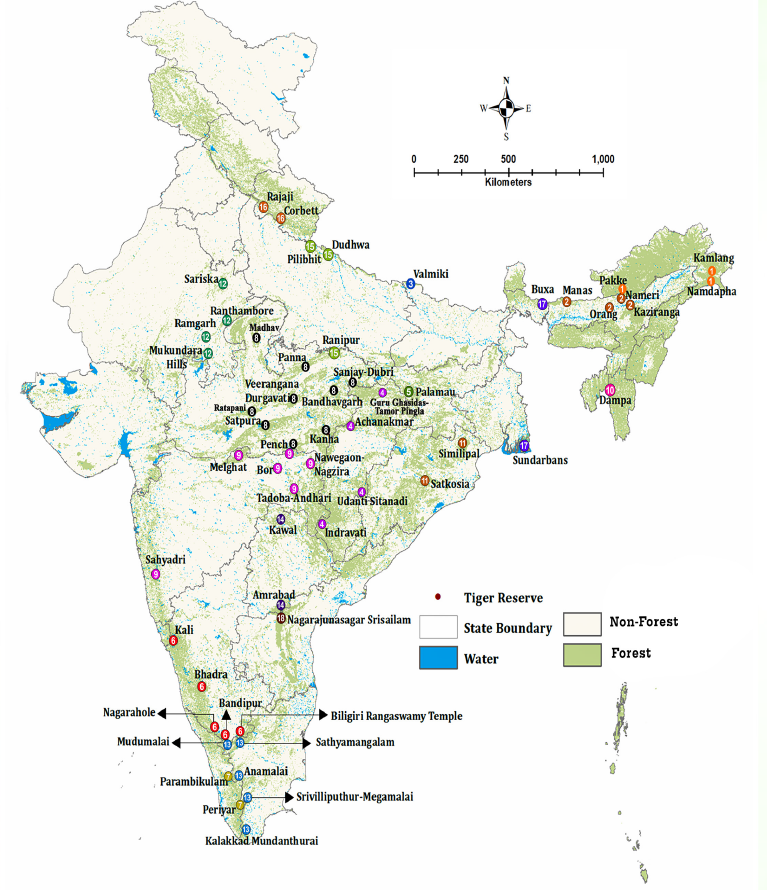
Tiger Reserves in India Map
The map of tiger reserves in India is shown below.
Tiger Reserves in India Facts
India’s tiger reserve network is notable for its geographic spread, varied habitats and growing conservation coverage, although tiger numbers and recovery differ significantly between landscapes.
- Tiger reserves across India: 58
- Tiger-range states with reserves: 18
- Approximate notified reserve area: 84,487 km²
- Estimated wild tigers in India in 2022: 3,682
- Largest Tiger Reserve in India: Nagarjunsagar–Srisailam Tiger Reserve in Andhra Pradesh is the largest tiger reserve in India by total notified area, covering approximately 3,296.31 km².
- Smallest Tiger Reserve in India: Ranipur Tiger Reserve in Uttar Pradesh has the smallest total notified area, at approximately 529.36 km².
- Tiger Reserve with the Highest Tiger Population: The 2022 national assessment identified Corbett Tiger Reserve in Uttarakhand as the reserve with the highest estimated tiger population, with around 260 tigers.
- Five tiger reserves had zero tigers in the 2022 tiger assessment:
| No. | Tiger Reserve | State |
|
1 |
Sahyadri Tiger Reserve |
Maharashtra |
|
2 |
Satkosia Tiger Reserve |
Odisha |
|
3 |
Kamlang Tiger Reserve |
Arunachal Pradesh |
|
4 |
Kawal Tiger Reserve |
Telangana |
|
5 |
Dampa Tiger Reserve |
Mizoram |
Tiger Reserves in India Importance
Tiger reserves in India protect more than an iconic carnivore: their habitats support biodiversity, ecological processes, water security and livelihoods across many Indian landscapes.
- Apex-predator function: Tigers influence prey populations and contribute to the balance of food webs.
- Umbrella-species conservation: Protecting habitats large enough for tigers also safeguards many other species that share the same forests and grasslands.
- Forest and watershed protection: Well-managed forest landscapes help reduce soil erosion, sustain catchments and support water regulation.
- Biodiversity conservation: Reserves shelter threatened mammals, birds, reptiles, amphibians and plant communities.
- Landscape connectivity: Corridors between reserves allow dispersal and genetic exchange, helping reduce the risks associated with isolated populations.
- Climate resilience: Healthy forests store carbon and can help buffer local environments against heat and rainfall variability.
- Scientific research: Camera trapping, field surveys and habitat assessments improve understanding of wildlife populations and ecosystem change.
- Employment and livelihoods: Responsible tourism, guiding, habitat restoration and conservation programmes can provide local income when benefits are fairly distributed.
- Environmental education: Reserves help communicate the value of wildlife protection and sustainable resource use.
- Long-term ecological security: Conserving natural habitats supports ecosystem services that benefit communities beyond reserve boundaries.
Tiger Reserves in India Major Threats
Tiger reserves in India face a combination of habitat pressure, illegal wildlife activity, ecological disruption and human–wildlife conflict that can weaken conservation gains.
- Habitat Loss and Fragmentation: Roads, railways, mining, dams, settlements and other infrastructure can break continuous habitat into smaller patches.
- Fragmentation can restrict tiger movement, isolate breeding populations and increase the risk of animal deaths during dispersal.
- Poaching and Illegal Wildlife Trade: Tigers are targeted for illegal trade in body parts and products. Poaching can undermine population recovery, especially where the number of breeding adults is already small.
- Decline in Prey Animals: Deer, wild pigs and other prey species can decline because of hunting, habitat degradation, competition with livestock and disturbance. Low prey availability may force tigers to travel farther or approach settlements.
- Human–Tiger Conflict: As settlements and farms border forests, encounters involving livestock and people may increase.
- Retaliatory killing, fear and damage to livelihoods can erode community support for conservation if response systems are slow or compensation is inadequate.
- Forest Fires and Invasive Species: Fires can damage vegetation, prey habitat and water availability. Invasive plants may alter forest structure, reduce forage quality and complicate habitat restoration.
- Climate Change: Changing rainfall, extreme heat, drought and floods can affect prey, water availability, vegetation and habitat quality. Mangrove landscapes such as the Sundarbans face additional pressures from sea-level rise and coastal hazards.
- Tourism and Infrastructure Pressure: Poorly managed tourism, traffic, noise, waste and excessive construction can disturb wildlife. Tourism needs to be regulated so that revenue does not come at the cost of habitat quality.
Tiger Reserves in India Conservation Efforts
India combines statutory protection, scientific population monitoring, habitat management and community-focused programmes to conserve tigers and the landscapes they depend on.
- Project Tiger: Launched in 1973, Project Tiger is the flagship centrally sponsored programme supporting tiger conservation in designated reserves. It assists in protection, habitat management, monitoring and other approved conservation activities.
- National Tiger Conservation Authority: The NTCA oversees implementation of the statutory tiger conservation framework, supports reserve management and coordinates national tiger assessments. It also plays a role in the prescribed process for notifying tiger reserves.
- Wildlife Protection Act 1972: The Act provides the legal foundation for wildlife protection and the notification and management framework for tiger reserves. Sections 38V and 38W address the notification of tiger reserves and safeguards governing boundary alteration or de-notification.
- All India Tiger Estimation: India undertakes national tiger assessments approximately every four years using field surveys, camera traps, signs and statistical methods.
- The 2022 assessment estimated the national population at 3,682, compared with 2,967 in the 2018 assessment. These are estimates, not a direct census of every tiger.
- Anti-Poaching and Wildlife Crime Control: Forest staff patrol reserves, monitor wildlife movement, gather intelligence and work with enforcement agencies to prevent illegal hunting and trade. Technology and inter-agency cooperation can improve detection and response.
- Habitat and Corridor Conservation: Restoring degraded habitats, maintaining water sources, managing fires and protecting corridors can improve the long-term viability of tiger populations. Corridor protection is especially important where reserves are separated by roads, farmland or settlements.
- Voluntary Relocation and Community Participation: Where relocation from critical habitat is proposed, it must follow applicable law, informed processes and appropriate rehabilitation safeguards. Communities living in buffer landscapes can also participate through local conservation committees, livelihood support and conflict-prevention programmes.
- Responsible Ecotourism: Regulated tourism can raise awareness and generate local income, but it requires limits on disturbance, careful waste management, trained guides and fair sharing of benefits with local communities.
Tiger Reserves in India UPSC PYQs
Q1. With reference to Madhav National Park, which of the following statements is/are correct? (Prelims 2026)
- It was declared a Tiger Reserve in India in 2025.
- Sakhya Sagar, which is designated as a Ramsar Site, is situated within this National Park.
- Its area is shared between Madhya Pradesh and Rajasthan.
Select the answer using the code given below:
a) 1 only
b) 1 and 2
c) 2 and 3
d) 3 only
Ans: (b)
Q2. Among the following Tiger Reserves, which one has the largest area under ‘Critical Tiger Habitat’? (Prelims 2020)
a) Corbett
b) Ranthambore
c) Nagarjunasagar-Srisailam
d) Sundarbans
Ans: (c)
Q3. The term ‘M-STrIPES’ is sometimes seen in the news in the context of: (Prelims 2017)
a) Captive breeding of Wild Fauna
b) Maintenance of Tiger Reserves
c) Indigenous Satellite Navigation System
d) Security of National Highways
Ans: (b)
Q4. From the ecological point of view, which one of the following assumes importance in being a good link between the Eastern Ghats and the Western Ghats? (Prelims 2017)
a) Sathyamangalam Tiger Reserve
b) Nallamala Forest
c) Nagarhole National Park
d) Seshachalam Biosphere Reserve
Ans: (a)
Q5. Consider the following pairs: (Prelims 2014)
- Dampa Tiger Reserve: Mizoram
- Gumti Wildlife Sanctuary: Sikkim
- Saramati Peak: Nagaland
Which of the above pairs is/are correctly matched?
a) 1 only
b) 2 and 3 only
c) 1 and 3 only
d) 1, 2 and 3
Ans: (c)

 Last updated on Oct, 2026
→ UPSC 2027 Notification will be released on 13 January 2027 at upsconline.nic.in.
→ Check Nobel Prize 2026 Winners List here.
→ Download PIB PRiSM Monthly Magazine 2026 here.
→ Check UPSC Monthly Current Affairs Magazine The Recitals here.
→ Check out the latest UPSC Syllabus here.
→ Download UPSC Model Answers for Mains 2026
→ UPSC Mains Question Paper 2026 is out now for Essay & GS Paper 1, 2, 3 & 4.
→ UPSC Calendar 2027 has been released.
→ Enroll in Vajiram & Ravi’s UPSC Mains Test Series 2027 for structured answer writing practice, expert evaluation, and exam-oriented feedback.
→ Join Vajiram & Ravi’s UPSC Mentorship Program 2027 for personalized guidance, strategy planning, and one-to-one support from experienced mentors.
→ Go through the UPSC Mains Previous Year Papers to enhance your preparation.
→ UPSC has released UPSC Toppers List 2025 with the Civil Services final result on its official website.
→ Also check Best UPSC Coaching in India
Tiger Reserves in India FAQs
Q1. Which is the 58th tiger reserve of India?+
Q2. How many tiger reserves are there in India?+
Q3. Which is the first tiger reserve in India?+
Q4. Which is the largest tiger reserve in India?+
Q5. Which is the smallest tiger reserve in India?+
Tags: quest tiger reserves in india UPSC Environment & Ecology Notes