Hindustani music began to diverge from Carnatic music in the 14th century. It draws inspiration from Bharatamuni's Natyashastra. It uses the Shudha Swara Saptaka scale and focuses on improvisation and musical structure. Dhrupad, Dhamar, Hori, Khayal, Tappa, Chaturang, Ragasagar, Tarana, Sargam, and Thumri are the ten primary vocal and compositional styles of Hindustani music.
Indian classical music originally followed a unified system but diverged during the medieval period when North India came under Persian influence, leading to the formation of two schools: Hindustani (North Indian) and Carnatic (South Indian) music.
Classical Hindustani Music About
Hindustani music represents one of India’s richest cultural heritages as a classical music tradition that has evolved over centuries, shaped by Persian influences, the Bhakti movement, Mughal patronage, and various stylistic gharanas into a sophisticated improvisational art form fundamental to India’s identity.
Hindustani Music Examples
Hindustani music includes various vocal and instrumental forms such as Dhrupad, Khayal, Dhamar, Thumri, Tappa, and Tarana. Prominent instrumental traditions feature instruments like the Sitar, Sarod, Sarangi, Shehnai, Santoor, and Bansuri, while major gharanas such as Gwalior, Kirana, Agra, and Jaipur-Atrauli have contributed to its development.
Hindustani Music Singers
Hindustani classical music has been enriched by renowned vocalists such as Dagar Brothers (Dhrupad), Bhimsen Joshi, and Amir Khan (Khayal), Girija Devi, and Begum Akhtar (Thumri). Other notable artists include Kishori Amonkar, Gangubai Hangal, Kumar Gandharva, and Mallikarjun Mansur.
Hindustani Music Evolution
Hindustani music denotes the cultural traditions of Hindustan, encompassing regions east of the Sindhu River, primarily Northern India. The origin of Hindustani music dates back to ancient times, with references to musical notes and incantation rituals found in Vedic Literature.
- The process of differentiation from Carnatic music began in the 14th century, under the Delhi Sultanate. Amir Khusrau developed Hindustani classical music by synthesising Indian music with Persian "Mausiqui", introducing new ragas and instruments like the sitar and tabla.
- Key Developments: In the 16th century, under Akbar's patronage, the renowned musician Tansen took Hindustani music to new heights. His compositions in the band style are timeless and have had a lasting impact on the genre.
- Other notable musicians like Swami Haridas and Baiju Bawra rose to prominence in the courts of Gwalior and Jaipur, further enriching the Hindustani tradition.
- Gharanas and Regional Styles: In the 19th century, specific stylistic schools were developed with the foundation of gharanas bearing regional names.
- For example, the Gwalior, Patiala, and Kirana gharanas each have unique characteristics that distinguish them from one another. They contributed to the diversity and richness of Hindustani music.


Hindustani Music Elements
Hindustani music derives its unique flavour from improvisational exploration within the framework of ragas (melodies) and taals (rhythmic cycles). The following fundamental elements give Hindustani music its unique flavour:-
- Ragas: Hindustani music employs a 12-note scale using seven basic notes and five interspersed half-notes.
- Taals: A taal is a cyclic arrangement of time units like laghu, guru, and pluta. The tempo of the taal, which keeps the time span uniform, is called the laya.
- The most common taal is the "teental," which has 16 beats. Other important taals include Jhaptal and Ektal.
- Swar: Swar, or notes, form the basic building blocks of Hindustani music. There are seven swaras (Sapta Swaras): Sa, Re, Ga, Ma, Pa, Dha, and Ni.
- Thaat: It is a system used in Hindustani classical music to classify ragas according to their underlying note arrangements.
- Thaats provide a systematic way to study and organise ragas, although a thaat itself is primarily a classificatory scale rather than a complete performing raga.
- Rasa: Rasa refers to the aesthetic emotions evoked in performers and audiences through music. Traditionally, there were eight rasas, later expanded to nine (Navarasa) with the addition of Shanta (tranquillity).
- Samay (Time Theory): In Hindustani classical music, ragas are traditionally associated with specific times of the day. The 24 hours are divided into Poorva Bhaag (12 AM–12 PM), associated with Poorva ragas, and Uttar Bhaag (12 PM–12 AM), associated with Uttar ragas.
- Forms: Different presentation formats are used: Thumri, Ghazal, Dhamar, Dhrupad, and Khayal, each with a distinct tempo and complexity.
- Anthara and Sthayi: Melodies are divided into sthayi (main phrase) and antara (second phrase) sections, and improvisation happens mainly in the antara section.
Hindustani Music Ragas
Raga is the melodic foundation of Hindustani classical music. Derived from the Sanskrit word Ranj, meaning to delight or evoke emotions, it creates distinct moods through specific arrangements of musical notes.
- Raga Structure: Each raga has a distinct ascending (Aroha) and descending (Avaroha) sequence of notes. It is more than a musical scale, as it has a unique melodic identity and emotional character.
- Classification (Jati): Based on the number of notes used, ragas are classified as Audav (five notes), Shadava (six notes), and Sampurna (seven notes).
- Types of Raga (Raga Bhed): Shuddha retains its basic identity, Chhayalag incorporates the influence of another raga, while Sankeerna combines two or more ragas.
- Important Notes: Vadi is the most prominent note, Samvadi is the second most important, Anuvadi refers to the other notes used, and Vivadi denotes dissonant notes.
- Laya and Performance: Ragas are performed at different speeds—Vilambit (slow), Madhya (medium), and Drut (fast). Their performances may begin with Alap, a slow, non-metric elaboration of the raga.
Hindustani Music Major Styles
Hindustani music includes 10 main styles of singing and compositions. These are Dhrupad, Dhamar, Hori, Khayal, Tappa, Chaturang, Ragasagar, Tarana, Sargam, and Thumri. The prominent forms of Hindustani music:
- Hindustani Music Classical Form: Hindustani classical music has evolved through several vocal forms, each characterised by distinct styles of composition, improvisation, and expression.
- Major forms include Dhrupad, Dhamar, Khayal, Thumri, Tappa, Tarana, and Dadra. These forms reflect the diversity and richness of North Indian classical music.
- Hindustani Music Semi-Classical Form: Hindustani Music's semi-classical styles use swara but deviate slightly from the standard raga structure by using lighter raga versions in a faster tempo. Greater emphasis is placed on bhava and lyrics over alap-jod-tan-jhala. Major examples include Thumri, Tappa and Ghazal among others.
Hindustani Music Classical Form
Hindustani classical music comprises various vocal and instrumental forms that emphasise melody, improvisation and emotional expression. Its major forms include Dhrupad, Dhamar, Khayal, Thumri, Tappa and Tarana.
Dhrupad
Dhrupad is an ancient Hindustani vocal music form that derives its name from 'Dhruva' (the fixed pole star) and 'pada' (poetry). It is monophonic and known for its modal structure, characterised by a single melodic line without harmonic parts.
- Historically, it became a classical form in the 13th century and flourished under Emperor Akbar with noted singers like Tansen and in the court of Raja Man Singh Tomar of Gwalior.
- Typically, Dhrupad is performed by a solo vocalist, accompanied by the Tanpura and Pakhawaj.
- There are four main schools or vanis of Dhrupad: Gauhar Vani, Dagar Vani, Khandar Vani, and Nauhar Vani, each having distinct styles and collections.
Khayal
Khayal is one of the most popular forms of Hindustani classical music, offering considerable scope for imagination and improvisation. The word Khayal is derived from Persian, meaning an idea or imagination.
- Historical Development: Its development is traditionally associated with Amir Khusrau, while Sultan Hussain Shah Sharqi of Jaunpur is credited with encouraging its growth. It gained prominence under later Mughal patronage.
- Characteristics: Khayal compositions, known as Bandish, allow musicians to explore ragas through improvisation, Alap, Taan, and rhythmic variations. Its two main forms are Bada Khayal (slow tempo), which allows elaborate improvisation, and Chhota Khayal (fast tempo), which emphasises rhythmic and melodic agility.
Tarana
Tarana is a rhythmic vocal form of Hindustani classical music characterised by the use of syllables rather than conventional lyrical compositions.
- Characteristics: It employs syllables such as Tana, Dere, Tom and Yali to create rhythmic and melodic patterns. These syllables are arranged to complement the rhythm and enhance musical expression.
- Performance: Tarana is generally performed at medium or fast tempos and highlights rhythmic precision, vocal agility, and improvisational skills. It is often presented towards the concluding part of a classical vocal performance.
Dhamar
Dhamar is a traditional vocal form closely related to Dhrupad and is particularly associated with the festival of Holi.
- Themes: Its compositions generally depict the playful activities of Radha and Krishna, including the celebration of Holi, colours, and devotional expressions.
- Characteristics: It is traditionally performed in Dhamar Tala, a rhythmic cycle of 14 beats. Compared with Dhrupad, it has a relatively lighter, playful, and expressive character.
Thumri
Thumri is a common genre of semi-classical Indian music that originated in the eastern part of Uttar Pradesh. It is influenced by Hori, Kajri, and Dadra and is often referred to as the "lyric of Indian classical music".
- Themes: Its compositions frequently explore love, separation, and devotion, especially the relationship between Radha and Krishna. The lyrics often draw upon themes from Krishna's life and devotional poetry.
- Characteristics: It allows greater freedom in melodic expression than strict classical forms and uses graceful ornamentation and improvisation. The Lucknow and Banaras styles are particularly prominent, with Begum Akhtar, Girija Devi and Siddheshwari Devi among its noted exponents.
Tappa
Tappa is a semi-classical vocal style that originated from folk songs of camel riders in North-West India and gained legitimacy at the Mughal court under Emperor Muhammad Shah. It is characterised by quick turns of phrase, vigorous taans, irregular melodic patterns, and lyrics expressing love and physical intimacy.
- Origin: Tappa was developed into a classical music form by Mian Ghulam Nabi Shori, popularly known as Shori Mian, a court singer of Nawab Asaf-ud-Daulah of Awadh.
- Ragas: It employs ragas such as Khamaj, Jhinjhoti, Kafi, Tilang, Bhairavi and Des, conveying emotions ranging from affection and joy to sadness.
- Features: Unlike Khayal and Thumri, Tappa features short lyrics with less elaborate lyrical development. It is particularly associated with the Gwalior Gharana, where its singing is embellished with techniques such as geetkari, khatka, murki and harkat.
Ghazal
Ghazal is a form of poetry that expresses the pain of loss and separation alongside the beauty of love. It originated in Iran in the 10th century CE and spread to South Asia in the 12th century under the influence of Sufi mystics and the courts of emerging Islamic sultanates. It reached its zenith during the Mughal Empire.
- Composition: A ghazal traditionally consists of a series of couplets, known as ashaar, and generally contains between 5 and 15 couplets. Amir Khusrau was among the early exponents of the ghazal tradition in the Indian subcontinent.
- Famous Poets: Famous poets associated with ghazals include Rumi (13th century), Hafez (14th century), Mirza Ghalib, Muhammad Iqbal and Kazi Nazrul Islam.
Hindustani Music Gharana System
The Gharana system is a social organisation linking musicians/dancers by lineage or apprenticeship and adherence to a distinct musical style. It denotes a comprehensive musicological ideology distinguishing one school from another. It impacts musical thinking, teaching, performance, and appreciation. Well-known Hindustani singing gharanas are Agra, Gwalior, Indore, Jaipur, Kirana, Patiala, etc.
Major Gharanas of Hindustani Music
Gharanas are distinct schools of Hindustani classical music that have developed their own styles, techniques, and traditions of singing. They are traditionally associated with particular regions and influential musicians.
- Gwalior Gharana: It is one of the oldest and most influential gharanas in Hindustani classical music.
- Founders: Ustad Hassu Khan, Ustad Haddu Khan, and Ustad Nathu Khan.
- Prominent Artists: Ustad Amir Khan, Pandit D.V. Paluskar, and Pandit Krishna Rao Shankar Pandit.
- Agra Gharana: It was founded by Haji Sujan Khan and Ustad Gagghe Khuda Bakhsh.
- Tradition: Also known as the Rangeela Gharana.
- Prominent Artists: Ustad Faiyaz Khan, Ustad Vilayat Hussain Khan, and Ustad Khadim Hussain Khan.
- Jaipur Gharana: It was founded by Ustad Alladiya Khan and Ustad Abdul Karim Khan.
- Prominent Artists: Pandit Mallikarjun Mansur, Pandit Jasraj, and Pandit Rajan-Sajan Mishra.
- Patiala Gharana: Founders include Ustad Fateh Ali Khan and Ustad Ali Bakhsh.
- Prominent Artists: Ustad Bade Ghulam Ali Khan, Ustad Fateh Ali Khan, and Ustad Salamat Ali Khan.
Hindustani Music Instruments
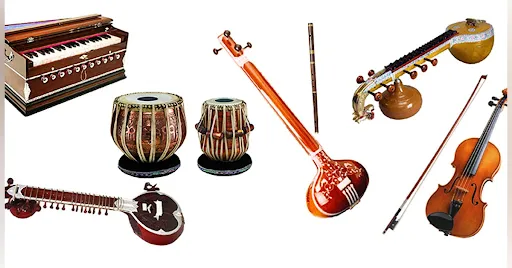
Hindustani music uses string, wind, and percussion instruments to produce melody, rhythm, and tonal support. Instruments such as the sitar, sarod, tabla, and sarangi are closely associated with its performance tradition.
- Sitar: A plucked string instrument widely associated with Hindustani classical music and known for its resonating strings.
- Sarod: A fretless string instrument valued for its deep, resonant tone and used for both solo performance and accompaniment.
- Sarangi: A bowed string instrument capable of closely imitating the expressive qualities of the human voice.
- Tabla: A pair of drums that provides the principal rhythmic accompaniment in many Hindustani performances.
- Pakhawaj: A barrel-shaped, double-headed drum traditionally associated with Dhrupad.
- Bansuri: A bamboo flute used as a major melodic wind instrument in Hindustani music.
- Shehnai: A reed wind instrument traditionally associated with auspicious occasions, ceremonies, and religious performances.
- Tanpura: It provides the continuous drone or shruti, creating the tonal foundation for a performance.
- Harmonium: A keyboard instrument commonly used for vocal accompaniment, particularly in lighter classical and semi-classical forms.
Hindustani Music and Carnatic Music Difference
Hindustani and Carnatic music are the two major traditions of Indian classical music. While both share common foundations such as Raga, Tala and Swara, they differ in their historical development, musical styles and performance practices.
| Basis | Hindustani Music | Carnatic Music |
|
Region |
Predominantly practised in North India. |
Predominantly practised in South India. |
|
Historical Influence |
Influenced by Persian, Central Asian and indigenous musical traditions. |
Retains stronger continuity with ancient Indian musical traditions. |
|
Nature |
Emphasises improvisation and elaborate melodic exploration. |
Emphasises structured compositions and intricate rhythmic patterns. |
|
Major Forms |
Dhrupad, Dhamar, Khayal, Thumri, Tappa and Tarana. |
Kriti, Varnam, Ragam-Tanam-Pallavi and Javali. |
|
Raga System |
Uses the 10-Thaat classification system developed by V.N. Bhatkhande. |
Uses the 72-Melakarta system of parent ragas. |
|
Instruments |
Sitar, Sarod, Sarangi, Santoor, Shehnai and Tabla. |
Veena, Violin, Mridangam, Ghatam and Nadaswaram. |
|
Performance Style |
Often begins with an elaborate, unaccompanied Alap followed by rhythmic compositions. |
Commonly follows a structured sequence involving compositions and improvisational sections. |
|
Prominent Exponents |
Tansen, Bhimsen Joshi, Ravi Shankar, Bismillah Khan and Amir Khan. |
Tyagaraja, Muthuswami Dikshitar, Syama Sastri, M.S. Subbulakshmi and Balamuralikrishna. |
|
Patronage |
Historically received patronage from royal courts, particularly during the Mughal period. |
Traditionally developed through temples, royal courts, and religious institutions, particularly in South India. |
Hindustani Music Significance
Hindustani music is a major tradition of North Indian classical music, shaped by centuries of interaction between indigenous musical traditions, devotional movements, and courtly cultures. Its significance extends to India’s cultural heritage, artistic expression, and musical traditions.
- Cultural Heritage: Preserves centuries-old traditions of ragas, talas, compositions, and performance practices.
- Ganga-Jamuni Culture: Reflects the interaction of Indian, Persian, and Central Asian influences, particularly in its medieval development.
- Bhakti and Sufi Traditions: Provided a medium for expressing devotional and spiritual themes, helping music reach wider sections of society.
- Musical Innovation: Developed diverse forms such as Dhrupad, Khayal, Thumri, and Tarana, offering different approaches to musical expression.
- Gharana Tradition: Gharanas preserve distinctive styles, repertoires, and methods of musical training through the guru–shishya tradition.
- Mental Well-being: The meditative nature of Carnatic music can promote relaxation, stress reduction, and mental well-being.
- Cultural Integration: Its development across different courts, regions, and communities demonstrates the evolution of India's composite cultural traditions.
- Global Outreach: Indian musicians have taken Hindustani classical music to international audiences through concerts, teaching, and cultural exchanges.
Hindustani Music UPSC PYQs
Q1: A community of people called Manganiyars is well-known for their (UPSC Prelims 2014)
(a) martial arts in North-East India
(b) musical tradition in Northwest India
(c) classical vocal music in South India
(d) pietra dura tradition in Central India
Ans: (b)

 Last updated on Oct, 2026
→ UPSC 2027 Notification will be released on 13 January 2027 at upsconline.nic.in.
→ Check Nobel Prize 2026 Winners List here.
→ Download PIB PRiSM Monthly Magazine 2026 here.
→ Check UPSC Monthly Current Affairs Magazine The Recitals here.
→ Check out the latest UPSC Syllabus here.
→ Download UPSC Model Answers for Mains 2026
→ UPSC Mains Question Paper 2026 is out now for Essay & GS Paper 1, 2, 3 & 4.
→ UPSC Calendar 2027 has been released.
→ Enroll in Vajiram & Ravi’s UPSC Mains Test Series 2027 for structured answer writing practice, expert evaluation, and exam-oriented feedback.
→ Join Vajiram & Ravi’s UPSC Mentorship Program 2027 for personalized guidance, strategy planning, and one-to-one support from experienced mentors.
→ Go through the UPSC Mains Previous Year Papers to enhance your preparation.
→ UPSC has released UPSC Toppers List 2025 with the Civil Services final result on its official website.
→ Also check Best UPSC Coaching in India
Hindustani Music FAQs
Q1. What is Hindustani music?+
Q2. What is thaat in Hindustani music?+
Q3. What are the 12 notes of Hindustani music? +
Q4. Who is the father of Hindustani music?+
Q5. Who are the top 10 Hindustani classical singers?+
Tags: hindustani music quest UPSC Art and Culture Notes