Carnatic music, also known as Karnataka Sangeetha, is a classical music tradition that has its roots in the Southern part of India. It is largely based on kritis and emphasises each composition's saahitya, or lyrical content. The southern Indian states of Karnataka, Andhra Pradesh, Telangana, Tamil Nadu, and Kerala are major centres of this musical style. Its structured development began around the 14th century. It reached a significant peak during the 18th and 19th centuries, largely due to the contributions of the renowned musical trinity - Tyagaraja, Muthuswami Dikshitar, and Syama Sastri.
The lyrics of Carnatic music are mostly devotional, with the majority of the songs being dedicated to Hindu gods. Many songs focus on love and other social issues, or they are based on the idea of sublimating human emotions to achieve union with the divine.
Carnatic Music About
Carnatic music is the classical music tradition of South India. It is primarily Kriti-based, with greater emphasis on the lyrical content (Sahitya) and structured musical compositions set to specific ragas and talas.
- Nature and Structure: Carnatic music follows the traditional octave and places importance on composed musical pieces called Kritis. These compositions combine melody, rhythm, and devotional lyrics.
- Components of Kriti: A Kriti generally consists of three main sections—Pallavi (opening thematic lines), Anupallavi (the section following Pallavi), and Charanam (the concluding section).
- Other Musical Forms: Varnam is generally performed at the beginning of a recital to introduce the raga, while Ragamalika often appears towards the conclusion and allows improvisation across different ragas.
Father of Carnatic Music
Purandara Dasa (1484–1564) is revered as the Pitamaha (Father) of Carnatic music for systematising its teaching methods. He introduced graded musical exercises such as Sarali Varisai, Janta Varisai and Alankaras, which continue to form the foundation of Carnatic music training.
Carnatic Music Origin and History
Ancient music dates back to the Vedic Age and the Sangita Ratnakara period, following which the medieval musical system developed. Around the 14th century, it culminated in the bifurcation of Indian music into two branches- Hindustani and Carnatic systems.
- The two distinct styles became popular following the arrival of Muslims, particularly during the reign of the Mughal Empire of Delhi.
- Deogiri, the Yadava capital, was the centre of South Indian music during the Middle Ages. Following the Muslim conquest and looting of the city, the entire city's cultural life fled to the Carnatic Vijayanagar Empire, which was ruled by Krishnadevaraya.
- Advent of Purandaradasa, 1484: Known as the "Karnataka Sangita Pitamaha", Saint Purandara Dasa established the Malavagowla scale as the foundational scale for teaching music.
- He simplified the 108 ancient Talas into a system of 35 Talas. He formulated Sarali Varisa, Sapta tala Alankaras, Gitas in Malahari Raga, and systematised the Abhyasagana for beginners.
- The ancient tala system's shadangas were mostly replaced by laghu, Druta, and Anudruta in the new system. The chapu talas were also widely employed for the many religious hymns known as "Dasara Padagalu" or "Kirtanas".
- Venkatamakhi's 'Chaturdandiprakaashikaa' (1650 AD): He classified all the raagas of Karnatak music within the framework of seventy-two melakartaas or 72 janaka or major raagas and laid them down in his monumental work Chaturdandi Prakasika.


Carnatic Music Features
Carnatic music emphasises vocal music, devotional compositions and intricate melodic and rhythmic patterns. The system of ragas (melodic scales) and talas (rhythmic cycles) is the basis of Carnatic music. Core musical elements include:
- Sruti: It is the raw sound of Carnatic music and refers to the composition's musical pitch.
- Raga (Melodic Framework): Built on 72 parent scales called Melakartas, from which hundreds of derived ragas are created.
- Tala (Rhythmic Cycle): Maintained through fixed beat cycles like Adi (8 beats), Rupaka (3 beats), and Mishra/Khanda Chapu, using hand gestures to track time.
- Swarams (Notes): The seven basic notes are Shadjam (Sa), Rishabham (Ri), Gandharam (Ga), Madhyamam (Ma), Panchamam (Pa), Dhaivatam (Da), and Nishadham (Ni).
- Instrumentation: Traditionally anchored by the Tanpura (drone), Mridangam or Ghatam (percussion), and violin or flute for melodic accompaniment.
- Kriti-Based Music: This music is Kriti-based. The minimum and most important angas of a kriti are the pallavi, anupallavi, and charana. There may be one or more charanas.
- First, the pallavi is sung, and then the anupallavi. At the end of the anupallavi, the pallavi is repeated. The charana is next sung.
Carnatic Music Trinity
The Trinity of Carnatic Music (also called the Three Jewels or Tiruvarur Trinity) refers to three legendary composer-musicians who transformed South Indian classical music in the late 18th and early 19th centuries: Tyagaraja, Muthuswami Dikshitar, and Syama Sastri.
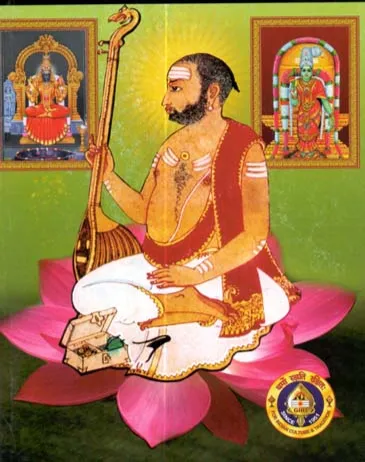
- Sri Shyama Shastri (1763-1827): Almost all of his kritis are dedicated to Kanchi's mother goddess, Kamakshi. The Language of his kritis is Telugu and Sanskrit.
- He composed nine kritis dedicated to Meenakshi of Madurai, collectively known as the Navaratnamalika. His compositions are especially renowned for their exceptional rhythmic brilliance.
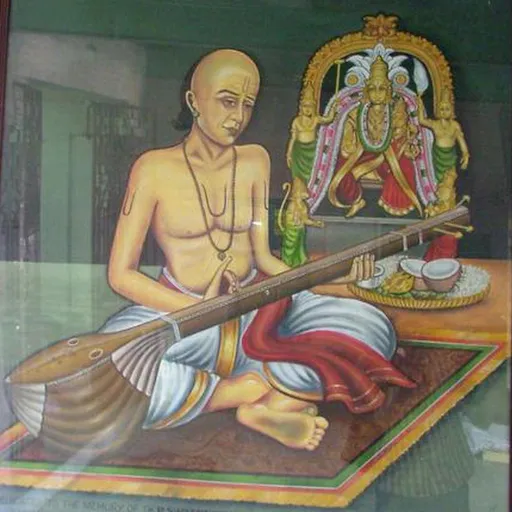
- Sri Tyagaraja (1767-1847): He composed more than 1000 kritis and several Samudayakritis (Group Kritis), such as Ghana Raga Pancharatna, groups of Utsava Sampradaya kritis, and also three beautiful musical operas, Prahlada Bhakti Vijayam, Nowka Charitram, and Sri Sita Rama Vijayam.
- The language of the kritis is Telugu and Sanskrit. For some of his Kritis, he used Desadi and Madhyadi Talas. He was a devotee of Lord Rama.
- Muthuswami Dikshitar (1775-1835): He was an upasaka of Sri Vidya and wrote most of the Kritis on Devi in Sanskrit. The Kritis are brilliant, with musical and literary beauties such as swaraksharas, various Mudras, Samashti Charana, Madhyama Kala Sahityas, Yati-Prasas, and so on.
- Dikshitar was a specialist in writing for the scholarly group Kritis. Astrology's Navagraha Kritis and Tantra Shastra's Kamalamba Navavarana are two examples.
Musical Forms of Carnatic Music
In Carnatic music, a study of the structure of its present form - kriti, keertanam, varnam, padam, jaavali, etc. makes it fairly clear that this music maintains the ancient traditions of the prabandhas more closely and rigidly than Hindustani music.
- Gitam: This form's music is just a pure melodic extension of the raga it is written in.
- Suladi: The Suladi is a talamalika, the sections being in different talas. Purandaradasa has composed many Suladis.
- Svarajati: It began as a dance style with jatis (tala, solfa syllables such as taka tari kita naka tatin gina tam) attached. But later, Syama Sastri composed svarajatis without jatis.
- Jatisvaram: This form has no sahitya or words. The piece is sung with solfa syllables only.
- Varnam: Unlike other Carnatic musical forms, the Varnam has no equivalents in Hindustani music either. The Varnam combines all of the distinctive qualities of the raga it is composed for, making it a stunning example of high-quality musical artistry.
- Kirtanam: It is esteemed for the sahitya's devotional content. It is appropriate for both solo presentation and congregational singing.
- Both Tyagaraja and Bhadrachalam Ramadasa composed a large number of Kirtanams.
- Kriti: A composition that primarily derives its claim to permanence from its music rather than its saahitya is referred to as "kriti." The development of aesthetic enjoyment is the primary motivation behind the kriti.
- Javali: A javali is a composition belonging to the sphere of light classical music. This form resembles the Thumris of Hindustani Music.
- Padam: Padams are scholarly compositions. The term is limited to compositions that fall under the dance music category. The song flows organically and is slow and solemn.
- Tillana: The Tillana is a brief and clear form that is comparable to the Tarana in Hindustani music. A Tillana's Sahitya could be in Tamil, Telugu, or Sanskrit.
Carnatic Music Instruments
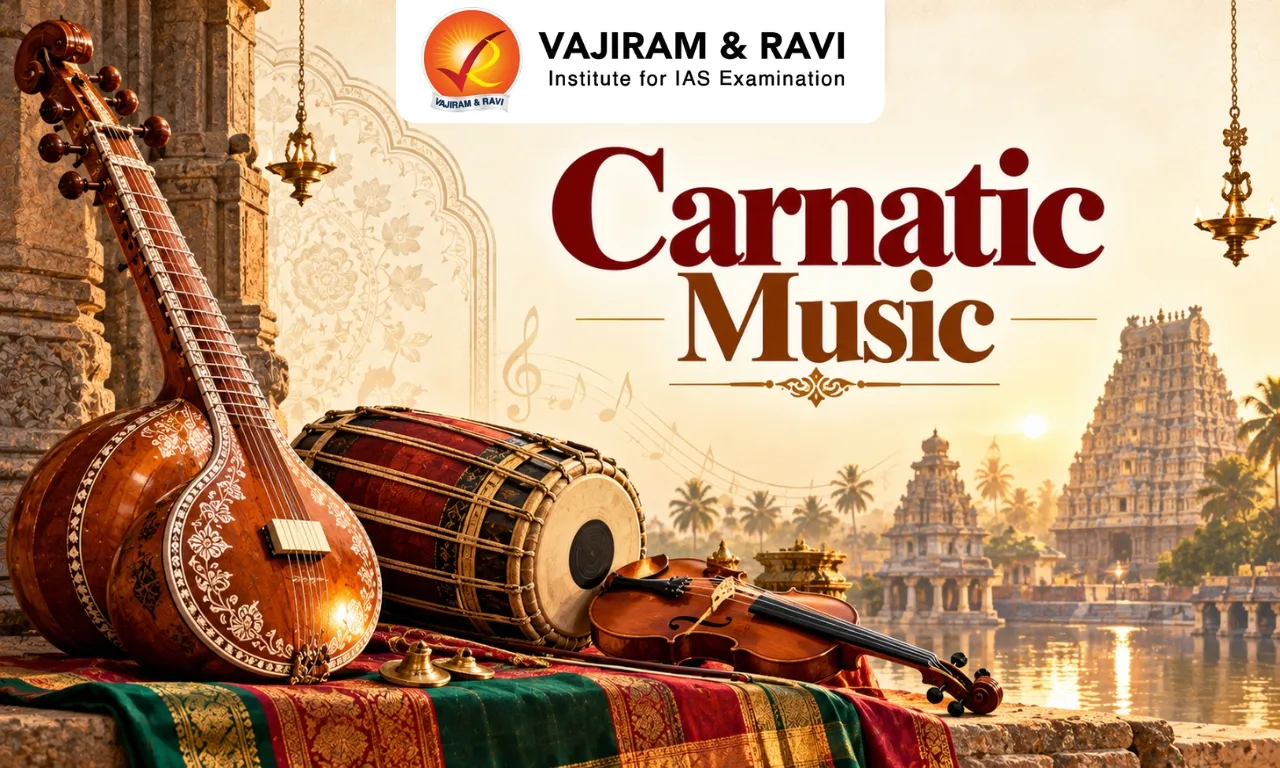
Carnatic music employs string, wind, and percussion instruments for melody, rhythm, and tonal support. Instruments such as the veena, violin, and mridangam form an integral part of its performance tradition.
- Veena: A principal string instrument, known for producing the characteristic gamakas of Carnatic music.
- Violin: It is widely used for melodic accompaniment to vocalists and is also performed as a solo instrument.
- Mridangam: The principal rhythmic accompaniment, providing the basic tala framework of concerts.
- Ghatam: A clay-pot percussion instrument used to provide additional rhythmic patterns.
- Kanjira: A small frame drum used as a rhythmic accompaniment, often alongside the mridangam.
- Nadaswaram: A powerful wind instrument traditionally associated with temples, processions, and auspicious occasions.
- Tavil: A barrel-shaped percussion instrument commonly played alongside the nadaswaram.
- Flute (Venu): A bamboo wind instrument used for melodic performance in Carnatic music.
- Tambura: Provides the continuous sruti/drone, establishing the tonal base of a performance.
- Chitraveena (Gottuvadyam): A fretless string instrument capable of producing smooth melodic movements and gamakas.
Carnatic Music Vocalist
During the years that extend from 1930 to 1960, several Carnatic vocalists of greater skill rose to fame. D. K. Pattammal, M. L. Vasanthakumari, and M. S. Subbulakshmi are referred to as the female trinity of Carnatic music.
- M.S. Subbulakshmi was the first musician ever to be awarded the Bharat Ratna.
- The leading male vocalists of Carnatic music were Muthiah Bhagavathar, Vasudevachar, Chintalapalli Venkata Rao, Asthan Vidwan Chintalapalli Ramachandra Rao, Kanchipuram Naina Pillai, and so on.
Carnatic Music vs Hindustani Music
Carnatic and Hindustani music are the two major traditions of Indian classical music. While both share concepts such as raga, tala, and improvisation, they developed distinct styles due to different historical and regional influences.
| Basis | Carnatic Music | Hindustani Music |
|
Region |
Mainly South India. |
Mainly North and Central India. |
|
Historical Influence |
Strongly shaped by temple, Bhakti, and South Indian traditions. |
Influenced by Persian, Central Asian, and Mughal traditions. |
|
Core Emphasis |
Greater emphasis on composed kritis and structured improvisation |
Greater emphasis on raga development and improvisation. |
|
Raga System |
Uses the 72 Melakarta system as its theoretical framework. |
Uses the Thaat system, traditionally associated with Vishnu Narayan Bhatkhande. |
|
Common Forms |
Kriti, Varnam, Tillana, Ragam-Tanam-Pallavi. |
Dhrupad, Khayal, Thumri, Tarana. |
|
Improvisation |
Raga Alapana, Neraval, Kalpana Swara. |
Alap, Bol Alap, Taan, Bol Taan. |
|
Rhythm |
Uses tala systems such as Adi, Rupaka, and Misra Chapu. |
Uses talas such as Teental, Ektaal, and Jhaptal. |
|
Major Instruments |
Veena, Mridangam, Violin, Nadaswaram. |
Sitar, Sarod, Tabla, Bansuri, Sarangi. |
|
Important Composers |
Carnatic Trinity – Tyagaraja, Muthuswami Dikshitar, Syama Sastri. |
Major figures include Tansen, Swami Haridas, and Sadarang. |
|
Performance Style |
Often combines fixed compositions with extensive mathematical/rhythmic improvisation. |
Often develops the raga progressively, especially through alap and taan. |
Carnatic Music Significance
Carnatic music is a major tradition of Indian classical music that evolved in South India. Its significance extends beyond musical performance, contributing to Bhakti traditions, cultural identity, literature, and the preservation of India's intangible heritage.
- Cultural Heritage: Preserves centuries-old traditions of South Indian music, compositions, and performance practices.
- Bhakti Tradition: Strongly connected with devotional traditions, with compositions of Tyagaraja, Muthuswami Dikshitar, and Syama Sastri expressing devotion.
- Literary Contribution: Carnatic compositions integrate Tamil, Telugu, Kannada, and Sanskrit literature with music.
- Regional Identity: Serves as an important expression of the cultural identity of South India, particularly Tamil Nadu, Karnataka, Andhra Pradesh, and Kerala.
- Musical Innovation: Its sophisticated use of raga, tala, gamaka, and improvisation demonstrates India's highly developed musical tradition.
- Guru–Shishya Tradition: Sustains traditional methods of oral learning and direct transmission of musical knowledge.
Carnatic Music Challenges
Carnatic music faces several challenges that affect its practice, accessibility, and continuity across generations.
- Limited Audience Reach: Carnatic music is often perceived as complex and traditional, restricting its appeal among younger and wider audiences.
- Declining Patronage: Reduced support from traditional patrons and limited institutional funding can affect concerts, training, and opportunities for emerging artists.
- High Cost of Learning: Long-term training under experienced gurus, along with the cost of instruments and concert participation, can make learning inaccessible to many.
- Generational Gap: The declining interest of some younger generations in traditional music poses challenges to the transmission of knowledge and performance traditions.
- Commercialisation: Greater emphasis on popular and commercial formats may weaken the space available for traditional compositions and less widely performed ragas.
- Regional and Language Barriers: Its strong association with South Indian languages and cultural traditions can limit its reach among audiences unfamiliar with them.
Carnatic Music UPSC PYQs
Q1: Which one of the following Carnatic music ragas is similar to Raga Bilawal in Hindustani music? (UPSC Prelims 2026)
a) Nat Bhairavi
b) Kamavardhini
c) Hanumatodi
d) Dheera Shankarabharanam
Ans: (d)
Q2: With reference to the cultural history of India, consider the following statements: (UPSC Prelims 2018)
- Most of the Tyagaraja Kritis are devotional songs in praise of Lord Krishna.
- Tyagaraja created several new ragas.
- Annamacharya and Tyagaraja are contemporaries.
- Annamacharya kirtanas are devotional songs in praise of Lord Venkateshwara.
Which of the statements given above are correct?
(a) 1 and 3 only
(b) 2 and 4 only
(c) 1, 2, and 3
(d) 2, 3, and 4
Ans: (b)

 Last updated on Oct, 2026
→ UPSC 2027 Notification will be released on 13 January 2027 at upsconline.nic.in.
→ Check Nobel Prize 2026 Winners List here.
→ Download PIB PRiSM Monthly Magazine 2026 here.
→ Check UPSC Monthly Current Affairs Magazine The Recitals here.
→ Check out the latest UPSC Syllabus here.
→ Download UPSC Model Answers for Mains 2026
→ UPSC Mains Question Paper 2026 is out now for Essay & GS Paper 1, 2, 3 & 4.
→ UPSC Calendar 2027 has been released.
→ Enroll in Vajiram & Ravi’s UPSC Mains Test Series 2027 for structured answer writing practice, expert evaluation, and exam-oriented feedback.
→ Join Vajiram & Ravi’s UPSC Mentorship Program 2027 for personalized guidance, strategy planning, and one-to-one support from experienced mentors.
→ Go through the UPSC Mains Previous Year Papers to enhance your preparation.
→ UPSC has released UPSC Toppers List 2025 with the Civil Services final result on its official website.
→ Also check Best UPSC Coaching in India
Carnatic Music FAQs
Q1. What is the Carnatic style of music?+
Q2. What are the top 10 Carnatic songs?+
Q3. Why is Carnatic music called Carnatic?+
Q4. What are the 72 ragas in Carnatic music?+
Q5. Who composed Carnatic music?+
Tags: carnatic music quest UPSC Art and Culture Notes