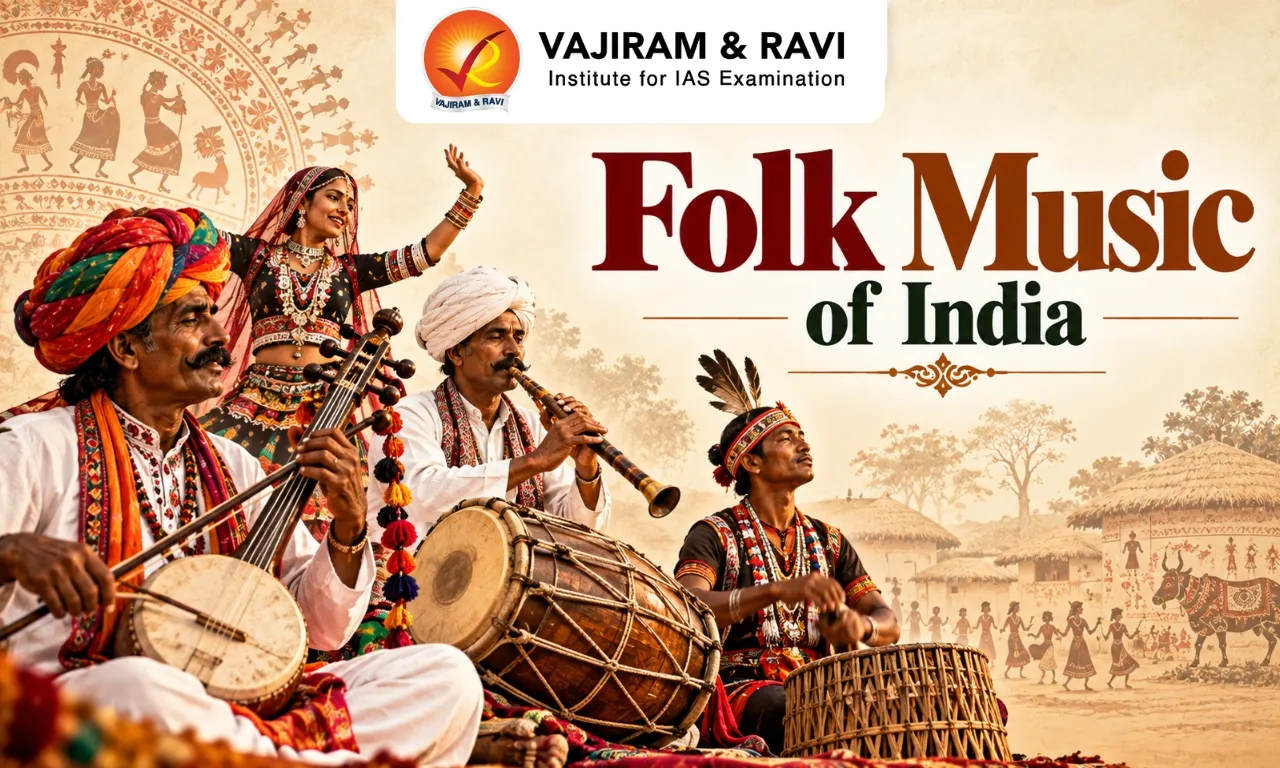
Folk Music of India represents the musical traditions developed and preserved by communities across the country. These traditions express everyday experiences through songs about farming, festivals, marriage, love, migration, devotion, and local history. They form an important part of India’s intangible cultural heritage, alongside traditional dance, theatre, and storytelling.
From the Baul songs of Bengal to Rajasthan’s Kalbelia traditions, Indian folk music connects performance with community identity. Its preservation involves not only recording songs but also supporting singers, instrumentalists, instrument makers, and the transmission of knowledge between generations.
Folk Music of India About
Folk music of India refers to musical expressions rooted in the shared life and traditions of a community. It is often learned through listening, observation, participation, and practice rather than exclusively through written notation. UNESCO’s documentation of Kalbelia traditions, for example, describes songs transmitted orally without formal texts or training manuals.
- Different from Classical Music: Unlike classical music, which generally follows more formalised systems of musical training and composition, folk music often develops within local communities and is closely connected with everyday experiences.
- Regional Diversity: India's geographical and cultural diversity has given rise to numerous folk music traditions. Examples include Baul music of West Bengal, Maand of Rajasthan, Bihu songs of Assam, Lavani of Maharashtra, Mando of Goa and Pandavani of Chhattisgarh.
- Themes and Content: Folk songs are based on diverse aspects of life, including agriculture, festivals, religious beliefs, love, local legends, and social experiences.
Folk Music of India Origin and History
The origin of Indian folk music cannot be traced to a single date or individual. It developed gradually through community life, oral traditions, religious practices and regional cultural interactions.
- Ancient Period: Music has been associated with religious ceremonies, storytelling, agricultural activities and community celebrations since the prehistoric period.
- Vedic Period: Ancient Indian textual traditions, including Vedic chanting, provide evidence of the long history of organised vocal traditions in the subcontinent. However, Vedic chanting belongs to a distinct ritual and textual tradition and should not automatically be classified as folk music.
- For example, Pandavani, a folk tradition popular in Central India, is said to be as old as the Mahabharata, as its narrative focuses on the heroic exploits of Bhima from the epic.
- The Natyashastra, a classical text by Bharata Muni, also highlights the significance of folk music in shaping the foundations of both folk and classical Indian music.
- Medieval Period: During the medieval period, folk music evolved alongside regional kingdoms, devotional movements and Sufi traditions. The Bhakti movement encouraged devotional expression through accessible languages and musical forms.
- Regional traditions such as Abhangas in Maharashtra and Baul music in Bengal reflect distinctive devotional and philosophical approaches.
- Evolution Over Time: Over the centuries, Indian folk music has evolved, influenced by invasions, migrations, and cultural exchanges. The Mughal era introduced Persian styles like Qawwali and Ghazal, while British colonial rule brought Western musical elements, leading to hybrid genres.


Folk Music of India Characteristics
Folk music of India, both traditional and modern, has deep roots in cultural traditions, passed down orally across generations. It often originates from rural communities and serves various purposes, from expressing cultural identity to accompanying activities like harvests, weddings, and religious rituals.
- Oral Transmission: Folk music of India is traditionally passed down through generations orally, without written notation.
- Anonymous Origin: The original composers are often unknown, allowing the music to evolve and spread organically within communities.
- Use of Traditional Instruments: Folk music of India is typically performed using traditional, region-specific instruments, which contribute to its cultural authenticity.
- Expression of Cultural Identity: It often embodies themes of cultural or national identity, reflecting the customs and values of specific regions or communities.
- Connection with Everyday Life: Folk music frequently reflects everyday experiences, including farming, fishing, marriage, childbirth, migration, festivals and family relationships.
- For instance, Koli songs are associated with fishing communities in Maharashtra, while Sohar songs in parts of northern India are traditionally sung to celebrate childbirth.
- Rural Origins: Folk music has historically been rooted in rural traditions, closely linked to the everyday lives and occupations of local populations.
- Collective Participation: Unlike contemporary performances, folk music was traditionally participatory, with entire communities involved in singing and playing, rather than being mere spectators.
Folk Music of India State Wise List 2026
Folk music of India varies from state to state, reflecting differences in language, geography, religious practices, occupations and community life. In South India, folk music played a key role in socio-religious reforms, with leaders like Adi Shankaracharya using songs to spread their messages. Some folk songs are tied to local dance forms, creating a rich blend of music and movement, with each Indian state having its own cherished folk traditions as follows:
| State/Union Territory | Folk Music Styles |
|
Sikkim |
Lepcha, Gha, Kito |
|
Punjab |
Tappe, Sithnian, Chhand, Heara, Lorian |
|
Arunachal Pradesh |
Ja-Jin-Ja, Baryi, Nyioga |
|
Jammu and Kashmir |
Ladishah, Sufiana Kalam, Hafiz Nagma |
|
Assam |
Bihu songs, Bodo, Karbi, Mising |
|
Karnataka |
Karadimajal, Yakshagana, Janapada Geethe |
|
Goa |
Dekhn, Foogdi, Dhalo, Mando |
|
Nagaland |
Heliamleu, Hereileu, Neuleu, Hekialeu |
|
Haryana |
Jogis, Bhats, Sangis |
|
Maharashtra |
Lavoni, Pavodas, Gondhal, Tamasha |
|
Tripura |
Jaduni, Sarbang, Chamari Tunmani, Kuchuk Ha Sikam, Goria Rwmani, Reser Khakra, Waying Khilimani |
|
Mizoram |
Bawh Hla, Hlado, Dar Hla, Puipun Hla |
|
Manipur |
Khullang eshei, Thabal chongba, Nupi pala, Gaur Padas |
|
Kerala |
Kathakali Music, Mappila Pattu, Ottamthullal Songs, Sopanam, Oppana, Kol Kali |
|
Uttarakhand |
Mandals, Panwaras, Jhoda, Thadya |
|
Himachal Pradesh |
Jjhoori, Laman, Samskara, Ainchaliyan |
|
Tamil Nadu |
Pulayar melodies, Talams, Pann |
|
Uttar Pradesh |
Rasiya, Birha, Chaiti, Kajari, Ghazals, Thumari, Khayal, Marsiya, Qawwali |
|
Andhra Pradesh |
Madiga Dappu, Mala Jamidika |
|
Telangana |
Oggukatha, Sarada Kala, Suvvi Paatalu |
|
Odisha |
Avanti, Panchali, Odramagadhi |
|
Bihar |
Sohar, Sumangali, Ropnigeet, Katnigeet |
|
Chhattisgarh |
Sohar, Bihav, Sua, Goura, Khuduwa, Pathoni, Faag, Sawnahi, Cher Chera, Dohe, Bhojali |
|
Gujarat |
Dayro, Lokvarta, Marasiyas, Fattanna, Lagna-geets, Kabir Vani, Sidi in Kutchh |
|
Madhya Pradesh |
Relo, Dhankul, Leha, Pai, Nirguni Lavani, Shringari Lavani |
|
West Bengal |
Bishnupur Gharana, Baul Sangeet, Rabindra Sangeet, Nazrul Geeti, Dwijendrageeti, Jeebonmukhi, Adhunik |
|
Jharkhand |
Dohari, Domkach, Janani, Jhumar, Jhumta, Mardana, Daidhara, Pahil Sanjha, Adhratiya, Vinsaria |
|
Rajasthan |
Panihari songs, Maand, Pabuji Ki Phach, Manganiars, Langas music |
Famous Folk Music of India Regional Styles
Folk music of India often extends across geographical boundaries, with neighbouring regions sharing similar musical traditions due to cultural exchange and common historical influences.
Baul (West Bengal)
Baul is a mystical folk music tradition associated with travelling spiritual minstrels of West Bengal. It reflects elements of Hindu Bhakti and Sufi philosophy. Its songs express devotion, mysticism, and the search for the divine through human experience. Baul traditions have also influenced Bengali literature and music, including the work of Rabindranath Tagore.
Wanawan (Kashmir)
Wanawan is a traditional Kashmiri folk music form associated with wedding ceremonies. It is sung by women during various stages of traditional Kashmiri marriages and expresses blessings, joy, and good wishes for the bride and groom.
Pandavani (Chhattisgarh)
Pandavani is a traditional musical storytelling form in Chhattisgarh that narrates episodes from the Mahabharata. Pandavani focuses particularly on the life and heroic deeds of Bhima and it combines expressive singing, dramatic narration, and instrumental accompaniment, often using the tambura. Teejan Bai is a renowned exponent.
Panihari (Rajasthan)
Panihari is a traditional Rajasthani folk music form depicting the everyday experiences of rural women. It describes women's journeys to fetch water from wells, reflecting the scarcity of water in desert regions, and portrays love, relationships, and domestic life in rural communities.
Lavani (Maharashtra)
Lavani is a popular folk music and dance tradition from Maharashtra known for its energetic rhythm and expressive performance. It is a blend of traditional singing and dance that is typically performed to the rhythms of the Dholki, a percussion instrument, and combines powerful singing with energetic dance movements, traditionally performed by women.
Mando (Goa)
Mando is a traditional Goan musical form that reflects the region's cultural interactions and historical influences. It combines Indian musical traditions with Western influences, particularly Portuguese elements, and commonly uses instruments such as the guitar, violin, and Ghumot drum.
Dandiya Raas (Gujarat)
Dandiya Raas is a traditional folk dance of Gujarat, associated with the divine love of Radha and Krishna and the celebrations of Navratri. It is traditionally linked to the Holi festivities and the Raas Leela of Krishna and Radha at Vrindavan. Men and women dance in two circles, rhythmically striking decorated sticks (dandiyas) held in their hands.
Alha (Madhya Pradesh)
This form is from Madhya Pradesh and is a heroic ballad song with intricate words. It is usually sung in different languages like Braj, Awadhi, and Bhojpuri. This form is also related to the epic Mahabharata, as they try to glorify the heroes who are the reincarnations of the Pandavas.
Ovi (Maharashtra and Goa)
Ovi is from Maharashtra and Goa and consists of traditional songs, often sung by women during household activities, leisure, and social occasions. These songs commonly express family life, marriage, motherhood, and everyday experiences.
Pai Song (Madhya Pradesh)
Pai songs are from Madhya Pradesh, associated with the Saira dance, and are traditionally performed during festivals, particularly in the rainy season. Their lyrics often express prayers for good monsoons and a successful harvest.
Powada (Maharashtra)
Powada is a fast-paced heroic ballad tradition from the state of Maharashtra that narrates the bravery and achievements of historical figures, particularly Chhatrapati Shivaji Maharaj. Its performers, known as Shahirs, use energetic singing and rhythmic accompaniment.
Khongjom Parva (Manipur)
Khongjom Parva is a musical narrative from the state of Manipur commemorating the Battle of Khongjom (1891), fought between British forces and Manipuri resistance fighters. Its songs honour the courage and sacrifice of Manipuri soldiers.
Bhavageete (Karnataka and Maharashtra)
Bhavageete are emotional songs that are very popular amongst the masses in Karnataka and Maharashtra. They refer to emotional and lyrical songs expressing feelings, love, nature, and philosophical ideas. Their musical style is often compared to the ghazal tradition.
Kolattam (Southern India)
Kolattam is a traditional stick-dance form popular in Andhra Pradesh, Karnataka, and Tamil Nadu, in which participants move rhythmically in groups while striking sticks together. It is accompanied by folk songs and is similar in performance style to Gujarat's Dandiya Raas.
Naatupura Paatu (Tamil Nadu)
Naatupura Paatu refers to Tamil folk music rooted in village and community life. It includes Gramathisai (village folk music) and Gana (urban folk music).
Veeragase (Karnataka)
Veeragase is a vigorous folk performance from Karnataka inspired by Hindu mythology, particularly the story of Veerabhadra. It is performed during religious occasions and processions, especially during Dussehra.
Basant Geet (Uttarakhand)
Basant Geet comprises seasonal folk songs from Uttarakhand associated with the arrival of spring and Basant Panchami. These songs celebrate nature, seasonal change, and local cultural traditions.
Villu Pattu (Tamil Nadu)
Villu Pattu, meaning Bow Song, is a musical storytelling tradition from Tamil Nadu in which a large bow is used as a percussion instrument. Performers narrate religious stories, folklore, and themes depicting the victory of good over evil.
Chhakri (Kashmir)
Chhakri is one of the popular traditional forms of Kashmiri folk music, usually performed as a group song. It commonly features rhythmic accompaniment and themes drawn from local stories and everyday life.
Pankhida (Rajasthan)
Rajasthani peasants sing and play algoza and manjira while working in the fields. The word "Pankhida" literally means "lover".
Laman (Himachal Pradesh)
In Laman, a group of girls sing a verse and a group of lads respond to the song. This continues for several hours. It's interesting to note that the girls singing on one of the hill's peaks rarely see the boys singing on another. In between is a hill that echoes their love song.
Folk Music of Northeast India
Northeast India features a rich mosaic of indigenous folk music styles tied to agricultural cycles, mythology, community events, and ancestral traditions.
| State | Folk Music |
|
Assam |
|
|
Manipur |
|
|
Arunachal Pradesh |
|
|
Nagaland |
|
|
Mizoram |
|
|
Meghalaya |
|
|
Sikkim |
|
|
Tripura |
|
Folk Music Instruments
Folk music of India uses a wide variety of locally crafted instruments, often made from materials such as wood, bamboo, leather, metal and natural fibres. Their forms and uses vary according to regional traditions and community practices.
- Dhol: A double-headed drum widely used in Punjab, Rajasthan, Gujarat and other regions during festivals, dances and celebrations.
- Dholak: A smaller two-headed drum commonly accompanying folk songs, devotional music and social ceremonies across North India.
- Ektara: A simple single-string instrument associated particularly with Baul singers of Bengal and other itinerant musical traditions.
- Algoza: A pair of wooden flutes played together, strongly associated with Punjabi and Rajasthani folk traditions.
- Ravanhatha: A bowed string instrument traditionally associated with Rajasthan, particularly Bhopa performers.
- Tumbi: A small, high-pitched single-string plucked instrument closely associated with Punjabi folk music.
- Khartal: A pair of wooden clappers used to provide rhythmic accompaniment, especially in Rajasthani folk and devotional performances.
- Nadaswaram: A powerful double-reed wind instrument prominent in Tamil Nadu, particularly in ceremonial and temple contexts.
- Ghumot: A traditional earthen percussion instrument from Goa, used prominently in Goan folk and devotional music.
Indian Folk Music Artists
Indian folk music has been enriched by artists who have preserved regional musical traditions and brought them to wider audiences.
- Notable Indian folk musicians include Teejan Bai (Pandavani, Chhattisgarh), Gazi Khan Barna (Manganiyar folk music, Rajasthan), Malini Awasthi (Awadhi, Bhojpuri and other North Indian folk traditions), Bhai Baldeep Singh (Punjabi folk and traditional music) and Sharda Sinha (Bhojpuri and Maithili folk songs, Bihar).
Folk Music of India Significance
Folk music of India serves as a living expression of community life, preserving regional traditions while adapting to changing social conditions. Its importance extends beyond entertainment to cultural identity, social communication, and livelihoods.
- Cultural Identity: Distinctive songs such as Bihu of Assam and Baul of Bengal reflect the customs, beliefs, and collective identity of their communities.
- Social Bonding: Community singing during festivals, marriages, harvests, and religious occasions strengthens social relationships and collective participation.
- Social Awareness: Folk performers can communicate messages on health, education, environment, and social issues in familiar local languages.
- Livelihood Support: Performances at festivals, cultural events, and tourism venues provide income opportunities for traditional artists and artisan communities.
- Cultural Continuity: Oral transmission enables younger generations to learn regional languages, musical practices, and traditional values, helping sustain intangible cultural heritage.
- Creative Adaptation: Contemporary collaborations with films, fusion music, and digital platforms have introduced folk traditions to wider audiences while allowing them to evolve.
Folk Music of India Challenges
Folk music of India faces challenges from changing lifestyles, shrinking traditional audiences, and weak economic security for performers. Rapid modernisation has also made the transmission of several community-based traditions more difficult.
- Declining Patronage: Traditional performers often receive fewer opportunities as community-based patronage and local performance spaces decline.
- Commercialisation: Adaptation for commercial markets can sometimes dilute the original style, context, and cultural meaning of folk traditions.
- Economic Insecurity: Irregular performances and limited income make it difficult for traditional musicians to depend solely on folk music for their livelihoods.
- Loss of Traditional Instruments: Declining demand and fewer skilled instrument-makers can threaten the continued use of locally crafted folk instruments.
- Uneven Institutional Support: Government and cultural institutions provide support, but access to training, grants, platforms, and wider markets remains uneven across regions.
Folk Music of India Way Forward
Folk music of India preservation requires a balance between protecting traditional forms and enabling them to adapt to contemporary audiences. Greater livelihood support, documentation, and digital outreach can help keep these traditions relevant.
- Digital Documentation: Systematic recording of songs, performers, instruments, and regional traditions can safeguard oral heritage for future generations.
- Community Participation: Local communities and traditional practitioners should remain central to decisions concerning the documentation, presentation, and transmission of their traditions.
- Responsible Innovation: Collaboration with contemporary musicians can expand audiences while retaining the core musical identity and cultural context of traditional forms.
- Tourism Linkages: Cultural festivals and responsible heritage tourism can create regular performance platforms and income opportunities for folk artists.
- Global Outreach: Digital platforms and international cultural exchanges can provide wider visibility and new audiences for India's diverse folk traditions.

 Last updated on Oct, 2026
→ UPSC 2027 Notification will be released on 13 January 2027 at upsconline.nic.in.
→ Check Nobel Prize 2026 Winners List here.
→ Download PIB PRiSM Monthly Magazine 2026 here.
→ Check UPSC Monthly Current Affairs Magazine The Recitals here.
→ Check out the latest UPSC Syllabus here.
→ Download UPSC Model Answers for Mains 2026
→ UPSC Mains Question Paper 2026 is out now for Essay & GS Paper 1, 2, 3 & 4.
→ UPSC Calendar 2027 has been released.
→ Enroll in Vajiram & Ravi’s UPSC Mains Test Series 2027 for structured answer writing practice, expert evaluation, and exam-oriented feedback.
→ Join Vajiram & Ravi’s UPSC Mentorship Program 2027 for personalized guidance, strategy planning, and one-to-one support from experienced mentors.
→ Go through the UPSC Mains Previous Year Papers to enhance your preparation.
→ UPSC has released UPSC Toppers List 2025 with the Civil Services final result on its official website.
→ Also check Best UPSC Coaching in India
Folk music of India FAQs
Q1. What are the top 10 folk songs in India?+
Q2. What is folk music in India?+
Q3. What are the 7 types of folk songs?+
Q4. What are 7 popular folk dances in India?+
Q5. What are the types of folk music?+
Tags: folk music of india quest UPSC Art and Culture Notes