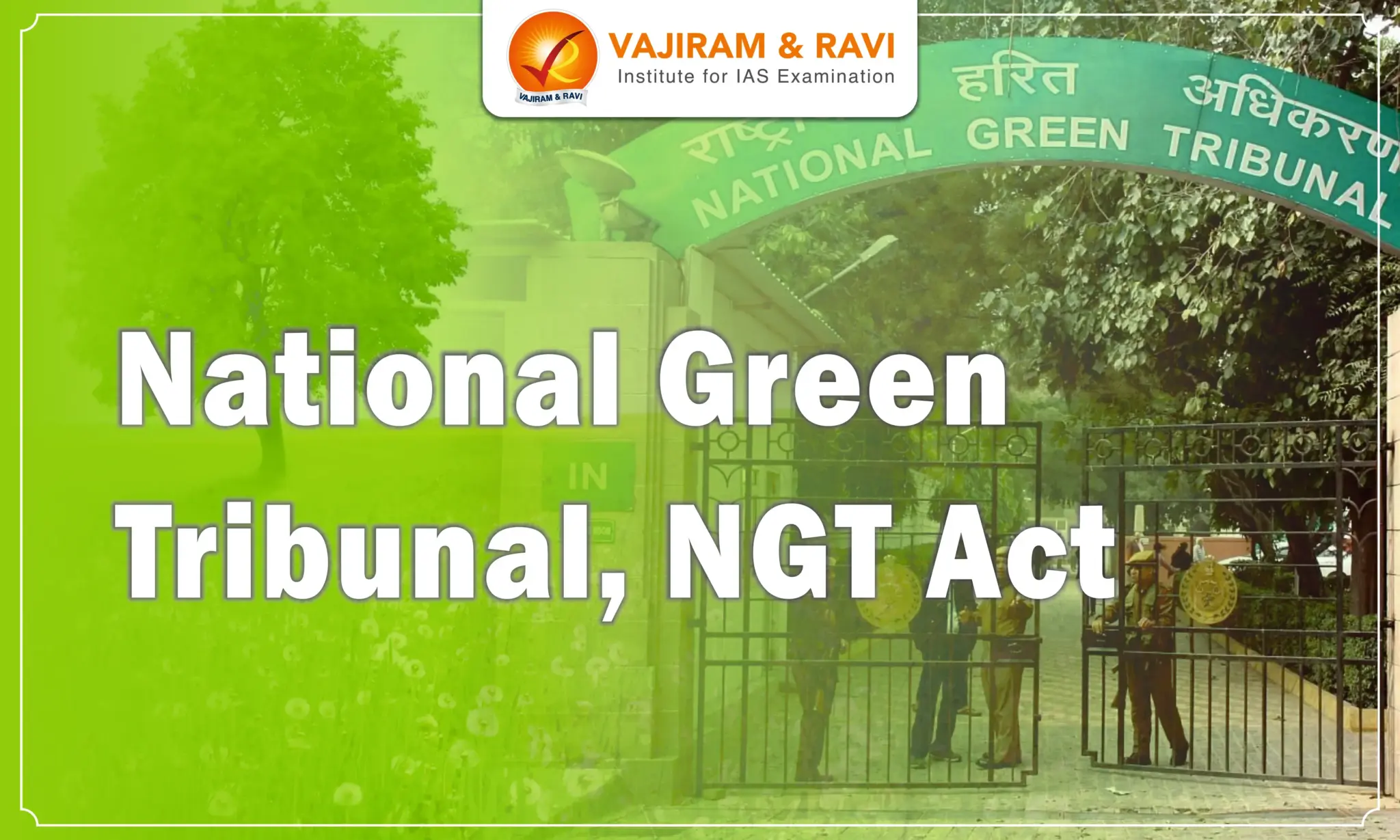
The National Green Tribunal (NGT), established in 2010, is a specialised body that fast-tracks environmental justice in India. It handles cases related to environmental protection, forest conservation, and environmental rights, offering compensation for damages caused by environmental violations. The NGT operates with a six-month case disposal target, guided by principles of natural justice. It is composed of a Chairperson, Judicial Members, and Expert Members, ensuring a balanced approach.
Despite challenges such as limited jurisdiction, financial constraints, and judicial delays, the NGT strives to strengthen environmental laws, encourage sustainable development, and reduce court burdens.
What is National Green Tribunal (NGT)?
The National Green Tribunal (NGT) was established on October 18, 2010, under the National Green Tribunal Act, 2010, to expedite environmental justice in India. As a specialized body, the NGT is dedicated to handling cases related to environmental protection, forest conservation, and the enforcement of legal rights associated with the environment, including compensation for damages to individuals and property from environmental violations. The tribunal also covers issues related to accidental health impacts from environmental causes.
National Green Tribunal Features
The National Green Tribunal (NGT) ensures efficient environmental dispute resolution with expert input, aims to resolve cases within six months, operates independently of the Civil Procedure Code, and has regional benches in New Delhi, Bhopal, Pune, Kolkata, and Chennai.
- Expertise and Speed: NGT’s framework includes multidisciplinary experts to ensure efficient and informed handling of environmental disputes.
- Independence from Civil Procedure: Guided by natural justice principles rather than the Civil Procedure Code, 1908, the NGT aims for faster resolutions.
- Six-Month Disposal Aim: The tribunal endeavours to resolve cases within six months from the filing date.
- Jurisdiction and Accessibility: Initially proposed at five locations, NGT began functioning on July 4, 2011, with the main seat in New Delhi, with regional benches in Bhopal, Pune, Kolkata, and Chennai, and it follows a circuit procedure for accessibility.
National Green Tribunal Composition
The National Green Tribunal (NGT) composition is defined by the National Green Tribunal Act of 2010, which outlines as follows:
- Chairperson: A retired Supreme Court judge or Chief Justice of a High Court, appointed by the Central Government in consultation with the Chief Justice of India, serving for five years or until age 70.
- Judicial Members: Between 10 to 20 former Supreme Court or High Court judges appointed by the Central Government based on merit, serving for five years or until age 67 (for High Court judges) or 70 (for Supreme Court judges).
- Expert Members: Includes 10 to 20 members with a Master’s degree in Science, Engineering, or Technology and relevant environmental experience, appointed by the Central Government, serving for five years or until age 65.


National Green Tribunal Powers And Jurisdiction
The NGT adjudicates environmental cases, imposes penalties, acts as a Civil Court follows natural justice, handles multi-disciplinary disputes, ensures timely case disposal, and provides relief or compensation for environmental damage.
- Adjudication: The NGT handles civil cases and provides relief in disputes related to seven laws related to the environment. It has also implemented a provision where it can impose strict penalties for non-compliance with its orders.
- The Tribunal conducts proceedings under the sections of the Indian Penal Code, 1860 now Bharatiya Nyaya Sanhita (BNS). It has the power to act as a Civil Court when settling cases.
- The NGT operates under the principles of natural justice and has the authority to create its procedures, rather than following those outlined in the Code of Civil Procedure, 1908 now Bhartiya Nagarik Suraksha Samhita.
- Environmental laws: The National Green Tribunal (NGT) addresses violations of key environmental laws and decisions made by government authorities under these statutes can be contested before the NGT, including
- Water (Prevention and Control of Pollution) Act, 1974;
- Air (Prevention and Control of Pollution) Act, 1981;
- Environment (Protection) Act, 1986;
- Forest (Conservation) Act, 1980;
- Biological Diversity Act, 2002; and
- Public Liability Insurance Act, 1991.
- Expertise: The National Green Tribunal is equipped to handle environment-related disputes and issues of a multi-disciplinary nature.
- Suo Motu Powers: The NGT is endowed with suo motu powers, allowing it to take up environmental issues on its initiative without requiring a formal complaint.
- Enforcement: The Tribunal is bound to make every effort to dispose of any appeals or applications within 6 months from the date of filing.
- Other functions: It can reimburse damaged property or monetary compensation and reimbursement of areas of the environment as deemed necessary by the tribunal.
- The National Green Tribunal can provide relief and compensation to environmental and pollution injury victims, including accidents involving hazardous substances.
National Green Tribunal Significance
The significance of NGT includes providing swift justice in environmental disputes, offering compensation for damages, strengthening environmental laws, encouraging sustainable development, and reducing the burden on regular courts.
- Providing swift and effective justice: The NGT is a specialized court that deals exclusively with environmental disputes, which allows for faster and more efficient disposal of cases compared to the traditional court system.
- Providing compensation for damages: Providing compensation for damages caused to persons and property due to environmental degradation is an important way to address the harms caused by pollution and other environmental degradation.
- Strengthening environmental laws: The role of monitoring the implementation of environmental laws and regulations helps to ensure that these laws are effectively enforced and strengthened over time.
- Encouraging sustainable development: Alternative dispute resolution (ADR) guarantees strict compliance with the process of Environment Impact Assessment (EIA) and curbs activities that damage the environment.
- Reducing the burden on other courts: Since NGT is specialized in the environment, it reduces the burden of environmental disputes on regular courts, allowing them to focus on other legal matters.
National Green Tribunal Landmark Judgements
The NGT has delivered key rulings on environmental issues, including banning open waste burning, suspending a hydro project, holding industries accountable, compensating flood victims, fining the Art of Living Foundation, and addressing Ganga pollution.
Almitra H. Patel & Ors. vs. Union of India (2012): One of the key directives issued by the National Green Tribunal was a total ban on the open burning of waste on any land, including at landfills.
Save Mon Region Federation and Ors. vs. Union of India(2013): The Tribunal very proactively suspended the Environmental Clearance granted to the 6400 crore hydro project.
Vardhaman Kaushik v. Union of India (2014): This case led to NGT directing the Central Pollution Control Board to take action against industries that were not complying with environmental laws and regulations.
Srinagar Bandh Aapda Sangharsh Samiti & Anr. v. Alaknanda Hydro Power Co. Ltd.(2014): The National Green Tribunal (NGT) ordered the Alaknanda Hydro Power Co. Ltd. to pay compensation to the petitioner in the Uttarakhand floods case. The ruling was based on the principle of "polluter pays”.
The Art Of Living (Yamuna River) Foundation Case(2016): The National Green Tribunal (NGT) had imposed a fine of 5 crores on the foundation for environmental damage caused by the event, which was alleged to have caused severe damage to the floodplains and the river's ecosystem.
Ganga Pollution Case (2017): In the Ganga Pollution Case (2017), the NGT directed state governments to take immediate action against pollution, including setting up sewage treatment plants and regulating industrial discharges, to revitalize the river.
National Green Tribunal Challenges
The National Green Tribunal faces challenges such as limited jurisdiction over certain environmental acts, financial constraints, a shortage of benches, delays in judicial appointments, and the lack of a formula for calculating compensation for victims.
- Limited Jurisdiction: Some acts that directly relate to the environment and forests fall outside the jurisdiction of the National Green Tribunal, hindering its ability to fully function.
- These acts include The Scheduled Tribes and Other Traditional Forest Dwellers (Recognition of Forest Rights) Act, 2006 and The Wildlife Protection Act, 1972.
- Financial constraints: The tribunal is not that well-off financially which results in the tribunal not being able to dispose of the cases within the mandated period of 6 months.
- Limited number of benches: The limitation of benches is yet another matter which acts as a barrier in the mechanism of delivery of justice by the tribunal.
- Delay in appointment: The NGT has faced delays in the appointment of judges and the filling of vacancies, leading to a backlog of cases.
- As of September 2024, The tribunal has only six judicial members as against the required strength of 20.
- High Pendency: According to NCRB data, in 2022, over 88400 environmental cases were pending trial in India. Till 2014, NGT had a disposal rate of 60%.
- Other challenges: There is no set formula for the calculation of the compensation claimed by the victims of the accidents.
National Green Tribunal Way Forward
The way forward for the NGT includes increasing funding, expanding its jurisdiction, improving transparency and accountability, and enhancing its capacity building to better handle complex environmental issues.
- Increasing funding and resources: Providing more resources will allow the NGT to process cases more efficiently and make quicker decisions.
- Expanding the jurisdiction of the NGT: Expanding the NGT's jurisdiction to include other environmental laws and regulations would allow it to address a wider range of environmental issues.
- Improving transparency and accountability: Transparency and accountability should be improved by making its decisions and procedures more accessible to the public.
- Enhancing the capacity building of the NGT: The NGT should be provided with the necessary capacity building to ensure that its members are equipped with the knowledge, skills and expertise to handle complex issues.
National Green Tribunal UPSC PYQs
Question 1: How is the National Green Tribunal (NGT) different from the Central Pollution Control Board (CPCB)? (UPSC Prelims 2018)
- The NGT has been established by an Act whereas the CPCB has been created by an executive order of the Government.
- The NGT provides environmental justice and helps reduce the burden of litigation in the higher courts whereas the CPCB promotes cleanliness of streams and wells, and aims to improve the quality of air in the country.
Which of the statements given above is/are correct?
- 1 only
- 2 only
- Both 1 and 2
- Neither 1 nor 2
Answer: (b)

 Last updated on Oct, 2026
→ UPSC 2027 Notification will be released on 13 January 2027 at upsconline.nic.in.
→ Check Nobel Prize 2026 Winners List here.
→ Download PIB PRiSM Monthly Magazine 2026 here.
→ Check UPSC Monthly Current Affairs Magazine The Recitals here.
→ Check out the latest UPSC Syllabus here.
→ Download UPSC Model Answers for Mains 2026
→ UPSC Mains Question Paper 2026 is out now for Essay & GS Paper 1, 2, 3 & 4.
→ UPSC Calendar 2027 has been released.
→ Enroll in Vajiram & Ravi’s UPSC Mains Test Series 2027 for structured answer writing practice, expert evaluation, and exam-oriented feedback.
→ Join Vajiram & Ravi’s UPSC Mentorship Program 2027 for personalized guidance, strategy planning, and one-to-one support from experienced mentors.
→ Go through the UPSC Mains Previous Year Papers to enhance your preparation.
→ UPSC has released UPSC Toppers List 2025 with the Civil Services final result on its official website.
→ Also check Best UPSC Coaching in India
National Green Tribunal FAQs
Q1. What is the Green National Tribunal?+
Q2. Who is the chairman of the National Green Tribunal?+
Q3. Is NGT a constitutional or statutory body?+
Q4. What are the objectives of NGT?+
Q5. Which ministry is NGT under?+
Tags: national green tribunal quest