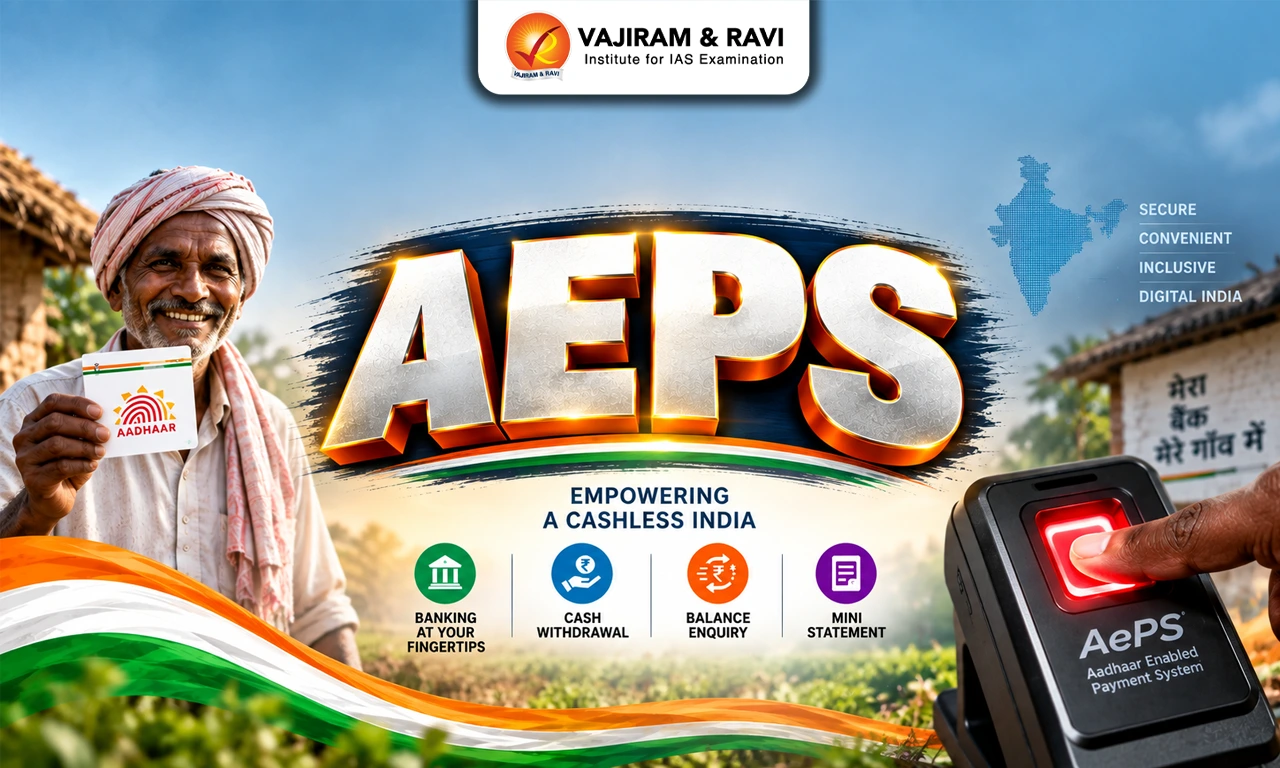
AEPS (Aadhaar Enabled Payment System) is a bank-led digital payment model developed by the National Payments Corporation of India (NPCI) to extend basic banking services to underserved and remote areas through Aadhaar-based biometric authentication. AEPS enables customers to access services such as cash withdrawal, cash deposit, balance enquiry, fund transfer and mini statements through Business Correspondents (BCs), micro-ATMs and other authorised touchpoints, without requiring a debit card or PIN.
By facilitating interoperable, last-mile banking, AEPS has emerged as an important instrument of financial inclusion and supports access to government benefits. However, concerns relating to biometric fraud, authentication failures, cybersecurity, infrastructure gaps and privacy highlight the need for stronger safeguards and user protection.
AEPS Background
The 'AEPS' full form is ‘Aadhaar Enabled Payment System', which is a bank-led digital payment model developed by the National Payments Corporation of India (NPCI) to extend basic banking services to every corner of the country using Aadhaar-based authentication.
- RBI-Led Institutional Framework: RBI constituted Working Groups on MicroATM Standards and Aadhaar-based transaction infrastructure with members from the Reserve Bank of India, UIDAI, National Payments Corporation of India, and the Institute for Development and Research in Banking Technology to accelerate financial inclusion through interoperable Aadhaar-enabled banking systems.
- Development of AEPS Infrastructure: The Working Groups submitted recommendations to RBI and successfully demonstrated a lab-level PoC integrating UIDAI authentication and encryption standards, laying the foundation for a secure and standardised Aadhaar-Enabled Payment System.
- Bank-Led Interoperable Banking Model: AEPS was designed as a simple interoperable banking platform enabling services like cash withdrawal, deposit, fund transfer, balance inquiry, and mini statement using only Aadhaar number, bank name, biometrics, and transaction type through NPCI’s central switching system.
- Financial Inclusion & DBT Impact: AEPS expanded rapidly after demonetisation in 2016 and became a major financial inclusion tool, supporting Direct Benefit Transfers (DBT), welfare schemes, and serving over 37 crore users in 2023 while helping eliminate fake beneficiaries.
AEPS Objectives
AEPS was conceived with a clear and purposeful mandate to make banking accessible, interoperable, and inclusive for every Indian, regardless of geography or socio-economic status. The key objectives are as follows:
- Core objective of AEPS: To extend financial services to every corner of the country where there are no bank branches, through micro ATMs or business correspondents.
- Customer Empowerment: Enables Aadhaar-linked bank customers to access banking services like cash withdrawal, deposit, fund transfer, balance inquiry, and mini statement through AEPS touchpoints.
- Financial Inclusion: Supports the goals of the Government of India and Reserve Bank of India by extending banking services to unbanked and underbanked rural populations.
- Digital Retail Payments: Promotes cashless, paperless, and card-less retail transactions using Aadhaar biometric authentication.
- Interoperable Banking System: Facilitates seamless interbank transactions through the National Payments Corporation of India as the central switching and clearing agency.
- Direct Benefit Transfers (DBT): Ensures secure and leakage-free transfer of government benefits like VB-G RAM G wages, pensions, and welfare schemes through Aadhaar authentication.
- Secure Aadhaar-Based Banking: Provides safe and interoperable banking across member banks and lays the foundation for expanded Aadhaar-enabled financial services in the future.


AEPS Services
The Aadhaar Enabled Payment System (AEPS) enables customers to carry out basic banking transactions at Micro ATMs or Point-of-Sale (PoS) terminals using only their Aadhaar number and biometric authentication, without requiring a debit card, PIN, or signature.
Core Services under AEPS
- Balance Enquiry: It enables customers to check the available balance in their Aadhaar-linked bank account.
- Cash Withdrawal: It allows withdrawal of cash from an Aadhaar-linked bank account without using a debit card or ATM.
- Cash Deposit: It facilitates cash deposits into an Aadhaar-linked bank account through a Business Correspondent (BC).
- Fund Transfer (Intra-bank/Inter-bank): Enables intra-bank and inter-bank fund transfers through it.
- Mini Statement: It provides a summary of the most recent transactions in the Aadhaar-linked bank account.
- BHIM Aadhaar Pay: It allows customers to make merchant payments using Aadhaar numbers and biometric authentication at PoS terminals or micro ATMs, eliminating the need for cash or cards.
AEPS Working
- The customer visits a Business Correspondent (BC) or agent equipped with a Micro ATM or PoS device.
- The customer provides the 12-digit Aadhaar number and selects the bank and desired banking service.
- The BC captures the customer's biometric authentication (fingerprint or iris scan).
- The NPCI switch routes the authentication request to UIDAI for biometric verification.
- After successful authentication, the customer's bank authorises the transaction, and it is completed instantly.
AEPS vs APBS vs UPI
| Dimension | AEPS | APBS | UPI |
|
Full Form |
Aadhaar-Enabled Payment System |
Aadhaar Payment Bridge System |
Unified Payments Interface |
|
Nature |
Aadhaar-enabled banking/payment system |
Aadhaar-based DBT payment-routing mechanism |
Real-time digital payment system |
|
Developed by |
NPCI |
NPCI |
NPCI |
|
Primary Objective |
Provide basic banking services through BC/agent touchpoints. |
Route government benefits/subsidies to Aadhaar-linked bank accounts |
Enable instant account-to-account digital payments. |
|
Primary Users |
Bank customers, particularly those using BC/agent-assisted banking |
Government/DBT beneficiaries |
Individuals, businesses and merchants |
|
Authentication |
Aadhaar number + biometric authentication |
Aadhaar seeding/authentication in the DBT ecosystem |
UPI PIN and other prescribed authentication methods |
|
Smartphone Required |
No |
No for the beneficiary to receive the payment |
Generally yes for app-based transactions |
|
Bank Account Required |
Yes, Aadhaar-linked bank account |
Yes, an Aadhaar-linked bank account |
Yes, linked to a UPI-enabled bank account |
|
Main Access Channel |
BCs, Micro-ATMs and authorised touchpoints |
Government DBT systems |
UPI apps, QR codes, UPI IDs and other enabled channels |
|
Key Services/Uses |
Cash withdrawal, cash deposit, fund transfer, balance enquiry, mini statement |
Crediting government benefits/wages/subsidies into the beneficiary's Aadhaar-linked account |
P2P/P2M payments, fund transfers, bill payments and online payments |
|
Role in DBT |
Helps beneficiaries access funds through assisted banking |
Routes DBT funds to the beneficiary's Aadhaar-linked bank account |
Not primarily a DBT-routing mechanism |
|
Role in Financial Inclusion |
High—enables last-mile banking without a card or smartphone |
Improves efficiency of Aadhaar-based DBT |
Expands digital payment access through mobile-based payments |
|
Typical Example |
A beneficiary withdraws VB-G RAM G wages through a BC using Aadhaar biometric authentication. |
The government sends VB-G RAM G wages to the bank account mapped through APBS. |
A consumer pays a shopkeeper by scanning a UPI QR code. |
AEPS Advantages
The Aadhaar Enabled Payment System (AEPS) makes banking much easier and more accessible. Here’s a simple look at its main advantages:
- Simple Banking: Enables cash withdrawal, deposit, balance enquiry and fund transfer using Aadhaar-based authentication, without a debit card or PIN.
- Last-Mile Accessibility: Extends banking services to rural and remote areas through Business Correspondents (BCs) and Micro-ATMs.
- Secure Authentication: Uses Aadhaar-based biometric authentication to verify the customer and facilitate transactions.
- Paperless Banking: Reduces the need for physical documents, passbooks and cards for basic banking transactions.
- Financial Inclusion: Improves access to formal banking for rural, low-income and underserved populations, including those with limited digital literacy.
- Convenient Access: Enables elderly and low-literacy users to access basic banking services through assisted, biometric transactions.
- Supports DBT Access: Facilitates last-mile access to government benefits credited to beneficiaries' bank accounts.
- Emergency Access: Enables beneficiaries to access funds through BC networks when conventional banking access is limited.
- Promotes Formal Banking: Greater access to basic banking services can encourage account usage, saving and participation in the formal financial system.
AEPS Challenges
Despite strengthening financial inclusion and DBT delivery, AEPS faces growing concerns related to fraud, biometric authentication, infrastructure gaps and privacy.
- AEPS Biometric Fraud & Identity Theft: Spoofing, compromised credentials and fraudulent biometric authentication can expose customers to unauthorised transactions.
- AEPS Biometric Authentication Issues: AEPS transactions frequently fail because of unclear or worn-out fingerprints of labourers, farmers, and elderly users, along with technical problems in biometric verification systems.
- AEPS Infrastructure Issues: AEPS depends on biometric devices, internet, electricity, and PoS machines, which remain weak or unreliable in rural and remote areas.
- Low Awareness of AEPS Usage: Poor digital and financial literacy among AEPS users increases vulnerability to fraud, transaction errors, and misuse.
- AEPS Agent-Level Fraud: Weak agent controls, device compromise, credential misuse and fraudulent authentication can increase the risk of unauthorised transactions.
- Transaction awareness: Delayed or unavailable customer alerts in some cases can reduce the ability to detect and report unauthorised transactions promptly.
- AEPS Regulatory & Privacy Concerns: AEPS faces issues related to biometric data privacy, grievance redressal, and MDR-related policy challenges.
- Weak AEPS Operator Onboarding: Rising AEPS fraud exposed gaps in operator onboarding, KYC compliance, API security, and third-party integration oversight, leading RBI to propose stricter controls continuously.
- High Cash Dependence in AEPS: Despite digital banking objectives, most AEPS transactions are still cash withdrawals, reflecting limited adoption of broader digital financial services.
AEPS Way Forward
AEPS needs stronger security architecture, better coordination among stakeholders, and improved user protection mechanisms to sustain secure digital financial inclusion, especially in rural India.
- Strengthening AEPS Security: Introduce biometric liveness detection, stronger encryption, and dual authentication for high-value AEPS transactions to prevent biometric spoofing and identity theft.
- Enhanced AEPS Fraud Monitoring: Implement certified micro-ATMs, secure APIs, encrypted transaction systems, and real-time monitoring to detect suspicious AEPS activities.
- AEPS User Awareness & Protection: Promote digital literacy and encourage users to lock/unlock Aadhaar biometrics through the UIDAI portal to prevent unauthorised access.
- Efficient AEPS Grievance Redressal: Develop a centralised and time-bound mechanism for resolving AEPS transaction failures, delayed settlements, and unauthorised deductions.
- Expanding AEPS Financial Services: Move beyond cash withdrawals by integrating micro-savings, micro-credit, insurance, and other financial products through Business Correspondents (BCs).
- Institutional Coordination for AEPS: Strengthen coordination among the Reserve Bank of India, the National Payments Corporation of India, and UIDAI for better regulation, security, and interoperability of AEPS.
- Integrating AI: Integrating Artificial Intelligence (AI) into the Aadhaar Enabled Payment System (AEPS) is becoming necessary to ensure the future security, scalability, and accessibility of digital banking in India.

 Last updated on Oct, 2026
→ UPSC 2027 Notification will be released on 13 January 2027 at upsconline.nic.in.
→ Check Nobel Prize 2026 Winners List here.
→ Download PIB PRiSM Monthly Magazine 2026 here.
→ Check UPSC Monthly Current Affairs Magazine The Recitals here.
→ Check out the latest UPSC Syllabus here.
→ Download UPSC Model Answers for Mains 2026
→ UPSC Mains Question Paper 2026 is out now for Essay & GS Paper 1, 2, 3 & 4.
→ UPSC Calendar 2027 has been released.
→ Enroll in Vajiram & Ravi’s UPSC Mains Test Series 2027 for structured answer writing practice, expert evaluation, and exam-oriented feedback.
→ Join Vajiram & Ravi’s UPSC Mentorship Program 2027 for personalized guidance, strategy planning, and one-to-one support from experienced mentors.
→ Go through the UPSC Mains Previous Year Papers to enhance your preparation.
→ UPSC has released UPSC Toppers List 2025 with the Civil Services final result on its official website.
→ Also check Best UPSC Coaching in India
AEPS FAQs
Q1. What is the Aadhaar-enabled payment system?+
Q2. What is the limit of the Aadhaar-enabled payment system?+
Q3. Who launched the Aadhaar-enabled payment system?+
Q4. Can I withdraw money using AEPS?+
Q5. What is the difference between UPI and AEPS?+
Tags: aeps quest upsc economy notes