



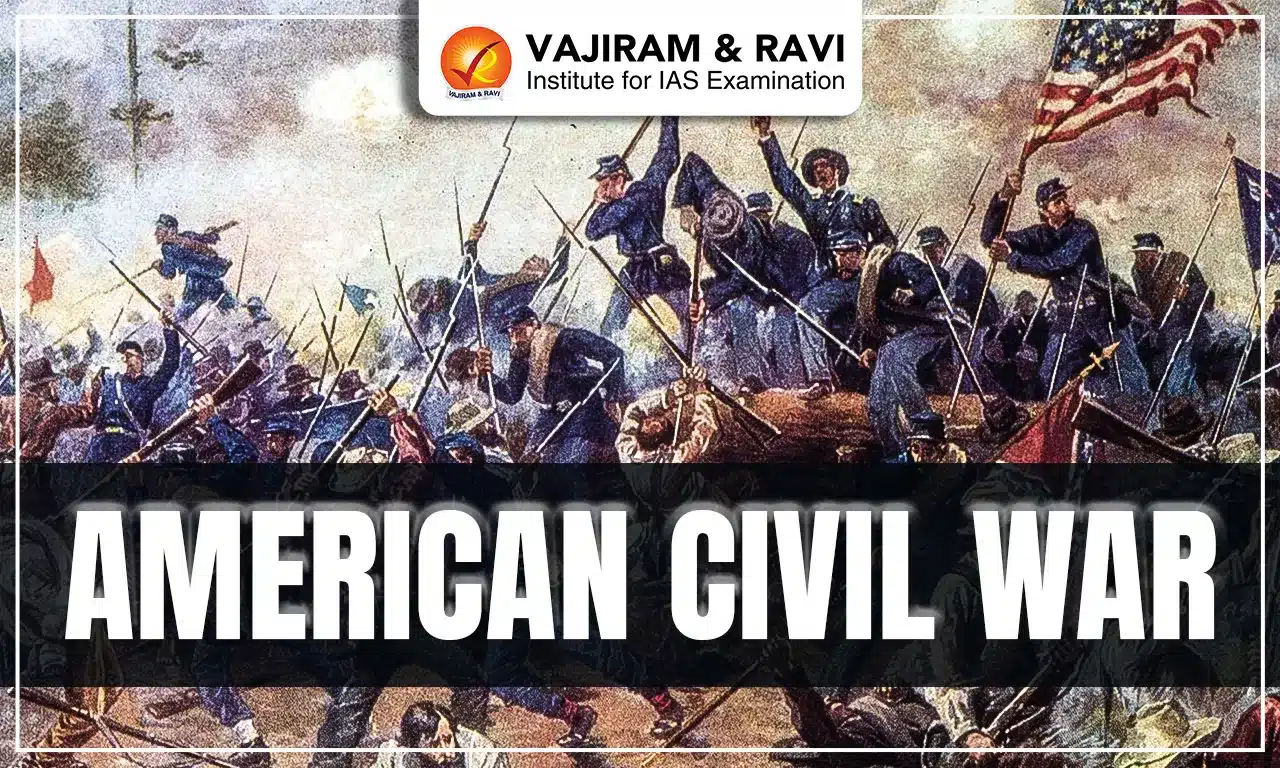
American Civil War was a civil war in the United States between the Union ("the North") and the Confederacy ("the South"), over slavery, states’ rights, and federal authority. The industrial North opposed slavery’s expansion, while the agrarian South depended on enslaved labour. Rising abolitionism, the Republican Party’s emergence, and Abraham Lincoln’s 1860 election prompted eleven Southern states to secede, forming the Confederacy and triggering war.
The war preserved the Union and brought profound changes to American society. Slavery was abolished, and citizenship and voting rights were extended to formerly enslaved people. The Southern economy collapsed, while the North further industrialised. Abraham Lincoln’s leadership was pivotal in guiding the Union to victory and shaping the nation’s post-war political and social order.

American Civil War Origin
American Civil War (1861–1865) arose from deep-rooted conflicts over slavery, states’ rights, and the authority of the federal government. The North’s growing opposition to slavery, in direct contrast to the South’s economic and social reliance on it, created deep political, economic, and sectional divisions. Decades of political compromises failed to resolve these disputes, and rising sectional tensions eventually led Southern states to secede, forming the Confederacy.
- The Union (Northern States): Included states like Maine, Pennsylvania, Ohio, New York, and California. Led by Abraham Lincoln, the Union opposed the expansion of slavery and aimed to preserve the nation.
- The Confederacy (Southern States): Comprised states such as Texas, Alabama, Georgia, Virginia, and Florida. Led by Jefferson Davis, it fought to defend slavery and assert states’ rights.
- Border States: Maryland, Delaware, Kentucky, and Missouri were slaveholding states that remained in the Union, with divided loyalties that made them strategically important.
- West Virginia: Separated from Virginia in 1863 and joined the Union, reflecting internal divisions within the South and strengthening the Union’s position.
American Civil War Reasons
American Civil War was primarily caused by slavery and disputes over its expansion, intensified by economic, political, and constitutional differences between the North and South. Failed compromises, growing abolitionist movements, and fears of losing influence led Southern states to secede, ultimately sparking the war.
- Issue of Slavery: Slavery was the central factor dividing the nation. It became a profound moral and political issue, challenging the very ideals of liberty and equality on which the Union was founded.
- Expansion of Slavery: The question of whether slavery should spread into the newly acquired western territories became a major source of conflict. The North resisted its expansion to prevent the South from gaining political dominance, whereas the South viewed any restriction as a direct threat to its way of life and economic security.
- Legislative Attempts: Legislative efforts like the Missouri Compromise (1820) and the Kansas-Nebraska Act (1854) attempted to balance the political and economic interests of the North and the South, but only postponed the growing dispute.
- Economic Differences Between the North and the South: The South relied on enslaved labour for its plantation-based agricultural economy, cultivating crops like cotton and tobacco, while the North developed an industrial economy driven by factories, cities, and wage labour.
- These contrasting economic systems created conflicting interests over trade, taxation, and labour policies, deepening sectional divisions and fuelling tensions that eventually led to the Civil War.
- States’ Rights and Compact Sovereignty: Southern states argued that, having voluntarily joined the Union, they had the right to govern themselves and protect slavery, which was known as compact sovereignty.
- The North, under President Abraham Lincoln, maintained that the Union must remain intact, as allowing secession would threaten the nation’s democratic foundations.
- Fear of Losing Power: As abolitionist movements grew in the North during the 1830s and 1840s, many in the South feared for the survival of slavery and their economy.
- Northern publications like The Liberator and novels such as Uncle Tom’s Cabin heightened opposition to slavery, increasing Southern anxiety.
- Political Developments: The formation of the Republican Party in the 1850s, aimed at preventing the expansion of slavery, alarmed Southern leaders.
- Lincoln’s Election: Abraham Lincoln’s election in 1860 was a turning point, leading several Southern states to secede and form the Confederacy, fearing his presidency would threaten slavery and their political rights.
- Key Laws and Judicial Decisions: Several laws and judicial decisions further deepened the sectional divide and strengthened Southern power in matters related to slavery.
- Three-Fifths Compromise (1787): It determined that each enslaved person would be counted as three-fifths of a person for purposes of representation and taxation, thereby granting Southern states greater representation in the House of Representatives, though it did not affect representation in the Senate.
- Fugitive Slave Act (1850): Required free states to return escaped slaves, creating resentment in the North.
- Dred Scott Decision (1857): Declared enslaved individuals as property with no citizenship rights, reinforcing the South’s legal defence of slavery.
- Tariff Policy and Trade Conflicts: The North supported protective tariffs to encourage industrial growth, while the South, reliant on imported goods and slave labour, opposed them.
- Division Within the South: Not all slaveholding states supported secession. In Virginia, the western counties opposed leaving the Union and formed West Virginia, which was admitted as a separate state in 1863.
- Role of Border States: Slaveholding states like Maryland, Delaware, Kentucky, and Missouri remained in the Union despite divided loyalties. Their strategic locations and resources made their allegiance crucial, highlighting the complexity of sectional tensions.





American Civil War Timeline
American Civil War period events reflected decades of mounting tensions, conflicts, and political struggles. They arose from deeply rooted issues such as slavery, sectionalism, and disagreements over states’ rights. The origins can be traced back to the 1787 U.S. Constitution, which included compromises over slavery that laid the foundation for future conflicts.
- Missouri Compromise (1820): Missouri was admitted as a slave state and Maine as a free state to maintain the balance between slave and free states in the Senate.
- While this temporarily reduced sectional tensions, it did not resolve the deeper conflict over slavery in new territories.
- Northern Anti-Slavery Movements (1830s–1850s): While the compromise maintained a formal balance, Northern activists increasingly opposed slavery:
- The Liberator, published by William Lloyd Garrison, called for a crusade against slavery. Anti-slavery societies were established to campaign for the abolition of slavery. Harriet Beecher Stowe’s novel Uncle Tom’s Cabin exposed the harsh realities of Southern slavery.
- These efforts alarmed the Southern states, which perceived Northern activism as a direct threat to their economic and social system.
- Kansas-Nebraska Act and Squatter Sovereignty (1854): The Act allowed settlers in the Kansas and Nebraska territories to decide by popular vote whether to allow slavery, effectively repealing the Missouri Compromise line and igniting violent conflict known as “Bleeding Kansas.”
- Dred Scott Case (1857): The Supreme Court ruled that enslaved people were property, not citizens, and could not be freed by the courts. This verdict strengthened Southern claims on slavery and enraged the Northern abolitionists and moderates.
- Political Developments (1850s): The Republican Party was formed, uniting various anti-slavery factions with the principal aim of preventing the expansion of slavery into the western territories.
- John Brown’s Raid (1859): John Brown, a radical abolitionist, led a raid on the federal arsenal at Harpers Ferry to arm enslaved people for a rebellion, increasing tensions between the regions.
- Election of Abraham Lincoln(1860): Lincoln, the first Republican president opposed to slavery’s expansion, won the election with no support from Southern states. His victory convinced Southern leaders that their interests and way of life were under existential threat.
- Secession and Formation of the Confederacy (1860–1861): In response to Lincoln’s election, seven Southern states seceded from the Union and formed the Confederate States of America under Jefferson Davis. The Confederacy explicitly protected slavery, asserted states’ rights, and opposed Northern economic policies, formally dividing the nation and precipitating the Civil War.
American Civil War Abraham Lincoln Role
American Civil War had a major contribution from Abraham Lincoln, the 16th President of the United States. His leadership combined political strategy, military guidance, and moral vision, positioning him as the central figure in the Union’s success. Lincoln preserved the Union, ended slavery, and strengthened the principles of American democracy.
- Fort Sumter and Emergency Measures (1861): When Confederate forces attacked Fort Sumter, Lincoln responded by calling thousands of volunteers and taking emergency measures, including temporarily suspending habeas corpus in certain areas to protect the Union.
- Naval Blockade and Diplomacy: Lincoln established a naval blockade of Southern ports to cut off supplies and weaken the Confederacy’s economy. He also ensured that Britain and other European powers remained neutral, preventing foreign support for the South.
- Military Strategy and Leadership: As Commander-in-Chief, Lincoln coordinated campaigns on multiple fronts, carefully managed Union generals, and appointed Ulysses S. Grant to lead the armies. He also worked to maintain the loyalty of key border states.
- Shift to a Moral Cause: Lincoln gradually reframed the war as a struggle against slavery. The Emancipation Proclamation (1863) declared that all enslaved people in the Confederate states rebelling against the Union were to be “forever free,” though it did not apply to enslaved people in loyal border states or Confederate areas already under Union control.
- The proclamation also allowed African Americans to join the Union army, giving the war a stronger moral and humanitarian purpose.
- Thirteenth Amendment: Lincoln championed the Thirteenth Amendment, which permanently abolished slavery across the United States, ensuring the legal end of the institution after the war.
- National Unity and Reconstruction: In his final months, Lincoln focused on reunifying the nation and supported limited African American voting rights. He laid the foundation for post-war Reconstruction before his assassination in 1865.
American Civil War Impacts
American Civil War had profound consequences for the United States, reshaping its political institutions, society, and economy. Although it left behind deep scars, the Union emerged stronger and more unified.
- Emergence of a Stronger Union: The war preserved the federal Union by defeating the Confederacy, making secession impossible for any state. It reinforced the United States as a single, unified nation rather than a loose confederation of independent states.
- Constitutional Changes: The war prompted major constitutional reforms that redefined citizenship, equality, and civil rights:
- Thirteenth Amendment (1865): Abolished slavery throughout the United States, freeing nearly four million enslaved people.
- Fourteenth Amendment (1868): Granted citizenship to all born in the U.S., including freed slaves, and ensured equal protection under the law, overturning discriminatory Black Codes.
- Fifteenth Amendment (1870): Prohibited denial of voting rights based on race, colour, or previous servitude, extending suffrage to formerly enslaved men.
- Social and Political Impact: The Republican Party gained long-term national dominance due to its anti-slavery stance.
- In the South, Jim Crow laws and violent groups like the Ku Klux Klan limited African American rights during Reconstruction (1865–1877).
- Economic Consequences: The Southern economy, heavily dependent on slavery and plantation agriculture, collapsed, resulting in prolonged hardship. The Northern economy, in contrast, grew rapidly due to industrialisation and infrastructure expansion.
- Reconstruction: Confederate states were readmitted after accepting the new constitutional amendments and pledging loyalty to the Union.
- Federal programs like the Freedmen’s Bureau sought to provide education, land, and economic opportunities for freed slaves, but achieved limited success. Reconstruction ended in 1877, allowing Southern states to regain control and undo many gains for African Americans.
| Other Related Posts | |
| Industrial Revolution | French Revolution |
| American Revolution | Decolonisation |

 Last updated on March, 2026
→ UPSC Final Result 2025 is now out.
→ UPSC has released UPSC Toppers List 2025 with the Civil Services final result on its official website.
→ Anuj Agnihotri secured AIR 1 in the UPSC Civil Services Examination 2025.
→ UPSC Marksheet 2025 is now out.
→ UPSC Notification 2026 & UPSC IFoS Notification 2026 is now out on the official website at upsconline.nic.in.
→ UPSC Calendar 2026 has been released.
→ Check out the latest UPSC Syllabus 2026 here.
→ UPSC Prelims 2026 will be conducted on 24th May, 2026 & UPSC Mains 2026 will be conducted on 21st August 2026.
→ The UPSC Selection Process is of 3 stages-Prelims, Mains and Interview.
→ Prepare effectively with Vajiram & Ravi’s UPSC Prelims Test Series 2026 featuring full-length mock tests, detailed solutions, and performance analysis.
→ Enroll in Vajiram & Ravi’s UPSC Mains Test Series 2026 for structured answer writing practice, expert evaluation, and exam-oriented feedback.
→ Join Vajiram & Ravi’s Best UPSC Mentorship Program for personalized guidance, strategy planning, and one-to-one support from experienced mentors.
→ Shakti Dubey secures AIR 1 in UPSC CSE Exam 2024.
→ Also check Best UPSC Coaching in India
American Civil War FAQs
Q1. What was the American Civil War?+
Q2. Who won the Civil War in America?+
Q3. What are the three main causes of the Civil War?+
Q4. Why did the South lose the Civil War?+
Q5. Did slavery cause the Civil War?+
Tags: american civil war