
Question
Analyze the importance of Ashokan inscriptions for reconstructing Mauryan history.
Detailed Solution
Deciphered by James Prinsep in 1837, Ashokan inscriptions constitute the earliest extensive corpus of contemporary royal epigraphy in India.
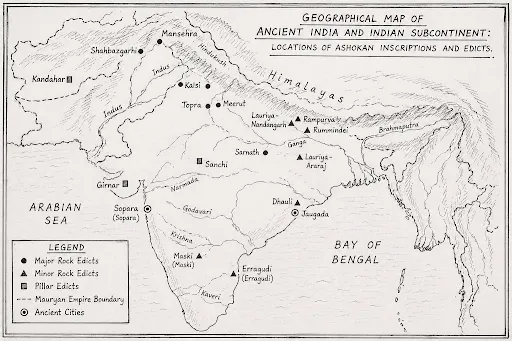
Importance in Reconstructing Mauryan History
A. Mapping the Empire and External Relations
- Geographical Spread: Inscriptions from Shahbazgarhi and Mansehra (northwest) to Kalsi (north), Girnar (west), and Brahmagiri/Yerragudi (south) delineate the extensive territorial boundaries of the empire.
- Border Kingdoms: Major Rock Edicts (MRE) II & XIII record southern neighbors (Cholas, Pandyas, Satyaputras, Keralaputras, and Tamraparni/Sri Lanka), mapping the peninsular geopolitical landscape.
- International Diplomacy: MRE XIII explicitly names five contemporary Hellenistic rulers (Antiochus II, Ptolemy II, Antigonus Gonatas, Magas, and Alexander), providing a synchronistic chronological benchmark for ancient Indian history.
B. Reconstructing Administrative Machinery
- Hierarchical Cadres: MRE III records provincial administrative tiers, identifying Yuktas (subordinate revenue officers), Rajukas (rural administrators/judges), and Pradesikas (district heads).
- Specialized Institutions: MRE V documents the creation of Dhamma Mahamatras, illustrating the formal institutionalization of Ashoka’s moral policy.
- Judicial Standardization: Pillar Edict IV grants autonomy to Rajukas while mandating Vyavahara-samata (procedural consistency) and Danda-samata (uniformity in penal punishment).
- Paternalistic Kingship: The Separate Rock Edicts (Dhauli and Jaugada) codify the state's ethical governance philosophy: "Sabbe Munisse Paja Mama" (All men are my children).
C. Understanding Dhamma and Religious Policy
- Civic-Ethical Code: Inscriptions clarify that Dhamma was a secularized moral framework emphasizing non-violence (Ahimsa), filial piety, and humane treatment of servants rather than sectarian Buddhist dogma.
- Religious Pluralism: MRE XII advocates Vachaguti (restraint in speech) and mutual respect among diverse sects, reflecting an official policy of inter-faith harmony.
- Non-Buddhist State Patronage: The Barabar Cave Inscriptions record royal donations to the Ajivika sect, proving that state patronage extended beyond Buddhism.
D. Insights into Economy, Society, and Welfare
- Agrarian Taxation: The Rummindei (Lumbini) Pillar Inscription provides direct fiscal evidence, recording the reduction of the agrarian produce share (Bhaga) to 1/8th and the waiver of the religious cess (Bali).
- Welfare Infrastructure: MRE II and Pillar Edict VII record public welfare initiatives, including medicinal plant cultivation, veterinary care, road networks, and roadside wells.
- Social Stratification: References to Brahmanas, Sramanas, householders, and dasa-bhatakas (servants/slaves) illuminate social groups recognized by the Mauryan state.
E. Linguistic and Regional Adaptability
- Administrative Pragmatism: The state utilized local scripts to communicate with diverse populations, Prakrit in Brahmi across mainland India, Kharosthi in the northwest, and Greek and Aramaic in the bilingual Shar-i-Kuna (Kandahar) edict.
Limitations of Ashokan Inscriptions as Historical Sources
- Ashoka-Centric Focus: They offer detailed insights into Ashoka's reign but remain silent on Chandragupta Maurya, Bindusara, and key ministerial advisors like Chanakya.
- Normative Nature: Edicts reflect the ruler’s moral ideals and prescriptive decrees rather than objective accounts of ground-level administrative implementation.
- Selective Omission: The complete narrative of the Kalinga War (MRE XIII) is absent from the Dhauli and Jaugada inscriptions in Kalinga, indicating deliberate political filtering of imperial messaging.
- Limited Economic Data: Inscriptions offer minimal empirical data on overall trade volumes, currency mechanics, military expenditures, and urban guilds.
Hence, Ashokan inscriptions, corroborated with archaeological and literary sources like Arthashastra, Indica and Mahavamsa, transformed Mauryan history into an evidence-based reconstruction, revealing the synthesis of imperial authority and ethical statecraft.
Latest UPSC Exam 2027 Updates
Last updated on Oct, 2026







