
Question
Discuss the impact of Macaulay's Minute on colonial administration and education in India.
Detailed Solution
Macaulay’s Minute (1835), enacted via Bentinck’s English Education Act, 1835, resolved the Orientalist–Anglicist debate in favor of Western education through the English medium, fundamentally restructuring colonial administration while unintentionally equipping Indians to challenge imperial rule.
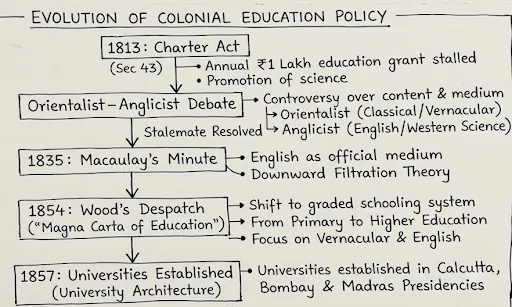
Impact on Macaulay’s Policy on Education
- Medium of Instruction: Established English as the official medium for higher learning and government patronage.
- Curricular Focus: Promoted European science, literature, and secular rationalism over classical Sanskrit, Arabic, and Persian texts.
- Indigenous Systems: Withdrew state funding from traditional institutions (Tols, Madrasas, Pathshalas), leading to their decline.
- Access & Equity: Institutionalized the Downward Filtration Theory, educating an elite minority while neglecting mass primary schooling.
- Social Mobility: Linked English proficiency to colonial administrative jobs, creating a new urban-educated middle class.
- Institutional Growth: Laid the structural trajectory culminating in the Wood’s Despatch (1854) and modern universities (1857).
- Divide: The policy deepened the socio-linguistic divide between the English-educated elite and vernacular-speaking masses.
Impact on Colonial Administration
- Supply of Low-Cost Subordinate Manpower: Produced an inexpensive indigenous cadre of clerks, accountants, and translators to manage the expanding lower bureaucracy.
- Creation of a Cultural Buffer Class: Intentionally cultivated an intermediary class, "Indian in blood and colour, but English in taste, opinions, and intellect," to cushion against native rebellions.
- Administrative & Linguistic Standardization: Replaced Persian with English in higher courts and state correspondence, standardizing governance across the Bengal, Bombay, and Madras Presidencies.
- Catalyzed Legal Codification: Aligned with Macaulay’s leadership of the First Law Commission (1834), laying the groundwork for uniform colonial law via the Indian Penal Code (1860).
- Modern professional class: Its wider consequences included the emergence of lawyers, journalists, teachers, and professionals who initially strengthened colonial institutions but later became important critics of imperial rule.
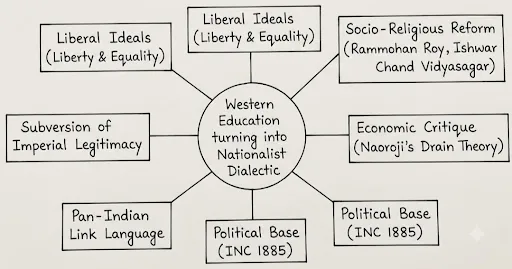
Macaulay’s policy aimed at imperial consolidation, yet its unintended dialectic was transformative. It equipped the educated middle class with the intellectual vocabulary and constitutional tools to challenge colonial legitimacy.
Latest UPSC Exam 2027 Updates
Last updated on Oct, 2026







