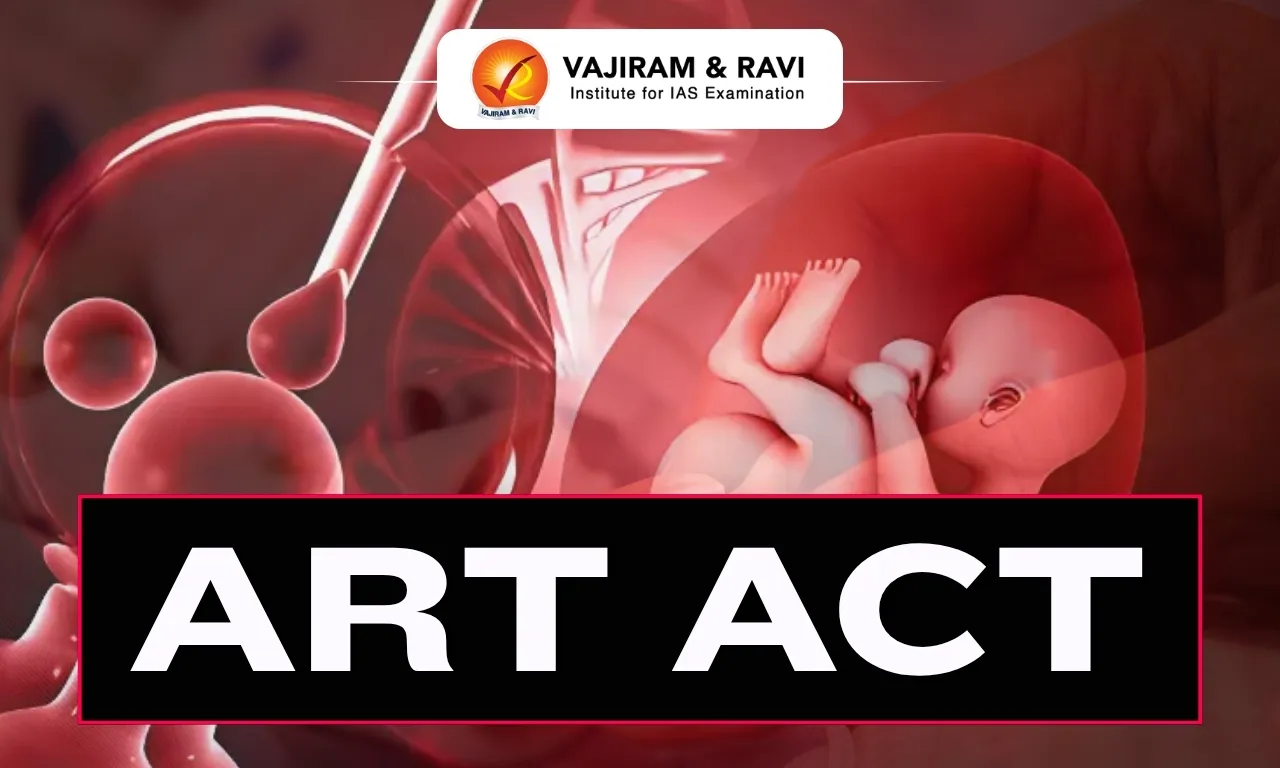
The Assisted Reproductive Technology (Regulation) Act, 2021 (ART Act), is India’s first comprehensive legislation to regulate and supervise ART clinics and banks. Enacted on 18 December 2021 and brought into force on 25 January 2022, the ART Act aims to ensure the safe, ethical and regulated provision of assisted reproductive services. It covers procedures involving the handling of sperm or oocytes outside the human body and the transfer of gametes or embryos, including IVF, gamete donation and embryo-related procedures.
The ART Act establishes the National Registry, National and State Boards and appropriate authorities for registration, monitoring and supervision. It safeguards informed consent, record-keeping, gamete and embryo storage, prohibits sex selection, regulates research, protects children born through ART, and prescribes offences and penalties to prevent misuse.
ART Act 2021 Background
Before the ART Act, India lacked any statutory framework to regulate the rapidly growing fertility industry, leaving patients, donors, and children born through ART without legal protection. The legislative process that led to the Act spanned over a decade of policy deliberation and multiple failed attempts at enactment.
- Around 2.8 crore couples in the reproductive age group in India are estimated to be infertile, of whom approximately 20–25% undergo in vitro fertilisation treatment.
- In 2005, the Indian Council of Medical Research (ICMR) issued guidelines to regulate ART clinics, but these were non-binding and lacked the force of law.
- In July 2019, the government introduced the Surrogacy (Regulation) Bill, which was passed by the Lok Sabha but referred to a Select Committee in the Rajya Sabha.
- The Committee recommended that comprehensive legislation first be introduced to regulate ART services, with surrogacy addressed separately.
- The ART Bill was introduced in the Lok Sabha in September 2021 and passed with amendments on December 1, 2021.
ART Act 2021 Provisions
The ART Act 2021 lays down a comprehensive regulatory framework covering the registration of clinics and banks, eligibility criteria, the rights of donors and children, and penalties for violations. Its key provisions are as follows:
- Definition of ART (Section 2): The ART Act defines Assisted Reproductive Technology (ART) as techniques such as IVF, gamete donation, embryo transfer, and related procedures involving the handling of sperm or oocytes outside the human body.
- Registration of Clinics and Banks (Sections 15-20): The ART Act mandates compulsory registration of all ART clinics and banks under the National Registry for a period of five years.
- Regulatory Bodies (Section 5-15): The ART Act establishes National and State Boards along with a National Registry to regulate, supervise, and monitor ART services.
- Eligibility Criteria (Section 21): The ART Act permits ART services for married infertile couples and single women, with the woman aged 21–50 years and the man aged 21–55 years, subject to prescribed conditions.
- Donor Eligibility and Restrictions (Section 27): The ART Act allows semen donation by males aged 21–55 years and oocyte donation by females aged 23–35 years, with strict donation limits. The woman can donate eggs only once in her life, and not more than seven eggs can be retrieved from her.
- Rights of the Child (Section 31): The ART Act recognises a child born through ART as the biological child of the commissioning couple with all legal rights.
- Consent and Insurance (Section 22): The ART Act requires written informed consent from all parties and mandates 12 months of insurance coverage for the oocyte donor.
- Prohibition on Sex Selection and Sale of Gametes (Sections 26, 29 and 32): The ART Act prohibits sex-selective procedures and bans the sale, purchase, or trade of human gametes and embryos. It also mandates compliance with the Pre-Conception and Pre-Natal Diagnostic Techniques (Prohibition of Sex Selection) Act, 1994 (PCPNDT Act), which separately prohibits sex selection and prenatal sex determination.
- Offences and Penalties (Sections 33-34): The ART Act prescribes fines and imprisonment for offences such as exploitation of donors, sale of gametes, and abandonment of children born through ART.


ART Act 2021 Challenges
Despite its landmark status, the ART Act faces several legislative, structural, and ethical concerns that may limit its effectiveness in practice.
- Exclusion of Single Men and LGBTQ+ Individuals: The Act restricts access to married infertile couples and single women, raising concerns regarding equality and non-discrimination under Article 14.
- Overlap with the Surrogacy Act: Inconsistencies between the ART Act, 2021, and the Surrogacy (Regulation) Act, 2021, create regulatory ambiguity and compliance challenges for clinics.
- Commercialisation of ART Services: Despite regulation, risks of commercial exploitation, unethical practices, and profit-driven fertility services continue to persist.
- High Cost and Limited Accessibility: ART procedures remain expensive and are beyond the reach of many couples due to limited insurance coverage and inadequate public-sector infrastructure.
- Privacy and Data Protection Concerns: Mandatory collection and sharing of sensitive personal information raises concerns over informational privacy and inadequate data protection safeguards.
- Weak Enforcement Mechanism: Shortage of regulatory capacity, inadequate inspections, and uneven implementation across States weaken effective oversight of ART clinics.
- Cross-border Reproductive Services: Limited regulation of international fertility services and movement of gametes or embryos may encourage reproductive tourism and jurisdictional challenges.
- Ethical Issues: Concerns remain regarding informed consent, donor exploitation, embryo handling, donor anonymity, and the rights of ART-conceived children.
ART Act 2021 Case Laws
The ART Act, 2021, is guided by the constitutional principles of reproductive autonomy, dignity, privacy, and bodily integrity developed through landmark Supreme Court judgements under Article 21. These decisions form the constitutional foundation of India's reproductive rights jurisprudence.
- Suchita Srivastava v. Chandigarh Administration (Supreme Court, 2009): The Supreme Court of India held that a woman's reproductive choice is an integral part of personal liberty under Article 21, encompassing both the right to procreate and the right to refrain from procreation, subject to the provisions of the MTP Act.
- K.S. Puttaswamy v. Union of India (Supreme Court, 2017): The nine-judge Bench recognised the Right to Privacy as a fundamental right under Article 21 and held that reproductive autonomy, procreation, and family life are essential facets of decisional privacy.
- X v. Principal Secretary, Health & Family Welfare Department, GNCTD (Supreme Court, 2022): The Supreme Court held that unmarried women are entitled to the same reproductive rights as married women under the MTP Act, affirmed bodily autonomy under Article 21, and interpreted the law to ensure non-discriminatory access to reproductive healthcare.
ART Act 2021 Way Forward
Realising the full potential of the ART Act requires addressing its legislative gaps, strengthening implementation mechanisms, and ensuring that the framework evolves with medical and social realities.
- Harmonising ART and Surrogacy Laws: The ART Act and the Surrogacy (Regulation) Act, 2021, should be harmonised through a unified regulatory framework.
- This will resolve inconsistencies such as differing registration validity periods - five years under the ART Act versus three years under the Surrogacy Act - and varying waiting periods for infertility eligibility.
- Expanding Eligibility: The ART Act should extend ART services to single men and LGBTQ+ individuals, as the current restriction to married couples and single women excludes a significant section of the population seeking to have children through assisted reproduction.
- Strengthening Data Privacy: The ART Act should ensure that data shared with the National Registry is anonymised and collected for specific, defined purposes only, as mandated by the Supreme Court's Puttaswamy judgement.
- For instance, while tracking the number of oocyte donations per donor may be necessary, sharing the personal details of all commissioning parties serves no clear regulatory purpose.
- Mandatory Counselling for Donors: The ART Act should provide for pre-procedure counselling and the right to withdraw consent before implantation for gamete donors, consistent with ICMR guidelines of 2005.
- Robust Grievance Redressal: The ART Act should establish an independent grievance redressal mechanism within the Registration Authority, with a defined 30-day resolution timeframe, to address complaints against ART clinics and banks without burdening courts.
- Effective National Registry: The National Registry under the ART Act should be operationalised promptly with adequate technical infrastructure to function as a reliable central database.
- For instance, tracking the number of donations per donor and outcomes of ART procedures across clinics for effective policy formulation.
- Periodic Legislative Review: The ART Act should undergo periodic parliamentary review to address emerging scientific and ethical developments, such as the use of artificial gametes, gene editing technologies like CRISPR, and evolving social understandings of parenthood and family.
ART Act 2021 UPSC PYQs
Q1. In the context of recent advances in human reproductive technology, "Pronuclear Transfer" is used for (UPSC Prelims 2020)
(a) Fertilisation of an egg in vitro by the donor sperm
(b) Genetic modification of sperm-producing cells
(c) Development of stem cells into functional embryos
(d) Prevention of mitochondrial diseases in offspring
Ans: (d)

 Last updated on Oct, 2026
→ UPSC 2027 Notification will be released on 13 January 2027 at upsconline.nic.in.
→ Asian Games 2026 are being held in Aichi-Nagoya, Japan, from 19 September to 4 October.
→ Check Nobel Prize 2026 Winners List here.
→ Download PIB PRiSM Monthly Magazine 2026 here.
→ Check UPSC Monthly Current Affairs Magazine The Recitals here.
→ Check out the latest UPSC Syllabus here.
→ Download UPSC Model Answers for Mains 2026
→ UPSC Mains Question Paper 2026 is out now for Essay & GS Paper 1, 2, 3 & 4.
→ UPSC Calendar 2027 has been released.
→ Enroll in Vajiram & Ravi’s UPSC Mains Test Series 2027 for structured answer writing practice, expert evaluation, and exam-oriented feedback.
→ Join Vajiram & Ravi’s UPSC Mentorship Program 2027 for personalized guidance, strategy planning, and one-to-one support from experienced mentors.
→ Go through the UPSC Mains Previous Year Papers to enhance your preparation.
→ UPSC has released UPSC Toppers List 2025 with the Civil Services final result on its official website.
→ Also check Best UPSC Coaching in India
ART Act 2021 FAQs
Q1. What is the ART Act?+
Q2. Who is eligible for IVF/ART treatments in India?+
Q3. Who is the legal parent of an ART child?+
Q4. Are ART clinics mandated to protect your privacy?+
Q5. Can anyone donate eggs or sperm?+
Tags: art act quest UPSC Social Justice Notes