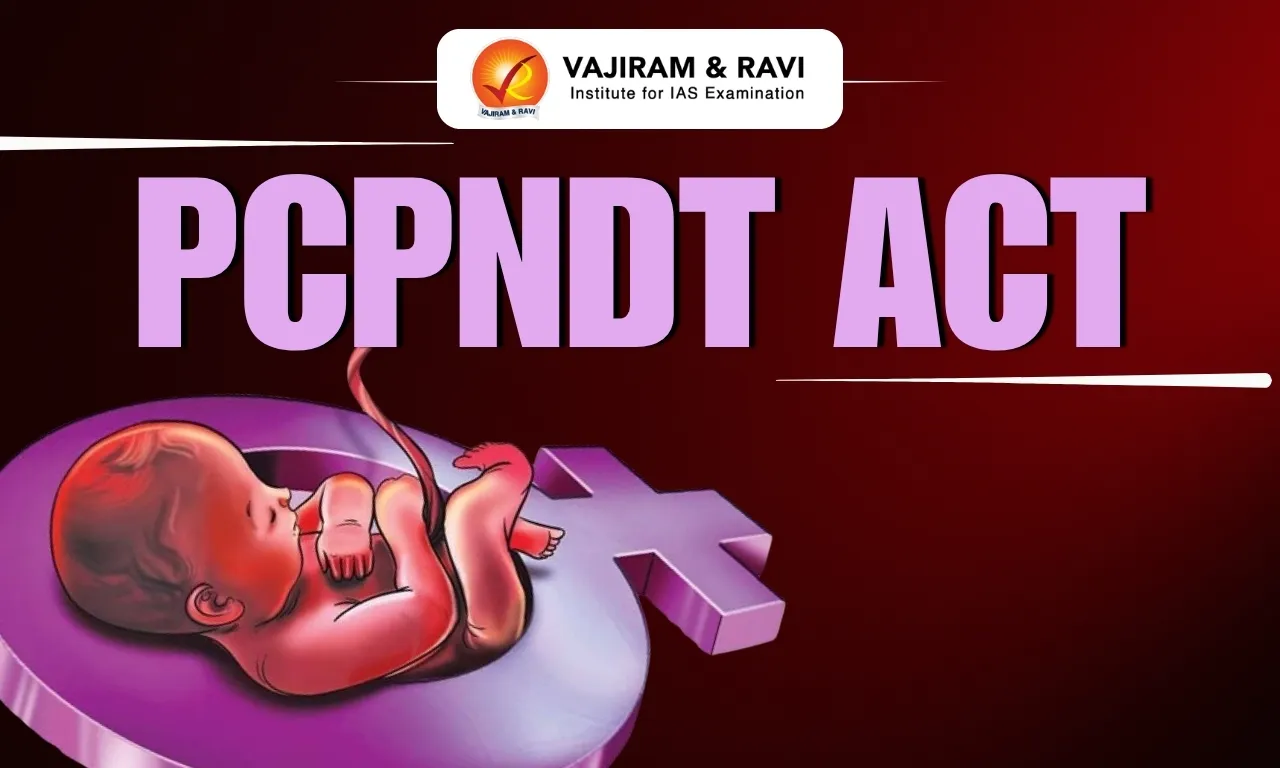
The PCPNDT Act (Pre-Conception and Pre-Natal Diagnostic Techniques (Prohibition of Sex Selection) Act, 1994) is the principal legislation aimed at prohibiting sex selection before or after conception and preventing the misuse of prenatal diagnostic techniques for sex determination and female foeticide.
The PCPNDT Act was enacted on 20 September 1994 and enforced from 1 January 1996; the Act regulates Genetic Counselling Centres, Genetic Laboratories and Genetic Clinics, requiring their registration and prescribing strict standards for prenatal diagnostic procedures. It prohibits communicating the sex of the foetus and provides penalties for violations. The Act is closely linked with the constitutional guarantees of equality and non-discrimination under Articles 14 and 15 and the right to life and dignity under Article 21, reinforcing the constitutional commitment to gender equality.
PCPNDT Act Background
The PCPNDT Act did not emerge in isolation; it was a legislative response to a deepening demographic and social crisis driven by son preference and the misuse of emerging medical technology.
- Declining Child Sex Ratio: A persistent decline in India's sex ratio, from 972 females per 1,000 males (1901) to 927 (1991), highlighted the growing prevalence of gender discrimination and female foeticide.
- Shift from Infanticide to Foeticide: The widespread use of ultrasound and prenatal diagnostic techniques in the 1980s and 1990s enabled sex-selective abortions, shifting the practice from female infanticide to female foeticide.
- Maharashtra's Pioneering Legislation: The Maharashtra Regulation of Prenatal Diagnostic Techniques Act, 1988, was India's first State law to prohibit sex determination and served as the model for the subsequent national legislation.
- Enactment and Strengthening of the PCPNDT Act: The Act was enacted in 1994 and came into force in 1996.
- The 2003 amendment expanded its scope to prohibit pre-conception sex selection, regulate ultrasound clinics, and strengthen institutional oversight through Central and State Supervisory Boards.
PCPNDT Constitutional Basis
The PCPNDT Act derives its constitutional legitimacy from the principles of equality, dignity, life, and the State's obligation to protect women and children.
- Article 14: Ensures equality before the law by combating gender-based discrimination through sex selection.
- Article 15(1) & 15(3): Prohibits discrimination on the ground of sex while permitting special laws for the protection of women and children.
- Article 21: Protects the right to life and dignity of the girl child by preventing sex-selective elimination.
- Article 39(f): Directs the State to ensure that children develop in conditions of freedom and dignity.
- Article 42: Encourages the State to secure humane conditions and maternity protection.
- Article 51A(e): Imposes a Fundamental Duty on citizens to renounce practices derogatory to the dignity of women.


PCPNDT Act Provisions
The PCPNDT Act establishes a multi-layered regulatory framework spanning prohibition, registration, oversight, and penalties. Its key provisions are as follows:
- Prohibition of Sex Selection (Sections 3A and 6): The Act prohibits sex selection before or after conception and bans any person from conducting or assisting in such practices.
- Regulation of Diagnostic Techniques (Section 4): The Act permits prenatal diagnostic techniques only for detecting specified genetic or congenital disorders and strictly prohibits their use for sex determination.
- Mandatory Registration under the PCPNDT Act (Sections 3, 3B and 18): All genetic counselling centres, laboratories, and clinics using prenatal diagnostic techniques must be registered under the Act. Sale of ultrasound machines to unregistered centres is prohibited.
- Consent and Non-Disclosure Provisions (Sections 5 and 6): The Act mandates written informed consent of the pregnant woman and prohibits disclosure of the sex of the foetus to anyone.
- Supervisory and Regulatory Bodies (Sections 7, 16A, 17 and 17A): The Act establishes Central and State Supervisory Boards and empowers Appropriate Authorities to monitor implementation, investigate violations, and suspend or cancel registrations.
- Ban on Advertisements (Section 22): The Act prohibits all advertisements relating to sex determination or sex selection, including through electronic and online media.
- Offences and Penalties under the PCPNDT Act (Sections 23-28): Violations of the Act attract imprisonment, fines, and suspension or removal of medical practitioners from the medical register.
- Protection of Pregnant Women (Section 24): The Act protects pregnant women forced to undergo sex determination procedures and presumes coercion by relatives or the husband in such cases.
PCPNDT Act Challenges
Despite its robust legal framework, the PCPNDT Act has faced persistent challenges in implementation that have limited its effectiveness in reversing the decline in child sex ratio.
- Continued Decline in Child Sex Ratio: Despite the enactment of the Act, the child sex ratio (0–6 years) declined from 945 in 1991 to 927 in 2001 and further to 914 in 2011, raising concerns about the effectiveness of implementation.
- Deep-Rooted Son Preference: The effectiveness of the Act is limited by entrenched patriarchy, gender bias, and strong societal preference for sons, which cannot be addressed through legislation alone.
- Weak Enforcement of the PCPNDT Act: Poor monitoring, corruption, lack of awareness, social complicity, and judicial delays continue to weaken enforcement of the Act at the ground level.
- Misuse of Digital Platforms: The challenge before the Act has expanded to digital platforms, where influencers and unqualified individuals promote illegal or unscientific gender-prediction methods online.
- Institutional and Procedural Gaps: Courts have highlighted the need to revisit certain provisions of the Act, particularly regarding police powers, raids, seizures, and procedural alignment with criminal law.
- Limited Regulatory Scope of the PCPNDT Act: While the Act mainly regulates clinic-based prenatal diagnostic procedures, emerging technologies such as IVF and pre-implantation genetic diagnosis pose new regulatory challenges.
PCPNDT Act Way Forward
Addressing the limitations of the PCPNDT Act requires a comprehensive approach that combines stronger enforcement mechanisms, adaptation to emerging technologies, and sustained social and behavioural change.
- Strengthening Enforcement of the PCPNDT Act: Appropriate authorities under the Act must be adequately staffed, trained, and empowered to ensure regular inspections, timely investigations, and swift prosecution of violations.
- Regulating Digital Platforms: The PCPNDT Act should be expanded to explicitly regulate online promotion of sex determination services and enable coordination with IT authorities to remove illegal digital content.
- Technology-Responsive Framework: The Act must be periodically updated to regulate emerging technologies such as advanced IVF techniques, non-invasive prenatal testing, and AI-based imaging that may facilitate sex selection.
- Convergence with Welfare Schemes: Effective implementation of the PCPNDT Act should be combined with initiatives such as Beti Bachao Beti Padhao to address the social roots of son preference through awareness, education, and women’s empowerment.
- Community Awareness and Social Change: Long-term success of the Act requires community participation, school-level sensitisation, and involvement of local women’s organisations to challenge patriarchal attitudes and son preference.
- Judicial Reforms: Fast-track courts and dedicated judicial mechanisms should be established for speedy disposal of cases under the PCPNDT Act.
- Periodic Review of the PCPNDT Act: The Act should undergo regular legislative review to address enforcement gaps and incorporate scientific and technological developments.

 Last updated on Oct, 2026
→ UPSC 2027 Notification will be released on 13 January 2027 at upsconline.nic.in.
→ Asian Games 2026 are being held in Aichi-Nagoya, Japan, from 19 September to 4 October.
→ Check Nobel Prize 2026 Winners List here.
→ Download PIB PRiSM Monthly Magazine 2026 here.
→ Check UPSC Monthly Current Affairs Magazine The Recitals here.
→ Check out the latest UPSC Syllabus here.
→ Download UPSC Model Answers for Mains 2026
→ UPSC Mains Question Paper 2026 is out now for Essay & GS Paper 1, 2, 3 & 4.
→ UPSC Calendar 2027 has been released.
→ Enroll in Vajiram & Ravi’s UPSC Mains Test Series 2027 for structured answer writing practice, expert evaluation, and exam-oriented feedback.
→ Join Vajiram & Ravi’s UPSC Mentorship Program 2027 for personalized guidance, strategy planning, and one-to-one support from experienced mentors.
→ Go through the UPSC Mains Previous Year Papers to enhance your preparation.
→ UPSC has released UPSC Toppers List 2025 with the Civil Services final result on its official website.
→ Also check Best UPSC Coaching in India
PCPNDT Act FAQs
Q1. What is the meaning of the PCPNDT Act?+
Q2. What is the main objective of the PCPNDT Act?+
Q3. When was the PCPNDT Act passed?+
Q4. What is the amendment of the PCPNDT Act 2003?+
Q5. What is Section 31 of the PCPNDT Act?+
Tags: pcpndt act quest UPSC Social Justice Notes