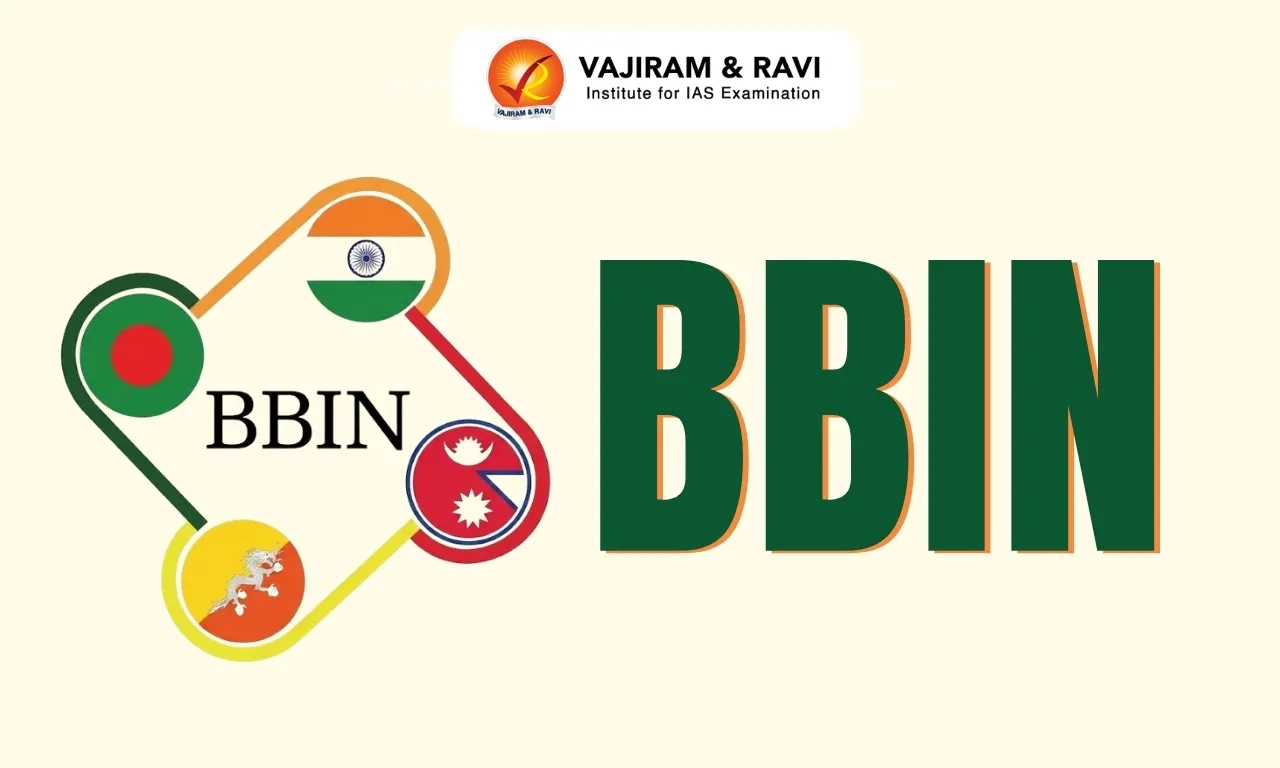
The BBIN (Bangladesh-Bhutan-India-Nepal) Initiative is a sub-regional cooperation framework designed to strengthen connectivity, trade, transport, energy cooperation and economic integration among four neighbouring South Asian countries. Its approach is largely practical and project-oriented, focusing on areas where cooperation can produce tangible benefits. The framework is particularly significant for India because it can connect the Northeast Region with neighbouring countries and wider regional markets.
The BBIN Motor Vehicles Agreement (MVA) is one of its most important components. Signed in June 2015 in Thimphu, Bhutan, the agreement seeks to facilitate the movement of passenger, personal and cargo vehicles across the participating countries and reduce delays associated with transhipment at borders.
BBIN History
The BBIN full form is Bangladesh, Bhutan, India, and Nepal, which is a sub-regional cooperation framework that emerged as a practical response to the difficulties faced by broader South Asian regional cooperation, especially under the SAARC Motor Vehicle Agreement.
- Instead of depending on a large regional grouping, it focuses on a smaller set of neighbouring countries and specific areas of cooperation such as transport, trade, energy and connectivity.
- A major milestone came in June 2015, when Bangladesh, Bhutan, India and Nepal signed the Motor Vehicle Agreement for the Regulation of Passenger, Personal and Cargo Vehicular Traffic.
- The agreement was designed to facilitate smoother cross-border movement and strengthen regional transport connectivity.
- However, implementation has progressed unevenly. Bhutan decided in 2017 to temporarily opt out of the MVA because of domestic concerns, while allowing the other three countries to proceed.
- In February 2020, an enabling MoU for implementation by India, Bangladesh and Nepal was finalised, pending Bhutan's ratification. Further progress was made during a meeting in New Delhi on 7–8 March 2022, when participating countries worked towards an MoU for regulating cross-border passenger and cargo traffic.
- The Motor Vehicle Agreement still requires the necessary protocols for complete operationalisation. Once fully implemented, it can facilitate seamless or "through" movement of vehicles and improve cross-border trade.
BBIN Components
BBIN cooperation framework extends beyond road transport and can be understood through several interconnected areas.
- Transport Connectivity: Improved connectivity is central to the framework. The Motor Vehicle Agreement seeks to simplify the movement of passenger and cargo vehicles across borders, reduce transshipment requirements and improve the efficiency of regional supply chains.
- Bangladesh, for example, can benefit from its geographical position as a transit link between India's Northeast and the rest of the subcontinent, thus improving India-Bangladesh relations.
- Multimodal Connectivity: The framework's connectivity agenda also includes roads, railways, inland waterways and the digital economy. Diversifying transport modes can make regional supply chains more efficient, while digital systems can support customs and trade facilitation.
- Energy Cooperation: The framework also aims for regional energy cooperation. Nepal and Bhutan possess considerable hydropower potential, while India and Bangladesh have large and growing energy markets.
- People-to-People Connectivity: To strengthen easier movement across borders through tourism, employment opportunities, cultural interaction and social links among neighbouring populations.
India's Role in BBIN
In the BBIN region, India occupies a central geographical position and acts as an important connecting link between Bangladesh, Bhutan and Nepal. For India, it complements the Neighbourhood First Policy by promoting stronger economic and infrastructural ties with immediate neighbours.
- The BBIN MVA is particularly important for India's Northeast. The agreement is a major opportunity to integrate the Northeast with India as well as neighbouring countries.
- India's role includes developing transport infrastructure, improving border connectivity, facilitating trade, strengthening logistics networks and working with partner countries to establish the regulatory arrangements required for smoother cross-border movement.


BBIN Initiatives and Projects
BBIN initiatives translate the framework’s regional vision into practical connectivity and economic linkages. BBIN projects focus on improving the movement of people and goods while creating new opportunities for trade and regional supply chains.
BBIN Motor Vehicle Agreement
- The Motor Vehicle Agreement is the flagship initiative of the BBIN framework. It aims to permit smoother movement of passenger and cargo vehicles across participating countries while reducing the need for repeated transshipment at borders connecting India's Northeast
- Two important routes of MVA:
- Kolkata–Dhaka–Sylhet–Tamabil–Dawki–Shillong–Guwahati
- Agartala–Akhaura–Dhaka–Kolkata
- The study estimates that the first route could reduce the distance by about 28%, while the second could reduce it by about 72%, compared with existing routes through the Siliguri corridor.
Inland Waterway Connectivity
- India and Bangladesh already have an inland water transit and trade protocol. Important routes through the Northeast include National Waterway-2 on the Brahmaputra and National Waterway-16 on the Barak.
- These routes can provide additional options for transporting goods between the Northeast and wider markets.
BBIN and Supply-Chain Development
- BBIN connectivity impacts on sectors such as pharmaceuticals and fresh and processed pineapple in the Northeast are being studied by experts.
- It highlights how lower transport time and costs can improve the export competitiveness of regional producers. For example, the study identifies opportunities for Tripura's pineapple industry.
- Better connectivity could make it more viable to establish processing facilities closer to production areas, reducing wastage and transportation difficulties associated with perishable products.
BBIN Benefits
BBIN can generate wide-ranging economic and strategic gains by improving regional connectivity and reducing barriers to cross-border movement. Its benefits extend from lower logistics costs and wider markets to stronger regional integration and development.
- Lower Transportation Costs: By reducing border delays and transshipment requirements, it can lower logistics costs and improve the competitiveness of goods moving across the region.
- Faster Movement of Goods: Seamless vehicle movement can reduce transit time and make regional supply chains more predictable.
- Greater Market Access: Improved connectivity can allow businesses in the Northeast and other peripheral regions to reach larger domestic and international markets.
- Strengthening the Northeast: It can help reduce the geographical isolation of India's Northeast by creating alternative routes to markets through Bangladesh and other neighbouring countries.
- Development of Regional Supply Chains: The agreement can encourage firms to source inputs, manufacture products and distribute goods across multiple BBIN economies, thereby supporting regional value chains.
- Growth of Transit and Logistics Hubs: Better connectivity can encourage the development of logistics centres, warehousing facilities, border markets and specialised manufacturing hubs along important transport corridors.
- Energy Security: Cooperation between hydropower-rich Nepal and Bhutan and energy-consuming markets such as India and Bangladesh can support regional electricity trade and improve energy security.
- Greater Regional Interdependence: Stronger economic links can create mutual stakes in stability and encourage regular institutional cooperation among neighbouring countries.
BBIN Challenges
Despite its significant potential, BBIN’s success depends on overcoming institutional, infrastructural and political barriers. Addressing these challenges is essential to ensure that regional connectivity translates into equitable and sustainable economic gains.
- Slow Implementation: The biggest challenge is the gap between signing agreements and putting them fully into operation. The BBIN MVA still requires protocols and operational arrangements for complete implementation.
- Bhutan's Reservations: Bhutan's decision to temporarily opt out of the MVA highlights the importance of domestic political, environmental and sovereignty-related considerations in regional connectivity projects.
- Infrastructure Gaps: Poor roads, inadequate logistics facilities, weak border infrastructure and insufficient multimodal connectivity can reduce the benefits of BBIN.
- Regulatory Differences: Differences in customs procedures, legal frameworks, technical standards and administrative processes can slow the movement of vehicles and goods.
- Unequal Distribution of Benefits: Smaller countries may be concerned about India's larger economic and geographical influence. Ensuring that BBIN produces visibly balanced benefits is therefore important for long-term political support.
- Border and Security Concerns: Greater movement across borders can also create risks of smuggling, trafficking, narcotics movement and other illegal activities. Stronger customs coordination, surveillance and information-sharing mechanisms are therefore necessary.
BBIN Way Forward
BBIN success will ultimately depend not merely on agreements but on businesses, communities and consumers experiencing faster, cheaper and more reliable regional connectivity.
- Implementation should move from agreements to functioning connectivity corridors.
- The participating countries should prioritise finalising operational protocols for the MVA, harmonising customs and transport procedures, strengthening border infrastructure and expanding multimodal connectivity.
- India and its partners should also develop integrated logistics systems, improve inland container depots, strengthen digital trade facilitation and build the skills required in the logistics sector.
- Need for better export-data systems, stronger logistics ecosystems, improved backward linkages, correction of trade-policy distortions and capacity building for logistics workers.
- At the political level, it should remain inclusive and benefit-sharing oriented. Greater transparency, consultation with local communities and sensitivity towards environmental and sovereignty concerns can help address reservations among smaller members.
- BBIN should be linked with wider connectivity initiatives such as Asian transport corridors and inland waterway networks so that individual projects develop into an integrated regional economic corridor.

 Last updated on Oct, 2026
→ UPSC 2027 Notification will be released on 13 January 2027 at upsconline.nic.in.
→ Asian Games 2026 are being held in Aichi-Nagoya, Japan, from 19 September to 4 October.
→ Check Nobel Prize 2026 Winners List here.
→ Download PIB PRiSM Monthly Magazine 2026 here.
→ Check UPSC Monthly Current Affairs Magazine The Recitals here.
→ Check out the latest UPSC Syllabus here.
→ Download UPSC Model Answers for Mains 2026
→ UPSC Mains Question Paper 2026 is out now for Essay & GS Paper 1, 2, 3 & 4.
→ UPSC Calendar 2027 has been released.
→ Enroll in Vajiram & Ravi’s UPSC Mains Test Series 2027 for structured answer writing practice, expert evaluation, and exam-oriented feedback.
→ Join Vajiram & Ravi’s UPSC Mentorship Program 2027 for personalized guidance, strategy planning, and one-to-one support from experienced mentors.
→ Go through the UPSC Mains Previous Year Papers to enhance your preparation.
→ UPSC has released UPSC Toppers List 2025 with the Civil Services final result on its official website.
→ Also check Best UPSC Coaching in India
BBIN FAQs
Q1. What is the purpose of the BBIN?+
Q2. Who are the members of the BBIN?+
Q3. Has Bhutan ratified BBIN MVA?+
Q4. When was BBIN established?+
Q5. How does the BBIN Initiative differ from SAARC?+
Tags: bbin quest UPSC International Relations and Institutions Notes