Question
Distinguish between a Fast Breeder Reactor (FBR) and a thermal nuclear reactor. In the context of the first indigenously developed prototype FBR at Kalpakkam, explain the term ‘criticality’. What are its implications for the clean energy future of our country?
Detailed Solution
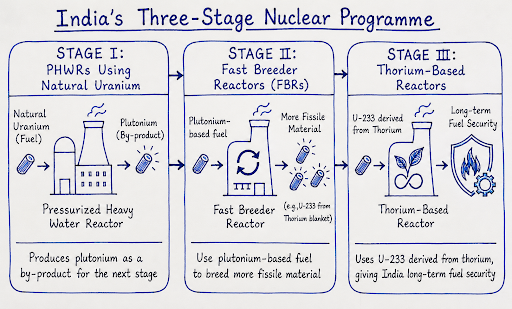
India’s indigenous 500 MWe Prototype Fast Breeder Reactor (PFBR) at Kalpakkam attained first criticality in April 2026, marking a major advance into Stage II of India’s three-stage nuclear programme and towards eventual thorium utilisation.
FBR vs Thermal Nuclear Reactor
|
Parameter |
Thermal Reactor — PHWR |
Fast Breeder Reactor — PFBR |
|
Neutrons |
Slow/thermal neutrons |
High-energy fast neutrons |
|
Moderator |
Required; PHWR uses heavy water |
No moderator |
|
Fuel |
Primarily uranium-based |
Uranium-Plutonium MOX |
|
Coolant |
PHWR uses heavy water |
Liquid sodium |
|
Breeding |
Not designed for net breeding |
Breeds fissile material from fertile material |
|
Programme |
Stage I |
Stage II |
What is ‘Criticality’?
Criticality is the point at which asustained and controlled nuclear fission chain reaction begins. At this stage, neutrons produced by fission equal those lost through absorption and leakage, resulting in a stable power output.
It marks the transition from the construction/commissioning phase towards reactor operation and is the essential first step towards generating heat and, ultimately, electricity.
|
Subcritical → Neutrons decline | Critical → Stable | Supercritical → Neutrons increase |
Thus, PFBR attaining first criticality demonstrates the successful establishment of a self-sustaining controlled chain reaction.
Implications for India’s Clean-Energy Future
- Closing the Fuel Cycle: PFBR can utilize plutonium recovered from spent PHWR fuel, converting spent nuclear material into an energy resource.
- Better Uranium Utilization: Fast neutrons enable fertileU-238 → fissile Pu-239, substantially extending the energy potential of India's uranium resources.
- Gateway to Thorium: FBRs form the crucial bridge towardsStage III, eventually enabling exploitation of India's largethorium resources through U-233.
- Firm Clean Power: FBRs can provide continuouslow-carbon electricity, complementing intermittent solar and wind in India's Net Zero 2070 transition.
- Strategic Energy Security: Recycling fissile material and developing the thorium cycle can reduce long-term dependence onimported uranium and fossil fuels.
- Technological Self-Reliance: Indigenous development by IGCAR/BHAVINI strengthens capabilities in sodium systems, fuel reprocessing, advanced materials and reactor engineering.
PFBR criticality connects India’s uranium present with its thorium future. By combining fuel breeding, recycling and firm low-carbon power, FBR technology can strengthen energy security, technological autonomy and India’s clean-energy transition
Last updated on Oct, 2026