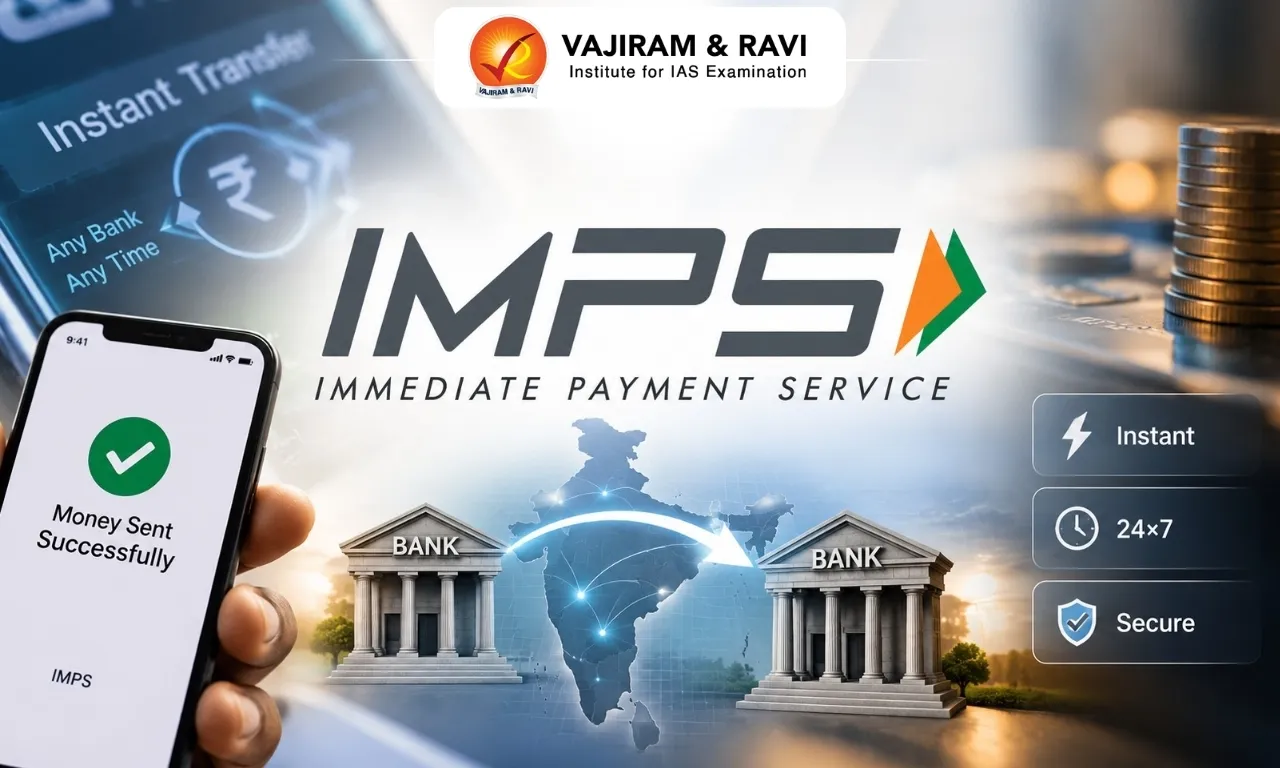
Immediate Payment Service, or IMPS, is a real-time, 24×7 interbank electronic fund-transfer system developed by the National Payments Corporation of India (NPCI) and launched in 2010. It enables instant transfer of funds through multiple channels, including mobile banking, internet banking and ATMs, irrespective of weekends and bank holidays. IMPS marked a significant milestone in India’s digital payments journey by making round-the-clock retail fund transfers possible and contributing to the evolution of the country’s interoperable payment ecosystem.
IMPS provided an important technological foundation for subsequent innovations such as the Unified Payments Interface (UPI). Despite its efficiency and wide accessibility, IMPS faces challenges related to cybersecurity, transaction limits, technical disruptions, digital literacy and competition from newer payment platforms..
IMPS Meaning
Immediate Payment Service (IMPS) is a real-time, 24×7 interbank electronic fund transfer system developed by the National Payments Corporation of India (NPCI).
- Launched in 2010, IMPS enables instant transfer of funds between bank accounts through mobile phones, internet banking, ATMs, and bank branches.
- IMPS facilitates secure transfers using account number & IFSC, mobile number & MMID, or Aadhaar (where supported) across participating banks.
- The Immediate Payment Service (IMPS) was introduced based on the recommendations and broader goals of the Reserve Bank of India (RBI) regarding the "electronification of retail payments".
IMPS Transfer Types
IMPS can be used through mobile banking, internet banking, ATMs, SMS, and bank branches, ensuring wide accessibility.
- IMPS via mobile number and MMID: You can transfer money using the recipient’s mobile number and Mobile Money Identifier (MMID).
- Both the sender and receiver need to register their mobile numbers with their respective banks.
- IMPS via account number and IFSC: This involves using the recipient’s account number and IFSC.
- It’s suitable for transferring funds to any bank account in India.


IMPS Evolution
Immediate Payment Service (IMPS) was introduced by NPCI as India’s first real-time interbank electronic fund transfer system operating 24×7. IMPS transformed digital banking by enabling instant money transfers anytime, anywhere, and laid the technological foundation for later innovations such as the Unified Payments Interface (UPI).
- Pilot Launch (2010): The National Payments Corporation of India launched the IMPS pilot in August 2010 with State Bank of India, Bank of India, Union Bank of India and ICICI Bank, later joined by Yes Bank, Axis Bank and HDFC Bank.
- Public Launch: IMPS was officially launched on 22 November 2010 in Mumbai by Shyamala Gopinath, who was the Deputy Governor of the Reserve Bank of India (RBI) at the time, alongside the NPCI.
- Major Innovation: IMPS became India’s first 24×7 real-time interbank fund transfer system, enabling instant transfers anytime, including holidays.
- Rapid Expansion: Between 2012 and 2013, IMPS recorded nearly 2,600% YoY growth in transaction volume, reflecting India’s growing adoption of digital payments.
- Simplified Transfers: National Payments Corporation of India upgraded IMPS with a mobile-number-based transfer system, reducing dependence on account numbers, IFSC codes and MMIDs.
- Foundation for UPI: IMPS laid the technological base for Unified Payments Interface (UPI).
- 24×7 Architecture: IMPS introduced 24×7, instant interbank fund transfers in 2010, proving that India's banking system could process retail payments in real time.
- Backend Infrastructure: UPI reused the robust underlying real-time payment rails and switching network of IMPS to clear and settle transactions.
- Mobile-First Design: IMPS first tied instant payments to mobile numbers, which evolved into UPI's mobile-centric architecture.
IMPS Features
IMPS stands out as one of India's most reliable payment systems due to its speed, accessibility, and security. Here are its core features:
- Instant Transfer: IMPS ensures immediate fund transfer in seconds, which is crucial for emergency transactions. The beneficiary's account is credited instantly.
- 24×7×365 Availability: IMPS is available round the clock, including on holidays, making it functional even when traditional banking services are closed.
- Multi-Channel Access: IMPS can be accessed on multiple channels like mobile, internet, branch, ATM, and SMS, making it a multichannel and multidimensional platform.
- Multiple Transfer Modes: IMPS enables instant transfers via account number + IFSC or mobile number + MMID (Mobile Money Identifier), giving users flexibility in how they send money.
- MMID is now a legacy mechanism.
- Transaction Limit of ₹5 Lakh: The per-transaction limit on IMPS is ₹5 lakh for all channels except SMS and IVR.
- Supports P2P and P2M Transfers: IMPS is capable of processing person-to-person, person-to-account, and person-to-merchant remittances.
- Safe & Secure: Transactions are encrypted and routed through secure NPCI servers, and IMPS is regulated by the Reserve Bank of India (RBI) following strict compliance norms.
- Debit & Credit Confirmation: Both the sender and receiver get immediate SMS confirmation upon successful transaction completion.
- Economical: IMPS is not only safe but also economical, making it accessible for everyday banking needs.
- Wide Participation: Currently, around 1000 members are live on IMPS, including banks and Prepaid Payment Instrument (PPI) issuers.
IMPS vs NEFT
Here is the fundamental difference between IMPS and NEFT fund transfers.
| Parameter | IMPS | NEFT |
|
Operator |
National Payments Corporation of India (NPCI) |
The Reserve Bank of India (RBI) |
|
Ultimate Regulatory Body |
RBI |
RBI |
|
Transaction Speed |
Instant/near-instant fund transfer |
Processed through periodic settlement cycles |
|
Operational Timings |
24×7, including weekends and bank holidays |
24×7, including weekends and bank holidays |
|
Transaction Limits |
Up to ₹5 lakh per transaction* |
No RBI-prescribed minimum or maximum limit* |
|
Transfer Mechanism |
Real-time fund transfer |
Deferred Net Settlement (DNS) |
|
Transfer Details |
Account number + IFSC and other supported identifiers |
Beneficiary account number + IFSC |
|
Transfer Modes |
Online/digital channels |
Online banking as well as bank branches |
| Note: *Limits may vary based on the bank/channel. | ||
IMPS Limitations
Despite being a robust and widely adopted payment system, IMPS is not without its drawbacks. While it revolutionised real-time banking in India, certain structural, technical, and accessibility constraints continue to limit its reach and usability. Understanding these challenges helps users and businesses make more informed choices when selecting a payment method.
- Transaction Limits & Charges: IMPS has a transfer limit of ₹5 lakh per transaction, and banks may levy transaction charges, making it costlier than free or low-cost digital payment options.
- Security & Fraud Risks: Real-time processing in IMPS increases the risk of phishing and unauthorised transactions, while fund reversal remains difficult after transfer.
- User Input Errors: Incorrect account details, IFSC codes or MMIDs in IMPS can result in failed transactions and delayed auto-reversals.
- Technical & Connectivity Issues: Bank server downtime, maintenance or poor internet connectivity can disrupt IMPS transactions, especially in rural and remote areas.
- Digital Literacy Barrier: Effective use of IMPS requires mobile banking awareness and digital skills, limiting accessibility for elderly, rural and non-tech-savvy users.
- Less Suitable for Small Payments: Compared to Unified Payments Interface (UPI), IMPS is less convenient for quick QR-based micro-transactions and small merchant payments.
IMPS Way Forward
Immediate Payment Service (IMPS) pioneered India’s 24×7 real-time interbank fund transfer system and became the foundation for modern digital payment platforms like Unified Payments Interface (UPI). As India moves towards a less-cash digital economy, IMPS is expected to evolve into a more integrated, secure and globally connected payment infrastructure.
- Greater Interoperability: IMPS should strengthen interoperability across India's digital payment ecosystem while improving resilience and settlement efficiency.
- Cross-Border Expansion: IMPS can be linked with international payment systems to enable faster and low-cost global remittances for businesses and the Indian diaspora.
- AI-Based Fraud Detection: Future IMPS infrastructure should adopt Artificial Intelligence (AI) and Machine Learning (ML) for real-time fraud monitoring and predictive risk management.
- Voice-Based Payments: Integration of Natural Language Processing (NLP) can enable voice-enabled IMPS transactions in regional languages, improving accessibility for digitally less-aware users.
- Financial Inclusion & Data Empowerment: IMPS transaction history can support consent-based digital lending, insurance and micro-credit access for small businesses and unbanked populations.
- Infrastructure Modernisation: To manage rising digital payment volumes, the National Payments Corporation of India must further strengthen the scalability, speed and reliability of the IMPS network.

 Last updated on Oct, 2026
→ UPSC 2027 Notification will be released on 13 January 2027 at upsconline.nic.in.
→ Check Nobel Prize 2026 Winners List here.
→ Download PIB PRiSM Monthly Magazine 2026 here.
→ Check UPSC Monthly Current Affairs Magazine The Recitals here.
→ Check out the latest UPSC Syllabus here.
→ Download UPSC Model Answers for Mains 2026
→ UPSC Mains Question Paper 2026 is out now for Essay & GS Paper 1, 2, 3 & 4.
→ UPSC Calendar 2027 has been released.
→ Enroll in Vajiram & Ravi’s UPSC Mains Test Series 2027 for structured answer writing practice, expert evaluation, and exam-oriented feedback.
→ Join Vajiram & Ravi’s UPSC Mentorship Program 2027 for personalized guidance, strategy planning, and one-to-one support from experienced mentors.
→ Go through the UPSC Mains Previous Year Papers to enhance your preparation.
→ UPSC has released UPSC Toppers List 2025 with the Civil Services final result on its official website.
→ Also check Best UPSC Coaching in India
IMPS FAQs
Q1. What is the limit of IMPS?+
Q2. Is UPI the same as IMPS?+
Q3. Can I transfer 50 lakhs through IMPS?+
Q4. How much time do IMPS take?+
Q5. Is IMPS chargeable or free?+
Tags: imps quest upsc economy notes