King Kanishka, also known as Kanishka I or Kanishka the Great, was one of the most powerful rulers of the Kushan dynasty. He ruled a vast empire covering parts of Central Asia, Afghanistan, Pakistan, and northern India during the early second century CE.
Kanishka is remembered for expanding the Kushan Empire, encouraging Silk Route trade, supporting Buddhist institutions, issuing remarkable gold and copper coins, and promoting the Gandhara and Mathura schools of art. His reign connected India with Central Asia, China, and the Roman world.
Kushan King Kanishka History
Kanishka belonged to the Kushan Empire, which emerged from the Yuezhi tribes of Central Asia. The Kushans gradually established a powerful empire in the northwestern Indian subcontinent.
- Kanishka is generally considered one of the greatest Kushan rulers. The exact dates of his reign remain debated among historians, although he is traditionally placed around the 2nd century CE.
- His empire extended across important regions of Central Asia, Afghanistan, Pakistan, and northern India. His strategic location allowed the Kushans to control important trade routes connecting India with Central Asia, China, and the Roman world.
- Kanishka succeeded Vima Kadphises around 127 CE. Under him, the Kushan Empire reached its height, with Purushapura (Peshawar) and Mathura serving as major centres of administration.
Kanishka's Conquests
Kanishka was the most prominent ruler of the Kushana dynasty. During his reign, Kushana power expanded across northern India and Central Asia, creating a vast empire that connected important regions of the Indian subcontinent with the north-west. He started his reign with an empire that already included Afghanistan, Sindh, parts of Parthia, and Punjab.
Kanishka’s South and Central Asian Conquests
His dual-frontier campaigns successfully subjugated strategic Silk Road hubs in Central Asia and fertile kingdoms deep within the South Asian subcontinent.
- Kashmir Annexation: He conquered and annexed the Kashmir Valley, founded a city named after himself, and built numerous monuments there.
- Magadha Campaign: He marched deep into the Gangetic plains, defeated Pataliputra, and brought the famous Buddhist philosopher Asvaghosa back to his court.
- Western Satraps Defeat: He fought the Western Satraps to capture Malwa, reducing rulers like Nahapana or Chastana to subordinate vassals.
- Central Asian & Chinese Victory: He crossed the Pamir Mountains, conquered Kashgarh, Khotan, and Yarkand, and defeated Chinese forces, taking royal hostages.
- Eastern Push (Bengal): His armies advanced toward Bengal (reaching Kajangal); while his coins are widely found there, historians debate whether it was fully annexed.
- Final Empire Extent: His vast empire ultimately stretched from Central Asia and Afghanistan down to Bihar (Pataliputra) and Malwa, ruled from his capital at Purushapura (Peshawar).


Kanishka Empire Map
Kanishka’s conquests in the 2nd century CE made the Kushan Empire a major power linking Central Asia with northern India. The Rabatak inscription is an important source for identifying several territories associated with his expansion.

Kanishka Administration
Kanishka’s administration combined strong central kingship with regional officials, allowing the large Kushan Empire to be governed across diverse regions of Central and South Asia. Evidence mainly comes from inscriptions, coins, and archaeological remains.
- Centralized Seat of Power: The absolute capital and seat of the Central Government was located at Purushapura (modern Peshawar).
- The Satrapy System: Kanishka divided the vast empire into provinces called Satrapies, continuing a decentralized governance system inherited from the Sakas and the Pahlavas.
- Eastern Part: It was governed by Mahakshatrapa Kharapallana and Kshatrapa Vanaspara.
- Northern Part: It was ruled by General Lala as Mahakshatrapa, assisted by Kshatrapas Vaspasi and Laika.
- Territorial Subdivisions: For localized governance, the empire was systematically broken down into descending units called Rashtra, Ahara, Janapada, and Desa or Vishaya.
- Absolute Monarchy: Kanishka reigned as the supreme head of state in all religious and secular matters.
- Policy of Welfare and Religious Toleration: Kanishka actively emulated the imperial methods of King Asoka. He leveraged state administration to foster a spirit of deep religious toleration, providing active state backing for welfare and the propagation of Buddhism.
Kanishka Religion
The Kushanas incorporated diverse local deities into their pantheon and depicted them on coins, using religious imagery as a means of royal propaganda that reinforced the king’s authority and divine status.
- Iranian Influence: Kanishka’s coins predominantly feature Iranian deities, reflecting his Bactrian cultural background.
- Iranian Gods: The Rabatak inscription mentions Iranian gods, with Nana as the presiding deity and source of Kushana power.
- Buddha as Boddo: The depiction of Buddha as Boddo was a significant addition to Kanishka’s coinage.
- Divine Kingship: Buddha was depicted alongside Shiva, Mithra, and Ahurmazda, suggesting Kanishka’s association of his rule with divine authority.
- Buddhist Influence: The Buddha images on his coins indicate Kanishka’s close association with Buddhism and the religious cults prevalent in his empire.
Kanishka and Buddhism
Kanishka is closely associated with the growth of Buddhism under Kushan rule, particularly through royal patronage, support for Buddhist centres and the expansion of Buddhist ideas along Central Asian trade routes.
- Buddhist Patronage: Kanishka supported Buddhist institutions, contributing to the flourishing of Buddhist thought, monasteries and sacred art during his reign.
- Fourth Buddhist Council: Buddhist tradition associates Kanishka with a major council held in Kashmir, traditionally linked with the compilation and clarification of Buddhist teachings.
- Mahayana Buddhism: Kanishka is traditionally regarded as an important patron of Mahayana Buddhism. Under Kushan rule, Gandhara became a major Buddhist centre; many important Buddhist centres were founded or expanded during the 2nd century CE.
Kanishka Coins
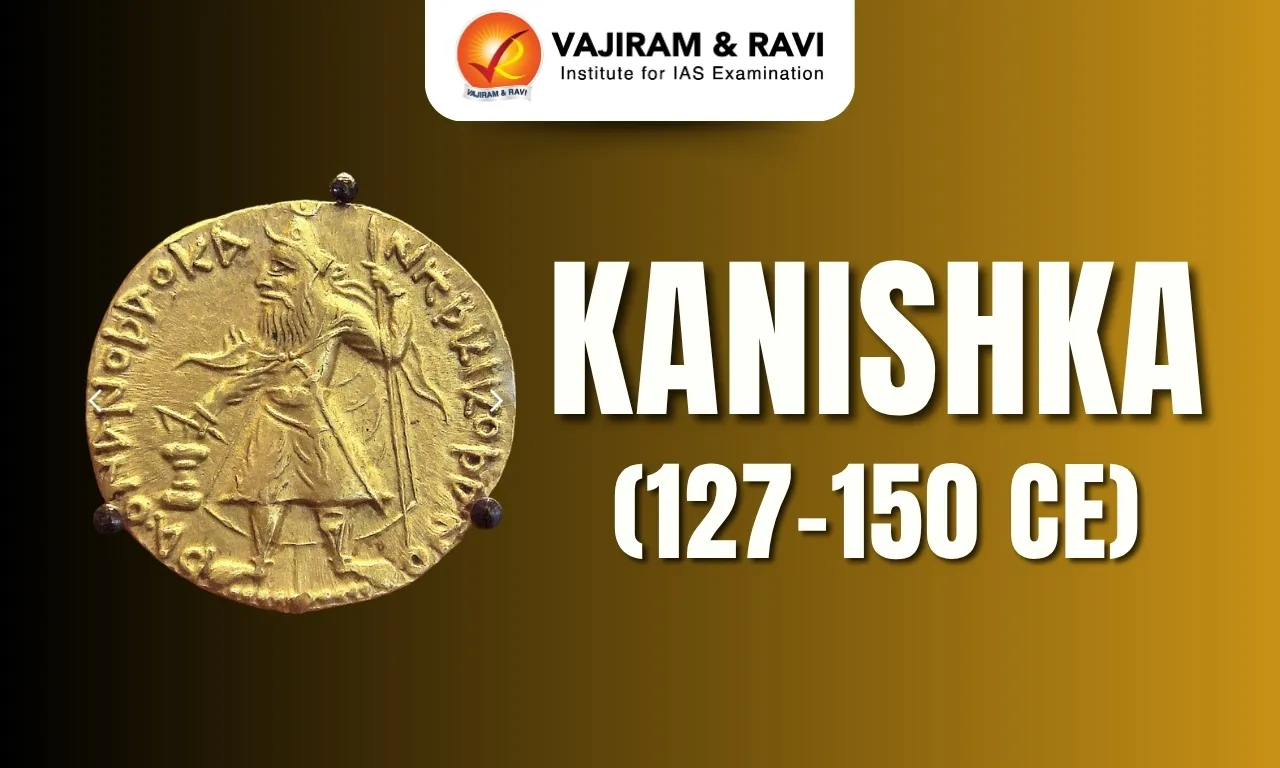
Kanishka’s coins are an important source for understanding the Kushan economy, kingship and religious diversity. His coinage combined imperial imagery with a wide range of deities, reflecting the multicultural character of the Kushan Empire.
- Gold and Copper Coinage: Kanishka issued both gold and copper coins, which date to approximately 127–150 CE.
- King on the Obverse: Kanishka is commonly shown standing beside an altar, holding a spear and making a ritual offering. Some coins show him wearing a heavy coat, cloak, and high boots, highlighting his Central Asian appearance.
- Diverse Deities on Reverse: His coins depict deities from different religious traditions, including Buddha (Boddo), Shiva/Oesho, Nana, Mithra, and Athsho. This provides evidence of the religious diversity of the Kushan Empire.
- Buddha on Coins: Some Kanishka coins portray Shakyamuni Buddha, with the Bactrian name “Boddo”. For example, Buddha is shown standing with his right hand raised in the abhaya mudra.
- Economic Significance: The widespread Kushan coinage and its gold issues indicate the importance of long-distance trade and monetisation in the empire.
Kanishka Literature
Kanishka’s reign is associated with the growth of Buddhist literature and scholarship, particularly through royal patronage and the development of Buddhist centres in the north-west. However, many works traditionally linked with his period are difficult to date precisely.
- Ashvaghosha: He was traditionally associated with Kanishka’s court; he is credited with Buddhacharita, a Sanskrit biography of the Buddha, and Saundarananda, a Buddhist poetic work.
- Also, Sariputraprakarana, a Sanskrit Buddhist drama depicting the conversion of Shariputra and Maudgalyayana, was written by him.
- Charaka: Tradition connects the physician Charaka with Kanishka’s court. The Charaka Samhita became an important work of Ayurvedic medicine, although the exact date and extent of Charaka’s association with Kanishka remain debated.
- Vasumitra: Buddhist tradition associates Vasumitra with the Fourth Buddhist Council and with the compilation and interpretation of Buddhist teachings under Kanishka.
Kanishka Art and Architecture
Kanishka’s reign marked an important phase in the development of Kushan art and architecture, particularly in Gandhara and Mathura. His period witnessed a strong blending of Indian, Central Asian, and Greco-Roman artistic traditions.
- Gandhara School: Gandhara School of Art reached its highest expression during Kanishka’s 2nd-century reign, especially in Buddhist sculpture. It incorporated strong Greco-Roman features such as realistic modelling, drapery and architectural motifs.
- Mathura School: The Mathura School of Art developed as another major artistic centre under the Kushans, producing predominantly indigenous Indian-style sculptures alongside Buddhist, Jain and Brahmanical images.
- Kanishka Stupa: Kanishka is traditionally associated with a monumental stupa at Shah-ji-ki-Dheri near Peshawar. Excavations at the site produced the famous Kanishka reliquary, associated with Buddhist relic worship.
- During the Kanishka-Huvishka period, Gandharan Buddhist sites increasingly featured tall stupas on high square bases, replacing earlier massive rounded forms.
- Buddhist Sculpture: The period saw the flourishing of Buddha and Bodhisattva images, including narrative reliefs depicting important episodes from the Buddha’s life.
- Cultural Synthesis: Kushan art combined Indian religious themes with Central Asian and classical Mediterranean influences, reflecting Kanishka’s empire's position between South and Central Asia.
Kanishka Death
Kanishka’s death is not clearly recorded in contemporary sources, so the exact date and circumstances remain uncertain. What is better established is that he was succeeded by Huvishka, whose reign is documented from around 154 CE, while Kanishka’s own inscriptions are attested up to about 150 CE.

 Last updated on Oct, 2026
→ UPSC 2027 Notification will be released on 13 January 2027 at upsconline.nic.in.
→ Check Nobel Prize 2026 Winners List here.
→ Download PIB PRiSM Monthly Magazine 2026 here.
→ Check UPSC Monthly Current Affairs Magazine The Recitals here.
→ Check out the latest UPSC Syllabus here.
→ Download UPSC Model Answers for Mains 2026
→ UPSC Mains Question Paper 2026 is out now for Essay & GS Paper 1, 2, 3 & 4.
→ UPSC Calendar 2027 has been released.
→ Enroll in Vajiram & Ravi’s UPSC Mains Test Series 2027 for structured answer writing practice, expert evaluation, and exam-oriented feedback.
→ Join Vajiram & Ravi’s UPSC Mentorship Program 2027 for personalized guidance, strategy planning, and one-to-one support from experienced mentors.
→ Go through the UPSC Mains Previous Year Papers to enhance your preparation.
→ UPSC has released UPSC Toppers List 2025 with the Civil Services final result on its official website.
→ Also check Best UPSC Coaching in India
Kanishka FAQs
Q1. What is Kanishka famous for?+
Q2. Was Kanishka a Hindu?+
Q3. Why was Kanishka called the second Ashoka?+
Q4. Who converted Kanishka to Buddhism?+
Q5. Who defeated Kanishka?+
Tags: kanishka quest upsc ancient history notes