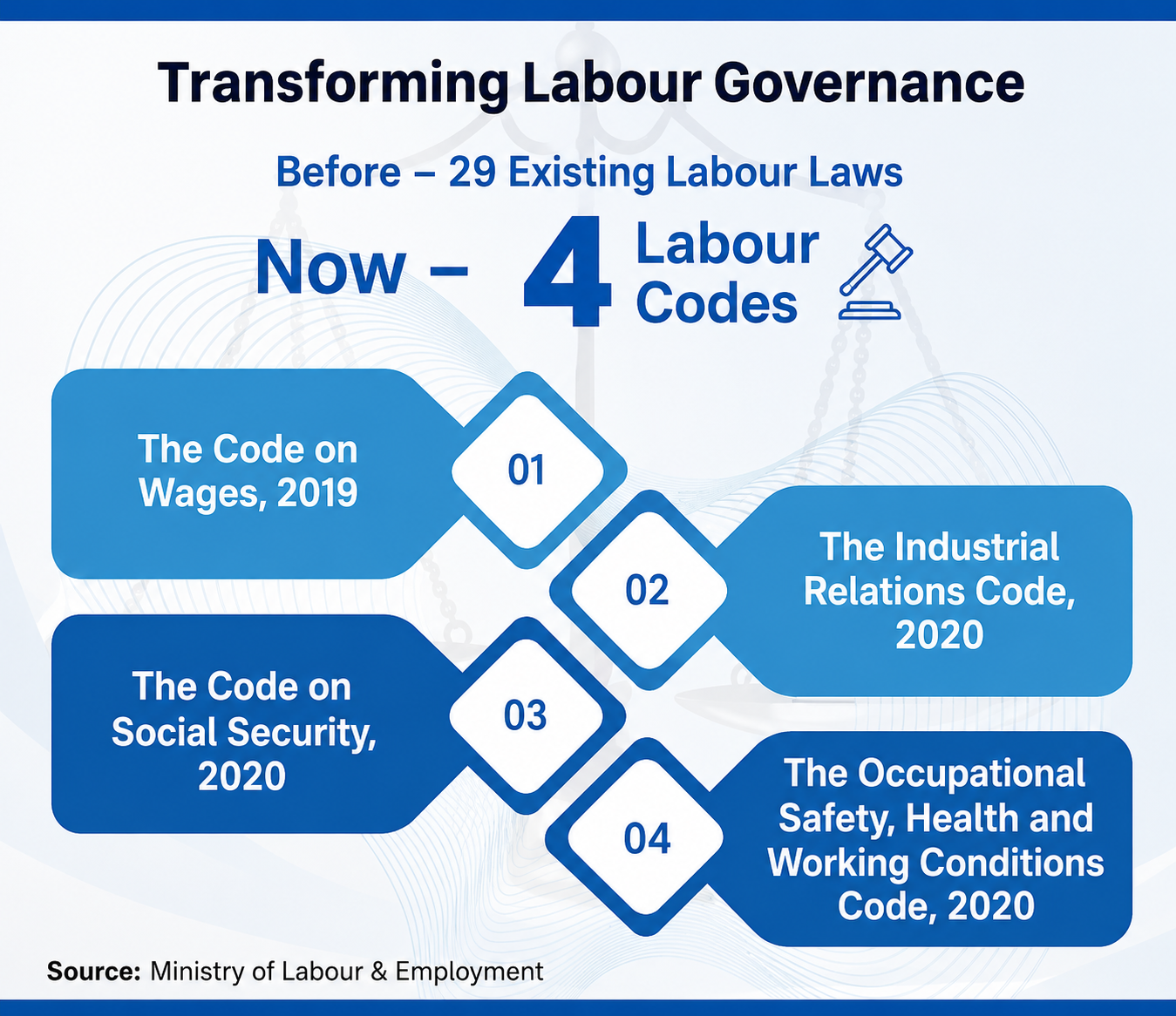
Labour reforms in India aim to modernise the country’s labour market by simplifying regulations, strengthening worker protection and promoting employment-led economic growth. A major labour reform was the consolidation of 29 central labour laws into four Labour Codes: Code on Wages, 2019; Industrial Relations Code, 2020; Code on Social Security, 2020; and Occupational Safety, Health and Working Conditions (OSHWC) Code, 2020.
Based substantially on the recommendations of the Second National Commission on Labour, these labour codes seek to simplify and rationalise labour laws, reduce compliance burdens, improve ease of doing business, and promote greater formalisation of employment. The Labour Codes also seek to strengthen social security coverage, improve workplace safety, and extend protection to gig, platform and unorganised workers, supporting sustainable labour-market development.
Labour Reforms
Labour reforms in India have evolved from fragmented, sector-specific labour laws to a simplified and unified Labour Code framework, aiming to strike a balance between economic efficiency and social justice. They seek to create a transparent, inclusive, and modern labour law regime that promotes industrial growth, improves ease of doing business, and safeguards workers' rights.
Chronology of Labour Reforms in India
- Second National Commission on Labour (2002): The Commission recommended consolidating existing labour laws into 4-5 labour codes based on functional categories.
- Consultation Process for Labour Reforms (2015–2019): Extensive tripartite consultations were held with the government, states, employers, industry bodies, and trade unions to build consensus on the labour reforms.
- Code on Wages, 2019: Notified on 8 August 2019.
- Enactment of the Remaining Three Labour Codes (2020): On 29 September 2020, Parliament enacted the Industrial Relations Code, 2020; the Code on Social Security, 2020; and the Occupational Safety, Health and Working Conditions (OSHWC) Code, 2020.
- Simplification through the Four Labour Codes (2020–2025): 1,228 sections streamlined into 480 sections.
- 31 returns replaced with one electronic return.
- 84 registers reduced to 8 registers.
- Implementation of the Four Labour Codes (2025–2026): 21 November 2025: The Four Labour Codes came into force.
-
- 8 May 2026: Final Central Rules notified, completing a major milestone in India's labour reforms and operationalising the labour codes nationwide. However, full on-the-ground implementation depends on individual state rules.
Labour Codes Meaning
A labour code is a consolidated set of laws that streamlines, modernises, and replaces multiple fragmented workplace regulations into unified legal frameworks. In India, the government reformed its legal framework by combining 29 separate central labour laws into four comprehensive labour codes.


Labour Codes List
The Four Labour Codes are the cornerstone of labour reforms in India, streamlining labour laws related to wages, industrial relations, social security, and occupational safety into a unified legal framework. They aim to enhance productivity, improve compliance, strengthen workers' rights, and support sustainable economic growth.
The Code on Wages, 2019
The Code on Wages, 2019, is the first of India's Four Labour Codes, consolidating four major wage-related labour laws into a single framework.
- Consolidation of Labour Laws: It merges the Payment of Wages Act, 1936; the Minimum Wages Act, 1948; the Payment of Bonus Act, 1965; and the Equal Remuneration Act, 1976 into a single wage code.
- Universal Minimum Wages (Section 5): The Code extends the statutory right to minimum wages to all workers in both the organised and unorganised sectors, replacing the earlier scheduled employment framework.
- National Floor Wage (Section 9): It empowers the Central Government to fix a floor wage based on minimum living standards; states cannot prescribe minimum wages below this threshold.
- Scientific Wage Fixation: Minimum wages are determined based on skill level, geographical location, and nature of work, including hazardous or difficult working conditions.
- Equal Wages & Gender Equality: The Code prohibits discrimination based on gender, including transgender identity, in recruitment, wages, and service conditions for similar work.
- Overtime Wages (Section 14): It mandates payment of at least twice the normal wage rate for overtime work.
- Employer Accountability: The Code makes employers legally responsible for timely wage payment, with liability for unpaid wages.
- Inspector-cum-Facilitator (Section 51): It replaces the traditional inspector with an Inspector-cum-Facilitator, promoting guidance, transparency, and voluntary compliance.
Industrial Relations Code, 2020
This Labour Code aims to strengthen industrial relations, simplify dispute resolution, promote labour market flexibility, and balance workers' rights with ease of doing business.
- Consolidation of Labour Laws: The Code merges the Trade Unions Act, 1926, the Industrial Employment (Standing Orders) Act, 1946, and the Industrial Disputes Act, 1947, into one comprehensive code.
- Fixed Term Employment (FTE) (Section 2(o)): Permits direct fixed-term employment with wages, benefits and statutory entitlements comparable to permanent workers performing similar work.
- Fixed-term employees are eligible for gratuity after one year of continuous service under the Code on Social Security, 2020.
- Re-skilling Fund (Section 83): The Code establishes a Re-skilling Fund for retrenched workers, financed by employers with an amount equal to 15 days' wages per retrenched worker, credited within 45 days.
- Trade Union Recognition (Section 14): It recognises a union with 51% membership as the Negotiating Union; where unavailable, a Negotiating Council is formed with unions having at least 20% membership.
- Higher Threshold for Layoff, Retrenchment & Closure (Section 77): It raises the prior government approval threshold from 100 to 300 workers, with states empowered to prescribe higher limits.
- Standing Orders Threshold (Section 28): It increases the applicability threshold for Standing Orders from 100 to 300 workers, reducing compliance burden for smaller establishments.
- Women's Representation (Section 4(4)): The code mandates proportionate representation of women in grievance redressal committees.
- Work-from-Home Provision: The 2026 Model Standing Orders permit work from home, remote location and virtual workplace arrangements subject to employment conditions or agreement between the employer and workers.
- Industrial Tribunals (Section 44): It establishes two-member industrial tribunals comprising judicial and administrative members for faster dispute resolution.
- Notice for Strikes & Lockouts (Section 62): It makes a 14-day prior notice mandatory before strikes or lockouts across all industrial establishments.
- Expanded Definition of Strike (Section 2(zk)): It includes mass casual leave within the definition of a strike to discourage sudden work stoppages.
- Digital Compliance: Promotes electronic registration, record-keeping, filings and communication, reducing paperwork and improving transparency and efficiency.
Code on Social Security, 2020
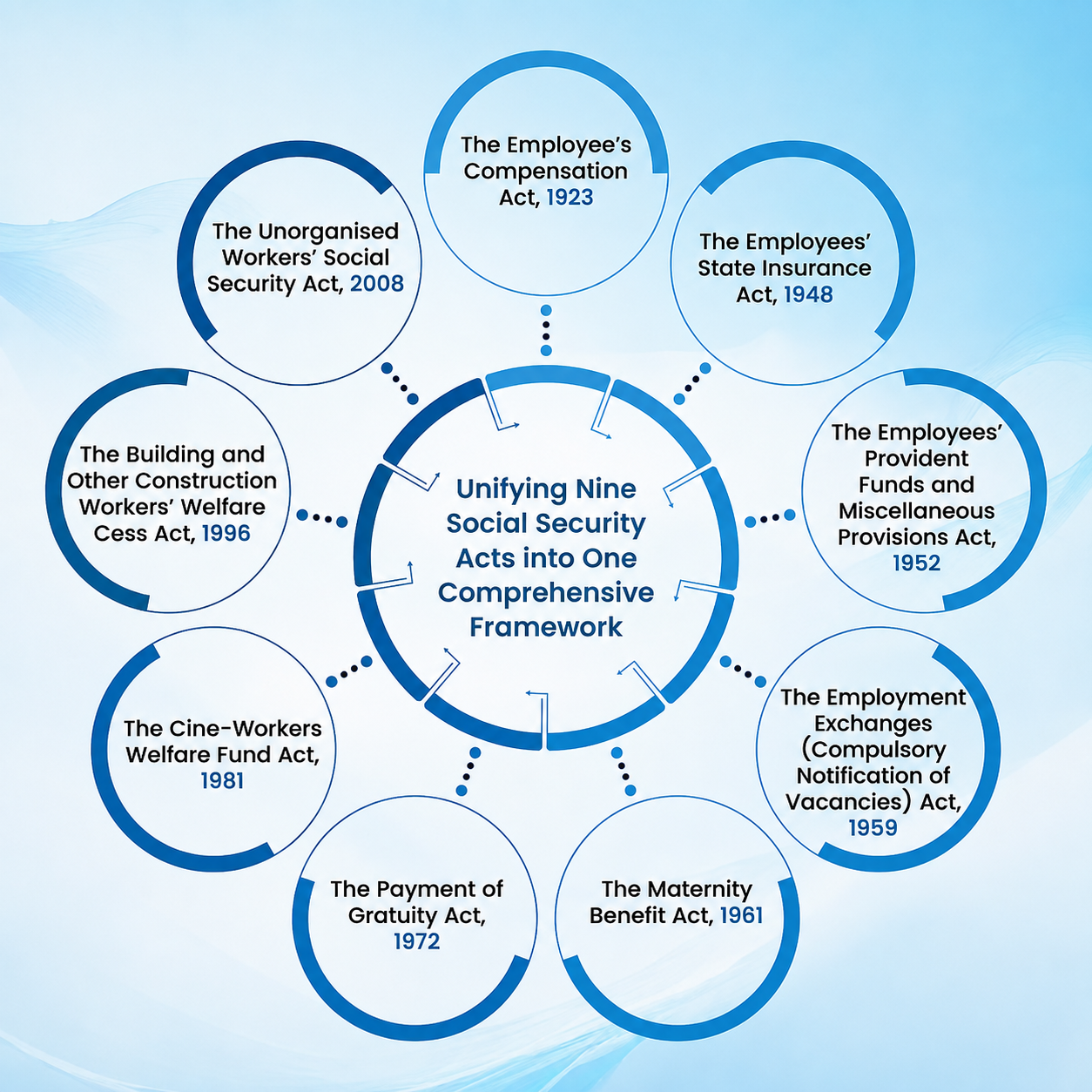
This Labour Code is one of the four labour codes that consolidate nine major social security laws into a single framework.
- Social Security Coverage (Sections 109, 113, 114): The Code creates a broader framework for social security schemes covering organised, unorganised, gig and platform workers, including life, health, maternity, old-age and disability protection, subject to notified schemes and eligibility.
- Expanded ESIC Coverage (Section 1(7)): It extends Employees' State Insurance (ESIC) across India, enables voluntary coverage for establishments with fewer than 10 employees, and mandates coverage for hazardous occupations.
- Time-bound EPF Proceedings (Section 125): It introduces a five-year limit for initiating EPF inquiries, ensuring faster disposal and eliminating indefinite reopening of cases.
- Social Security for Gig & Platform Workers (Section 114(4)): It recognises gig workers, platform workers, and aggregators, with aggregators contributing 1–2% of annual turnover (subject to the prescribed cap) towards social security.
- Social Security Fund (Section 141): The Code establishes a dedicated Social Security Fund for unorganised, gig, and platform workers to finance welfare schemes covering health, disability, old-age, and life benefits.
- Expanded Definition of Dependents (Section 2): It broadens the definition of dependents by including maternal grandparents and dependent parents-in-law of female employees.
- Uniform Definition of Wages (Section 2(88)): Introduces a uniform definition of wages for calculating EPF, gratuity, pension, bonus, and other social security benefits, ensuring consistency across labour laws.
- Compensation for Commuting Accidents (Section 34(3)): It treats accidents occurring during travel between home and workplace as employment-related for compensation purposes.
- Gratuity for Fixed-Term Employees (Section 53(1)): The code makes fixed-term employees eligible for gratuity after one year of continuous service.
Occupational Safety, Health and Working Conditions (OSHWC) Code, 2020
The OSHWC Code, one of the four labour codes, aims to improve workplace safety, occupational health, and working conditions, while simplifying compliance, strengthening labour welfare, and promoting ease of doing business.
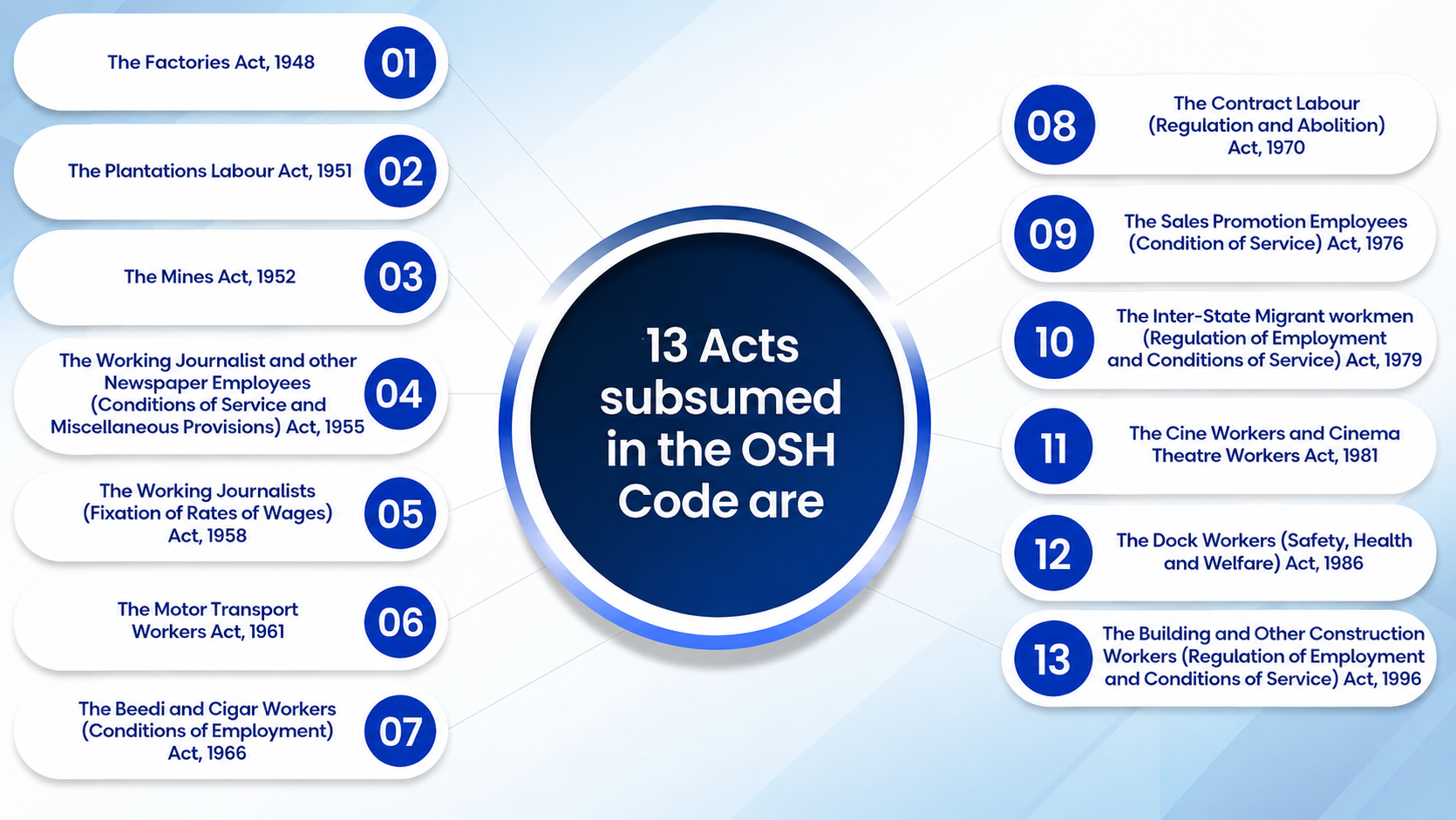
- Consolidation of Labour Laws: The code integrates 13 Central Labour Laws relating to occupational safety, health, factories, contract labour, migrant workers, and working conditions into a single OSHWC Code.
- One Registration, One Licence, One Return (Sections 3, 33, 47): It introduces a unified compliance framework through single registration, single licence, and single return, reducing regulatory burden and improving ease of doing business.
- Coverage of Hazardous Occupations (Section 2(v)): The Code empowers the Government to apply the OSHWC Code to any hazardous establishment, even if it employs only one worker.
- Protection of Inter-State Migrant Workers (Sections 59-63): It expands the definition of inter-state migrant workers and provides benefits such as annual travel allowance, portability of PDS and social security, and access to a toll-free helpline.
- Women's Employment (Section 43): Allows women to work in all establishments, including night shifts, subject to their consent and prescribed safety measures.
- Inter-State Migrant Worker Database (Section 21): Provides for an electronic database/portal for inter-state migrant workers, including self-registration through prescribed mechanisms.
- Contract Labour Reforms (Sections 45-48): The Code raises the licensing threshold for contract labour from 20 to 50 workers and introduces a simplified licensing framework, while statutory safety and welfare protections continue to apply as prescribed.
- National Occupational Safety & Health Advisory Board (Section 16): It establishes a single tripartite advisory board to recommend uniform occupational safety and health standards across sectors.
- Revised Factory Thresholds (Section 2(w)): The code raises factory applicability thresholds from 10 to 20 workers (with power) and 20 to 40 workers (without power), reducing compliance burden for smaller establishments.
- Working Hours & Overtime (Sections 25 and 27): The code prescribes 8 hours/day and 48 hours/week as normal working hours, with overtime payable at twice the ordinary wage rate.
Labour Codes Significance
The Four Labour Codes mark a major milestone in India's labour reforms, creating a simplified, modern, and balanced labour law framework that promotes both worker welfare and economic growth.
- Improve Gross Domestic Product: India’s new labour codes can improve GDP by an estimated 1.25% by 2029-30 through reduced business compliance costs, higher job formalisation, and boosted domestic consumption.
- Projections expect formalisation in the workforce to rise from 60.4% to 75.5%, bringing millions from the unorganised sector into the formal tax and savings net.
- Modernisation of Labour Laws: Aligns labour laws with changing economic conditions, technological advancements, and evolving employment patterns.
- Expanded Worker Protection: The codes strengthen wage security, occupational safety, health, and social security for organised, unorganised, gig, and platform workers.
- Employment Generation: By simplifying compliance, enabling greater labour-market flexibility and encouraging formal employment relationships, the Codes seek to support employment generation and investment.
- Technology-driven Labour Governance: Introduces online registration, licensing, electronic records, and risk-based inspections, improving efficiency and transparency.
- Balanced Labour Market: Balances workers' rights with industrial competitiveness, supporting sustainable economic growth.
Labour Codes Challenges
The Four Labour Codes present significant compliance, operational, and administrative challenges as organisations transition from the legacy labour law regime to India's new Labour Reforms framework.
- Transition from Multiple Labour Laws to Four Labour Codes: Shifting from 29 Central Labour Laws to a unified Labour Code framework requires comprehensive revision of compliance processes, HR policies, contracts, and documentation.
- State-wise Implementation Challenges: Although the Four Labour Codes came into force on 21 November 2025 and Central Rules were notified in May 2026, differences in State rules, administrative capacity and enforcement practices can create transitional uncertainty and uneven implementation across jurisdictions.
- Interpretation of Labour Codes Provisions: Inconsistent interpretation of provisions such as wages, employee classification, and statutory thresholds may result in non-uniform implementation across organisations.
- Restructuring of Wage Components: The revised definition of wages under the Labour Codes affects provident fund, gratuity, bonus, and other statutory benefits, requiring organisations to redesign salary structures.
- Compliance for Contract, Gig & Platform Workers: Expanding coverage to contract labour, gig workers, and platform workers increases compliance obligations and necessitates better monitoring of contractors and vendors.
- Capacity Building & Change Management: Successful implementation of the Labour Codes requires extensive awareness, training, and coordination among HR, finance, legal, compliance, and operational teams.
Labour Codes Way Forward
The Four Labour Codes require coordinated action by the Central Government, State Governments, employers, and workers to ensure effective implementation while balancing worker welfare with ease of doing business.
- Ensure Uniform State-Level Implementation: Expedite notification and harmonisation of State Labour Code Rules to avoid regulatory uncertainty and ensure consistent implementation across India.
- Issue Comprehensive Operational Guidelines: Publish clear FAQs, standard operating procedures (SOPs), and illustrative examples to reduce ambiguity in interpreting provisions such as wages, social security, and compliance requirements.
- Strengthen Digital Labour Governance: Expand digital platforms for registration, licensing, inspections, returns, and grievance redressal to improve transparency, efficiency, and ease of compliance.
- Build Institutional Capacity: Conduct regular training and capacity-building programmes for labour officials, employers, HR professionals, and workers to facilitate smooth implementation of the Labour Codes.
- Promote Social Dialogue: Institutionalise continuous consultation among government, employers, and trade unions to resolve implementation issues and build consensus on labour reforms.
- Strengthen Social Security Coverage: Accelerate registration of unorganised, gig, platform, and migrant workers to ensure effective delivery of social security benefits.
- Support MSMEs and Industry: Provide simplified compliance tools, awareness programmes, and transition support to help MSMEs and businesses adapt to the new labour law framework.
- Adopt a Phased and Predictable Compliance Framework: Ensure timely notifications, adequate transition support, and continuous monitoring to minimise compliance risks and facilitate seamless implementation of the Four Labour Codes.
Labour Codes UPSC PYQs
Q1. Discuss the merits and demerits of the four 'Labour Codes' in the context of labour market reforms in India. What has been the progress so far in this regard? (UPSC Mains 2024)
Q2. "Success of the Make in India program depends on the success of the Skill India programme and radical labour reforms". Discuss with logical arguments. (UPSC Mains 2015)

 Last updated on Oct, 2026
→ UPSC 2027 Notification will be released on 13 January 2027 at upsconline.nic.in.
→ Check Nobel Prize 2026 Winners List here.
→ Download PIB PRiSM Monthly Magazine 2026 here.
→ Check UPSC Monthly Current Affairs Magazine The Recitals here.
→ Check out the latest UPSC Syllabus here.
→ Download UPSC Model Answers for Mains 2026
→ UPSC Mains Question Paper 2026 is out now for Essay & GS Paper 1, 2, 3 & 4.
→ UPSC Calendar 2027 has been released.
→ Enroll in Vajiram & Ravi’s UPSC Mains Test Series 2027 for structured answer writing practice, expert evaluation, and exam-oriented feedback.
→ Join Vajiram & Ravi’s UPSC Mentorship Program 2027 for personalized guidance, strategy planning, and one-to-one support from experienced mentors.
→ Go through the UPSC Mains Previous Year Papers to enhance your preparation.
→ UPSC has released UPSC Toppers List 2025 with the Civil Services final result on its official website.
→ Also check Best UPSC Coaching in India
Labour Codes FAQs
Q1. What are new labour codes?+
Q2. What is fixed-term employment?+
Q3. Is there a revised threshold for retrenchment under the new labour codes?+
Q4. What are the prescribed working hour limits under new labour codes?+
Q5. Are there limits on overtime hours in new labour codes?+
Tags: labour codes quest upsc economy notes