



Left wing extremism in India (LWE), often synonymous with the Naxalite movement, represents a complex socio-political challenge that has its roots in 1967. Originating in Naxalbari, West Bengal, LWE was a response to deep-seated social and economic injustices, particularly in rural areas.
Over the years, left wing extremism has evolved and spread to several states, aiming to overthrow the government and establish a communist society. The movement has been marked by its violent tactics, including guerrilla warfare, and has been involved in numerous conflicts with Indian security forces.
Left Wing Extremism Meaning
Left-Wing Extremism (LWE) in India refers to violent insurgency driven by Maoist or Naxalite ideologies, primarily targeting marginalised regions. It stems from socio-economic inequalities, land disputes, tribal neglect, corruption, human rights violations, and the ideological appeal of revolutionary justice.
Left Wing Extremism in India Origin
Left-Wing Extremism (LWE), commonly known as Naxalism in India, is a major internal security concern for India. This movement, which draws its ideology from Maoism, thrives on socio-economic disparities, primarily affecting remote, underdeveloped, and tribal regions of the country.
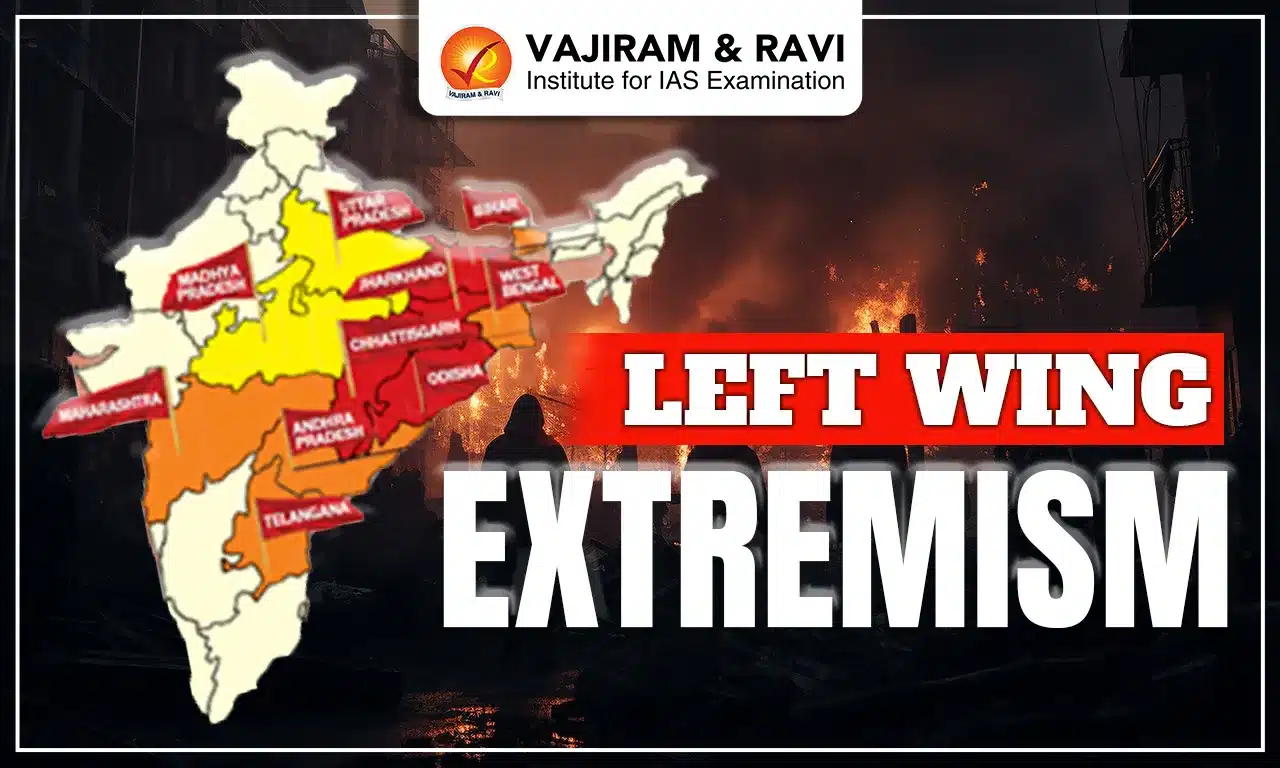
- Emerging from the Naxalbari uprising in West Bengal in 1967, LWE has gradually spread across the "Red Corridor," impacting states such as Chhattisgarh, Jharkhand, Odisha, Maharashtra, Kerala, West Bengal, Madhya Pradesh, and parts of Andhra Pradesh and Telangana.
- Its primary objective is to challenge the Indian state through armed conflict and establish a parallel governance system.
- Although the insurgents claim to champion the rights of marginalised communities, especially tribal populations, their actions often involve armed attacks, infrastructure sabotage, extortion, and forced recruitment of civilians, including minors.
- In India, the left-wing extremist organisations, including the Communist Party of India (Maoist), are listed as terrorist organisations under the Unlawful Activities (Prevention) Act. The movement represents the gravest challenge to India’s internal security.
Status of Left Wing Extremism in India
Present status of Left-Wing Extremism (LWE) in India shows significant decline, with reduced violence, fewer affected districts, increased surrenders, and enhanced government efforts aimed at complete eradication by 2026.
- Significant Decline in LWE-Affected Districts: The number of LWE-affected districts in India has drastically reduced from 126 in 2018 to just 38 in 2024, reflecting the success of counter-insurgency measures.
- Reduced Most Affected Districts: The most affected districts have decreased from 12 to 6, with four in Chhattisgarh (Bijapur, Kanker, Narayanpur, Sukma), one in Jharkhand (West Singhbhum), and one in Maharashtra (Gadchiroli).
- Sharp Drop in Violence: Violent incidents involving LWE have plummeted by 81%, from a peak of 1,936 incidents in 2010 to 374 in 2024. Civilian and security force deaths have also fallen by 85%.
- Surrender and Rehabilitation: Over 8,000 Naxalites have abandoned the path of violence in the last decade, choosing to reintegrate into mainstream society through government rehabilitation schemes.
- Government’s Commitment to Eradicate LWE: The Government of India aims to eliminate Naxalism in India by March 31, 2026, with a focus on development, security, and community engagement in affected areas.
- Enhanced Financial Support for Affected Areas: Under the Special Central Assistance (SCA) scheme, the most affected districts receive ₹30 crore, while districts of concern receive ₹10 crore for infrastructure and development.





Left Wing Extremism Causes
Left-Wing Extremism in India stems from the country’s inability to ensure equitable development, leading to widespread disillusionment among marginalised communities. Multiple factors, including socio-economic disparities, poor governance, and land disputes, fuel this insurgency.
- Socio-Economic Inequalities: Persistent poverty, landlessness, and a high unemployment rate in India among marginalised communities create a sense of deprivation, making them vulnerable to extremist ideologies.
- Linkages Between Development and Spread of Extremism: The spread of extremism is often linked to underdevelopment, where poverty, lack of education, unemployment, and poor governance create grievances. These conditions are exploited by extremist groups to recruit and radicalize vulnerable populations.
- Land Disputes and Land Reforms Failure: Ineffective implementation of land reforms in India and unresolved land disputes have led to the exploitation of tribal populations, fueling resentment.
- Lack of Democratic Representation: Tribal needs and aspirations are poorly represented in democratic and political spaces, leading to ineffective governance and implementation of schemes.
- External Support: The Naxalite movement was initially inspired by Mao Zedong. In 2011, Indian police accused the Chinese government and intelligence of providing sanctuary and training to the leaders and also accused the Pakistani ISI of providing financial support.
- Corruption and Poor Governance: Mismanagement of funds, exploitation by local authorities, and lack of accountability in governance have eroded public trust, making extremist narratives more appealing.
Left Wing Extremism Modus Operandi
Left Wing Extremism Modus Operandi in India involves violent insurgent activities aimed at overthrowing the government through guerrilla warfare, extortion, indoctrination, and establishing parallel governance structures, often exploiting socio-economic grievances to gain local support.
- Guerrilla Warfare Tactics: Left Wing extremist groups employ guerrilla warfare, utilising ambushes, hit-and-run attacks, and sabotage to target security forces and infrastructure, leveraging dense forests and difficult terrains to their advantage.
- Extortion and Financial Mobilisation: They finance operations through systematic extortion from industries, contractors, and local businesses, often imposing levies on mining activities and infrastructure projects within their areas of influence.
- Propaganda and Indoctrination: Left Wing extremist outfits disseminate propaganda via pamphlets, posters, and digital platforms to indoctrinate local populations, portraying themselves as champions of the oppressed to garner support and recruit members.
- Parallel Governance Structures: In regions under their control, they establish parallel administrative systems, conducting 'people's courts' to deliver swift judgments, thereby undermining the state's authority and judicial processes.
- Exploitation of Socio-Economic Grievances: LWE groups exploit local grievances related to land rights, displacement, and lack of development, positioning themselves as defenders of marginalised communities to legitimise their insurgency.
Left Wing Extremism Affected States
Left Wing Extremism Affected States are famously known as the Red Corridor (Red Zone), the region in the eastern, central, and southern parts of India where the Naxalite–Maoist insurgency has the strongest presence.
- The Red Corridor stretches across 10 Indian states, i.e., Andhra Pradesh, Bihar, Chhattisgarh, Jharkhand, Madhya Pradesh, Maharashtra, Odisha, Telangana, West Bengal, and Kerala.
- As of April 2024, 38 districts in seven states- Chhattisgarh, Odisha, Jharkhand, Telangana, Maharashtra, Andhra Pradesh, and Madhya Pradesh- are officially classified as LWE-affected.
- Chhattisgarh remains the most impacted, with districts like Bijapur, Sukma, and Kanker witnessing significant extremist activity.

Left Wing Extremism Challenges
Left Wing Extremism (LWE) in India poses a complex challenge, rooted in socio-economic disparities and fueled by insurgent strategies. Combating LWE demands a balanced approach, addressing security concerns while promoting inclusive development and effective governance.
- Geographical and Terrain Challenges: LWE-affected regions often encompass dense forests and rugged terrains, providing insurgents with natural cover and complicating security operations, surveillance, and infrastructure development.
- Local Support and Ideological Appeal: Maoist groups garner support from marginalised communities by addressing socio-economic grievances, such as land displacement and lack of basic amenities, facilitating recruitment and sustained influence.
- Coordination and Intelligence Gaps: Effective action is often hampered by poor coordination between central and state agencies, limited intelligence sharing, and occasional lack of specialised training among local police forces.
- Urban Networks and Covert Operations: Maoist groups have developed underground urban networks for funding, recruitment, and spreading ideology, making it harder for authorities to dismantle their support systems.
- Potential for Resurgence: Any lapse in governance, development outreach, or law enforcement can lead to a revival of extremist activities, as Maoist ideology remains attractive in neglected and marginalised areas.
Government Measures Against Left Wing Extremism
The Government of India has adopted a comprehensive strategy to combat Left Wing Extremism (LWE). It has employed a three-pronged strategy to counter Naxalism: use of coercion, promotion of development, and collaboration for tribal confidence.
Security Initiatives
The Government of India has implemented robust security initiatives to counter Left Wing Extremism (LWE), combining intelligence-driven operations, specialised forces, and fortified infrastructure. These measures aim to neutralise extremist threats and ensure regional stability.
- Operation Steeplechase: In the early 1970’s during the President's rule, Operation Steeplechase, a joint Army-CRPF-Police operation, was launched against the Naxalites in the bordering districts of West Bengal, Bihar, and Orissa, which were worst affected.
- Police Modernisation Scheme: The Ministry of Home Affairs (MHA) provides funds for communication, mobility, and infrastructure equipment. Funds were allocated for improving and fortifying vulnerable police stations and outposts, including telecommunication equipment purchases.
- Special Intelligence Structures: Andhra Pradesh's model of grassroots intelligence gathering by street-level police. MHA assists in establishing streamlined intelligence structures for actionable field intelligence in anti-Naxalite operations.
- Security Related Expenditure Scheme: MHA implements schemes for funding operational needs, insurance, training, and community policing infrastructure.
- Use of India Reserve Battalions (IRBs), COBRA, and Greyhounds:
- IRBs offer opportunities for local youth in Naxal-affected areas.
- CRPF's COBRA battalion specialises in guerrilla warfare.
- Andhra Pradesh Police's Greyhounds battalion is skilled in specialised guerrilla warfare.
- Counter Insurgency and Anti-Terrorism (CIAT) Schools and Fortified Police Stations: CIAT schools have been established for training police in guerrilla warfare, ambush operations, and weapons training.
- The MHA provides funds for fortifying police stations, with 400 identified for this purpose.
- Salwa Judum Movement: The Salwa Judum movement was the counter-Naxal operation that ran from 2004 to 2009.
- Under this, a force of volunteers was trained by the security forces for the defence of villages in Naxal-affected areas and to offer an alternative to the youths who were being compelled by the CPI-Maoist cadres to join them.
- Operation Green Hunt: It was launched in 2009 against insurgents in Chhattisgarh, the epicentre of violence between Maoist fighters and security forces. The Operation dealt a severe blow to the Naxal insurgency and practically cleansed Andhra Pradesh of CPI-Maoist footprints.
SAMADHAN Framework
SAMADHAN Framework is the Indian government’s comprehensive strategy to combat Left Wing Extremism (LWE), focusing on a multi-dimensional approach. This framework ensures a balanced approach by combining security operations, intelligence sharing, technological advancements, and targeted development initiatives.
- It aims to weaken extremist networks while improving governance in affected regions.
- The acronym "SAMADHAN" stands for
- S – Smart Leadership
- A – Aggressive Strategy
- M – Motivation and Training
- A – Actionable Intelligence
- D – Dashboard for Key Performance Indicators
- H – Harnessing Technology
- A – Action Plan for Each Theatre
- N – No Access to Financing
Naxals Surrender and Rehabilitation Policy
Naxal Surrender and Rehabilitation Policy, initiated by the Government of India, aims to reintegrate Left Wing Extremists into mainstream society. The policy offers immediate financial assistance, vocational training, and incentives for weapon surrender to encourage militants to abandon violence. By providing alternative livelihoods and support, the initiative seeks to address the root causes of extremism and promote lasting peace in affected regions.
PESA and Forest Rights Act
Panchayat Extension To Scheduled Areas Act (PESA) recognises the cultural and economic vulnerabilities of tribals, their unique characteristics, and historical injustices. It has several key
provisions to address tribal injustice issues:
- Empowerment and Self-governance: It shifts the power balance in favour of tribal communities, providing mechanisms for self-governance and protection.
- Role of Gram Sabha: It empowers Gram Sabha to prevent land alienation, restore tribal land, own Minor Forest Produce (MFP), control money lending, and regulate intoxicants.
- The combined FRA and PESA have directly empowered tribals and have contributed to attrition in Naxal ranks.
Left Wing Extremism Way Forward
Left Wing Extremism in India (LWE) remains a significant internal security challenge for India, demanding a multi-pronged approach. Effective counter-strategies include IED prevention, police modernisation, surrender reforms, youth engagement, and strong Central-State coordination.
- Strengthening IED Countermeasures: Proactive and innovative strategies are essential to prevent incidents involving Improvised Explosive Devices (IEDs), which have led to considerable casualties in recent years.
- Enhancing Police Capabilities: Prioritising the modernisation and capacity-building of local police forces is crucial to improve their effectiveness in combating Left Wing Extremism (LWE).
- Reforming Surrender Policies: States should reassess and refine their surrender policies, ensuring that individuals, especially those misled into LWE, are provided with an opportunity to reintegrate into mainstream society.
- Targeted Eradication and Development: States must adopt a time-bound, strategic approach to completely eradicate LWE groups while simultaneously promoting comprehensive development in affected areas.
- Addressing Youth Vulnerability: Given the large youth population in India, there is an urgent need to provide adequate employment opportunities, as widespread unemployment could escalate internal security challenges.
- Central-State Coordination: Both the Central and State governments must ensure seamless coordination, which is vital to effectively counter radicalization and maintain peace in LWE-affected regions.
Left Wing Extremism UPSC PYQs
Q1: Naxalism is a social, economic and developmental issue manifesting as a violent internal security threat. In this context, discuss the emerging issues and suggest a multilayered strategy to tackle the menace of Naxalism (UPSC Mains 2022)
Q2: What are the determinants of left-wing extremism in the Eastern part of India? What strategy should the Government of India, civil administration and security forces adopt to counter the threat in the affected areas? (UPSC Mains 2020)
Q3: The persisting drives of the Government for development of large industries in backward areas have resulted in isolating the tribal population and the farmers who face multiple displacements. With Malkangiri and Naxalbari foci, discuss the corrective strategies needed to win the Left Wing Extremism (LWE) doctrine-affected citizens back into the mainstream of social and economic growth (UPSC Mains 2015)

 Last updated on March, 2026
→ UPSC Final Result 2025 is now out.
→ UPSC has released UPSC Toppers List 2025 with the Civil Services final result on its official website.
→ Anuj Agnihotri secured AIR 1 in the UPSC Civil Services Examination 2025.
→ UPSC Marksheet 2025 is now out.
→ UPSC Notification 2026 & UPSC IFoS Notification 2026 is now out on the official website at upsconline.nic.in.
→ UPSC Calendar 2026 has been released.
→ Check out the latest UPSC Syllabus 2026 here.
→ UPSC Prelims 2026 will be conducted on 24th May, 2026 & UPSC Mains 2026 will be conducted on 21st August 2026.
→ The UPSC Selection Process is of 3 stages-Prelims, Mains and Interview.
→ Prepare effectively with Vajiram & Ravi’s UPSC Prelims Test Series 2026 featuring full-length mock tests, detailed solutions, and performance analysis.
→ Enroll in Vajiram & Ravi’s UPSC Mains Test Series 2026 for structured answer writing practice, expert evaluation, and exam-oriented feedback.
→ Join Vajiram & Ravi’s Best UPSC Mentorship Program for personalized guidance, strategy planning, and one-to-one support from experienced mentors.
→ Shakti Dubey secures AIR 1 in UPSC CSE Exam 2024.
→ Also check Best UPSC Coaching in India
Left Wing Extremism FAQs
Q1. What is left-wing extremism in India?+
Q2. What does extreme left wing mean?+
Q3. What is the left-wing ideology?+
Q4. What is the difference between right and left-wing extremism?+
Q5. What do naxals want?+
Tags: left wing extremism