



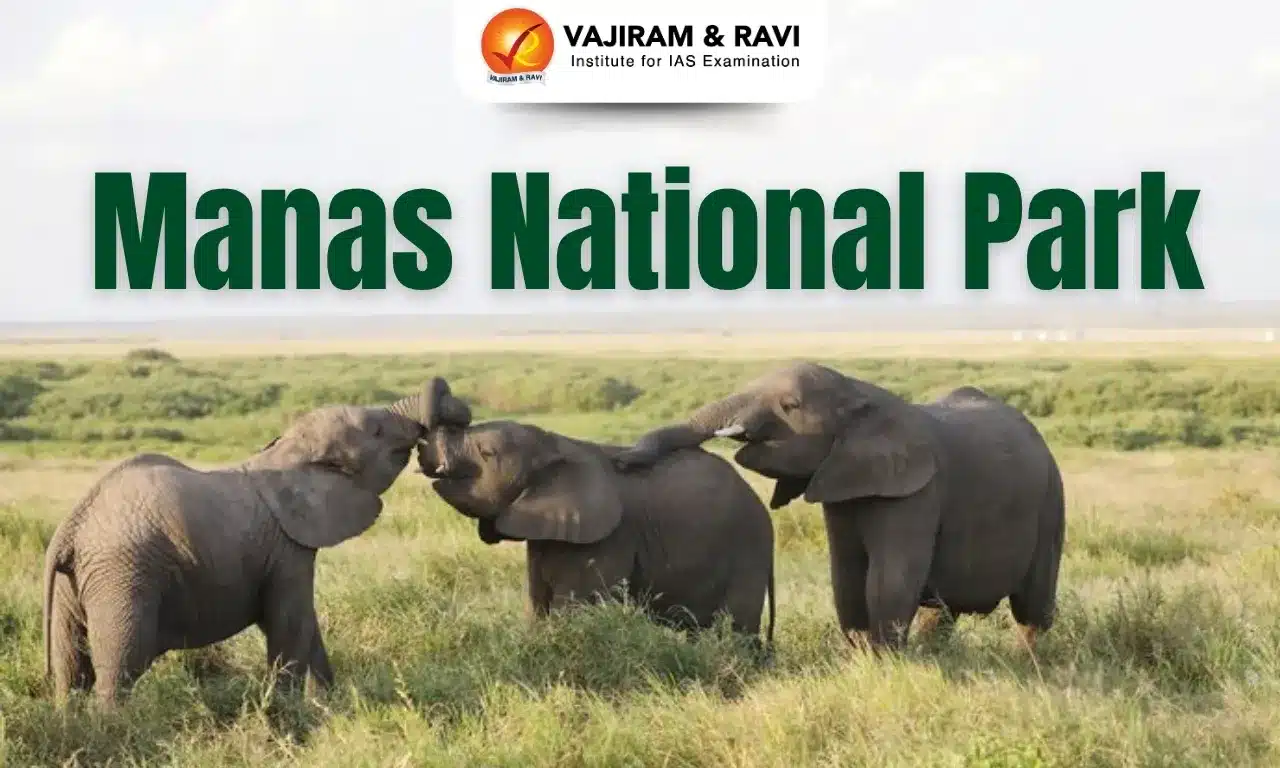
Manas National Park is located in Assam, shares its northern boundary with the Royal Manas National Park in Bhutan. The Manas National Park derives its name from the Manas River, a major tributary of the Brahmaputra, while the Beki River also flows through it. Recognized for its ecological significance, Manas National Park is recognised as a UNESCO Natural World Heritage Site, a Tiger Reserve, an Elephant Reserve, a Biosphere Reserve, and an Important Bird and Biodiversity Area (IBBA). The park experiences a tropical monsoon climate and features diverse vegetation, including semi-evergreen forests, mixed moist and dry deciduous forests, alluvial grasslands, and creeper swamp forests. It is home to a wide range of wildlife, including Asiatic elephants, tigers, greater one-horned rhinos, clouded leopards, and sloth bears.
Manas Tiger Reserve
Manas Tiger Reserve spans 39,100 hectares. The sanctuary lies within the river channels of the Manas River and forms the core zone of the 283,700-hectare Manas Tiger Reserve. The landscape is marked by forested hills, alluvial grasslands, and tropical evergreen forests, adding to its scenic beauty. It serves as a crucial habitat for several rare and endangered species, including the tiger, greater one-horned rhino, swamp deer, pygmy hog, and Bengal florican, ensuring the conservation of these species in a viable ecosystem.
Manas National Park History
Manas National Park was declared a sanctuary on October 1, 1928. Before its establishment as a sanctuary, it was a reserved forest known as Manas Reserve Forest and North Kamrup Reserve Forest, serving as a hunting reserve for the royal family of Cooch Behar and the Raja of Gauripur. The area was expanded to 391 km² between 1951 and 1955, and in 1973, the Manas Biosphere Reserve was established.
UNESCO designated it as a World Heritage Site in December 1985. In 1990, the Manas National Park was further expanded to include the Kahitama Reserve Forest, Kokilabari Reserve Forest, and Panbari Reserve Forest. However, due to poaching and insurgent activities, UNESCO listed it as a World Heritage Site in Danger in 1992. The Manas National Park area was later increased to 500 km² on February 25, 2008. The only forest village within the national park is Pagrang, while 56 other villages surround the park, with many more settlements on the outskirts relying on it for their livelihood.





Manas National Park Flora
Manas National Park's dynamic ecosystem supports three main types of vegetation: semi-evergreen forests, mixed moist and dry deciduous forests, and alluvial grasslands. The dry deciduous forests represent an early successional stage, constantly renewed by seasonal floods. As one moves away from water bodies, these forests transition into moist deciduous forests, which eventually give way to semi-evergreen climax forests. The park’s highly fertile soil enhances the plant life here and has a remarkable ability to regenerate and sustain itself, contributing to its rich biodiversity and ecological resilience.
Manas National Park Fauna
The Wildlife Protection Act classifies over 22 endangered species under Schedule 1, granting them the highest level of protection in India. Manas National Park serves as an important sanctuary for many of these species, including the Greater One-Horned Rhino, Swamp Deer, Pygmy Hog, Hispid Hare, Golden Langur, and the endangered Bengal Florican. The park's diverse ecosystem provides these rare and threatened species with a sustainable and secure habitat, ensuring their survival in the wild.
Manas National Park Interesting Facts
- Manas National Park was designated a UNESCO World Heritage Site in 1985 and declared a National Park on September 7, 1990.
- Initially a hunting reserve for royal families, it was named North Kamrup Wildlife Sanctuary before being upgraded to Manas Wildlife Sanctuary on December 1, 1928, and later a Project Tiger Reserve in 1973.
- The park covers 519.77 sq km and is home to 22 of India’s most threatened wildlife species, listed under Schedule 1 of the Wildlife (Protection) Act, 1972.
- Indian Rhinos were declared extinct in Manas due to poaching during the Bodo uprising in the 1990s but were reintroduced in 2007.
- A collaborative effort between Assam’s government, WWF, the International Rhino Foundation, the U.S. Fish and Wildlife Foundation, and the Bodoland Territorial Council aimed at increasing the One-Horned Rhino population to 3,000 across Assam’s national parks.
- Since 2008, 18 rhinos have been transferred to Manas, followed by 8 more under the Centre for Wildlife Rehabilitation and Conservation, totaling 32 rhinos by 2019. As of present, there are 54 one- horned rhinos in the Manas National Park.
- The park is governed by the Indian Forest Act, 1927/Assam Forest Regulation 1891 and the Wildlife (Protection) Act, 1972.
- The Assam Forest Department and the Bodoland Territorial Council are responsible for the management and conservation of Manas National Park.

 Last updated on March, 2026
→ UPSC Final Result 2025 is now out.
→ UPSC has released UPSC Toppers List 2025 with the Civil Services final result on its official website.
→ Anuj Agnihotri secured AIR 1 in the UPSC Civil Services Examination 2025.
→ UPSC Marksheet 2025 is now out.
→ UPSC Notification 2026 & UPSC IFoS Notification 2026 is now out on the official website at upsconline.nic.in.
→ UPSC Calendar 2026 has been released.
→ Check out the latest UPSC Syllabus 2026 here.
→ UPSC Prelims 2026 will be conducted on 24th May, 2026 & UPSC Mains 2026 will be conducted on 21st August 2026.
→ The UPSC Selection Process is of 3 stages-Prelims, Mains and Interview.
→ Prepare effectively with Vajiram & Ravi’s UPSC Prelims Test Series 2026 featuring full-length mock tests, detailed solutions, and performance analysis.
→ Enroll in Vajiram & Ravi’s UPSC Mains Test Series 2026 for structured answer writing practice, expert evaluation, and exam-oriented feedback.
→ Join Vajiram & Ravi’s Best UPSC Mentorship Program for personalized guidance, strategy planning, and one-to-one support from experienced mentors.
→ Shakti Dubey secures AIR 1 in UPSC CSE Exam 2024.
→ Also check Best UPSC Coaching in India
Manas National Park FAQs
Q1. Which is the first tiger reserve in Assam?+
Q2. Which is the first tiger reserve in Assam?+
Q3. What is Manas also known as?+
Q4. Which animal is Manas famous for?+
Q5. Which river flows in Manas National Park?+
Tags: manas national park