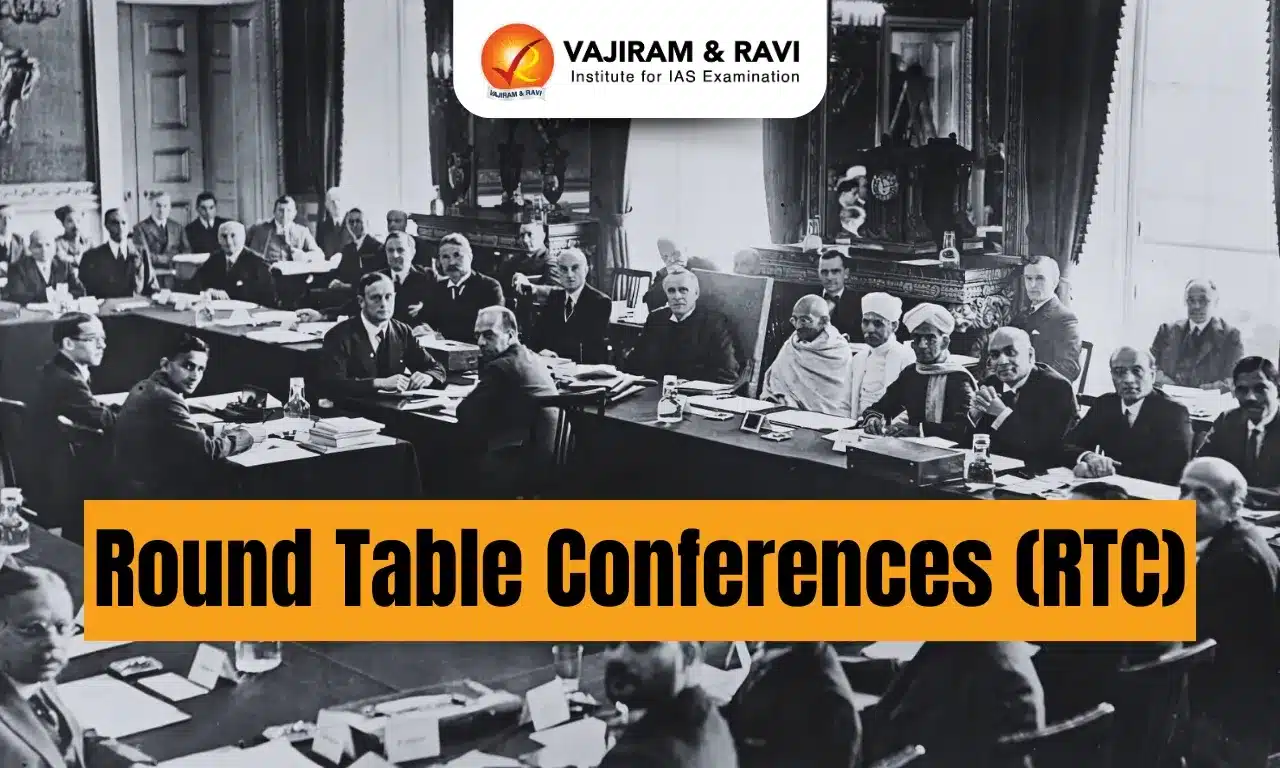
The Round Table Conferences were a series of three high-level meetings held by the British government in London between 1930 and 1932. Their goal was to plan constitutional reforms and future government structures for India based on the Simon Commission report.
The Round Table Conferences involved British leaders, representatives of Indian princely states, minority communities, liberals, and selected political groups. However, their effectiveness was limited because the Indian National Congress, the principal nationalist organisation, did not participate in the First and Third Round Table Conferences.
Round Table Conferences 1930-32
The Round Table Conferences were held in London by the British government between 1930 and 1932 to review India's constitutional reforms and address rising nationalist demands.
- First Round Table Conference (Nov 1930 - Jan 1931): The Indian National Congress stayed out due to the Civil Disobedience Movement, resulting in limited progress.
- Second Round Table Conference (Sep – Dec 1931): Mahatma Gandhi participated as the Congress’s sole representative following the Gandhi-Irwin Pact. However, disagreements over minority representation prevented any consensus.
- Third Round Table Conference (November - December 1932): The Congress and the British Labour Party did not attend, limiting the conference's significance and conclusions.
Round Table Conferences Background
The demand for constitutional reform in India intensified after the First World War. The British government had enacted the Government of India Act 1919, which introduced dyarchy in provinces but failed to satisfy Indian political aspirations. The key reasons for convening the Round Table Conferences are as follows:
- Simon Commission Boycott: The all-British Simon Commission of 1928 lacked Indian representation, triggering widespread nationwide protests and boycotts.
- Demand for Dominion Status: Escalating demands for self-government led Viceroy Lord Irwin to propose future discussions regarding Indian dominion status.
- Civil Disobedience Movement: Mahatma Gandhi launched large-scale public protests and the historic Salt March, compelling the British to seek a political compromise.
- Failure of the Nehru Report: Disagreements over internal minority safeguards in the Nehru Report highlighted deep factional divisions, convincing the British that imperial mediation was necessary to reach a consensus.


Round Table Conferences Objectives
The objectives of the Round Table Conferences were to discuss India’s constitutional future, examine the possibility of establishing a federal system, provide greater provincial autonomy, address the representation and safeguards of minorities and depressed classes, determine the role of princely states, and formulate a framework for future constitutional reforms in India.
First Round Table Conference
The First Round Table Conference was held in London from 12 November 1930 to 19 January 1931. It was held in response to the Simon Commission Report's shortcomings by the Labour Government led by Ramsay MacDonald in London. It was the first time that Indians and the British met as 'equals'. On November 12th, 1930, the first conference began.
The First Round Table Conference was attended by delegates representing various Indian political groups, princely states, and British political parties, but it was boycotted entirely by the Indian National Congress.
|
Date: 12th November, 1930 |
Place: London |
|
Presided by |
- Ramsay MacDonald (Prime Minister of Britain) |
|
Participants |
-The Princely States, Muslim League, Justice Party, Hindu Mahasabha, and others were among those who attended. - The Indian National Congress, as well as other prominent politicians, did not participate because Congress decided to boycott the round table conferences at the Lahore session, and majority of leaders had been imprisoned for being involved in the Civil Disobedience Movement. |
|
Issues Discussed |
- The federal government structure. - The executive's accountability to the legislature. - Separate electorates for "untouchables" as proposed by Dr B R Ambedkar. - Tej Bahadur Sapru proposed an All-India Federation. The Muslim League agreed with this. |
|
Outcome |
- It was generally agreed that if India was to develop into a federation, there were to be safeguards regarding defence and finance, while other departments were to be transferred. -The Indian National Congress leaders continued the Civil Disobedience Movement during the First Round Table Conference. As a result, the First Round Table Conference was deemed a failure. |
Second Round Table Conference
The Second Round Table Conference was held in London from September to December 1931. The British Government acknowledged the importance of the Congress Party's participation in Round Table Conferences for effective reform implementation and expressed hope that INC leaders would attend the Second Round Table Conference. Mahatma Gandhi attended as the sole representative of the Indian National Congress.
Lord Irwin met with Gandhi to reach a compromise. On 5 March 1931, Mahatma Gandhi and Lord Irwin signed the Gandhi-Irwin Pact, and they agreed on the following to pave the way for the Congress' participation in the second Round Table Conference:
- Congress would end the Civil Disobedience Movement and attend the second Round Table Conference.
- The government would withdraw all ordinances enacted to restrain the Congress.
- The government would cease all prosecutions for nonviolent offences.
- The government would release all individuals serving prison sentences for their involvement in the Civil Disobedience Movement.
|
Date: 7th September 1931 |
Place: London |
|
Presided by |
- Ramsay MacDonald |
|
Participants |
- Indian National Congress, which was solely represented by Gandhi, the Muslim League, Hindu Mahasabha, Dr. B. R. Ambedkar and others. - Representatives from Burma, as well as Sindh, Assam, Central Provinces, and the NWFP, were also present. |
|
Issues discussed |
- Gandhi demanded the immediate establishment of a responsible government at the national and provincial levels. He also stated that:
|
|
Outcomes |
- This session only widened the difference between Congress and minorities. - MacDonald ended the session with an address announcing the:
|
Third Round Table Conference
The Third Round Table Conference was held in November 1932 to finalise India’s constitutional roadmap. It was convened after Gandhi relaunched the Civil Disobedience Movement upon returning empty-handed from the second conference, leading to the re-arrest of Congress leaders, a boycott by major parties, and the eventual drafting of the Government of India Act 1935.
|
Date: November 17, 1932 |
Place: London |
|
Presided by |
- Ramsay MacDonald |
|
Participants |
- Attended by 46 delegates, but the Indian National Congress and the Labour Party in the United Kingdom decided not to attend. - Dr. B. R. Ambedkar (Depressed Classes). - Indian princely states were represented by princes and divans. - Muhammad Ali, Agha Khan, and Fazlul Haq were among the Muslim leaders who attended the conference. |
|
Issues Discussed |
- In the Conference, the reports of the Sub-Committees appointed during the Second Round Table Conference were heard and formed the basis of discussions. - Some more details about the new constitution were settled. - The Indian delegates tried to push through some progressive provisions, which were instantly put into cold storage. - Similarly, the question of including a Bill of Rights for the citizens was shelved on flimsy excuses. |
|
Outcomes |
- In March 1933, the British Government came out with the White Paper containing the proposals, indicating the line on which the new Constitution of India was to take shape. - On this basis, the Government of India Act of 1935 was enacted. |
Round Table Conferences Outcomes
The Round Table Conferences failed to meet Indian nationalist demands for self-government. However, they had significant constitutional consequences. Major outcomes included:
- Acceptance of the idea of an All-India Federation.
- Recognition of the need for greater provincial autonomy.
- Detailed discussion on minority representation and communal electorates.
- Emergence of the Communal Award and Poona Pact.
- Preparation of constitutional proposals that led to the Government of India Act, 1935.
Round Table Conferences Significance
The Round Table Conferences are important in the history of India's freedom struggle for several reasons. They brought major Indian constitutional questions before an international forum. They also highlighted the complexity of India’s social, regional, and political diversity.
- Foundation for the 1935 Act: The British administration collated the debates and ideas from these conferences and created the administration of India Act in 1935. This act served as the blueprint for independent India's constitution.
- Equality in Negotiations: For the first time, Indian and British leaders sat down as political equals to negotiate India's fate, rather than the British imposing unilateral judgements.
- Framework for a Federal India: The conferences created the concept of a united India, including British-administered provinces and sovereign Princely States, into a single federal system.
- Rise of Dalit Representation: The conferences provided an important platform for Ambedkar to articulate the political rights of the Depressed Classes on the world political scene.
- Deep Communal Divides: The conferences revealed serious disputes among Indian politicians about minority rights and separate electorates (particularly among Hindus, Muslims and Dalits).
Round Table Conferences Limitations
Despite their importance, the conferences failed to achieve their primary objective of reaching a broad constitutional settlement. The absence of agreement between Gandhi, Ambedkar, Muslim representatives, princes, and British leaders particularly weakened the Second Round Table Conference. The major limitations of these conferences included the following:
- The Congress did not attend the First and Third Conferences.
- There was no consensus among Indian groups on minority representation.
- The British government was unwilling to transfer real power immediately.
- Princely states were hesitant to join a federal arrangement.
- The British policy of safeguarding imperial interests limited meaningful reforms.
- Communal and political divisions weakened the possibility of a united Indian position.
Round Table Conferences UPSC PYQs
Q1: Highlight the importance of the new objectives that got added to the vision of Indian Independence since the twenties of the last century. (UPSC Mains 2017)
Q2: With reference to the Indian freedom struggle, consider the following events: (UPSC Prelims 2017)
- Mutiny in Royal Indian Navy
- Quit India Movement launched
- Second Round Table Conference
What is the correct chronological sequence of the above events?
(a) 1-2-3
(b) 2-1-3
(c) 3-1-2
(d) 3-2-1
Ans: (d)
Q3: Consider the following statements : (UPSC Prelims 2009)
- The discussions in the Third Round Table Conference eventually led to the passing of the Government of India Act of 1935.
- The Government of India Act of 1935 provided for the establishment of an All India Federation to be based on a Union of the provinces of British India and the Princely States.
Which of the statements given above is/are correct?
(a) 1 only
(b) 2 only
(c) Both 1 and 2
(d) None
Ans: (c)
| Other Related Posts | |
| Civil Disobedience Movement | Poona Pact |
| Round Table Conference | 1937 Elections |
| Gandhi Irwin Pact | |

 Last updated on Oct, 2026
→ UPSC 2027 Notification will be released on 13 January 2027 at upsconline.nic.in.
→ Check Nobel Prize 2026 Winners List here.
→ Download PIB PRiSM Monthly Magazine 2026 here.
→ Check UPSC Monthly Current Affairs Magazine The Recitals here.
→ Check out the latest UPSC Syllabus here.
→ Download UPSC Model Answers for Mains 2026
→ UPSC Mains Question Paper 2026 is out now for Essay & GS Paper 1, 2, 3 & 4.
→ UPSC Calendar 2027 has been released.
→ Enroll in Vajiram & Ravi’s UPSC Mains Test Series 2027 for structured answer writing practice, expert evaluation, and exam-oriented feedback.
→ Join Vajiram & Ravi’s UPSC Mentorship Program 2027 for personalized guidance, strategy planning, and one-to-one support from experienced mentors.
→ Go through the UPSC Mains Previous Year Papers to enhance your preparation.
→ UPSC has released UPSC Toppers List 2025 with the Civil Services final result on its official website.
→ Also check Best UPSC Coaching in India
Round Table Conferences FAQs
Q1. What were the three Round Table Conferences?+
Q2. Who led the first round table conference?+
Q3. Which city hosted the Round Table Conference?+
Q4. Who joined the 2nd Round Table Conference?+
Q5. Who attended all three Round Table Conferences?+
Tags: quest round table conferences upsc modern history notes