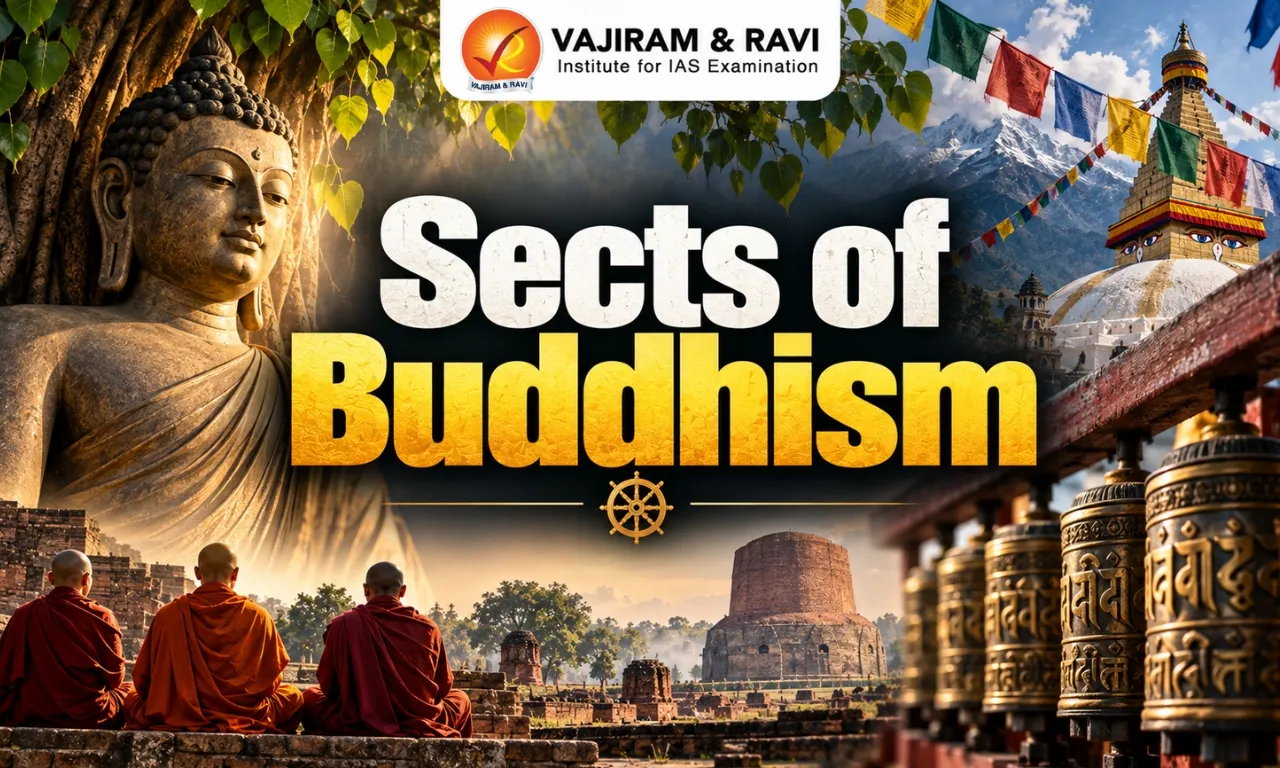
Sects of Buddhism emerged from differences in doctrine, monastic discipline, and religious practices after the Buddha’s death. The Second Buddhist Council at Vaishali is traditionally associated with the early division of the Buddhist community, which gradually led to the emergence of diverse schools and traditions.
The development of Theravada, Mahayana, and Vajrayana expanded Buddhism’s philosophical and cultural influence across Asia. However, sectarian divisions, doctrinal differences, changing political patronage, and competition from other religious traditions contributed to the decline or disappearance of several early Buddhist schools, particularly in India.
Sects of Buddhism Background
The emergence of sects of Buddhism can be traced to the period after the Buddha’s death, traditionally dated to c. 483 BCE, when differences emerged within the Sangha. The Second Buddhist Council at Vaishali (c. 383 BCE) became an important turning point due to disagreements over 10 monastic practices. The divisions became more pronounced during the 3rd century BCE, particularly around the period of Ashoka (c. 268–232 BCE).
- Second Buddhist Council (383 BCE, Vaishali): It resulted in the Sangha's first significant split between the Sthaviravada (Elders who rigidly adhered to the Vinaya code) and the Mahasanghikas (Great Community who preferred loosened norms).
- Third Buddhist Council (250 BCE, Pataliputra): It is traditionally associated with Moggaliputta Tissa, sought to address doctrinal disputes and organise the Sangha.
- Fourth Buddhist Council (1st Century CE, Kundalvana): It established the formal formation of Mahayana as a distinct movement from previous traditional routes, with King Kanishka as sponsor.
Sects of Buddhism Causes for Emergence
The emergence of Sects of Buddhism was a gradual process driven by differences in monastic discipline, interpretation of Buddhist teachings, regional practices, and changing social needs.
- Differences in Monastic Discipline: Disputes over the interpretation of Vinaya rules, particularly the 10 practices debated at the Second Buddhist Council at Vaishali (c. 383 BCE), contributed to the early division of the Sangha.
- Doctrinal Differences: Monks developed differing interpretations of the Buddha’s teachings, especially concerning the nature of the Buddha, the path to liberation, and the status of the Arhat.
- Changing Religious Needs: As Buddhism expanded beyond its original monastic communities, new ideas and practices developed to address the needs of lay followers, contributing to the emergence of Mahayana.
- Geographical Expansion: The spread of Buddhism from the Gangetic region to north-western, western, and southern India created regional variations in practices and philosophical interpretations.
- Philosophical Development: New concepts such as the Bodhisattva ideal, Sunyata (emptiness), and Buddha-nature encouraged the development of new philosophical traditions associated with Mahayana.
- Influence of Local Traditions: As Buddhism spread across Central, East, and Southeast Asia, it interacted with local religious and cultural traditions, producing diverse practices and forms of Buddhist thought.


Major Sects of Buddhism
Buddhism gradually developed into several schools due to differences in doctrine, monastic practices, and methods of attaining liberation. The three broad sects of Buddhism are Theravada, Mahayana, and Vajrayana, each contributing to the expansion and diversification of Buddhist thought and practices across Asia.
Theravada Sect of Buddhism
Developed from the early Buddhist monastic tradition, with greater emphasis on preserving the Buddha’s teachings and strict Vinaya discipline.
- Meaning: “Teaching of the Elders”; one of the oldest surviving Buddhist traditions.
- Core Ideal: Arhat – an individual who attains liberation through personal spiritual discipline.
- Scriptures: Primarily the Pali Canon (Tipitaka).
- Buddha: Primarily regarded as the historical teacher who attained enlightenment.
- Practices: Emphasis on meditation, monastic discipline, and the Eightfold Path.
- Spread: Predominant in Sri Lanka, Myanmar, Thailand, Cambodia, and Laos.
Hinayana Sect of Buddhism
Historically used as a term by Mahayana Buddhists for certain early Buddhist schools that emphasised individual liberation and adherence to the original teachings and monastic discipline.
- Meaning: “Lesser Vehicle”; a historical term that was used to distinguish non-Mahayana schools from Mahayana.
- Core Ideal: Arhat – an individual who attains liberation through personal spiritual discipline.
- Scriptures: Primarily associated with the early Buddhist teachings and Nikaya/Agama traditions.
- Buddha: Primarily regarded as the historical teacher who attained enlightenment and showed others the path to liberation.
- Practices: Emphasis on meditation, ethical conduct, monastic discipline, and the Noble Eightfold Path.
- Spread: Historically associated with several early Buddhist schools across India and other parts of Asia; it is not the same as Theravada, although older textbooks often equate the two terms.
Mahayana Sect of Buddhism
Developed partly in response to the desire for a broader path to salvation and greater emphasis on the Bodhisattva ideal. It also developed through interaction with existing Buddhist schools and changing social and religious conditions.
- Core Ideal: Bodhisattva – one who seeks enlightenment while postponing final liberation to assist other beings.
- Buddha: Buddha came to be understood in multiple forms and manifestations, with devotion to figures such as Amitabha Buddha becoming important.
- Scriptures: Includes numerous Mahayana Sutras, in addition to earlier Buddhist literature.
- Practices: Greater emphasis on devotion, compassion and Bodhisattva practices.
- Spread: Prominent in China, Japan, Korea and Vietnam.
Vajrayana Sect of Buddhism
Developed from Mahayana, introducing Tantric rituals, mantras, mandalas, mudras and specialised meditation techniques as additional methods for attaining Buddhahood. Its tantric development in India became increasingly prominent from around the 6th–8th centuries CE.
- Meaning: “Diamond Vehicle” or “Thunderbolt Vehicle”.
- Development: Emerged from Mahayana traditions, becoming prominent around the 6th–7th centuries CE.
- Core Practices: Uses mantras, mandalas, mudras, visualisation, and tantric practices as methods for spiritual transformation.
- Religious Figures: Gives importance to Buddhas, Bodhisattvas, and tantric deities.
- Spread: Particularly influential in Tibet, Bhutan, Mongolia, and parts of the Himalayan region.
Other Sects of Buddhism
Beyond the three broad traditions—Theravada, Mahayana, and Vajrayana—Buddhism developed numerous early schools and philosophical sects of Buddhism, particularly in India.
- Mahāsāṃghika: One of the earliest major schools, traditionally associated with the Second Buddhist Council (c. 383 BCE); it placed greater emphasis on the transcendent nature of the Buddha.
- Sthaviravāda: An early school that stressed strict monastic discipline and preservation of the older teachings; several later schools developed from the Sthavira tradition.
- Sarvāstivāda: Flourished particularly in northwestern India and Central Asia; its distinctive doctrine held that dharmas exist in the past, present, and future.
- Sautrāntika: Emerged from the broader Sarvāstivada milieu and gave greater authority to the Sūtras, questioning aspects of Sarvāstivada Abhidharma philosophy.
- Mādhyamika: Associated with Nāgārjuna (c. 2nd–3rd century CE), it developed the philosophy of Śūnyatā (emptiness) and became a major Mahayana philosophical school.
- Yogācāra: Associated with Asanga and Vasubandhu (c. 4th–5th century CE), it emphasised consciousness and mental processes in explaining experience and reality.
Sects of Buddhism Literature
Buddhist sects produced a rich body of literature reflecting their different doctrines, philosophies and religious practices. The earliest teachings were preserved through oral traditions and later compiled into the Tripitaka, while the emergence of Mahayana and Vajrayana led to a much wider range of sutras, philosophical texts and tantric works.
- Theravada Literature: Preserved mainly in the Pali Canon (Tipitaka), consisting of the Vinaya Pitaka, Sutta Pitaka and Abhidhamma Pitaka. Important later works include Buddhaghosa’s Visuddhimagga (5th century CE).
- Mahayana Literature: Produced numerous Mahayana Sutras, including the Prajnaparamita Sutras, Lotus Sutra, and Pure Land Sutras. Philosophers such as Nagarjuna developed influential works on Sunyata (emptiness), particularly the Mulamadhyamakakarika.
- Vajrayana Literature: Developed an extensive body of Tantric texts, including Tantras, Dharanis, and ritual manuals, dealing with mantras, mandalas, meditation, and esoteric practices.
- Jataka Literature: Stories of the Buddha’s previous births became an important part of Buddhist literary and artistic traditions and are preserved in the Khuddaka Nikaya of the Pali Canon.
- Buddhist Chronicles: Works such as the Dipavamsa and Mahavamsa of Sri Lanka provide valuable information about the history and spread of Buddhism, particularly during the period of Ashoka and the Mauryas.
Sects of Buddhism Impacts
Sects of Buddhism brought significant changes to India’s religious, philosophical, literary, and artistic traditions, while also facilitating the spread of Buddhism across Asia.
- Expansion Across Asia: Mahayana and Vajrayana spread Buddhism to East Asia, Central Asia, and the Himalayan region, while Theravada became prominent in Sri Lanka and Southeast Asia.
- Development of Buddhist Philosophy: Schools such as Madhyamaka and Yogacara enriched Buddhist thought through concepts such as Śūnyatā (emptiness) and consciousness.
- Growth of Art and Architecture: The development of new sects encouraged the creation of Buddha and Bodhisattva images, stupas, monasteries, murals, and mandalas.
- Literary Enrichment: Buddhist literature expanded from the Pali Canon to Mahayana Sutras and Vajrayana Tantric texts, along with philosophical works and chronicles.
- Growth of Educational Centres: Buddhist monasteries developed into centres of learning, debate and manuscript preservation, with institutions such as Nalanda University and Vikramashila gaining prominence.
Contemporary Sects of Buddhism
Contemporary Sects of Buddhism is mainly represented by Theravada, Mahayana, and Vajrayana, which continue to flourish in different geographical regions. Theravada remains prominent in Sri Lanka, Myanmar, Thailand, Cambodia, and Laos; Mahayana is dominant in China, Japan, Korea, and Vietnam, while Vajrayana remains influential in Tibet, Bhutan, Nepal, and Mongolia.
- Global Expansion: Buddhist communities and centres have developed in North America, Europe, and Australia, supported by migration and modern Buddhist movements.
- Modern Adaptation: Buddhist teachings are increasingly associated with meditation, mindfulness, ethics, and interfaith dialogue, alongside traditional religious practices.
- Indian Revival: Buddhism has experienced renewed visibility in India through Neo-Buddhist movements, particularly among followers inspired by Dr.B.R. Ambedkar.
Sects of Buddhism UPSC PYQs
Q1: In which one of the following regions was Dhanyakataka, which flourished as a prominent Buddhist center under the Mahasanghikas, located? (UPSC Prelims 2023)
a) Andhra
b) Gandhara
c) Kalinga
d) Magadha
Ans: (a)
Q2: With reference to the religious history of India consider the following statements: (UPSC Prelims 2020)
1. Sthaviravadins belong to Mahayana Buddhism.
2. Lokottaravadin sect was an offshoot of the Mahasanghika sect of Buddhism.
3. The deification of Buddha by Mahasanghikas fostered Mahayana Buddhism.
Which of the statements given above is/are correct?
a) 1 and 2 only
b) 2 and 3 only
c) 3 only
d) 1, 2 and 3
Ans: (b)
Q3: Consider the following: (UPSC Prelims 2019)
1) Deification of the Buddha
2) Treading the path of Bodhisattvas
3) Image worship and rituals
Which of the above is/are the feature/ features of Mahayana Buddhism?
a) 1 only
b) 1 and 2 only
c) 2 and 3 only
d) 1, 2 and 3
Ans: (d)
Q4: With reference to the religious history of India, consider the following statements: (UPSC Prelims 2016)
1) The concept of Bodhisattva is central to the Hinayana sect of Buddhism
2) Bodhisattva is a compassionate one on his way to enlightenment
3) Bodhisattva delays achieving his own salvation to help all sentient beings on their path to it.
Which of the statements given above is/are correct?
a) 1 only
b) 2 and 3 only
c) 2 only
d) 1, 2 and 3
Ans: (b)

 Last updated on Oct, 2026
→ UPSC 2027 Notification will be released on 13 January 2027 at upsconline.nic.in.
→ Check Nobel Prize 2026 Winners List here.
→ Download PIB PRiSM Monthly Magazine 2026 here.
→ Check UPSC Monthly Current Affairs Magazine The Recitals here.
→ Check out the latest UPSC Syllabus here.
→ Download UPSC Model Answers for Mains 2026
→ UPSC Mains Question Paper 2026 is out now for Essay & GS Paper 1, 2, 3 & 4.
→ UPSC Calendar 2027 has been released.
→ Enroll in Vajiram & Ravi’s UPSC Mains Test Series 2027 for structured answer writing practice, expert evaluation, and exam-oriented feedback.
→ Join Vajiram & Ravi’s UPSC Mentorship Program 2027 for personalized guidance, strategy planning, and one-to-one support from experienced mentors.
→ Go through the UPSC Mains Previous Year Papers to enhance your preparation.
→ UPSC has released UPSC Toppers List 2025 with the Civil Services final result on its official website.
→ Also check Best UPSC Coaching in India
Sects of Buddhism FAQs
Q1. What are different sects of Buddhism?+
Q2. What are the three main denominations of Buddhism?+
Q3. What is a female monk called?+
Q4. What were the two sects of Buddhism called?+
Q5. What is the difference between Hinayana and Mahayana sects?+
Tags: quest sects of buddhism upsc ancient history notes