



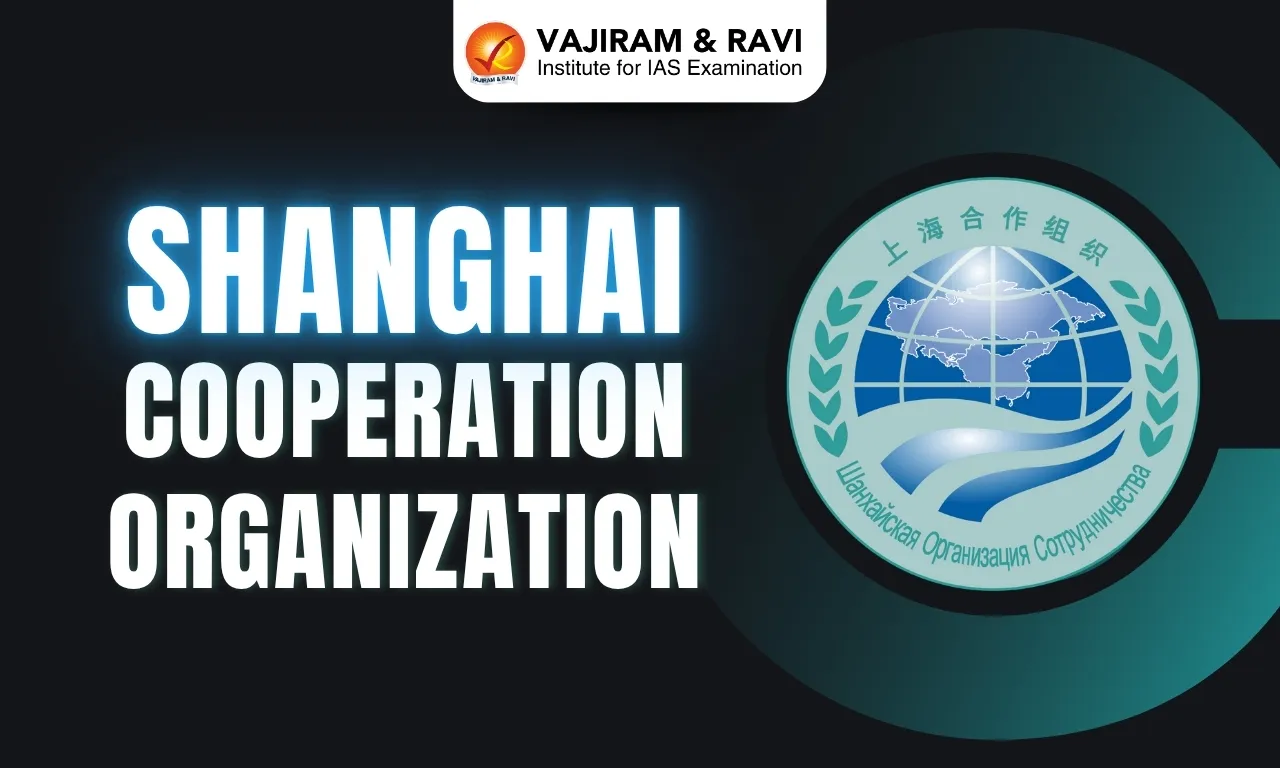
Shanghai Cooperation Organisation (SCO) is one of the most influential intergovernmental regional organisations in the world, with a focus on security, political stability, economic cooperation, and cultural exchange. Established in 2001 in Shanghai, the SCO evolved from the earlier Shanghai Five grouping (1996), which consisted of China, Russia, Kazakhstan, Kyrgyzstan, and Tajikistan. It was created to foster regional cooperation, address common security threats like terrorism, separatism, and extremism, and to strengthen trust among neighbouring states.
Today, Shanghai Cooperation Organisation (SCO) represents nearly 40% of the global population and around 25% of global GDP, giving it substantial geopolitical and geoeconomic weight. Recently, the Indian Prime Minister visited Tianjin, China, to participate in the 25th SCO Summit 2025, marking his first visit in seven years at a time of major global and geopolitical shifts.
Shanghai Cooperation Organisation (SCO) About
Shanghai Cooperation Organisation (SCO) is a permanent regional intergovernmental body, officially founded on 15 June 2001 in Shanghai, China. It was created by Kazakhstan, China, Kyrgyzstan, Russia, Tajikistan, and Uzbekistan, evolving from the earlier framework known as the Shanghai Five.
- SCO Charter: In 2002, member states adopted the SCO Charter during a meeting of the Council of Heads of State in St. Petersburg. This charter, which came into effect on 19 September 2003, serves as the organisation’s constitutional document.
- Evolution of SCO: Over the years, the SCO has expanded its membership to include India and Pakistan in 2017, Iran in 2023 and Belarus in 2024, transforming it into a powerful Eurasian partnership that connects East Asia, South Asia, Central Asia, and parts of the Middle East.
- Principle of the “Shanghai Spirit”: The SCO emphasises the principle of the “Shanghai Spirit”, which is based on mutual trust, mutual benefit, equality, respect for cultural diversity, and the pursuit of common development.
- Official Language: The official working language of the SCO Secretariat is Russian and Chinese.
- Shanghai Cooperation Organisation Headquarters: The permanent secretariat of the Shanghai Cooperation Organisation (SCO) is located in Beijing, China. The SCO has a second permanent body, the Executive Committee of the Regional Anti-Terrorist Structure (RATS), which is headquartered in Tashkent, Uzbekistan.
Shanghai Cooperation Organisation (SCO) Objectives
The objectives of the SCO are broad-based, aiming to address both traditional and non-traditional security threats while also fostering economic and cultural cooperation. At its core, the SCO seeks to build mutual trust and good-neighbourly relations among its members.
- Regional Trust and Friendship: Foster mutual confidence, cooperation, and good-neighbourly relations among all member states to build a stable and harmonious regional environment.
- Comprehensive Cooperation: Encourage active collaboration across diverse fields such as politics, trade, economy, science and technology, culture, education, energy, transport, tourism, and environmental protection.
- Peace and Stability: Work collectively to safeguard regional peace, enhance security mechanisms, and maintain long-term stability within Eurasia.
- Supporting a Fair Global Order: Advocate for a more balanced, democratic, and equitable international political and economic system that reflects the interests of developing nations and multipolarity in world affairs.
Shanghai Cooperation Organisation Members
The members of the Shanghai Cooperation Organisation (SCO) have expanded since 2001. As of August 2025, the SCO has 10 permanent member states and 17 SCO partners.
- SCO Founding Members: The Shanghai Cooperation Organisation (SCO) began in 2001 with six founding members—China, Russia, Kazakhstan, Kyrgyzstan, Tajikistan, and Uzbekistan.
- Inclusion of Later Members: In 2015, the SCO agreed to include India and Pakistan as full members. After signing obligations in Tashkent in 2016, both countries officially became SCO members at Astana in 2017.
- In 2023, Iran joined the SCO as a full member, followed by Belarus in 2024, expanding the organisation’s influence and strengthening its strategic presence in West Asia.
- SCO Partners: Earlier, the Shanghai Cooperation Organisation (SCO) had Observer States and Dialogue Partners as separate categories. However, at the SCO Summit 2025, these were merged into a single category called “SCO Partners.” There are now 17 SCO Partners, with Laos becoming the latest member in 2025.
SCO Organisational Structure
The SCO has a well-defined organisational framework that allows it to function as a permanent institution rather than an ad-hoc grouping. At the top is the Council of Heads of State (CHS), which is the supreme decision-making body and meets annually to set priorities and resolve key issues. The SCO organisational structure is explained below:
|
The Council of Heads of State |
|
|
The Council of Heads of Government |
|
|
The Council of Ministers of Foreign Affairs |
|
|
The Сouncil of National Coordinators |
|
|
The Secretariat |
|
|
The Regional Anti-Terrorist Structure (RATS) |
|
|
The SCO Business Council |
|
|
The SCO Interbank Consortium |
|





Shanghai Cooperation Organisation Significance
Shanghai Cooperation Organisation (SCO) is a vital Eurasian forum enhancing security, energy, and connectivity. It strengthens multipolarity, fosters economic integration, counters terrorism, and promotes dialogue, making it strategically significant for India and the region.
- Regional Security: The Shanghai Cooperation Organisation (SCO) plays a central role in combating terrorism, extremism, and drug trafficking while filling security vacuums left after NATO’s reduced presence, particularly in and around Afghanistan.
- Economic Integration: By promoting trade, infrastructure, energy partnerships, and supply chain stability, the SCO fosters deeper economic cooperation among Eurasian states, linking resource-rich regions with major consumer markets like India and China.
- Strategic Stability: Acting as a catalyst for regional integration, the SCO enhances cross-border connectivity, encourages cooperative infrastructure projects, and promotes stability across Eurasia, which is crucial for long-term peace and prosperity.
- Geopolitical Balance: The Shanghai Cooperation Organisation gives the Global South and Eurasian nations a stronger collective voice in global governance, advocating United Nations reforms, resisting unilateralism, and supporting a more balanced multipolar international order.
- Diplomacy and Dialogue: By bringing together competing powers like India, China, Pakistan, and Russia, the Shanghai Cooperation Organisation provides a rare platform for dialogue, crisis management, and dispute resolution in a complex geopolitical environment.
Shanghai Cooperation Organisation Importance for India
The Shanghai Cooperation Organisation (SCO) is important for India as it enhances counterterrorism cooperation, energy security, connectivity with Central Asia, and strengthens its strategic presence in Eurasia while promoting multipolar global governance.
- Counterterrorism and Security: The Shanghai Cooperation Organisation (SCO) provides India with a platform to raise concerns about cross-border terrorism, extremism, and radicalisation, especially through the Regional Anti-Terrorist Structure (RATS). This is vital as India continues to face security threats from its neighbourhood.
- Energy Security: Central Asia and Russia, rich in hydrocarbons, are crucial for India’s growing energy needs. SCO membership allows India to strengthen energy cooperation and seek long-term partnerships in oil, gas, and renewables.
- Connectivity with Central Asia: India lacks direct land access to Central Asia due to Pakistan’s denial of transit. The SCO facilitates dialogue on alternative connectivity projects, such as the International North-South Transport Corridor (INSTC) and Chabahar Port.
- Balancing China and Pakistan: The Shanghai Cooperation Organisation provides a multilateral setting for India to engage with both China and Pakistan, reducing isolation and keeping dialogue channels open despite bilateral tensions.
- Strategic Presence in Eurasia: Participation in SCO summits helps India strengthen ties with Russia, Iran, and Central Asian states, ensuring a stronger Eurasian footprint in its foreign policy.
Shanghai Cooperation Organisation Challenges for India
Shanghai Cooperation Organisation (SCO) offers India strategic opportunities, but challenges like China’s dominance, Pakistan’s presence, connectivity gaps, and geopolitical balancing complicate India’s engagement and limit its regional influence.
- China’s Dominance: China plays a leading role in the SCO, especially through the Belt and Road Initiative (BRI). Since BRI projects pass through Pakistan-occupied Kashmir (PoK), India faces sovereignty concerns and cannot fully align with the SCO’s connectivity agenda.
- Pakistan Factor: As a full member since 2017, Pakistan often raises bilateral disputes within SCO platforms. Its presence complicates India’s efforts to push anti-terrorism initiatives, as Pakistan itself is accused of harbouring terror networks.
- Consensus-based Decisions: Shanghai Cooperation Organisation functions on consensus, meaning any single member can block proposals. This often prevents India from pushing its security concerns effectively, especially if China or Pakistan oppose.
- Lack of Connectivity to Central Asia: India lacks direct land access to Central Asia due to Pakistan’s denial of transit routes. This limits India’s ability to capitalize on SCO’s economic and energy cooperation.
- Geopolitical Balancing: Shanghai Cooperation Organisation (SCO) is often perceived as a counterweight to Western blocs like NATO. India’s closer ties with the US, QUAD, and Indo-Pacific region strategy sometimes create friction with the SCO’s largely China-Russia-driven narrative.
SCO Summit 2025
The latest Shanghai Cooperation Organisation summit, the 25th SCO Summit 2025, was held in Tianjin, China, from August 31 to September 1, 2025. It marked a significant shift in global politics, bringing together leaders from 10 member nations along with representatives from other countries. The 2025 SCO Summit led to the following key outcomes:
- Tianjin Declaration: The summit adopted the Tianjin Declaration, strongly condemning terrorism, including recent attacks such as the Pahalgam incident in India. Member states agreed to strengthen joint efforts to end cross-border terrorism and enhance counterterrorism cooperation through dedicated mechanisms.
- Expansion of Partnerships: Laos was granted partner status, expanding the SCO family to 27 countries, including 10 full members and 17 partners. The summit also merged observer states and dialogue partners into a single category to streamline cooperation and engagement.
- Development Strategy until 2035: A long-term Development Strategy until 2035 was approved, focusing on reducing trade barriers, boosting investment flows, and strengthening regional value chains.
- Development Bank: The SCO Development Bank was proposed, with China pledging financial support to foster infrastructure and sustainable economic growth across member states.
- Sustainable Energy and Innovation: The summit emphasised energy cooperation and green development, endorsing a roadmap until 2030 for energy security and clean energy adoption.
- New Institutional Mechanisms: Four specialised SCO centres were inaugurated to address security threats, organised crime, information security, and drug trafficking.
- India’s Influence: India’s vision "One Earth, One Family, One Future" was recognised in the summit, and India’s Prime Minister emphasised "Security, Connectivity, and Opportunity," positioning India as a key voice in the SCO’s future direction.
Shanghai Cooperation Organisation UPSC PYQs
Question 1: Critically examine the aims and objectives of SCO. What importance does it hold for India? (UPSC Mains 2021)
Question 2: Consider the following: (UPSC Prelims 2022)
- Asian Infrastructure Investment Bank
- Missile Technology Control Regime
- Shanghai Cooperation Organisation
India is a member of which of the above?
(a) 1 and 2 only
(b) 3 only
(c) 2 and 3 only
(d) 1, 2 and 3
Ans: (d)

 Last updated on March, 2026
→ UPSC Final Result 2025 is now out.
→ UPSC has released UPSC Toppers List 2025 with the Civil Services final result on its official website.
→ Anuj Agnihotri secured AIR 1 in the UPSC Civil Services Examination 2025.
→ UPSC Marksheet 2025 is now out.
→ UPSC Notification 2026 & UPSC IFoS Notification 2026 is now out on the official website at upsconline.nic.in.
→ UPSC Calendar 2026 has been released.
→ Check out the latest UPSC Syllabus 2026 here.
→ UPSC Prelims 2026 will be conducted on 24th May, 2026 & UPSC Mains 2026 will be conducted on 21st August 2026.
→ The UPSC Selection Process is of 3 stages-Prelims, Mains and Interview.
→ Prepare effectively with Vajiram & Ravi’s UPSC Prelims Test Series 2026 featuring full-length mock tests, detailed solutions, and performance analysis.
→ Enroll in Vajiram & Ravi’s UPSC Mains Test Series 2026 for structured answer writing practice, expert evaluation, and exam-oriented feedback.
→ Join Vajiram & Ravi’s Best UPSC Mentorship Program for personalized guidance, strategy planning, and one-to-one support from experienced mentors.
→ Shakti Dubey secures AIR 1 in UPSC CSE Exam 2024.
→ Also check Best UPSC Coaching in India
Shanghai Cooperation Organisation FAQs
Q1. How many members are in SCO 2025?+
Q2. Where is the SCO Summit held in 2025?+
Q3. What is the main purpose of the SCO?+
Q4. When did India join SCO?+
Q5. Which country recently joined SCO?+
Tags: quest sco shanghai cooperation organization UPSC International Relations and Institutions Notes