




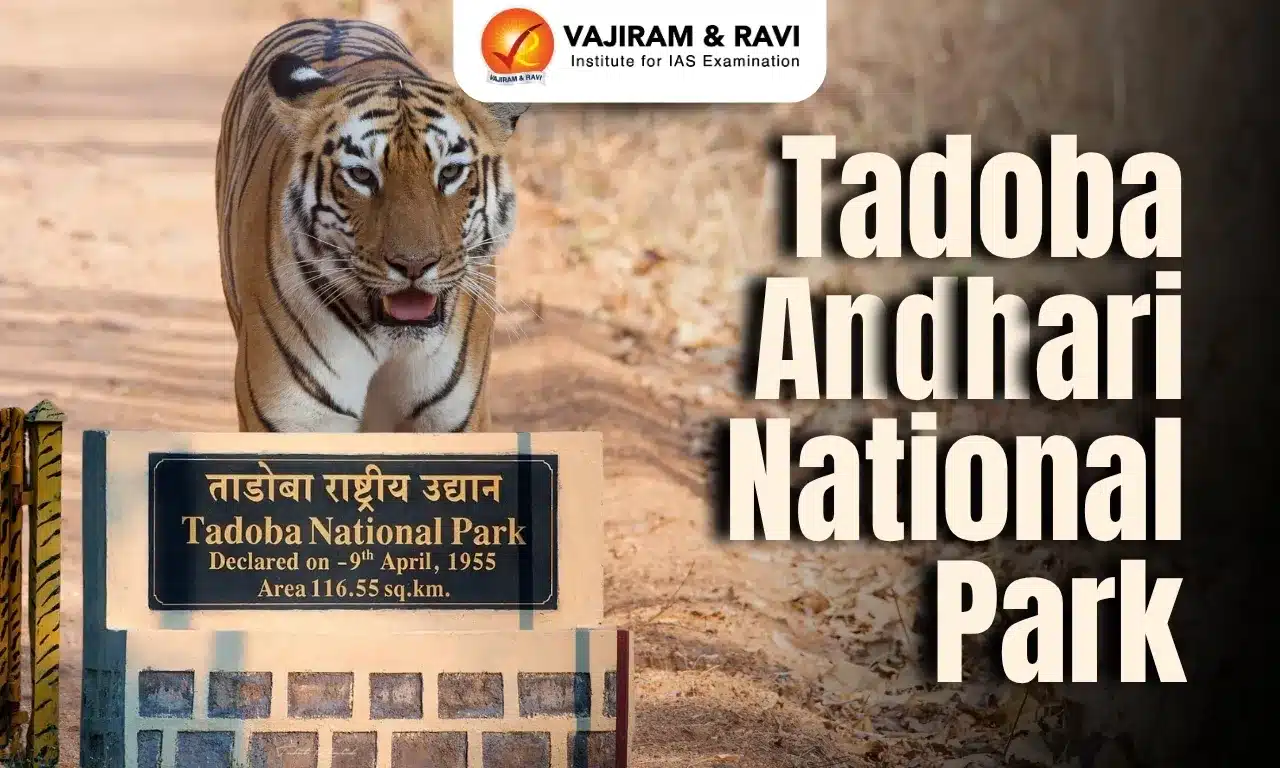
Tadoba National Park is located in Maharashtra’s Chandrapur district and holds the title of state’s oldest and largest national park, covering 626 square kilometers. Situated about 150 km from Nagpur, it is also known as the Tadoba Andhari Tiger Reserve. Apart from its tiger population, visitors may spot leopards, striped hyenas, jungle cats, sambar deer, spotted deer, barking deer, marsh crocodiles, and various snake species like the Indian cobra and python. The Tadoba Tiger Reserve is also a famous place for birdwatchers, with species like peacocks and crested serpent eagles adding to its charm.
Tadoba Tiger Reserve
Tadoba Tiger Reserve was established in 1995 and originally declared a national park in 1955. Named after Tadoba Lake, which lies within its boundaries, the reserve is home to diverse flora and fauna, including tigers, leopards, sloth bears, wild dogs, bison, reptiles, and numerous bird species. Historically, the area was once a hunting ground for Gond and Mughal rulers, later established as a reserve forest by the British in the 19th century. With an estimated tiger population of around 80, Tadoba Tiger Reserve has gained recognition for its successful conservation efforts.
Tadoba Andhari National Park History
Tadoba Tiger Reserve has deep historical and cultural significance, as it was once owned by the Gond tribal people. The name 'Tadoba' is derived from their local deity, also known as 'Taru', who was killed in a fierce battle with a tiger. The reserve also gets its name from the Andhari River, which flows through the region. Tadoba National Park was established in 1955 over an area of 116.5 square kilometers. In 1986, the Andhari Wildlife Sanctuary was created nearby, and later, in 1995, both were merged to form the 41st Tiger Reserve under Project Tiger.





Tadoba National Park Flora
- Tadoba Tiger Reserve is home to a diverse range of flora, including trees, shrubs, grasses, and medicinal plants.
- Among the trees, Teak stands out as a dominant species, valued for its strong and durable wood, while Ain is known for its medicinal properties. Jamun, a fruit-bearing tree, is utilized for both its wood and traditional medicine, and Bamboo, a fast-growing plant, serves various purposes, including furniture-making and as a food source for wildlife.
- The reserve also has shrubs like Lantana, and Oleander, known for its beautiful but toxic flowers.
- In the grasses category, Kans Grass is commonly used for making thatched roofs and baskets, while Spear Grass serves as an essential food source for herbivores.
- Tadoba is also rich in medicinal plants, including Aloe Vera, widely used for treating skin conditions, and Indian Sarsaparilla, which has Ayurvedic applications for curing fever and rheumatism.
Tadoba National Park Fauna
- Tadoba Tiger Reserve holds a rich and diverse range of fauna, including big cats, wild dogs, bears, deer, antelopes, primates, reptiles, and birds.
- Among the big cats, the Bengal Tiger is the star attraction, with over 80 individuals roaming the reserve. The Indian Leopard, a highly adaptable predator, is also found across various habitats in the park.
- The reserve is home to the Indian Wild Dog (Dhole), a highly social and endangered carnivore known for its unique whistling calls.
- Among the bears, the Sloth Bear is a common sight, easily recognizable by its shaggy fur and long claws, which it uses to dig for termites and honey.
- The deer species include the Sambar Deer, the largest in India, and the Spotted Deer (Chital), which survive in the grasslands.
- The Rhesus Macaque is omnivorous and easily spotted due to its red face and long tail.
- Among reptiles, the Indian Python, a non-venomous but powerful constrictor, can grow up to 10 meters in length.
Tadoba Tiger Reserve Threats
- Around 59 villages with a population of over 40,000 exist near Tadoba, with five villages inside the Core Zone, impacting the park’s ecosystem.
- Grazing is restricted in the core zone but allowed in the buffer zone in a regulated manner. However, stray cattle often enter the Reserve, damaging the habitat.
- Annual summer forest fires burn 2% to 16% of the park’s area, leaving a significant threat to wildlife and vegetation.
- Human-wildlife conflicts are common. In 2013 alone, 30-50 cattle and more than four people were killed by tigers, leopards, and sloth bears.
- A 2020 Prey-Predator estimate showed that while the tiger population has improved, its density has slightly declined.
- Extensive coal mining in Chandrapur and surrounding areas is harming tiger habitats, causing irreversible ecological damage.
- A proposed dam on the Hooman River in Maharashtra threatens to submerge 90% of a 7 km forested area within Tadoba Andhari Tiger Reserve.

 Last updated on March, 2026
→ UPSC Final Result 2025 is now out.
→ UPSC has released UPSC Toppers List 2025 with the Civil Services final result on its official website.
→ Anuj Agnihotri secured AIR 1 in the UPSC Civil Services Examination 2025.
→ UPSC Marksheet 2025 is now out.
→ UPSC Notification 2026 & UPSC IFoS Notification 2026 is now out on the official website at upsconline.nic.in.
→ UPSC Calendar 2026 has been released.
→ Check out the latest UPSC Syllabus 2026 here.
→ UPSC Prelims 2026 will be conducted on 24th May, 2026 & UPSC Mains 2026 will be conducted on 21st August 2026.
→ The UPSC Selection Process is of 3 stages-Prelims, Mains and Interview.
→ Prepare effectively with Vajiram & Ravi’s UPSC Prelims Test Series 2026 featuring full-length mock tests, detailed solutions, and performance analysis.
→ Enroll in Vajiram & Ravi’s UPSC Mains Test Series 2026 for structured answer writing practice, expert evaluation, and exam-oriented feedback.
→ Join Vajiram & Ravi’s Best UPSC Mentorship Program for personalized guidance, strategy planning, and one-to-one support from experienced mentors.
→ Shakti Dubey secures AIR 1 in UPSC CSE Exam 2024.
→ Also check Best UPSC Coaching in India
Tadoba Andhari National Park FAQs
Q1. In which state is Tadoba Andhari national park?+
Q2. Which is the largest tiger reserve in Maharashtra?+
Q3. Why is Tadoba National Park famous?+
Q4. Which city is closest to Tadoba National Park?+
Q5. Which is the No 1 tiger reserve in India?+
Tags: tadoba andhari pational park