Question
"The centre of global trade is gradually shifting from the Atlantic region to the Indo-Pacific region." Examine this statement.
Detailed Solution
Global economic gravity has decisively shifted from the trans-Atlantic corridor to the Indo-Pacific, powered by Asian manufacturing scale, mega-regional trade architectures, expanding demographic consumption, and high-density maritime trade corridors.
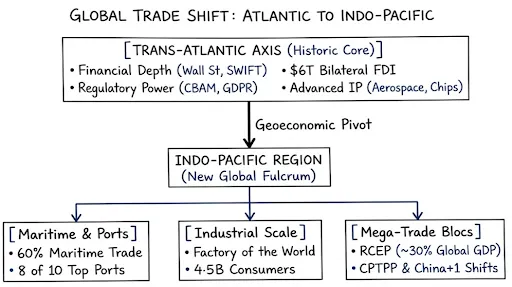
Factors Driving the Shift to the Indo-Pacific
- Maritime Trade Dominance: The Indo-Pacific carries over 60% of global maritime commerce and 50% of container traffic, with the Strait of Malacca alone handling over 25% of global seaborne goods.
- Global Port Superiority: Reflecting volume migration, 9 of the world's 10 busiest container ports (e.g., Shanghai, Singapore, Ningbo-Zhoushan) are located in the Indo-Pacific, overtaking traditional Atlantic hubs like Rotterdam.
- Mega-Regional Trade Blocs: The RCEP (encompassing nearly 30% of global GDP and population) and CPTPP anchor the regional trade architecture, outperforming stalled trans-Atlantic pacts.
- Manufacturing Scale & China+1: East Asia, ASEAN, and India form the world's primary industrial workshop, reinforced by supply-chain diversification and an integrated production network.
- Rising Demand-Side Gravity: Rapid middle-class expansion across India and Southeast Asia provides a consumer base of over 4.5 billion people, converting the region from an assembly hub into a premier consumption destination.
- Eastward Energy Realignment: More than 80% of China’s crude imports now transit eastward across the Indian Ocean through Strait of Mallaca to sustain industrial expansion.
Counter-Perspective: Enduring Structural Atlantic Strength
- Financial Market Depth: Wall Street and London dominate global liquidity, with over 80% of cross-border trade invoicing settled in US Dollars and Euros via SWIFT.
- Reserve Currency Leverage: The US Dollar’s status as the global reserve currency gives Atlantic institutions structural control over trade financing, liquidity lines, and sanctions.
- Deep Bilateral FDI Integration: US–EU cross-border FDI stocks exceed $6 trillion, anchoring the world’s most deeply integrated corporate value chains.
- High-Value IP and Services Hegemony: While Asia leads in assembly, the Atlantic retains near-monopoly control over high-margin inputs: semiconductor architecture, biopharmaceuticals, aerospace, and advanced enterprise software.
- Global Regulatory Power (Brussels Effect): Atlantic regulatory instruments like the EU Carbon Border Adjustment Mechanism (CBAM) and GDPR set global compliance benchmarks that Indo-Pacific exporters must adopt.
- Chokepoint and Geopolitical Vulnerability: Unlike the stable Atlantic corridor, the Indo-Pacific faces systemic friction, including the South China Sea disputes, the Taiwan Strait flashpoint, and the Malacca Dilemma.
While the Atlantic maintains financial, regulatory, and technological primacy, the Indo-Pacific now drives physical trade, energy, and consumption, making secure, open sea lines essential for India's long-term economic security.
Latest UPSC Exam 2027 Updates
Last updated on Oct, 2026