



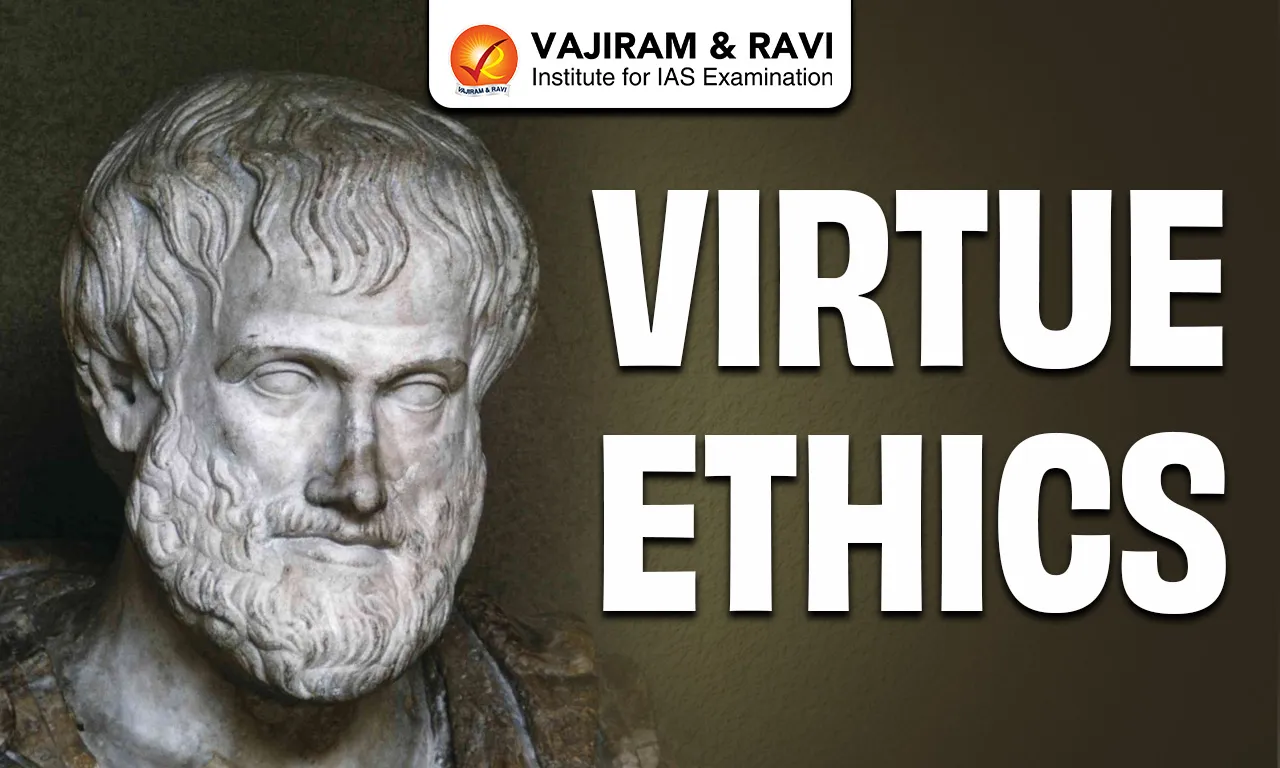
Virtue Ethics is a moral philosophy that focuses on the character and virtues of a person rather than on rules (deontology) or consequences (utilitarianism). It is concerned with “What kind of person should I be?” instead of “What should I do?”
The central idea is that a virtuous person, guided by qualities such as honesty, courage, and compassion, will naturally make ethical choices. In this framework, ethics is less about following rigid rules and more about building character traits that guide one’s conduct across situations.
What are Virtues?
Virtues are good habits or qualities that help a person do the right thing and be a good person. They guide your character and behavior, not just one action. Examples of Virtues are:
- Honesty: Always telling the truth.
- Courage: Facing your fears, like standing up against unfairness.
- Compassion: Helping people who are in need.
- Justice: Treating everyone fairly, like a judge giving a fair verdict.
- Temperance: Controlling your desires, like not overeating or being greedy.
Read about: Code of Ethics
Virtue Ethics Importance
Importance of Virtue Ethics is as follows:
- Focuses on Moral Character: Virtue ethics emphasizes the development of a person’s moral character, rather than only judging actions as right or wrong.
- Example: A public servant who consistently demonstrates honesty and integrity is more likely to make ethical decisions in administration.
- Promotes Consistent Ethical Behavior: Cultivating virtues ensures that individuals act ethically across different situations, not just occasionally.
- Example: A doctor practicing compassion and empathy treats all patients fairly, regardless of their social or economic background.
- Encourages Self-Reflection and Moral Growth: Virtue ethics motivates individuals to examine their own behavior and continuously improve themselves morally.
- Example: Journalists critically verifying facts before publishing news reflect Socratic self-examination.
- Supports Societal Well-Being: By producing individuals of good character, virtue ethics contributes to the overall ethical health of society.
- Guides Decision-Making in Complex Situations: In circumstances where rules or outcomes are unclear, virtuous character guides ethical choices naturally.
- Balances Individual and Social Interests: Virtue ethics teaches individuals to act not only for personal benefit but also for the collective good.
- Example: Environmental activists promoting sustainable practices balance individual convenience with society’s long-term welfare.
- Encourages Long-Term Ethical Development: Unlike rule-based ethics, virtue ethics focuses on habitual cultivation of virtues, leading to enduring moral behavior.
- Applicable Across Cultures and Professions: Core virtues such as honesty, courage, and compassion are universally recognized, making virtue ethics adaptable in various contexts.





Virtue Ethics Criticisms
While Virtue Ethics focuses on building good character and moral habits, it is not without limitations.
- Lack of Clear Decision-Making Rules: Virtue ethics does not provide specific guidelines or step-by-step rules for making moral decisions in complex situations.
- Subjectivity of Virtues: The definition of what constitutes a virtue can be subjective and culturally dependent, leading to varying interpretations across societies.
- Example: Courage in one culture might mean speaking out publicly, while in another it may mean quietly enduring hardships; this can cause differences in ethical judgment.
- Potential for Conflicting Virtues: Sometimes, virtues can conflict with each other, making it difficult to determine the correct course of action.
- Example: Honesty may conflict with compassion when telling a terminally ill patient the full truth about their condition.
- Overemphasis on Individual Character: Virtue ethics focuses primarily on the individual’s character, sometimes neglecting rules, laws, or consequences that are important for societal regulation.
- Difficulty in Measuring Virtue: Virtue is inherently qualitative and internal, making it hard to measure or assess objectively.
- Example: How do we evaluate whether a leader consistently demonstrates justice or integrity? There is no precise metric.
- Limited Guidance in Novel Situations: In new or unprecedented scenarios, relying solely on established virtues may not provide sufficient guidance.
- Example: Emerging ethical dilemmas in AI and biotechnology require rules and policies beyond traditional virtues.
Read about: Ethics in International Relations
Virtue Ethics Thinkers
The development of Virtue Ethics is closely associated with three classical Greek philosophers: Socrates, Plato, and Aristotle.
Socrates Virtue Ethics
Socrates, the classical Greek philosopher, is considered a founder of virtue ethics, which emphasizes the development of moral character over mere rule-following or outcomes. According to him, virtue is knowledge, meaning that a person who truly understands what is good will naturally act rightly, and wrong actions arise from ignorance. He believed that all virtues - such as courage, justice, and temperance are interconnected, and the cultivation of one leads to the cultivation of others. Central to his philosophy is the focus on the soul, where moral improvement through self-knowledge and reflection is paramount. Socrates famously stated, “The unexamined life is not worth living,” highlighting the importance of self-inquiry and ethical reflection in achieving a virtuous life. The Socratic method of dialogue and questioning was aimed at helping individuals examine their beliefs and attain moral wisdom. In essence, Socratic virtue ethics teaches that ethical living stems from knowledge, wisdom, and the continual improvement of one’s character
Plato Virtue Ethics
Plato identified four cardinal virtues that are necessary for a happy individual and a good society.
- Wisdom: The ability to make the right decisions and judge correctly. It helps a person understand what is truly good and act accordingly.
- Example: A ruler or leader using knowledge to make fair laws.
- Temperance: The ability to control desires and impulses. Maintains balance between pleasures and duties.
- Example: A person resisting greed or overindulgence in food, drink, or wealth.
- Courage: The ability to face fears and challenges with strength. It helps a person do the right thing even when it is difficult.
- Example: A soldier standing firm in battle, or a citizen standing up for justice.
- Justice: Ensures that each person gets what they deserve and duties are performed properly. It creates harmony in society by balancing individual and collective good.
- Example: A judge giving a fair verdict or citizens respecting each other’s rights.
Aristotle Virtue Ethics
Aristotle, a Greek philosopher, taught virtue ethics, which means living a good life by building a strong moral character. He said the goal of life is eudaimonia, or true happiness and well-being, which comes from acting rightly. Virtues are habits we develop by practicing good actions.
According to Aristotle golden mean is the virtue which can also be referred to as the Middle path of Buddhism. For example, courage is between being reckless (too much) and being cowardly (too little).
For Example, In case of any discontent one shouldn’t resort to violent protest or should not stay silent in case of discrimination, the golden mean is to fight the legal constitutional battle.

 Last updated on March, 2026
→ UPSC Final Result 2025 is now out.
→ UPSC has released UPSC Toppers List 2025 with the Civil Services final result on its official website.
→ Anuj Agnihotri secured AIR 1 in the UPSC Civil Services Examination 2025.
→ UPSC Marksheet 2025 is now out.
→ UPSC Notification 2026 & UPSC IFoS Notification 2026 is now out on the official website at upsconline.nic.in.
→ UPSC Calendar 2026 has been released.
→ Check out the latest UPSC Syllabus 2026 here.
→ UPSC Prelims 2026 will be conducted on 24th May, 2026 & UPSC Mains 2026 will be conducted on 21st August 2026.
→ The UPSC Selection Process is of 3 stages-Prelims, Mains and Interview.
→ Prepare effectively with Vajiram & Ravi’s UPSC Prelims Test Series 2026 featuring full-length mock tests, detailed solutions, and performance analysis.
→ Enroll in Vajiram & Ravi’s UPSC Mains Test Series 2026 for structured answer writing practice, expert evaluation, and exam-oriented feedback.
→ Join Vajiram & Ravi’s Best UPSC Mentorship Program for personalized guidance, strategy planning, and one-to-one support from experienced mentors.
→ Shakti Dubey secures AIR 1 in UPSC CSE Exam 2024.
→ Also check Best UPSC Coaching in India
Virtue Ethics FAQs
Q1. What is Virtue Ethics?+
Q2. What are virtues?+
Q3. Why is Virtue Ethics important?+
Q4. What are criticisms of virtue ethics?+
Q5. Who are the key thinkers associated with Virtue Ethics?+
Tags: ethics ethics notes virtue ethics