




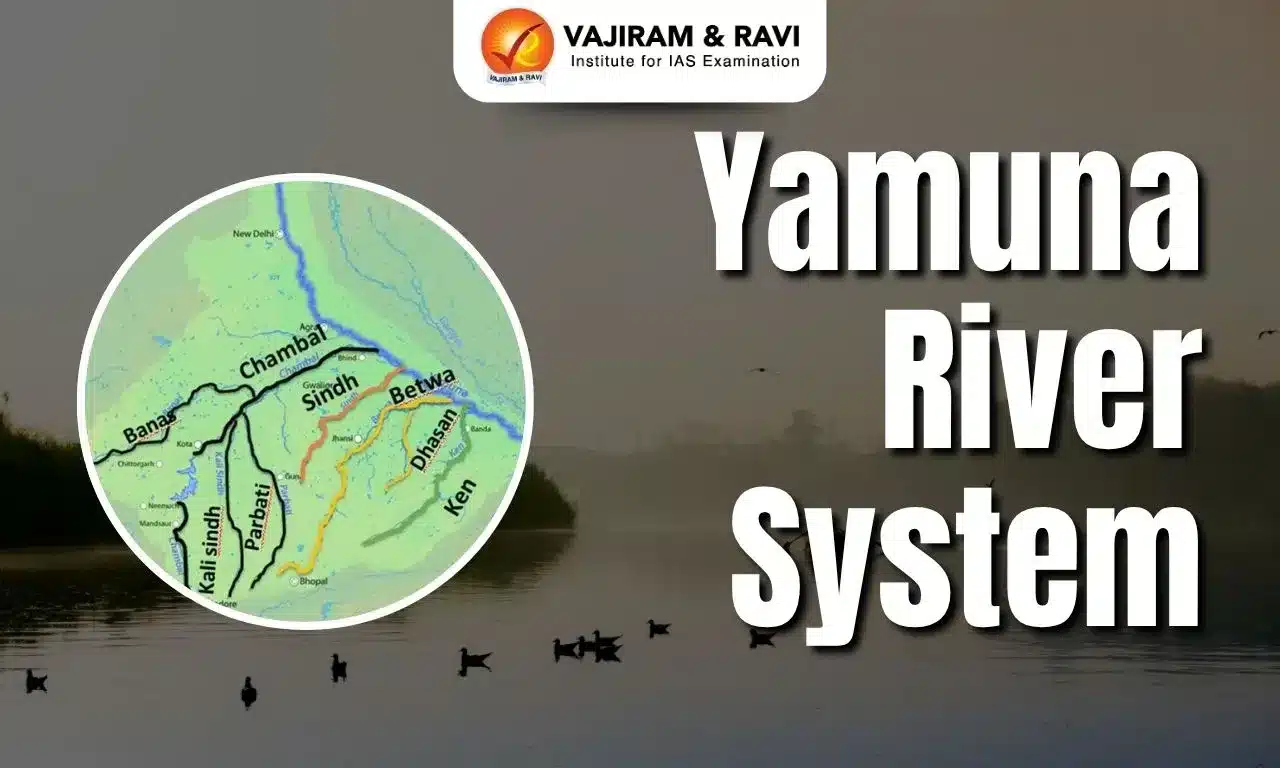
The Yamuna River System is a vital component of the Ganga River System, one of the three major river basins in the Himalayan region. Flowing through the northern Indian subcontinent, the Yamuna and its multiple tributaries play a significant role in shaping the landscape and sustaining diverse ecosystems. Spanning over 1,300 kilometers, the Yamuna is a crucial river in India and a key tributary of the Ganga.
Yamuna River System Origin
The Yamuna River System originates from the Yamunotri Glacier, located near Bandarpoonch Peak in the Mussoorie range of the Lower Himalayas. Situated at an altitude of approximately 6,387 meters in Uttarkashi district, Uttarakhand, this glacier marks the source of the Yamuna, one of India’s most significant rivers.
- Source: Yamunotri Glacier, Uttarakhand (Lower Himalayas)
- Elevation at Source: ~3,291 meters (10,800 feet)
- Initial Flow: Begins as a small glacial stream
- Tributaries Joining Early: Tons River, Giri River, Hanuman Ganga
- Course: Flows through Uttarakhand, Haryana, Delhi, Uttar Pradesh
- Religious Significance: Sacred river in Hinduism; part of pilgrimage circuit
- Confluence: Joins the Ganga at Prayagraj (Allahabad), Uttar Pradesh
Yamuna River System Map
The Yamuna River System Map presents a detailed visual representation of the Yamuna River, one of the major tributaries of the Ganga and a vital component of the northern Indian river network. The map highlights the river’s origin, course, major tributaries, states covered, and confluence points, offering valuable insights into its geographical and hydrological importance.






Yamuna River System Tributaries
The Yamuna River spans a total length of 1,376 km, with a catchment area of approximately 69,000 sq km. Over time, the river, along with its tributaries, has shaped the landscape of its basin.
| Yamuna River System Tributaries | |
|
Chambal |
The Chambal River, historically known as Charmanvati, is the longest tributary of the Yamuna. Originating in the Vindhya Range near Mhow, it flows for approximately 960 kilometers (600 miles) across Rajasthan and Madhya Pradesh. Along its course, it supports hydro-power generation at the Gandhi Sagar, Rana Pratap, and Jawahar dams before merging with the Yamuna south of Sohan Goan in Uttar Pradesh’s Etawah district. The river's drainage basin spans around 143,219 square kilometers (55,297 square miles). |
|
Tons |
Originating from the 6,315-meter-high Bandarpoonch mountain, the Tons River is the largest tributary of the Yamuna. It has an extensive basin in Himachal Pradesh and merges with the Yamuna near Kalsi, close to Dehradun in Uttarakhand. |
|
Hindon |
The Hindon River originates in the Upper Shivalik region of the Lesser Himalayan Range, rising in the Saharanpur district of Uttar Pradesh. It flows for approximately 400 kilometers through Muzaffarnagar, Meerut, Baghpat, Ghaziabad, Noida, and Greater Noida before merging with the Yamuna just outside Delhi. Being a fully rainfed river, it has a catchment area of around 7,083 square kilometers (2,735 square miles). |
|
Betwa |
Originating from the Vindhya Mountains, the Betwa River, also known as Betravati, flows northeast through Madhya Pradesh and Uttar Pradesh. It merges with the Yamuna in the Hamirpur district of Uttar Pradesh. Notably, the Indian Navy has honored the river by naming one of its frigates, INS Betwa. |
|
Ken |
The Ken River flows through the Bundelkhand region of Madhya Pradesh and Uttar Pradesh. Originating near Ahirgawan village in the Jabalpur district, it travels approximately 427 kilometers (265 miles) before merging with the Yamuna at Chilla village near Fatehpur, Uttar Pradesh. Its drainage basin covers an area of about 28,058 square kilometers (10,833 square miles). |
|
Sind |
The Sindh River originates on the Malwa Plateau in the Vidisha district of Madhya Pradesh. It flows through the districts of Guna, Ashoknagar, Shivpuri, Datia, Gwalior, and Bhind before merging with the Yamuna River in Uttar Pradesh's Jalaun district, just downstream of the Chambal River’s confluence. |
|
Giri |
The Giri River is a significant tributary of the Yamuna and a vital water source for southern Himachal Pradesh. Originating from the Kupar Peak above Jubbal town, it flows through the central Shimla Hills. Moving in a southeasterly direction, it divides the Sirmaur district into two regions—Cis-Giri and Trans-Giri. Eventually, it joins the Yamuna upstream of Paonta, near Mokkampur. |
|
Sabi |
The Sabi River, an ephemeral rain-fed tributary of the Yamuna mentioned in the Vedas, drains into Delhi just before the Signature Bridge and continues toward the Wazirabad Barrage. Originating in the Aravalli range near Saiwar, it flows for approximately 300 kilometers through Rajasthan, Haryana, and Delhi. Along its course, it nourishes several wetlands, including Chuchakwas Wetland, Bhindrawas Wetland, Masani Barrage, Bucahra Dam, and Babariya Dam, supporting diverse wildlife. Notably, it is the only major river from the Aravalli range that flows northward to merge with a Himalayan river. |
|
Dhasan |
The Dhasan River is a right-bank tributary of the Betwa River. It originates in the Begumganj tehsil of the Raisen district in Madhya Pradesh. The river forms the southern boundary of the Lalitpur district in Uttar Pradesh. Covering a total length of 365 kilometers, it flows for 240 kilometers in Madhya Pradesh, 54 kilometers along the Madhya Pradesh-Uttar Pradesh border, and 71 kilometers within Uttar Pradesh |
States through which Yamuna River Flows
The Yamuna River, one of the major tributaries of the Ganga, originates from the Yamunotri Glacier in Uttarakhand and flows through several northern states of India. It traverses Uttarakhand, Haryana, Himachal Pradesh, Delhi, and Uttar Pradesh before joining the Ganga at Prayagraj (Allahabad).
- Uttarakhand
- Himachal Pradesh
- Uttar Pradesh
- Haryana
- Delhi
Cities located on the banks of Yamuna River
Several important cities and towns have developed along the banks of the Yamuna River due to its water resources and fertile plains. Key cities include Yamunotri, Paonta Sahib, Delhi, Mathura, Agra, and Allahabad (Prayagraj), which are significant for religion, culture, industry, and agriculture.
- Noida
- Mathura
- Agra
- Firozabad
- Etawah
- Kalpi
- Hamirpur
- Prayagraj (Allahabad).
Economic Importance of the Yamuna River System
The Yamuna River System plays a crucial role in supporting agriculture, industry, fisheries, and inland navigation across northern India. It also boosts tourism and cultural activities, provides water for irrigation and hydropower, and contributes significantly to the regional economy.
- The Yamuna River supports irrigation across northern states like Uttarakhand, Haryana, Delhi, and Uttar Pradesh, enabling cultivation of wheat, rice, sugarcane, and other crops.
- Its fertile floodplains contribute significantly to the agricultural productivity of the Indo-Gangetic plains.
- The river provides water for industries in cities like Delhi, Mathura, Agra, and Yamunanagar, supporting textiles, chemicals, and paper production.
- It supports fisheries along its course, providing livelihoods for local communities and contributing to regional food supply.
- Navigable stretches of the Yamuna facilitate local transport and trade, connecting towns and smaller cities along its banks.
- Several hydroelectric and multipurpose projects on the Yamuna and its tributaries generate electricity, supply irrigation water, and help with flood management.
- The river’s ghats, pilgrimage sites, and cultural centers attract millions of tourists annually, boosting the economy through tourism and religious activities.
- Sand and gravel extracted from the Yamuna are used in construction, contributing to local economies.

 Last updated on March, 2026
→ UPSC Final Result 2025 is now out.
→ UPSC has released UPSC Toppers List 2025 with the Civil Services final result on its official website.
→ Anuj Agnihotri secured AIR 1 in the UPSC Civil Services Examination 2025.
→ UPSC Marksheet 2025 is now out.
→ UPSC Notification 2026 & UPSC IFoS Notification 2026 is now out on the official website at upsconline.nic.in.
→ UPSC Calendar 2026 has been released.
→ Check out the latest UPSC Syllabus 2026 here.
→ UPSC Prelims 2026 will be conducted on 24th May, 2026 & UPSC Mains 2026 will be conducted on 21st August 2026.
→ The UPSC Selection Process is of 3 stages-Prelims, Mains and Interview.
→ Prepare effectively with Vajiram & Ravi’s UPSC Prelims Test Series 2026 featuring full-length mock tests, detailed solutions, and performance analysis.
→ Enroll in Vajiram & Ravi’s UPSC Mains Test Series 2026 for structured answer writing practice, expert evaluation, and exam-oriented feedback.
→ Join Vajiram & Ravi’s Best UPSC Mentorship Program for personalized guidance, strategy planning, and one-to-one support from experienced mentors.
→ Shakti Dubey secures AIR 1 in UPSC CSE Exam 2024.
→ Also check Best UPSC Coaching in India
Yamuna River System FAQs
Q1. What is Yamuna River system?+
Q2. What is the drainage pattern of the Yamuna River?+
Q3. Where is the Yamuna River at the start and end point?+
Q4. Why is Yamuna River called Dead river?+
Q5. Who is the father of Yamuna River?+
Tags: yamuna river system