Industrial Disputes Act, 1947, Historical Background, Objectives

Industrial Disputes Act, 1947

The Industrial Disputes Act, 1947 was a landmark legislation that governs the labour relations and industrial harmony in India. The act regulates trade unions, individual workers and all industrial establishments employing one or more persons. The act was enforced on 1st April, 1947 to investigate and resolve industrial disputes while safeguarding the rights of both employers and the employees. In this article, we are going to cover all about The Industrial Disputes Act, 1947 its features, historical background and objectives. 

Industrial Disputes Act, 1947 

The Industrial Disputes Act, 1947 provides a legal framework to regulate disputes between employers and employees. It covers both collective disputes, such as those raised by trade unions or a group of workers, and individual disputes, such as wrongful termination or unfair dismissal. Its key aim is to maintain industrial peace, prevent arbitrary practices, and ensure that conflicts do not disrupt production or social stability.

What is the meaning of Industrial Dispute?

An industrial Dispute refers to a conflict between employers and employees or between employees within themselves, regarding conditions like employment, wages, working hours, job security and other labour related issues. 

As per Section 2(k) of the Industrial Disputes Act, 1947, an industrial dispute means any dispute or difference between employers and employers, or between employers and workmen, or between workmen and workmen, which is connected with the employment, non-employment, terms of employment, or conditions of labour of any person.

Industrial Disputes Act, 1947 Historical Background

The roots of the Industrial Disputes Act can be traced back to the colonial period when labour unrest became a recurring phenomenon.

  • Post World War I: Workers began demanding fair wages and better service conditions, leading to frequent strikes and lockouts.
  • Trade Disputes Act, 1929: Enacted to resolve conflicts but proved inadequate as it lacked enforceable mechanisms and restrictions on strikes/lockouts in public utility services.
  • World War II (1938–1945): Under Rule 81-A of the Defence of India Rules, industrial disputes could be referred to adjudication, ensuring continuity of production during wartime.
  • Post-War Transition: With the expiry of Rule 81-A in 1946, the Government introduced the Industrial Disputes Act in 1947, incorporating wartime mechanisms into peacetime law.

Industrial Disputes Act, 1947 Objectives

The Industrial Disputes Act, 1947 has the following objectives: 

  • The act promotes Industrial peace that establishes a mechanism to reduce any tension between employers and the workers. 
  • The act provides legal processes such as conciliation, arbitration and adjudication. 
  • It protects employees against wrongful dismissals, retrenchments and exploitation. 
  • The act helps recognise trade unions and foster negotiations between employers and employees. 
  • Provides social justice to balance rights and obligations of employers and workers. 
  • Provides the legal procedures to prevent illegal work stoppages. 
  • Gives guidelines and norms for lay-offs, retrenchments and compensation. 

Industrial Disputes Act, 1947 Features

The Industrial Disputes Act, 1947 has the following features: 

  • Prohibition of Strikes and Lockouts During Proceedings: Work stoppages are prohibited when conciliation or adjudication is in progress.
  • Reference to Tribunals: Disputes may be referred to industrial tribunals either by mutual consent or by government intervention.
  • Binding Nature of Awards: Awards passed by tribunals are binding on both parties for up to one year.
  • Declaration of Public Utility Services: Essential sectors such as transport, coal, and steel can be declared as public utilities to prevent disruption.
  • Compensation for Lay-offs and Retrenchment: Employers are mandated to provide compensation to workers in cases of job loss.
  • Dispute Resolution Mechanisms: Multiple institutions like Works Committees, Conciliation Officers, Labour Courts, Industrial Tribunals have been established for dispute resolution.

Industrial Disputes Act FAQs

Q1: What are the 4 types of industrial disputes?

Ans: The four types are interest disputes, rights disputes, termination disputes, and recognition disputes.

Q2: What is the notice period for Industrial Disputes Act, 1947?

Ans: A 14-day notice is required before a strike or lockout in public utility services.

Q3: What is Section 7 of the Industrial Disputes Act, 1947?

Ans: Section 7 provides for the establishment of Labour Courts to adjudicate disputes specified in the Second Schedule.

Q4: What is Section 12 of the Industrial Disputes Act?

Ans: Section 12 deals with the duties of the Conciliation Officer in mediating and promoting the settlement of disputes.

Q5: What is Section 4 of the Industrial Disputes Act?

Ans: Section 4 provides for the appointment of Conciliation Officers by the government to resolve disputes amicably.

Exercise Aarogya Setu

Exercise Aarogya Setu

Exercise Aarogya Setu Latest News

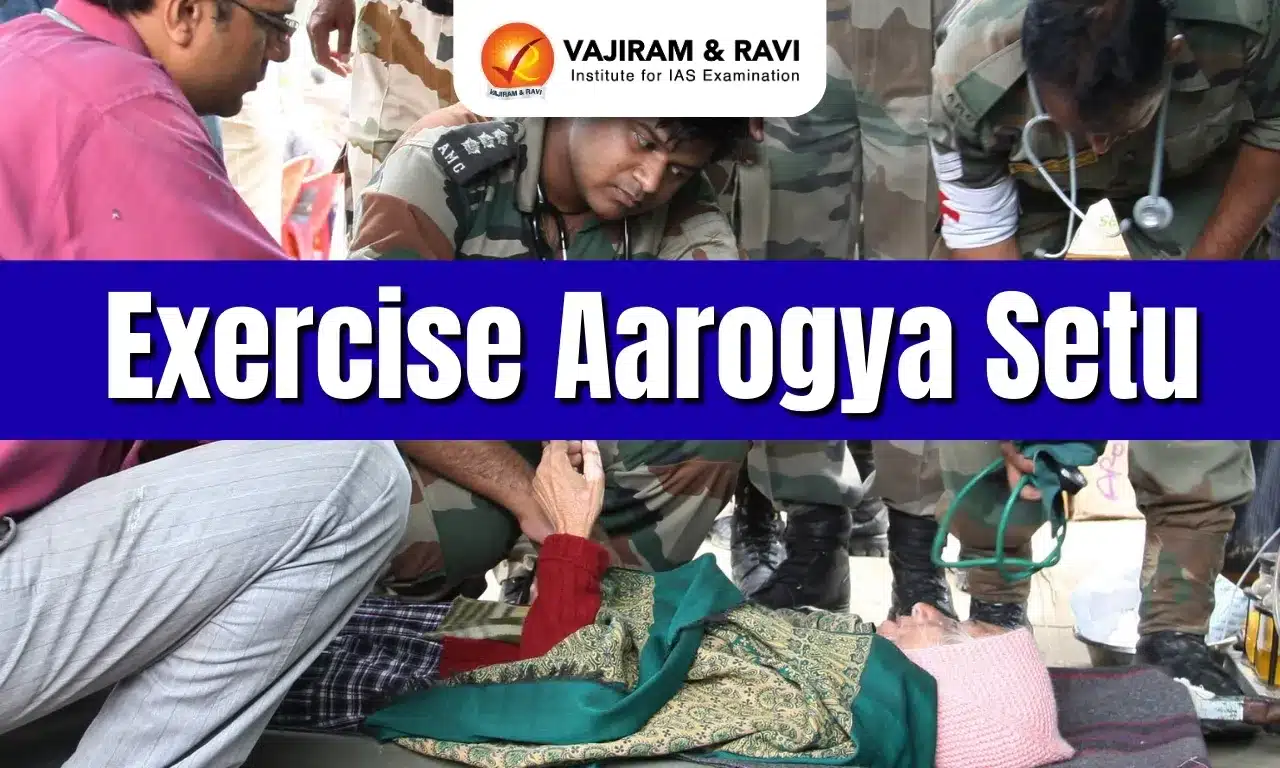
In a landmark initiative, the Indian Army recently organised the maiden Exercise Aarogya Setu at Rupai, Doomdooma in the Tinsukia district of Assam.

About Exercise Aarogya Setu

  • It was organised by the Indian Army at Rupai, Doomdooma, in the Tinsukia district of Assam.
  • A first of its kind, it marked a civil-military medical fusion exercise in the region.
  • The event aimed at strengthening cooperation between the Army Medical Corps, reputed senior civil doctors from leading hospitals, and PHCs of Tinsukia and the Northern Frontier Railway Hospital, Tinsukia.
  • The focus of the exercise was on how Army and Civil medical fraternities can work together during disasters and war-like situations.
  • A special highlight was the participation of a doctor from the Northern Frontier Railway Hospital, who introduced the concept of train ambulances —a life-saving facility.
  • The presentation drew great interest and sparked discussions on innovative methods of large-scale casualty evacuation.
  • Doctors from both sides discussed how civil institutions can extend crucial support to Army medical authorities.

Source: NEN

Exercise Aarogya Setu FAQs

Q1: Exercise Aarogya Setu was organised by which institution?

Ans: Indian Army

Q2: Where was Exercise Aarogya Setu conducted?

Ans: Doomdooma, Tinsukia district, Assam

Q3: What was the key focus of Exercise Aarogya Setu?

Ans: Civil-military medical fusion during disasters and war-like situations.

Psephology

Psephology

Psephology Latest News

The Supreme Court recently stayed criminal proceedings initiated against psephologist Sanjay Kumar for a social media post concerning an erroneous analysis of the 2024 Maharashtra Assembly election.

About Psephology

  • Psephology is a branch of political science that deals with the scientific analysis of elections or polls.
  • This field is dedicated to offering a meticulous quantitative analysis of elections. 
  • The toolbox of psephology encompasses a variety of instruments employed for the statistical examination of election data. 
  • These invaluable tools include voting data, opinion polls, campaign insights, and related datasets. 
  • Those who wield the expertise of psephology are known as Psephologists.
  • Psephologists study the patterns of elections, using past voting figures and their percentage, public opinion polls and other related information. 
  • They estimate the results of the public opinion for the future elections using statistical applications. 
  • India does not have an actual post called ‘Psephologist’. 
  • However, some major parties have in-house analysts who can be called Psephologists
  • Several accomplished media editors, political analysts, and marketing research scientists double up as Psephologists.

Source: TH

Psephology FAQs

Q1: Psephology is a branch of which discipline?

Ans: Political Science

Q2: Who are experts in the scientific analysis of elections called?

Ans: Psephologists

Q3: What is the main focus of Psephology?

Ans: Predicting election outcomes.

Shipki La Pass

Shipki La Pass

Shipki-La Pass Latest News

China has agreed in principle to the proposal of resuming trade through Shipki-La in Kinnaur district of Himachal Pradesh during the recent visit of its Foreign Minister Wang Yi to India.

About Shipki-La Pass

  • It is a motorable mountain pass situated at an altitude of 3,930 meters, bordering India and China in tribal district of Kinnaur in Himachal Pradesh.
  • It also serves as the boundary post on the frontier between China and India.
  • It is one of the highest motorable passes.
  • Through this pass the Sutlej River (known as Langqen Zangbo in Tibet) enters India, has long served as a vital trade corridor between India and Tibet.
  • The old name of Shipki La was Pema La, or Shared Gate, also known as Shared Pass.
  • It was declared the Line of Actual Control post-1962, and later, the Indo-Tibetan Border Police named it Shipki La.
  • Shipki La Pass Significance: The opening of Shipki La to tourists is part of a broader strategy to stimulate economic growth in Kinnaur and Lahaul-Spiti, which share a 240-km border with China.

Source: TH

Shipki La Pass FAQs

Q1: Where is the Shipki La pass located?

Ans: Kinnaur district

Q2: Which is the longest pass in India?

Ans: Umling La or Umlingla Pas

Vaquita

Vaquita

Vaquita Latest News

A report by the North American Environmental Commission has criticized Mexico for failing to protect the endangered vaquita porpoise, with only 10 remaining.

About Vaquita

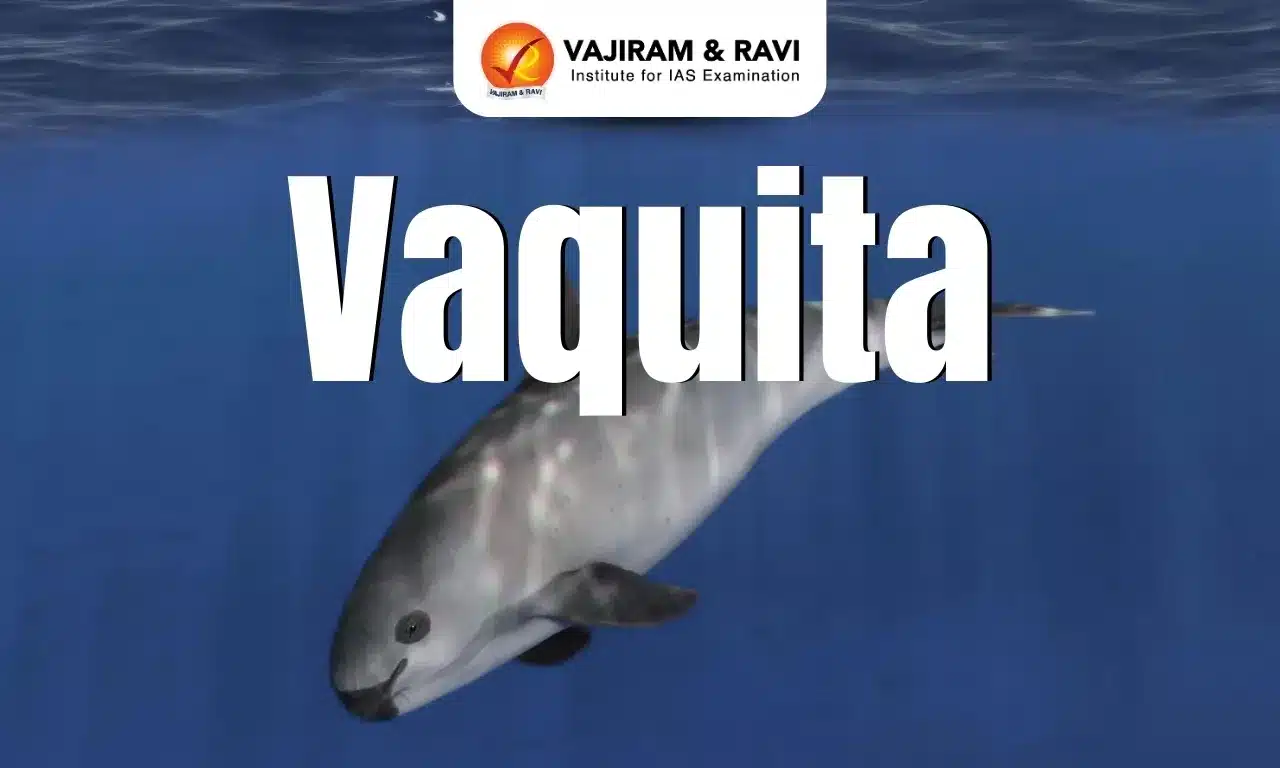
  • It is a shy member and the smallest of the porpoise family.
  • Vaquitas are the most endangered of the world’s marine mammals.

Distribution of Vaquita

  • It is the smallest range of any whale, dolphin, or porpoise.
  • It lives in the northern part of the Gulf of California, an area that is rich in fish and shrimp. 
  • It is most commonly sighted in shallow waters up to 50 metres deep.

Features of Vaquita

  • Vaquitas are the smallest cetaceans—the group that includes dolphins, porpoises,
  • Although they do visually resemble dolphins, their closest relatives, vaquitas, have chunkier bodies and rounded heads with no snouts.
  • Their dorsal fins are unique in that they are taller and wider than most other porpoises.
  • Known for their elusive nature, vaquitas tend to shy away from boats and human activity.
  • Vaquitas communicate using echolocation (or sonar) by emitting high-frequency clicks.
  • Conservation Status: Critically Endangered (IUCN)
  • Threats: The decrease in the vaquita population is also related to the totoaba, a large fish that also only lives in the Gulf of California.

Source: DTE

Vaquita FAQs

Q1: What are cetaceans?

Ans: These are a group of marine mammals that include whales, dolphins, and porpoises. They are well-adapted to life in aquatic environments.

Q2: What is the echolocation?

Ans: Echolocation, or sonar, is the use of sound waves to determine the location of objects.

National Youth Award

National Youth Award

National Youth Award Latest News

The Ministry of Youth Affairs & Sports, Government of India, invited nominations for the National Youth Award (NYA) 2024.

About National Youth Award

  • It is sponsored by the Ministry of Youth Affairs.
  • It is for the Indian youth for their tremendous and outstanding work in social service.
  • This award is to motivate young persons to achieve excellence in the field of national development or social service
  • It aims to motivate young persons (aged between 15 – 29 years) to achieve excellence in the field of national development or social service;
    • To encourage young people to develop a sense of responsibility to the community and thus to improve their own personal potential as good citizens; and
    • To give recognition to the outstanding work done by voluntary organizations working with the youth for national development and/or social service.
  • The National Youth Awards are conferred usually during the National Youth Festival.
  • The award is given in two categories: Individual Category and Organisation Category
  • The number of awards given each year would ordinarily not exceed 20 for individual category and five for organization category. It may, however, vary at the discretion of the sanctioning authority in deserving case.
  • Prize money: Award to individuals will comprise a medal, a certificate and award money of ₹1,00,000/-. Award to voluntary youth organizations will comprise a medal, a certificate and award money of ₹3,00,000/-.
  • Eligibility for Award:
    • Individuals/organisations who have shown identifiable excellent work for youth in different fields of development activities and social service such as health, research and innovation, culture, promotion of human rights, art and literature, tourism, traditional medicine, active citizenship, community service, sports and academic excellence, and smart learning are encouraged.

Source: PIB

National Youth Award FAQs

Q1: Who is eligible for National Youth Award?

Ans: The applicant should have done extraordinarily identifiable social work.

Q2: What is the age limit for National Youth Award?

Ans: 15 – 29 years

Fiji

Fiji

Fiji Latest News

India will provide training and equipment to upgrade Fiji’s maritime security, Prime Minister said recently.

About Fiji

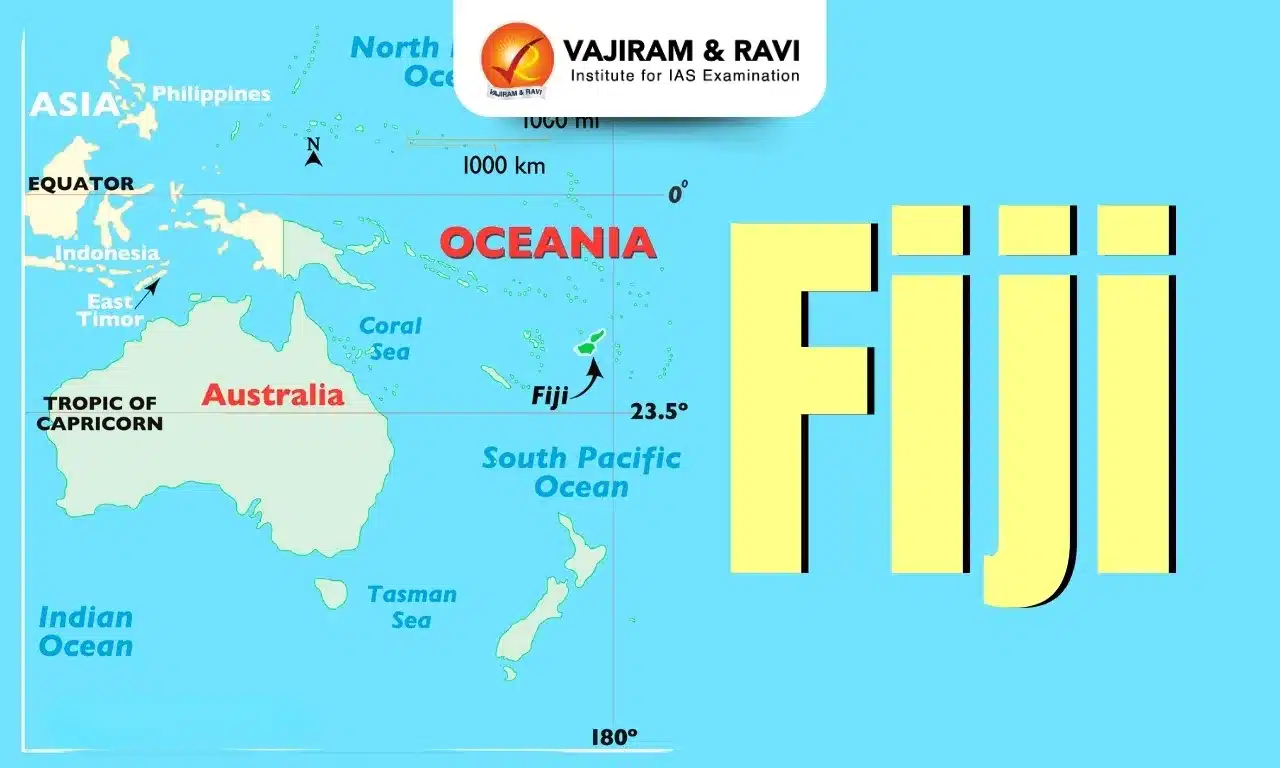
  • It is a country located in the South Pacific Ocean, surrounding the Koro Sea, to the northeast of New Zealand and southwest of Hawaii.
  • It is an archipelago consisting of some 300 islands and 540 islets scattered over about 1,000,000 square miles (3,000,000 sq.km).
  • It does not share land borders with any other country. 
  • Of the 300 islands, about 100 are inhabited. 
  • The capital, Suva, is on the southeast coast of the largest island, Viti Levu (“Great Fiji”).
    • Viti Levu accounts for more than half of Fiji’s land area.
    • This region is characterized by rugged terrain, with a central mountain range that includes the country’s highest peak, Mount Tomanivi, standing at 1,324 m (4,344 ft). 
  • Fiji has a complex geologic history and the islands are largely the product of volcanic action, sedimentary deposit, and formations of coral. 
  • Almost half of Fiji’s total area remains forested, while dry grasslands are found in western areas of the large islands.
  • The majority of Fijians are of mixed Melanesian-Polynesian ancestry, with a large South Asian minority
  • Languages: English (official), Fijian.
  • Currency: Fiji dollar. 

Source: TH

Fiji FAQs

Q1: Fiji is located in which part of the world?

Ans: South Pacific Ocean

Q2: What is the capital of Fiji?

Ans: Suva

Q3: Which is the highest peak in Fiji?

Ans: Mount Tomanivi

Q4: The majority of Fijians are of which ancestry?

Ans: Mixed Melanesian-Polynesian.

Minicoy Island

Minicoy Island

Minicoy Island Latest News

A 12-year-old tigress, which had been sick and roaming near the forest boundary in the Singara forest range of the Mudumalai Tiger Reserve (MTR), died recently.

About Minicoy Island

  • Minicoy, locally known as Maliku, is the second largest and southernmost island in Lakshadweep.
  • Minicoy is famous for coral reefs and white sand beaches amidst the vast expanse of the Arabian sea.
  • It is  crescent-shaped and has an area of 4.80 sq.km.
  • This island lies near the 9-degree channel, which is one of the busiest shipping routes and is about 130 km from the northernmost island of the Maldives. 
  • It has a very large lagoon on the western side, measuring about 6 km across the two entrances, one on the west and the other on the northernmost point. The lagoon area is 30.60 sq.km.
  • The island is about 2 m above the mean sea level on the western side and about 3 to 4 m on the eastern side, and is 11 km long.
  • The lighthouse of the island is one of the oldest and was constructed in 1885. 
  • Minicoy is set apart from the Northern group of islands by its culture.
  • The main attraction of the island is its carefully arranged villages, known as ‘Avah’. 
    • Each Avah has its own internal organization headed by a Moopan, around which the life of the community rests.
    • Every village has its own village house. In total there are 10 villages on the island.
  • The languages spoken are Hindi, English, Malayalam, and Mahal. Minicoy being the only people in India speaking Mahal as a linguistic minority.
  • The folk dances of Minicoy are ‘Lava’, Thaara’, ‘Dandi’, ‘Fuli’ and ‘Bandiya’.

Source: TOI

Minicoy Island FAQs

Q1: Minicoy Island, locally known as Maliku, is part of which Union Territory?

Ans: Lakshadweep

Q2: Minicoy is located near which important maritime route?

Ans: 9-Degree Channel

Q3: What are the traditional villages of Minicoy Island called?

Ans: Avah

Archaeological Survey of India

Archaeological Survey of India

Archaeological Survey of India Latest News

The Archaeological Survey of India (ASI) has once again drawn public scrutiny following the controversial transfer of archaeologist K. Amarnath Ramakrishna.

About Archaeological Survey of India

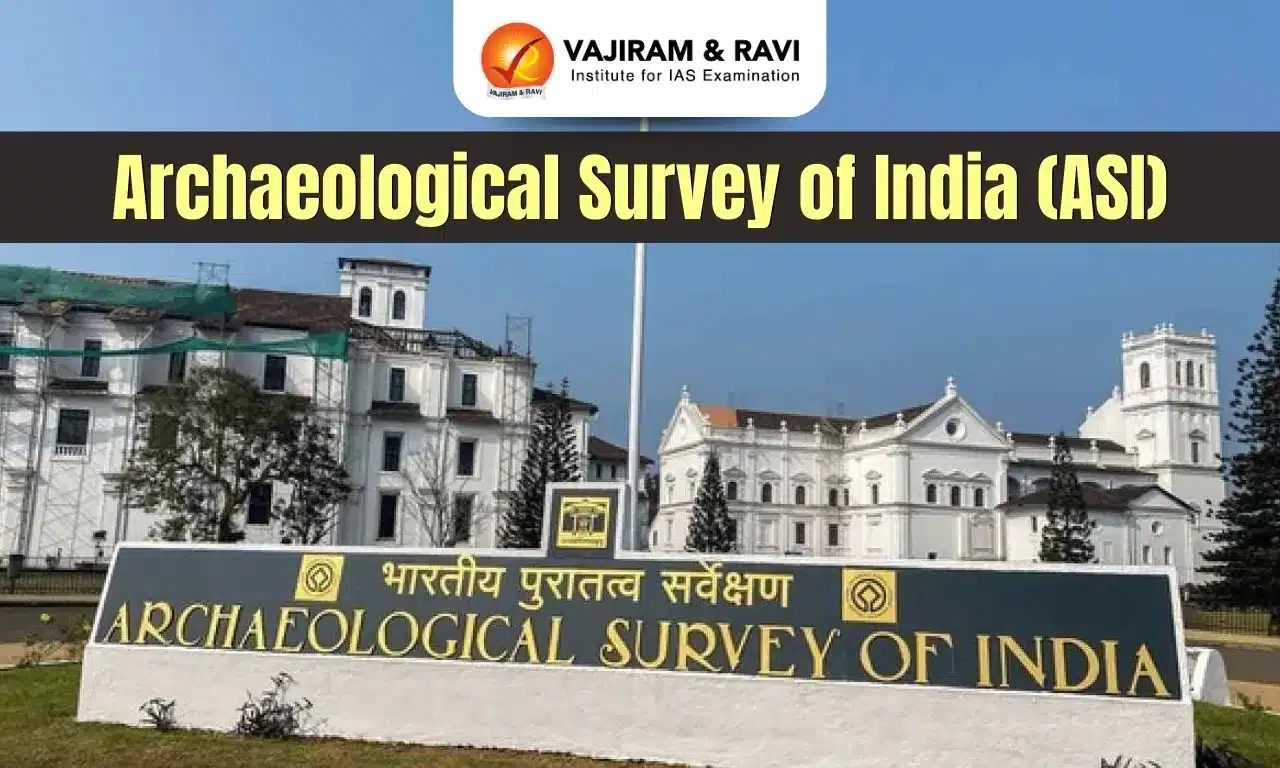
  • ASI, under the Ministry of Culture, Government of India, is a premier organisation for archaeological research and protection of the tangible heritage of the nation. 
  • It was established in 1861 by Sir Alexander Cunningham, with its headquarters in New Delhi. 
  • After independence, it was established as a statutory body under the Ancient Monuments and Archaeological Sites and Remains Act, 1958 (AMASR Act).
  • The prime concern of ASI is the maintenance of ancient monuments, archaeological sites, and remains of national importance. 
  • Besides, it regulates all archaeological activities in the country as per the provisions of the AMASR Act. 
  • It also regulates the Antiquities and Art Treasure Act, 1972. 
  • The Central Government has declared 3679 monuments and sites as of national importance, and ASI shoulders the responsibility of protecting and maintaining them.
  • The organization has a large workforce of trained archaeologists, conservators, epigraphists, architects, and scientists for conducting archaeological research projects through its Circles, Museums, Excavation Branches, Prehistory Branch, Epigraphy Branches, Science Branch, Horticulture Branch, Building Survey Project, Temple Survey Projects, and Underwater Archaeology Wing.

Source: TH

Archaeological Survey of India FAQs

Q1: The Archaeological Survey of India (ASI) functions under which Ministry?

Ans: Ministry of Culture

Q2: Who established the Archaeological Survey of India in 1861?

Ans: Sir Alexander Cunningham

Q3: Where is the headquarters of the Archaeological Survey of India located?

Ans: New Delhi

Q4: Under which Act did Archaeological Survey of India become a statutory body after Independence?

Ans: Ancient Monuments and Archaeological Sites and Remains Act, 1958

Anamalai Tiger Reserve

Anamalai Tiger Reserve

Anamalai Tiger Reserve Latest News

A year-long study by the Tamil Nadu Forest Department has identified that at least eight species of fireflies light up Anamalai Tiger Reserve forests with their bioluminescence.

About Anamalai Tiger Reserve

  • Location: It is a protected area located at an altitude of 1400 m in the Anamalai Hills of Pollachi and Coimbatore District of Tamil Nadu.
  • It lies south of the Palakkad gap in the Southern Western Ghats. 
  • It is surrounded by the Parambikulum Tiger Reserve on the east, Chinnar Wildlife Sanctuary, and Eravikulum National Park on the southwestern side.
  • The reserve is also surrounded by the Nenmara, Vazhachal, Malayattur, and Marayur reserved forests of Kerala.
  • It was declared a tiger reserve in the year 2007.
  • It is inhabited by six indigenous communities viz., Kadar, Muduvar, Malasar, Malai malasar, Eravalar and Pulayar.
  • Vegetation: It supports diverse habitat types, viz. Wet evergreen forests, semi-evergreen forests, moist deciduous, dry deciduous, dry thorn, and shola forests. Other unique habitats like montane grasslands, savannah and marshy grasslands are also present.
  • Flora: The reserve is rich in wild relatives of cultivated species like mango, jackfruit, wild plantain, ginger (Zingiber officinale), turmeric, pepper (Piper longum), cardamom, etc.
  • Fauna: The important wild animals of the reserve include: Tiger, Asiatic elephant, Sambar, Spotted deer, Barking deer, Jackal, Leopard, Jungle cat, etc

Source: TH

Anamalai Tiger Reserve FAQs

Q1: In which state is Anamalai Tiger Reserve located?

Ans: Tamil Nadu

Q2: Which river flows in Anamalai Tiger Reserve?

Ans: It is home to several rivers, such as Aliyar, Uppar, and Nirar.

Daily Editorial Analysis 26 August 2025

Daily Editorial Analysis

The Dangerous Wiring Together of a ‘Conspiracy’ 

Context

  • The words of Shakespeare, O horror, horror, horror! Tongue nor heart cannot conceive nor name thee! resonate in contemporary India, where the freedom of the press, once recognised as an inviolable constitutional right, now faces grave threats.
  • What is unfolding is not merely the summoning of journalists by the Assam police, but a larger erosion of the safeguards that protect democratic dissent.
  • At the heart of the controversy lies Section 152 of the Bharatiya Nyaya Sanhita (BNS), a provision that many argue is sedition disguised in sheep’s clothing.

The Context of the FIR

  • The recent case against Thapar and Varadarajan stems from a First Information Report lodged in Guwahati in May 2025.
  • The complaint accused the journalists of conspiring to undermine national security through video interviews and articles published by The Wire.
  • Though the FIR, written in polished language, attempts to link journalistic critique with national security threats, it fails to establish any offence under the BNS.
  • Even so, the Assam police took cognisance of the complaint three months later, summoning the accused for questioning.
  • This delay, coupled with the weak legal basis of the FIR, reveals not a concern for national security but a determination to harass and intimidate critics.

Section 152 of the BNS: Sedition Reborn

  • While sedition as an offence has formally been removed from Indian penal law, Section 152 of the BNS has stepped into its place.
  • This provision criminalises actions that endanger the sovereignty, unity and integrity of India.
  • In principle, such language is appropriate when applied to secessionist or armed rebellions, as envisaged in Article 19 of the Constitution.
  • However, the elasticity of the clause enables its misuse against dissenting voices, even when their actions fall far short of rebellion or separatism.
  • By threatening life imprisonment, Section 152 casts a long shadow over free expression, creating fertile ground for abuse by overzealous authorities.

Consequences of the Summons

  • Erosion of Critical Debate and Financial Burden

    • The summoning of journalists under such provisions has immediate and chilling consequences.
    • First, it freezes critical debate. Any journalist, scholar, or citizen risks being dragged into prolonged litigation simply for voicing dissent against government policies.
    • Second, the financial burden of defending oneself against frivolous accusations is severe, lawyers’ fees, travel, and lodging expenses often amount to more than most individuals can bear.
    • Thapar and Varadarajan, for instance, face repeated trips to Guwahati, with no assurance that questioning will be limited to a single day.
    • The process itself becomes the punishment.
    • Moreover, the refusal of the police to provide a copy of the FIR, despite Supreme Court rulings mandating this, illustrates the impunity with which authorities defy judicial pronouncements.
    • Without access to the FIR, the accused cannot even properly defend themselves.
    • This institutional defiance erodes both legal accountability and citizens’ trust in the justice system.
  • A Broa der Threat

    • The Assam case may not remain confined to Thapar and Varadarajan.
    • The logic of Section 152 allows investigative agencies to rope in others connected with critical publications, retired intelligence chiefs, defence analysts, or other journalists.
    • In this sense, the threat extends beyond individual cases to the very idea of free debate in India.

Alternatives to Harassment and Urgent Questions

  • Alternatives to Harassment

    • The harassment of journalists is not only unnecessary but avoidable.
    • Modern technology permits questioning through video conferencing, as recognised in Delhi’s allowance for cross-examining police officers via digital means.
    • Such methods would reduce the expense and inconvenience for those accused, while also creating a transparent record of the proceedings.
    • The refusal to adopt such alternatives highlights the real intention: not investigation, but intimidation.
  • Three Urgent Questions

    • The present controversy raises three pressing questions for Indian democracy.
    • First, should Section 152 of the BNS, given its potential for abuse, remain on the statute books at all?
    • Second, regardless of its constitutionality, should not the police be bound to respect the mandates of the law, particularly judicial rulings on transparency and due process?
    • Finally, should the state not be held accountable when its agents weaponize legal provisions to harass citizens rather than protect justice?

Conclusion

  • What is unfolding in India today is a tragedy of Shakespearean proportions, except it is not acted upon a stage, but upon the fragile fabric of democracy.
  • The resurrection of sedition through Section 152 of the BNS imperils not only individual journalists but the freedom of all citizens to question power.
  • Unless checked by judicial intervention, legislative reform, and greater police accountability, the chilling effect will grow into a freezing silence. A democracy without dissent is no democracy at all.

The Dangerous Wiring Together of a ‘Conspiracy’ FAQs

 Q1. What is Section 152 of the BNS often compared to?
Ans. Section 152 of the BNS is often compared to sedition in “sheep’s clothing” because it revives similar restrictions under a new name.

Q2. Why were Karan Thapar and Siddharth Varadarajan summoned by the Assam police?
Ans. They were summoned because of an FIR accusing them of undermining national security through video interviews and articles.

Q3. What is the main consequence of police summons for journalists?
Ans. The main consequence is a chilling effect on free speech, as journalists fear harassment and financial burdens for expressing dissent.

Q4. How could questioning of journalists be made less harassing?
Ans. Questioning could be conducted through video conferencing, reducing cost, inconvenience, and misuse of power.

Q5. What larger issue does this controversy highlight?
Ans. The controversy highlights the erosion of press freedom and the misuse of legal provisions to silence dissent in India.

Source: The Hindu


Before Legislation Becomes Litigation 

Context

  • The framers of the Indian Constitution faced a formidable task: defining the boundaries of constitutional democracy.
  • Unlike the British model of absolute parliamentary sovereignty, where Parliament can legislate without restraint, the Constituent Assembly deliberately chose to subject Parliament’s authority to the Constitution.
  • The principle was clear, Parliament may legislate, but no law can contravene constitutional provisions.
  • However, over time, a troubling pattern has emerged in India’s law-making process; Constitutional courts have increasingly become arbiters of legislation, not solely because of judicial assertiveness but also due to Parliament’s lapses in drafting, deliberation, and constitutional foresight.

Judicial Review and Its Expanding Role

  • The power to strike down legislation was originally conceived as an exception, to be exercised sparingly in rare cases of constitutional violation.
  • Yet, in practice, this exceptional power has gradually transformed into a regular judicial function.
  • Over the past decade, the courtroom has become a recurring site where Parliament’s legislative authority is contested.
  • For instance, in May 2025, the Supreme Court heard challenges to the Waqf (Amendment) Act almost immediately after its passage, ironically, by Members of Parliament themselves.
  • The Union Law Ministry’s 2022 statement that 35 cases challenging central laws and constitutional amendments were pending before the Supreme Court underscores the scale of this phenomenon.
  • While judicial review is essential for safeguarding constitutional values, its frequent invocation raises questions about the quality and consistency of legislative drafting.

The Problem of Legislative Execution

  • Legal challenges typically stem from three areas: constitutional violations, political theatrics, or poor drafting.
  • The most pervasive problem lies in execution. Indian laws often contain vague definitions, incoherent clauses, cross-references that lead nowhere, or even provisions that directly contradict constitutional mandates.
  • Such deficiencies not only weaken the legitimacy of legislation but also damage economic stability, social cohesion, and the democratic relationship between the legislature and judiciary.
  • On paper, the legislative process is well-structured.
  • The Manual of Parliamentary Procedure provides for thorough vetting: policy formulation by ministries, stakeholder consultations, review by the Law Ministry, Cabinet approval, and three stages of parliamentary debate, including committee scrutiny and clause-by-clause examination.
  • In practice, however, this system is frequently bypassed.
  • Bills are introduced without sufficient notice, committees are ignored, and debates are hurried. This leads to avoidable inconsistencies, such as Section 18(d) of the Transgender Persons (Protection of Rights) Act, 2019, which prescribes only a two-year sentence for sexual abuse of transgender persons, compared to seven years or life imprisonment for similar offences against women under the Bharatiya Nyaya Sanhita, 2023.
  • Such disparities are not merely technical flaws; they invite constitutional scrutiny and raise doubts about Parliament’s ability to legislate with fairness and precision.

The Democratic Deficit in Law-Making

  • When legislation is incomprehensible, democracy itself is weakened.
  • A functioning constitutional democracy depends on informed participation, yet MPs often face dense legal texts passed under time pressure.
  • Instead of deliberating meaningfully, legislators are left to follow party instructions, reducing their role to symbolic rhetoric rather than substantive debate.
  • The disconnect between complex legislation and the representative function of MPs points to a deeper democratic dilemma.
  • Parliamentarians, drawn from diverse walks of life, are expected to engage with intricate constitutional jurisprudence without adequate institutional support.
  • As a result, the law-making process risks becoming a technical exercise confined to legal experts, undermining Parliament’s representative character.

The Case for a Retainer Attorney-General

  • To address these systemic flaws, Parliament requires a constitutional safeguard before laws are enacted.
  • Article 88 of the Constitution already grants the Attorney-General of India (AG) the right to participate in parliamentary proceedings, though this power is seldom invoked.
  • Reviving this role could prove transformative.
  • If the AG were systematically involved in legislative deliberations, two benefits would follow.
  • First, the AG could pre-emptively identify constitutional inconsistencies and problematic drafting, reducing the burden of judicial review.
  • Second, MPs would gain access to expert, non-partisan legal guidance, enabling them to vote with greater understanding and confidence.
  • A well-drafted statute not only enhances Parliament’s credibility but also allows the judiciary to focus on interpretation rather than invalidation.
  • In this way, the Attorney-General could act as a constitutional gatekeeper, bridging the divide between law-making and judicial review.

Conclusion

  • The framers of the Constitution envisioned Parliament as the supreme law-making body within the boundaries of constitutional discipline.
  • However, the frequent judicial intervention in recent years signals systemic weaknesses in legislative drafting and deliberation.
  • By institutionalising the Attorney-General’s advisory role during parliamentary debates, India can strengthen the quality of its laws, safeguard democratic participation, and reduce unnecessary litigation.
  • Ultimately, ensuring that laws are precise, constitutional, and comprehensible is not just a legal necessity, it is vital for preserving the integrity of India’s constitutional democracy.

Before Legislation Becomes Litigation FAQs

Q1. Why did the framers of the Indian Constitution reject the British model of parliamentary sovereignty?
Ans. They rejected it because they wanted Parliament to be bound by the Constitution, ensuring that no law could violate constitutional principles.

Q2. Why has judicial review become more frequent in India?
Ans. Judicial review has become frequent due to poor legislative drafting, inadequate scrutiny, and constitutional inconsistencies in laws passed by Parliament.

Q3. What is the main problem in the execution of law-making?
Ans. The main problem lies in rushed procedures, bypassing committees, and drafting errors that create vague or contradictory provisions.

Q4. How does complex legal drafting affect democracy?
Ans. It weakens democracy because legislators struggle to understand and debate laws, often leaving them to simply follow party directions.

Q5. How can involving the Attorney-General improve the legislative process?
Ans. The Attorney-General can provide non-partisan constitutional advice, flag inconsistencies, and help Parliament pass clearer, stronger, and more constitutional laws.

Source: The Hindu


Tourism Sector in India - A Strategic Economic Driver and Tariff-Proof Sector

Context:

  • The US decision to impose higher tariffs on Indian exports highlights India’s vulnerability to external trade shocks.
  • Tourism emerges as a resilient alternative growth engine, offering employment, foreign exchange, and soft power advantages.

Tourism’s Economic Potential:

  • Labour-intensive sector:

    • Generates jobs across transport, hospitality, handicrafts, wellness, food services, and entertainment.
    • Employs both skilled professionals (urban) and semi-skilled youth (rural).
  • Current contribution:

    • Tourism contributes around 5% of India’s GDP (compared to the global average of 10%).
    • Countries like Spain and UAE, where tourism accounts for about 12% of GDP, illustrate the potential when the sector is treated as a national growth priority.
  • Foreign exchange earnings:

    • In 2024, tourism generated $28 billion or Rs 2,45,000 crore in foreign exchange earnings for India.
    • This is only a fraction of the potential of $130-140 billion, which can be achieved if the sector reaches 10% of GDP.
  • Outbound tourism challenge:

    • In 2024, over 28 million Indians travelled abroad, spending an estimated $28-31 billion.
    • Indian travellers are among the highest spenders globally, presenting both a challenge and an opportunity.
    • Unless India offers world-class domestic experiences, spending will flow outward.

Growth Projections:

  • If India can raise tourism’s GDP contribution from 5 to 10% over the next decade, the results would be transformative.
  • For example, it will lead to an additional $516 billion to the economy each year, 40 million new jobs, and foreign exchange earnings rising to $130-140 billion.

Addressing Capacity Constraints:

  • Unlike goods exports, the tourism sector is shaped primarily by perception, infrastructure, and facilitation — all of which can be directly enhanced.
  • India currently has about 1,80,000 branded hotel rooms and 1.5 million unbranded rooms.
  • Industry estimates indicate that India needs to triple its capacity in both categories to meet demand, remain price-competitive, and position itself as a major global events and conventions host.

Strategic Pathways for Tourism Growth:

  • Infrastructure and destination development:

    • The Union Budget 2025-26 announcement on developing 50 destinations in partnership with states is an important step.
    • A world-class destination in each state, blending infrastructure, sustainability, and brand, can shift India’s positioning from a “place to see” to a “place to experience.”
  • Seamless travel and connectivity:

    • Simplifying e-visas, reducing immigration queues and delivering a seamless arrival experience.
    • With India’s airlines set to expand their fleet by 1,000 aircraft, improved connectivity can give a decisive boost to tourism.
  • Digital and content-led promotion:

    • Millions of creators already showcase India to the world; the task now is to amplify visibility of India’s culture and experiences through AI-enabled curation and partnerships with global platforms.
  • Private investment:

    • Expanding the tourism sector’s inclusion in the Harmonised Master List of Infrastructure can catalyse investments, including PPP projects like hotels, ropeways, wayside amenities, and convention centres.
  • Domestic tourism as a movement:

    • Domestic tourism, accounting for 86% of sector revenues, fosters cultural exchange, economic redistribution, and national integration.
    • Making interstate travel more affordable and convenient will amplify these benefits.
    • The Dekho Apna Desh campaign can evolve into a national movement.

Tourism as a Green and Inclusive Growth Driver:

  • High multiplier effect: Every rupee spent flows across multiple sectors (transport, crafts, food services and community enterprises).
  • Sustainable development: When developed sustainably, tourism is also a green growth driver, creating livelihoods without large-scale environmental costs.
  • New niches: Wellness tourism, spiritual journeys, medical value travel, cultural experiences.

Conclusion:

  • Tourism can provide economic resilience against trade shocks.
  • It creates jobs that cannot be offshored, generates untaxable domestic demand, and fosters national pride.
  • With bold strategy, infrastructure push, and sustainable promotion, India can turn adversity (tariffs) into opportunity by making tourism a pillar of economic growth and soft power projection.

Tourism Sector in India FAQs

Q1. How does the recent US tariff hike on Indian exports highlight the need for tourism-led economic diversification?

Ans. It shows India’s dependence on external trade and the resilience tourism offers for growth, jobs, and forex earnings.

Q2. What is the employment potential of tourism in India compared to other sectors?

Ans. Tourism can generate 40 million jobs across skilled urban and semi-skilled rural areas if its GDP share doubles to 10%.

Q3. What are the key challenges constraining India’s tourism growth?

Ans. Low hotel capacity, weak infrastructure, facilitation bottlenecks, and high outbound spending limit growth.

Q4. How can government initiatives reposition India as a global tourism hub?

Ans. By developing 50 world-class destinations, easing e-visas, boosting connectivity, and strengthening the “Dekho Apna Desh” campaign.

Q5. How can sustainable tourism drive inclusive and green growth in India?

Ans. It creates livelihoods with minimal environmental costs while promoting wellness, spiritual, and cultural travel.

Source: IE

Daily Editorial Analysis 26 August 2025 FAQs

Q1: What is editorial analysis?

Ans: Editorial analysis is the critical examination and interpretation of newspaper editorials to extract key insights, arguments, and perspectives relevant to UPSC preparation.

Q2: What is an editorial analyst?

Ans: An editorial analyst is someone who studies and breaks down editorials to highlight their relevance, structure, and usefulness for competitive exams like the UPSC.

Q3: What is an editorial for UPSC?

Ans: For UPSC, an editorial refers to opinion-based articles in reputed newspapers that provide analysis on current affairs, governance, policy, and socio-economic issues.

Q4: What are the sources of UPSC Editorial Analysis?

Ans: Key sources include editorials from The Hindu and Indian Express.

Q5: Can Editorial Analysis help in Mains Answer Writing?

Ans: Yes, editorial analysis enhances content quality, analytical depth, and structure in Mains answer writing.
UPSC Daily Quiz 26 August 2025

UPSC Daily Quiz

The Daily UPSC Quiz by Vajiram & Ravi is a thoughtfully curated initiative designed to support UPSC aspirants in strengthening their current affairs knowledge and core conceptual understanding. Aligned with the UPSC Syllabus 2025, this daily quiz serves as a revision resource, helping candidates assess their preparation, revise key topics, and stay updated with relevant issues. Whether you are preparing for Prelims or sharpening your revision for Mains, consistent practice with these Daily UPSC Quiz can significantly enhance accuracy, speed, and confidence in solving exam-level questions

[WpProQuiz 52]  


UPSC Daily Quiz FAQs

Q1: What is the Daily UPSC Quiz?

Ans: The Daily UPSC Quiz is a set of practice questions based on current affairs, static subjects, and PYQs that help aspirants enhance retention and test conceptual clarity regularly.

Q2: How is the Daily Quiz useful for UPSC preparation?

Ans: Daily quizzes support learning, help in revision, improve time management, and boost accuracy for both UPSC Prelims and Mains through consistent practice.

Q3: Are the quiz questions based on the UPSC syllabus?

Ans: Yes, all questions are aligned with the UPSC Syllabus 2025, covering key areas like Polity, Economy, Environment, History, Geography, and Current Affairs.

Q4: Are solutions and explanations provided with the quiz?

Ans: Yes, each quiz includes detailed explanations and source references to enhance conceptual understanding and enable self-assessment.

Q5: Is the Daily UPSC Quiz suitable for both Prelims and Mains?

Ans: Primarily focused on Prelims (MCQ format), but it also indirectly helps in Mains by strengthening subject knowledge and factual clarity.

India–Fiji Relations: Key Outcomes of Fiji PM Sitiveni Rabuka’s 2025 Visit

India–Fiji Relations

India–Fiji Relations Latest News

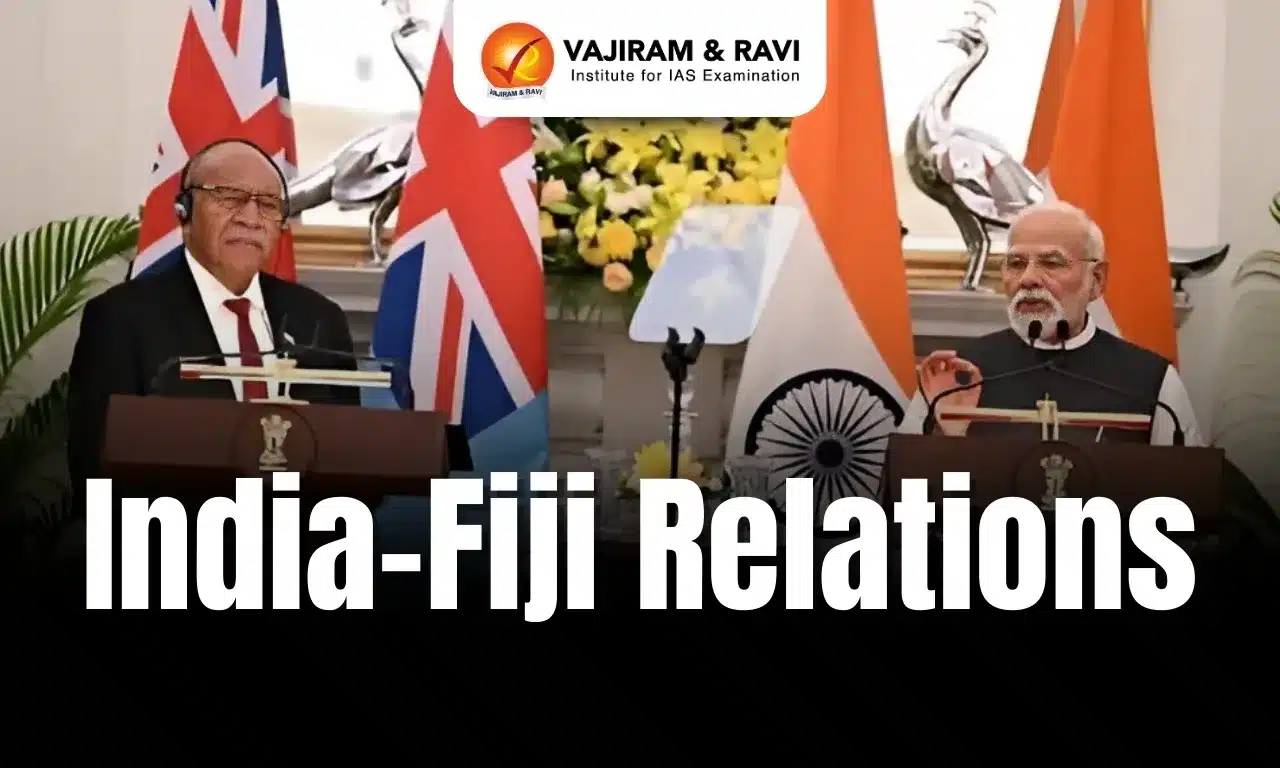
  • Prime Minister of Fiji, Sitiveni Rabuka, paid an official visit to India from 24–26 August 2025. This was his first visit in his current capacity.

India–Fiji Bilateral Relations

  • Ties began in 1879 when ~60,553 Indians were brought under the indenture system to work in Fiji’s sugar plantations (till 1916).
  • India established a Commissioner’s office in 1948, upgraded to High Commission after Fiji’s independence in 1970.

FIPIC (Forum for India-Pacific Islands Cooperation)

  • 2014 (FIPIC-I, Suva): Historic first summit hosted by PM Modi; participation of 14 Pacific Island Countries.
  • 2023 (FIPIC-III, Papua New Guinea): 12-step action plan; PM Modi awarded Fiji’s highest honour – Companion of the Order of Fiji.

Development Partnership & Assistance

  • Capacity Building: Annual ITEC slots increased from 55 to 110; Sagar Amrut Scholarships (1000 across Pacific, 100 annually for Fiji). Centre of Excellence in IT established at Fiji National University (2021).
  • Humanitarian Aid: Support after Cyclone Yasa (2020): relief materials, renovation of schools, seeds, $1mn to relief fund. Regular supply of medical kits, vehicles, and election materials.
  • Community Projects: Jaipur Foot Camps (600 beneficiaries), Youth Farm Initiative support, parametric insurance schemes.
  • Solarisation Project: India co-funded solarisation of Fijian State House & traditional sites (2023).

Economic and Commercial Ties

  • Trade statistics apparently do not project realistically the trade happening through third countries/places such as Australia, New Zealand, Hong Kong, etc. 
  • Bilateral trade heavily in India’s favour – In 2023-24; Indian exports $76.28mn; Fijian exports to India only $1.19mn.

Cultural and People-to-People Links

  • Indian Diaspora: About 2300 Indians living in Fiji; Indo-Fijians form ~1/3rd of Fiji’s population (2017 Census).
  • Girmitiyas’ legacy honoured through Girmit Day commemorations, postage stamps, and events in both countries.
  • World Hindi Conference (2023, Nadi): 1000 participants from 31 countries; stamp releases and publications.
  • Pravasi Bharatiya Samman Awards: Recognising Indo-Fijians like PM Mahendra Chaudhry, golfer Vijay Singh, NGOs.
  • Know India Programme (KIP): Popular among Indo-Fijian youth.

New Areas of Cooperation

  • Global Biofuels Alliance: Fiji joined in November 2024.
  • Digital Transformation: MoU signed in 2024 on sharing population-scale digital solutions.
  • Pharmacopoeial Cooperation (2025): Recognition of Indian Pharmacopoeia, paving way for Jan Aushadhi Kendras in Fiji.

Outcomes of Fiji PM Sitiveni Rabuka’s Visit to India

  • PM Modi welcomed Fiji’s Prime Minister Sitiveni Rabuka on his first official visit to India.
  • The leaders celebrated the deep-rooted people-to-people ties, acknowledging the role of over 60,000 Girmitiyas in shaping Fiji’s society and economy.

Defence & Security

  • MoU on Defence Cooperation (2017) strengthened → focus on UN peacekeeping, military medicine, maritime security.
  • Defence Wing in Suva to be set up.
  • Cyber Security Training Cell (CSTC) in Fiji.
  • Indian Naval Ship port call planned; ambulances gifted to Fijian Military Forces.

Healthcare & Development

  • MoU for 100-bed Super Specialty Hospital in Suva (largest Indian grant project in Pacific).
  • Expansion of Jan Aushadhi Kendras in Fiji.
  • e-Sanjeevani telemedicine to link India–Fiji.
  • Heal in India: advanced treatment for 10 Fijians annually.
  • 2nd Jaipur Foot Camp to be held in Fiji.
  • Quick Impact Projects: Tubalevu Village Ground Water Project for clean drinking water.

Trade, Economy & Agriculture

  • MoUs signed: NABARD–Fiji Development Bank, CII–FCEF, BIS–DNTMS, NIELIT–Pacific Polytechnic.
  • Indian ghee gets Fijian market access.
  • Support for sugar sector: 12 agri drones, 2 soil-testing labs, ITEC expert deputation, training programmes.
  • Supply of 5 MT cowpea seeds for food security.

Climate & Energy

  • Shared commitment to Mission LiFE & Fiji’s Blue Pacific 2050 Strategy.
  • Collaboration under ISA, CDRI, GBA.
  • STAR-Centre to be set up at Fiji National University.
  • Focus on scaling biofuels, solar, resilience projects.

Culture, Education & People-to-People Ties

  • Declaration on Migration & Mobility to ease movement of students/professionals.
  • Hindi–Sanskrit teacher deputed to University of Fiji.
  • Training for Fijian Pundits in India; joint celebration of International Geeta Mahotsav 2025.
  • Exchange visits: Parliamentary delegation & Great Council of Chiefs (2026).
  • Land handover for Indian Chancery in Suva; reciprocal plot for Fiji in New Delhi.

Regional & Global Cooperation

  • Fiji joins Indo-Pacific Oceans Initiative (IPOI) → supporting regional maritime security.
    • IPOI was launched by India in November 2019 at the ASEAN-led East Asia Summit (EAS) in Bangkok.
  • Fiji supports India’s UNSC permanent membership & candidature (2028–29).
  • Shared voice for Global South → active role in Voice of Global South Summits and DAKSHIN Centre of Excellence.

Diplomatic Statement

  • India-Fiji Joint Statement on partnership in the spirit of Veilomani Dosti.

Source: TH | MEA | HCoIF

India–Fiji Relations FAQs

Q1: What was the purpose of Fiji PM Sitiveni Rabuka’s 2025 India visit?

Ans: To strengthen India–Fiji ties through cooperation in defence, healthcare, agriculture, trade, climate action, and cultural exchanges.

Q2: What healthcare initiatives were announced during the visit?

Ans: India pledged a 100-bed Super Specialty Hospital in Suva, telemedicine collaboration via e-Sanjeevani, Jan Aushadhi Kendras, and ‘Heal in India’ programme for Fijian patients.

Q3: What defence agreements were made?

Ans: MoUs on defence cooperation, establishment of a Defence Wing in Suva, creation of a Cyber Security Training Cell, and port calls by Indian Naval ships.

Q4: How will agriculture benefit from this visit?

Ans: India announced gifting drones, soil-testing labs, cowpea seeds, and training experts to support Fiji’s sugar industry and food security initiatives.

Q5: How do India and Fiji collaborate globally?

Ans: Both nations cooperate on climate action, support UN reforms, strengthen Global South initiatives, and uphold peace in the Indo-Pacific under IPOI and FIPIC.

Understanding India’s Internal Diasporas: Cultural, Linguistic, and Migration Patterns

India’s Internal Diasporas

India’s Internal Diasporas Latest News

  • Since the High-Level Committee on the Indian Diaspora report (2001-02), the term ‘diaspora’ has gained traction in policy debates. 
  • India’s international diaspora, now estimated at over 30 million, has been widely studied on its various aspects. However, the concept of diaspora need not be confined to crossing national borders. 
  • In India, terms like pravasi and videshi often apply to long-distance internal migrants as well. For example, Odia workers in Surat describe their relocation as going “abroad.” 
  • A diasporic experience arises from crossing significant cultural zones, whether within or outside national boundaries. Yet, compared to the extensive literature on international migration, research on internal diasporas remains limited.

Internal Diasporas in India

  • Internal diasporas differ from simple migration as they reflect both historical and recent population movements that have established enduring cultural and linguistic communities. 
  • For example, while Census data in Madurai, Tamil Nadu, records few Gujarati ‘migrants’, the language Census identifies over 60,000 Gujarati speakers—a number larger than India’s diaspora in many countries. 
  • Like the Indian diaspora in Mauritius, which originated from 19th-century migration, such communities emerge from layers of past and present movements.
  • A recent study in Sociological Bulletin estimated internal and international diasporas through language data. 
  • Strikingly, while India’s international diaspora is about 30 million, the internal diaspora—measured by dispersed language groups across states—totals over 100 million, highlighting a far more significant domestic diasporic experience.

Patterns of India’s Internal Diasporas

  • Among Indian language groups, Punjabi, Malayalam, and Tamil are the most dispersed (over 10% relative to their size), followed by Telugu and Gujarati
  • Hindi speakers (including Bhojpuri and Marwari) form the largest diaspora overall but are less dispersed proportionally, while Marathi, Kannada, and Bengali are the least dispersed. 
  • Internal diasporas also show a distinction between ‘old’ communities, such as Gujarati traders and weavers in Tamil Nadu for centuries, and ‘new’ communities linked to more recent business migrations in Karnataka and Maharashtra. 
  • Significant clusters include the Telugu diaspora in West Bengal and Maharashtra, complementing the well-known Telugu presence in the US. 
  • Notably, except for Malayalam and Tamil, all major Indian languages have larger internal than international diasporas, with nearly one-third of the internal diaspora concentrated in India’s ten largest cities.
  • This highlights the enduring and evolving role of internal migration in shaping India’s cultural and linguistic landscapes.

Cultivation of Diasporic Identities

  • Diasporic identities are often sustained through community associations, such as Bengali groups organising Durga Puja, Marathi Mandals promoting Ganapati festivals, and Gujarati Samaj bodies in India and abroad. 
    • The Gujarat State Non-Resident Gujaratis Foundation once recorded 176 Gujarati associations within India and 120 overseas, underscoring their scale. 
  • A key marker of diasporic identity is the preservation of language, though this tends to weaken over generations. 
  • While some communities balance their native and local languages, in highly cosmopolitan settings, learning local languages is sometimes deemed unnecessary, reflecting varied patterns of cultural adaptation.

Rethinking Diaspora: Beyond Borders

  • The challenges of integration and intergenerational conflicts between first- and second-generation migrants, evident in cases of international migration, are equally visible within India’s internal diasporas. 
  • Yet, despite being nearly three times larger than international diasporas, they remain understudied. 
  • Viewing diasporas through the lens of linguistic dispersion highlights their interlinkages — for instance, Antwerp’s diamond trade with Surat or West Asia’s oil sector links with Kerala were enabled by Gujarati and Malayalam diasporas in Mumbai. 
  • Internal migration often precedes international migration, and sometimes the reverse
  • Limiting diaspora to national borders is misleading; India’s true diasporic experience is closer to 100 million people, shaping the spread of customs, cuisines, and cultures both abroad and within India. 
  • Recognising the subnational as part of the transnational is essential to fully understand what it means to be videshi — outside one’s homeland, whether abroad or within the country itself.

Source: IE

India’s Internal Diasporas FAQs

Q1: What defines internal diasporas in India?

Ans: Internal diasporas are enduring communities formed by historical and recent migrations across cultural zones, marked by distinct language, traditions, and identities within India.

Q2: How large is India’s internal diaspora compared to international?

Ans: India’s internal diaspora exceeds 100 million, far larger than its 30 million international diaspora, highlighting significant domestic cultural and linguistic dispersal.

Q3: Which Indian language groups are most dispersed?

Ans: Punjabi, Malayalam, Tamil, Telugu, and Gujarati are highly dispersed, while Hindi is the largest group by size but proportionally less dispersed.

Q4: How do diasporic identities sustain across India?

Ans: Through community associations, religious events, and cultural bodies like Bengali Durga Puja committees or Gujarati Samajs that preserve traditions and languages.

Q5: Why rethink diaspora beyond borders?

Ans: Internal diasporas shape culture, trade, and migration patterns, showing that diasporic experiences exist within India as much as across national borders.

Explained | Key Features of Online Gaming Act 2025

Online Gaming Act

Online Gaming Act Latest News

  • The Online Gaming Act 2025 has been passed by Parliament, banning Real Money Games while promoting e-sports and social gaming under a regulated framework.

Introduction

  • The Indian Parliament has passed the Online Gaming Act 2025, marking a decisive step in regulating the rapidly growing digital gaming industry. 
  • The Act aims to strike a balance between promoting innovation in e-sports and social gaming while addressing the social and economic harms caused by Real Money Games (RMGs). 
  • With government data estimating annual losses of Rs. 15,000 crore by Indians on such games, the legislation comes amid rising concerns of addiction, suicides, fraud, and tax evasion linked to online money gaming.

Key Provisions of the Online Gaming Act 2025

  • The Act classifies online games into three categories: e-sports, social gaming, and RMGs.
    • E-sports: Games officially recognised under the National Sports Governance Act, 2025. These include competitive video games with performance-based prize pools, such as Call of Duty and Grand Theft Auto.
    • Social Gaming: Games played primarily for recreation or educational purposes, often without monetary stakes. The Act encourages their development through budgetary support.
    • Real Money Games (RMGs): Defined as online games played with stakes involving money, credits, or convertible tokens, including Poker, Rummy, Fantasy Cricket, and Ludo variants. These have been banned outright.
  • The ban extends to advertisements, celebrity endorsements, and platforms offering RMGs. Notably, several high-profile celebrities had previously endorsed such platforms, raising concerns about their influence on youth.

Penalties and Enforcement Mechanisms

  • The Act prescribes stringent penalties to curb illegal activities:
    • Offering or facilitating RMGs: Up to three years of imprisonment or a fine of Rs. 1 crore, or both.
    • Unlawful advertisements: Two years of imprisonment or a fine of Rs. 50 lakh, or both.
    • The offences are classified as cognisable and non-bailable under the Bharatiya Nagarik Suraksha Sanhita (BNSS), 2023.
  • For enforcement, the government has empowered CERT-IN (Indian Computer Emergency Response Team) to block or disable non-compliant apps. 
  • It may also collaborate with Interpol to target offshore operators bypassing Indian laws. Importantly, the Act does not criminalise players but targets operators and promoters.

Rationale Behind the Legislation

  • The government clarified that the move is not a knee-jerk reaction but a response to alarming trends:
    • Addiction and suicides: WHO has linked RMGs to compulsive behaviour, and Karnataka alone reported 32 gaming-related suicides in 31 months.
    • Financial fraud: A Defence Ministry report revealed Chinese app FIEWIN defrauded Indians of Rs. 400 crore.
    • Tax evasion: Reports show gaming firms evaded over Rs. 30,000 crore in GST liabilities and Rs. 2,000 crore in income tax.
    • Money laundering and terrorism funding: A 2023 Parliamentary Panel flagged gaming portals as potential conduits for terror financing.
  • By targeting opaque algorithms and offshore operators, the Act seeks to safeguard users and restore transparency in the sector.

Legal and Constitutional Challenges

  • Skill vs. chance debate - The law does not differentiate between games of skill (like Fantasy Sports or Rummy) and games of chance, which critics argue violates Article 19(1)(g), guaranteeing the right to trade and occupation.
  • Jurisdictional overlap - Betting and gambling fall under State jurisdiction (Entries 34 and 62 of the State List). States like Telangana, Andhra Pradesh, and Tamil Nadu have already banned online gambling, creating legal ambiguities.
  • Supreme Court intervention - Earlier rulings held Rummy and Fantasy Sports as games of skill. The SC has also stayed retrospective GST notices to gaming firms. Future judgments will determine how far the Act aligns with constitutional guarantees.

Promoting E-sports and Social Gaming

  • Unlike its restrictive stance on RMGs, the Act actively promotes safe online gaming ecosystems:
    • Government funding from the Consolidated Fund of India will support e-sports and social gaming.
    • Provisions encourage educational and recreational games, fostering innovation and digital inclusion.
    • No restrictions have been placed on minors accessing social games or e-sports, though critics argue that stronger safeguards are needed.
  • This dual approach reflects India’s ambition to become a hub for competitive gaming while protecting citizens from exploitative practices.

Source: TH

Online Gaming Act FAQs

Q1: What does the Online Gaming Act 2025 ban?

Ans: It bans all Real Money Games (RMGs) and their advertisements in India.

Q2: Who will regulate online gaming under the new Act?

Ans: The Central government will constitute a regulatory authority with CERT-IN enforcing compliance.

Q3: What penalties does the Act prescribe for illegal RMGs?

Ans: Operators face up to three years’ imprisonment or a fine of ₹1 crore, while unlawful ads can lead to two years’ jail or a ₹50 lakh fine.

Q4: How does the Act treat e-sports and social gaming?

Ans: It promotes e-sports as recognised competitive games and encourages social gaming for recreation and education.

Q5: Why has the Act faced criticism?

Ans: Critics argue it erases the distinction between games of skill and chance, raising constitutional concerns and industry challenges.

INS Udaygiri and INS Himgiri

INS Udaygiri and INS Himgiri

INS Udaygiri and INS Himgiri

Indian Navy is set to commission the latest state of the art Project 17A multi-mission stealth frigates Udaygiri and Himgiri at Naval Base, Visakhapatnam, on 26 Aug 2025. 

About INS Udaygiri and INS Himgiri

  • Udaygiri and Himgiri are built under the Project 17 (Shivalik) class frigates.
  • Udaygiri, built by Mazagon Dock Shipbuilders Ltd. (MDL), Mumbai, and Himgiri, constructed by Garden Reach Shipbuilders & Engineers (GRSE), Kolkata, showcase the nation’s growing shipbuilding prowess, as well as, the synergy between India’s premier defence shipyards. 
  • Both frigates were designed in-house by the Indian Navy’s Warship Design Bureau (WDB).
  • Upon commissioning, the two frigates will join the Eastern Fleet, strengthening India’s ability to safeguard its maritime interests across the Indian Ocean Region.

Features of INS Udaygiri and INS Himgiri

  • The ships feature modern Combined Diesel or Gas (CODOG) propulsion plants, state of the art Integrated Platform Management System and a suite of advanced weapons and sensors developed by Indian manufacturers.
  • The ships, with about 75% indigenous content, supported by hundreds of indigenous MSMEs, align with the Government’s vision of Aatmanirbhar Bharat in defence manufacturing.
  • Udaygiri also holds the distinction of being the fastest ship of her class to be delivered post-launch, a result of the modular construction methodology adopted by Indian shipyards.
  • Both these vessels incorporate significant improvements in design, stealth, weapon and sensors systems and are capable of executing full spectrum of maritime missions in Blue Water conditions.
  • Significance: The commissioning of these two will augment the Navy’s combat readiness and reaffirm India’s resolve to achieve self-reliance in warship design and construction.

Source: PIB

INS Udaygiri and INS Himgiri FAQs

Q1: Under which project is the naval ship Himgiri constructed and launched?

Ans: PROJECT 17A

Q2: Which was the first ship of Project 17A?

Ans: INS Nilgiri

Enquire Now