
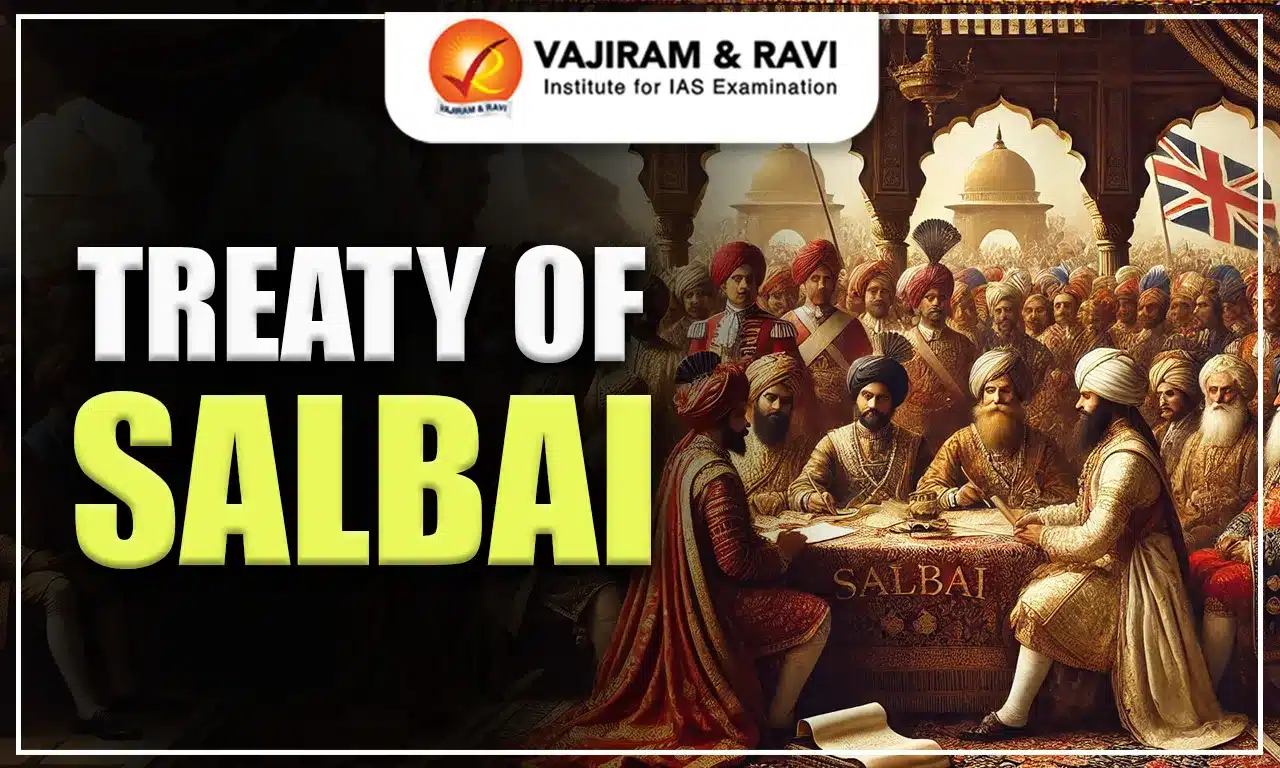
The Treaty of Salbai brought the First Anglo-Maratha War to an end on 17th May 1782. The war was going on between the Marathas and the British East India Company. Salbai is located in Gwalior district of Madhya Pradesh. In this article, we are going to cover the treaty of Salbai, the sequence of events and the importance of the treaty.
Treaty of Salbai
The Treaty of Salbai, which helped in bringing the First Anglo-Maratha War to an end, was concluded on 17 May 1782 between the Marathas and the British East India Company. Salbai lies in the Gwalior district of Madhya Pradesh. The treaty was signed between Warren Hastings and Mahadji Scindia.
Treaty of Salbai Sequence of Events
The First Anglo-Maratha War commenced in 1775 after the Treaty of Surat was signed between Raghunathrao, uncle of Peshwa Narayanrao, and the East India Company in Bombay. Raghunathrao harbored aspirations of becoming Peshwa and sought British support.
However, the Calcutta Council of the Company endorsed Narayanrao and his astute minister Nana Phadnavis. They concluded the Treaty of Purandar (1776), which annulled the Surat agreement. This new pact granted Salsette to the British while providing Raghunathrao with a pension.
Despite this, relations worsened when the Bombay Council sheltered Raghunathrao, and Nana Phadnavis allowed the French to use a port. Tensions escalated and culminated in the Battle of Wadgaon, where Mahadaji Shinde led the Marathas to victory over the British, compelling them to accept the Treaty of Wadgaon.
Further confrontations continued, and eventually, negotiations paved the way for the Treaty of Salbai, which formally ended hostilities. Under the agreement, Salsette and Broach (Bharuch) remained with the Company. The Marathas pledged to defeat Mysore’s Hyder Ali, reclaim their lost Carnatic territories, and prevent any French settlements in their domains.
The British, on their side, recognized Madhavrao II, Narayanrao’s son, as the legitimate Peshwa and granted a pension to Raghunathrao. They also accepted Mahadaji Shinde’s control of territories west of the Yamuna and returned to the Marathas all lands acquired after the Purandar Treaty.
Though the treaty ensured two decades of relative calm, the truce eventually collapsed, and the Second Anglo-Maratha War broke out in 1802.
Significance of the Treaty of Salbai
The Treaty of Salbai had the following significance:
- Ended the First Anglo-Maratha War : It brought peace after seven years of conflict between the Marathas and the British East India Company.
- Restored Balance of Power: The treaty maintained a political balance, with neither side gaining a decisive upper hand.
- Recognition of Madhavrao II: The British formally accepted Madhavrao II as the rightful Peshwa, strengthening Maratha legitimacy.
- Maratha Unity Consolidated: Mahadaji Shinde’s leadership was acknowledged, and Maratha power was reaffirmed in northern India.
- British Strategic Gains: The Company retained Salsette and Broach (Bharuch), expanding its foothold on the western coast.
- Check on French Influence: The Marathas agreed not to allow the French into their territories, which aligned with British strategic interests.
- Temporary Peace: It secured nearly 20 years of relative peace (1782–1802), delaying further Anglo-Maratha conflict until the Second Anglo-Maratha War.
- Impact on Mysore Relations: The Marathas were obliged to assist the British against Hyder Ali of Mysore, tilting the balance in southern India.
Treaty of Salbai FAQs
Q1: What were the points of the Treaty of Salbai?
Ans: The treaty ended the First Anglo-Maratha War, recognized Madhavrao II as Peshwa, confirmed British control over Salsette and Broach, restricted French influence, and secured peace for 20 years.
Q2: Which Peshwa signed the Treaty of Salbai?
Ans: Peshwa Madhavrao II was recognized under the Treaty of Salbai.
Q3: What was the Treaty of Salbai in 1802?
Ans: There was no Treaty of Salbai in 1802; the reference is to the Treaty of Bassein (1802).
Q4: Who was the Governor-General of India during the Treaty of Salbai?
Ans: Warren Hastings was the Governor-General of India when the Treaty of Salbai was signed in 1782.
Q5: Which Treaty was signed in 1802?
Ans: The Treaty of Bassein (1802) was signed between the British East India Company and Peshwa Baji Rao II.
