
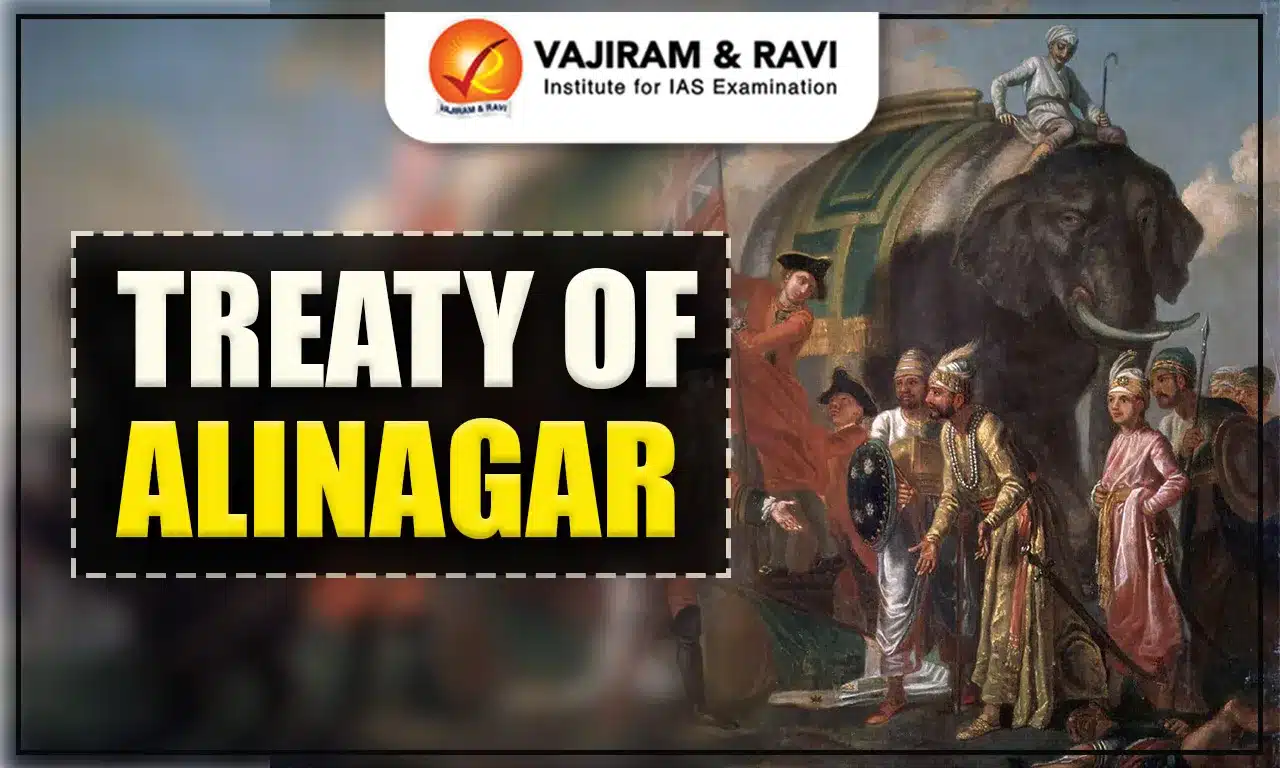
The Treaty of Alinagar (1757), signed between Robert Clive of the British East India Company and Nawab Siraj-ud-Daulah of Bengal, marked a turning point in colonial history. The Nawab agreed to recognize the provisions of Mughal Emperor Farrukhsiyar’s farman of 1717. All British goods passing through Bengal were exempted from duties. The Company was allowed to fortify Calcutta and mint its own coins there. This agreement restored British privileges in Bengal and directly covered the way for the Battle of Plassey (1757), where Siraj-ud-Daulah was defeated and killed by Clive and his allies.
The Treaty of Alinagar strengthened the East India Company’s position in Bengal and served as the immediate beginning to the Battle of Plassey. It marked the transition of the Company from a trading enterprise to a rising imperial power in India.
Treaty of Alinagar
Despite his easy capture of Calcutta in 1756, Siraj-ud-Daulah’s position was far weaker than it seemed. He faced the looming threat of Afghan invasions under Ahmad Shah Abdali, who had already destabilized northern India. At the same time, the East India Company regrouped under Robert Clive, whose surprise attack in early 1757 forced the Nawab’s troops into retreat.
Under pressure from his ministers and wary of Abdali’s threat, Siraj reluctantly signed the Treaty of Alinagar on February 9, 1757. The treaty restored all the privileges of Farrukhsiyar’s 1717 farman, allowing the Company duty-free trade, fortification of Calcutta, and the right to mint coins.
The treaty, though preserving the Nawab’s nominal sovereignty, greatly strengthened the Company’s position in Bengal. It exposed the Nawab’s vulnerability and showcased the Company’s growing influence.
Treaty of Alinagar Significance
The Treaty of Alinagar marked the transition of the East India Company from a trading body to an emerging political force in Bengal. Though often overshadowed by the Battle of Plassey (June 23, 1757), it was this treaty that laid the groundwork for the Company’s eventual rise as the dominant colonial power in India.
Treaty of Alinagar History
The East India Company’s journey in India began in 1613, when it received a royal farman from Mughal Emperor Jahangir allowing trade. Over time, it established trading posts across the subcontinent.
The decline of the Mughal Empire after Aurangzeb’s death in 1707 created political instability and opportunities for the Company to expand its influence. A major turning point came in 1717, when Mughal Emperor Farrukhsiyar issued a farman granting the Company significant trade privileges. Though often called the Magna Carta of the Company, its misuse by officials led to corruption and strained relations with Bengal’s rulers.
Nawab Murshid Quli Khan resisted the Company’s attempts to extend duty-free privileges to its private trade, purchase villages, or mint coins, leading to recurring tensions. This highlighted the need for the Company to secure territorial control to safeguard its commercial interests.
The conflict peaked under Siraj-ud-Daulah, who opposed the Company’s unauthorized fortifications at Calcutta. In 1756, after the Company sheltered Krishna Ballabh inside Fort William against his orders, Siraj attacked, seizing Cossimbazar factory and then Calcutta on June 20, 1756. The city was renamed Alinagar, setting the stage for direct confrontation that culminated in the Treaty of Alinagar and later the Battle of Plassey (1757).
Treaty of Alinagar FAQs
Q1: What is the significance of the Treaty of Alinagar?
Ans: The Treaty of Alinagar (1757) reaffirmed Mughal privileges, restored British trading rights in Bengal, and set the stage for the decisive Battle of Plassey.
Q2: Which Treaty is related to the Battle of Plassey?
Ans: The Treaty of Alinagar is directly related to the Battle of Plassey, as it increased British influence in Bengal before Clive’s victory over Siraj-ud-Daulah.
Q3: Who renamed Calcutta as Alinagar?
Ans: Siraj-ud-Daulah, the Nawab of Bengal, renamed Calcutta as Alinagar in 1756 after capturing the British settlement, before later clashing with them at Plassey.
Q4: What was the first Treaty of Allahabad?
Ans: The first Treaty of Allahabad (1765) granted Diwani rights of Bengal, Bihar, and Orissa to the East India Company after the Battle of Buxar.
Q5: Who signed the Treaty of Alinagar with the Britishers?
Ans: Siraj-ud-Daulah, the Nawab of Bengal, signed the Treaty of Alinagar with the British East India Company in 1757 after seizing Calcutta.

