UPSC Daily Quiz 22 September 2025

UPSC Daily Quiz

The Daily UPSC Quiz by Vajiram & Ravi is a thoughtfully curated initiative designed to support UPSC aspirants in strengthening their current affairs knowledge and core conceptual understanding. Aligned with the UPSC Syllabus 2025, this daily quiz serves as a revision resource, helping candidates assess their preparation, revise key topics, and stay updated with relevant issues. Whether you are preparing for Prelims or sharpening your revision for Mains, consistent practice with these Daily UPSC Quiz can significantly enhance accuracy, speed, and confidence in solving exam-level questions.

[WpProQuiz 76]  

UPSC Daily Quiz FAQs

Q1: What is the Daily UPSC Quiz?

Ans: The Daily UPSC Quiz is a set of practice questions based on current affairs, static subjects, and PYQs that help aspirants enhance retention and test conceptual clarity regularly.

Q2: How is the Daily Quiz useful for UPSC preparation?

Ans: Daily quizzes support learning, help in revision, improve time management, and boost accuracy for both UPSC Prelims and Mains through consistent practice.

Q3: Are the quiz questions based on the UPSC syllabus?

Ans: Yes, all questions are aligned with the UPSC Syllabus 2025, covering key areas like Polity, Economy, Environment, History, Geography, and Current Affairs.

Q4: Are solutions and explanations provided with the quiz?

Ans: Yes, each quiz includes detailed explanations and source references to enhance conceptual understanding and enable self-assessment.

Q5: Is the Daily UPSC Quiz suitable for both Prelims and Mains?

Ans: Primarily focused on Prelims (MCQ format), but it also indirectly helps in Mains by strengthening subject knowledge and factual clarity.

Macroeconomics and Microeconomics, Difference, Scope, Limitations

Macroeconomics and Microeconomics

Economics is the study of how individuals, businesses, governments, and societies manage limited resources to meet their needs and wants. It examines decision-making, market functioning, and the processes that drive economic growth and development. The discipline is broadly divided into Macroeconomics and Microeconomics.

Microeconomics focuses on the behavior of individual economic agents and market dynamics, while Macroeconomics looks at the economy as a whole, studying large-scale patterns such as inflation, unemployment, and national income. Together, they provide a complete understanding of economic functioning and serve as a foundation for effective policy-making.

Difference Between Macroeconomics and Microeconomics

To fully grasp how an economy functions, it’s essential to study both Macroeconomics and Microeconomics. Each focuses on different aspects of economic activity, yet together they provide a complete picture. Below is a comparative analysis of the Difference Between Macroeconomics and Microeconomics.

Difference Between Macroeconomics and Microeconomics

Macroeconomics

Microeconomics

Deals with the economy as a whole

Deals with individual units within the economy

Focuses on aggregate economic variables like GDP, inflation, unemployment, and interest rates

Focuses on specific economic units such as households, firms, and industries

Analyzes the behaviour of large-scale economic systems

Analyzes the behaviour of small-scale economic systems

Examines the economy at a national and international level

Examines the economy at a local and regional level

Concerned with government policies that impact the economy

Concerned with how individual economic agents make decisions and how markets operate

Studies the interactions between different sectors of the economy, such as the financial sector, the labour market, and the international trade sector

Studies how prices, supply and demand, and market structures impact the decisions of individual economic agents

Examples include inflation, economic growth, fiscal and monetary policy, and international trade

Examples include consumer behaviour, production costs, market competition, and labour economics

Macroeconomics Scope

Macroeconomics deals with the functioning of the economy as a whole rather than individual markets. Its scope is wide and covers the following key areas:

  • National Income and Output: It studies how national income is measured and analyzed through indicators like Gross Domestic Product (GDP), Gross National Product (GNP), and Net National Product (NNP). These aggregates help evaluate the overall economic performance of a country.
  • Unemployment: Macroeconomics explores the causes, types, and effects of unemployment. It also focuses on policies and strategies that can reduce joblessness and ensure full employment.
  • Inflation: The subject examines the reasons behind rising prices, their impact on purchasing power, and policy tools such as monetary measures to control inflation and maintain price stability.
  • Economic Growth: It studies the long-term growth of an economy, driven by factors like capital formation, technological advancement, human capital development, and productivity improvements.
  • Monetary Policy: Macroeconomics looks at the role of central banks in regulating money supply and credit through interest rates, reserve ratios, and other instruments to achieve goals like price stability and employment generation.
  • Fiscal Policy: It analyzes the impact of government spending and taxation on economic activity, budgetary balance, and growth. Fiscal policy is a key tool to tackle unemployment and demand fluctuations.
  • International Trade and Finance: Macroeconomics examines how economies interact globally through trade, foreign exchange rates, balance of payments, and capital flows, which influence growth and stability.
  • Economic Development: It studies the structural transformation of developing economies, focusing on reducing poverty, improving living standards, and policies for sustainable development.

Macroeconomics Limitations

While Macroeconomics provides valuable insights into the functioning of an economy as a whole, it also has certain limitations that policymakers and analysts must keep in mind:

  • Aggregate Analysis May Overlook Individual Behaviour: Macroeconomics studies the economy in terms of aggregates such as national income, output, or consumption. This may fail to capture the diverse behaviour of individual households and firms, which can lead to oversimplified conclusions.
  • Data Limitations: Reliable and accurate data is the backbone of macroeconomic analysis. However, data may be incomplete, outdated, or subject to errors. Inaccurate data often leads to faulty analysis and ineffective policies.
  • Simplified Assumptions: Many macroeconomic models assume conditions like perfect competition, rational behaviour, or full information. These assumptions rarely hold in real-world scenarios, which limits the applicability of theoretical models.
  • Difficulty in Predicting the Future: Economic systems are highly complex and influenced by multiple internal and external factors. This makes forecasting economic events like recessions, inflation trends, or growth rates extremely uncertain.
  • Political Influence: Policy decisions in macroeconomics are not always based on purely economic reasoning. Political pressures, vested interests, or short-term electoral goals often shape fiscal and monetary policies, which may not be economically optimal.
  • Neglect of International Factors: National-level analysis sometimes underestimates the impact of global influences such as international trade, foreign investment, oil prices, or global recessions. These external shocks can drastically alter domestic economic outcomes.

Basic Macroeconomic Concepts

Macroeconomics revolves around a few fundamental concepts that help in understanding the functioning of the economy as a whole. Some of the key concepts are:

Basic Macroeconomic Concepts

Concept

Definition

Gross Domestic Product (GDP)

The total value of goods and services produced within a country’s borders over a specific period, usually a year.

Inflation

The sustained rise in the general price level of goods and services in an economy, typically measured by the inflation rate.

Unemployment

The number of people who are willing and able to work but cannot find employment despite actively seeking it.

Monetary Policy

Actions taken by a central bank to control the money supply and interest rates in order to achieve goals such as price stability, economic growth, and full employment.

Fiscal Policy

The use of government spending and taxation to influence the level of economic activity and achieve objectives like growth, stability, and employment.

Trade Balance

The difference between the value of a country’s exports and imports of goods and services. A surplus indicates more exports than imports, while a deficit shows the opposite.

National Debt

The total outstanding borrowing of a government, often expressed as a percentage of GDP, which reflects the financial health of a nation.

Gross National Product (GNP)

The total value of goods and services produced by a country’s citizens, whether located domestically or abroad, during a given period.

Balance of Payments (BoP)

A record of all economic transactions between a country and the rest of the world, including trade, investment flows, and financial transfers.

Exchange Rate

The value of one currency in terms of another, showing how much of one currency is needed to purchase a unit of another.

Interest Rate

The cost of borrowing money, expressed as a percentage of the loan amount, or the return earned on savings and investments.

Aggregate Demand (AD)

The total demand for goods and services in an economy at a given overall price level, including consumption, investment, government spending, and net exports.

Aggregate Supply (AS)

The total output of goods and services that producers in an economy are willing and able to provide at a given price level.

Economic Growth

The long-term increase in the production of goods and services in an economy, usually measured by growth in GDP or GNP.

Business Cycle

The recurring pattern of economic expansion and contraction, typically measured through fluctuations in GDP.

Phillips Curve

A graphical relationship showing the trade-off between inflation and unemployment: lower unemployment often comes with higher inflation, and vice versa.

Crowding Out

A situation where increased government spending or borrowing reduces private sector investment by competing for resources.

Trickle-Down Economics

A theory suggesting that benefits provided to businesses and the wealthy (such as tax cuts) eventually benefit the wider population through job creation and investment.

Keynesian Economics

A school of thought emphasizing the role of government intervention, especially fiscal policy, in stabilizing the economy and ensuring full employment.

Macroeconomics and Microeconomics FAQs

Q1: What is the difference between macroeconomics and microeconomics?

Ans: Macroeconomics studies the economy as a whole—growth, inflation, unemployment. Microeconomics focuses on individual units like households, firms, and market behavior.

Q2: What is an example of microeconomics and macroeconomics?

Ans: Microeconomics: Demand-supply of apples. Macroeconomics: National unemployment rate.

Q3: Who is the father of macroeconomics?

Ans: John Maynard Keynes is regarded as the father of macroeconomics for his work on employment, interest, and money.

Q4: What is the major difference between macro and micro?

Ans: Macro deals with aggregate economic issues; micro examines individual choices and markets. Scale of analysis is the key difference.

Q5: Who is the father of microeconomics?

Ans: Adam Smith, with The Wealth of Nations, is considered the father of microeconomics for analyzing markets and individual decision-making.

Temperate Cyclones, Formation, Characteristics, Movement, Impact

Temperate Cyclones

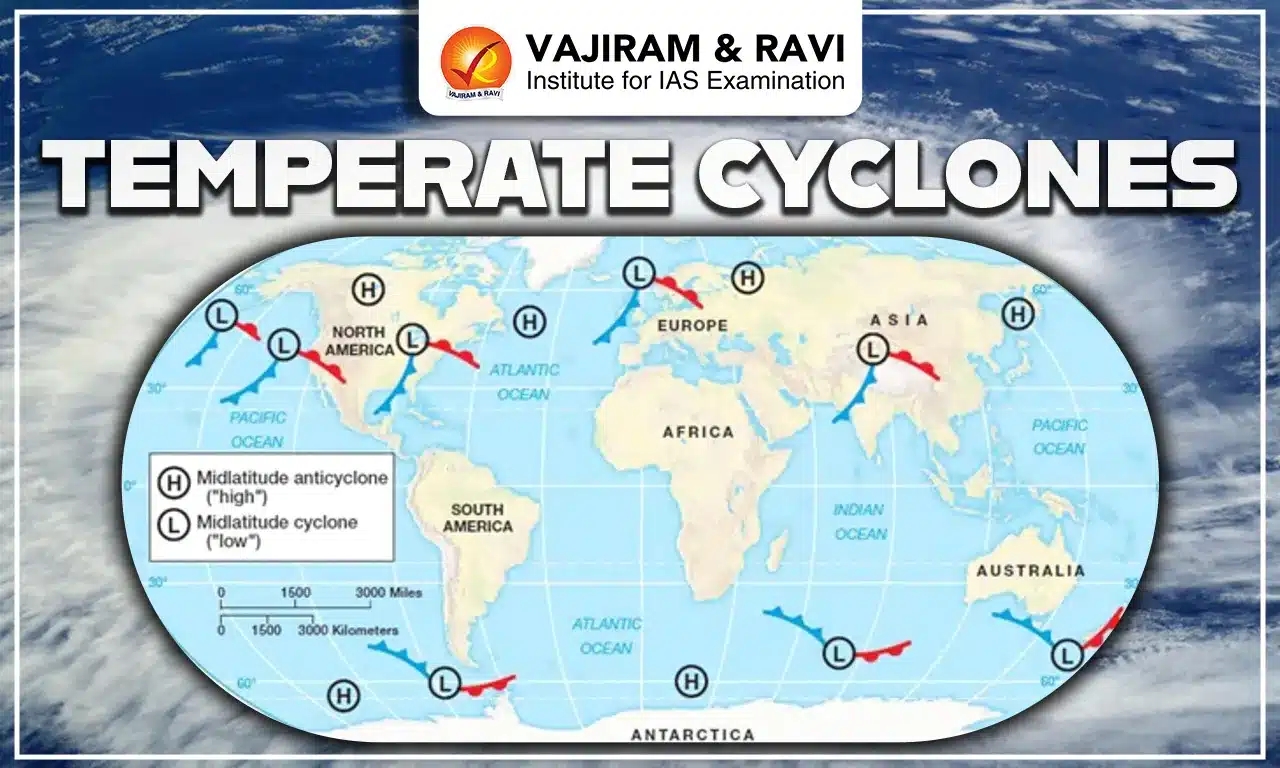
A Temperate Cyclones is a storm system that forms in the mid-latitudes, typically between 30° and 60° latitude. While similar to tropical cyclones, they differ in structure and formation. These cyclones usually develop from October to April, originating in regions such as the Gulf of Alaska, off the coast of Japan, or in the Southern Hemisphere. They create low-pressure areas and are more frequent during fall and winter, though they can occur at any time of the year.

Cyclones

Cyclones are localized low-pressure systems where air from surrounding areas converges. The Coriolis force deflects the moving air, giving the cyclone its characteristic spinning motion. In the Northern Hemisphere, cyclones rotate counter-clockwise, while in the Southern Hemisphere, they rotate clockwise. Isobars lines connecting areas of equal pressure are closely spaced and typically form circular or elliptical patterns around the cyclone.

Cyclones are generally classified into two main types:

  • Temperate Cyclones
  • Tropical Cyclones

Temperate Cyclones

Temperate Cyclones are significant atmospheric phenomena that influence weather in the mid-latitudes. They are also called extra-tropical cyclones, mid-latitude cyclones, or frontal cyclones. These systems are characterized by low pressure and are associated with cold fronts, warm fronts, and occluded fronts. Temperate cyclones play a vital role in global air circulation, helping redistribute heat and maintain the overall heat balance of Earth.

Temperate Cyclones Formation

The formation of temperate cyclones is explained by the Polar Front Theory proposed by Bjerkens and Bjerkens during World War I. The development occurs in four main stages which includes

Temperate Cyclones Formation

Stage

Description

Stage I - Frontogenesis

Two contrasting air masses converge along the sub-polar low-pressure belt. Cold air moves southward, warm air moves northward, forming a boundary with parallel but opposite winds.

Stage II - Cyclogenesis

Warm air pushes into the cold air region, and cold air advances into the warm air. A wave forms, initiating strong cyclonic circulation.

Stage III - Mature Stage

Cyclonic circulation intensifies. Warm air moves further into the cold region, cold air advances equatorward along the cold front. Cyclone reaches peak strength.

Stage IV - Occlusion Stage

Cold front overtakes the warm front, shrinking the warm air area. The two air masses mix, occluded front disappears, and the cyclone dissipates.

Temperate Cyclones Characteristics

Extra-tropical cyclones are large storm systems that develop in mid-to-high latitudes, away from the tropics. They are characterized by a low-pressure center and the presence of both warm and cold fronts, typically forming along the polar front.

The development of an extra-tropical cyclone occurs in stages:

  • Stationary Front Formation: Initially, the warm and cold air masses meet along a stationary front.
  • Cyclonic Rotation: In the Northern Hemisphere, warm air from the south and cold air from the north converge. A drop in pressure along the front initiates counter-clockwise rotation, pulling warm air northward and cold air southward.
  • Cloud and Rain Formation: Rising warm air over the cold air leads to cloud formation and precipitation. As the cold front advances, it forces the warm air higher, forming cumulus clouds.
  • Occlusion and Dissipation: The faster-moving cold front eventually overtakes the warm front, lifting the warm air entirely. This process, called occlusion, signals the weakening and eventual dissipation of the cyclone.

Extra-tropical cyclones can form over both land and ocean, often spanning vast areas, and are significant contributors to mid-latitude weather, including storms and rainfall.

Also Read: Amphan Cyclone

Temperate Cyclone Movement

Temperate Cyclones, also known as mid-latitude or extra-tropical cyclones, are generally less organized than tropical cyclones. They typically move from west to east across continents, driven by prevailing westerlies.

In terms of rotation:

  • Northern Hemisphere: Counter-clockwise around a low-pressure center.
  • Southern Hemisphere: Clockwise around a low-pressure center.

These cyclones can occur at any time of the year, but they are most frequent between September and May, corresponding to the colder months in mid-latitudes. Temperate Cyclones are major contributors to storms, rainfall, and seasonal weather variations in these regions.

Temperate Cyclone Associated Weather

Temperate Cyclones rotate counter-clockwise in the Northern Hemisphere and are capable of producing a range of severe weather phenomena, including:

  • Heavy Rain and Snow: Intense precipitation can lead to flooding and disruption of normal life.
  • Thunderstorms and Hail: Convection within the cyclone can generate strong storms and occasional hail.
  • Strong Winds: Gusty winds may damage buildings, uproot trees, and down power lines.
  • Tornadoes: In some cases, these cyclones can spawn tornadoes, adding to the destructive potential.
  • Coastal Effects: Cyclones moving near coastlines can create large waves, beach erosion, and flooding.

A notable example is Cyclone Sandy (2012), which caused extensive damage in the northeastern United States. Despite being called "temperate," these cyclones can occur in both tropical and temperate regions, affecting large areas with diverse hazards.

Differences between Temperate Cyclone & Tropical Cyclone

The table below highlights the key Differences between Temperate Cyclone & Tropical Cyclone. It compares their movement, area of impact, wind speed, formation conditions, and duration, providing a clear overview of the distinct characteristics of these two major types of cyclonic systems.

Differences between Temperate Cyclone & Tropical Cyclone

Feature

Tropical Cyclone

Temperate Cyclone

Direction of Movement

Moves westward from east to west.

Moves eastward from west to east.

Area Affected

Impacts a relatively smaller region.

Affects a substantially larger area.

Wind Speed

Winds are faster and more destructive.

Winds are slower compared to tropical cyclones.

Formation Conditions

Forms only over warm waters above 26-27°C; dissipates on land.

Can develop over both land and ocean.

Duration

Typically lasts up to 7 days.

Can persist for 15-20 days.

Also Check Other Posts
Geomorphology Major Dams in India
Composition and Structure of Atmosphere Major Ports in India
Types of Forests in India Coastal States of India
Ocean Acidification Migration in India
Deep Ocean Mission Natural Vegetation of India

Temperate Cyclones FAQs

Q1: What are the temperate cyclones?

Ans: Temperate cyclones, or extratropical cyclones, are low-pressure systems in middle latitudes, forming along fronts with strong winds, clouds, and precipitation.

Q2: What is the difference between tropical zone and temperate cyclone?

Ans: Tropical cyclones form in tropical regions over warm oceans, fueled by heat; temperate cyclones form in mid-latitudes, driven by temperature contrasts between air masses.

Q3: Why do temperate cyclones move from west to east?

Ans: They follow the westerlies wind belt in mid-latitudes, which blows from west to east, guiding cyclones across continents.

Q4: Is there any temperate cyclone in India?

Ans: Yes, India experiences temperate cyclones rarely, mainly in northern regions during winter, associated with western disturbances in the Himalayas.

Q5: What are the two main types of cyclones?

Ans: Tropical cyclones (hurricanes, typhoons) and temperate/extratropical cyclones are the two main types, distinguished by origin, energy source, and location.

Mixed Economy, Definition, Examples, Features, Merits, Demerits

Mixed Economy

A Mixed Economy is an economic system that blends the features of both capitalism (free market) and socialism (command economy). In this system, economic decision-making is shared between the government and the private sector. The government regulates key industries, provides essential public goods and services such as education, healthcare, and infrastructure, and intervenes when markets fail. 

At the same time, individuals and businesses retain the right to own property, earn profits, and freely participate in market transactions. This balance allows a Mixed Economy to combine the efficiency and innovation of markets with the social welfare and stability provided by government oversight.

Mixed Economy

A Mixed Economy is a system where free markets and government intervention work side by side in allocating resources, conducting trade, and managing businesses. It aims to combine the advantages of capitalism and socialism while reducing their drawbacks.

In this system, both private corporations and state-owned enterprises own the means of production. Market forces like pricing, demand, and supply largely guide the economy, but the government steps in to prevent monopolies, ensure fairness, and protect vulnerable sections of society.

A Mixed Economy values private property, resource ownership, and individual freedom, while also acknowledging the risks of unchecked capitalism. Through regulation and economic planning, the government seeks to promote equity, safeguard public interest, and ensure that no group, especially the poor, faces discrimination.

Mixed Economy Features

A Mixed Economy is an economic system where both the government and private sector share responsibility for production, distribution, and decision-making. It blends the efficiency of capitalism with the equity of socialism, aiming to balance growth with social welfare.

Mixed Economy Features

Feature

Explanation

Coexistence of Public and Private Sectors

Both state-owned enterprises and private businesses operate side by side.

Economic Planning with Market Mechanism

Prices are shaped by demand and supply, but the government uses planning and regulation to guide development.

Government Regulation and Control

The state intervenes to prevent monopolies, ensure fair trade, and protect weaker sections.

Social Welfare Orientation

Government policies focus on reducing inequality and promoting welfare schemes.

Right to Private Property

Citizens and firms can own resources, though restrictions may apply for public interest.

Balanced Economic Growth

Seeks to achieve efficiency, innovation, and equity through joint participation of market and state.

Consumer and Worker Protection

Labour laws, wage regulations, and consumer rights safeguard against exploitation.

Mixed Economy in India

India is one of the most prominent examples of a Mixed Economy, where both the government and private sector shape economic activities.

Historically, the government had a strong presence in the economy through public sector undertakings (PSUs) and state-owned enterprises in key industries like energy, transportation, and telecommunications. Economic planning focused heavily on reducing inequality and promoting social welfare.

Since the 1990s, India has moved towards liberalization, adopting policies that encourage deregulation, privatization, and foreign investment. This shift boosted private sector participation and opened the economy to global markets.

Today, the Mixed Economy in India reflects a balance of public and private ownership. While the private sector drives growth in industries such as IT, manufacturing, and services, the government still plays a vital role in areas like banking, insurance, infrastructure, education, and healthcare. This dual structure ensures economic growth while addressing social needs.

Mixed Economy Examples

Many countries around the world operate under mixed economies, where both governments and private enterprises influence economic activity. These systems balance market freedom with state regulation and social welfare.

Mixed Economy Examples

Country

Key Features of its Mixed Economy

Canada

Blends private and public ownership; government plays a major role in healthcare and education; strong social welfare programs.

Germany

Follows a social market economy model; private enterprise thrives alongside government regulation; robust welfare schemes like pensions and healthcare.

Japan

Highly developed economy with a focus on innovation; government intervenes in strategic sectors like transport and energy; strong welfare system.

Sweden

Known for the Nordic model; combines a competitive private sector with universal welfare, innovation, and high social security standards.

United Kingdom

Maintains a balance between capitalism and socialism; state ensures healthcare and education while encouraging private enterprise and competition.

Mixed Economy Merits

Mixed Economy are widely adopted because they strike a balance between free markets and government regulation. This balance helps address social needs while still encouraging growth and innovation. Below are some key strengths:

Mixed Economy Merits

Strength

Explanation

Flexibility

Combines private enterprise with government intervention, allowing quick adaptation to changing economic and social conditions.

Innovation

Encourages entrepreneurship and competition while supporting research, infrastructure, and public goods that drive innovation.

Stability

Uses market mechanisms alongside government policies to reduce risks from business cycles and economic crises.

Social Welfare

Ensures that citizens’ basic needs such as healthcare, education, and housing are met through welfare programs.

Balanced Growth

Promotes sustainable and equitable development by ensuring that economic benefits are shared across different sections of society.

Mixed Economy Demerits

While the Mixed Economy offers a balance between markets and state intervention, they are not free from drawbacks. The constant tug-of-war between private and public interests creates unique challenges, as shown below:

Mixed Economy Demerits

Challenge

Explanation

Balancing Private Enterprise and Government Intervention

Too much government control can limit innovation, while too little can result in inequality and market failures.

Political Pressure

Policy decisions may be driven by political agendas rather than sound economics, creating inefficiencies.

Coordination

Requires strong cooperation between government, private sector, and institutions, which can be difficult in large economies.

Bureaucracy

Heavy government involvement often leads to red tape, slowing down decision-making and efficiency.

Fiscal Sustainability

High spending on welfare and infrastructure can strain public finances if not supported by sufficient revenue.

Difference Between Capitalist, Socialist and Mixed Economy

Some of the key points of Difference Between Capitalist, Socialist and Mixed Economy are outlined below:

Difference Between Capitalist, Socialist and Mixed Economy

Aspect

Capitalist Economy

Socialist Economy

Mixed Economy

Ownership of Resources

Mostly private ownership of land, industries, and capital

Entirely state or collective ownership

Combination of private and public ownership

Role of Government

Minimal intervention, limited to regulation

Complete control over production and distribution

Active role in regulation, planning, and providing public goods

Decision-Making

Market forces (demand and supply) decide allocation of resources

Centralized planning by the state

Both market forces and government planning

Profit Motive

Strong driving force of production and innovation

Profit motive absent, focus on welfare

Profit motive coexists with social welfare goals

Consumer Choice

Wide variety of goods and services driven by competition

Limited consumer choice, as production is planned

Moderate choice; variety exists but some industries regulated

Social Welfare

Limited; focus on individual success

High priority; welfare ensured by the state

Balanced approach with both welfare schemes and private opportunities

Economic Inequality

High, as wealth depends on ownership and success

Low, as wealth is redistributed by the state

Moderate, with measures to reduce inequality

Also Check Other Posts
Care Economy Mutual Funds
Alternative Investment Funds GDP Deflator

Mixed Economy in India FAQs

Q1: What do you mean by mixed economy?

Ans: A mixed economy combines private and public sector ownership of resources, allowing market forces and government intervention to coexist for economic stability and social welfare.

Q2: Why is India called a mixed economy?

Ans: India is called a mixed economy because it integrates private enterprise with government control, balancing profit motives with welfare-oriented policies for equitable growth.

Q3: What are the three characteristics of a mixed economy?

Ans: Key characteristics: coexistence of private and public sectors, government intervention for welfare, and market-driven allocation of resources alongside state regulation.

Q4: What is the best example of a mixed economy?

Ans: India is the best example, as it blends free-market principles with government policies to regulate sectors like agriculture, education, and healthcare.

Q5: What is another name for a mixed economy?

Ans: It is also called a dual economy or cooperative economy, reflecting the balance between private enterprise and government participation in economic activities.


Biogeographic Zones in India, Location, Provinces, Key Features

Biogeographic Zones in India

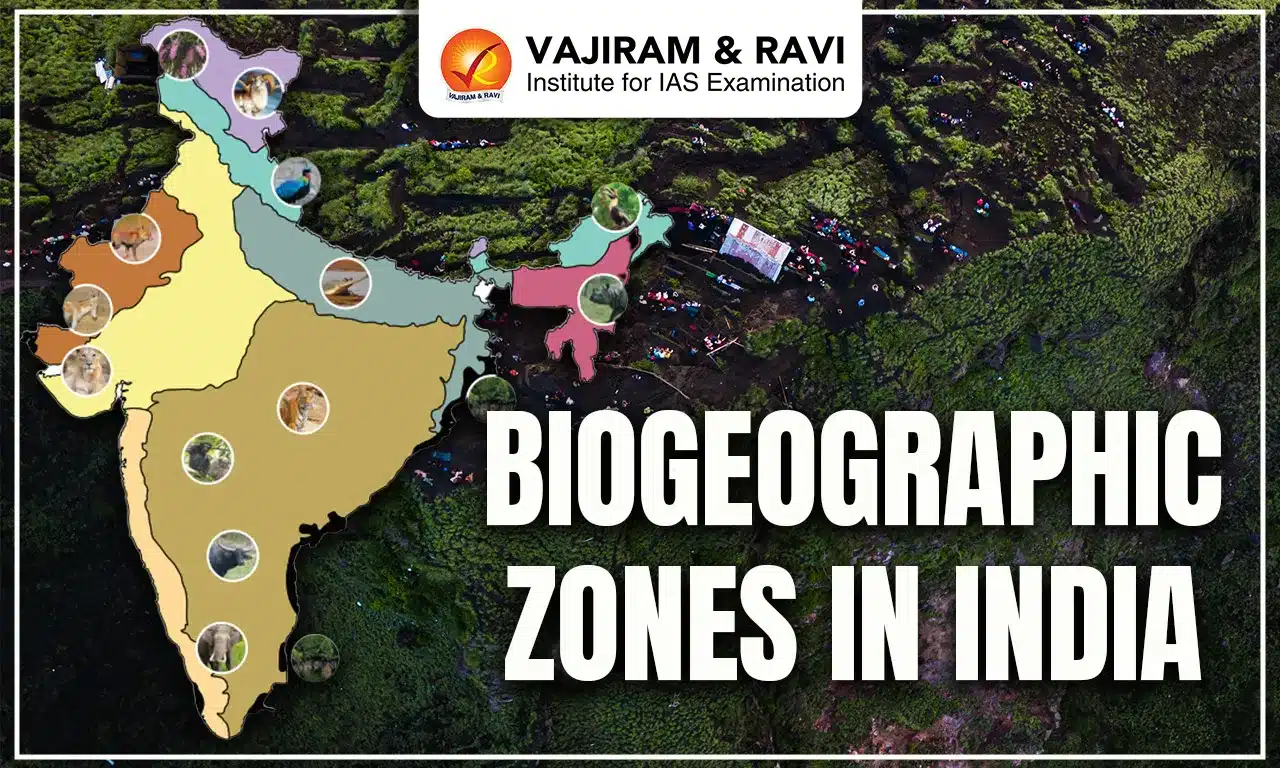
Biogeographic Zones of India provide the natural division of the country into 10 different regions classified on the basis of geography, climate, vegetation, and wildlife. India’s varied landscapes for mountains, deserts, coasts, and islands provide diverse habitats that nurture rich biodiversity. Every zone supports unique plants, animals, and ecosystems. Studying these zones helps us understand how life adapts to its surroundings and why their conservation is crucial for maintaining ecological balance.

Biogeographic Zones of India

Biogeographic Zones of India are big natural areas where ecosystems, animals, and plants share similar features. These divisions arise from factors like climate, latitude, altitude, geography, and habitat type. Simply put, a biogeographic region is an area where organisms of similar kinds live together because the environment and conditions are almost the same.

10 Biogeographic Zones of India

Biogeographic Zones of India are vast natural areas with plants, animals, and ecosystems sharing common environmental traits. Owing to India’s biodiversity, the nation is divided into 10 biogeographic zones, each defined by specific climate, terrain, vegetation, and wildlife. These zones highlight how living beings adjust to their habitats and survive across changing environments.

Zone Biogeographic Provinces Location / States Key Features Major Wildlife

1. Trans-Himalayan

Ladakh, Sikkim, Tibetan Plateau

J&K, Himachal, Ladakh

Cold, dry, high-altitude

Snow leopard, marmots, black-necked crane

2. Himalayan

West, Central, East Himalayas

J&K, Himachal, Uttarakhand, Sikkim, Arunachal

Tall mountains, diverse biodiversity

Musk deer, red panda, Himalayan tahr

3. Indian Desert

Thar Desert, Rann of Kutch

Rajasthan, Gujarat, Punjab, Haryana

Hot, dry, scanty rainfall

Indian bustard, camels, desert fox

4. Semi-Arid

Transitional dry areas

Rajasthan, Gujarat, MP

Dry climate, sparse vegetation

Nilgai, blackbuck, chinkara

5. Western Ghats

Biodiversity hotspots

Maharashtra, Goa, Karnataka, Kerala, TN

Evergreen forests, endemic species

Lion-tailed macaque, Malabar civet

6. Deccan Plateau

Peninsular highlands

Telangana, AP, Karnataka, MP, Maharashtra

Volcanic soil, mixed forests

Sloth bear, wild boar, Indian wolf

7. Gangetic Plain

Indo-Gangetic lowlands

UP, Bihar, WB, Haryana, Punjab

Fertile plains, agriculture

Elephants, rhinos, river dolphins

8. North-East India

Hills and valleys

Assam, Meghalaya, Nagaland, Manipur, Mizoram

Heavy rainfall, biodiversity

Hornbill, hoolock gibbon, orchids

9. Islands

Andaman, Nicobar, Lakshadweep

Bay of Bengal, Arabian Sea

Coral reefs, mangroves

Saltwater crocodile, dugong, turtles

10. Coasts

East & West Coastlines

Entire Indian coastline

Mangroves, estuaries, deltas

Olive ridley turtles, flamingos

Biogeographic Zones Challenges in India 

While India’s Biogeographic zones are rich in biodiversity, they face many environmental and human-induced pressures. These resources threaten natural ecosystems, wildlife and long-term ecological stability. 

  • Changing Climate: Rising temperatures and irregular rainfall impact crops, forests, and animal survival.
  • Water Scarcity: Rivers and aquifers are depleting due to overuse and low rainfall, affecting dry and desert regions.
  • Loss of Species: Poaching, deforestation, and climate shifts are pushing many species towards extinction.
  • Desertification: Overgrazing, deforestation, and poor land practices convert fertile lands into deserts.
  • Melting Glaciers: Rapid glacial melt in the Himalayas threatens water availability and downstream farming.
  • Floods & Droughts: Uneven rainfall triggers droughts in some areas and flash floods in others, especially in plains and coasts.

Biogeographic Zones Problems of India 

Understanding the problems associated with Biogeographic zones also means recognizing the serious environmental challenges impacting biodiversity. These problems include: 

  • Deforestation & Habitat Loss: Logging, farming, mining, and urbanization reduce forests and wildlife shelter.
  • Poaching & Wildlife Trade: Illegal hunting of tigers, elephants, and pangolins pushes species towards extinction.
  • Invasive Species: Foreign plants like Lantana and Parthenium disturb natural forest ecosystems.
  • Climate Change: Fragile zones like Himalayas, NE India, and coastal belts are highly climate-sensitive.
  • Pollution: Industrial waste, pesticides, and sewage contaminate air, soil, and rivers.
  • Human-Wildlife Conflict: Shrinking forests force animals into villages, causing frequent clashes.
  • Overgrazing: Excessive livestock grazing damages grasslands and limits food for wild herbivores.
  • Mining & Quarrying: Extraction in sensitive zones like Western Ghats harms habitats and rivers.
  • Unsustainable Tourism: Excess tourism in Himalayas and islands disrupts fragile ecosystems.
  • Poor Conservation Efforts: Weak laws, low funding, and limited community role hamper biodiversity protection.

Biogeographic Zones Benefits 

Biogeographic Zones have the following benefits: 

  • Biodiversity Conservation:  They help in identifying, conserving, and protecting India’s unique flora and fauna.
  • Ecological Balance: Each zone maintains natural cycles like water, carbon, and nutrients, ensuring ecosystem stability.
  • Climate Regulation: Forests, wetlands, and deserts within zones act as carbon sinks and regulate temperature and rainfall.
  • Habitat Protection: Provide safe habitats for endangered and endemic species, reducing the risk of extinction.
  • Resource Management :Enable sustainable use of natural resources like forests, water, and soils.
  • Cultural Value: Many zones hold sacred groves, traditional practices, and tribal livelihoods connected to biodiversity.
  • Scientific Research: Serve as natural laboratories for ecological and environmental studies.
  • Tourism & Economy: Promote eco-tourism and generate income while encouraging awareness about wildlife.
  • Disaster Mitigation: Coastal, desert, and Himalayan zones buffer floods, droughts, and landslides.
Also Check Other Posts
Coastal Regulation Zone Global Plastic Treaty
Nitrogen Cycle Carbon Cycle

Biogeographic Zones in India FAQs

Q1: Does India have 12 biogeographical regions?

Ans: Yes, India is divided into 10 biogeographic zones and 2 island groups, making 12 biogeographic regions.

Q2: Which is the largest biogeographic zone of India?

Ans: The Deccan Plateau Zone is the largest biogeographic zone of India.

Q3: What is a biogeography zone?

Ans: A biogeographic zone is a large geographical area with distinct climate, flora, fauna, and ecosystems.

Q4: What are the 10 biogeographic zones of India?

Ans: Trans-Himalaya, Himalaya, Desert, Semi-Arid, Western Ghats, Deccan Plateau, Gangetic Plain, North-East, Islands, Coasts.

Q5: What are the two types of biogeography?

Ans: The two types are Historical Biogeography (past distribution) and Ecological Biogeography (present distribution).

Yuan Wang 5

Yuan Wang 5

Yuan Wang 5 Latest News

China’s spy ship Yuan Wang 5 has returned to the maritime neighbourhood of India, three years after it had docked at Hambantota Port of Sri Lanka.

About Yuan Wang 5

  • Launched in 2007, Yuan Wang 5 is part of a series of specialized tracking ships built by China for strategic space and missile monitoring. 
  • It is operated by China’s People’s Liberation Army Strategic Support Force.
  • It can provide near-real-time situational awareness to the PLA Rocket Force and Navy.
  • It also plays a role in validating the performance of China’s new generation of intercontinental ballistic missiles and hypersonic weapons, providing telemetry data critical for weapons development and operational readiness.

Yuan Wang 5 Features

  • It displaces about 25,000 tons, has a length of over 222 metres, a beam of over 25 metres, and can accommodate 400 people.
  • The ship is driven by diesel engines and can generate sufficient electricity to light up a small town of over 300,000 inhabitants. 
  • With endurance measured in weeks, the ship can remain on station during key test windows or naval exercises.
  • Its suite of high-power phased-array radar systems is capable of detecting ballistic missile launches at distances exceeding 3,000 kilometers.
  • These radars track the trajectory of missiles through various flight stages, from boost to reentry, while simultaneously collecting telemetry signals that reveal propulsion performance, warhead separation, and guidance accuracy.
  • In addition to ballistic missile monitoring, Yuan Wang 5 is equipped with satellite-tracking antennas that can lock onto spacecraft in low-earth orbit, geostationary orbit, and deep-space trajectories.
  • These antennas are estimated to operate in multiple frequency bands, giving the ship flexibility to track both civilian and military launches. 
  • The vessel’s electronic support measures (ESM) suite further enables it to intercept radar emissions and communications from foreign warships and aircraft operating in the vicinity.

Source: DH

Yuan Wang 5 FAQs

Q1: What is Yuan Wang 5?

Ans: A missile-tracking and satellite-tracking ship.

Q2: Which country developed Yuan Wang 5?

Ans: China

Q3: Yuan Wang 5’s radar can detect missile launches at what approximate maximum distance?

Ans: It is capable of detecting ballistic missile launches at distances exceeding 3,000 kilometers.

Lactifluus khasianus

Lactifluus khasianus

Lactifluus khasianus Latest News

Researchers recently discovered a new species of edible mushroom, now formally named Lactifluus khasianus—but long known to Khasi tribal communities as “Tit iongnah.”

About Lactifluus khasianus

  • It is a new species of edible mushroom.
  • It was discovered in Meghalaya’s East Khasi Hills.
  • It is long known to Khasi tribal communities as “Tit iongnah.”
  • Belonging to the Lactifluus sect. Gerardii, the new species, stands out for its chocolate-brown cap, distinctive microscopic features, and genetic markers. 
  • It grows in association with Khasi pine (Pinus kesiya) at altitudes of around 1,600 metres.
  • Though it resembles the widespread Lactifluus gerardii found in North America and Asia, L. khasianus differs in its larger cystidia (specialised fungal cells) and DNA signatures. 
  • It is now the fifth confirmed species of this section in India—and notably, the first to be reported as edible.
  • For Khasi villagers, however, the mushroom has never been a stranger.
    • “Tit iongnah” has long been gathered from the forest floor, sold in local markets during the monsoon, and savoured as a seasonal delicacy.

Source: HUB

Lactifluus khasianus FAQs

Q1: What type of organism is Lactifluus khasianus?

Ans: It is a new species of edible mushroom.

Q2: In which district of Meghalaya was Lactifluus khasianus found?

Ans: East Khasi Hills

Q3: What is the Khasi tribal name for Lactifluus khasianus?

Ans: Tit iongnah

Project Vijayak

Project Vijayak

Project Vijayak Latest News

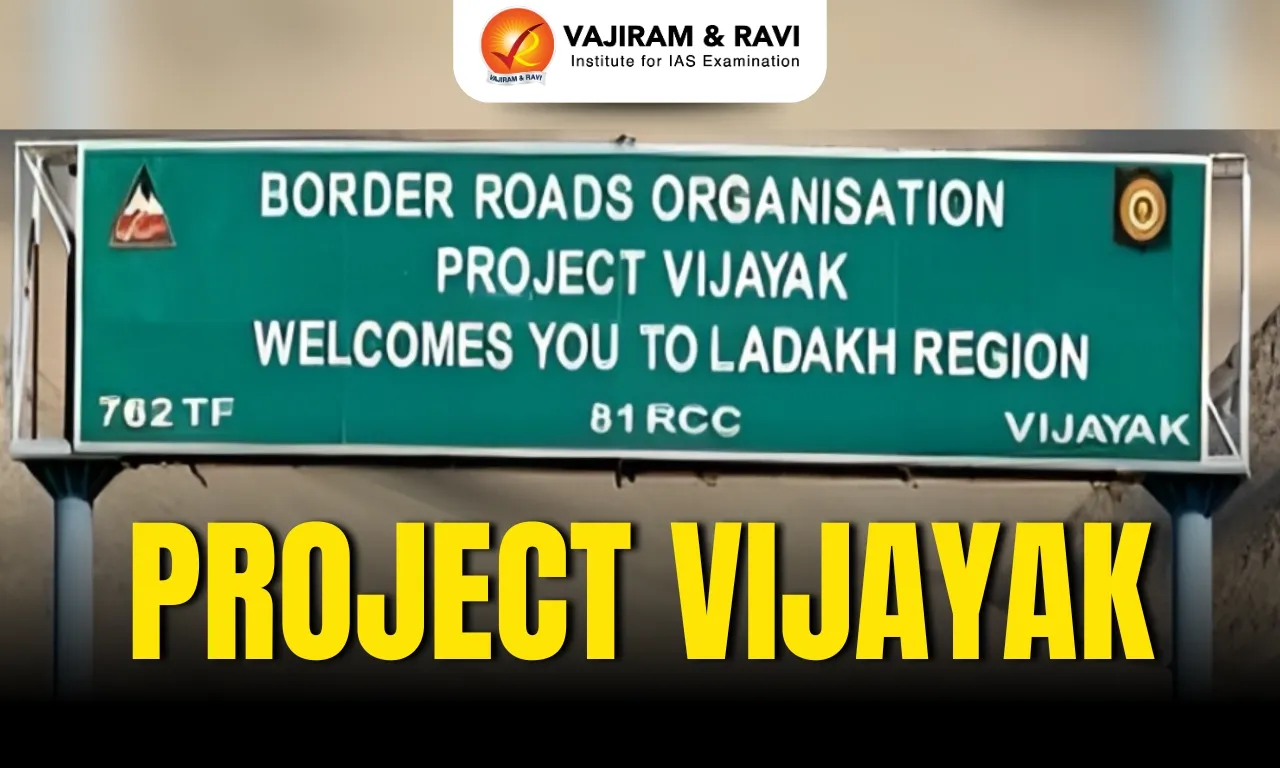
Recently, the Project Vijayak of the Border Roads Organisation (BRO) celebrated its 15th Raising Day at Kargil, Ladakh. 

About Project Vijayak

  • It was launched by the Border Roads Organisation in 2010.
  • It drew its name from Operation Vijay, signifying the congruence between the Theatre of Battle and the Project Area of Responsibility.
  • Objective: It was entrusted with the responsibility of providing road connectivity in the areas of Kargil and Zanskar, which previously were under Project Himank.
  • The project was entrusted with two strategically important lines of communication in the Western Indus Corridor, namely, the Zojila - Kargil - Leh axis and Nimmu - Padam - Darcha axis.
  • This project has played a significant role in strengthening the security infrastructure along the LC and has also contributed positively in shaping the socio-economic landscape of the region.
  • Other Initiatives under Project
    • It has also placed strong focus on welfare of its Casual Paid Labourers.
    • Welfare initiatives such as insulated shelters, improved sanitation, enhanced protective gear, winter clothing, and regular health camps have been introduced to ensure safety and well-being.

Source: PIB

Project Vijayak FAQs

Q1: Where is the headquarters of BRO located?

Ans: New Delhi

Q2: What is the role of Border Roads Organisation?

Ans: It develops and maintains road networks in India’s border areas and friendly neighboring countries.

Bagram Air Base

Bagram Air Base

Bagram Air Base Latest News

The Taliban government recently rejected U.S. President Donald Trump’s bid to retake Bagram Air Base, four years after America’s chaotic withdrawal from Afghanistan left the sprawling military facility in the Taliban hands.

About Bagram Air Base

  • It is the largest air base in Afghanistan, located north of the capital, Kabul.
  • It has a strategic position at the crossroads of Iran, Pakistan, China's Xinjiang province, and Central Asia.
  • It was built during the Cold War by the Soviet Union. 
  • The airbase served Soviet operations in the country for decades until they withdrew in the late 1980s.
  • The US revamped the facility following its own occupation of Afghanistan decades later.
  • It had served as a crucial hub in the US war against the Taliban and Al Qaeda since 2001. 
    • It was the largest American military installation in Afghanistan.
    • It served as a hub for air operations, intelligence, and logistics throughout the war.
    • The air base had, at its peak in 2012, more than 100,000 US troops passing through its compound.
  • Features:
    • It has runways longer than many international airports, and hardened shelters, hospitals, and fuel depots.
    • The base also housed fast-food restaurants to cater to the US troops, along with shops selling everything from electronics to Afghan rugs. 
    • Bagram also had a massive prison complex.
  • The base fell under the control of the Taliban after they swept to power in the country in 2021, with the US troops having withdrawn from the country.
  • US forces officially vacating Bagram Air Base in July 2021 was seen as a symbolic end to America's 20-year military presence in Afghanistan.

Source: TH

Bagram Air Base FAQs

Q1: What is the largest military base in Afghanistan?

Ans: Bagram Air Base

Q2: Which country originally built Bagram Air Base?

Ans: It was built during the Cold War by the Soviet Union.

Q3: When did the Taliban take control of Bagram Air Base?

Ans: The base fell under the control of the Taliban after they swept to power in the country in 2021, with the US troops having withdrawn from the country.

Q4: What feature made Bagram Air Base suitable for US military operations?

Ans: Long runways, hardened shelters, and large compound for logistics.

Key Facts about Mozambique

Mozambique

Mozambique Latest News

Recently, the Indian Navy’s First Training Squadron comprising INS Tir, INS Shardul, INS Sujata, and ICGS Sarathi concluded its four-day port visit to Maputo, Mozambique.

About Mozambique

  • Location: It is a country in Southern Africa and is located in the Southern and Eastern Hemispheres of the Earth.
  • The country also has a coastline on the Indian Ocean to the east.
  • The island countries and territories of Madagascar, Comoros, and Mayotte are separated from Mozambique by the Mozambique Channel.
  • Bordering countries: Zimbabwe (west), Eswatini and South Africa (south and southwest), Zambia, Malawi (north west), and Tanzania (North). 
  • Rivers: The River Zambezi being the largest and other rivers are Limpopo, Licungo, Lurio, Rovuma etc.
  • Major Lakes: Lake Malawi (Nyasa) is the country’s major lake. 
  • Highest Peak: Mount Binga
  • Capital: Maputo is the country’s capital while the largest city is Matola.
  • Natural Resources: The country’s principal natural resources are natural gas, coal, mineral, sand, hydropower, and most likely oil.

Source: PIB

Mozambique FAQs

Q1: Which ocean borders Mozambique to the east?

Ans: Indian Ocean

Q2: What is the official language of Mozambique?

Ans: Portuguese

National Archives of India

National Archives of India

National Archives of India Latest News

Recently, the 50th Golden Jubilee Meeting of the National Committee of Archivists (NCA), organized by the National Archives of India (NAI).

About National Archives of India

  • It is the custodian of the records of enduring value of the Government of India. 
  • History of National Archives of India
    • It was originally established as the Imperial Record Department on 11 March 1891 in Kolkata (Calcutta). 
    • It was transferred to New Delhi in 1911.
  • The NAI also serves as the nodal agency for implementing the Public Records Act, 1993, and the Public Record Rules, 1997.
  • A significant portion of its oriental records is in Sanskrit, Persian, Odia, and other languages.
  • Access to the records in the NAI is governed by the provisions of the Public Records Rules, 1997.
  • The NAI keeps and conserves records of the government of India and its organisations. It does not receive classified documents.
  • Headed by: Director General of Archives
  • Nodal Ministry: Ministry of Culture.
  • Location: New Delhi and has one regional office at Bhopal and three Records Centers at Bhubaneswar, Jaipur, and Puducherry.

Source: PIB

National Archives of India FAQs

Q1: Under which ministry does the National Archives of India function?

Ans: Ministry of Culture

Q2: Where is the National Archives of India located?

Ans: New Delhi

Q3: What type of records does the National Archives of India hold?

Ans: A vast corpus of records including public records, private papers, oriental records, cartographic records, and microfilms

Chenab River

Chenab River

Chenab River Latest News

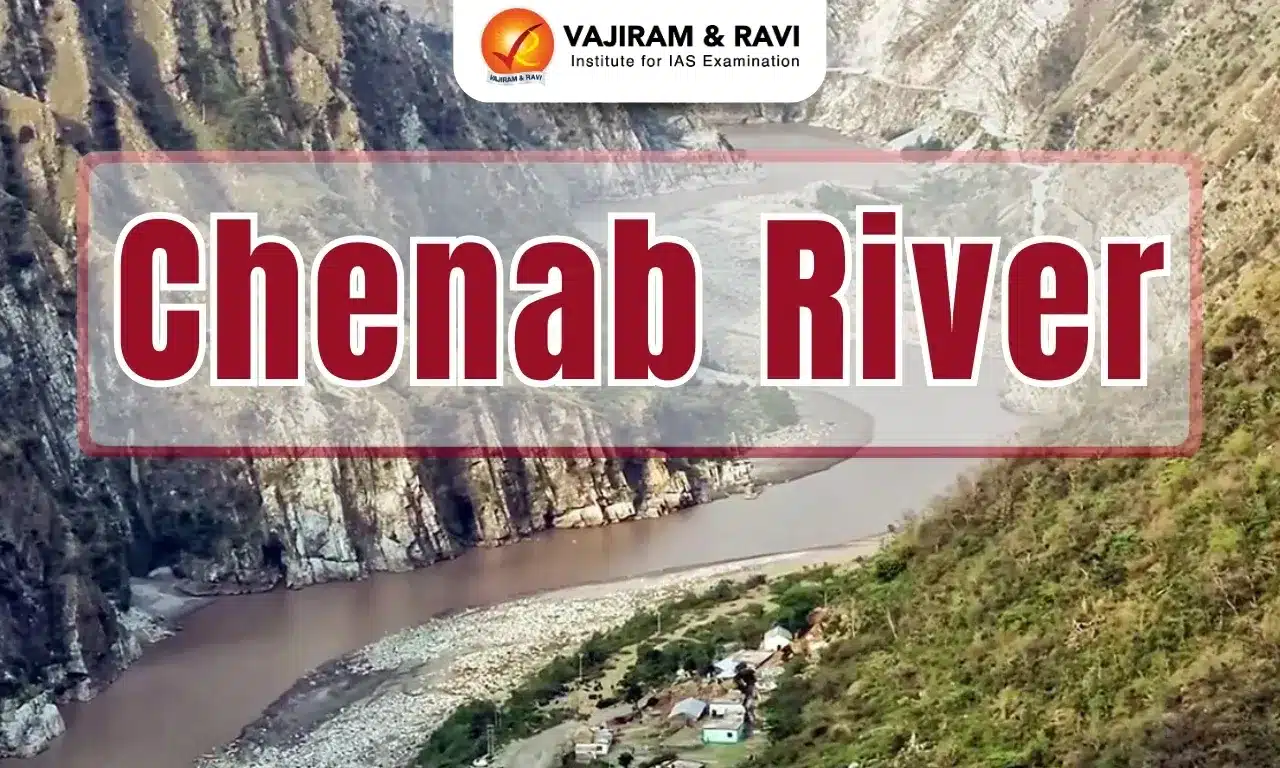
Recently, the stalled Sawalkote dam on the Chenab river is back at the centre of India’s strategy to tap the river’s hydropower potential.

About Chenab River

  • It is a tributary of the Indus River.
  • Origin: It is formed by the confluence of two streams, Chandra and Bhaga, in the Lahaul and Spiti Districts of Himachal Pradesh.
  • In its upper reaches, it is also known as the Chandrabhaga.
  • It flows through Jammu and Kashmir union territory, Himachal Pradesh and after receiving the Jhelum River near Trimmu, the Chenab empties into the Sutlej River.
  • Major Tributaries:
    • Left Bank:  Niru, Tawi, Neeru, and Liddrari
    • Right Bank: Ans, Bhut Nalla, Bichleri, Kalnai Marusudar and Miyar Nalla.
  • Major Dams on Chenab River: Salal (rockfill dam), Aalal (concrete dam), Baglihar, and Dul. 
  • The waters of the Chenab are shared by India and Pakistan as per the terms of the Indus Water Treaty.

What is the Indus Waters Treaty (IWT)?

  • It was signed in 1960 between India and Pakistan, with the World Bank acting as a mediator. 
  • The treaty outlines water usage rights over six rivers of the Indus River System, categorizing them into Eastern and Western rivers. 
  • The Eastern rivers—Ravi, Beas, and Sutlej—are allocated for India’s exclusive and unrestricted use. 
  • The Western rivers—Indus, Jhelum, and Chenab—are allocated primarily to Pakistan.

Source: IE

Chenab River FAQs

Q1: What is the largest tributary of Chenab River?

Ans: Marusudar

Q2: Chenab River is a tributary of which major river?

Ans: Indus River

Daily Editorial Analysis 22 September 2025

Daily Editorial Analysis

Breaking the Academic Paywall

Context

  • India today stands as the fourth-largest producer of PhD graduates globally, according to the Organisation for Economic Co-operation and Development.
  • Yet, this achievement is shadowed by a paradox: many of these scholars come from regions where universities lack the resources to subscribe to essential academic journals.
  • Completing doctoral research requires reading hundreds of papers, but students, already constrained by limited stipends of ₹20,000–35,000, are forced to pay anywhere between $20 and $3,000 (₹17,000–2.64 lakh) for access to a single article.
  • Such barriers effectively block access to knowledge for those who most need it.

The High Cost of Knowledge

  • The issue became particularly visible when the Delhi High Court, in August, ordered the blocking of Sci-Hub and LibGen, two popular free-access platforms.
  • The case, filed by three of the world’s largest academic publishers that control 40% of the global market, rested on copyright infringement claims.
  • This decision sparked widespread debate on the ethics of restricting access to scientific knowledge, especially for researchers in the Global South.
  • Academic publishing operates on a business model that extracts immense profits from the unpaid labour of researchers, whose work is funded through taxpayers or student fees.
  • Publishers neither create content nor review its quality, yet they exert ownership over knowledge and charge exorbitant fees for access.
  • A 2021 study in the Journal of Scientometric Research revealed that India accounted for 8.7% of all Sci-Hub downloads in 2017, over 13 million requests, with nearly one-fifth related to medical and health sciences.
  • Clearly, students and professionals rely heavily on such platforms to access information vital for local research and problem-solving.

Health, Innovation, and the Cost of Exclusion

  • The consequences of paywalled science are most dire in healthcare.
  • As organisations like Doctors Without Borders (MSF) note, medicine is never static; it evolves in response to climate change, disease patterns, and shifting social realities.
  • Yet in the Global South, where two-thirds of tuberculosis cases occur and where antimicrobial-resistant HIV is an urgent challenge, doctors struggle to develop effective treatment plans without access to the latest research.
  • Tailored healthcare solutions, sensitive to geography, malnutrition, age, and co-morbidities, require constant innovation grounded in updated knowledge.
  • Denying access becomes not just an academic concern but a moral question of equity and justice.

Knowledge as a Commodity

  • The problem extends beyond healthcare; today, knowledge is treated as a luxury commodity.
  • Universities increasingly favour researchers who publish in high-profile journals rather than those whose work addresses urgent social needs.
  • Corporate interests dominate research priorities, with patents and intellectual property rights reinforcing the privatisation of human knowledge.
  • This narrow view sidelines grassroots expertise, particularly in the Global South, where communities often serve as mere field sites for Global North researchers.
  • Local researchers are underrepresented in authorship, relegated to assistant roles while conceptual framing remains rooted in Northern perspectives.
  • This imbalance not only perpetuates inequity but also distorts the framing of Southern challenges through foreign lenses.

Towards Collective Action and Open Science

  • The Global South faces overlapping crises, climate disasters, displacement, drug resistance, systemic inequities, that demand collective knowledge-sharing.
  • Recognising this, 193 member states of UNESCO, including India, adopted the first international framework on open science in 2021.
  • This initiative sought to make scientific knowledge transparent, accessible, and collaborative.
  • Yet, just a few years later, powerful publishers continue to enforce paywalls, creating an artificial scarcity around what is inherently abundant: knowledge.
  • Science is already a collective exercise, built upon the contributions of countless individuals across borders.
  • However, even communities who participate in research often cannot access the findings that emerge from their involvement.
  • This exclusion undermines the very spirit of inquiry and solidarity that science is meant to embody.

Conclusion

  • If humanity is to confront the complex challenges of the 21st century, from pandemics to climate change and systemic inequities, knowledge must be recognised as commons rather than a commodity.
  • The continued stranglehold of corporate publishers denies millions the opportunity to learn, innovate, and adapt.
  • It is imperative that governments, institutions, and civil society pressure publishing giants to dismantle paywalls and democratise access.
  • Only then can knowledge serve its true purpose: empowering people everywhere to build healthier, more just, and more resilient societies.

Breaking the Academic Paywall FAQs

 Q1. Why do many PhD students in India struggle to access research papers?
Ans. They struggle because journals are expensive, while students receive only modest stipends and lack institutional subscriptions.

Q2. What sparked debate on access to knowledge in India recently?
Ans. The Delhi High Court’s decision to block Sci-Hub and LibGen triggered debate over students’ rights to access research.

Q3. How does restricted access to journals affect healthcare in the Global South?
Ans. It prevents doctors and researchers from developing updated, tailored treatment plans for diseases like TB and HIV.

Q4. What problem arises from Global North dominance in publishing?
Ans. Researchers from the Global South are often underrepresented, with their issues framed through Northern perspectives.

Q5. What solution is needed to overcome the artificial scarcity of knowledge?
Ans. Dismantling paywalls and treating knowledge as a commons to ensure open and equitable access.

Source: The Hindu


India’s Foreign Policy Dilemma - Strategic and Multi-Dependence

Context:

  • The Prime Minister (PM) of India recently highlighted India’s overdependence on foreign countries as a major strategic risk.
  • Despite aspirations of strategic autonomy and multi-alignment, India faces the reality of strategic and multi-dependence on China, Russia, and the US.
  • This dependence is distributed across critical sectors like manufacturing, defence, energy, and markets, and constrains New Delhi’s foreign policy manoeuvrability.

India’s Dependence on Major Powers:

  • Dependence on China:

    • Manufacturing and consumer goods: Heavy reliance on Chinese white goods, mobile phone components, and computers.
    • Pharmaceuticals: Active pharmaceutical ingredients (APIs) and precursor chemicals critical for India’s pharma sector.
    • Energy and commodities: Import of rare earths, polysilicon, wafers, and solar cells.
    • Infrastructure inputs: Fertilisers and tunnel-boring machines.
    • Semiconductors: Large-scale imports from China.
  • Dependence on Russia:

    • Defence: 60–70% dependence on platforms and systems across Army, Navy, and Air Force.
    • Energy: Oil imports from Russia rose from 4% (2022) to nearly 40% in recent times.
    • Legacy factor: While India has tried to diversify to France, Israel, and the US, dependence on Russia goes back to the 1970s, and it is hard for the armed forces to wean themselves off Russian equipment.
  • Dependence on the United States:

    • Economic and human capital links:
      • The US is India's largest export destination.
      • Indians in recent years have topped the list of H1-B visa recipients, up to 70% of those issued.
      • Indian students in the US rival Chinese students in terms of numbers, and the US is the top destination for the Indian students going abroad.
    • Defence and technology:
      • American arms and military technology are seen as vital for India’s defence modernisation.
      • Key military armaments and components include GE engines for India’s indigenous fighter aircraft - the Tejas, assault rifles, helicopters, missiles, unmanned aerial systems, etc.
    • Geopolitical: Counterbalancing against China’s power in the Indo-Pacific.

Foreign Policy Tightrope:

  • China: New Delhi cannot afford to offend China over the border without risking economic fallout.
  • Russia: Oil and defence links limit criticism of Russia over the Ukraine war, its arms sales to China, and its burgeoning relationship with Pakistan.
  • United States: Due to trade and technology dependence, India cannot offend the Americans over tariffs and India’s relations with China and Russia as well as Iran beyond a point.
  • Overall: India’s room for manoeuvre in foreign policy is severely restricted.

Historical Parallel:

  • Current dependence mirrors the post-Cold War crisis of 1989–91, when the Soviet collapse exposed India’s vulnerabilities.
  • Today, disruptions in global geopolitics (Trump’s tariffs, Ukraine war, US-China rivalry) highlight India’s fragile dependence.

Challenges Ahead for India:

  • Manufacturing stagnation: Despite 7% GDP growth since the 1990s, the sector remains weak.
  • Commodity deficit: India desperately needs various commodities including energy, rare earths, and APIs.
  • Limited export diversification: Large dependence on the US market.
  • Private and public sector response: Lack of sufficient competitiveness and “animal spirits” in Indian industry.

Way Forward:

  • Manufacturing revolution: Strengthen Make in India and Atmanirbhar Bharat initiatives.
  • Diversify imports and commodities: Expand sourcing of APIs, rare earths, energy, and semiconductors from multiple countries.
  • Export diversification: Reduce dependence on the US by tapping into African, ASEAN, and Latin American markets.
  • Defence indigenisation: Accelerate indigenous R&D, promote joint ventures, and reduce reliance on Russia and US.
  • Policy push: Galvanise private sector innovation, investment, and competitiveness.

Conclusion:

  • India’s strategic autonomy is undermined by its economic and defence dependencies on China, Russia, and the US.
  • Just as the 1991 crisis spurred economic reforms, today’s challenge should be seen as an opportunity to unleash a manufacturing and self-reliance revolution.
  • Achieving true Atmanirbharta across critical sectors is essential for safeguarding India’s foreign policy independence and national security.

India’s Foreign Policy Dilemma FAQs

Q1. How does India’s dependence on China impact its strategic autonomy?

Ans. Dependence on Chinese consumer goods, APIs, semiconductors, and rare earths constrains India’s ability to take a firm stance against Beijing.

Q2. Why is Russia considered indispensable to India’s defence and energy security?

Ans. Around 60–70% of India’s defence platforms and a surge in crude oil imports (up to 40%) come from Russia, making diversification difficult.

Q3. Examine the nature of India’s dependence on the United States.

Ans. India relies on the US for export markets, H-1B/student visas, defence technology (e.g., GE engines), and strategic counterbalance to China.

Q4. What historical parallels can be drawn from India’s current foreign policy challenges?

Ans. Just as the Soviet collapse exposed India’s economic vulnerability in 1991, current multi-dependence on China, Russia, and the US exposes strategic vulnerabilities.

Q5. What measures are necessary for India to reduce multi-dependence and strengthen strategic autonomy?

Ans. A manufacturing revolution, diversification of imports/exports, defence indigenisation, and galvanising private sector competitiveness are essential.

Source: IE

Daily Editorial Analysis 22 September 2025 FAQs

Q1: What is editorial analysis?

Ans: Editorial analysis is the critical examination and interpretation of newspaper editorials to extract key insights, arguments, and perspectives relevant to UPSC preparation.

Q2: What is an editorial analyst?

Ans: An editorial analyst is someone who studies and breaks down editorials to highlight their relevance, structure, and usefulness for competitive exams like the UPSC.

Q3: What is an editorial for UPSC?

Ans: For UPSC, an editorial refers to opinion-based articles in reputed newspapers that provide analysis on current affairs, governance, policy, and socio-economic issues.

Q4: What are the sources of UPSC Editorial Analysis?

Ans: Key sources include editorials from The Hindu and Indian Express.

Q5: Can Editorial Analysis help in Mains Answer Writing?

Ans: Yes, editorial analysis enhances content quality, analytical depth, and structure in Mains answer writing.

Baltic Sea

Baltic Sea

Baltic Sea Latest News

Germany's air force recently sent two Eurofighters to track a Russian IL-20M military aircraft that had entered neutral airspace over the Baltic Sea before handing the escort over to NATO partners in Sweden.

About Baltic Sea

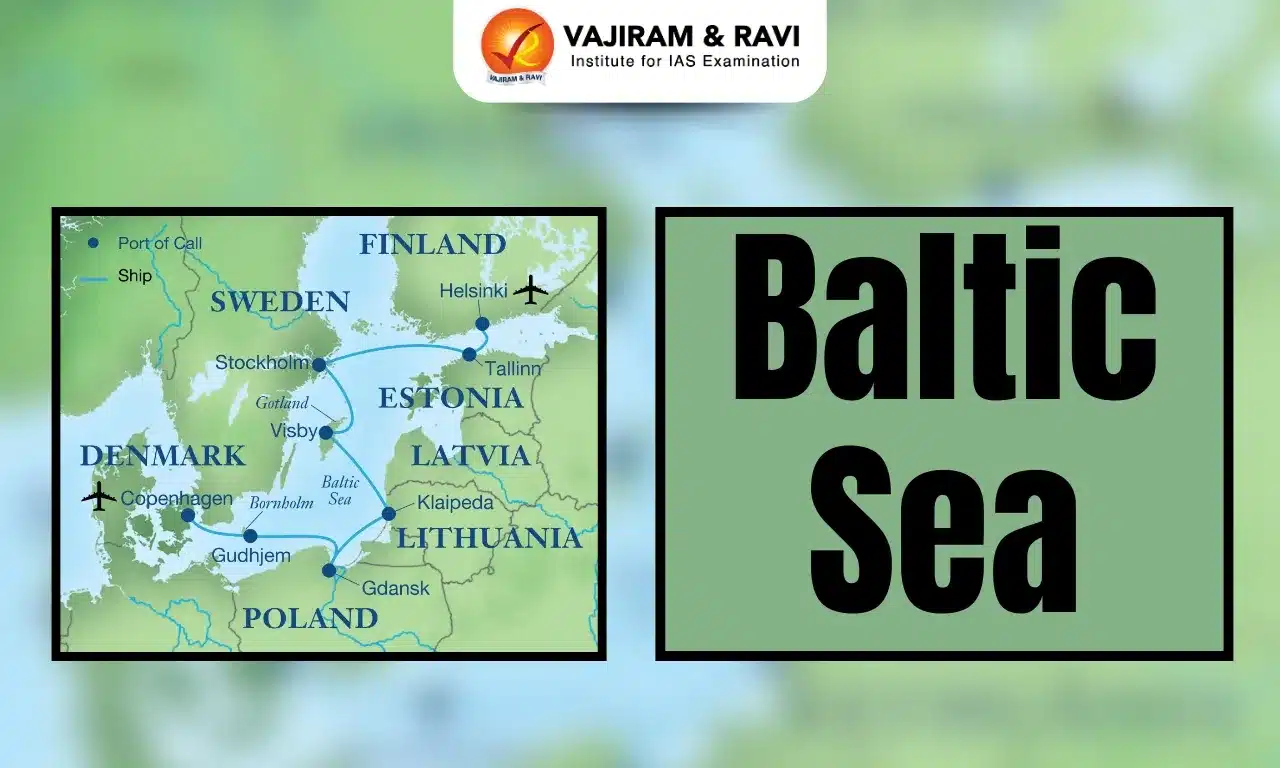
  • It is a semi-enclosed inland sea of the Atlantic Ocean, situated in Northern Europe.
  • It extends northward from southern Denmark to within a few degrees latitude of the Arctic Circle, separating the Scandinavian Peninsula from continental Europe.
  • It comprises several branches and basins, which include, from northeast to southwest, the Gulf of Bothnia, the Gulf of Finland, and the Gulf of Riga; the central-southern area known as the Baltic Proper; and the Danish straits of Kattegat and Skagerrak, which connect to the North Sea, an arm of the Atlantic Ocean. 
  • To the east, the White Sea-Baltic Canal, opened by Russia in 1993, allows traffic from the Baltic—via the Gulf of Finland and a chain of rivers and major lakes—to the White Sea, itself an arm of the Arctic Ocean.
  • To the southwest, the Kiel Canal, opened in 1895, cuts through the Jutland peninsula to connect the Baltic with the North Sea.
  • It is the youngest sea on our planet, emerging some 10,000-15,000 years ago as the glaciers retreated at the end of the last Ice Age.
  • It is approximately 1,600 km long and 193 km wide, covering an area of approximately 377,000 sq.km.
  • Surrounding Countries: It has a coastline of approximately 8,000 km, shared by several countries, including Sweden, Poland, Lithuania, Latvia, Finland, Estonia, Germany, Denmark, and Russia. 
  • It is often cited as the world’s largest brackish inland water body. 
  • Its water salinity levels are lower than that of the world oceans due to the inflow of fresh water from the surrounding land and the sea’s shallowness. 
  • There are about sixty rivers draining into the Baltic Sea. Neva is the largest river that drains into the Baltic Sea.
  • Islands: It is home to over 20 islands and archipelagos. Gotland, located off the coast of Sweden, is the largest island in the Baltic Sea.
  • Algal Harmful Blooms are also one of the issues that affect the Baltic Sea.

Source: TH

Baltic Sea FAQs

Q1: The Baltic Sea is a semi-enclosed inland sea of which ocean?

Ans: Atlantic Ocean

Q2: The Baltic Sea is connected to the North Sea through which straits?

Ans: Kattegat and Skagerrak

Q3: Which is the largest river draining into the Baltic Sea?

Ans: Neva

Q4: Gotland, the largest island in the Baltic Sea, belongs to which country?

Ans: Sweden

Q5: Which canal connects the Baltic Sea with the North Sea through the Jutland Peninsula?

Ans: Kiel Canal

Supreme Court Review on Governor’s Role in Assent to State Bills

Governor’s Role

Governor’s Role Latest News

  • The Supreme Court is examining a Presidential reference on whether timelines can be fixed for Governors and the President in giving assent to State Bills, amid debates over Articles 200 and 201 of the Constitution.

Introduction

  • The Supreme Court of India is currently examining a crucial constitutional reference concerning the role of Governors in the legislative process of States. 
  • The issue revolves around whether fixed timelines should be mandated for Governors and the President in granting assent to Bills passed by State legislatures. 
  • This matter has significant implications for Centre-State relations and India’s federal framework, especially at a time when multiple States have accused Governors of deliberately delaying assent to Bills, thereby obstructing governance.

The Role of Governors in Assent to Bills

  • Under Article 200 of the Constitution, when a Bill is passed by a State legislature, it is presented to the Governor for assent. The Governor has the following options:
    • Grant assent to the Bill.
    • Withhold assent.
    • Reserve the Bill for the consideration of the President.
    • Return the Bill (if not a Money Bill) with a message for reconsideration.
  • If the Bill is again passed by the legislature, the Governor is constitutionally bound to give assent. 
  • However, the Constitution does not prescribe any timeframe for the Governor’s decision, leading to controversies where Governors have sat on Bills indefinitely.
  • Similarly, Article 201 governs the President’s assent when a Bill is reserved for consideration. Even here, no timeline exists for the President to act, which sometimes results in prolonged delays.

Debate on Fixing Timelines

  • The absence of clear timelines has become a major flashpoint in Centre-State relations. 
  • Several States, including Tamil Nadu, Kerala, Punjab, and Telangana, have complained of Governors withholding or delaying assent to Bills, thus stalling key reforms.
  • The Supreme Court, while hearing the reference, is considering whether judicially enforceable timelines can be set to prevent such delays. 
  • Proponents argue that indefinite inaction by Governors violates the spirit of parliamentary democracy and undermines the functioning of elected governments.
  • On the other hand, critics caution that imposing strict timelines may constrain the discretionary powers vested in Governors and the President, potentially upsetting the delicate constitutional balance.

Background of the Case

  • The matter reached the Supreme Court through a Presidential Reference under Article 143, following disputes raised by multiple States. 
  • The Union government has argued that Governors act within their constitutional role and that delays may sometimes be due to the need for greater scrutiny or consultation with the Centre.
  • However, the Supreme Court in earlier cases, such as Shamsher Singh v. State of Punjab (1974) and Nabam Rebia v. Deputy Speaker (2016), has emphasised that the Governor is bound by the aid and advice of the Council of Ministers, except in a few exceptional circumstances.
  • The present reference is an attempt to resolve whether Governors’ inaction can be constitutionally limited through prescribed timelines, ensuring accountability without undermining constitutional checks.

Summary of the Current Issue

  • According to the reports, the Supreme Court is deliberating on the question of fixing time-bound limits for Governors and the President in granting assent to Bills. 
  • The Court has acknowledged that prolonged delays effectively amount to a pocket veto, which was never envisaged in the Constitution.
  • The bench is also exploring whether such timelines should be left to the legislature to define through constitutional amendment or whether the Court can lay down broad principles under its powers of interpretation.
  • This debate holds far-reaching implications for India’s federal structure. While Governors are meant to be neutral constitutional authorities, their actions are often viewed through the prism of partisan politics, especially when different parties are in power at the Centre and in the State. 
  • By addressing this grey area, the Supreme Court’s eventual decision could significantly reshape the relationship between Governors and State legislatures.

Implications for Federalism

  • Strengthening Legislative Authority: Time-bound assent would reinforce the authority of elected State legislatures, reducing executive interference.
  • Preventing Political Deadlocks: It would minimise friction between Governors and State governments, ensuring smoother legislative functioning.
  • Judicial Oversight on Federal Balance: The case marks an important judicial intervention in clarifying ambiguities of the Constitution that impact Centre-State relations.
  • Setting a Precedent: The ruling could also influence debates on other constitutional offices where delays in decision-making affect governance.

Source: TH

Governor's Role FAQs

Q1: What does Article 200 of the Constitution deal with?

Ans: It deals with the Governor’s options when a Bill passed by a State legislature is presented for assent.

Q2: Can a Governor indefinitely delay assent to a Bill?

Ans: Currently, the Constitution provides no timeline, which has led to prolonged delays in several States.

Q3: What is Article 201 of the Constitution?

Ans: It provides for the President’s assent when a State Bill is reserved for consideration by the Governor.

Q4: Why is the Supreme Court examining this issue now?

Ans: Multiple States have complained of Governors delaying Bills, leading to a Presidential reference to the Court.

Q5: How could fixing timelines impact federalism?

Ans: It would strengthen State legislatures, reduce political deadlocks, and reinforce democratic accountability.

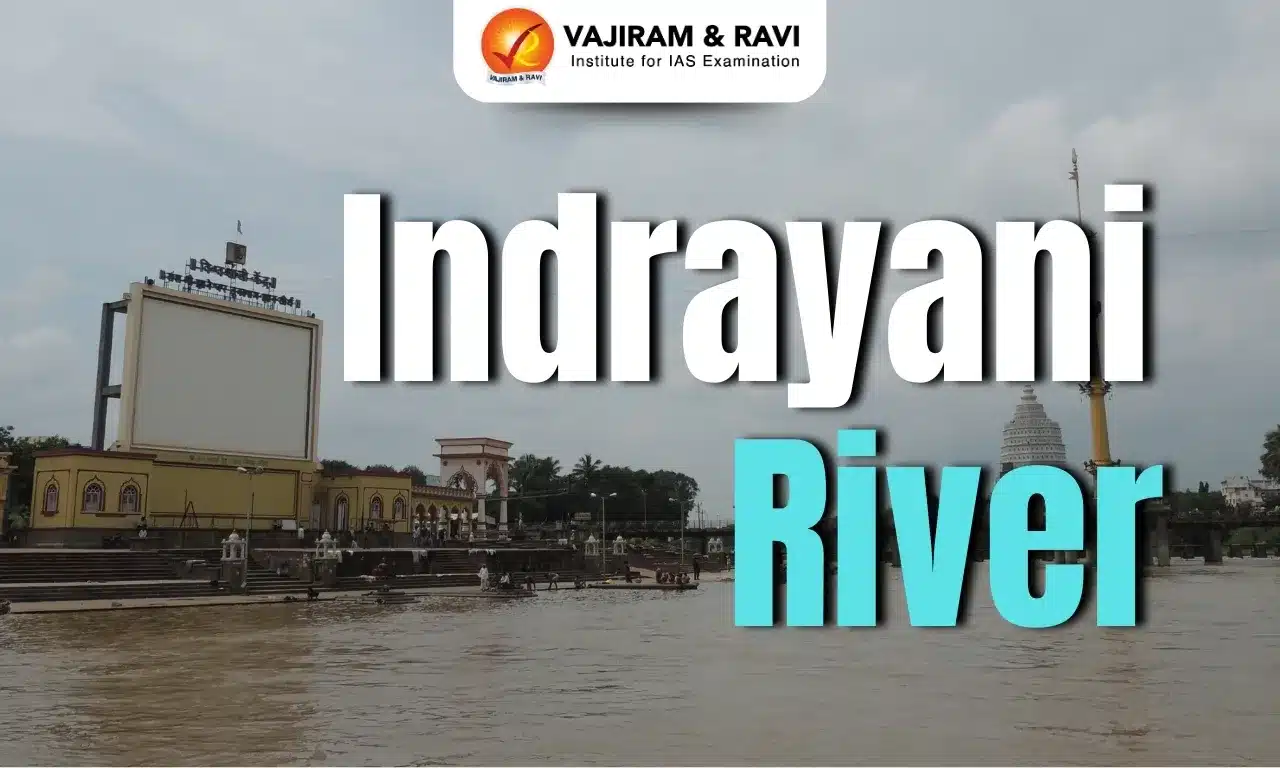
Indrayani River

Indrayani River

Indrayani River Latest News

State level technical committee (SLTC) recently approved two sewage treatment plant (STP) projects along the Indrayani River in Pimpri Chinchwad to curb water pollution.

About Indrayani River

  • It is a river located in the state of Maharashtra.
  • It is a tributary of the Bhima River (a tributary of the Krishna River).
  • Course
    • It is a rain-fed river that originates from the Western Ghats, near the hill station of Lonavala, located along the Mumbai-Pune Highway. 
    • It flows through the Pune district before merging into the Bhima River at Tulapur.
    • It travels a total length of 105.3 km.
  • The river has great religious importance, and the two sacred towns, Alandi and Dehu, are situated on its banks.
    • Dehu is known to be a sacred place for being the hometown of the poet Saint Tukaram, who was a popular saint of Maharashtra, and Alandi holds the samadhi of the poet Dnyaneshwar.
  • The Indrayani also passes through the industrial town of Pimpri-Chinchwad and plays a role in irrigation and local agriculture.
  • Valvan Dam at Kamshet, situated on the Indrayani River, is a hydroelectric generating station.

Source: TOI

Indrayani River FAQs

Q1: The Indrayani River is a tributary of which river?

Ans: Bhima

Q2: Where does the Indrayani River originate?

Ans: It originates from the Western Ghats, near the hill station of Lonavala.

Q3: The Indrayani River flows through which Indian state?

Ans: Maharashtra

Q4: What is the approximate length of the Indrayani River?

Ans: 105.3 km

Q5: Which industrial town does the Indrayani River pass through?

Ans: Pimpri-Chinchwad

Low Inflation in India: Fiscal Challenges and Nominal GDP Growth Impact

Low Inflation in India

Low Inflation in India Latest News

  • Recent data showed CPI inflation at 2.07% and WPI inflation at 0.52% in August, offering relief to households. 
  • However, such low inflation complicates the government’s budget calculations and fiscal management, making revenue mobilisation harder even as consumers benefit from stable prices.

Understanding Inflation

  • Inflation refers to the general rise in prices across an economy, often triggered by increased supply of money. 
  • Rising input costs, such as oil or food, also push prices higher, reducing the value of money.
  • The primary effect is erosion of purchasing power—the same amount of money buys fewer goods and services. 
  • While wages may adjust, most people end up spending more on essentials like food and rent.

Benefits of Inflation

  • Moderate inflation can stimulate economic growth when resources are underutilised. 
  • More spending fuels production and jobs. Keynes argued it prevents the Paradox of Thrift, where falling prices discourage spending. 
  • Inflation also eases debt burdens, as repayments are made with less valuable money, benefiting debtors and fixed-rate homeowners.

Who Benefits Most

  • Debtors and homeowners with fixed-rate mortgages.
  • Workers in secure jobs less vulnerable to cuts.
  • Holders of foreign currencies, who gain from weaker domestic currency.

When Inflation Becomes Harmful

  • High inflation reduces purchasing power, risks layoffs, and raises borrowing costs, making big purchases like homes unaffordable. 
  • Fixed-income workers and investors in long-term bonds also lose, as returns fail to keep up with rising costs and interest rates.

Low Inflation and Government Finances

  • While real GDP growth rose to 7.8% in April–June 2025, nominal GDP growth fell to 8.8%, below the government’s budget assumption of 10.1%. 
  • Nominal GDP, influenced by inflation, is key for revenue projections and fiscal planning.

Budget Expectations vs Reality

  • The 2025–26 Budget assumed India’s nominal GDP would reach ₹357 lakh crore, with tax revenue expected to grow nearly 11%. 
  • However, persistently low inflation has weakened nominal GDP growth, straining revenue mobilisation.

Impact on Tax Collections

  • With WPI inflation averaging 0.1% and CPI inflation at 2.4% this fiscal, subdued price growth has slowed tax inflows. 
  • Between April–July, gross tax revenue rose just 1% year-on-year, while net tax revenue fell 7.5%.
  • Although low inflation benefits consumers, it weakens the government’s balance sheet
  • Sluggish nominal GDP growth is already impacting finances, making it difficult to meet FY26 budget targets.

Challenges in Meeting Nominal GDP Growth Targets

  • Nominal GDP growth often diverges from Budget assumptions. 
  • In the last 13 years, actual growth has fallen short nine times, though in three of the last four years, it exceeded expectations.

Revised Base and Budget Assumptions

  • The GDP for 2024–25 was revised upward by 2% to ₹331 lakh crore. 
  • This reduces the required growth for 2025–26 to 8% to meet the Budget’s target of ₹357 lakh crore.

Fiscal Implications

  • Achieving the nominal GDP projection is critical for maintaining fiscal indicators. 
  • The fiscal deficit target of 4.4% and debt-to-GDP ratio of 56.1% hinge on meeting this number, provided the deficit stays within estimates.

Concerns for FY26

  • Economists expect nominal GDP growth to fall below the Budget’s 10.1% estimate, with Morgan Stanley projecting just 8.3%. 
  • This implies continued slowdown after April–June’s 8.8% growth.
  • Upcoming reductions in Goods and Services Tax (GST) rates are expected to lower prices and inflation. 
  • While beneficial for consumers, this will likely further suppress nominal GDP growth.

Low Inflation: Causes and Concerns

  • Low inflation is not inherently negative; its impact depends on the cause. If driven by oversupply, it signals healthy demand, but if due to weak demand, it is worrisome.
  • An RBI study showed that in April–June, private companies’ sales grew 5.5%, while net profits surged 17.6%; in manufacturing, profits rose 27.7% against sales growth of just 5.3%, aided by lower global commodity prices.
  • Despite strong margins and cash reserves, corporate investment (capex) remains weak. 
  • Economists warn this indicates subdued demand rather than productivity-driven efficiency, raising concerns about India’s growth momentum.

Source: IE | IP

Low inflation in India FAQs

Q1: Why is low inflation in India a fiscal concern?

Ans: Low inflation slows nominal GDP growth, reducing tax revenue and making it harder for the government to meet Budget and fiscal deficit targets.

Q2: How does inflation affect nominal GDP growth?

Ans: Nominal GDP reflects total value of goods and services, influenced by prices. Lower inflation suppresses growth, even if real GDP production remains strong.

Q3: What was India’s nominal GDP growth in April–June 2025?

Ans: Nominal GDP growth fell to 8.8%, below the Budget assumption of 10.1%, despite real GDP growth rising to 7.8% during the same period.

Q4: How has low inflation affected tax revenues?

Ans: Between April–July 2025, gross tax revenue grew just 1% year-on-year, while net tax revenue fell 7.5%, reflecting sluggish revenue mobilisation.

Q5: Why is corporate investment weak despite high profits?

Ans: Though margins are strong due to lower global commodity prices, weak demand and low inflation have kept corporate capital expenditure subdued.

SC Ruling on Anand Marriage Act: Sikh Marriage Rights and Legal Debate

Anand Marriage Act

Anand Marriage Act Latest News

  • The Supreme Court has ordered 17 states and eight Union Territories to frame rules within four months for registering Sikh marriages under the Anand Marriage Act, 1909
  • Until then, Anand Karaj marriages must be registered under existing marriage laws. 
  • The ruling aims to ensure uniform legal recognition of Sikh marriages across India. 
  • However, critics argue that while the directive addresses procedural gaps, it does not fix deeper shortcomings in the Act itself, leaving broader issues unresolved.

The Anand Marriage Act and Its 2012 Amendment

  • Anand Karaj, meaning “blissful union,” is the Sikh marriage ceremony conducted before the Guru Granth Sahib. 
  • To solemnise the marriage, the couple walks around the Guru Granth Sahib four times, as hymns, known as laavan, are recited. 
    • The four chosen verses, composed by Guru Ram Das, the fourth Sikh Guru, outline the spiritual journey of a married couple.
  • To secure distinct legal recognition for this practice, the Anand Marriage Act, 1909 was enacted, validating all marriages solemnised through Anand Karaj and distinguishing them from Hindu rituals. 
  • However, the original Act lacked provisions for registration. 
  • This gap was filled over a century later by the Anand Marriage (Amendment) Act, 2012, which inserted Section 6 mandating states to frame rules for registering such marriages. 
  • Once registered under this Act, couples no longer need to register under any other marriage law.

State Inaction and Supreme Court’s Intervention

  • Despite the 2012 Amendment mandating registration rules for Anand Karaj marriages, most states and Union Territories failed to act, denying Sikh couples legal certificates essential for residence, maintenance, inheritance, and succession. 
  • Highlighting this inaction, petitions were filed in the Supreme Court in 2022, arguing that uneven access to rights disenfranchised the community. 
  • As a result, the Court directed all states and UTs to frame rules within four months, stressing that in a secular framework, Anand Karaj marriages must be registered on par with others. 
  • It placed a positive duty on states to create workable registration systems and clarified that applications cannot be refused merely because rules have not been notified.

The Ongoing Debate on Sikh Marriage Rights

  • Despite legal recognition through the Anand Marriage Act, 1909 and its 2012 Amendment, most Sikh couples still register marriages under the Hindu Marriage Act, 1955, which also governs divorce and disputes. 
  • The Anand Act lacks provisions for divorce or matrimonial issues, forcing Sikhs to rely on Hindu law, undermining their distinct religious identity. 
  • Community leaders and scholars argue that Sikhs need a comprehensive marriage law similar to those for Muslims and Christians. 
  • Critics highlight that the Anand Act, barely a page long, is symbolic rather than substantive, offering limited rights and failing to fully recognise Sikhs as a separate community.

Importance of Marriage Registration

  • The Supreme Court stressed that marriage registration is essential for equality, civil administration, and legal proof of status in matters such as residence, maintenance, inheritance, insurance, succession, and monogamy. 
  • It also safeguards the rights of women and children. 
  • Emphasising uniformity, the bench stated that in a secular framework, marriages solemnised by Anand Karaj must be recorded and certified on the same footing as other marriages to ensure both religious respect and civic equality.

Source: IE | MC

Anand Marriage Act FAQs

Q1: What is the Anand Marriage Act?

Ans: The Anand Marriage Act, 1909, legally recognised Sikh Anand Karaj marriages, later amended in 2012 to mandate states to frame registration rules.

Q2: What did the Supreme Court rule recently?

Ans: The SC ordered 17 states and eight UTs to frame registration rules within four months, ensuring Sikh couples can register marriages under their faith.

Q3: Why is marriage registration important?

Ans: Marriage registration ensures proof for residence, inheritance, maintenance, insurance, and succession, safeguarding women’s and children’s legal rights.

Q4: What shortcomings exist in the Anand Marriage Act?

Ans: The Act lacks provisions for divorce or disputes, forcing Sikhs to rely on the Hindu Marriage Act, undermining distinct religious identity.

Q5: Why do critics call the Act symbolic?

Ans: At just a page long, the Act offers limited rights. Leaders argue Sikhs need a comprehensive marriage law similar to those for Muslims and Christians.

Clean Plant Programme

Clean Plant Programme

Clean Plant Programme Latest News

The Clean Plant Programme (CPP) which was approved by the Union Cabinet is gaining momentum in its implementation.

About Clean Plant Programme

  • It was conceptualized by the Ministry of Agriculture & Farmers Welfare in collaboration with the Asian Development Bank.
  • It was launched as a major initiative to provide farmers with access to high-quality, virus-free planting material of key fruit crops.
  • Implemented by: It is implemented by the National Horticulture Board (NHB) in association with Indian Council of Agricultural Research (ICAR)
  • Components of Clean Plant Programme
    • Establishment of Nine Clean Plant Centers (CPCs): These centres will offer disease diagnostics and treatments, develop mother plants for nurseries, and quarantine all domestic and imported planting materials intended for commercial propagation and distribution.
    • Infrastructure Development: This includes setting up large-scale nurseries to efficiently multiply clean planting material. The mother plants produced by the CPCs will be propagated in these nurseries and then distributed to farmers.
    • Regulatory and Certification Framework: A regulatory and certification process will be created to ensure complete accountability and traceability in the production and distribution of planting material.

Source: PIB

Clean Plant Programme FAQs

Q1: What are the objectives of the clean plant program?

Ans: It is designed to address critical issues in horticulture by providing access to high-quality, virus-free planting material.

Q2: Who launched the Clean Plant program?

Ans: The Union government of India

Enquire Now