UPSC Daily Quiz 27 September 2025

UPSC Daily Quiz

The Daily UPSC Quiz by Vajiram & Ravi is a thoughtfully curated initiative designed to support UPSC aspirants in strengthening their current affairs knowledge and core conceptual understanding. Aligned with the UPSC Syllabus 2025, this daily quiz serves as a revision resource, helping candidates assess their preparation, revise key topics, and stay updated with relevant issues. Whether you are preparing for Prelims or sharpening your revision for Mains, consistent practice with these Daily UPSC Quiz can significantly enhance accuracy, speed, and confidence in solving exam-level questions.

[WpProQuiz 81]  

UPSC Daily Quiz FAQs

Q1: What is the Daily UPSC Quiz?

Ans: The Daily UPSC Quiz is a set of practice questions based on current affairs, static subjects, and PYQs that help aspirants enhance retention and test conceptual clarity regularly.

Q2: How is the Daily Quiz useful for UPSC preparation?

Ans: Daily quizzes support learning, help in revision, improve time management, and boost accuracy for both UPSC Prelims and Mains through consistent practice.

Q3: Are the quiz questions based on the UPSC syllabus?

Ans: Yes, all questions are aligned with the UPSC Syllabus 2025, covering key areas like Polity, Economy, Environment, History, Geography, and Current Affairs.

Q4: Are solutions and explanations provided with the quiz?

Ans: Yes, each quiz includes detailed explanations and source references to enhance conceptual understanding and enable self-assessment.

Q5: Is the Daily UPSC Quiz suitable for both Prelims and Mains?

Ans: Primarily focused on Prelims (MCQ format), but it also indirectly helps in Mains by strengthening subject knowledge and factual clarity.

Pink Revolution, Challenges, Government Strategies, Current Status

Pink Revolution

The Pink Revolution refers to the rise and modernization of India's meat and poultry processing industry. It focuses on improving technologies in poultry, meat, onion production, and pharmaceuticals. Durgesh Patel is regarded as the Father of the Pink Revolution. This revolution aimed at increasing exports, ensuring better hygiene, and increasing productivity in the sector. With India’s large livestock population, this industry holds immense potential for economic and employment growth. It also sparked debates around dietary practices and environmental concerns in the country.

Pink Revolution

The Pink Revolution marks the modernization of India’s meat and poultry processing sector. It also includes advancements in onion production, pharmaceuticals, and prawn farming. The goal is to upgrade traditional methods through mechanization and specialization in processing. To meet global standards, Indian companies need to adopt industrial practices and modern technology. Mass production promotes the output and helps meet rising domestic and export demands. Many Indian consumers still prefer fresh cuts from local butchers, leaving room for growth in packaged meat consumption.

Pink Revolution Potential

  • The UN’s Food and Agriculture Organization (FAO), in its report “Indian Meat Industry Perspective”, noted India is steadily modernizing its meat and poultry production systems.
  • The sector holds serious growth potential especially in rural employment and agricultural value addition.
  • Roughly 10% of India’s rural labor force is involved in livestock and allied activities, contributing around 26% to the total agricultural value-added.
  • Due to cultural norms, India’s bovine meat exports focus exclusively on buffalo (carabeef), not cow meat.
  • Research by Meat & Livestock Australia shows that India produces bovine meat at a much lower cost than Brazil or Australia.
  • Strategically, India’s location makes it a natural supplier to high-demand markets in the Gulf and East Asia.
  • India holds the world’s largest population of cattle and buffalo, accounting for 58% of the global buffalo population alone.
  • The meat industry plays a key role in generating jobs across the agriculture and processing sectors.
  • In most cases, meat is produced as a by-product of livestock rearing rather than dedicated farming.
  • Rising incomes, urbanization, and changing food habits are pushing Indian diets toward more protein-rich foods creating a strong demand curve for meat products.

Also Check:

Pink Revolution Challenges

India has the Largest Cattle Population in World but holds only about 2% of the global livestock market. Poor infrastructure like modern abattoirs, cold storage units, stockyards, and hygienic facilities, limits the sector’s growth. The Pink Revolution also focuses on ensuring meat quality and safety, including establishing proper meat testing labs. Hygiene in meat and poultry processing remains a major gap that needs urgent attention. India requires stronger investments to modernize its meat processing systems and cold chain logistics.

Expanding infrastructure like modern stockyards and temperature-controlled storage is essential but still lacking. Without these improvements, the sector’s cost advantage could be wiped out. There’s also a need to standardize regulations for meat production and export quality. Inconsistent guidelines around meat hygiene and safety are barriers to international competitiveness.

Political and religious restrictions, especially around buffalo slaughter, have worsened the challenges. Some states have banned buffalo slaughter entirely, disrupting the meat supply chain. Without direct government support, these challenges will continue to hold back the sector’s full potential.

Pink Revolution Government Strategies

The government has spent over 700 billion dollars to the poultry sector in India which is developing at the rate of 8% to 15% yearly. Below mentioned are the Government Strategies which are associated with the Pink Revolution:

  • There are no restrictions on the export of chicken and poultry products, opening up global markets for Indian producers.
  • The government offers transportation subsidies and exempts the sector from taxes and excise duties, easing operational costs for businesses.
  • Restrictions on Foreign Direct Investment (FDI) have been lifted, allowing 100% FDI in the meat and poultry sector. This makes the industry more attractive to global investors and helps tap into international market opportunities.
  • A national plan has been launched to modernize slaughterhouses across the country. The goal is to reduce meat wastage, ensure hygienic practices, and maintain quality standards to meet global expectations.
  • Despite progress, poor infrastructure remains a key obstacle, especially the lack of adequate abattoirs, cold storage facilities, and hygienic meat processing units. According to the Report of the Working Group on Animal Husbandry and Dairying (2012-17), without improvements in these areas, the sector risks losing its competitive edge.
  • Addressing these issues requires active government support. Without it, the cost advantage currently enjoyed by Indian producers may be lost.
  • Steps are being taken to improve meat production efficiency through better management techniques across different animal species.
  • India exports beef (buffalo meat) to countries including Malaysia, Thailand, Vietnam, Australia, Saudi Arabia, the UAE, and Egypt. This reflects both the demand for Indian meat and the industry’s export potential.
  • Punjab, Maharashtra, and Uttar Pradesh are the leading states in buffalo meat exports.
  • There’s growing emphasis on processing slaughterhouse by-products to extract more value. This not only increases revenue but also reduces waste management costs

Pink Revolution Current Status

The Pink Revolution is still in its early stages, but it’s already making solid progress. The government has taken key steps to support its growth offering subsidies for new technologies and setting up slaughter houses and meat processing units in rural areas. At the same time, the private sector has stepped in with major investments, building new meat processing facilities and cold chain networks.

India’s meat and poultry industry is expanding quickly. The country is now the largest producer of poultry meat and the second-largest producer of buffalo meat in the world. As the Pink Revolution continues, it’s expected to generate new jobs and drive economic growth in rural regions.

Pink Revolution FAQs

Q1: What is the Pink Revolution?

Ans: The Pink Revolution refers to the growth and modernization of meat and poultry production in India, especially under organized sectors.

Q2: Why is it called the 'Pink' Revolution?

Ans: The term “pink” symbolizes meat products, just as “green” symbolises agriculture and “white” refers to milk production.

Q3: Who is associated with the Pink Revolution in India?

Ans: The revolution is often credited to the efforts during the UPA government, particularly under Agriculture Minister Sharad Pawar.

Q4: What are the objectives of the Pink Revolution?

Ans: To boost meat exports, improve livestock breeds, modernize slaughterhouses, and ensure hygienic meat production.

Q5: Which products are included in the Pink Revolution?

Ans: Mainly meat, poultry, and prawns focusing on export-quality and hygienic processing.

Largest Volcanoes in World, List, Locations, Heights

Largest Volcanoes in World

Volcanoes are natural geological structures formed when molten rock, gases, and ash escape from beneath the Earth’s crust and erupt onto the surface. They occur primarily along tectonic plate boundaries or at mantle hotspots, where immense pressure forces magma upward. Volcanoes play a dual role in shaping our planet while their eruptions can be destructive, causing loss of life, property, and environmental damage, they also create fertile soils, new landforms, and contribute to the recycling of Earth’s crust. In this article, we are going to cover the Largest Volcanoes in the World.

Largest Volcanoes in the World

Volcanoes are natural landforms created when molten rock, volcanic ash, and gases from the Earth’s mantle escape through cracks in the crust and reach the surface. They are commonly found along tectonic plate boundaries, where lithospheric plates collide, diverge, or slide past one another. Volcanic activity manifests in various ways, from violent explosions that release ash and pyroclastic material to slower outflows of lava that build new landmasses. Volcanoes differ greatly in their size, structural form, and eruptive behavior. The main types include:

  • Shield Volcanoes: Characterized by wide, gently sloping profiles formed by the flow of fluid, low-viscosity basaltic lava. A classic example is Mauna Loa in Hawaii.
  • Stratovolcanoes (Composite Volcanoes): Built from alternating layers of lava, ash, and rock debris, these steep-sloped giants are known for explosive eruptions. Mount St. Helens in the USA is a prominent example.
  • Cinder Cone Volcanoes: Small, conical volcanoes that arise from the accumulation of volcanic fragments around a central vent.
  • Calderas: Enormous depressions formed when the summit of a volcano collapses after a cataclysmic eruption.
  • Submarine Volcanoes: Underwater volcanoes that play a vital role in shaping the seafloor, particularly along mid-ocean ridges.

The effects of volcanic eruptions differ in magnitude and consequences. They emit gases like water vapor, carbon dioxide, and sulfur dioxide, which can alter climate patterns and impact life. Despite their destructive power, volcanoes are essential to Earth’s geological evolution, contributing to fertile soils, mineral resources, and even the formation of new islands and landforms.

List of Largest Volcanoes in the World

Studying the Largest Volcanoes in the World and their formation not only strengthens understanding of physical geography but also offers insights into natural processes that have profoundly shaped Earth’s landscapes and human civilizations over millennia.

Largest Volcanoes In the World
Feature & Location Volcanoes in the World Feet Metres

Hawaii, U.S.A

Mauna Loa

3085

9170

Canary Islands, Spain

Teide

24066

7500

Hawaii, U.S.A

Haleakala

30000

9144

Reunion, France

Piton des Neiges

23199

7071

Argentina/Chile – Highest active volcano on Earth

Ojos del Salado

22615

6893

Argentina/Chile – Second highest active volcano on Earth

Llullaillaco

22110

6739

Ecuador – Second highest in Ecuador

Cotopaxi

19347

5897

Ecuador – Farthest point from Earth’s centre

Chimborazo

20561

6267

Bolivia – The highest peak of Bolivia

Nevado Sajama

21463

6542

Tanzania – Highest volcano outside South America; the highest peak in Africa

Kilimanjaro

19341

5895

Russia – Highest volcano in Eurasia; the highest peak in Russia

Mount Elbrus

18510

5642

Ecuador – Third highest in Ecuador

Cayambe

18996

5790

Mexico – Highest volcano in North America; the highest peak in Mexico

Pico de Orizaba

18491

5636

Iran – Highest volcano within Asia; the highest peak in Iran

Mount Damavand

18406

5610

Kenya – Second highest volcano in Africa; the highest mountain in Kenya

Mount Kenya

17057

5199

Mexico – Second highest volcano in North America

Popocatepetl

17802

5426

Mexico – Third highest volcano in North America

Iztaccihuatl

17559

5230

Turkey/Armenia – The highest mountain in Turkey

Mount Ararat

16854

5137

Georgia – Highest volcano in Georgia

Mount Kazbek

16558

5047

Alaska – highest volcano in the United States

Mount Bona

16421

5047

The Kamchatka Peninsula, Russia – highest active in Eurasia; the highest mountain in Siberia

Klyuchevskaya Sopka

1584

4750

Rwanda/Democratic Republic of Congo – highest mountain in Rwanda

Mount Karisimbi

14787

4507

Guatemala – highest mountain in Central America

Volcan Tajumulco

13845

4220

Papua New Guinea – highest volcano in Australasia and Pacific islands

Mount Giluwe

14331

4368

Washington – highest volcano in the contiguous United States

Mount Rainier

14409

4392

Hawaii, United States – World’s tallest mountain from base to summit

Mauna Kea

13796

4205

Antarctica – Highest volcano in Antarctica

Mount Sidley

13717

4181

Armenia – highest mountain in Armenia

Mount Aragats

13435

4095

Cameroon – highest mountain in Cameroon

Mount Cameroon

13435

4095

Sumatra, Indonesia – Highest volcano in Indonesia; the highest mountain in Sumatra

Mount Kerinci

12484

3085

Chubu Region, Honshu – highest mountain in Japan

Mount Fuji

12388

3776

Lombok, Indonesia – Second-highest volcano in Indonesia

Mount Rinjani

1224

3726

Tenerife, Canary Islands – the highest peak in the Atlantic Islands and Spain

Teide

12198

3718

Java, Indonesia – highest mountain in Java

Semeru

12060

3676

Chad – the highest mountain in Chad & the Sahara

Emi Koussi

11204

3415

Sicily – active; highest volcano in Western Europe; the highest peak in Italy south of the Alps

Mount Etna

10922

3329

Maui, Hawaii – the highest peak of Maui

Haleakala

10023

3055

Bali, Indonesia – highest mountain in Bali

Mount Agung

9944

3031

Bioko, Equatorial Guinea – the highest mountain in Equatorial Guinea

Pico Basile

9879

3011

Mindanao – highest mountain in the Philippines

Mount Apo

9692

2954

Oromia Region – highest volcano in Ethiopia

Mount Zuqualla

9806

2989

Unimak Island, Alaska – highest mountain in the Aleutian Islands

Mount Shishaldin (Sisquk)

9373

2857

Heard Island – the highest mountain in Australia

Mawson Peak

9006

2745

Azores – highest mountain in Portugal

Pico

7713

2351

Jan Mayen, Norway – highest volcano in Norway

Beerenberg

7470

2277

Argentina–Chile border region

Pali-Aike volcanic field

591

180

Batangas, Philippines – – Smallest volcano on earth

Taal Volcano

1020

311

Volcanoes Distribution in the World

Volcanoes are not uniformly distributed across the planet; rather, they occur in specific zones influenced by tectonic plate interactions and mantle hotspot activity. Below is an overview of the global distribution of volcanoes:

  • Ring of Fire: The Pacific Ring of Fire remains the most prominent volcanic belt, surrounding the Pacific Ocean. It is marked by a dense cluster of active volcanoes and intense seismicity. Nations such as Japan, Indonesia, the Philippines, along with the western margins of North and South America (United States, Canada, Mexico, Chile), and several Pacific islands lie within this region.
  • Mid-Atlantic Ridge: This submarine volcanic chain extends along the Atlantic Ocean’s center. Here, the North American, Eurasian, South American, and African plates diverge, allowing magma to rise and solidify, giving birth to new oceanic crust.
  • Iceland: Located directly atop the Mid-Atlantic Ridge, Iceland exhibits vigorous volcanic activity due to the rifting of the Eurasian and North American plates. The island frequently experiences eruptions and geothermal phenomena.
  • East African Rift: Stretching from Ethiopia’s Afar Triangle to Mozambique, this rift represents a continental divergence zone. Volcanism is active here, with renowned peaks such as Mount Kilimanjaro and Mount Kenya.
  • Andes Mountains: Extending along western South America, the Andes owe their origin to the subduction of the Nazca Plate beneath the South American Plate. This tectonic process has fueled numerous volcanoes across Chile, Peru, and Colombia.
  • Mediterranean: Around southern Europe, particularly Italy and Greece, volcanic activity has historical significance. Famous examples include Mount Etna in Sicily and Mount Vesuvius near Naples.
  • Indonesian Archipelago: Situated at the confluence of the Indian-Australian, Pacific, and Eurasian plates, Indonesia is one of the most volcanically active nations. Notorious eruptions like Krakatoa and Mount Merapi originate here.
  • Alaska: The Aleutian volcanic arc in Alaska lies within the Pacific Ring of Fire, resulting from Pacific Plate subduction beneath the North American Plate, creating numerous active cones.
  • Hawaii: The Hawaiian chain is formed by a persistent hotspot under the Pacific Plate. Its volcanoes, including Mauna Loa and Kilauea, highlight the island-building process as the plate shifts northwestward.
  • East Asia: Countries such as Japan, Indonesia, and the Philippines showcase frequent eruptions, owing to tectonic convergence and subduction zones dominating the region.
Also Check Other Posts
Geomorphology Major Dams in India
Composition and Structure of Atmosphere Major Ports in India
Types of Forests in India Coastal States of India
Ocean Acidification Migration in India
Deep Ocean Mission Natural Vegetation of India

Largest Volcanoes in World FAQs

Q1: Which is the largest volcano in the world?

Ans: Mauna Loa in Hawaii is the largest volcano in the world.

Q2: What are the top 10 biggest volcanoes in the world?

Ans: Mauna Loa, Mauna Kea, Tamu Massif, Mount Kilimanjaro, Mount Elbrus, Mount Fuji, Mount Etna, Mount St. Helens, Mount Vesuvius, Mount Merapi.

Q3: Where is the 2nd largest volcano in the world?

Ans: Mauna Kea in Hawaii is the second-largest volcano in the world.

Q4: Where are active volcanoes present?

Ans: Active volcanoes are primarily found along tectonic plate boundaries, hotspots, and regions like the Pacific Ring of Fire, Indonesia, Japan, Iceland, and East Africa.

Q5: Are there any volcanoes present in India?

Ans: Yes, India has active and dormant volcanoes, notably Barren Island (active) and Narcondam Island (dormant) in the Andaman and Nicobar Islands.

Hung Parliament, Meaning, Historical Background, Causes, Implications

Hung Parliament

A Hung Parliament is an important phenomenon in parliamentary democracies, where no single political party is able to secure an absolute majority of seats in the legislature. The inability of a party or pre-poll alliance to cross the halfway mark significantly influences the course of governance, policymaking, and stability of the political system. It often sets the stage for negotiations, alliances, or even political uncertainty. In this article, we are going to cover the Hung Parliament, its importance in India, historical background, causes and implications.

Hung Parliament

A Hung Parliament occurs when no political party or alliance secures a clear majority in the legislature after an election. This absence of majority implies that no party can independently form the government and run the executive. Such situations necessitate coalition building, minority governments, or fresh elections.

The term is widely used in parliamentary democracies like the United Kingdom, Canada, and India. A Hung Parliament is not inherently dysfunctional but does create a political landscape filled with uncertainties, compromises, and negotiations, often leading to coalition politics.

Hung Parliament Historical Background in India

During the first decade after independence, India saw stable governments led by the Indian National Congress, which commanded comfortable majorities. This dominance began to change after the 1977 general election, when the Emergency’s backlash led to the rise of the Janata Party, marking India’s first significant experience of a Hung Parliament at the Union level.

The 1990s saw frequent Hung Parliaments, giving rise to fragile governments. Examples include:

  • H.D. Deve Gowda’s United Front Government (1996-97)
  • I.K. Gujral’s short tenure (1997-98)

These governments highlighted the inherent challenges of functioning without a stable majority. However, the Atal Bihari Vajpayee-led NDA coalition (1999-2004) demonstrated that even coalition governments could deliver stability and growth if built on structured alliances.

Thus, India’s experience shows both the fragility and resilience of democracy under a Hung Parliament.

Hung Parliament Causes

The causes of Hung Parliament includes:

  • Strength of Regional Parties: The rise of regional parties has been the most important factor. From 27 seats in 1989, regional parties increased their share to nearly 159 seats in 2004, making it almost impossible for a single national party to secure a majority. Their growing power fragments the mandate, often compelling coalition arrangements.
  • Declining Dominance of National Parties: The weakening dominance of the INC and the emergence of the BJP as a national alternative created an era of bipolar competition, but with neither party always assured of majority. This competitive environment increases the chances of Hung Parliaments.
  • Low Election Turnout: The average turnout in India’s general elections has hovered around 60%, which dilutes the mandate of national parties and amplifies the role of regional and issue-specific parties. Low participation makes it harder for one party to sweep the electorate.
  • Social and Political Fragmentation: India’s diverse caste, religious, linguistic, and regional identities often find expression in regional parties. This fragmented voting behavior ensures no single party represents all groups, leading to fractured verdicts.

Hung Parliament Implications

Hung Parliament had the following implications:

  • Political Instability: Hung Parliaments lead to political instability. Coalition governments depend on constant negotiations and compromises, sometimes leading to incoherent policies or frequent changes in leadership.
  • Impact on Economy and Trade: Markets prefer stable governments. For example, after the 2004 Hung Parliament, the Sensex crashed by over 900 points in a single day. Investors and businesses face uncertainty as long-term policies may be compromised by coalition compulsions.
  • Minority Governments: When coalitions cannot hold, minority governments are formed, dependent on outside support. These governments are vulnerable to no-confidence motions and often make short-term populist policies instead of long-term reforms.
  • Erosion of Public Confidence: Frequent elections or unstable coalitions create a perception of weak governance, eroding the trust of citizens in political institutions.

Hung Parliament and Role of President

In India, the President’s role becomes central in resolving a Hung Parliament. The President exercises discretion in inviting parties to form a government, guided by constitutional conventions and judicial precedents.

The Sarkaria Commission guidelines are often referred to in such situations:

  1. First Preference: A pre-poll alliance with a majority.
  2. Second Preference: The single largest party, even without a majority.
  3. Third Preference: A post-poll coalition commanding a majority.
  4. Last Preference: A coalition where some parties join the government while others provide outside support.

If no combination proves workable, the President’s Rule may be imposed, followed by fresh elections.

Hung Parliament Global Comparison

A Hung Parliament is not just a political event but a reflection of India’s pluralistic democracy. While it often brings instability, compromises, and uncertainty, it also shows the diversity of political voices in the country.

Aspect India United Kingdom Canada

System of Government

Parliamentary democracy, federal structure

Parliamentary democracy, constitutional monarchy

Parliamentary democracy, federal structure

Notable Instances of Hung Parliament

1977 (Janata Party), 1989, 1996–99 (United Front), 2004 (UPA I)

2010 (Conservatives + Liberal Democrats), 2017 (Conservatives relying on DUP)

Multiple instances common at federal level (e.g., 2004, 2006, 2008, 2019)

Outcome of Hung Parliament

Coalition governments (often fragile, e.g., Deve Gowda, Gujral) or minority governments with outside support

Stable coalition in 2010, confidence-and-supply arrangements in 2017

Minority governments often formed; rely on smaller parties for issue-based support

Stability of Governance

Mixed some governments short-lived, others (like Vajpayee NDA, UPA I) lasted full term

Relatively stable; 2010 coalition completed term

Functional but requires constant negotiations; minority governments may fall early

Role of Head of State

President invites party/coalition to prove majority; may impose President’s Rule if no solution

Monarch (formally) invites party leader to form government; based on conventions

Governor General invites leader most likely to command confidence of House

Impact on Politics

Rise of coalition politics, regional parties gaining influence, frequent instability in 1990s

Strengthened role of compromise and coalition-building

Institutionalized minority governments; culture of negotiation and cooperation

Impact on Economy & Policy

Sometimes market instability (e.g., 2004 Sensex crash); coalition compulsions affect reforms

Markets usually stable; coalition agreements ensure policy continuity

Policies shaped by compromises; minority govts focus on consensus-building

Public Perception

Often seen as unstable, but also reflects India’s diversity and pluralism

Seen as a temporary phase requiring compromise

Widely accepted as a normal outcome of fragmented politics

Also Check Other Posts
Important Articles of Indian Constitution 9th Schedule
Schedules of Indian Constitution Anti Defection Law
5th Schedule Preamble of the Indian Constitution
6th Schedule

Hung Parliament FAQs

Q1: What is a Hung Parliament?

Ans: A Hung Parliament occurs when no single party or pre-poll alliance secures a clear majority in the legislature.

Q2: What are the causes of the Hung Parliament?

Ans: Hung Parliaments arise due to regional party dominance, low voter turnout, and fragmented electoral mandates.

Q3: What are the implications of the Hung Parliament?

Ans: They lead to political instability, fragile coalition governments, and policy uncertainty affecting governance and economy.

Q4: When does the Hung Parliament take place in India?

Ans: It occurs during general elections when no party or alliance wins the required majority in the Lok Sabha.

World Tourism Day 2025, Theme, Significance, Historical Background

World Tourism Day 2025

World Tourism Day 2025 is observed on 27th September with the central theme “Tourism and Sustainable Transformation.” The day provides a global platform to highlight tourism’s role in cultural exchange, peace-building, sustainability, and international cooperation. Spearheaded by UNWTO, the event underscores eco-friendly travel, inclusivity, and community empowerment through responsible and transformative tourism practices. In this article, we are going to cover World Tourism Day 2025, its theme, importance and historical background.

World Tourism Day 2025

World Tourism Day 2025 is celebrated each year on 27th September, as a reminder to the world of the economic, cultural, and social power of tourism. Beyond leisure and entertainment, it is recognised as a powerful instrument of sustainable growth and intercultural dialogue. The day is observed to stress that tourism contributes not only to culture and economic prosperity but also to development, global harmony, and sustainability.

Acknowledged by the United Nations, World Tourism Day underlines the idea that tourism promotes peace, development, and international cooperation. Each year, the observance is centred around a theme reflecting urgent global challenges. In 2025, the theme “Tourism and Sustainable Transformation” highlights tourism’s role in building resilience and sustainability while making the sector inclusive for all communities.

World Tourism Day 2025 Overview 

World Tourism Day 2025 creates a more inclusive and environmentally conscious tourism sector. The day aims to promote tourism not just as a travel but as a global connector that strengthens communities, safeguards cultural heritage, and promotes sustainable growth for the future.

Aspect Details

Event

World Tourism Day 2025

Date

27 September 2025 (Saturday)

Established By

United Nations World Tourism Organization (UNWTO) in 1980

Historical Origin

Date commemorates adoption of UNWTO Statutes in 1970

Theme 2025

“Tourism and Sustainable Transformation”

Core Purpose

Stress tourism’s role in sustainability, peace, cultural exchange, and cooperation

Significance

Promotes growth, job creation, inclusivity, cultural preservation

UNWTO Role

Guides global tourism policies and advocates sustainable practices

World Tourism Day Historical Background

World Tourism Day was initiated by UNWTO in 1980. The date of 27 September was chosen to mark the anniversary of the adoption of the UNWTO Statutes (1970), a turning point in the organisation of global tourism policies.

Since its inception, the day has provided a platform to promote awareness about the role of tourism in cultural promotion, mutual understanding, and inclusivity. Over the years, the observance has focused increasingly on sustainability, environmental protection, and equal opportunities for all stakeholders.

By 2025, the observance links tourism directly with the Sustainable Development Goals (SDGs). It enables nations, communities, and industries to showcase their cultural heritage while committing to practices that ensure tourism is safe, inclusive, and eco-friendly.

World Tourism Day 2025 Theme

The theme for World Tourism Day 2025, is “Tourism and Sustainable Transformation.” The theme covers that tourism must evolve beyond recovery and growth by addressing global issues such as environmental degradation, social inequality, and cultural preservation.

It motivates stakeholders to adopt practices like reducing emissions, protecting biodiversity, encouraging local entrepreneurship, and embedding education and skills to build resilience. The idea is to transform tourism into a sector that nurtures both people and the planet while ensuring long-term sustainability.

World Tourism Day 2025 Importance

World Tourism Day 2025 is important as the tourism sector continues to be a major engine of growth and recovery. Tourism contributes substantially to global GDP and supports millions of livelihoods, particularly in developing regions where it provides a pathway to economic stability.

The World Tourism Day highlights that tourism is not just about recreation but also about social inclusion, cultural preservation, and sustainability. It empowers communities to showcase their local traditions, crafts, and heritage, turning cultural wealth into economic opportunity.

In 2025, with pressing global issues like climate change, migration, and international conflicts, tourism is viewed as a bridge for peace and cooperation. This makes World Tourism Day 2025 a powerful reminder of tourism’s ability to unite and transform societies globally.

Role of UNWTO and Global Initiatives 

UNWTO has been helpful in leading the charge for responsible, sustainable, and people-centred tourism. Through education, policy guidance, and awareness programs, it makes sure that World Tourism Day becomes a space for meaningful global action. UNWTO has played multiple roles when it comes to global initiatives. These include:

Aspect Details

Primary Role

Guides policies, promotes responsible and sustainable tourism practices

Key Initiatives

Tourism education, youth and women empowerment, community-based tourism

Global Actions 2025

International conferences, dialogues, and awareness drives

Member States’ Role

Implementing policies for safe, accessible, and eco-friendly travel

Celebration Events

Cultural exhibitions, cross-border collaborations, heritage festivals

Overall Impact

United Nations under peace, inclusivity, and responsible tourism

World Tourism Day and Sustainable Tourism

The focus on sustainability in 2025 shows how tourism can become an ally in addressing the climate crisis and ensuring inclusive growth. Eco-friendly practices, cultural preservation, and community-based tourism remain central pillars.

Aspect Details

Core Focus

Eco-friendly travel, emission reduction, cultural safeguarding

Green Infrastructure

Adoption of renewable energy, sustainable hotels, eco-certification

Community Participation

Growth of locally guided tourism benefiting residents directly

Conservation Efforts

Initiatives for wildlife, forests, and marine ecosystem preservation

Future Outlook

Tourism growth aligned with sustainability and peace-building

Impact on Travellers

Encouragement to travel responsibly and foster cultural understanding

This sustainable model balances economic gains with environmental responsibilities, ensuring that future generations inherit both thriving ecosystems and vibrant cultural traditions.

Tourism and Cultural Exchange

A key highlight of World Tourism Day 2025 is cultural exchange. Tourism allows people to discover diverse languages, cuisines, lifestyles, and traditions. These experiences foster empathy, respect, and appreciation for diversity.

The events in 2025 spotlight traditional arts, heritage conservation, and cross-cultural dialogues. These exchanges ensure that cultural diversity is celebrated while also contributing to peace and mutual respect among nations. Moreover, they strengthen global cooperation by showcasing humanity’s shared heritage and values.

By promoting both sustainability and inclusivity, World Tourism Day 2025 reiterates that tourism is more than a leisure industry; it is a transformative force for peace, progress, and preservation of our collective heritage.

World Tourism Day 2025 FAQs

Q1: Why is World Tourism Day celebrated?

Ans: World Tourism Day is celebrated to highlight tourism’s role in cultural exchange, sustainable development, peace-building, and global cooperation.

Q2: What is the theme for World Tourism Day 2025?

Ans: The theme for World Tourism Day 2025 is “Tourism and Sustainable Transformation.”

Q3: Why is India Tourism Day celebrated?

Ans: India Tourism Day is celebrated to promote awareness about the importance of tourism in boosting India’s economy, culture, and heritage.

Q4: When is World Tourism Day celebrated?

Ans: World Tourism Day is celebrated every year on 27th September.

Q5: Who initiated World Tourism Day?

Ans: World Tourism Day was initiated by the United Nations World Tourism Organization (UNWTO) in 1980.

Important Straits of the World, List, Key Details

Important Straits of the World

A strait is a narrow natural water channel that connects two larger water bodies, usually seas or oceans, and is often flanked by landmasses such as continents or islands. Straits have been at the centre of human history, shaping trade, culture, and geopolitics. They are not just physical features on the map but also strategic chokepoints, economic lifelines, and zones of cultural exchange. Straits are not just geographical features but the arteries of global trade, energy, and security. From the Strait of Malacca that sustains Asian economies to the Hormuz and Bab-el-Mandeb that fuel the energy needs of the world, their importance is unmatched. For UPSC, mastering these straits means not only memorising their locations but also understanding their strategic, economic, and geopolitical implications. In this article, we are going to cover the important straits of the world, their formation, and its strategic importance. 

What are Straits?

A strait is a naturally formed narrow passage of water that links two larger water bodies, such as seas or oceans. These water channels are often bordered by land masses on both sides and act as natural connectors in global geography. Straits are generally the result of geological processes such as tectonic shifts, erosion, or rising sea levels.

They are important for:

  • Navigation and trade, as ships use them as shorter routes.
  • Geopolitics, since controlling a strait gives strategic dominance.
  • Cultural exchange, enabling people, ideas, and goods to flow between regions.
  • Climate regulation, as they act as corridors for ocean currents.

Straits Formation

Straits are formed due to many natural processes:

  • Tectonic activity: Movement of Earth’s plates can create narrow openings between land masses. Example: Strait of Gibraltar formed by the African and Eurasian plates.
  • Water erosion: Continuous erosion by ocean currents or rivers can shape narrow channels.
  • Glacial activity: Retreating glaciers may carve out deep, narrow waterways later filled with seawater.
  • Sea level rise: Historical rise in sea levels submerged low-lying land strips, leaving behind narrow water channels.

Thus, straits are both geological marvels and strategic connectors.

Important Straits of the World

To understand their importance, let’s explore the most well-known straits all over the world. These straits not only link continents but also act as strategic arteries of global commerce. The list of important straits in the world includes:

Bering Strait

  • Connects the Bering Sea (Pacific Ocean) with the Chukchi Sea (Arctic Ocean).
  • Lies between Russia (Asia) and USA (North America).
  • Narrowest width: 85 km between Cape Dezhnev (Russia) and Cape Prince of Wales (USA).
  • Contains Diomede Islands- Big Diomede (Russia) and Little Diomede (USA) separated by the International Date Line.
  • It is geographically important as it marks the maritime boundary between two superpowers.

Dardanelles Strait

  • Also called Hellespont, connects the Aegean Sea with the Sea of Marmara, and further via Bosporus to the Black Sea.
  • Located in northwestern Turkey; approx. 61 km long, narrowest width 1.2 km.
  • Historically defended Byzantium and Ottoman Empires.
  • Played a decisive role in the World War I Gallipoli Campaign.
  • Under the Montreux Convention, Turkey controls military passage.

Taiwan Strait (Formosa Strait)

  • Separates Taiwan and mainland China.
  • Connects the East China Sea with the South China Sea.
  • A major hotspot for US-China geopolitical rivalry.

Strait of Tartary

  • Between Russia’s Sakhalin Island and mainland Asia.
  • Links the Sea of Japan with the Gulf of Tartary.
  • Supports regional shipping and fisheries.

Yucatán Strait

  • Lies between Mexico and Cuba.
  • Connects the Gulf of Mexico and the Caribbean Sea.
  • A vital shipping lane for oil and trade entering the Gulf.

Strait of Messina

  • Separates Italy and Sicily.
  • Joins the Tyrrhenian Sea with the Ionian Sea.
  • Known for strong tidal currents and whirlpools.

Otranto Strait

  • Lies between Italy and Albania.
  • Connects the Adriatic Sea with the Ionian Sea.
  • A vital link between western and eastern Mediterranean.

Cook Strait

  • Separates North and South Islands of New Zealand.
  • Connects the Tasman Sea with the South Pacific Ocean.
  • One of the world’s most dangerous waterways due to unpredictable currents.

Hudson Strait

  • Located in Canada, between Baffin Island and Labrador.
  • Connects the Atlantic Ocean with Hudson Bay.
  • Historically vital for Arctic exploration and shipping.

Mozambique Channel

  • Between Mozambique and Madagascar.
  • Part of the Indian Ocean.
  • Significant for oil routes and rich fishing grounds.

Strait of Hormuz

  • Between Iran and Oman.
  • Connects the Persian Gulf with the Gulf of Oman.
  • Carries over 25% of global seaborne oil trade.
  • A critical chokepoint often in global headlines.

Bab-el-Mandeb Strait

  • Between Yemen and Djibouti/Eritrea.
  • Connects the Red Sea with the Gulf of Aden.
  • Gateway to the Suez Canal; handles nearly 12% of global trade.

Ten Degree Channel

  • Lies between the Andaman Islands and Nicobar Islands (India).
  • Connects the Andaman Sea with the Bay of Bengal.
  • Strategically important for India’s maritime security.

Sunda Strait

  • Between Java and Sumatra (Indonesia).
  • Connects the Indian Ocean with the Java Sea.
  • Important shipping route for Indo-Pacific trade.

Strait of Gibraltar

  • Separates Spain (Europe) and Morocco (Africa).
  • Connects the Atlantic Ocean with the Mediterranean Sea.
  • Only natural entrance/exit to the Mediterranean.

Strait of Malacca

  • Lies between Malaysia and Indonesia (Sumatra).
  • Connects the Andaman Sea with the South China Sea.
  • One of the busiest maritime routes, carrying ~25% of global trade.

Palk Strait

  • Between India and Sri Lanka.
  • Connects the Bay of Bengal with the Palk Bay.
  • Historically and culturally significant for Indo-Sri Lankan ties.

Bosporus Strait

  • In Turkey it divides Europe and Asia.
  • Connects the Black Sea with the Sea of Marmara.
  • Along with Dardanelles, it forms the Turkish Straits – critical to NATO and Russia.

Bass Strait

  • Between Australia and Tasmania.
  • Connects the Tasman Sea with the Southern Ocean.

Davis Strait

  • Between Greenland and Canada.
  • Connects the Labrador Sea with Baffin Bay.
  • Crucial for Arctic navigation.

Strategic Importance of Straits of the World

Straits have historically influenced trade routes, naval wars, colonisation, and diplomacy. Their strategic importance today includes:

  • Global trade arteries  that control 90% of world trade. It is seaborne, much of it through straits.

  • Energy transport: Chokepoints like Hormuz, Malacca, and Bab-el-Mandeb handle most global oil & LNG flows.
  • Military bases: Nations secure straits to project power.
  • Climate role: They regulate ocean circulation.
  • Cultural crossroads: Straits like Gibraltar have long been points of cultural interaction.

Important Strait Points of Global Trade

  1. Strait of Hormuz: Manages 25% of oil trade, 20% of LNG.
  2. Bab-el-Mandeb: It is the Gateway to the Suez Canal, ~12% of trade.
  3. Strait of Malacca : ~25% of world’s shipping trade.
  4. Turkish Straits (Bosporus + Dardanelles):  Critical for Black Sea nations.

Difference between a Gulf and a Strait

The differences in between a gulf and a strait includes:

Aspect Gulf Strait

Definition

Large body of water partly surrounded by land

Narrow passage of water connecting larger water bodies

Size

Generally larger and wider

Narrower and elongated

Examples

Gulf of Mexico, Persian Gulf

Malacca, Hormuz, Gibraltar

Formation

Flooding of river valleys, tectonic activity

Erosion, tectonic shifts, sea-level rise

Significance

Harbours, fishing, tourism

Trade routes, naval strategy

Also Check Other Posts
Geomorphology Major Dams in India
Composition and Structure of Atmosphere Major Ports in India
Types of Forests in India Coastal States of India
Ocean Acidification Migration in India
Deep Ocean Mission Natural Vegetation of India

Important Straits of the World FAQs

Q1: Which is the biggest strait in the world?

Ans: The Malacca Strait between the Malay Peninsula and Sumatra is the biggest strait in the world.

Q2: How many major Straits are there in the world?

Ans: There are around 200 major straits in the world, significant for global navigation and trade.

Q3: What are the important Straits of India?

Ans: The Palk Strait and the Malacca Strait are the most important straits for India.

Q4: Where does the Strait of Hormuz lie?

Ans: The Strait of Hormuz lies between Oman and Iran, connecting the Persian Gulf with the Gulf of Oman.

Q5: What is a Strait?

Ans: A strait is a narrow waterway connecting two larger bodies of water and often serving as a key maritime route.

Kenya

Kenya

Kenya Latest News

The Indian Navy’s First Training Squadron (1TS), comprising INS Tir, INS Sujata, INS Shardul, and ICGS Sarathi, made a port call at Mombasa, Kenya, recently.

Recent Development

  • The deployment is part of a long-range training mission in the South West Indian Ocean Region, with earlier visits to Seychelles, Mauritius, La Réunion, and Mozambique.
  • The visit involves joint training, Maritime Partnership Exercise (MPX), Passage Exercise (PASSEX), professional exchanges, yoga sessions, cultural performances, and community outreach.
  • The initiative aligns with the vision of MAHASAGAR – Mutual and Holistic Advancement for Security and Growth Across Regions, reflecting India’s commitment to maritime security and regional cooperation.

Political and Geographical Features of Kenya

  • Location: Eastern Africa, bordering Somalia (NE), Ethiopia (N), South Sudan (NW), Uganda (W), Tanzania (S), and the Indian Ocean (E).
  • Political Significance: Nairobi hosts UNEP (United Nations Environment Programme) and UN-HABITAT headquarters.
  • Geographical Features:
    • Almost bisected by the Equator.
    • Major lakes: Lake Victoria (shared with Uganda & Tanzania), Lake Turkana.
    • Rivers: Athi/Galana, Tana, Mara.
    • Mountain Ranges: Aberdare, Mau Escarpment.
    • Highest Peak: Mount Kenya (second highest in Africa after Kilimanjaro).

Source: PIB

Kenya FAQs

Q1: Why is Kenya strategically important for India?

Ans: Because of its Indian Ocean coastline, trade hub role, and location in the South West Indian Ocean Region, vital for maritime security.

Q2: Which UN organizations are headquartered in Nairobi, Kenya?

Ans: UNEP (United Nations Environment Programme) and UN-HABITAT (United Nations Human Settlements Programme).

Q3: What is the highest point in Kenya?

Ans: Mount Kenya, the second highest peak in Africa.

Q4: Which major lakes does Kenya share with neighboring countries?

Ans: Lake Victoria (shared with Tanzania and Uganda) and Lake Turkana.

Santorini and Kolumbo Volcanoes

Santorini and Kolumbo Volcanoes

Santorini and Kolumbo Volcanoes Latest News

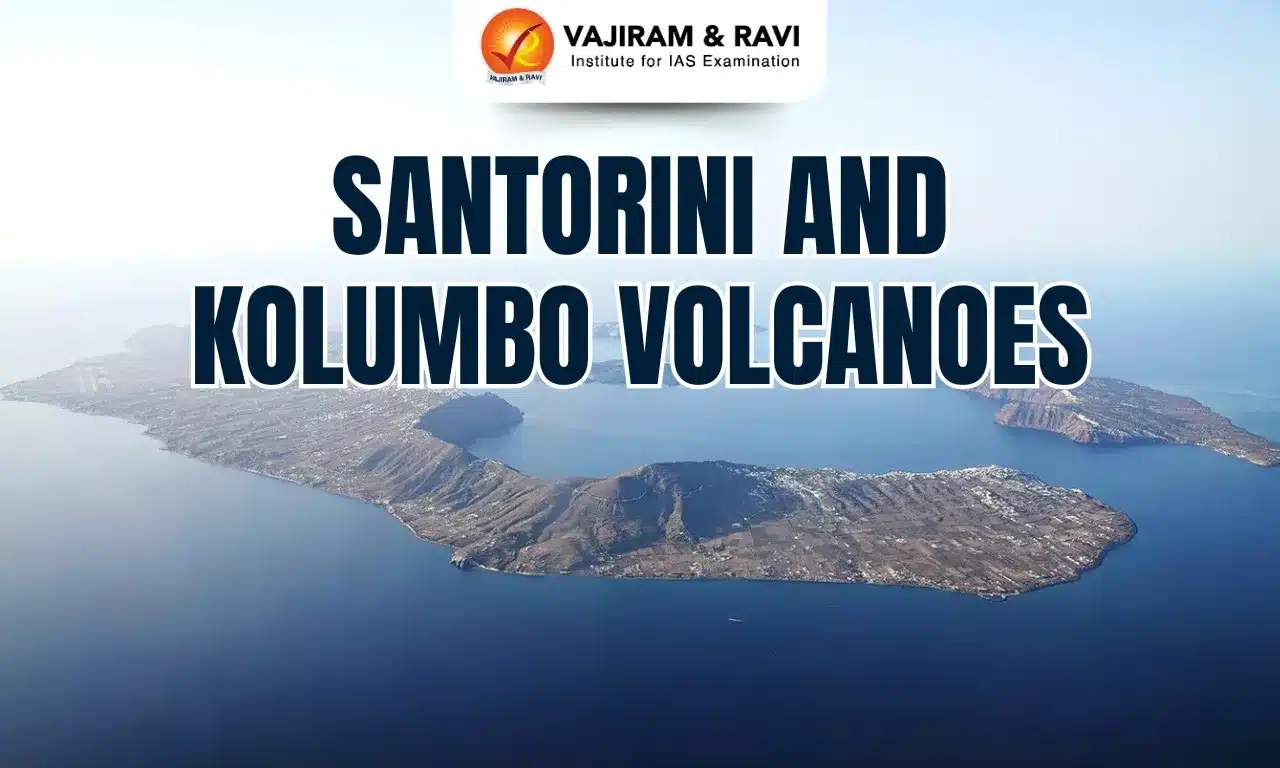
Recently, an earthquake swarm of over 1,200 quakes around Santorini revealed that Santorini and the submerged Kolumbo volcano share an underground magma reservoir.

About Santorini Volcano

  • Located in the southern Aegean Sea, about 200 km southeast of mainland Greece.
  • It is the largest island of a small archipelago, forming the remnant of a volcanic caldera.
  • Part of the South Aegean Volcanic Arc, and the southernmost member of the Cyclades group.
  • Famous for the Minoan (Thera) eruption (~1600 BCE), one of the largest eruptions in recorded history, which contributed to the collapse of the Minoan civilisation and may have triggered a volcanic winter.

About Kolumbo Volcano

  • A submarine volcano located about 7 km northeast of Santorini.
  • Last major eruption: 1650 AD, which caused tsunamis and toxic gas emissions, leading to destruction on Santorini and nearby islands.
  • It forms part of the Christiana-Santorini-Kolumbo (CSK) volcanic field.

Recent Findings

  • This is the first scientific evidence of a magmatic connection between the two volcanoes, complicating eruption prediction and risk assessment.
  • Both volcanoes lie in the Hellenic Volcanic Arc, one of the most active volcanic zones in Europe, making them critical for global geological studies and disaster management planning.
  • Seismic & GPS data (2024–2025): Showed swelling of Santorini due to magma accumulation.
  • Earthquake migration (Jan 2025): Quakes shifted from Santorini toward Kolumbo, while both volcanoes simultaneously deflated, indicating a shared magma source.
  • Significance: Proves that interconnected volcanic systems exist and may behave in coordination (similar to volcanoes in Hawaii, Iceland, and Kamchatka).
  • Calls for real-time, high-resolution monitoring to improve eruption forecasting and minimise risks.

Source: SCN

Santorini and Kolumbo Volcanoes FAQs

Q1: Where are Santorini and Kolumbo volcanoes located?

Ans: They are part of the Hellenic Volcanic Arc in the southern Aegean Sea, about 200 km from mainland Greece.

Q2: What was the historical significance of the Santorini eruption?

Ans: The Minoan eruption (~1600 BCE) devastated the Minoan civilisation, causing earthquakes, tsunamis, and possibly climatic impacts.

Q3: When did Kolumbo last erupt?

Ans: In 1650 AD, a volcanic eruption produced tsunamis and toxic gas emissions that killed people and livestock on nearby islands.

Gaia Telescope 3D Map

Gaia Telescope 3D Map

Gaia Telescope 3D Map Latest News

Recently, a new 3D map created using data from the Gaia Telescope shows stellar nurseries (star-forming regions) within 4,000 light-years of the Sun in all directions.

Latest Development

  • This is the most detailed chart of glowing hydrogen gas clouds, helping scientists understand how stars form and the dynamics of turbulent interstellar gas.
  • The study integrates Gaia dust maps with the radiation impact of 87 massive O-type stars, which emit intense ultraviolet light capable of ionising hydrogen gas.
  • The resulting simulation shows glowing hydrogen clouds, aligning closely with older hydrogen emission maps, but with much higher precision.

About the GAIA Mission

  • Full name: Originally Global Astrometric Interferometer for Astrophysics (GAIA), simplified to Gaia.
  • Launch Year: 2013, by the European Space Agency (ESA).
  • Objective: To create the most precise 3D map of the Milky Way Galaxy through astrometry (measurement of star positions, distances, and movements).
  • Position: Located at Lagrange Point 2 (L2), about 1.5 million km from Earth, providing a stable and unobstructed cosmic view.

Structure and Instruments

  • Twin Telescopes: Capture light from two directions simultaneously.
  • Digital camera: Contains nearly 1 billion pixels, making it the largest camera ever flown in space.
  • Three Main Instruments:
    • Astrometer – Measures precise positions of celestial objects.
    • Photometer – Determines the brightness and temperature of stars.
    • Spectrometer – Identifies chemical composition and radial motion of stars.

Source: SCN

Gaia Telescope 3D Map FAQs

Q1: What is the Gaia Telescope?

Ans: The Gaia Telescope is a space observatory by ESA, designed to create the most precise 3D map of the Milky Way.

Q2: When was Gaia launched?

Ans: It was launched in 2013 by the European Space Agency.

Q3: Where is Gaia located?

Ans: Gaia is positioned at the Lagrange Point 2 (L2), 1.5 million km from Earth.

Q4: What is Gaia’s main contribution to astronomy?

Ans: Gaia provides detailed astrometric data of over 1.8 billion stars, aiding in the study of stellar evolution and galaxy formation.

Grue Jay

Grue Jay

Grue Jay Latest News

Researchers at the University of Texas at Austin have identified the first known hybrid of these species, a bird nicknamed the "Grue Jay," according to a 2025 study published in Ecology and Evolution.

About the Grue Jay

  • The Grue Jay is a rare natural hybrid between the Blue Jay (Cyanocitta cristata) and the Green Jay (Cyanocorax yncas).
  • It displays turquoise-blue plumage with black facial markings, combining features of both parent species.
  • First spotted in San Antonio, Texas (2023) by a homeowner, later confirmed by researchers from the University of Texas at Austin.

Key Features of the Grue Jay

  • Appearance: Body and tail resemble Blue Jay, but the face mask resembles Green Jay.
  • Behaviour: Calls are a blend of both species; they appeared solitary rather than socially integrated.
  • Reproduction: Being a male, it may be capable of reproducing, though hybrid sterility remains a risk.
  • Symbolism: Like other hybrids such as the “Pizzly Bear” (polar bear–grizzly) and “Zonkey” (zebra–donkey), the Grue Jay highlights species interactions under stress.

Source: SCN

Grue Jay FAQs

Q1: What is Grue Jay?

Ans: The Grue Jay is a rare hybrid bird formed from a cross between a Blue Jay and a Green Jay.

Q2: Where was it discovered?

Ans: It was first sighted in San Antonio, Texas, in 2023.

Q3: Why is it significant?

Ans: It is considered a climate change indicator as range shifts due to warming led to the hybridization.

Q4: How long ago did Blue Jays and Green Jays diverge?

Ans: Around 7 million years ago in the late Miocene Epoch.

Hanle Dark Sky Reserve (HDSR)

Hanle Dark Sky Reserve

Hanle Dark Sky Reserve (HDSR) Latest News

The Hanle Dark Sky Reserve (HDSR) in Ladakh recently hosted its third annual Star Party.

About Hanle Dark Sky Reserve (HDSR)

  • The Hanle Dark Sky Reserve (HDSR) was notified in December 2022 by the Government of Ladakh.
  • It is India’s first International Dark Sky Reserve, centred around the Indian Astronomical Observatory (IAO) at Hanle, managed by the Indian Institute of Astrophysics (IIA) under the Department of Science and Technology (DST).
  • The Reserve is a science-driven socio-economic development project, built on two pillars:
    • Curtailing light pollution in the region.
    • Promoting astro-tourism for local livelihood generation.
  • It is part of the Changthang Wildlife Sanctuary, located at 4,500 metres altitude, offering Bortle-1 dark skies (the darkest category).
  • The UT Ladakh administration supports the project by funding astro-tourism initiatives and light management plans.
  • The event was jointly organised by the Indian Institute of Astrophysics (IIA), the Department of Wildlife Protection of UT Ladakh, and the Bhabha Atomic Research Centre (BARC).

What is a Dark Sky Reserve?

  • Defined by the International Dark Sky Association (IDSA) as a large land area (at least 700 km²) with exceptionally dark skies, protected for scientific, cultural, natural, and public enjoyment.
  • Requires:
    • A core area free from light pollution.
    • A surrounding buffer area to protect core values.
    • A Lighting Management Plan (LMP) covering at least 80% population and area.
    • Regular annual reporting to IDSA.

Source: PIB

Foreign Contribution Regulation Act (FCRA) FAQs

Q1: What is Hanle Dark Sky Reserve (HDSR)?

Ans: It is India’s first International Dark Sky Reserve, located in Ladakh, dedicated to astronomy, research, and astro-tourism.

Q2: When was HDSR established?

Ans: It was notified in December 2022 by the Government of Ladakh.

Q3: Why is Hanle ideal for astronomy?

Ans: Its high altitude (4,500 m), dry climate, sparse population, and clear skies make it perfect for observing faint celestial bodies.

India’s Dugong Conservation Reserve

Dugong Conservation Reserve

India’s Dugong Conservation Reserve Latest News

Recently, the International Union for Conservation of Nature (IUCN) has formally adopted a motion recognising India’s first Dugong Conservation Reserve in Palk Bay.

About India’s Dugong Conservation Reserve

  • It is India’s first Dugong Conservation Reserve.
  • It was established on September 21, 2022, by the Tamil Nadu government under the Wildlife Protection Act, 1972,
  • It covers 448.34 sq. km. in northern Palk Bay.
  • The region is home to over 12,250 hectares of seagrass meadows, vital feeding grounds for dugongs (Dugong dugon).       
  • Seagrasses also support a host of other marine species, making the reserve ecologically significant.

Key Facts about Dugong

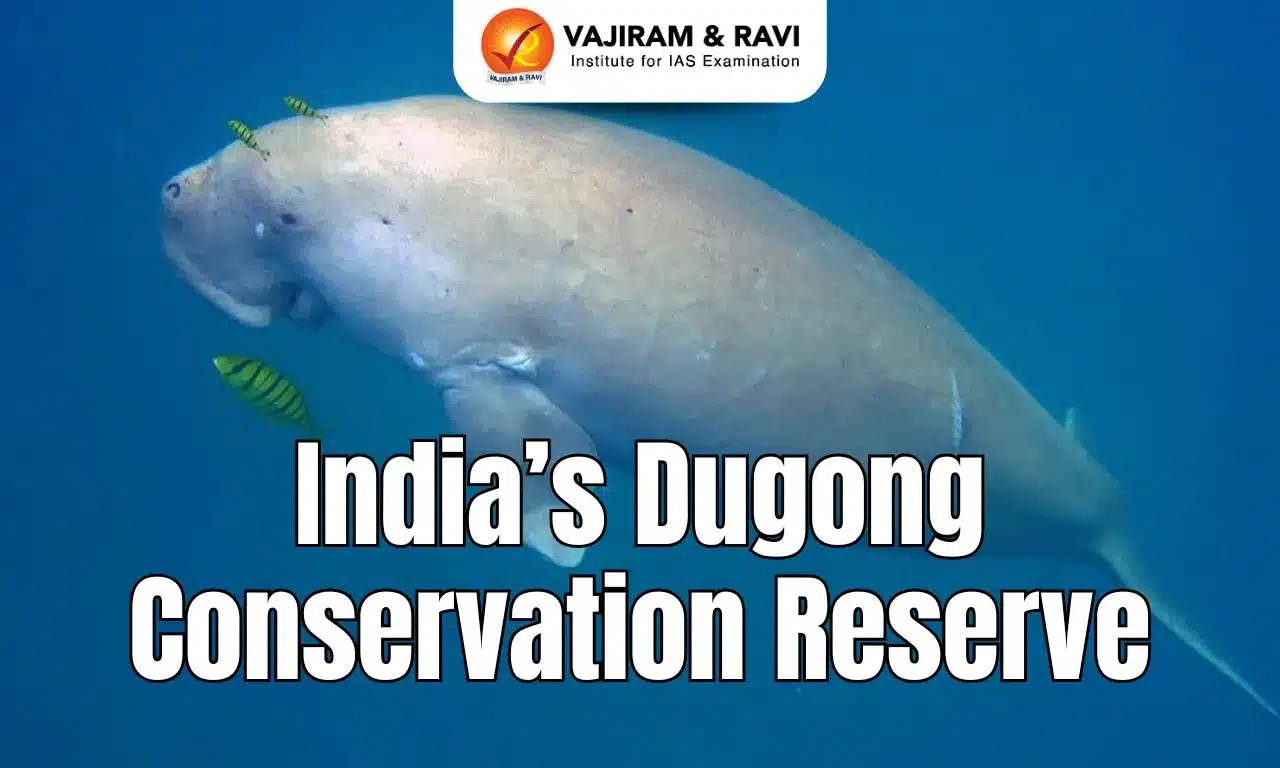
  • Dugongs (Dugong dugon) are the only herbivorous mammals found in India’s marine ecosystems.
  • Appearance: It is known as the sea cow, but resembles a cross between a seal and a whale, and is distributed through the Indo-Pacific region.
  • Distribution: They are found along the Indian coastline, primarily inhabiting warm waters around the Andaman and Nicobar Islands, the Gulf of Mannar, Palk Bay, and the Gulf of Kutch. The dugong is a long-lived species, able to live up to 70 years.
  • Habitat: Dugongs are restricted to shallow waters, where they spend the day feeding on seagrasses of the genera Cymodocea, Halophila, Thalassia, and Halodule.
  • Reproduction of Dugong 
    • Individuals reach reproductive maturity after only nine or ten years and can give birth at intervals of around three to five years.
    • Due to its slow reproductive cycle, extended time to maturity, and infrequent calving, a dugong population’s maximum potential growth rate is estimated to be just about 5% per year.
  • Conservation status of Dugong
    • IUCN: Vulnerable
    • CITES: Appendix I
    • Wildlife Protection Act 1972: Schedule I

Source: TH

India’s Dugong Conservation Reserve FAQ's

Q1: Which is the first state to set up India's first dugong conservation reserve?

Ans: Tamil Nadu

Q2: What is the IUCN status of dugong in India?

Ans: Vulnerable

Aralam Wildlife Sanctuary

Aralam Wildlife Sanctuary

Aralam Wildlife Sanctuary Latest News

Recently, herpetologists surveyed the Aralam Wildlife Sanctuary and documented 16 species of lizards across varied habitats.

About Aralam Wildlife Sanctuary

  • Location: It is located on the western slopes of Western Ghats and is the northern most wildlife sanctuary of Kerala.
  • It was declared a Sanctuary during 1984.
  • Topography:  Its altitude ranges from 650 to 1150m.                                        
  • Rivers: The River Cheenkannipuzha forms the main drainage system on the southern side.  Narikkadavu thodu, Kurukkathodu and Meenumuttithodu from the northern upper reaches flow southwards to join Cheenkannipuzha.
  • Vegetation: The forest types include West Coast tropical evergreen  forest. , West coast semi-evergreen forests, South Indian moist deciduous forest, Southern hilltop evergreen forest and plantations.                                                                                                                        
  • Flora: The major tree species are Artiocarpus heterophyllus, Bishofia javanica, Calophyllum elatum, Cannarium strictum, Cullenia exarillita, Dipterocarpus sp etc.
  • Fauna: Elephant, Gaur, Tiger, Panther,Sambar, Spotted deer, Nilgiri langur, Bonnet macaque, Common langur, Wild dog, common otter, Malabar giant squirrel etc are the major mammals found here.

Source: TH

Aralam Wildlife Sanctuary FAQs

Q1: Where is Aralam Wildlife Sanctuary located?

Ans: Kerala

Q2: What is a notable phenomenon observed in Aralam Wildlife Sanctuary?

Ans: Butterfly migration

Coffee Board of India

Coffee Board of India

Coffee Board of India Latest News

Recently, the Coffee Board of India held capacity-building programmes to increase the number of growers registering on its mobile application for EU Deforestation Regulation compliance.       

About Coffee Board of India

  • It is a statutory organization constituted under Section (4) of the Coffee Act, 1942.
  • Members: The Board comprises 33 members representing all sectors of the coffee industry who are nominated by the central government and hold office for a period of three years.
  • The remaining 32 Members representing various interests are appointed as per provisions under Section 4(2) of the Coffee Act read with Rule 3 of the Coffee Rules, 1955.
  • Functions: The Board is mainly focusing its activities in the areas of research, extension, development, market intelligence, external & internal promotion and welfare measures.
  • Nodal Ministry: It functions under the administrative control of the Ministry of Commerce and Industry, Government of India.
  • Head office: The head office of the Coffee Board is situated in Bangalore.

Key Facts about Coffee cultivation

  • It is a tropical plant generally grown under shady trees.
  • It is grown on hill slopes at elevations from 600 to 1,600 metres above sea level.
  • The vast majority of the world’s coffee comprises two species — Coffea Arabica (Arabica) and Coffea Canephora (Robusta).
  • Distribution: In India coffee is largely cultivated in Karnataka, Kerala, Tamil Nadu, Andhra Pradesh and Odisha, among which, Karnataka produces the most with over 70% of the total output.
  • Required climatic conditions for Coffee cultivation
    • Climate: Hot and humid climate for its growth.
    • Temperatures: Between 15°C and 28 °C
    • Rainfall: 150 to 250 cm.
    • Soil: Well-drained, loamy soil containing a good deal of humus and minerals like iron and calcium are ideal for coffee cultivation.
    • Dry weather is necessary at the time of ripening of the berries.

Source: TH

Coffee Board of India FAQs

Q1: Where is the headquarter of Coffee Board of India?

Ans: Bengaluru

Q2: Which state is the largest producer of coffee in India?

Ans: Karnataka

Ocean Resources, Definition, Types, Biotic & Abiotic Resource

Ocean Resources

Marine resources are the wealth we derive from the oceans, which cover about 70.8% of Earth’s surface and form the planet’s most dominant feature. Oceans are deeply tied to the origin and evolution of life, carrying an ancient history that shaped the world as we know it. Of the four major oceans, the Pacific, Atlantic, Indian, and Arctic, the Pacific stands out as the largest and deepest, named by Ferdinand Magellan in 1520.

Oceans are among the most valuable natural resources on Earth, sustaining billions of people by offering food, livelihoods, and raw materials. Their economic importance is immense, providing fish, fuel, energy sources, medicines, minerals, and even building materials. Offshore drilling extracts crude oil, while mining yields salt, sand, gravel, and metals such as manganese, copper, nickel, iron, and cobalt from the seabed.

Beyond tangible resources, oceans play a crucial role in regulating the planet’s climate. They absorb massive amounts of carbon dioxide, produce much of the world’s oxygen, and influence weather patterns across continents, making them not only an economic asset but also a lifeline for environmental stability.

Ocean Resources Types

The seas and oceans hold a wide variety of resources, both living and non-living, that come from two main sources. First, rivers bring along minerals, organic matter, and other materials as they flow across the land and eventually empty into the sea. These deposits enrich marine waters with essential elements, plants, and animals. Second, marine plants, especially those found in shallow waters, also contribute significantly by producing resources that sustain aquatic life.

Marine resources are generally classified into two categories:

  • Biotic Resources - living resources such as fish, seaweeds, and other marine organisms.
  • Abiotic Resources - non-living resources like minerals, salts, and fossil fuels extracted from the ocean floor.

Oceanic Biotic Resources

Biotic resources are the living organisms found in marine waters. These include phytoplankton, zooplankton, algae, fish, crustaceans, mollusks, corals, reptiles, and even mammals. Together, they form the foundation of marine ecosystems and support food chains that extend from microscopic organisms to large predators like whales.

Plankton in Oceans

Plankton refers to a wide variety of tiny organisms that drift in water and cannot swim against currents. Each individual organism is called a plankter. While most plankton live in aquatic environments, some airborne forms, known as aeroplankton, float in the atmosphere.

Plankton are essential to the marine food chain. They include bacteria, archaea, algae, and protozoa, all of which float in saltwater or brackish estuarine waters. Countless marine animals, from bivalves to fish and whales, depend on plankton as their primary source of food.

Algae in Oceans

Algae are primarily aquatic, photosynthetic organisms with a nucleus, but unlike higher plants, they lack roots, stems, leaves, and specialized reproductive organs. Marine algae are extremely useful to humans.

  • Brown algae produce algin, used as a stabilizer in paints, to strengthen ceramics, and as a thickener in jams.
  • Red algae provide agar and carrageenan. Agar is crucial for bacterial culture in laboratories and is also used in desserts and pharmaceuticals. Carrageenan serves as a stabilizer in ice creams and as an emulsifier in cosmetics and medicines.
  • Sea lettuce is consumed as a flavoring in soups and salads.
  • Kelp can be cultivated for the production of methane gas, which can be converted into energy.

Zooplankton in Oceans

Zooplankton are tiny organisms floating in the water column. They are divided into:

  • Primary consumers that feed on algae.
  • Secondary consumers that feed on other zooplankton.

Together, these groups form the zooplankton community, which includes crustaceans, rotifers, insect larvae, and aquatic mites. Zooplankton are vital links in the aquatic food web. They transfer energy from microscopic algae (the producers) to larger predators like invertebrates and fish. Any change in aquatic habitats directly affects zooplankton populations, making them reliable indicators of environmental disturbances.

Nekton Community in Oceans

Nekton are actively swimming organisms capable of moving against currents. Fish are the most important members of this group.

  • Demersal fish live near or on the seabed.
  • Reef fish are associated with coral ecosystems.
  • Pelagic fish occupy open waters away from both the shore and the seabed.

The pelagic environment, covering about 1,370 million cubic kilometers, is the largest aquatic habitat on Earth and supports nearly 11% of all known fish species.

Benthos Community in Oceans

Benthos are organisms that live on, in, or near the seabed. They play a key role in recycling nutrients and supporting marine food chains.

Types of Benthos:

  • Epifauna live on the surface of the ocean floor, attaching themselves to rocks, shells, or hard surfaces. Examples include oysters, sponges, sea stars, and barnacles.
  • Infauna burrow into sediments and include worms, clams, and other species that build their own communities.

Importance of Benthos:

  • They connect producers like phytoplankton to higher levels in the food chain.
  • Filter feeders such as clams and oysters consume plankton and organic particles.
  • Economically important species such as crabs, striped bass, and croakers depend on benthic organisms for food.
  • Bacteria and decomposers living at the seabed recycle waste, dead plants, and animals, maintaining ecological balance.

Fishing Ocean Resources

Fishing is not limited to catching fish alone. It also includes the capture of other aquatic animals such as mollusks, crustaceans, and echinoderms like starfish and sea urchins. Depending on the type of water body, fishing can be broadly classified into inland fishing and marine fishing.

Fishing Ocean Resources

Inland Fishing

Marine Fishing

Practised in freshwater sources such as rivers, ponds, canals, and reservoirs.

Carried out in seas and oceans where saltwater dominates.

Fish are often raised in controlled environments like tanks or ponds for human consumption.

Large-scale fishing is done using mechanized boats, synthetic nets, and advanced techniques.

Primarily part of commercial freshwater fishing for local markets.

Catches from marine fisheries are often exported to international markets.

Common species include Rohu, Grass Carp, Catla, and Mrigal.

Marine species include catfish, sardines, tuna, mackerel, mollusks, and crustaceans.

Fishing Grounds in Temperate Ocean Regions

Temperate regions across the globe have some of the most productive fishing grounds. Several geographical, biological, and climatic factors make these areas favorable for large-scale fishing.

  • Plankton Availability: Plankton, the microscopic organisms that drift in seawater, form the base of the marine food chain. They are of two types, phytoplankton (plant-like) and zooplankton (animal-like). Zooplankton feed on phytoplankton, and in turn, fish feed on zooplankton. The abundance of plankton in temperate waters makes these regions ideal breeding and feeding zones for fish.
  • Continental Shelves: Temperate regions often have wide continental shelves, providing shallow waters where fish tend to concentrate. These areas are also home to coral reefs and submerged banks, which serve as breeding and nursery grounds for smaller fish species. Famous examples include the Grand Banks of Newfoundland, Georges Bank, and Dogger Bank in the North Sea.
  • Carbon Fixation Rate: The rate of carbon fixation in oceanic waters directly affects plankton growth, and consequently, fish populations. Marine scientists note that a rate below 0.3 g-calorie per cubic meter per day is ideal for sustaining healthy fish stocks. Upwelling systems in temperate zones, like the Benguela Current near Africa and the Canary Current near Europe, provide just the right conditions.
  • Indented Coastlines: Coastlines with natural indentations, bays, or fjords offer excellent shelter for fishing activities. They make it easier to construct ports and protect fishing vessels from storms. Norway and Sweden, with their fjord coastlines, are prime examples of this advantage.
  • Fish Variety and Quality: Temperate seas are rich in edible fish species, unlike some tropical waters where certain species are toxic. This makes fishing more commercially viable in temperate zones.
  • Favorable Climate: Fish spoil quickly, making preservation a major concern. Cool temperate climates act as a natural preservative, allowing catches to last longer. In contrast, tropical regions face greater challenges in storing and transporting fish. This is one reason why the per capita fish catch in temperate areas is higher than in tropical ones.
  • Suitable Topography: Flat and accessible coastal plains in temperate zones provide better conditions for establishing ports, fishing settlements, and related industries. Rugged or inaccessible coastlines, on the other hand, hinder fishing activities.
  • Role of Forests: Forests near coastal regions indirectly support fishing. They supply timber for boats and jetties, regulate sea temperatures, and enrich waters with organic material through weathering. This creates favorable conditions for fish communities to thrive.

Reasons for Backwardness in Commercial Fishing in Tropical Regions

Despite abundant marine waters, fishing in tropical regions faces several challenges that limit its growth. These factors are both natural and socio-economic.

  • Plankton Deficiency: Tropical seas are characterized by high water temperatures, which are not conducive to plankton growth. Since plankton forms the base of the marine food chain, its scarcity leads to lower fish populations and reduced fishery productivity.
  • High Temperature: The extreme heat in tropical regions makes it difficult to preserve fish after capture. Without proper refrigeration or processing facilities, the perishable nature of fish becomes a major obstacle for fishers.
  • Species Diversity: Tropical waters are home to a wide variety of fish species, but many are inedible or even toxic. A significant portion of the catch often goes unused, increasing the overall cost of fish production and reducing efficiency.
  • Absence of Shallow Continental Shelves: Shallow shelves and banks act as breeding and nursery grounds for fish. Tropical seas tend to be deep and lack such structures, limiting fish abundance in easily accessible areas.
  • Lack of Indented Coastlines: Coastlines with natural inlets, bays, or fjords are ideal for constructing fishing harbors. Tropical coasts often lack these features, making fishing operations and port development difficult.
  • Transportation Challenges: Rapid transport of perishable fish is essential for a thriving fishing industry. In tropical areas, poor infrastructure and inaccessible terrain hamper timely transportation, limiting market reach and profitability.
  • Unsanitary Conditions: Tropical regions are prone to epidemics and diseases, which can directly affect fishermen’s health and reduce labor availability for fishing activities.
  • Underdeveloped Economy: The fishing sector in many tropical countries suffers from low investment, limited technology, and lack of modern equipment. The industry is often unorganized, restricting large-scale or efficient operations.
  • Low Investment Capacity: Many fishermen in tropical regions remain economically disadvantaged. Low income prevents them from investing in better boats, nets, or storage facilities, creating a cycle of low output and minimal profit.

Major Fishing Grounds of the World

The world’s most productive fishing regions are distributed across both temperate and tropical oceans. These areas are rich in nutrients and support high fish populations, making them key contributors to global fisheries.

  • North-East Pacific Region: This region stretches from the Aleutian Islands in the north to the Philippines in the south. It also includes the eastern coastal waters of Russia, China, South Korea, Japan, and the Philippines. China, Japan, and South Korea are major contributors, accounting for approximately 13%, 8%, and 3% of the global fish catch, respectively.
  • North-East Atlantic Region: Extending along the European coasts from Portugal to Iceland, this region is dominated by Norway, Great Britain, and Denmark. The North Sea is a particularly significant area due to its rich fish stocks and well-developed fishing infrastructure.
  • North-West Atlantic Region: This area covers the continental shelves along New England in the USA and parts of Canada, including New Brunswick, Nova Scotia, and Newfoundland. The Grand Banks are a key fishing ground here. Productivity is high due to the convergence of the cold Labrador Current with the warm Gulf Stream near Newfoundland, creating nutrient-rich waters.
  • South-East Pacific Region: Stretching along the western coasts of South America, particularly Chile and Peru, this region benefits from upwelling of cold, nutrient-rich waters that support dense fish populations. Peru is especially famous for its fisheries. However, during strong El Niño events, fish populations decline sharply, causing major losses.
  • West-Central Pacific Region: This region extends from the Philippines to the eastern coasts of Australia. The warm, nutrient-rich waters here support a diverse and abundant marine life, making it an important fishing zone in the Pacific.

Ocean Energy Resources

Marine energy, also called ocean energy or marine and hydrokinetic energy, is the power derived from the movement and properties of ocean water. It includes energy from waves, tides, salinity differences, and temperature gradients.

The kinetic energy generated by the continuous movement of ocean waters represents a vast and largely untapped source of power. This energy can be harnessed to produce electricity, which in turn can supply homes, industries, and transportation systems.

Oceans store enormous amounts of energy and are often located near densely populated coastal regions, making them highly suitable for energy extraction. Marine energy has the potential to become a significant renewable energy source, complementing solar, wind, and hydroelectric power globally.

While wave and tidal energy have already been explored under conventional energy resources, another promising method is Ocean Thermal Energy Conversion (OTEC), which utilizes the temperature differences between surface and deep ocean waters to generate power.

Ocean Thermal Energy Conversion (OTEC)

Ocean Thermal Energy Conversion (OTEC) is the process of generating electricity by exploiting the temperature difference between the surface and deeper layers of the ocean. Because it relies on the sun to warm the ocean’s surface, OTEC plants are sometimes referred to as Solar Sea Power plants.

In tropical regions, surface waters are significantly warmer than the deep waters below. This temperature gradient drives the generation of electricity and can also be used for desalinating seawater.

OTEC is a renewable and environmentally friendly energy source with virtually unlimited supply. Despite its potential, widespread adoption has been limited due to the high cost of technology required to harness it. The world’s largest OTEC plant is operated by Makai Ocean Engineering in Kailua-Kona, Hawaii, USA.

Also Check Other Posts
Geomorphology Major Dams in India
Composition and Structure of Atmosphere Major Ports in India
Types of Forests in India Coastal States of India
Ocean Acidification Migration in India
Deep Ocean Mission Natural Vegetation of India

Ocean Resources FAQs

Q1: What are the ocean resources in India?

Ans: India’s ocean resources include fish, seaweeds, minerals, crude oil, natural gas, sand, salt, tidal energy, and marine biodiversity along its 7,500 km coastline.

Q2: Why is the ocean an important resource?

Ans: Oceans provide food, energy, minerals, transportation, climate regulation, and livelihood, making them crucial for economic development and ecological balance.

Q3: What are the resources of the ocean Class 11?

Ans: Class 11 ocean resources include biological (fish, plankton), mineral (manganese nodules, sand), energy (tidal, wave, thermal), and water resources (desalination).

Q4: What is the importance of ocean resources for the future?

Ans: Ocean resources are vital for food security, renewable energy, mineral extraction, trade, and sustaining biodiversity in the face of population growth and climate change.

Q5: What are the main types of ocean resources?

Ans: The main types are biotic (living: fish, algae), abiotic (non-living: oil, minerals), and renewable (tidal, wave energy, desalinated water).


Tungabhadra River

Key Facts about Tungabhadra River

Tungabhadra River Latest News

Police retrieved bodies of three Karnataka youngsters from Tungabhadra river near Mantralayam in Kurnool district recently.

About Tungabhadra River

  • It is a significant peninsular river in southern India, flowing through the states of Karnataka and Andhra Pradesh.
  • It is the principal tributary of the Krishna River.
  • The Hindus consider this river sacred, and there is a mention of the river in the Ramayana, where it is referred to as Pampa. 
  • Course
    • It originates at Koodli, near Shimoga district in the state of Karnataka, where two rivers—the Tunga River and the Bhadra River—meet and give birth to the Tungabhadra.
      • Both the Tunga & Bhadra Rivers originate on the eastern slopes of the Western Ghats.
    • From this starting point, the Tungabhadra River travels a length of 531 km before joining the Krishna River at Sangamaleshwaram in Andhra Pradesh.
    • The Krishna River finally ends in the Bay of Bengal.
    • It runs for 382 km in Karnataka, forms the boundary between Karnataka and Andhra Pradesh for 58 km, and further runs for the next 91 km in Andhra Pradesh.
  • The total catchment area of the river is 69,552 sq.km. up to its confluence with Krishna.
  • The landscape around the Tungabhadra is dominated by massive piles of granite in hues of grey, ochre, and pink. 
  • The locked land that lies in the north of the Tungabhadra River between the Tungabhadra and the Krishna River is called the "Raichur Doab".
  • It is influenced chiefly by the southwest monsoon.
  • Major Tributaries: Varada River and Hagari (Vedathy) River.
  • The river has several dams and reservoirs built on it, including the Tunga Anicut Dam, the Bhadra Dam, the Hemavathy Dam, and the Tungabhadra Dam.
  • The city of Hampi, which was the capital of the Vijayanagara Empire, is located on the banks of the river.

Source: TOI

Tungabhadra River FAQs

Q1: The Tungabhadra River is the principal tributary of which major river?

Ans: Krishna

Q2: Which major historical site is located on the banks of the Tungabhadra River?

Ans: The city of Hampi, which was the capital of the Vijayanagara Empire, is located on the banks of the river.

Q3: How long is the Tungabhadra River before it merges with the Krishna River?

Ans: 531 km

Q4: The Tungabhadra River flows through which states?

Ans: Karnataka and Andhra Pradesh

Financial Intelligence Unit-India

Financial Intelligence Unit-India

Financial Intelligence Unit-India Latest News

Recently, the Department of Telecommunications (DoT) and the Financial Intelligence Unit-India (FIU-IND) signed a comprehensive Memorandum of Understanding (MoU) to enhance data sharing and inter-agency coordination.

About Financial Intelligence Unit-India

  • It was set by the Government of India in 2004.
  • It is the central national agency responsible for receiving, processing, analyzing and disseminating information relating to suspect financial transactions.
  • FIU-IND is an independent body reporting directly to the Economic Intelligence Council (EIC) headed by the Finance Minister.  

Function of Financial Intelligence Unit-India

  • Collection of Information: It acts as the central reception point for receiving Cash Transaction reports (CTRs), Non-Profit Organisation Transaction Report(NTRs), Cross Border Wire Transfer Reports (CBWTRs), Reports on Purchase or Sale of Immovable Property (IPRs) and Suspicious Transaction Reports (STRs) from various reporting entities.
  • Analysis of Information: Analyze received information in order to uncover patterns of transactions suggesting suspicion of money laundering and related crimes.
  • Sharing of Information: It shares information with national intelligence/law enforcement agencies, national regulatory authorities and foreign Financial Intelligence Units.
    Central Repository: It establishes and maintains a national database on the basis of reports received from reporting entities.
  • Coordination: It coordinates and strengthens collection and sharing of financial intelligence through an effective national, regional and global network to combat money laundering and related crimes.
  • Research and Analysis: Monitor and identify strategic key areas on money laundering trends, typologies and developments.

Source: DD News

Financial Intelligence Unit-India FAQs

Q1: When was the Financial Intelligence Unit-India (FIU-IND) established?

Ans: 2004

Q2: Under which ministry is the Financial Intelligence Unit-India (FIU-IND) functioning?

Ans: Ministry of Finance

Daily Editorial Analysis 27 September 2025

Daily Editorial Analysis

The Turmoil in Kathmandu, the Road Ahead for Nepal

Context

  • The political turmoil in Nepal following the Gen Z protests of September 2025 marks a significant turning point in South Asia’s democratic landscape.
  • Unlike previous uprisings in Nepal that were largely steered by political parties, this movement was spearheaded by the younger generation, frustrated with systemic corruption, elite domination, and lack of economic opportunities.
  • The resignation of Prime Minister K.P. Sharma Oli, the swearing-in of former Chief Justice Sushila Karki as interim Prime Minister, and the dissolution of parliament reflect both the fragility and resilience of Nepal’s democratic framework.
  • Placed against the backdrop of wider regional unrest across South Asia in the 2020s, Nepal’s transition underscores broader themes of generational change, institutional weakness, and the struggle for political legitimacy.

Regional Context of Turbulence

  • The upheavals in Nepal cannot be examined in isolation and the wider South Asian region has experienced a wave of political instability throughout the decade.
  • Myanmar reverted to military rule in 2021; Afghanistan fell to the Taliban the same year; Sri Lanka’s Aragalaya protests of 2022 toppled President Gotabaya Rajapaksa.
  • Also, Pakistan witnessed widespread protests in 2023 following the arrest of Imran Khan; and Bangladesh’s Sheikh Hasina resigned under pressure in 2024.
  • Although these events share common threads, particularly the role of disillusioned youth and high youth unemployment, each country’s crisis stems from its unique political trajectory.
  • Myanmar and Pakistan remain dominated by their militaries, Afghanistan continues its cycle of failed foreign interventions, while Sri Lanka and Bangladesh suffered from entrenched dynastic rule.
  • In all cases, however, young populations have emerged as catalysts of change, challenging authoritarianism, corruption, and political inertia.

Nepal’s Distinctive Path

  • Nepal’s political journey diverges from its neighbours in significant ways.
  • Since the 1990 Jan Aandolan, which curtailed monarchical powers and introduced multi-party democracy, Nepal has seen frequent government changes, seven since the adoption of the 2015 constitution alone.
  • This apparent instability masked deeper continuity: the same handful of leaders, from Oli to Prachanda to Sher Bahadur Deuba, repeatedly rotated in office, entrenching corruption and stalling economic growth.
  • The Maoist insurgency (1996–2006) and subsequent peace process transformed Nepal into a republic in 2008, but the promise of stable, inclusive governance has not been realised.
  • Instead, the 2025 protests reflect a rejection not just of a government, but of an entire political class perceived as self-serving and unaccountable.

The Interim Government and its Challenges

  • The intervention of the army in facilitating talks and ensuring security, along with President Ramchandra Paudel’s reliance on military mediation, underscores the fragility of civilian political authority in Nepal.
  • The appointment of Sushila Karki as interim Prime Minister marks a cautious step towards restoring stability.
  • Her three stated priorities, ensuring elections on March 5, 2026; investigating police excesses and protest violence; and tackling high-level corruption, are ambitious yet fraught with difficulty.
  • Nepal’s judicial system lacks mechanisms for fast-track prosecutions, and political gangs infiltrating the protests complicate accountability.
  • More significantly, calls for constitutional amendments risk destabilising the fragile consensus built since 2006.
  • Proposals to abolish federalism or alter proportional representation would alienate marginalised groups such as the Madhesis, Janjatis, and Tharus, potentially reigniting ethnic tensions.

Youth, Democracy, and the Question of Legitimacy

  • At the heart of Nepal’s crisis lies a generational divide. Youth unemployment, exceeding 20%, fuels resentment against a political elite seen as benefiting from cronyism while ignoring structural reforms.
  • The Gen Z protests highlight a hunger for new political platforms, but the challenge remains whether these movements can institutionalise themselves into coherent parties capable of governing.
  • The upcoming elections provide both opportunity and risk. Established parties require time to undergo internal renewal, which veteran leaders may resist.
  • At the same time, new youth-led forces may struggle with organisation, while pro-monarchy factions could attempt to exploit disillusionment.
  • Thus, the March 2026 elections will be a critical test of whether Nepal can transition from protest-driven change to durable democratic renewal.

India’s Role and Regional Implications

  • India, often accused of meddling in Nepal’s affairs, has so far responded with restraint.
  • Prime Minister Narendra Modi’s congratulatory call to Sushila Karki signalled goodwill without overt interference.
  • Given the turbulence across South Asia, stability in Nepal is in India’s interest.
  • A fair and peaceful electoral process would serve as a counter-example to the democratic backsliding seen in neighbouring states.

Conclusion

  • Nepal’s current phase of political transition encapsulates both the promise and peril of generational change in South Asia.
  • While the Gen Z protests have succeeded in breaking the monopoly of entrenched elites, the task ahead lies in converting popular anger into institutional reform without destabilising the fragile democratic consensus.
  • The March 2026 elections will be decisive: if conducted fairly, they could herald a new era of accountable governance; if undermined by opportunism or constitutional adventurism, they risk plunging Nepal back into cycles of instability.

The Turmoil in Kathmandu, the Road Ahead for Nepal FAQs

 Q1. What triggered the Gen Z protests in Nepal in September 2025?
Ans. The protests were triggered by frustration with corruption, lack of accountability, and high youth unemployment.

Q2. Who became Nepal’s interim Prime Minister after K.P. Sharma Oli resigned?
Ans. Former Chief Justice Sushila Karki was sworn in as the interim Prime Minister.

Q3. Why are constitutional amendment proposals seen as risky in Nepal?
Ans. They risk alienating marginalised groups such as the Madhesis, Janjatis, and Tharus, potentially sparking new unrest.

Q4. What are the main priorities of the interim government?
Ans. Its priorities are to conduct elections on March 5, 2026, investigate police excesses and protest violence, and address corruption in high office.

Q5. How has India responded to Nepal’s political crisis?
Ans. India has shown restraint, with Prime Minister Narendra Modi offering support and congratulations to the interim leadership. 

Source: The Hindu


Shaping the Next Chapter of the Indian Story  

Context

  • The leadership of Prime Minister Narendra Modi has often been praised for its charisma and organizational skill.
  • Yet, beneath the spectacle lies a deeper, less acknowledged trait, an ethic of discipline, preparation, and systemic thinking.
  • This professionalism, developed through decades of public service as Chief Minister of Gujarat and later as Prime Minister of India, forms the foundation of his governance style.
  • Modi’s approach, as seen through policy choices and personal habits, highlights a distinctive emphasis on action, inclusion, and institution-building, rather than mere rhetoric.

PM Modi’s Approach Towards Governance

  • Vision Anchored in Duty

    • What sets Modi apart is not simply his ability to capture public imagination but his consistent transformation of vision into functioning systems.
    • His work ethic is evident in his rigorous preparation, as illustrated by personal anecdotes of meetings where hours of study precede discussions.
    • This discipline reflects a larger philosophy: governance should not rest on symbolic gestures but on outcomes that make a tangible difference to citizens.
    • This ethic framed his Independence Day address, which went beyond celebration to outline a charter for shared work.
    • Citizens, scientists, states, and start-ups were invited to participate in the project of Viksit Bharat (a developed India).
    • The speech emphasised practical ambitions, in deep technology, clean energy, and resilient supply chains, with Jan Bhagidari (people’s participation) as the method.
  • Policy as a Living Instrument

    • A central feature of Modi’s governance has been treating policy as adaptive and responsive rather than static.
    • The simplification of the Goods and Services Tax (GST) illustrates this method. By reducing tax slabs and minimizing friction points, the reform lowered compliance burdens on small businesses and ensured quicker benefits to consumers.
    • The focus was not on abstract fiscal calculations but on the experience of everyday citizens and traders.
    • This adaptability also reflects cooperative federalism, the ongoing dialogue between the Centre and states within the GST Council.
    • Rather than preserving rigid uniformity, policy here becomes a living instrument, tuned to the rhythm of the economy.
    • It is governance designed for responsiveness rather than permanence on paper.
  • Citizen-Centric Systems

    • Perhaps the most transformative legacy of recent years lies in the creation of systems that empower citizens at scale.
    • The triad of digital identity (Aadhaar), universal bank accounts, and real-time payments has redefined inclusion by embedding it into infrastructure.
    • Benefits now reach verified citizens directly, reducing leakages and ensuring predictability for small businesses.
    • Data, not anecdotes, shapes policy design. The principle of Antyodaya, uplifting the last citizen, is not just a rhetorical flourish but a litmus test for every programme reaching the Prime Minister’s Office.
    • A striking example of this citizen focus was seen during the launch of India’s first bamboo-based 2G ethanol plant in Assam.

Some Other PM Modi’s Commendable Governance Approach

  • Clarity in Economic and Strategic Statecraft

    • This clarity extends beyond domestic policy to India’s external engagements.
    • In energy, India has pursued a diversified supplier basket, ensuring affordability and stability during global volatility.
    • Negotiations abroad were guided by a simple but powerful brief: secure supplies, protect consumers, and prioritise national interest.
    • National security has been approached in the same manner, without unnecessary drama but with resolve and restraint.
    • Operations are defined by clear objectives, operational freedom for security forces, and protection of civilians.
    • Once again, the ethic is evident: outcomes matter more than posturing.
  • A Distinctive Work Culture

    • Behind these decisions lies a distinctive working style. Modi cultivates an environment where discussions are rigorous but respectful, where the best argument, not the loudest, prevails.
    • Preparation is rewarded, responsibility is clearly assigned, and follow-up is relentless. In this culture, drift is not tolerated, and performance is measured against defined metrics.
    • This ethos points to a broader philosophy of institution-building.
    • Modi’s birthday coincides with Vishwakarma Jayanti, a symbolic reminder that lasting monuments in public life are not statues or spectacles but institutions, platforms, and standards that endure.
    • For citizens, this translates into services delivered efficiently and affordably. For businesses, it means clarity of policy and predictability.
    • For the state, it means systems that withstand stress and evolve over time.

Conclusion

  • PM Modi’s leadership is defined by an ethic of hard work, attention to detail, and a citizen-first orientation.
  • By embedding inclusion into infrastructure, treating policy as adaptive, and developing a culture of rigorous preparation, Modi has sought to build durable institutions rather than transient symbols.
  • In doing so, he is shaping not just the current political moment but potentially the next chapter of India’s developmental story.

Shaping the Next Chapter of the Indian Story FAQs

Q1. What distinguishes Narendra Modi’s leadership style according to the analysis?
Ans. Narendra Modi’s leadership is distinguished by discipline, rigorous preparation, and the ability to turn vision into durable systems rather than relying on spectacle. 

Q2. How does Modi treat policy-making?
Ans. Modi treats policy-making as a living and adaptive instrument, designed to respond to real conditions rather than remaining static on paper.

Q3. What role does technology play in Modi’s governance approach?
Ans. Technology in Modi’s governance is used to create citizen-centric systems, such as digital identity, bank accounts, and real-time payments, which ensure inclusion and reduce leakages.

Q4. How is national security described in his working style?
Ans. National security under Modi is described as firm yet restrained, with clear objectives, operational freedom for forces, and protection of civilians.

Q5. What lasting legacy does Modi aim to build according to the text?
Ans. Modi aims to build enduring institutions, platforms, and standards that provide reliable benefits for citizens, businesses, and the state.

Source: The Hindu


China’s WTO Concession and Implications for India

Context:

  • China’s announcement at the UN General Assembly that it will no longer seek Special and Differential Treatment (SDT) in future WTO negotiations marks a significant shift in global trade dynamics.
  • This decision comes amid US tariff pressures and criticisms of SDT exploitation.
  • The development has direct implications for India, which continues to rely heavily on SDT flexibilities to safeguard its agricultural and social welfare priorities.

SDT and China’s Tactical Retreat:

  • What is SDT?

    • SDT refers to provisions within World Trade Organisation (WTO) agreements that grant developing countries and Least-Developed Countries (LDCs) special rights and more favorable treatment.
    • These include longer implementation periods, preferential access to markets, and support for capacity building to help them participate in global trade and economic development.
    • The aim is to recognise the differing economic capacities between developed and developing nations and create a more equitable trading system.
  • China’s retreat:

    • China’s decision, while preserving its self-declared developing country status and all existing perks (such as lenient subsidy caps), is a tactical retreat amid long-standing US objections to the practice.
    • While the WTO lauded it as a breakthrough for reform, sceptics see it as symbolic window-dressing, allowing China to deflect criticism without dismantling its agricultural and industrial advantages.

Implications for India:

  • Rising external pressure:

    • President Donald Trump has announced a fresh salvo of 100% tariffs on branded and patented pharmaceutical products and also announced broader tariffs on furniture, kitchen cabinets, and trucks.
    • Growing calls for India to shed its developing country status as its economy expands.
  • India’s dependence on SDT:

    • SDT, which is rooted in the GATT legacy, offers flexibilities such as higher tariffs and longer compliance periods.
    • These concessions are crucial for protecting vulnerable populations in a country where per capita income ranks 136th globally.

Agriculture at the Core of the Debate:

  • Agriculture employs around half of India’s workforce and underpins the food security of 1.4 billion people.
  • Under the WTO’s Agreement on Agriculture (AoA), the trade-distorting Amber Box caps subsidies at 10% of production value for developing countries (versus 5% for developed ones).
  • India leverages Article 6.2 exemptions for input subsidies to low-income farmers, channeling over $40 billion annually through mechanisms like Minimum Support Prices (MSP) for staples such as rice and wheat.
  • These support the Public Distribution System (PDS), distributing subsidised grains to 800 million beneficiaries.

Hypocrisy of Developed Nations:

  • The 1986-88 reference prices: Inflate India’s reported Aggregate Measurement of Support (AMS), often exceeding the 10% threshold — drawing fire from the US and the Cairns Group for alleged market distortion.
  • Double standards of developed nations: They provided $850 billion in global farm subsidies in 2023 (as per OECD estimates), protecting their own programmes through Green Box loopholes for research and environmental aid.

Risks of Forced Graduation from SDT:

  • Phased AMS reductions could slash subsidies by 20-30% over a decade, leading to a 10-15% drop in rural incomes and heightened food price volatility.
  • Malnutrition, affecting 35% of children under five, might worsen, undermining the National Food Security Act.
  • Recent WTO disputes, like the 2023 sugar subsidy panel, underscore these vulnerabilities.

Strategic Options for India:

  • Agriculture:

    • India should strive to lead the G33 coalition to extend the 2013 Bali Ministerial’s interim “peace clause” on public stockholding beyond 2023, shielding MSP and PDS from WTO disputes until 2030.
    • Transition input subsidies to Green Box measures (research, climate-resilient crops).
    • It can also advocate for updating AoA reference prices to reflect current market realities.
  • E-Commerce:

    • India should join plurilateral e-commerce talks, offering commitments on consumer protection and cross-border data flows in exchange for tariff-free access to developed markets.
    • Expand the Open Network for Digital Commerce (ONDC) to empower MSMEs in global e-commerce, and reduce reliance on SDT tariff protections.
    • India should propose tiered data regulations in WTO talks, allowing developing nations longer transition periods to comply with global standards, preserving India’s Personal Data Protection Act.
  • Selective SDT phase-out:

    • Reduce protections in non-core sectors for better market access.
    • Retain exemptions for agriculture and vulnerable sectors.
    • Use Green Box funds for cold storage and processing to boost exports.
  • Intellectual property:

    • India must maintain compulsory licensing and patent opposition provisions under TRIPS Article 31, citing public health needs for 1.4 billion people (as affirmed in the Doha Declaration, 2001).
    • India should offer phased alignment with stricter IP rules in non-critical sectors to secure concessions in other areas of strength.
    • India should increase Green Box-style funding for biotech innovation, reducing dependence on generic exports while preserving access for low-income populations.
  • Reforming SDT framework:

    • India should propose a tiered SDT framework based on per capita GDP or sectoral competitiveness, allowing India to retain agricultural protections.

Conclusion:

  • India faces mounting pressure to reduce dependence on SDT, but its demographic, agrarian, and developmental constraints make abrupt withdrawal risky.
  • India’s services dominance (55% of GDP) offers leverage, and reforms like DBT (covering 90% of fertiliser subsidies) can also help.
  • A calibrated strategy can safeguard food security while boosting global competitiveness.
  • Rather than resisting inevitable change, India must proactively shape WTO reforms, positioning itself as a middle power that bridges growth and equity in global trade governance.

China’s WTO Concession and Implications for India FAQs

 Q1. Why is China’s decision to forego SDT in future WTO negotiations significant?

Ans. It signals a tactical retreat under US pressure, reshaping WTO reform debates and increasing pressure on other emerging economies like India.

Q2. How does SDT support India’s developmental priorities?

Ans. SDT allows India flexibilities such as higher tariffs and longer compliance timelines, which are vital to protect its agriculture-dependent workforce and ensure food security.

Q3. What challenges does India face if coerced into graduating from developing country status at the WTO?

Ans. Forced graduation could mandate subsidy cuts of 20–30%, reduce rural incomes, heighten food price volatility, and worsen malnutrition.

Q4. What is the role of agriculture in shaping India’s stance on WTO negotiations?

Ans. Agriculture employs ~50% of India’s workforce and sustains MSP and PDS programmes, making SDT crucial for protecting farm subsidies.

Q5. What strategies can India adopt to balance its reliance on SDT with global trade obligations?

Ans. India can extend the Bali “peace clause,” shift subsidies to Green Box categories, negotiate flexibilities in e-commerce and data regulation, etc.

Source: IE

Daily Editorial Analysis 27 September 2025 FAQs

Q1: What is editorial analysis?

Ans: Editorial analysis is the critical examination and interpretation of newspaper editorials to extract key insights, arguments, and perspectives relevant to UPSC preparation.

Q2: What is an editorial analyst?

Ans: An editorial analyst is someone who studies and breaks down editorials to highlight their relevance, structure, and usefulness for competitive exams like the UPSC.

Q3: What is an editorial for UPSC?

Ans: For UPSC, an editorial refers to opinion-based articles in reputed newspapers that provide analysis on current affairs, governance, policy, and socio-economic issues.

Q4: What are the sources of UPSC Editorial Analysis?

Ans: Key sources include editorials from The Hindu and Indian Express.

Q5: Can Editorial Analysis help in Mains Answer Writing?

Ans: Yes, editorial analysis enhances content quality, analytical depth, and structure in Mains answer writing.

IAF Restructures Fighter Fleet After MiG-21 Retirement

IAF Fighter Fleet Restructuring

IAF Fighter Fleet Restructuring Latest News

  • On September 26, the Indian Air Force formally retired its iconic MiG-21 fighter jets, with the last two squadrons — No. 23 (Panthers) and No. 3 (Cobras), operating 36 jets — decommissioned in Chandigarh. 
  • The move marks the end of a Soviet-era legacy but also highlights the IAF’s shrinking squadron strength, underscoring the challenges it faces in modernising its fleet.

MiG-21: India’s Trusted but Controversial Fighter

  • Inducted in 1963 as cutting-edge interceptors, MiG-21s became the backbone of the Indian Air Force, fighting in the 1965, 1971, and Kargil wars. 
  • Over 700 jets of various variants were procured, with the latest Bison upgrades adding advanced avionics, radar, and missiles. 
  • However, engine flaws plagued the single-engine aircraft, contributing to over 500 crashes and 170 pilot deaths in six decades, including more than 20 since 2010. 
  • Despite this record, many IAF veterans argue the MiG-21’s performance and longevity make its safety record better than often perceived.

IAF’s Fighter Shortfall and Growing Reliance on Air Defence

  • The retirement of the MiG-21s has reduced the Indian Air Force’s strength to 29 fighter squadrons, well below the sanctioned 42 — a target that has never been met. 
  • This decline poses serious concerns, especially in the event of a simultaneous conflict with Pakistan and China. 
  • While Pakistan maintains an estimated 20–25 squadrons, China’s strength exceeds 60, giving both adversaries a numerical edge. 
    • Each squadron comprises 16–18 jets, making the shortfall significant.
  • The challenge will deepen in the coming decade, as several older aircraft — including the MiG-29s, Jaguars, and Mirage 2000s — are slated for phase-out by 2035. 
  • Unless new fighters are inducted soon, India risks falling further behind its regional rivals in air power.

Focus on Air Defence

  • Given this reality, military planners are currently focused on bolstering India’s air defence capabilities to offset the shortage of fighters. 
  • Advanced systems like the Russian S-400 mobile surface-to-air missile (SAM) systems, despite U.S. opposition, have been inducted into service. 
  • Additionally, India’s indigenous Akashteer air-defence system has been deployed. 
  • Both systems demonstrated their effectiveness during Operation Sindoor, underscoring their role as critical stopgaps in safeguarding India’s skies until new fighter jets can fill the squadron gap.

Rebuilding IAF’s Fighter Fleet: Indigenous and Global Plans

  • To address its shrinking fighter fleet, the IAF is banking heavily on indigenous aircraft
  • Currently operating two squadrons of Tejas Mk1, the IAF is set to induct 180 upgraded Tejas Mk1A jets from HAL. 
    • The Mk1A brings advanced features such as AESA radar, an electronic warfare suite with jammers, and enhanced beyond-visual-range (BVR) capabilities through Derby and ASTRA missile integration. 
  • In addition, HAL is working on Tejas Mk2 and the fifth-generation stealth Advanced Medium Combat Aircraft (AMCA), expected to join the IAF in the next decade.

Global Fighter Procurement Plans

  • Alongside indigenous projects, the IAF is also pursuing the acquisition of 114 fighters from global manufacturers. 
  • The Dassault Rafale is reportedly the frontrunner, with plans to procure some jets in flyaway condition for immediate reinforcement. 
  • The majority, however, will likely be manufactured in India under a partnership between Dassault and Indian firms, strengthening the domestic defence ecosystem.

Su-30MKI Upgrades

  • India also intends to modernise its existing fleet of 84 Su-30MKI aircraft under the “Super-30” program. 
  • This upgrade aims to extend their service life and enhance combat effectiveness, ensuring they remain a backbone of the IAF until newer platforms are fully inducted.

Persistent Delays in Aircraft Induction

  • The Indian Air Force continues to grapple with delays in aircraft development and delivery, forcing the MiG-21 to remain operational well beyond its planned phase-out due to the lack of replacements.

The LCA and Tejas Mk1A Delays

  • The LCA program, conceived in the 1980s, has seen repeated setbacks. 
  • Out of 40 Tejas Mk1 jets ordered in 2006 and 2010, only 38 have been delivered so far. 
  • The Tejas Mk1A, expected earlier, will see its first two deliveries in October after a two-year delay caused by late procurement of F404 engines from GE Aerospace and issues in weapons and radar integration. 
  • HAL now plans to manufacture 16 aircraft annually, but even then, deliveries may extend into the mid-2030s, beyond the original 2030 target.

Engine and Technology Transfer Challenges

  • Negotiations between HAL and GE over co-production of F414 engines for the Tejas Mk2 remain slow, despite a deal signed two years ago that promised 80% technology transfer. This delay hampers progress on the Mk2 program.

AMCA and Foreign Fighter Procurement Uncertainty

  • The AMCA, India’s ambitious fifth-generation fighter project, is still in its development phase, with even a prototype several years away. 
  • At the same time, the deal to acquire 114 foreign fighters remains unsigned, further delaying critical reinforcements to the IAF’s dwindling squadrons.

Source: IE | IE

IAF Fighter Fleet Restructuring FAQs

Q1: Why did the IAF retire the MiG-21?

Ans: The MiG-21 was retired due to safety concerns, outdated technology, and the need to modernise the IAF fleet with advanced indigenous and global fighters.

Q2: How has the MiG-21 shaped India’s defence history?

Ans: Since 1963, MiG-21s fought in the 1965, 1971, and Kargil wars, serving as India’s backbone despite accidents and engine issues.

Q3: What is the IAF’s current squadron strength?

Ans: The IAF now has 29 squadrons, far below the sanctioned 42, creating risks during a potential two-front conflict with Pakistan and China.

Q4: How will India rebuild its fighter fleet?

Ans: Plans include inducting 180 Tejas Mk1A jets, developing Tejas Mk2 and AMCA, acquiring 114 foreign fighters, and upgrading 84 Su-30MKI under the Super-30 program.

Q5: What challenges remain for the IAF?

Ans: Persistent delays in Tejas deliveries, slow technology transfer for engines, and uncertainty in AMCA and foreign fighter deals hinder timely modernisation.

India–EU Strategic Agenda: Trade, Technology, Defence, and Connectivity

India–EU Strategic Agenda

India–EU Strategic Agenda Latest News

  • As the U.S. under President Trump disrupts long-standing global alignments, Europe is presenting itself as a stable and reliable partner for India. 
  • This shift is underscored by the upcoming India–EU leaders’ summit scheduled for February 2026, which will build upon European Commission President Ursula von der Leyen’s earlier visit to India.
  • The EU has also released a strategic agenda outlining its vision for ties with India, anchored on five key pillars and a commitment to mutual benefit. 
  • This framework signals Europe’s intent to position itself as India’s “all-weather” friend and a counterbalance to the uncertainties in U.S. foreign policy.

Five Pillars of the New India–EU Strategic Agenda

  • The India–EU Strategic Agenda is built on five core pillars:
    • Prosperity and Sustainability – covering trade, investment, resilient supply chains, and sustainable development.
    • Technology and Innovation – focusing on critical technologies, digital infrastructure, and joint research.
    • Security and Defence – emphasising new agreements, regional stability, and countering traditional and hybrid threats.
    • Connectivity and Global Issues – strengthening cooperation in third countries and global governance.
    • Enablers Across Pillars – promoting skills mobility, mutual understanding, business linkages, research collaboration, and stronger institutional frameworks for EU–India relations.

Prosperity and Sustainability: Strengthening India–EU Economic and Trade Ties

  • The EU is India’s largest trading partner, while India is the EU’s biggest partner in the Global South. 
  • In 2024, bilateral trade in goods reached €120 billion — a 90% rise over the past decade — with services adding another €60 billion. 
  • Nearly 6,000 European companies operate in India, directly employing 3 million people and indirectly supporting millions more. 
  • EU foreign direct investment has surged to €140 billion in 2023, nearly doubling in five years.
  • Despite these gains, India accounts for less than 2.5% of the EU’s trade, and Indian investment in the EU stands at only €10 billion. 
  • To expand ties, both sides are pushing to finalise a Free Trade Agreement (FTA) by 2025 to cut tariff and non-tariff barriers. 
  • They are also negotiating an Investment Protection Agreement, a bilateral macroeconomic dialogue, a Geographical Indications pact, and a comprehensive air transport agreement, all aimed at deepening economic cooperation.

India–EU Collaboration on Emerging Technologies

  • India and the EU are leveraging complementary strengths to drive innovation. 
  • The EU offers world-class research, regulation, and green-digital expertise, while India contributes a skilled workforce, vast datasets, a thriving startup ecosystem, and frugal innovation.
  • Planned initiatives include EU-India Innovation Hubs for key technologies and an EU-India Startup Partnership with the European Innovation Council and Start-up India. 
  • Cooperation will focus on AI, particularly large language models, multilingual datasets, and AI applications in healthcare, agriculture, and climate action.
  • Both sides are working on safeguards to prevent unauthorised transfer or misuse of sensitive technologies, aligning with global stability and democratic values. 
  • Additionally, the Euratom-India agreement will boost collaboration in peaceful nuclear energy, including reactor safety, waste management, nuclear security, and fusion research. 

India–EU Connectivity and Strategic Corridors

  • The EU’s Global Gateway initiative (€300 billion) and India’s MAHASAGAR programme provide strong platforms for joint connectivity efforts. 
  • Their 2021 Connectivity Partnership has laid the foundation for cooperation in energy, transport, and digital infrastructure.
  • A flagship project is the India-Middle East-Europe Economic Corridor (IMEC), which integrates maritime, rail, digital, energy, and clean hydrogen networks to revive historic Eurasian trade routes. 
  • Within this, the EU-Africa-India Digital Corridor is advancing through the 11,700 km Blue Raman submarine cable system, linking Europe and India via the Mediterranean, Middle East, and East Africa. 
    • This will ensure ultrafast, secure, and resilient data connectivity.
  • Additionally, India and the EU are developing Green Shipping Corridors to promote sustainable maritime trade and reduce reliance on carbon-intensive transport routes, further boosting commercial and strategic opportunities. 

Deepening India–EU Security and Defence Cooperation

  • India and the EU are strengthening ties through the Strategic Dialogue on Foreign and Security Policy (2025), with thematic discussions on maritime security, cybersecurity, counterterrorism, and non-proliferation. 
  • A formal EU-India Security and Defence Partnership is under consideration.
  • Both sides are negotiating a Security of Information Agreement to enable classified information sharing. 
  • Cooperation will also expand in the Indo-Pacific, with proposed arrangements between the EU Naval Force and Indian Navy to boost coordination in the western Indian Ocean.
  • Joint efforts include combating terrorism, terror financing, online propaganda, drug trafficking, and risks from emerging technologies.
  • On the industrial front, increased collaboration between Indian and EU defence industries aims to strengthen supply chain security, boost innovation, and expand production capabilities. 
  • Plans include establishing an EU-India Defence Industry Forum to connect businesses, share best practices, and explore cooperation opportunities.

Strengthening India–EU People-to-People Ties

  • India and the EU are deepening social and cultural links. 
  • In 2023, 825,000 Indians lived in the EU, forming the largest group receiving Blue Cards and intra-corporate transfer permits. 
  • Travel has become easier, with nearly one million Schengen visas issued in 2024, many as multiple-entry.
  • Educational exchanges are expanding through initiatives like the Union of Skills and Erasmus, making Europe more attractive for Indian students amid U.S. restrictions under Trump.

Source: IE | ORF

India–EU Strategic Agenda FAQs

Q1: What are the five pillars of the India–EU Strategic Agenda?

Ans: They include prosperity and sustainability, technology and innovation, security and defence, connectivity and global issues, and enabling frameworks across all areas.

Q2: How strong are India–EU trade relations?

Ans: The EU is India’s largest trading partner, with €120 billion in goods trade in 2024, €60 billion in services, and €140 billion in EU FDI.

Q3: What role does technology play in India–EU ties?

Ans: Both sides collaborate on AI, digital infrastructure, startups, and nuclear energy research, supported by Innovation Hubs and an EU-India Startup Partnership.

Q4: What is the significance of the India-Middle East-Europe Economic Corridor (IMEC)?

Ans: IMEC integrates maritime, rail, energy, and digital infrastructure to revive Eurasian trade routes and improve connectivity between India, Europe, and Africa.

Q5: How are people-to-people links being strengthened?

Ans: With 825,000 Indians in the EU, rising Schengen visas, and student exchanges like Erasmus, migration and education are central to deeper bilateral ties.

Chero Archers – Honouring Jharkhand’s Warrior Heritage

Chero Archers

Chero Archers Latest News

  • The Jharkhand archery team has been named “Chero Archers” in the inaugural Archery Premier League (APL), paying tribute to the legendary Chero warrior clan known for their defiance against the Mughals and British.

About Chero Warrior Clan: A Historical Overview

  • The Cheros were a warrior community that rose to prominence in the medieval period. 
  • Predominantly found in Palamu (Jharkhand), Shahabad (Bihar), and parts of eastern Uttar Pradesh, they were known for their courage, skill with bows and arrows, and their ability to defend their territories against external forces.
  • Resistance against the Mughals
    • During the 16th and 17th centuries, the Cheros fiercely resisted Mughal expansion in eastern India. 
    • Palamu, under the rule of Chero King Medini Rai, became a symbol of defiance. Medini Rai fortified the Palamu forts and challenged Mughal armies led by generals under Emperor Aurangzeb. 
    • Although the forts were eventually captured, the Cheros’ resistance highlighted their martial spirit and determination to remain independent.
  • Defiance against British Colonial Rule
    • The Cheros were equally hostile toward British colonial expansion. 
    • In the late 18th and early 19th centuries, they joined forces with other tribal communities like the Santhals, Mundas, and Oraons in rebellions against British land revenue policies and forest exploitation. 
    • Their familiarity with the rugged terrain of Jharkhand and mastery of archery made them formidable guerrilla fighters.
  • Symbol of Tribal Identity
    • Over time, the Cheros came to represent resistance, valour, and identity for Jharkhand’s tribal population. 
    • Their martial traditions have been celebrated in folklore, songs, and oral histories passed down through generations.

Archery in Jharkhand: A Natural Legacy

  • Archery has always been more than a sport for Jharkhand’s tribal communities. It has been a way of life, a survival skill, and a cultural practice.
  • Traditional Significance: For centuries, bows and arrows were used for hunting and self-defence in the forests of Jharkhand.
  • Sporting Excellence: Jharkhand has produced some of India’s finest archers, including Deepika Kumari and Komalika Bari, who rose from humble tribal backgrounds to international fame.
  • Grassroots Training: Many villages in Jharkhand continue to train young children in archery using bamboo bows, symbolising both tradition and aspiration.
  • By naming its team the Chero Archers, Jharkhand has merged this ancient martial practice with modern sporting aspirations, ensuring that the legacy of the warrior clan finds renewed relevance in today’s context.

News Summary

  • The Archery Premier League (APL) is India’s newest sporting initiative, modelled on the franchise system that has boosted cricket and kabaddi. 
  • Jharkhand’s franchise, named Chero Archers, is not only a nod to the State’s dominance in archery but also a deliberate cultural assertion.
  • Tribute to Warrior Heritage: The team’s name commemorates the Chero warrior clan, whose martial legacy continues to inspire pride in the region.
  • Promoting Cultural Identity: By associating the team with the Cheros, Jharkhand is strengthening its tribal narrative in a national sporting arena.
  • Boost to Sports Tourism: The APL is expected to attract attention to Jharkhand’s rich history and its tradition of producing world-class archers.
  • Empowering Youth: The initiative provides an opportunity for tribal youth to connect with their heritage while pursuing sporting excellence at the professional level.
  • This symbolic gesture resonates deeply with Jharkhand’s population, where history and modernity are often woven together in narratives of struggle and achievement.

Significance of the Move

  • Cultural Revival: The move ensures that the memory of Chero warriors is not confined to history books but celebrated in a contemporary context.
  • Sports and Identity: It bridges the gap between traditional tribal identity and modern sports culture, making archery both a cultural and professional aspiration.
  • Inspirational Symbol: For the younger generation, the “Chero Archers” brand serves as a reminder of resilience, courage, and excellence.
  • National Spotlight: By honouring its indigenous warrior clan, Jharkhand has set a precedent for other States to celebrate local heroes in national sports events.

Source: IE

Chero Archers FAQs

Q1: Who were the Chero warriors?

Ans: The Cheros were a medieval warrior clan known for resisting Mughal and British expansion in Jharkhand, Bihar, and Uttar Pradesh.

Q2: Why is Jharkhand’s archery team named “Chero Archers”?

Ans: The team’s name honors the martial traditions of the Chero clan and their cultural significance in Jharkhand.

Q3: What is the Archery Premier League (APL)?

Ans: The APL is India’s franchise-based professional archery league, modeled on successful formats like the IPL.

Q4: What role did the Cheros play in history?

Ans: The Cheros, under leaders like Medini Rai, fought against Mughal armies and later resisted British colonial policies.

Q5: How is archery linked to Jharkhand’s tribal culture?

Ans: Archery has been a traditional skill among Jharkhand’s tribal communities and has produced world-class athletes like Deepika Kumari.

Blue Revolution In India, History, Features, Objectives, Importance

Blue Revolution

The Blue Revolution was a major step taken by the Indian government to increase the fish production and improve the livelihoods of those involved in aquaculture. It focused on the overall development of both marine and inland fisheries by supporting infrastructure, providing financial assistance, and promoting modern techniques. Father of Blue Revolution was Dr. Hiralal Chaudhuri. In the early 1980s, India saw a decrease in fish production due to poor management practices. But with sustained efforts under this initiative, aquaculture productivity saw a remarkable improvement, almost a 50% rise over time.

By 2017, the production of fish, shellfish, and seaweed had grown by about 5.8%. Aquaculture, as a result of this movement, became a major source of fish supply globally, contributing to a steady annual rise of 3.1% in global fish consumption.

Blue Revolution

In India, the Blue Revolution also called the Neel or Nili Kranti Mission was launched during the 7th Five-Year Plan, between 1985 and 1990. Its core aim was to increase fish production, improve livelihoods in the fisheries sector, and ultimately help farmers earn more.

The mission focused on expanding and managing both inland and marine fisheries through better infrastructure, scientific methods, and sustainable practices. The overall program is handled by the Ministry of Fisheries, Animal Husbandry, and Dairying under the banner Blue Revolution: Integrated Development and Management of Fisheries.

Also Check:

Blue Revolution in India History

  • The Blue Revolution began in India during the 1980s to increase fish production through scientific aquaculture.
  • It responded to the growing demand for fish as a protein source and aimed to uplift fishing-dependent communities.
  • The focus was on modernizing the fisheries sector using advanced techniques, sustainable practices, and efficient resource management.
  • It encouraged both inland and marine aquaculture, helping expand the overall scope of fish farming in the country.
  • The initiative played a key role in improving food security and nutrition across regions.
  • It also contributed significantly to rural development by increasing income opportunities in coastal and inland areas.

Blue Revolution Features

  • Modern Fish Farming Methods: Use of advanced tools and techniques like high-density fish stocking and scientific breeding to push fish production to the next level.
  • Focus on Sustainability: Encourages responsible fishing and farming that doesn’t harm ecosystems, so aquatic life and livelihoods can thrive long-term.
  • Better Coastal Management: Aligns fish farming with smart use of coastal zones, aiming to protect shorelines while promoting marine productivity.
  • Stronger Infrastructure: Expands cold storage, processing units, and transport facilities to keep the supply chain efficient and cut down post-harvest waste.
  • Backing Small-Scale Fishers: Gives local fishers access to better tools, training, and financial aid, helping them improve income and resilience.
  • Push for Research: Invests in science to improve breeding, nutrition, disease control, and environment-friendly practices across the Aquaculture Sector of India.

Blue Revolution Objectives

The Blue Revolution in India was launched with a set of well-defined objectives aimed at transforming the fisheries sector into a more productive, sustainable, and inclusive industry. Its primary goals are:

  • To increase fish production in a responsible and environmentally sustainable manner, ensuring the long-term health of aquatic ecosystems.
  • To modernise fisheries by introducing advanced technologies, scientific practices, and improved infrastructure for aquaculture and marine capture.
  • To enhance food and nutritional security by making affordable protein sources like fish more accessible to the population.
  • To promote employment generation in both rural and coastal regions, and promote foreign exchange earnings through seafood exports.
  • To ensure inclusive growth by empowering traditional fishers and small-scale aquaculture farmers through capacity building, financial assistance, and access to modern practices.

Blue Revolution in India Importance

  • Increased Fish Production: The revolution played a crucial role in expanding both inland and marine fisheries, significantly promoting fish availability and contributing to the nation’s food and nutritional needs.
  • Improved Livelihoods: By expanding employment opportunities in aquaculture, harvesting, and allied sectors, it enhanced income levels, particularly in rural and coastal communities.
  • Focus on Sustainability: It promoted responsible fishing and aquaculture practices, ensuring conservation of aquatic biodiversity and long-term ecological balance.
  • Contribution to Economic Growth: The fisheries sector emerged as an important contributor to India’s economy, especially through rising exports and increased domestic consumption.
  • Advancement in Technology: The Blue Revolution supported the development of modern aquaculture techniques, better hatcheries, and improved fish health and feed systems.
  • Strengthening Research and Innovation: Continued investment in research led to innovations in breeding, disease control, water management, and species diversification, enhancing sector resilience.

Blue Revolution 2.0

Blue Revolution 2.0 was the advance phase of Blue Revolution in India which focuses on promoting the aquaculture and the fisheries sector of India:

  • Acts as an upgraded phase of the original Blue Revolution, targeting current challenges through technology-driven solutions.
  • Promotes eco-friendly aquaculture practices that safeguard marine and inland aquatic ecosystems.
  • Encourages the use of improved breeding methods, better feed formulation, and enhanced fish nutrition for higher productivity.
  • Includes investments in cold storage, processing units, hatcheries, and transport systems to strengthen the supply chain.
  • Prioritises R&D to develop resilient fish species, tackle disease outbreaks, and improve water quality management.
  • Aims to increase fisher’s income by improving market access, value addition, and support mechanisms like training and financial aid.

Blue Revolution FAQs

Q1: What is the Blue Revolution?

Ans: The Blue Revolution refers to the rapid increase in fish and aquaculture production through modernization, improved technology, and sustainable practices in water bodies.

Q2: Who is known as the father of Blue Revolution in India?

Ans: Dr. Hiralal Chaudhuri is considered the father of India’s Blue Revolution for pioneering induced breeding of carp fish.

Q3: When did the Blue Revolution start in India?

Ans: The Blue Revolution began in India during the 1970s, gaining momentum with the launch of the Fish Farmers’ Development Agency (FFDA) in 1973.

Q4: What are the objectives of the Blue Revolution?

Ans: To increase fish production, enhance employment, improve food security, and promote sustainable aquatic resource management across inland and marine sectors.

Q5: How does the Blue Revolution differ from the Green Revolution?

Ans: While the Green Revolution focuses on agriculture, the Blue Revolution aims to boost fishery and aquaculture production sustainably.

Central American Integration System

Central American Integration System

Central American Integration System Latest News

Recently, the external affairs Minister highlighted India's deepening engagement with the countries of the Central American Integration System (SICA) during the India-SICA Foreign Minister's Meeting.

About Central American Integration System

  • It is the institutional framework of Regional Integration in Central America.
  • Background: It was established on December 13, 1991, by the signing of the Protocol to the Charter of the Organization of Central American States (ODECA) or Tegucigalpa Protocol, which amended the Charter of ODECA, signed in Panama on December 12, 1962, and formally came into operation on February 1, 1993.
  • Member countries: It was created by the States of Costa Rica, El Salvador, Guatemala, Honduras, Nicaragua and Panama. Subsequently, Belize and Dominican Republic joined as full members.
  • The SICA initiative was widely supported by the United Nations General Assembly, with the Tegucigalpa Protocol being duly registered with the UN.
  • Governance of Central American Integration System
    • The Presidency of SICA rotates every six months.
    • Secretariat: It is located in the Republic of El Salvador.

Objectives of Central American Integration System

  • The fundamental objective of SICA is to realize regional Peace, Liberty, Democracy and Development, based firmly on the respect and promotion of human rights.
  • It also focuses on integration of the region, formation of a Free Trade Area and later a Customs Union, integration of infrastructure, common position on regional and global issues and common passport and visa policy.

Source: ET

Central American Integration System FAQs

Q1: When was Central American Integration System (SICA) established?

Ans: 1993

Q2: What are the member countries of Central American Integration System?-

Ans: It includes the States of Belize, Costa Rica, Dominican Republic, El Salvador, Guatemala, Honduras, Nicaragua and Panama.

What is the Khalistan Movement?

What is the Khalistan Movement?

What’s in today’s article?

  • Why in news?
  • What is the Khalistan movement?
  • When did the movement start and why?
  • News Summary: Canada investigates Indian government link to killing of Khalistani activist
  • Background

Why in news?

  • Canada is investigating possible links between the Indian government and the assassination of Khalistan Tiger Force (KTF) chief Hardeep Singh Nijjar in Canada.
  • The Canadian government also said that it has expelled a top Indian diplomat as a consequence.

What is the Khalistan movement?

  • About
    • The Khalistan movement is a fight for a separate, sovereign Sikh state in present day Punjab (both India and Pakistan).
    • The movement was crushed in India following Operation Blue Star (1984) and Operation Black Thunder (1986 and 1988).
      • Operation Blue Star began on June 1, 1984 to flush out militants from the Golden Temple and neutralise Bhindranwale.
    • The Khalistan movement is banned in India, where officials see it and its affiliated groups as a national security threat.
    • But the movement still has some support in north India, as well as beyond, in countries like Canada and the United Kingdom which are home to a sizable Sikh diaspora.
  • Khalistan and Canada
    • As per the 2021 Canadian census, Sikhs account for 2.1 per cent of Canada’s population, and are the country’s fastest growing religious group.
      • After India, Canada is home to the largest population of Sikhs in the world.
    • In 2002, Toronto-based Punjabi-language weekly Sanjh Savera greeted Indira’s death anniversary with a cover illustration of her murder.
      • The magazine received government advertisements, and is now a prominent daily in Canada.
    • Last year in Brampton - home to Canada’s largest Sikh population - a pro-Khalistan organisation known as Sikhs for Justice (SFJ) held a so-called referendum on Khalistan.

When did the movement start and why?

  • Origin lies in India’s independence and subsequent Partition along religious lines
    • The Punjab province, which was divided between India and Pakistan, saw some of the worst communal violence and generated millions of refugees.
    • Lahore, the capital of Maharaja Ranjit Singh’s great Sikh Empire, went to Pakistan, as did holy Sikh sites including Nankana Sahib, the birthplace of Guru Nanak, the founder of Sikhism.
    • While most Sikhs found themselves in India, they were a small minority in the country, making up around 2 per cent of the population.
  • Struggle for greater autonomy & States Reorganisation Commission
    • The political struggle for greater autonomy began around the time of Independence, with the Punjabi Suba Movement for the creation of a Punjabi-speaking state.
    • The States Reorganisation Commission, in its 1955 report, rejected this demand, but in 1966, after years of protest, the state of Punjab was reorganised to reflect the Punjabi Suba demand.
    • The erstwhile Punjab state was trifurcated into the Hindi-speaking, Hindu-majority states of Himachal Pradesh and Haryana, and the Punjabi-speaking, Sikh-majority Punjab.
  • Anandpur Sahib Resolution
    • In 1973, leaders of the Akali Dal met at the sacred town of Anandpur Sahib, the birthplace of the Khalsa.
    • They released a list of demands that would guide the political path of the Akali Dal.
    • Among other things, the Anandpur Sahib Resolution demanded autonomy for the state of Punjab, identified regions that would be part of a separate state, and sought the right to frame its own internal constitution.
    • The Akali Dal was trying to cash in on the growing demand for an autonomous state which had emerged alongside the Punjabi Suba movement.
      • This demand had gone global by 1971 — when an advertisement appeared on The New York Times proclaiming the birth of Khalistan.
  • Rise of Jarnail Singh Bhindranwale
    • Many in Punjab sought to go beyond just a demand for greater autonomy. One such man was Jarnail Singh Bhindranwale.
    • Bhindranwale was a charismatic preacher who soon positioned himself as the authentic voice of the Sikhs.
    • He found a captive audience in the state’s youth, especially those in the lower rungs of the social ladder, and massed a massive following.
    • By 1982, he took up residence inside the Golden Temple, directing demonstrations and clashes with the police.
    • The movement was geared towards the demands first articulated in the Anandpur Sahib Resolution.
    • However, amidst growing religious polarisation, sectarian violence, and Bhindranwale’s own harsh rhetoric against Hindus, the then government declared the movement tantamount to secession.
  • The aftermath of Operation Blue Star
    • This operation gravely wounded the Sikh community around the world. It also galvanised the demand for Khalistan.
    • Punjab saw the worst violence, becoming the hub of a long drawn-out insurgency that lasted till 1995.

News Summary: Canada investigates Indian government link to killing of Khalistani activist

Background:

  • Death of the Khalistan Tiger Force (KTF) chief
    • Hardeep Singh Nijjar, wanted by the Indian government, was killed in a targeted shooting in June this year.
      • In 2022, the National Investigation Agency (NIA) declared a Rs 10 lakh reward on Nijjar.
      • This was after he was accused of conspiring to kill a Hindu priest in Punjab's Jalandhar.
    • Nijjar was shot dead outside a gurdwara in Surrey.
  • Issue raised on the sidelines of G20 Summit
    • On the sidelines the G20 Summit in Delhi, Canadian PM and PM Modi had discussed Khalistani extremism.
    • Canadian PM also raised the issue of foreign interference in this murder and asked India for cooperation in the investigation.
    • On the other hand, during the meeting, PM Modi had expressed his deep concerns to Canadian PM about the ongoing anti-India activities being carried out by extremist elements in Canada.
  • Recent anti-India activities in Canada
    • A massive controversy had erupted, in June 2023, over a social media video of a parade float in Canada depicting late PM Indira Gandhi's assassination.
      • A female figure was shown in a blood-stained white saree, with the hands up, as turbaned men pointed guns at her.
      • The parade seemed to celebrate the assassination of former Prime Minister Indira Gandhi.
    • The parade was allegedly organised by pro-Khalistani supporters days before the 39th anniversary of ‘Operation Bluestar’ (celebrated on June 6).

Q1) What is Operation Blue Star?

Operation Blue Star refers to a military operation conducted by the Indian government in June 1984 to remove Sikh militants who had taken shelter in the Golden Temple complex in Amritsar, Punjab, India. The operation was a response to the escalating violence and separatist activities led by Jarnail Singh Bhindranwale, who sought to establish an independent Sikh state called Khalistan.

Q2) What is the geographical location of Canada?

Canada is located in North America, specifically in the northern part of the continent. It spans a vast area, stretching from the Atlantic Ocean in the east to the Pacific Ocean in the west. Canada shares land borders with the United States to the south and maritime boundaries with France (overseas territories) and Denmark (Greenland) to the east.


Source: Canada investigates Indian government link to killing of Khalistani activist, expels Indian diplomat | Hindustan Times | Times of India | India Today

Enquire Now