Alexander Invasion of India, Impact, Cultural and Artistic Influence

Alexander Invasion

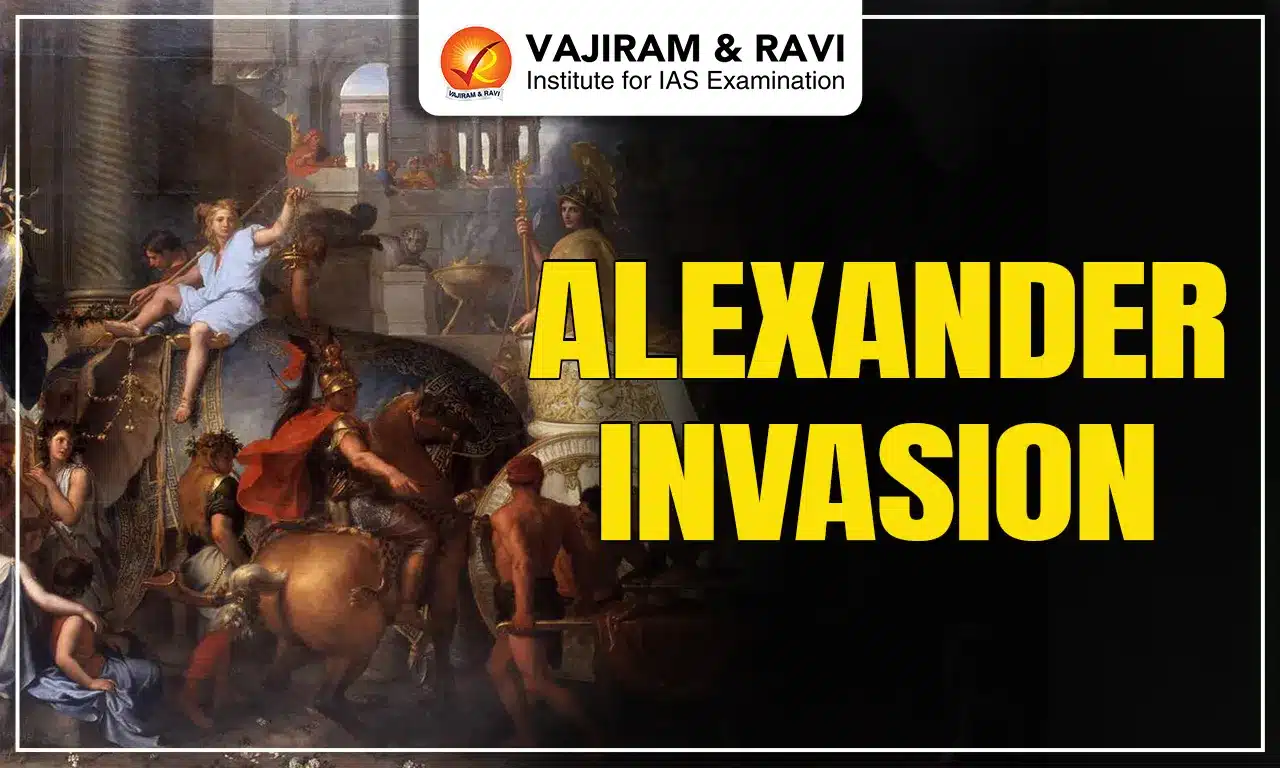
Alexander, the son of Philip of Macedonia, is remembered as one of history’s most remarkable conquerors. Born into the Macedonian royal family, he ascended the throne at the young age of twenty in 335 BCE. Driven by a desire to conquer the known world, Alexander quickly assembled a formidable army and launched his military campaigns in 334 BCE. His initial conquests included Persia, Asia Minor, Syria, and Egypt, where he established dominance by defeating local powers and consolidating control over strategic territories. Alexander’s campaigns laid the groundwork for one of the largest empires in ancient history, and his eventual advance into northwest India marked the easternmost limit of his expansion.  In this article, we are going to cover Alexander Invasion of India, his prelude to the Indian Campaign, the Battle of Hydaspes, its impact on India, cultural, artisanal and political implications.

Alexander Invasion of India

Alexander’s invasion of India, though short, was a watershed moment in ancient Indian history. It marked the first important contact between the civilizations of Europe and India, bringing about political, military, and cultural exchanges that influenced subsequent developments. While the conquest did not result in lasting Macedonian control, it paved the way for the rise of the Mauryan Empire, facilitated trade and communication with the Hellenistic world, and left an enduring legacy on Indian art and scholarship.

By integrating military strategy, cultural exchange, and political foresight, Alexander’s Indian campaign remains a defining episode that shaped the trajectory of Indian history, establishing connections that resonated for centuries in governance, art, and international relations.

Alexander’s Prelude to the Indian Campaign

Before Alexander ventured into India, the northwestern region of the subcontinent was a mosaic of small kingdoms and tribal states. Among the notable rulers were Ambhi, the king of Taxila, and Porus, who ruled the territory along the Jhelum River (known as Hydaspes in Greek accounts). While Ambhi chose to ally with Alexander, offering tribute and military support, Porus resisted the Macedonian advance. This set the stage for the legendary Battle of the Hydaspes in 326 BCE.

The Battle of the Hydaspes

The Battle of the Hydaspes remains one of Alexander’s most celebrated military engagements. The conflict occurred on the banks of the Jhelum River, where Porus commanded a well-equipped army with war elephants, formidable cavalry, and disciplined infantry. Despite facing an unfamiliar environment and the challenge of war elephants, Alexander employed strategic maneuvers and military ingenuity to defeat Porus. Following his victory, Alexander allowed Porus to retain his kingdom as a subordinate ally, a move that demonstrated both strategic foresight and political acumen.

Before reaching the Beas River, Alexander’s troops, exhausted by years of campaigning, refused to march further into India. Their mutiny effectively ended Alexander’s eastward expansion. By 326 BCE, Alexander was compelled to turn back, beginning his journey to Babylon, where he arrived in 323 BCE. Following his untimely death that year, his empire fragmented, and his generals divided control over various territories, including parts of northwest India.

Alexander Invasion of India and its Impact on India

Although Alexander’s campaign in India was relatively short, its consequences were significant. His invasion weakened many small kingdoms and warlike tribes, indirectly facilitating Chandragupta Maurya’s rise in the Punjab region. By destabilizing local powers and clearing the path for consolidation, Alexander’s incursion played a crucial role in the political unification of northern India. The Mauryan Empire, which emerged shortly after, benefited from the administrative and military vacuum created by the Macedonian withdrawal.

Alexander’s presence in India also opened new channels of trade and cultural exchange between the subcontinent and the Hellenistic world. Four primary routes, land and maritime, enabled direct interactions with Greek merchants, artisans, and scholars. These exchanges accelerated the spread of knowledge, art, and technology, influencing Indian society in diverse ways.

Alexander’s Invasion Cultural and Artistic Influence

Alexander’s campaign introduced Greeks to the Indian subcontinent and vice versa, initiating a period of Indo-Greek cultural synthesis. Greek accounts, particularly by historians and scholars accompanying Alexander such as Megasthenes, provide valuable records of Indian society, economy, and governance. These sources describe local customs, including sati practices, agricultural techniques, and cattle breeding, offering critical insights into life in northwest India during the 4th century BCE.

The artistic influence of Greek techniques became evident in the Gandhara School of Art, which flourished during and after the Mauryan period. Greek sculptural styles merged with Indian religious iconography, resulting in distinctive artworks depicting Buddhist themes with Hellenistic realism. This cultural interaction left a lasting legacy in Indian art, architecture, and numismatics.

Alexander’s Invasion Political Implications

Alexander’s invasion also had long-term political implications. By demonstrating the effectiveness of well-organized, disciplined armies and strategic governance, he provided a model for Indian rulers. Chandragupta Maurya, who observed the Macedonian military and administrative strategies, later applied similar techniques to overthrow the Nanda dynasty and establish the Mauryan Empire. This marked a pivotal moment in Indian history, as centralized governance and systematic administration became cornerstones of statecraft.

The Macedonian presence facilitated direct communication and diplomacy between India and Greece, enabling cross-cultural interactions in administration, trade, and military organization. Indo-Greek rule emerged in parts of northwest India after Alexander’s departure, further cementing Greek influence on the subcontinent.

Also Check Other Posts
Jainism Mauryan Administration
Vardhaman Mahavira Ashoka
Jain Councils Post Mauryan Period
Sects of Jainism Indo-Greek Kingdom
Buddhism and Jainism Sangam Age
Mauryan Empire Kushan Empire

Alexander Invasion FAQs

Q1: When did Alexander invade India?

Ans: Alexander invaded India in 326 BC.

Q2: Who defeated Alexander the Great in India?

Ans: No one defeated Alexander; his army refused to march beyond the Beas River.

Q3: Who was the king of India when Alexander invaded?

Ans: King Porus ruled the region around the Jhelum River during Alexander’s invasion.

Q4: Who was the ruler after Alexander?

Ans: After Alexander, Chandragupta Maurya eventually rose to power in northwestern India.

Q5: What is the Macedonian empire?

Ans: The Macedonian Empire was the kingdom of Macedonia, expanded by Alexander the Great across Greece, Asia Minor, Egypt, Persia, and parts of India.

Magadha Empire, Time Period, Rise, Dynasties, Economy, Culture

Magadha Empire

The Magadha Empire was one of the most powerful and influential empires of ancient India, known for its strategic location, military strength, and political acumen. Emerging as a prominent Mahajanapada during the 6th century BCE, Magadha played a decisive role in shaping the political, cultural, and economic landscape of the Indian subcontinent. It laid the foundation for subsequent empires such as the Mauryas and significantly influenced Indian history. This article delves into the Magadha Empire’s rise, its major dynasties, administrative and economic structures, cultural contributions, and enduring legacy.

Magadha Empire

The Magadha Empire covers the dynamic evolution of political power, economic organization, and cultural patronage in ancient India. Its rise was facilitated by a combination of strategic geography, strong leadership, military innovation, and economic prosperity. Successive dynasties the Brihadrathas, Pradyotas, Haryankas, Sisunagas, and Nandas each contributed uniquely to its consolidation and expansion.

The empire’s legacy, particularly in governance, trade, urbanization, and religious patronage, laid the foundation for the Mauryan Empire, which became one of the greatest empires in Indian history. Magadha’s story reflects the intricate interplay of geography, economy, military power, and culture that shaped the trajectory of ancient India, leaving a lasting imprint on its political and cultural landscape.

Magadha Empire Geographical Location and Importance

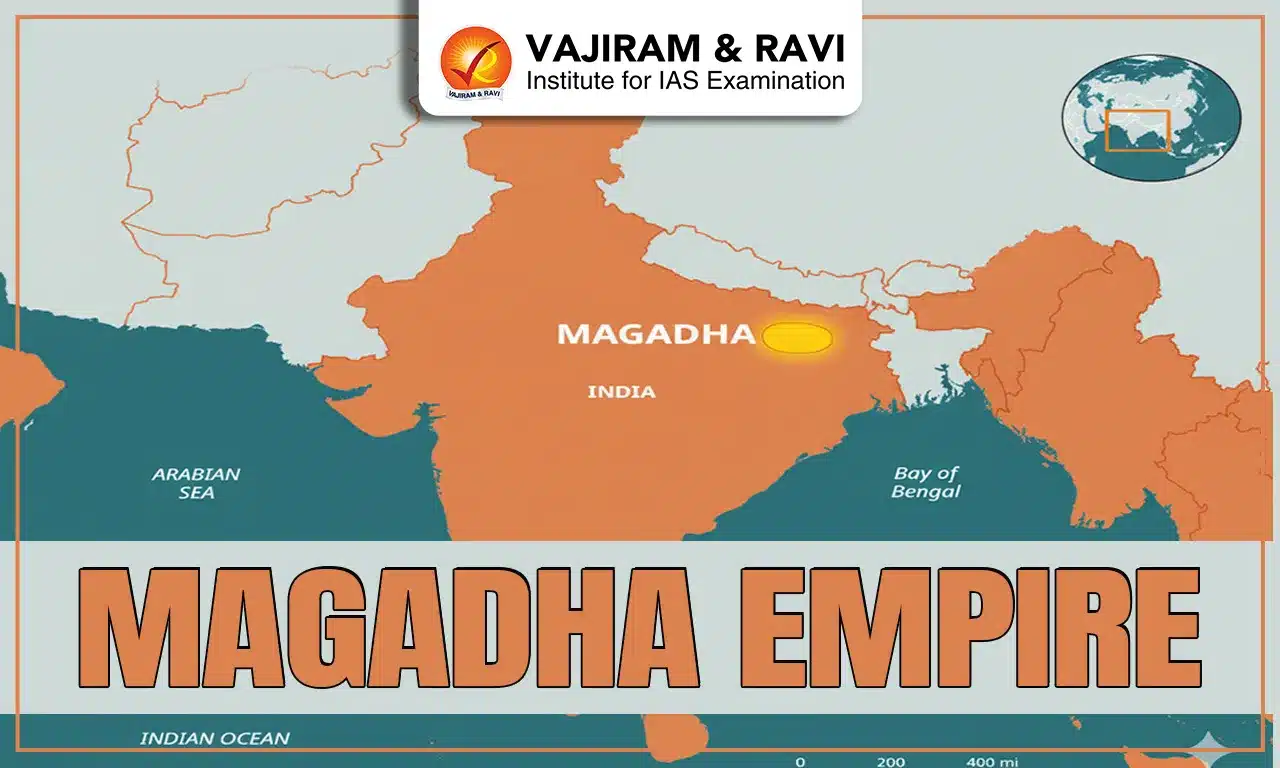
Magadha was located in the eastern part of the Gangetic plain, primarily in present-day Bihar, encompassing areas around Patna, Gaya, Rajgir, and Bodh Gaya. The kingdom was naturally fortified by hills and rivers, making it strategically defensible. Key geographical features contributing to its rise included:

  1. Fertile Alluvial Soil: The plains of the Ganga and Son rivers provided nutrient-rich soil, allowing abundant agricultural production and sustaining a growing population.
  2. Iron Resources: The Chotanagpur plateau offered a plentiful supply of iron ore, critical for weapons and agricultural tools, giving Magadha a technological and military edge.
  3. Rivers and Trade Routes: The Ganga, Son, and Gandak rivers facilitated trade, transport, and communication, enhancing economic prosperity and political control.
  4. Centralized Location: Being at the heart of northern India, Magadha could influence neighboring Mahajanapadas and act as a hub for trade, administration, and military campaigns.

Neighboring regions included the Republic of Vajjis to the north, the Kosala Kingdom to the west, and Avanti (Ujjain) further west. Control over these regions was crucial for dominance in northern India.

Mahajanapadas and the Context of Rise

By the 6th century BCE, northern India was divided into 16 Mahajanapadas, comprising monarchies and republics. Monarchical states like Magadha, Kosala, and Kashi concentrated on agriculture and centralized administration, whereas republics such as the Licchavis, Shakyas, and Mallas emphasized collective decision-making.

Urbanization played an important role in the rise of these states. Towns such as Rajgir, Vaishali, Hastinapur, Shravasti, Kaushambi, and Champa became centers of trade, administration, and culture. Markets emerged in areas of agricultural surplus, connecting distant regions through trade networks. Religious centers like Vaishali attracted scholars, monks, and pilgrims, promoting both cultural and economic activity.

The strategic positioning of Magadha, combined with its fertile land, iron resources, and central location, enabled it to gradually dominate other Mahajanapadas, setting the stage for an empire that would later encompass large parts of northern and eastern India.

Magadha Empire Rise

The ascendancy of the Magadha Empire was marked by successive dynasties, each contributing to territorial expansion, administrative consolidation, and military innovation. These dynasties include:

1. Brihadratha Dynasty

The Brihadratha Dynasty was the first known ruling line of Magadha. Its rulers are mentioned in the Mahabharata and Puranas, highlighting the dynasty’s early prominence. Key points include:

  • Founder: Brihadratha, son of Vasu of the Kuru kingdom of Chedi.
  • Famous King: Jarasandha, renowned as a warrior and ruler. He played a critical role in the political consolidation of Magadha.
  • Administration: Focused on central authority, consolidation of smaller principalities, and maintenance of order.
  • End of Dynasty: Ripunjaya, the last king, was assassinated by minister Punika/Pulika, who established the Pradyota Dynasty.

2. Pradyota Dynasty

The Pradyota Dynasty, founded by Punika/Pulika, ruled after the Brihadrathas. Although historical records are somewhat confusing, key aspects include:

  • Origins: Punika/Pulika placed his son, Pradyota, on the throne.
  • Capital: Avanti (Ujjain), though their influence extended over Magadha temporarily.
  • Religion: Brahmanism and Buddhism coexisted, reflecting religious diversity.
  • Significance: The Pradyotas consolidated territories and engaged in diplomacy, setting the stage for later expansion by Magadha proper.

3. Haryanka Dynasty

The Haryanka Dynasty (544–412 BCE) is central to Magadha’s expansion and political consolidation. It was founded by Bimbisara, a contemporary of Buddha. Highlights include:

  • Conquests and Diplomacy: Bimbisara annexed Anga, married princesses from Kosala, Licchavi, and Madra clans, creating strategic alliances.
  • Administrative Reforms: Strengthened centralized governance, maintained law and order, and introduced revenue measures.
  • Religious Patronage: Supported Buddhism and Jainism, facilitating the growth of monastic institutions.
  • Ajatashatru: Bimbisara’s son, known for aggressive expansion, conquered Kashi and Vaishali after 16 years of conflict, extending Magadha’s influence.
  • Patliputra Foundation: Successor Udayin built forts at the Ganga-Son confluence, founding Patliputra (modern Patna), a strategic capital.

4. Sisunaga Dynasty

The Sisunaga Dynasty succeeded the Haryankas and continued territorial consolidation:

  • Founder: Sisunaga, likely a minister or noble who rose to power.
  • Capital Shift: Kalasoka briefly moved the capital to Vaishali.
  • Achievements: Destroyed Avanti’s power, incorporating it under Magadha, ending a long-standing rivalry.
  • End of Dynasty: Mahananda, the last ruler, was killed by Mahapadma Nanda, who founded the Nanda Dynasty.

5. Nanda Dynasty

The Nanda Dynasty (c. 467-321 BCE) represents the peak of Magadha’s pre-Mauryan power. Its key features include:

  • Founder: Mahapadma Nanda, known for administrative skill and military might.
  • Military Strength: Maintained an infantry of 200,000, cavalry of 60,000, and 6,000 war elephants, supported by advanced tax collection systems.
  • Territorial Expansion: Annexed Kalinga, Kosala, and parts of present-day Uttar Pradesh and Bihar.
  • Wealth: Accumulated enormous riches, facilitating military campaigns and state administration.
  • End of Dynasty: Dhana Nanda, the last ruler, was unpopular due to low-caste origins and oppressive taxation. Overthrown by Chandragupta Maurya, paving the way for the Mauryan Empire.

Reasons for the Rise of Magadha Empire

Magadha’s rise as a dominant power was due to several interlinked factors:

  1. Strategic Geographical Location: Fertile plains, river systems, and central positioning enabled agricultural surplus, trade, and defense.
  2. Surplus Resources: Abundant food production and revenue allowed support for large armies and state infrastructure.
  3. Availability of Iron: Access to iron resources from Chotanagpur facilitated weapons, tools, and military superiority.
  4. Strong Leadership: Rulers like Bimbisara, Ajatashatru, and Mahapadma Nanda combined strategic marriages, military campaigns, and administrative reforms to consolidate power.
  5. Capital Location: Patliputra provided central administration, military defense (surrounded by rivers), and communication advantages.
  6. Trade and Urbanization: Emergence of towns as administrative, trade, and religious centers strengthened economic and cultural influence.

Magadha Empire Administration and Governance

Magadha Empire developed an organised administrative system:

  • Monarchical Structure: Kings wielded absolute power, assisted by ministers and regional governors.
  • Revenue Administration: Land revenue was a primary source of income. Tax collection was organized and supported the army and infrastructure.
  • Military Organization: Large standing armies included infantry, cavalry, chariots, and elephants.
  • Capital Fortifications: Rajgir was naturally fortified by hills, while Patliputra served as a riverine fortress, making invasion difficult.
  • Judicial System: Maintained law and order, resolved disputes, and protected property rights.

Magadha Empire Economy and Trade

Magadha Empire’s economic strength stemmed from:

  • Agriculture: Fertile alluvial soil produced surplus crops, enabling trade and taxation.
  • Iron Tools: Advanced metallurgy improved productivity and military strength.
  • Trade Networks: Towns like Rajgir, Patliputra, and Vaishali were key trade centers, connecting regions within India.
  • Urban Centers: Facilitated markets, crafts, and cultural activities, enhancing regional prosperity.

Magadha Empire Culture, Religion, and Society

Magadha Empire was a hub of religious and cultural development:

  • Buddhism: Gautama Buddha lived and taught in Magadha, with Rajgir and Bodh Gaya being prominent centers.
  • Jainism: Mahavira, the 24th Tirthankara, spent much of his life in the region.
  • Patronage: Kings supported monasteries, temples, and learning centers.
  • Arts and Architecture: Development of stupas, temples, and urban planning reflected a vibrant cultural life.

Magadha Empire Military Strategies and Conquests

Magadha Empire rulers emphasized military expansion:

  • Elephants and Cavalry: Provided battlefield dominance and intimidation.
  • Strategic Forts: Rajgir and Patliputra offered natural and constructed defenses.
  • Diplomacy and Marriage Alliances: Marriages with neighboring kingdoms reduced hostilities and expanded influence.
  • Conquest of Rival Mahajanapadas: Annexation of Anga, Kashi, Kosala, and Vaishali ensured political supremacy.

Magadha Empire Legacy

The Magadha Empire’s influence extended far beyond its time:

  1. Foundation for Mauryan Empire: Chandragupta Maurya built upon Magadha’s military, administrative, and economic framework.
  2. Political Models: Set precedents for centralized governance, taxation, and military organization.
  3. Cultural Hub: Nurtured Buddhism and Jainism, which spread across Asia.
  4. Economic Growth: Paved the way for trade, urbanization, and resource utilization in northern India.
  5. Infrastructure Development: Forts, roads, and urban centers enhanced connectivity and administration.

Magadha Empire FAQs

Q1: Who founded the Magadha Empire?

Ans: The Magadha Empire was established by Brihadratha of the Brihadratha Dynasty.

Q2: What are the 7 dynasties of Magadha?

Ans: The seven dynasties are Brihadratha, Pradyota, Haryanka, Shaishunaga (Sisunaga), Nanda, Maurya, and Shunga.

Q3: Who ruled the Haryanka Dynasty?

Ans: The Haryanka Dynasty was ruled by Bimbisara, Ajatashatru, and Udayin.

Q4: Who ruled the Nanda Dynasty?

Ans: ​​The Nanda Dynasty was ruled by Mahapadma Nanda and Dhana Nanda.

Q5: Who ruled the Sisunaga Dynasty?

Ans: The Sisunaga Dynasty was ruled by Sisunaga and Kalasoka (Kakvarnin).

UPSC Daily Quiz 15 October 2025

UPSC Daily Quiz

The Daily UPSC Quiz by Vajiram & Ravi is a thoughtfully curated initiative designed to support UPSC aspirants in strengthening their current affairs knowledge and core conceptual understanding. Aligned with the UPSC Syllabus 2025, this daily quiz serves as a revision resource, helping candidates assess their preparation, revise key topics, and stay updated with relevant issues. Whether you are preparing for Prelims or sharpening your revision for Mains, consistent practice with these Daily UPSC Quiz can significantly enhance accuracy, speed, and confidence in solving exam-level questions.

[WpProQuiz 96]

UPSC Daily Quiz FAQs

Q1: What is the Daily UPSC Quiz?

Ans: The Daily UPSC Quiz is a set of practice questions based on current affairs, static subjects, and PYQs that help aspirants enhance retention and test conceptual clarity regularly.

Q2: How is the Daily Quiz useful for UPSC preparation?

Ans: Daily quizzes support learning, help in revision, improve time management, and boost accuracy for both UPSC Prelims and Mains through consistent practice.

Q3: Are the quiz questions based on the UPSC syllabus?

Ans: Yes, all questions are aligned with the UPSC Syllabus 2025, covering key areas like Polity, Economy, Environment, History, Geography, and Current Affairs.

Q4: Are solutions and explanations provided with the quiz?

Ans: Yes, each quiz includes detailed explanations and source references to enhance conceptual understanding and enable self-assessment.

Q5: Is the Daily UPSC Quiz suitable for both Prelims and Mains?

Ans: Primarily focused on Prelims (MCQ format), but it also indirectly helps in Mains by strengthening subject knowledge and factual clarity.

World Food Day 2025, Date, Theme, History, Importance

World Food Day 2025

World Food Day 2025 is celebrated every year on 16th October to remind humanity of one of its most fundamental truths that food is life. It is not just a source of sustenance but a shared bond that connects individuals, communities, and nations. The day focuses on the importance of food security, sustainable agriculture, and collective action to eliminate hunger from the world. Celebrated all over the world on 16th October, World Food Day serves as a moment to express gratitude towards farmers, food producers, and workers who ensure that food reaches every table. In this article, we are going to cover World Food Day 2025, its history, theme, importance and initiatives taken up by the government.  

World Food Day 2025 Overview

In 2025, the observance of World Food Day carries a renewed vision “creating a future where every person has access to safe, nutritious, and sufficient food.” The theme encourages people across the globe to rethink their relationship with food, minimize waste, and adopt sustainable choices that nourish both humanity and the planet. 

Topic Key Points

World Food Day Date

Celebrated every year on 16th October.

Established by

Food and Agriculture Organization (FAO) in 1945.

First Celebrated

In 1981 after the proposal by Dr. Pal Romany.

Theme 2025

“Sustainable Food Systems for a Healthy Planet.”

FAO’s Role

Promotes global cooperation for ending hunger and ensuring food security.

World Food Day in Hindi

Known as “विश्व खाद्य दिवस,” highlighting food equality and awareness.

UPSC Relevance

Links with SDG-2 (Zero Hunger), agriculture, and international governance.

World Food Day 2025 History

The idea of observing a global day dedicated to food originated in 1979, when Dr. Pal Romany, the former Hungarian Minister of Agriculture and Food, proposed it during a conference of the Food and Agriculture Organization (FAO) of the United Nations. His proposal aimed to draw international attention toward food security and agricultural development.

In response, the FAO officially declared 16th October as the anniversary of its founding in 1945 as World Food Day. The first celebration was held in 1981, and since then, over 150 countries have participated in the observance each year. Every World Food Day is guided by a theme that focuses on a pressing global issue related to food and nutrition. Over the decades, World Food Day has grown into a movement that promotes awareness, inspires change, and encourages collaboration among nations to combat hunger and malnutrition.

World Food Day 2025 Date

World Food Day 2025 will be celebrated on 16th October 2025. This date marks the 80th anniversary of the founding of the FAO. On this day, governments, organizations, farmers, and citizens come together to discuss ways to build a resilient and inclusive global food system.

World Food Day 2025 Theme

The theme for World Food Day 2025 is “Sustainable Food Systems for a Healthy Planet.” It emphasizes how individual and collective food choices impact the environment, health, and the well-being of future generations.

The theme urges people to:

  • Reduce food waste.
  • Choose local and seasonal foods.
  • Support responsible farming practices.

It is a call to action reminding us that sustainability begins with daily choices. What we consume, how it is grown, and how much we waste all influence the planet’s future.

World Food Day 2025 Importance

World Food Day is very important as it reinforces the principle that access to food is a basic human right. It draws attention to the challenges of hunger, malnutrition, and food insecurity that affect millions.

Aspect Importance of World Food Day 2025

Raising Awareness

Educates people about global hunger, malnutrition, and the importance of balanced nutrition.

Encouraging Unity

Brings nations and communities together under the shared goal of achieving Zero Hunger.

Promoting Sustainability

Emphasizes responsible use of natural resources in food production.

Educating the Youth

Inspires students to understand the importance of farming, nutrition, and food ethics.

Encouraging Action

Motivates individuals and governments to tackle food waste and promote inclusivity.

What is the Food and Agriculture Organization (FAO)?

The Food and Agriculture Organization (FAO) is a United Nations agency established in 1945, headquartered in Rome, Italy. With 194 member nations and the European Union, it works toward achieving food security and sustainable agriculture globally.

FAO’s primary goal is to make sure that every person has access to sufficient, safe, and nutritious food to live an active and healthy life. It provides technical assistance, data, and policy guidance to countries for improving agriculture, fisheries, and forestry.

FAO’s mission is anchored in the global “Zero Hunger” goal striving to end hunger and malnutrition while promoting sustainable natural resource management.

Global Challenges to Food Security

Despite technological and agricultural advancements, food insecurity remains a persistent global challenge. The world produces enough food for everyone, yet millions suffer from hunger. The reasons are complex and interconnected poverty, inequality, environmental degradation, and conflict.

Challenges Explanation

Poverty and Inequality

Lack of income prevents millions from buying nutritious food, perpetuating hunger.

Climate Change

Extreme weather events disrupt crops and food production, reducing yields.

Food Wastage

Nearly one-third of food produced globally is wasted due to poor storage and careless consumption.

Conflict and War

Armed conflicts disrupt food production, trade routes, and access to food supplies.

Population Growth

A growing population increases demand for food and puts stress on resources.

Land and Water Degradation

Overuse and pollution of natural resources reduce productivity and threaten long-term sustainability.

Understanding these challenges helps policymakers and citizens work toward resilient food systems that balance human needs with environmental preservation.

India’s Initiatives to Strengthen Food Security

India, home to one of the largest populations in the world, has taken multiple initiatives to ensure that every citizen has access to affordable, nutritious, and safe food. The government’s focus is on strengthening agricultural productivity, empowering farmers, and reducing post-harvest losses.

Scheme / Initiative Purpose

Pradhan Mantri Kisan Sampada Yojana (PMKSY)

Builds modern food processing infrastructure and reduces post-harvest losses.

PM Formalisation of Micro Food Processing Enterprises (PMFME)

Supports small food processors with financial and technical help.

Production Linked Incentive Scheme for Food Processing (PLISFPI)

Enhances the global competitiveness of Indian food brands.

Mega Food Park Scheme

Establishes integrated parks with facilities for cold storage, packaging, and processing.

National Food Security Act (NFSA)

Ensures affordable food grains to poor and vulnerable households through the Public Distribution System (PDS).

These programmes collectively aim to make India’s food ecosystem more efficient, inclusive, and self-reliant.

Steps to Improve the Global Food System

Creating a hunger-free world demands reforming global food systems to be equitable, efficient, and environmentally sustainable. Here are some actionable steps that can drive change:

  1. Reduce Food Waste: Encourage responsible consumption and better food storage at every level.
  2. Promote Sustainable Farming: Encourage eco-friendly practices such as organic farming and water conservation.
  3. Adopt Agricultural Technology: Use innovations like drones, AI, and climate forecasting for smarter agriculture.
  4. Support Local Farmers: Buying locally produced food supports rural livelihoods and reduces carbon footprints.
  5. Encourage Healthy Diets: Promote balanced meals rich in fruits, vegetables, and whole grains.
  6. Improve Food Storage and Supply Chains: Strengthen cold storage facilities and logistics to prevent spoilage.
  7. Improve Global Cooperation: Nations must share knowledge, seeds, and sustainable practices to build food resilience.

World Food Day 2025 UPSC

World Food Day 2025 is not just a commemoration; it is a call for global responsibility. As the world faces challenges like climate change, conflict, and resource depletion, ensuring that every individual has access to nutritious food has become an urgent priority.

This day reminds us to be grateful for the food we consume, to respect the efforts of farmers, and to protect the planet that sustains life. The goal of achieving Zero Hunger by 2030 is not an impossible dream but it requires cooperation, compassion, and conscious action from everyone.

By observing World Food Day, we reaffirm our commitment to a future where no one sleeps hungry, where food systems are sustainable, and where humanity thrives in harmony with nature.

World Food Day 2025 FAQs

Q1: What is the theme of the World Food Day 2025?

Ans: The theme is “Sustainable Food Systems for a Healthy Planet.”

Q2: What is the theme of food safety 2025?

Ans: The theme is “Food Safety, Everyone’s Business.”

Q3: When is World Food Day celebrated?

Ans: It is celebrated on 16th October every year.

Q4: Who introduced World Food Day?

Ans: It was first proposed by Dr. Pal Romany and later adopted by the Food and Agriculture Organization (FAO).

Private Sector Banks, Meaning, Role, Advantages, Disadvantages

Private Sector Banks

The banking system of India forms the foundation of its economic architecture, and among its key components, private sector banks occupy an important position. These institutions have not only brought dynamism and competition into the sector but have also played a transformative role in enhancing efficiency, service quality, and technological advancement. Private sector banks refer to financial institutions in which the majority ownership or control rests in private hands rather than with the government. Their operations are primarily guided by profitability, innovation, and customer satisfaction features that differentiate them from public sector banks, which function with a larger social and developmental mandate. In this article, we are going to cover about Private Sector Banks, their structure, evolution and impact of private sector banks.

Private Sector Banks

Private sector banks are commercial banks where private individuals or entities hold more than 50% of the equity capital. They operate with a profit-driven approach but within the regulatory framework of the Reserve Bank of India (RBI).

Their major functions include:

  • Mobilizing deposits and providing credit facilities
  • Offering financial products such as insurance, wealth management, and investment services
  • Introducing innovative digital banking tools and enhancing financial inclusion in semi-urban areas
  • By combining efficiency, customer-centric services, and modern technology, private sector banks have helped shape the future of India’s financial ecosystem.

Read About: Indian Banks Association

Private Sector Banks Historical Evolution

The evolution of private sector banks in India is closely linked with the economic liberalization era of the early 1990s. Before this period, India’s banking sector was dominated by nationalized banks, which often struggled with bureaucracy, inefficiency, and high non-performing assets (NPAs).

The turning point came with the Narasimham Committee Report (1991), which recommended important banking reforms to improve competition and productivity. As part of these reforms, the RBI allowed the establishment of new private sector banks to infuse competition and modern practices into the sector. The post-liberalization phase witnessed the rise of several successful private banks, including HDFC Bank (1994), ICICI Bank (1994), and Axis Bank (1993). These banks revolutionized Indian banking by:

  • Introducing digital and mobile banking services
  • Improving customer service standards
  • Offering tailored loan products
  • Enhancing transparency and operational efficiency

Their entry marked a paradigm shift, forcing even public sector banks to upgrade their systems and embrace modern technologies.

Read About: Differentiated Banks

Private Sector Banks in India

At present, India has 21 private sector banks recognized by the RBI. Some of the most prominent ones include:

  • HDFC Bank: India’s largest private sector bank known for innovation and retail lending
  • ICICI Bank: Pioneered digital banking services and diversified financial products
  • Axis Bank: Known for its strong corporate banking operations
  • Kotak Mahindra Bank : Focused on wealth management and retail expansion
  • IndusInd Bank, Yes Bank, Federal Bank, RBL Bank, and South Indian Bank

These banks cater to millions of customers across the country through an extensive network of branches, ATMs, and digital platforms.

Private Sector Banks Advantages

Private Sector Banks offer the following advantages: 

  1. Technological Innovation: Private sector banks are at the forefront of adopting new technologies such as AI-driven banking, UPI services, and digital payment systems. They popularized internet banking, mobile apps, and paperless transactions, redefining convenience in financial services.
  2. Superior Customer Service: Unlike traditional banking, private banks focus heavily on customer satisfaction. Their prompt service delivery, digital query resolution, and customized financial advice have set new benchmarks in service excellence.
  3. Higher Efficiency and Profitability: Operating with a profit motive encourages these banks to maintain low NPAs, improve operational efficiency, and ensure better utilization of resources.
  4. Product Diversification: They offer a wide array of services—home loans, personal loans, credit cards, investment options, insurance, and private wealth management—under one umbrella, giving customers multiple choices.
  5. Increased Competition and Market Discipline: Their rise has compelled public sector banks to modernize, reduce inefficiencies, and adopt new technologies, thus improving the overall quality of India’s banking system.

Read About: Privatisation of Public Sector Banks

Private Sector Banks Disadvantages

Private Sector Banks have the following disadvantages: 

  1. Profit-Driven Approach: Their focus on profitability sometimes leads to neglect of social and rural banking objectives. Financial inclusion, particularly in remote areas, often takes a backseat.
  2. High Service Charges: Many private banks levy higher transaction fees, loan processing charges, and penalties compared to their public sector counterparts, which can burden low-income customers.
  3. Limited Rural Outreach: Most private banks operate primarily in urban and semi-urban areas, leaving rural regions dependent on public sector and cooperative banks.
  4. Job Insecurity and Performance Pressure: Employees in private banks face greater performance-based pressure and lesser job security compared to public sector bank staff.

Public Sector vs Private Sector Banks Difference 

Public Sector and Private Sector Banks have the following differences: 

Feature Public Sector Banks Private Sector Banks

Ownership

Majority owned by Government

Majority owned by private shareholders

Objective

Focus on social welfare and financial inclusion

Focus on profitability and customer satisfaction

Technology

Moderate technology adoption

Advanced digital banking and innovation

Customer Service

Traditional and process-driven

Fast, efficient, and customer-centric

NPAs

Relatively higher due to social lending

Comparatively lower due to stricter credit assessment

Job Security

Higher job stability

Lower job stability, performance-linked growth

Rural Presence

Extensive rural network

Limited rural coverage

This distinction highlights how both categories of banks contribute to India’s economy in complementary ways, public banks ensuring inclusivity and private banks driving innovation and competitiveness.

Role of Private Sector Banks in India’s Economic Growth

Private sector banks have highly influenced the modernization and digitization of Indian banking. Their role extends beyond profit-making they act as catalysts for financial transformation, contributing in the following ways:

  • Boosting GDP Growth: By mobilizing savings and providing credit to industries, they help stimulate economic activities.
  • Encouraging Financial Literacy: Through campaigns and digital awareness drives, they educate customers on savings, investments, and cyber safety.
  • Strengthening Capital Markets: Many private banks also play a role in underwriting, asset management, and facilitating investment flows.
  • Driving Digital India: Their contribution to the success of UPI, digital wallets, and e-banking aligns with India’s broader digital economy vision.

Private Sector Banks UPSC

Private sector banks have appeared as the driving force of modern banking in India, infusing energy, technology, and global best practices into the system. Their rise since liberalization has redefined banking from a government-led service to a customer-oriented, technology-driven experience.

However, challenges persist particularly the need to balance profit motives with social responsibility. As India moves toward becoming a $5 trillion economy, private sector banks will continue to play a critical role in sustaining growth, fostering inclusion, and ensuring that innovation reaches every corner of the country.

In essence, the future of India’s banking sector will depend on the collaborative coexistence of public and private institutions, working together to strengthen the economic fabric of the nation.

Private Sector Banks FAQs

Q1: What are private sector banks?

Ans: Private sector banks are those in which the majority of ownership lies with private individuals or institutions rather than the government.

Q2: How many private sector banks are there in India?

Ans: As of 2025, there are 21 private sector banks operating in India.

Q3: Which private sector bank is best in India?

Ans: HDFC Bank is often regarded as the best private sector bank in India due to its strong financial performance, customer service, and digital banking innovations.

Q4: What was the Narasimhan Committee Report?

Ans: The Narasimhan Committee Report (1991) recommended major banking sector reforms in India, including liberalization, prudential norms, and reduced government control to improve efficiency.

Q5: What are NPAs?

Ans: Non-Performing Assets (NPAs) are loans or advances where the borrower has stopped making interest or principal repayments for a specified period, typically 90 days.

National Bank for Agriculture and Rural Development (NABARD)

National Bank for Agriculture and Rural Development (NABARD)

The National Bank for Agriculture and Rural Development (NABARD) stands as the cornerstone of India’s rural financial ecosystem. As the apex development financial institution, it is dedicated to promoting sustainable, inclusive, and equitable growth across India’s villages and agricultural landscapes. Established on July 12, 1982, through an Act of Parliament, NABARD was envisioned as an institution that would bridge the gap between policy, finance, and grassroots implementation paving the path toward rural prosperity. Headquartered in Mumbai, Maharashtra, NABARD has since been at the forefront of India’s rural transformation by integrating financial support, developmental initiatives, and institutional reforms. Over the decades, it has evolved into a dynamic organization that not only facilitates rural credit but also empowers rural institutions, farmers, and entrepreneurs to thrive in an increasingly competitive economy. In this article, we are going to cover NABARD, its establishment, leadership, headquarters, functions and objectives and other major initiatives.

NABARD

NABARD is India’s principal institution for agriculture and rural development financing. It coordinates and monitors rural credit delivery, provides refinance to rural financial institutions, supports infrastructure creation, and guides policy interventions.

The full form of NABARD is National Bank for Agriculture and Rural Development, a name that precisely encapsulates its core mandate developing agriculture and rural sectors through financial inclusion, institutional strengthening, and developmental support.

Particulars Details

Full Form

National Bank for Agriculture and Rural Development

Nature

Apex Development Financial Institution for Agriculture and Rural Development

Established

12 July 1982 (Under Act 61 of Parliament, 1981)

Headquarters

Mumbai, Maharashtra

Chairman

Mr. Shaji K. V (as of 2025)

Ownership

100% Government of India

Vision

Development Bank of the Nation for Fostering Rural Prosperity

Mission

Promote sustainable and equitable agriculture and rural development through financial and non-financial interventions

Key Functions

Credit provision, refinancing, supervision, policy support, and infrastructure funding

Regional Offices

31 Regional Offices + 1 Cell in Srinagar

Training Establishments

4 (covering Northern, Eastern & Southern regions)

District Development Managers

415 operating across districts

Partner Institutions

Commercial Banks, RRBs, Cooperative Banks, NBFCs, NGOs, FPOs, State Governments

Website

www.nabard.org

NABARD Genesis and Establishment 

The origins of NABARD can be traced back to the Committee to Review Arrangements for Institutional Credit for Agriculture and Rural Development (CRAFICARD), chaired by Shri B. Sivaraman in 1979. The committee highlighted the need for a single, dedicated institution to integrate and oversee all agricultural and rural development financing functions.

Acting on these recommendations, the Parliament passed the NABARD Act (61 of 1981), leading to the creation of the institution on 12 July 1982. The inauguration by Prime Minister Smt. Indira Gandhi marked a transformative moment in rural policy.

NABARD took over:

  • The agricultural credit functions of the Reserve Bank of India (RBI), and
  • The refinance and development functions of the Agricultural Refinance and Development Corporation (ARDC).

This merger centralized rural development finance under a single, specialized authority, ensuring better planning, efficiency, and outreach.

NABARD Chairman and Leadership

Leadership plays an important role in steering NABARD’s mission. As of 2025, Mr. Shaji K. V serves as the Chairman. A veteran in banking and rural finance, he has earlier served in senior roles at Canara Bank and the Reserve Bank of India. Under his leadership, NABARD continues to embrace innovation in rural credit, fintech integration, and climate-resilient agriculture financing.

The Chairman is responsible for:

  • Strategic policy formulation and implementation,
  • Coordinating with the Government of India and RBI, and
  • Guiding developmental priorities in line with national goals such as Doubling Farmers’ Income and Atmanirbhar Bharat.

NABARD Headquarters and Institutional Network

NABARD’s headquarters in Mumbai functions as the nerve center of all policy, development, and supervision activities. It coordinates with multiple stakeholders, including ministries, banks, and international development agencies such as the World Bank, IFAD, and Asian Development Bank.

Its extensive operational network includes:

  • 31 Regional Offices at state capitals,
  • 415 District Development Managers (DDMs) monitoring district-level projects, and
  • Four premier training establishments for capacity building of banking and rural institutions.

This strong institutional presence ensures that NABARD’s policies translate effectively from boardroom strategy to grassroots implementation.

NABARD Functions and Objectives

The functions of NABARD are comprehensive, covering nearly every dimension of rural development. Its objectives are both financial and developmental.

  1. Credit Functions
  • NABARD provides refinance support to Cooperative Banks, RRBs, and Commercial Banks that lend to agriculture and rural sectors.
  • It also offers direct lending to eligible projects under priority areas like irrigation, renewable energy, and rural housing.
  1. Developmental Functions
  • NABARD plays a catalytic role by training rural financial institutions, promoting SHGs and FPOs, and capacity-building of rural entrepreneurs.
  • It supports technology adoption, digitalization of cooperatives, and promotes skill development through training institutes.
  1. Supervisory Functions
  • NABARD conducts on-site inspections of Cooperative Banks and RRBs to ensure transparency, risk management, and financial discipline.
  1. Policy and Planning
  • It advises the RBI and Government of India in formulating agricultural credit policy, interest rate frameworks, and infrastructure development strategies.

NABARD Major Initiatives 

NABARD has launched many flagship initiatives that have highly impacted India’s rural economy.

  1. Self-Help Group-Bank Linkage Programme (SHG-BLP): Launched in 1992, it is the world’s largest microfinance initiative, empowering over 12 million women’s groups to access institutional credit.
  2. Kisan Credit Card (KCC): A revolutionary credit instrument that provides flexible working capital to farmers with simplified documentation and low interest rates.
  3. Rural Infrastructure Development Fund (RIDF): Set up in 1995, RIDF finances rural infrastructure projects like roads, irrigation canals, bridges, and storage facilities through state governments.
  4. Watershed Development and Climate Initiatives: NABARD has implemented thousands of Watershed Projects focusing on soil and water conservation, reforestation, and climate adaptation.
  5. Umbrella Programme on Natural Resource Management (UPNRM): A direct financing model promoting sustainable natural resource management and rural entrepreneurship.
  6. Financial Inclusion and Digital Initiatives: Projects such as E-Shakti digitalize SHG records, while partnerships with fintechs promote digital financial literacy.

NABARD Subsidiaries

To expand its reach and diversify its developmental portfolio, NABARD operates through several specialized subsidiaries:

Subsidiary Focus Area

NABKISAN Finance Ltd.

Provides finance for agriculture, microenterprises, and FPOs.

NABFINS Ltd.

Offers microfinance and livelihood loans to rural poor.

NABCONS

Consultancy in agriculture, rural infrastructure, and project management.

NABFOUNDATION

CSR arm for social impact and community development.

NABSAMRUDDHI

Advisory services for sustainable and climate-resilient development.

NABVENTURES

Venture capital for agri-tech startups and rural enterprises.

NABSanrakshan

Focuses on livelihood promotion and environmental conservation.

Each subsidiary ensures that NABARD’s developmental footprint spans finance, consultancy, innovation, and sustainability.

NABARD Partner Institutions

NABARD functions through an extensive ecosystem of partners, including:

  • Commercial Banks and Cooperative Banks (for credit delivery),
  • Regional Rural Banks (RRBs),
  • Non-Banking Financial Companies (NBFCs),
  • Self-Help Groups (SHGs) and Farmers’ Producer Organizations (FPOs),
  • State Governments and NGOs for project implementation.

This multi-stakeholder approach ensures that NABARD’s interventions are inclusive and aligned with local development needs.

NABARD Importance in Rural Development

The importance of NABARD in India’s growth journey is immense and multi-dimensional. Some of its key contributions include:

  1. Increasing Rural Credit Flow: NABARD bridges the gap between banks and rural borrowers, ensuring timely and affordable credit availability.
  2. Strengthening Rural Institutions: It revitalizes Cooperative Banks and RRBs through capacity-building, modernization, and risk management reforms.
  3. Infrastructure Creation: Through RIDF and related funds, NABARD has financed thousands of rural projects that improve market access, irrigation, and logistics.
  4. Empowering Women and Farmers: Through SHGs, FPOs, and training programmes, NABARD promotes entrepreneurship and inclusive growth.
  5. Sustainable Agriculture Promotion: NABARD actively funds climate-resilient practices, organic farming, and renewable energy adoption in rural areas.
  6. Catalyst for Innovation: NABARD’s support for agri-startups through NABVENTURES has fostered innovation in agri-tech, supply chain, and fintech sectors.

NABARD Impact and Achievements 

NABARD had the following impact and led to the following achievements: 

  • Over ₹7 lakh crore refinanced to rural credit institutions since inception.
  • Over 12 million SHGs linked with banks under the SHG-BLP Programme.
  • More than 40,000 RIDF projects completed across India, improving infrastructure and livelihoods.
  • Active involvement in climate finance projects with global funds like GCF and Adaptation Fund.
  • Digital transformation of rural credit institutions through Core Banking Solutions and Data Digitization initiatives.

These achievements underline NABARD’s unparalleled contribution to rural transformation and poverty reduction.

NABARD UPSC 

NABARD is the lifeline of India’s rural financial system. Its functions go far beyond mere credit disbursal. It plays the role of mentor, regulator, policymaker, and innovator for the rural economy. Whether it is enabling a small farmer to access credit, helping women’s groups become financially independent, or supporting large-scale irrigation and infrastructure projects, NABARD’s presence is felt at every level of rural life.

As India moves toward becoming a $5 trillion economy, the focus on inclusive growth, rural infrastructure, and sustainable agriculture will only increase. NABARD’s mission of fostering rural prosperity through partnership, innovation, and empowerment ensures that it remains the Development Bank of the Nation, silently powering the economic and social transformation of India’s villages.

National Bank for Agriculture and Rural Development FAQs

Q1: What is NABARD and its function?

Ans: NABARD is India’s apex development financial institution, primarily responsible for financing and promoting agriculture and rural development.

Q2: When was NABARD established in India?

Ans: NABARD was established on 12th July 1982 through an Act of Parliament.

Q3: Where is the HQ of NABARD?

Ans: The headquarters of NABARD is located in Mumbai, Maharashtra.

Q4: What is the Objective of NABARD?

Ans: The objective of NABARD is to promote sustainable and equitable agriculture and rural development through financial and non-financial interventions.

Q5: What are NBFCs?

Ans: NBFCs (Non-Banking Financial Companies) are financial institutions that provide banking services like loans and credit but do not hold a banking license or accept demand deposits.

Commercial Banks, Meaning, Types, Examples, Functions

Commercial Banks

Commercial Banks form the backbone of India’s financial system and are the cornerstone of economic growth and stability. As important financial institutions, they mobilize savings from individuals and institutions and channel these funds toward productive investments in the economy. Their influence extends across every sector like agriculture, industry, trade, infrastructure, and services, making them indispensable to India’s development story. In this article we are going to cover about Commercial Banks, its nature, structure, types and importance of commercial banks in India while examining their regulatory framework, roles and contribution to financial inclusion and national growth.

Commercial Banks

Commercial Banks are financial institutions that accept deposits from the public, provide loans, and offer various financial services to generate profit. Unlike cooperative or development banks that have specific social or developmental objectives, commercial banks operate on a commercial basis, meaning their primary goal is to earn profits while maintaining financial stability and public trust.

They are governed by the Banking Regulation Act, 1949, and regulated by the Reserve Bank of India (RBI), which supervises their operations, ensures compliance with prudential norms, and safeguards the interests of depositors. In essence, commercial banks are intermediaries that bridge the gap between savers and borrowers mobilizing idle savings into productive use.

Read About: Difference between Scheduled and Non Scheduled Banks

Commercial Banks Structure in India

The structure of commercial banking in India is classified into two major categories:

  1. Scheduled Commercial Banks (SCBs)
  2. Non-Scheduled Commercial Banks (NSCBs)

This classification is based on their inclusion or exclusion from the Second Schedule of the Reserve Bank of India Act, 1934.

1. Scheduled Commercial Banks (SCBs)

Scheduled Commercial Banks are those banks that are listed in the Second Schedule of the RBI Act, 1934. To qualify as an SCB, a bank must:

  • Have a paid-up capital and reserves of at least ₹5 lakh, and
  • Make sure that its operations do not harm the interests of depositors.

These banks are eligible for various facilities from the RBI, such as borrowing funds and participating in the clearinghouse system. They also have to maintain a Cash Reserve Ratio (CRR) with the RBI and submit periodic reports as part of regulatory compliance.

The majority of commercial banks in India fall under this category.

2. Non-Scheduled Commercial Banks (NSCBs)

Non-Scheduled Commercial Banks are those that are not listed in the Second Schedule of the RBI Act, 1934. These banks do not meet the eligibility criteria required for inclusion in the schedule.

Unlike SCBs, NSCBs maintain their CRR independently rather than with the RBI, and they are generally smaller in size with limited operational reach. They are not entitled to borrow funds from the RBI except under exceptional circumstances.

At present, India does not have any significant NSCBs operating independently; over time, most have either merged with larger scheduled banks or ceased operations.

Read About: Indian Banks Association

Difference between Scheduled and Non-Scheduled Commercial Banks 

Here are the differences between Scheduled and Non- Scheduled Commercial Banks:

Basis of Difference Scheduled Commercial Banks (SCBs) Non-Scheduled Commercial Banks (NSCBs)

Legal Status

Listed in the Second Schedule of the RBI Act, 1934

Not listed in the Second Schedule

Capital Requirement

Minimum paid-up capital of ₹5 lakh

No specific minimum requirement

Regulation

Must maintain CRR with RBI

Maintain CRR with themselves

Borrowing Facility

Can borrow from RBI and use rediscounting facilities

Can borrow from RBI only in emergencies

Financial Stability

More stable and regulated

Considered riskier and less regulated

Examples

SBI, HDFC Bank, PNB, ICICI Bank

None at present

Scheduled Commercial Banks (SCBs) Types

India’s Scheduled Commercial Banks are further classified into four categories based on ownership and operational scope:

  1. Public Sector Banks (PSBs)
  2. Private Sector Banks
  3. Foreign Banks
  4. Regional Rural Banks (RRBs)

1. Public Sector Banks (PSBs)

Public Sector Banks, also known as Nationalised Banks, are those in which the Government of India holds more than 50% ownership. These banks were established through successive phases of bank nationalisation in 1969 and 1980, aimed at promoting financial inclusion and rural credit.

PSBs form the backbone of India’s banking system, commanding the largest market share in deposits and advances. They play a crucial role in implementing government welfare schemes and reaching underserved areas.

Major Public Sector Banks include:

  • State Bank of India (SBI)
  • Punjab National Bank (PNB)
  • Bank of Baroda (BoB)
  • Canara Bank
  • Union Bank of India (UBI)
  • Indian Bank
  • Bank of India
  • Indian Overseas Bank (IOB)
  • UCO Bank
  • Central Bank of India
  • Bank of Maharashtra
  • Punjab & Sind Bank

Note:

  • Oriental Bank of Commerce and United Bank of India merged with PNB.
  • Dena Bank and Vijaya Bank merged with Bank of Baroda.

2. Private Sector Banks

Private Sector Banks are those in which private shareholders hold more than 51% of the capital. These banks are profit-driven and are known for innovation, technology adoption, and customer-centric services.

They are classified into:

  • Old Private Sector Banks: Established before the 1991 reforms and were not nationalised due to their regional focus.
    Examples: Catholic Syrian Bank, Karur Vysya Bank, City Union Bank.
  • New Private Sector Banks: Established after 1991 as part of the financial liberalisation policy following the LPG (Liberalisation, Privatisation, and Globalisation) reforms.
    Examples: HDFC Bank, ICICI Bank, Axis Bank, Kotak Mahindra Bank, Yes Bank, IndusInd Bank.

These banks brought competition, efficiency, and technological advancement to India’s financial landscape.

3. Foreign Banks

Foreign Banks are those that have their headquarters abroad but operate in India through branches or subsidiaries. They bring global best practices, international financial expertise, and foreign capital to India’s economy.

Examples:

  • Standard Chartered Bank
  • Citi Bank
  • HSBC
  • Deutsche Bank
  • BNP Paribas

Foreign banks are regulated by the RBI and must comply with both domestic and international financial regulations. They are often active in corporate banking, investment banking, and foreign exchange operations.

Read About: Differentiated Banks

4. Regional Rural Banks (RRBs)

Regional Rural Banks were established in 1975, following the recommendations of the Narasimham Working Group, to address the credit needs of the rural poor. They were formally constituted under the Regional Rural Banks Act, 1976.

RRBs have a unique ownership structure shared among:

  • Central Government - 50%
  • State Government- 15%
  • Sponsor Bank- 35%

They aim to provide credit and banking facilities to small and marginal farmers, artisans, and rural entrepreneurs, thereby promoting rural development and reducing regional disparities.

Examples:

  • Andhra Pradesh Grameena Vikas Bank
  • Uttarakhand Gramin Bank
  • Prathama Bank
  • Paschim Banga Gramin Bank

RRBs are supervised by NABARD and regulated by the RBI. They are mandated to provide at least 75% of their total credit as priority sector lending, ensuring that rural development remains their central focus.

Commercial Banks Importance and Role in India

Commercial Banks play a multi-dimensional role in supporting the economy. Their importance extends beyond financial intermediation to include developmental, social, and technological contributions.

  1. Mobilisation of Savings: Banks mobilize idle household savings into productive investments. By offering safe and interest-bearing deposit accounts, they encourage savings and channel funds into economic development projects.
  2. Providing Loans and Advances: Commercial Banks provide short-term, medium-term, and long-term loans to individuals, industries, agriculture, and services sectors. This credit provision stimulates business activity, production, and employment.
  3. Promoting Entrepreneurship: Through the provision of credit, project financing, and advisory services, banks promote entrepreneurship and support the growth of micro, small, and medium enterprises (MSMEs).
  4. Financial Intermediation: Banks act as intermediaries between savers and borrowers, ensuring that resources flow efficiently within the economy. This financial intermediation improve capital formation and economic growth.
  5. Employment Generation: By financing industries, agriculture, and services, banks contribute indirectly to large-scale employment generation. The banking sector itself is also a major employer.
  6. Implementation of Government Schemes: Commercial Banks are instrumental in implementing flagship government schemes like PM-KISAN, Pradhan Mantri Mudra Yojana, Jan Dhan Yojana, and Stand-Up India, aimed at financial inclusion and poverty alleviation.
  7. Digital Transformation: With the advent of digital banking, UPI, internet banking, and mobile wallets, commercial banks have revolutionized financial services in India, promoting transparency, accessibility, and convenience.
  8. Rural Development: Through Regional Rural Banks and priority sector lending, commercial banks play a vital role in strengthening India’s rural economy by providing credit for agriculture, irrigation, and rural infrastructure.
  9. Financial Inclusion: Commercial Banks, with their extensive branch networks, have made formal financial services accessible to millions, particularly in rural and remote regions, thereby narrowing the gap between the formal and informal financial sectors.

Commercial Banks Challenges

Despite their achievements, commercial banks face several challenges in India:

  • Rising Non-Performing Assets (NPAs) affecting profitability and capital adequacy.
  • Growing competition from FinTech firms and digital payment platforms.
  • Need for stronger cybersecurity infrastructure due to increased digital transactions.
  • Inefficiency in some PSBs due to bureaucratic procedures.
  • Balancing profitability with social obligations such as priority sector lending.

Addressing these challenges requires structural reforms, technological upgrades, and a renewed focus on risk management and efficiency.

Read About: Privatisation of Public Sector Banks

Commercial Banks UPSC 

Commercial Banks are not just financial intermediaries but the lifeline of India’s economic architecture. By mobilizing savings, financing development, and promoting inclusion, they act as the primary catalyst for growth.

From the dominance of Public Sector Banks in the post-independence era to the rise of technologically advanced Private Banks and globally connected Foreign Banks, the evolution of India’s commercial banking sector reflects the nation’s economic journey itself.

As India moves toward becoming a $5 trillion economy, the role of commercial banks will continue to expand, bridging financial gaps, supporting innovation, and empowering every section of society through inclusive and sustainable banking.

Commercial Banks FAQs

Q1: What are the 4 types of commercial banks?

Ans: The four types of commercial banks are Public Sector Banks, Private Sector Banks, Foreign Banks, and Regional Rural Banks.

Q2: What is meant by a commercial bank?

Ans: A commercial bank is a financial institution that accepts deposits, provides loans, and offers financial services to earn profit.

Q3: What are regional rural banks?

Ans: Regional Rural Banks (RRBs) are government-sponsored banks established to provide credit and banking services to rural and agricultural sectors.

Q4: What are non-scheduled commercial banks?

Ans: Non-Scheduled Commercial Banks are those not listed in the Second Schedule of the RBI Act, 1934, and operate under different regulatory norms.

Q5: What are foreign banks?

Ans: Foreign banks are banks headquartered outside India but operate their branches or subsidiaries within the country.

World Students’ Day 2025, Theme, Significance, History, Criticism

World Students’ Day 2025

World Students’ Day 2025 is observed on 15 October every year to celebrate students’ potential and commemorate Dr. A.P.J. Abdul Kalam’s birth anniversary. The day honors his belief that education, innovation, and youth empowerment are the true drivers of national progress. It brings global attention to issues such as equitable access to education, mental health, and student leadership in shaping the future.

World Students’ Day 2025

In 2025, the observance of World Students’ Day focuses on fostering creativity, inclusivity, and leadership among students. The day is marked by nationwide discussions on improving quality education and nurturing innovation. Schools, colleges, and digital learning platforms conduct interactive activities and lectures emphasizing Dr. Kalam’s message that “students are the architects of the nation.” The event is also a reminder of the need for educational reforms aligned with sustainable development goals.

World Students’ Day 2025 Theme

The theme for World Students’ Day 2025 is “Empowering Students as Agents of Innovation and Change.” It highlights the role of students as contributors to societal transformation through education, science, and technology. This aligns with Dr. Kalam’s lifelong emphasis on research, self-reliance, and character development. The theme also resonates with India’s current educational priorities, such as implementing the National Education Policy (NEP 2020) and promoting digital learning ecosystems for inclusive growth.

Dr. APJ Abdul Kalam Birth Anniversary

World Students’ Day 2025 symbolizes not only a tribute to Dr. A.P.J. Abdul Kalam but also a global call to action for educational reform and youth-led innovation. Dr. Kalam’s life stands as a compelling example of learning, leadership, and humility. Born into a modest family in Rameswaram, he completed his schooling at Schwartz Higher Secondary School and pursued physics at St. Joseph’s College (1954), followed by aerospace engineering at MIT, Chennai. He joined DRDO (1958) and later ISRO, spearheading India’s SLV-III project and leading the Missile Programme (Agni, Prithvi). He played a significant role in Pokhran-II and served as the 11th President (2002-2007). Until his death in 2015, he remained deeply engaged with youth, often referring to himself as a teacher.

His remarks-“Dreams transform into thoughts, and thoughts result in action”, continue to motivate students globally. His efforts in technology, education, healthcare, and rural development reflect a holistic approach to nation building. 

World Students’ Day 2025 Historical Background

The day traces its roots to 15 October 1931, the birth of Dr. A.P.J. Abdul Kalam in Rameswaram, Tamil Nadu. His exceptional contribution to science, education, and nation-building inspired India to dedicate his birthday as a day to celebrate students. Although not officially recognized by the United Nations, it has become a national observance symbolizing knowledge, hard work, and innovation. Educational institutions across India began marking this day after Kalam’s presidency (2002-2007), strengthening its association with youth empowerment.

World Students’ Day 2025 Significance

World Students’ Day serves as a platform to recognize the transformative power of education. It underscores how India’s 24.8 crore school students and 4.33 crore higher education learners form the foundation of its demographic dividend. The day advocates for equality, digital literacy, and inclusive access to education. It also addresses critical issues such as student mental health, gender parity, and skill development for global employability. The observance reinforces the need to integrate values, innovation, and ethics in learning, echoing Kalam’s educational philosophy.

  • Educational Equality: Highlights the need for equal access to education across socio-economic and regional divides.
  • Youth Empowerment: Encourages students to become leaders, innovators, and social reformers.
  • Skill Development: Promotes technical education and life skills for employability.
  • Value-Based Learning: Reinforces moral education and ethical conduct in academic environments.
  • Alignment with SDG 4: Supports the United Nations Sustainable Development Goal (SDG) 4- “Quality Education for All.”

World Students’ Day 2025 Celebration

World Students’ Day 2025 is marked by a combination of educational, cultural, and digital activities conducted across India and globally. The celebrations reflect Dr. Kalam’s belief in learning beyond classrooms, fostering creativity, and building a sense of responsibility among youth. Major Ways of Celebration in 2025

  • Institutional Events: Schools and universities organize lectures, debates, essay competitions, and exhibitions on innovation.
  • Government Initiatives: The Ministry of Education and AICTE conduct online contests promoting skill-based learning.
  • Digital Engagements: Social media campaigns like #WorldStudentsDay2025 trend globally, sharing Kalam’s quotes and achievements.
  • International Collaboration: Global webinars focus on digital education, climate resilience, and student exchange programs.
  • NGO Participation: Organizations such as Teach For India and Pratham hold workshops on literacy and inclusion.

A.P.J. Abdul Kalam’s Vision

Dr. Kalam envisioned an India where education fosters not only knowledge but also moral strength, creativity, and service to humanity. His dream of a knowledge society centered on youth empowerment through science and values remains integral to this day. His educational initiatives, such as promoting indigenous technology, developing low-cost healthcare devices, and encouraging student innovation, reflected his idea of “learning by doing.” He believed in transforming classrooms into hubs of curiosity and invention, a message echoed globally through this observance.

World Students’ Day 2025 Criticism

While widely celebrated, World Students’ Day faces criticism for being mistakenly described as a UN-declared observance, which it is not. The United Nations officially observes 15 October as the International Day of Rural Women, not World Students’ Day. Critics also argue that many events on this day remain symbolic, lacking sustained follow-through on policy commitments. However, supporters emphasize that the spirit of the day lies in celebrating students’ aspirations and continuing Kalam’s educational mission, regardless of formal recognition.

World Students’ Day 2025 Challenges Faced by Students

Despite progress, Indian students face multiple challenges, ranging from digital inequality and mental health stress to curriculum rigidity. Addressing these is crucial to realizing Kalam’s dream of a globally competitive and morally strong youth.

Key Challenges

  • Digital Divide: Many students in rural India lack internet access and devices.
  • Mental Health Issues: Academic pressure and unemployment contribute to stress and anxiety.
  • Skill Gaps: Mismatch between education and job market demands.
  • Gender Inequality: Girls in marginalized communities still face educational barriers.
  • Quality of Teaching: Need for updated pedagogy and teacher training.

Way Forward

  • Expand Digital Infrastructure: Invest in affordable internet and digital literacy programs.
  • Strengthen Mental Health Support: Integrate counseling and awareness campaigns in schools.
  • Enhance Vocational Training: Align education with future job skills under Skill India Mission.
  • Encourage Research and Innovation: Provide funding for youth-led projects in science and social change.
  • Promote Global Collaboration: Partner with UNESCO, OECD, and NGOs for inclusive education.

World Students’ Day 2025 UPSC

World Student’s Day observed annually on October 15, the day reaffirms the importance of investing in students as agents of progress, capable of shaping an equitable, technologically advanced, and sustainable future for humanity

The observance coincides with several government and global initiatives focusing on education reform, innovation, and skill development. These reflect both India’s educational transformation and Kalam’s vision of a knowledge-based society. Recent initiatives strengthen the spirit of this day.

  • The Viksit Bharat Buildathon 2025 engages lakhs of students in nationwide innovation challenges.
  • NEP 2020 implementation continues with reforms in curriculum flexibility and multidisciplinary learning.
  • The UDISE+ 2023-24 report notes India’s school enrollment at 24.8 crore, supported by 98 lakh teachers and 14.72 lakh schools.
  • The Economic Survey 2024-25 recorded a 13.8% growth in higher education institutions and a GER of 28.4%.
  • Mental health programs, such as Andhra Pradesh’s Project EASE, train thousands of medical students in suicide prevention.
  • Digital India and SWAYAM: Ensuring equitable access to online education for rural and urban learners.
  • UNESCO’s Global Education Monitoring (GEM) Report 2024: Focused on "Leadership in Education" and it highlights systemic issues in India, such as leadership gaps, poor implementation of policies, and learning outcome challenges.
  • Atal Innovation Mission (AIM): Promoting scientific temperament through Atal Tinkering Labs across 10,000+ schools.
  • Digital Education & Smart Classrooms: States are launching virtual classrooms and studios to improve access in remote areas (e.g. Uttarakhand’s central virtual studio for 840 schools).
  • Higher Education: Enrollment in higher education reached 4.33 crore (43.3 million) in 2021-22, a 26.5% increase from 2014-15. Gross Enrollment Ratio (GER) for ages 18-23 rose from 23.7% to 28.4%.
  • Dropout Rates: Dropout rates have declined to 1.5% (primary), 3.0% (upper primary), and 12.6% (secondary) levels (According to UDISE+ data for 2021-22).
  • Female enrollment in Higher Education saw a particularly strong increase, reaching 2.07 crore in 2021-22, up 32% from 1.57 crore in 2014-15 According to UDISE+

World Students’ Day 2025 FAQs

Q1: When is World Students’ Day 2025 celebrated?

Ans: On October 15, commemorating Dr. A.P.J. Abdul Kalam’s birthday and his contribution to education and science.

Q2: What is the theme of World Students’ Day 2025?

Ans: “Empowering Students as Agents of Innovation and Change.”

Q3: Is World Students’ Day recognized by the UN?

Ans: No, it’s a national Indian observance; UN marks October 15 as International Day of Rural Women.

Q4: Why is Dr. Kalam called the “People’s President”?

Ans: He inspired youth, emphasized education, and remained humble, interacting directly with students throughout his presidency.

Q5: How is World Students’ Day 2025 celebrated?

Ans: Through seminars, digital campaigns, workshops, and innovation contests promoting Dr. Kalam’s ideals of learning and nation-building.

Naying Hydroelectric Project

Naying Hydroelcetric Project

Naying Hydroelectric Project Latest News

An environmental public hearing for the 1000MW Naying hydroelectric project is scheduled for November 12.

About Naying Hydroelectric Project

  • It is a proposed 1,000 MW hydropower project planned on the Siyom (Yomgo) river/basin in Arunachal Pradesh.
  • It will be implemented by the North Eastern Electric Power Corporation (NEEPCO). 
  • The project includes the construction of a concrete dam, an underground powerhouse, and tunnels, with work expected to begin around 2028 and commissioning planned for 2032. 
  • Once operational, it is expected to generate 4,966.77 GWh of electricity annually.

Key Facts about Siyom River

  • It is a right-bank tributary of the Brahmaputra River.
  • It flows in the Arunachal Pradesh state.
  • The Mouling National Park is located on the east bank of the river.
  • The Siyom has a length of about 170 km.

Source: TOI

Naying Hydroelectric Project FAQs

Q1: On which river is the Naying Hydroelectric Project proposed?

Ans: Siyom (Yomgo)

Q2: What is the planned capacity of the Naying Hydroelectric Project?

Ans: 1,000 MW

Q3: What type of hydropower structures will the Naying project include?

Ans: Concrete dam, underground powerhouse, and tunnels

Q4: Which national park is located near the Siyom River?

Ans: Mouling National Park

Q5: The Siyom River is a tributary of which major river?

Ans: Brahmaputra

Live Cases Dashboard of the Legal Information Management and Briefing System (LIMBS)

Live Cases Dashboard of the Legal Information Management and Briefing System

Live Cases Dashboard of the Legal Information Management and Briefing System (LIMBS) Latest News

Union Minister of State for Law and Justice recently  inaugurated the Live Cases Dashboard of Legal Information Management and Briefing System (LIMBS) in New Delhi.

About Live Cases Dashboard of the Legal Information Management and Briefing System

  • It is designed to provide real-time data visualisation of court cases and offer an overview of upcoming hearings to enable proactive decision-making and better inter-ministerial coordination.
  • It provides details of all cases scheduled to be heard in the next seven days in the Supreme Court, High Courts, or any other courts involving various ministries of the Government of India.

Key Facts about Legal Information Management and Briefing System

  • It is a web-based application for monitoring of all court cases where the Union of India is one of the parties. 
  • LIMBS came into existence for all ministries/departments/autonomous organizations/CPSUs in 2016, and an advanced version in January 2020.
  • Since then the application is seamlessly working under the supervision of the Department of Legal Affairs, Ministry of Law and Justice (as Nodal Ministry).
  • It is an innovative and easy-to-access online tool which is available 24x7 to all the stakeholders, viz., government officials, department users, nodal officers, higher officials of ministries, advocates, arbitrators, and claimants of ministries to upload the latest information.
  • It is a dashboard-based system for the user Ministries/Departments on which they can see their legal matters at a glance.

Source: DDN

Live Cases Dashboard of the Legal Information Management and Briefing System (LIMBS) FAQs

Q1: What is the main objective of the Live Cases Dashboard under Legal Information Management and Briefing System (LIMBS)?

Ans: To provide real-time data visualisation of court cases involving government ministries.

Q2: Which Ministry supervises the Legal Information Management and Briefing System (LIMBS)?

Ans: Ministry of Law and Justice

Q3: When did the LIMBS platform first come into existence?

Ans: LIMBS came into existence for all ministries/departments/autonomous organizations/CPSUs in 2016, and an advanced version in January 2020.

Astra Mark 2 Missile

Astra Mark 2 Missile

Astra Mark 2 Missile Latest News

The Defence Research and Development Organisation (DRDO) recently announced its intention to extend the range of its Astra Mark 2 air-to-air missile to more than 200 kilometres.

About Astra Mark 2 Missile

  • It is a Beyond Visual Range (BVR) air-to-air missile.
  • It is being developed by the Defence Research and Development Organisation (DRDO).
  • In addition to various laboratories of DRDO, more than 50 public and private industries, including Hindustan Aeronautics Limited, have contributed towards successful realisation of the weapon system. 
  • The Astra Mark-1 air-to-air missile with a strike range of around 90-100 kms is already in the Indian Air Force and is already integrated with the LCA Tejas and the Su-30 MKI fighter jets.
  • The Astra Mark 2 would give the Indian Air Force an edge over the adversaries in air-to-air combat and can also be offered as an export product to friendly foreign countries.

Astra Mark 2 Missile Features

  • While Astra Mark-1 is a single pulse, smokeless solid-fueled motor, the Astra Mark-2 is going to be a dual pulse missile, giving it a higher range. 
  • Astra Mk-1 is 3.6 m (12 ft) long with a diameter of 178 mm (7.0 in) and weighs 154 kg with a maximum range of 110 km. Astra Mark 2 will be a bigger missile with a diameter of 190 mm and weigh close to 175 kg.
  • It can go up to a distance of 150 to 180 km and can travel at around Mach 4.5.
  • It is equipped with a indigenous Radio Frequency (RF) Seeker from Su-30 Mk-I.

Astra Mark 2 Missile FAQs

Q1: What type of missile is the Astra Mark 2?

Ans: It is a Beyond Visual Range (BVR) air-to-air missile.

Q2: Who is developing the Astra Mark 2 missile?

Ans: Defence Research and Development Organisation (DRDO)

Q3: Which fighter jets have already been integrated with Astra Mark 1 missiles?

Ans: Tejas and Su-30 MKI

Impatiens Rajibiana

Impatiens Rajibiana

Impatiens Rajibiana Latest News

A team of the Botanical Survey of India recently discovered 'Impatiens rajibiana', a new species of balsam flower.

About Impatiens Rajibiana

  • It is a new species of balsam flower.
  • It was discovered in the natural forests of Shergaon in the West Kameng district of Arunachal Pradesh.
  • The plant was discovered growing in moist, shaded forest areas of Shergaon at an elevation of over 2,000 meters. 
  • It belongs to the family Balsaminaceae, commonly known as balsams.
    • Many balsam species are endemic, occurring only in the region and often in limited numbers. 
    • India currently has around 230 known balsam species, including well-known varieties like Impatiens balsamina (garden balsam or touch-me-not).
    • Between 2013 and 2017, over 16 new species were discovered in Arunachal Pradesh alone, including Impatiens godfreyi and Impatiens sashinborthakurii.

Source: PTI

Impatiens Rajibiana FAQs

Q1: Impatiens rajibiana is a newly discovered species of which type of plant?

Ans: Balsam flower

Q2: Where was Impatiens rajibiana discovered?

Ans: Shergaon, West Kameng district, Arunachal Pradesh

Q3: Impatiens rajibiana was found growing under what kind of conditions?

Ans: Moist and shaded forest areas

Crew Escape System

Crew Escape System

Crew Escape System Latest News

ISRO has developed a cost-effective, single-stage Test vehicle powered by the Vikas engine to validate the crew escape system (CES).

About Crew Escape System

  • It is an emergency escape measure designed to quickly pull the crew module along with the astronauts to a safe distance from the launch vehicle in the event of a launch abort. 
  • The CES is classified into two types based on the way it extracts the crew module:
    • Puller type: It is used in Gaganyaan, where the CES pulls the crew module away from the launch vehicle;
    • Pusher type: It is used in vehicles like SpaceX’s Falcon 9, where the crew module is pushed away using compact, high-thrust liquid-fuel engines.
  • The U.S.’s Saturn V, Russia’s Soyuz, and China’s Long March vehicles also use puller-type CES designs.

Working of Crew Escape System

  • Once the CES has moved the crew module a safe distance away from the failing vehicle, the module will be released and decelerated by a multistage parachute system.
  • It will reduce the module’s velocity in steps, ensuring it splashes down safely in the sea without exceeding the crew’s physiological limits upon impact.
  • Typically, the crew will remain inside the module until splashdown.
  • The Integrated Vehicle Health Management system (IVHM), which is a network of sensors, electronics, and software, will aid in taking a decision to activate the CES when a contingency arises.
    • It will monitor all vital parameters of vehicle systems and crew health in real time.
    • Based on the synthesised information and the flight regime, it will ensure prompt anomaly detection, minimise false alarms, and activate the CES early enough to protect the crew.

Source: TH

Crew Escape System FAQs

Q1: What is the primary purpose of the Crew Escape System (CES)?

Ans: To ensure the safe escape of astronauts during critical phases of flight.

Q2: During which phase of flight is the Crew Escape System (CES) most crucial?

Ans: Launch phase.

Sudden Infant Death Syndrome

Sudden Infant Death Syndrome

Sudden Infant Death Syndrome Latest News

Sudden Infant Death Syndrome (SIDS) is a leading cause of infant mortality globally and October is marked as Sudden Infant Death Syndrome month.

About Sudden Infant Death Syndrome

  • It is the term used to describe the sudden and unexpected death of an infant that is less than one year old, for which no cause can be found even after an investigation.
  • It is sometimes known as ‘cot death’ or ‘crib death’, even though cots and cribs are not the cause of these deaths.
  • The most SIDS deaths occur during the first six months of a baby’s life.
  • It occurs slightly more in baby boys and happens when the baby is asleep.

Risk Factors for SIDS

  • Premature birth or low birth weight;
  • A family history as babies who have had a sibling who died of SIDS are at a higher risk; Exposure to smoking/secondhand smoke during or after pregnancy;
  • Unsafe sleeping positions or environments and poor prenatal care.

Possible Causes of Sudden Infant Death Syndrome

  • Problems of under-development of the part of the brain that helps control breathing and waking during sleep.
  • It may also be a genetic vulnerability or a vulnerability to environmental stresses.
  • Vaccines do not cause SIDS.

Source: TH

Sudden Infant Death Syndrome FAQs

Q1: What is Sudden Infant Death Syndrome (SIDS)?

Ans: The sudden and unexplained death of an infant under one year.

Q2: What is the primary way to reduce the risk of SIDS?

Ans: Ensuring a safe sleep environment.

Mission Drishti

Mission Drishti

Mission Drishti Latest News

Space-tech start-up GalaxEye will launch the world's first multi-sensor Earth observation (EO) satellite 'Mission Drishti' in the first quarter of next year.

About Mission Drishti

  • It is the world's first multi-sensor Earth observation (EO) satellite.
  • It is India's largest privately built satellite and also the highest-resolution satellite developed in the country.
  • It is planned by Bengaluru based space startup – GalaxEye

Key Features of Mission Drishti

  • It is carrying synthetic aperture radar (SAR) and high-resolution optical payloads, will make available Earth observation data through any weather and at any time of the day.
  • It is envisioned to deploy 8-12 satellites by 2029.
  • It is engineered as a remote-sensing Earth observation system, optimised for spatial, spectral and temporal resolutions to capture high-precision imagery.
  • The satellite weighs 160 kg and offers 1.5 metre resolution.
  • It has successfully undergone stringent structural tests at ISRO’s U R Rao Satellite Centre, demonstrating its resilience to the extreme environment of space.
  • Range of applications: It will enable governments, defence agencies and industries to perform advanced geospatial analysis across a wide range of applications, including;
  • Border surveillance, disaster management, defence, infrastructure monitoring, agriculture financial and insurance assessment etc.

 Source: TH

Mission Drishti FAQs

Q1: Who developed Mission Drishti?

Ans: GalaxEye Space, a Bengaluru-based private space startup.

Q2: What are the potential applications of Mission Drishti?

Ans: It will enable governments, defence agencies and industries to perform advanced geospatial analysis.

Fare se Fursat Fixed Airfare Scheme

Fare se Fursat Fixed Airfare Scheme

Fare se Fursat Fixed Airfare Scheme Latest News

Recently, the Minister of Civil Aviation inaugurated the ‘Fare Se Fursat’ Fixed Airfare Scheme.

About Fare se Fursat Fixed Airfare Scheme

  • It is aimed at giving passengers freedom from the stress of fluctuating airfares and promoting ease of flying in the country. 
  • Objective: To address this long-standing challenge by introducing transparency and stability in pricing.
  • It is an initiative by India’s government-owned regional carrier, Alliance Air which offers a single, fixed fare that remains constant regardless of the booking date, even on the day of departure. 
    • Alliance Air operates short and medium-route flights, primarily connecting tier 2 and tier 3 cities under the union government’s Ude Desh ka Aam Nagrik (UDAN) scheme.
  • Pilot Phase: The initiative will be implemented on a pilot basis from October 13 to December 31, 2025 across select routes.
  • The initiative is also expected to encourage first-time flyers from smaller towns to opt for air travel, and make air travel available, accessible and affordable.
  • Advantages: The static fare system eliminates uncertainty and stress associated with fluctuating airfares, ensuring predictability of costs, even for last-minute bookings.

Source: PIB

Fare se Fursat Fixed Airfare Scheme FAQs

Q1: What is the main objective of the Fare Se Fursat Fixed Airfare Scheme?

Ans: To make air travel more affordable and predictable.

Q2: Which airline has introduced the Fare Se Fursat Fixed Airfare Scheme?

Ans: Alliance Air.

Parkinson’s Disease

Parkinson’s Disease (PD)

Parkinson's Disease Latest News

A condition that compels people to move their legs could indicate they have a greater chance of developing Parkinson's disease.

About Parkinson's Disease

  • It is a progressive neurodegenerative disorder that primarily affects movement.
  • It causes nerve cells (neurons) in parts of the brain to weaken, become damaged, and die, leading to symptoms that include problems with movement, tremor, stiffness, and impaired balance. 
  • As symptoms progress, people with PD may have difficulty walking, talking, or completing other simple tasks. 
  • Although many brain areas are affected in Parkinson’s disease, the most common symptoms result from the loss of neurons in an area near the base of the brain called the substantia nigra. 
    • The neurons in this area produce dopamine.
    • Dopamine is the chemical messenger that transmits signals in the brain to produce smooth, purposeful movement. 
    • Most people with PD have lost 60 to 80% or more of the dopamine-producing cells in the substantia nigra by the time symptoms appear. 
    • Lack of dopamine causes the slowed movements and tremors symptoms of Parkinson’s disease.
  • Who does it affect?
    • The disease usually occurs in older people, but younger people can also be affected. 
    • Men are affected more often than women.
    • The cause of PD is unknown but people with a family history of the disease have a higher risk. 
    • Exposure to air pollution, pesticides, and solvents may increase risk.
    • People with PD often develop a “parkinsonian gait.” 
      • This includes a tendency to lean forward, taking small, quick steps as if hurrying (called festination), and reduced swinging in one or both arms. 
      • They may have trouble initiating movement (called “start hesitation”) and stop suddenly as they walk, freezing in place.
  • Diagnosis: Currently, no blood laboratory or radiological tests are available to diagnose Parkinson’s disease. 
  • Treatment: There’s no cure for this disease, but treatments can help significantly improve your symptoms.

Source: SA

Parkinson's Disease FAQs

Q1: What type of disorder is Parkinson’s disease?

Ans: Progressive neurodegenerative disorder.

Q2: Which part of the brain is primarily affected in Parkinson’s disease?

Ans: Substantia nigra

Q3: Which group is more likely to develop Parkinson’s disease?

Ans: Men, particularly older adults.

Q4: What causes the tremors and slow movement in Parkinson’s disease?

Ans: Loss of dopamine-producing neurons

Daily Editorial Analysis 15 October 2025

Daily Editorial Analysis

Powering Up the Australia-India Clean Energy Partnership

Context

  • As the world faces an escalating climate crisis, cooperation between nations has become essential to achieving sustainable energy transitions.
  • In this context, the collaboration between India and Australia has emerged as a strategic partnership aimed at strengthening renewable energy capabilities while addressing vulnerabilities in global supply chains.
  • The visit of Australia’s Minister for Climate Change and Energy, Chris Bowen, to India in October 2025 marks a pivotal moment for this partnership, emphasising the urgency of moving from shared vision to tangible action.
  • Therefore, it is important to outline how the India–Australia Renewable Energy Partnership (REP) can serve as a model of bilateral cooperation in the Indo-Pacific, balancing climate ambition with pragmatic resilience.

The Urgency of Clean Energy Collaboration and The Challenge of Overdependence on China

  • The Urgency of Clean Energy Collaboration

    • Both India and Australia are pursuing ambitious clean energy goals.
    • India’s commitment to achieving 500 GW of non-fossil electricity capacity by 2030 and Australia’s target of reducing emissions by 62–70% below 2005 levels by 2035 reflect a shared sense of urgency.
    • These targets are not merely environmental aspirations but strategic necessities for nations increasingly exposed to climate-related disasters.
    • The Indo-Pacific region, home to some of the most climate-vulnerable populations, faces an alarming rise in natural calamities.
    • Between 1970 and 2022, the region averaged ten climate-related disasters each month, and projections suggest up to 89 million people could be displaced by 2050.
    • Against this backdrop, the partnership between India and Australia is both timely and essential, offering a framework for resilient, inclusive, and low-carbon growth.
  • The Challenge of Overdependence on China

    • Despite their ambitions, both countries face a structural obstacle: the concentration of the global clean energy supply chain in China.
    • With over 90% of rare earth refining and nearly 80% of solar module production under its control, China dominates the renewable energy value chain.
    • This dependency creates vulnerabilities that can undermine the world’s clean energy transition.
    • For India, the reliance on imported rare earth materials, particularly in electric mobility and wind power, has constrained domestic manufacturing.
    • For Australia, the challenge lies in being a raw-material supplier with limited downstream processing capacity.

The Promise of the India–Australia Renewable Energy Partnership

  • The REP, launched by Prime Ministers Narendra Modi and Anthony Albanese, aims to translate shared climate ambition into practical outcomes.
  • Its scope extends across eight key areas: solar photovoltaics, green hydrogen, energy storage, solar supply chains, circular economy initiatives, two-way investment, capacity building, and other shared priorities.
  • The inclusion of a Track 1.5 Dialogue, bringing together policymakers, industries, and research institutions, signals a recognition that collaboration must be both top-down and grassroots-driven.
  • The REP provides an institutional framework to mitigate supply chain risks while promoting innovation and shared growth.

Mutual Strengths and Strategic Synergy

  • The partnership’s success depends on leveraging each country’s comparative advantages.
  • Australia’s strengths lie in its vast reserves of critical minerals, such as lithium and rare earths, and in its stable regulatory environment.
  • However, its limited refining and manufacturing infrastructure highlight the need for joint investment in downstream processing.
  • India, by contrast, offers scale, a young and skilled workforce, and an expanding domestic market driven by production-linked incentives (PLIs).
  • Programs such as Skill India can train workers for clean energy manufacturing and maintenance, ensuring that the energy transition also becomes a driver of employment and inclusive development.
  • Together, Australia’s resources and India’s human capital form a complementary foundation for a more resilient Indo-Pacific clean energy ecosystem.

Regional and Global Implications

  • The India–Australia collaboration extends beyond bilateral gains; it holds regional and global significance.
  • As democracies located within a climate-vulnerable Indo-Pacific, both countries have the opportunity to demonstrate how cooperative action can enhance energy security and sustainability.
  • By reducing dependence on a single supplier nation and developing diversified, transparent supply chains, India and Australia can strengthen regional stability and contribute to a fairer clean energy economy.
  • Their partnership offers a model for balancing environmental stewardship with strategic autonomy, an example other nations in the region could emulate.

Conclusion

  • The India–Australia Renewable Energy Partnership represents more than a diplomatic initiative; it is a strategic vision for the future of sustainable development in the Indo-Pacific.
  • By aligning resources, technology, and human capital, the two nations can transform shared climate ambition into concrete action.
  • Chris Bowen’s visit to Delhi symbolises the transition from dialogue to implementation, a step toward creating resilient, diversified, and cooperative energy systems.
  • Ultimately, this partnership illustrates how two democracies, united by mutual interests and shared vulnerabilities, can lead the global transition to a cleaner, more secure, and equitable energy future.

Powering Up the Australia-India Clean Energy Partnership

Q1: What is the main goal of the India–Australia Renewable Energy Partnership (REP)?
Ans. The main goal of the REP is to strengthen renewable energy cooperation between India and Australia by focusing on joint projects, critical mineral development, and clean energy supply chain resilience.

Q2. Why is reducing dependence on China important for both India and Australia?
Ans. Reducing dependence on China is important because China dominates global clean energy manufacturing, and overreliance on it creates supply chain vulnerabilities that can disrupt renewable energy production.

Q3. How does India’s demographic advantage support the clean energy transition?
Ans. India’s large and youthful workforce provides the manpower needed for clean energy manufacturing, installation, and maintenance, supported by government programs like Skill India.

Q4. What strengths does Australia contribute to the partnership?
Ans. Australia contributes vast reserves of critical minerals such as lithium and rare earths, along with a stable regulatory environment that supports clean energy investment and innovation.

Q5. What larger message does the India–Australia partnership send to the Indo-Pacific region?
Ans. The partnership shows that two democracies can work together to build resilient, diversified, and sustainable clean energy systems, setting an example for regional cooperation in addressing climate change.

Source: The Hindu


A Green Advantage in Tractor Exports

Context

  • The government’s decision to reduce GST on tractors to 5% provides relief to farmers and manufacturers, promoting mechanisation and strengthening domestic manufacturing.
  • However, with global markets tightening emission norms, India must choose between relying on low-cost production or transitioning to cleaner, high-value tractors that meet international standards and enhance export competitiveness.
  • This article highlights how India’s tractor industry is entering a crucial phase of transformation, driven by lower GST rates, stricter emission norms, and rising global environmental standards.

Emission Standards and the Global Competitiveness of India’s Tractor Industry

  • Tractors are central to India’s farm economy, used for ploughing, sowing, harvesting, irrigation, and transport.
  • Their versatility has driven India to become a major global exporter, with shipments worth $1.15 billion to 162 countries in 2024–25.
  • However, as tractor numbers grow, their environmental impact has become significant — the International Council on Clean Transportation (ICCT) projects that emissions from tractors and other non-road machinery will surpass those from road vehicles by 2030.

India’s Leap in Emission Standards

  • To address these challenges, India implemented Bharat Stage (TREM) IV emission standards for agricultural tractors in 2023, cutting particulate emissions by up to 94% and nearly matching U.S. and EU norms.
  • By April 2026, the rollout of Bharat Stage (TREM) V standards will fully align Indian tractors with U.S. Tier 4f and EU Stage V standards.
  • This shift is not only an environmental milestone but also a strategic move to make Indian tractors globally competitive through harmonised regulations.

Trade Gains from Regulatory Alignment

  • Alignment with global standards has already yielded results. Despite a decline in overall tractor exports to the U.S. in 2023–24 and 2024–25, shipments in the large segment (75–130 kW), where Indian and U.S. norms align, rose sharply.
  • Similarly, in Europe, exports to Belgium grew dramatically after the adoption of TREM IV — medium-range tractor exports increased nearly 200-fold in 2023–24, and large tractor exports reached $28 million in 2024–25.

Lessons from Brazil’s Experience

  • India’s early adoption of emission norms also created export advantages in emerging markets.
  • When Brazil introduced MAR-I standards in 2017, Indian tractors were already compliant due to similar standards in India since 2010.
  • This readiness boosted exports from $4.5 million in 2017–18 to $88 million in 2024–25, marking a 65% annual growth rate.
  • The case underscores how regulatory foresight not only cuts emissions but also strengthens India’s position in global agricultural machinery markets.

Emission Standards as a Gateway to Global Opportunity for India’s Tractor Industry

  • While several factors influence global trade, trends show that India’s tractor exports rise when emission standards align between India and its trading partners.
  • Even though exports have grown in non-regulated markets like Bangladesh, South Africa, and Thailand due to affordability and reliability, data from major destinations reveal stronger performance where emission norms match.
  • This suggests that higher environmental standards can complement, not constrain, India’s export potential.

From Cost Competitiveness to Clean Innovation

  • Rising U.S. tariffs and tighter global regulations present Indian manufacturers with an opportunity to move beyond low-cost positioning.
  • By focusing on cleaner and more efficient machines that meet global emission norms, India can establish itself as a high-value, technology-driven exporter.
  • Such tractors offer lower lifetime costs, higher fuel efficiency, and resilience against future policy shifts.
  • The rollout of Bharat Stage (TREM) V norms will further ease entry into advanced markets like the U.S. and Europe while strengthening India’s leadership in emerging economies.

Policy Support and Future Pathway

  • Supportive measures such as the recent GST cut on tractors and targeted incentives for electric or hybrid models can accelerate this transformation.
  • Instead of viewing emission regulations as burdens, India must treat them as enablers of trade, innovation, and growth.
  • If effectively implemented, these reforms can turn India’s tractor sector into a global benchmark for low-emission, high-performance machinery—fueling both rural prosperity at home and export competitiveness abroad.

A Green Advantage in Tractor Exports FAQs

Q1. What impact will the GST reduction on tractors have on India’s agriculture sector?

Ans. The 5% GST cut lowers costs for farmers, promotes mechanisation, boosts manufacturing, and strengthens India’s domestic and export-oriented tractor industry.

Q2. What emission standards has India implemented for agricultural tractors?

Ans. India adopted Bharat Stage (TREM) IV in 2023 and will implement TREM V by 2026, aligning closely with U.S. Tier 4f and EU Stage V norms.

Q3. How has regulatory alignment benefited India’s tractor exports?

Ans. Alignment with global emission standards has increased exports to markets like Belgium, Brazil, and the U.S., especially in higher-powered tractor segments.

Q4. What lessons does Brazil’s experience offer for India’s tractor industry?

Ans. India’s early compliance with emission norms gave it a head start in Brazil, boosting exports from $4.5 million in 2017–18 to $88 million in 2024–25.

Q5. How can India sustain growth in its tractor exports amidst rising global tariffs?

Ans. By focusing on cleaner, high-efficiency machines, leveraging policy incentives, and viewing emission norms as trade enablers, India can lead global green tractor markets.

Source: TH


Ladakh Unrest - A Test of India’s Unity, Federalism, and Statesmanship

Context

  • The ongoing unrest in Ladakh highlights the growing strain within India’s federal framework, where governance without representation and delayed political dialogue have deepened local disillusionment.
  • The situation serves as a reminder that national integrity depends not just on territorial control but on the trust between citizens and the state — a vital lesson in the context of India’s internal security and nation-building.

The Fraying Bonds of Unity - Majoritarian Politics and Regional Alienation:

  • India faces growing internal discontent due to majoritarian politics and regional distrust.
  • Minorities and tribal communities feel alienated, as seen in Manipur and Kashmir, while parts of southern India express unease over perceived northern dominance.
  • The neglect of inclusive governance risks weakening the very fabric of Indian unity.

Ladakh’s Constitutional and Political Predicament:

  • From hope to disillusionment:

    • In 2019, after the revocation of Article 370, Ladakh was carved out as a Union Territory (UT) separate from Jammu & Kashmir.
    • Initially, Ladakhis welcomed this, expecting direct Central access and greater self-governance.
    • Over six years, however, the absence of legislative representation and autonomous safeguards (like those under the Sixth Schedule) has led to widespread disillusionment.
  • Governance without representation:

    • Decisions on land, hydropower, and mining are being taken from Delhi, often ignoring local voices.
    • This has created a sense of political marginalisation and resource alienation among the locals.
    • The region’s traditional ecological and cultural equilibrium is under threat from corporate exploitation.

Protests and Crackdown - Wangchuk’s Arrest and its Symbolism:

  • The September 2025 violence, which left four dead and dozens injured, followed by the arrest of Sonam Wangchuk under the National Security Act (NSA), has intensified anger.
  • His NGO’s Foreign Contribution Regulation Act (FCRA) licence was cancelled, and he was accused of “anti-national” activities despite a credible record of environmental and social work.
  • The administrative response — curfews, internet bans, and arrests — indicates absence of dialogue and administrative insensitivity.

The Security Dimension - China Factor

  • Ladakh and the Line of Actual Control (LAC)

    • Since the Galwan clashes (2020), the LAC in eastern Ladakh has become heavily militarised.
    • India’s military preparedness is strong, but political calm — once the region’s strength — is weakening.
    • The unrest risks complicating civil–military relations and could be exploited by China to destabilise the area.
  • National security beyond bunkers

    • True national security depends not only on military might but on people’s confidence in governance.
    • Distrust between locals and the state can weaken intelligence inputs and internal stability.

The Way Forward - Restoring Trust and Representation

  • Immediate release of Wangchuk: As a goodwill gesture to resume political dialogue.
  • Institutional dialogue: Engage with the Leh Apex Body (LAB) and Kargil Democratic Alliance (KDA).
  • Statutory safeguards: If Sixth Schedule inclusion is delayed, create special legislative protections for land, jobs, and local governance.
  • Narrative management: Frame a positive national narrative respecting Ladakhi identity while countering misinformation.
  • Diplomatic sensitivity: Brief international partners to prevent external interference in domestic unrest.

Broader Lessons for Governance - Inclusivity as the Core of Nation-Building:

  • Governance should reflect federal balance and respect for local aspirations.
  • Political engagement, not coercion, sustains democratic legitimacy and national integrity.
  • Lessons from Manipur, Kashmir, and Ladakh underline the need for responsive federalism.

Conclusion

  • Ladakh’s unrest is more than a regional crisis — it’s a mirror to the state of India’s internal unity.
  • The region, guarding India’s sensitive borders, is also where the “idea of India” is being tested.
  • Restoring calm through dialogue, inclusion, and autonomy will not weaken the Union; it will reaffirm the strength of Indian democracy and statesmanship.

Ladakh Unrest FAQs

Q1. How does the ongoing unrest in Ladakh reflect the challenges of governance?

Ans. It underscores the failure of centralized decision-making and highlights the need for institutional autonomy, local participation, and political dialogue.

Q2. Why is the inclusion of Ladakh under the 6th Schedule of the Constitution being demanded?

Ans. To secure constitutional safeguards for their land, jobs, and cultural identity through autonomous local governance.

Q3. What are the implications of the Ladakh unrest for India’s national security?

Ans. It risks eroding local trust, weakening intelligence cooperation, and providing strategic leverage to China along the sensitive LAC.

Q4. How does the Centre’s response reveal the limitations of a security-centric approach to internal conflicts?

Ans. Measures like curfews, internet bans, and arrests indicate administrative insensitivity and the absence of political dialogue.

Q5. In what way does the Ladakh situation serve as a test for India’s democratic inclusiveness and statesmanship?

Ans. The crisis tests India’s ability to balance national integrity with local aspirations through dialogue, empathy, and respect for diversity.

Source: IE

Daily Editorial Analysis 15 October 2025 FAQs

Q1: What is editorial analysis?

Ans: Editorial analysis is the critical examination and interpretation of newspaper editorials to extract key insights, arguments, and perspectives relevant to UPSC preparation.

Q2: What is an editorial analyst?

Ans: An editorial analyst is someone who studies and breaks down editorials to highlight their relevance, structure, and usefulness for competitive exams like the UPSC.

Q3: What is an editorial for UPSC?

Ans: For UPSC, an editorial refers to opinion-based articles in reputed newspapers that provide analysis on current affairs, governance, policy, and socio-economic issues.

Q4: What are the sources of UPSC Editorial Analysis?

Ans: Key sources include editorials from The Hindu and Indian Express.

Q5: Can Editorial Analysis help in Mains Answer Writing?

Ans: Yes, editorial analysis enhances content quality, analytical depth, and structure in Mains answer writing.

Nobel Prize 2025: How Innovation Drives Economic Growth

Nobel Prize

Nobel Prize 2025 Latest News

  • The 2025 Nobel Prize in Economics has been awarded to Joel Mokyr, Philippe Aghion, and Peter Howitt for their pioneering work in explaining innovation-driven economic growth.
  • The Royal Swedish Academy of Sciences announced that half the prize will go to Mokyr, with the remaining half shared by Aghion and Howitt. 
  • Their research highlights how technological progress and innovation act as key drivers of long-term prosperity.

2025 Economics Nobel Laureates: Pioneers of Innovation-Led Growth

  • Joel Mokyr (Netherlands), Professor at Northwestern University, was recognised “for identifying the prerequisites for sustained growth through technological progress.”
  • Philippe Aghion (France), Professor at Collège de France, INSEAD, and LSE, and Peter Howitt (Canada, 1946), Professor at Brown University, jointly received the other half of the prize “for the theory of sustained growth through creative destruction.”
  • Their combined work has deepened global understanding of how innovation, knowledge, and competition fuel long-term economic prosperity.

Joel Mokyr’s Theory of “Useful Knowledge”

  • Joel Mokyr’s research seeks to explain why global economic growth has accelerated and sustained over the past 200 years, breaking centuries of stagnation. 
  • His work, grounded in economic history, identifies how the systematic creation and application of knowledge triggered the Industrial Revolution and continues to sustain progress today.

The Concept of “Useful Knowledge”

  • Mokyr proposed that sustained growth depends on a continuous flow of “useful knowledge”, which he divided into two interconnected parts:
    • Propositional Knowledge: Understanding why things work — derived from scientific theories and natural observations.
    • Prescriptive Knowledge: Knowing how things work — practical, reproducible instructions or “recipes” that enable implementation, such as technical drawings or process manuals.
  • He argued that before the Industrial Revolution, innovators possessed ample propositional knowledge but lacked strong prescriptive knowledge, limiting their ability to apply scientific ideas to real-world production.

The Turning Point: Scientific Revolution and Reproducibility

  • According to Mokyr, the transformation began in the 16th and 17th centuries, when scientists started to use precise measurements, controlled experiments, and reproducible results. 
  • This new scientific discipline created a feedback loop between theoretical understanding and practical application — a dynamic exchange that laid the foundation for continuous technological improvement.

From Theory to Application: Examples of “Useful Knowledge”

  • Mokyr illustrated his theory with examples such as:
    • The steam engine’s evolution, enabled by deeper insights into atmospheric pressure and vacuums.
    • The advancement of steel production, made possible by understanding how oxygen reduces carbon content in molten iron.
  • These innovations exemplify how tighter feedback between scientific discovery and practical engineering created self-sustaining progress, driving industrialisation and modern economic growth.

Policy Lessons from Joel Mokyr’s Work: Skills and Openness as Pillars of Sustained Growth

  • Joel Mokyr’s research offers two key policy insights for achieving long-term, innovation-led economic growth.
  • First, new ideas succeed only when supported by abundant practical, technical, and commercial skills
    • The policy takeaway is that governments must invest heavily in skilling and vocational training to transform innovation into sustained prosperity.
  • Second, Mokyr emphasised that societies must remain open to change
    • Innovation inevitably creates winners and losers, and resistance from entrenched interests can stifle progress. 
    • Therefore, policymakers must foster a culture that embraces technological disruption and mitigates its social costs through inclusive, adaptive institutions.

Aghion and Howitt’s Theory of Creative Destruction: Modelling Innovation and Growth

  • Economists Philippe Aghion and Peter Howitt built a mathematical model of “creative destruction”, explaining how innovation drives economic growth by continuously replacing old technologies and firms with new ones.
  • Their model assumes that firms invest in research and development (R&D) to create new, patentable products, giving them temporary monopoly power. 
  • However, innovation is cumulative and competitive — a new firm can develop a better product that displaces the incumbent, shifting profits and market dominance to itself.
  • This constant cycle of innovation and replacement fuels long-term economic growth, but also brings instability and structural change. 
  • Aghion and Howitt’s framework allows economists to study the optimal level of R&D investment in a free-market economy, balancing innovation incentives against the disruptions caused by technological progress.

Balancing Innovation and Efficiency: How Much Should Governments Subsidise R&D

  • According to Philippe Aghion and Peter Howitt’s model of creative destruction, government support for research and development (R&D) requires a careful balance between encouraging innovation and avoiding inefficiency.
  • On one hand, when new innovations replace old technologies, society continues to benefit from the older inventions even after their creators stop earning profits. 
    • This social spillover effect justifies public subsidies for R&D, ensuring firms remain motivated to innovate despite diminishing private returns.
  • On the other hand, when an innovation offers only incremental improvements but yields disproportionately high monopoly profits for the innovating firm, excessive R&D spending can become socially inefficient. 
    • In such cases, subsidies may overstimulate research investment with limited societal gains.
  • Thus, the optimal level of R&D support depends on the structure of each economy, the pace of technological change, and the extent of knowledge spillovers — a balance policymakers must strike to achieve sustained, innovation-driven growth.

Source: TH | IE

Nobel Prize 2025 FAQs

Q1: Who won the 2025 Nobel Prize in Economics?

Ans: Joel Mokyr, Philippe Aghion, and Peter Howitt won for their pioneering work explaining how innovation and technological progress sustain long-term global economic growth.

Q2: What is Joel Mokyr’s key contribution?

Ans: Mokyr introduced the concept of “useful knowledge,” showing how scientific theory and practical skills together fueled the Industrial Revolution and sustained modern economic progress.

Q3: What theory did Aghion and Howitt develop?

Ans: They built the “creative destruction” model, explaining how innovation continuously replaces older technologies and firms, driving growth but also causing structural change.

Q4: What policy lessons emerge from Mokyr’s work?

Ans: Governments must invest in skilling and maintain openness to change, ensuring that innovation translates into prosperity while managing social disruption.

Q5: Should R&D be subsidised according to Aghion and Howitt?

Ans: Their model suggests a balance — subsidies encourage innovation but must avoid overinvestment when societal benefits from incremental improvements are limited.

Supreme Court Issues Landmark Order to Protect Pedestrians and Enforce Road Safety

Road Safety

Road Safety Latest News

  • In a major step to address India’s rising road fatalities, the Supreme Court has issued comprehensive directions to improve pedestrian safety and regulate road discipline
  • Pedestrians remain the most vulnerable road users, accounting for 20.4% of total fatalities in 2023, with 35,221 deaths—double the share in 2016. 
  • Additionally, over 54,000 two-wheeler riders died last year due to non-compliance with helmet norms, highlighting the urgent need for stronger enforcement and safer infrastructure.

Supreme Court Issues Comprehensive Blueprint for Pedestrian and Road Safety

  • A Supreme Court bench of Justices JB Pardiwala and KV Viswanathan issued the directives while hearing a PIL on road safety highlighting rising pedestrian deaths.
  • The Court observed that the lack of specific laws and the poor enforcement of existing rules to remove encroachments from footpaths compel pedestrians to walk on roads, increasing their vulnerability to accidents.

Nationwide Footpath Audit in Top 50 Cities

  • It directed NHAI and other road-owning agencies to audit existing footpaths across India’s top 50 cities with populations exceeding one million — including Delhi, Mumbai, Chennai, Lucknow, and Kolkata — where 4,604 pedestrians were killed in 2023.
  • The audit must prioritise crowded areas such as markets, railway stations, bus stands, religious and educational institutions, and accident-prone stretches (15–20 spots per city).
  • Authorities must identify deficiencies in width, height, and surface quality of footpaths and propose remedial measures to ensure safety and accessibility.

Adoption of Indian Roads Congress (IRC) Pedestrian Safety Standards

  • The Court endorsed the IRC 103-2022 guidelines on pedestrian infrastructure, mandating:
    • Footpath width: 4 m (residential) to 6.5 m (high-street areas)
    • Footpath height: 150 mm
    • Anti-skid surfaces and tactile paving for the visually impaired
    • Wheelchair ramps and bollards to deter illegal parking
  • The NHAI, State Governments, and Municipal Authorities must also set up an online grievance redressal system for public complaints and suggestions regarding encroachments and maintenance of footpaths.

Strict Enforcement of Helmet Rules

  • The Court ordered stringent implementation of helmet laws for two-wheeler riders and passengers.
  • Authorities must use electronic surveillance systems (such as traffic cameras) to detect violations and submit reports on:
    • Number of offenders penalised
    • Amounts collected through challans
    • Licenses suspended
  • These details are to be regularly reported to the Supreme Court.

Curbing Wrong-Lane Driving

  • To address lane discipline violations, the Court recommended:
    • Automated cameras and graduated fines
    • Coloured or textured lane markings (for bus/cycle lanes)
    • Dynamic lighting, rumble strips, and tyre killers at conflict points
    • Real-time dashboards displaying lane violation data to raise public awareness and improve compliance.

Regulation of Headlights and Banning Illegal Flashers

  • The MoRTH, State Transport Departments, and traffic police must:
    • Prescribe limits for maximum luminance and beam angles in headlights.
    • Conduct vehicle fitness checks and penalise non-compliance.
    • Launch targeted drives against modified or excessively bright headlights.
  • A complete ban on unauthorised red-blue strobe lights and illegal hooters must be enforced through seizures, market crackdowns, and penalties.
  • Additionally, nationwide awareness campaigns will be conducted to educate drivers and pedestrians about the dangers of dazzling headlights, flashing lights, and illegal hooters, promoting safer and more disciplined road use across India.

States Directed to Frame Rules for Pedestrian Safety and Road Design Standards

  • Following the Supreme Court’s order, all states and union territories (UTs) must formulate and notify rules within six months under two key provisions of the Motor Vehicles Act (MV Act):
    • Section 138(1A): To regulate the activities and access of non-mechanically propelled vehicles and pedestrians on public roads and highways.
    • Section 210-D: To establish standards for the design, construction, and maintenance of roads other than national highways.
  • Together, these rules aim to create a legal and infrastructural framework to enhance pedestrian safety and improve road design standards across India.

A Decade of Judicial Intervention: Timeline of the Supreme Court’s Road Safety Case

  • 2012 – The Petition is Filed
    • Orthopaedic surgeon Dr. S. Rajasekaran filed a Public Interest Litigation (PIL) highlighting India’s rising road fatalities despite multiple laws and court orders. He compared the scale of deaths and injuries to “national genocides.”
  • 2014 – Road Safety Recognised as a Public Health Issue
    • In April 2014, the Supreme Court acknowledged road safety as a matter of public health and governance, not just traffic control.
    • It established the Supreme Court Committee on Road Safety (SCCoRS) headed by Justice K.S. Radhakrishnan, focusing on the “four Es” — Enforcement, Engineering, Education, and Emergency Care.
    • States were directed to report within three months on vehicle fitness, licensing, enforcement, and emergency care facilities.
  • 2017 – Mandatory State-Level Road Safety Mechanisms
    • By November 30, 2017, with fatalities still rising, the Court issued binding directions to all States and Union Territories to:
      • Adopt Road Safety Policies
      • Establish State Road Safety Councils and District Road Safety Committees (DRSCs) under the Motor Vehicles Act, 1988
      • Create dedicated Road Safety Funds
      • Set up trauma care centres in every district
    • The Ministry of Road Transport and Highways (MoRTH) later launched a Road Safety Committee Portal to track state compliance.
  • 2024 – Victim Compensation Strengthened
    • In January 2024, the Court reviewed the Hit-and-Run Compensation Scheme (2022) and raised compensation to ₹2 lakh for deaths and ₹50,000 for grievous injuries.
    • It directed police to inform victims or families about these entitlements immediately after accidents.
  • 2025 – “Golden Hour” Cashless Treatment Mandated
    • In January 2025, the Supreme Court ordered the nationwide rollout of a cashless “Golden Hour” scheme.
    • This was to ensure immediate medical treatment for accident victims within the first critical hour, when timely care can significantly improve survival rates.

Source: IE | HT | SCCO

Road Safety FAQs

Q1: Why did the Supreme Court issue new road safety directions?

Ans: To address rising pedestrian fatalities and ensure safer roads through better infrastructure, stricter enforcement, and state-level road design regulations.

Q2: What are the key directives for pedestrian safety?

Ans: NHAI and states must audit footpaths in 50 major cities, improve width, height, and surfaces, and set up online grievance systems for public complaints.

Q3: What standards did the Court endorse?

Ans: The Court approved the Indian Roads Congress (IRC 103-2022) guidelines mandating anti-skid surfaces, ramps, tactile paving, and 4–6.5 m footpath widths.

Q4: What new rules must states frame?

Ans: Within six months, states must notify rules under Sections 138(1A) and 210-D of the MV Act to regulate pedestrian access and road design.

Q5: How has the Supreme Court shaped road safety over time?

Ans: Since 2012, it has mandated state road safety councils, trauma centres, compensation schemes, and cashless “Golden Hour” treatment for accident victims.

Wild Elephant Numbers Decline by 18% – DNA-Based Census

Wild Elephant

Wild Elephant Latest News

  • India’s first-ever DNA-based elephant census has estimated 22,446 wild elephants, showing an 18% decline since 2017.

Elephants in India: Symbol of Heritage and Ecological Balance

  • Elephants hold deep ecological, cultural, and spiritual significance in India. 
  • Revered in mythology as symbols of strength and wisdom, elephants are also keystone species, playing a vital role in maintaining forest ecosystems. 
  • India is home to over 60% of the global Asian elephant population, making it crucial to the survival of the species.
  • Habitat and Distribution
    • Asian elephants in India are distributed across four major landscapes: the Western Ghats, North Eastern Hills and Brahmaputra floodplains, Shivalik Hills and Gangetic plains, and Central India and Eastern Ghats
    • Major elephant-bearing states include Karnataka, Assam, Tamil Nadu, Kerala, Uttarakhand, and Odisha. Together, these states account for more than 80% of India’s elephant population.
  • Threats to Elephant Populations
    • Habitat fragmentation and encroachment due to agriculture, mining, and infrastructure projects.
    • Human-elephant conflict often results in loss of lives and property on both sides.
    • Poaching for ivory and retaliatory killings.
    • Barriers to migration corridors, including railways, highways, and power lines, disrupt traditional movement patterns.
    • Invasive plant species and land-use changes, particularly in the Western Ghats and Northeast, are further degrading habitats.
  • Conservation Status and Legal Protection
    • The Asian elephant (Elephas maximus) is listed as Endangered on the IUCN Red List and is included in Schedule I of India’s Wildlife (Protection) Act, 1972, providing the highest level of legal protection. 
    • It is also included in Appendix I of CITES, which prohibits international trade of elephant parts.
  • Conservation Efforts in India
    • India has implemented several measures for elephant conservation, including:
    • Project Elephant (1992) - A flagship initiative to ensure long-term conservation and management of elephants and their habitats.
    • Elephant Corridors Programme - Identification and protection of 101 critical corridors across India to facilitate safe migration.
    • Gaj Yatra Campaign - A nation-wide awareness initiative promoting coexistence between humans and elephants.
    • Technology-based monitoring - Use of satellite mapping, camera traps, and mobile apps such as M-Stripes for population estimation and conflict management.

News Summary - India’s First DNA-Based Elephant Census Sets a New Benchmark

  • India’s wild elephant population has been estimated at 22,446, according to the Synchronous All-India Elephant Estimation (SAIEE) 2021–25, released by the Ministry of Environment, Forest and Climate Change (MoEFCC), Project Elephant, and the Wildlife Institute of India
  • This marks an 18% decline from the 2017 estimate of 27,312 elephants, though officials emphasise that the figures are “not directly comparable” due to the introduction of new, scientific methodology.
  • The latest estimation, India’s first-ever DNA-based count, provides a new baseline for future monitoring and conservation planning. 
  • It used genetic mark-recapture methods, previously employed for tiger population surveys, to offer a more accurate picture of elephant abundance and distribution.

How the DNA-Based Census Was Conducted

  • The 2025 elephant census combined ground-based surveys, satellite mapping, and DNA fingerprinting.
  • Over 21,000 dung samples were collected from elephant landscapes across 20 states.
  • DNA extracted from these samples helped identify 4,065 unique elephants using genetic markers.
  • The final population estimate was derived through a mark-recapture model, which extrapolates total population size based on identified individuals.
  • The exercise covered 6.7 lakh km of forest trails and examined over 3.1 lakh dung plots.
  • Unlike traditional methods, which relied on direct sightings or dung-decay rates, the new approach provides a statistically robust, non-invasive, and replicable method for long-term monitoring.

Key Findings of the 2025 Report

  • Total Population: 22,446 elephants (range: 18,255-26,645).
  • Regional Distribution:
    • Western Ghats: 11,934 elephants (largest stronghold).
    • North Eastern Hills and Brahmaputra Floodplains: 6,559 elephants.
    • Shivalik Hills and Gangetic Plains: 2,062 elephants.
    • Central India and Eastern Ghats: 1,891 elephants.
  • State-Wise Leaders:
    • Karnataka: 6,013 elephants (highest), Assam: 4,159, Tamil Nadu: 3,136, Kerala: 2,785, Uttarakhand: 1,792, Odisha: 912

Ecological Insights and Conservation Concerns

  • The report emphasises the fragmentation of elephant habitats across key landscapes, with corridors increasingly disrupted by railways, roads, hydropower projects, and encroachments
  • In the Western Ghats, elephants are losing connectivity due to coffee and tea plantations, fencing, and land-use changes. In Central India, mining pressures remain a major threat.
  • Experts note that while the apparent decline in population may partly reflect methodological improvements, it also underscores real pressures on elephant habitats
  • The government has therefore called for stronger enforcement of habitat protection, restoration of ecological corridors, and community-based conflict mitigation measures.

Significance of the New Baseline

  • The SAIEE 2025 marks a scientific milestone in wildlife monitoring, establishing a reliable and repeatable framework for tracking elephant populations. 
  • Officials assert that this new approach will enable better integration of genetic, spatial, and ecological data, thereby strengthening India’s ability to plan conservation strategies under Project Elephant 2.0, a revamped version currently being drafted.

Source: TH | IE

Wild Elephant FAQs

Q1: What is India’s current estimated elephant population?

Ans: As per the 2025 DNA-based census, India has an estimated 22,446 wild elephants.

Q2: Which state has the highest elephant population in India?

Ans: Karnataka hosts the largest population, with 6,013 elephants.

Q3: Why are the 2025 and 2017 elephant estimates not comparable?

Ans: The 2025 count used a new DNA-based method instead of traditional sighting or dung-decay approaches.

Q4: What are the major threats to India’s elephant population?

Ans: Habitat fragmentation, human-elephant conflict, poaching, and infrastructure development are key threats.

Q5: What is the significance of the SAIEE 2025 census?

Ans: It provides India’s first scientific, DNA-based baseline for future elephant monitoring and conservation planning.

Rhodamine-B

Rhodamine B

Rhodamine B Latest News

Recently, scientists at Raman Research Institute (RRI) have developed a powerful and cost-effective technique that uses the coffee-stain effect to identify harmful dyes such as Rhodamine B.

About Rhodamine B

  • It is a synthetic dye known for its bright pink colour.
  • Characteristics:
    • It is a water-soluble chemical compound.
    • It appears green in powder form; it turns vivid fluorescent pink when it comes in contact with water.

Applications of Rhodamine B

  • It is commonly used in industries such as textiles, paper, and leather.
  • Its application extends to scientific research due to its fluorescent properties.

Impacts of Rhodamine B on Human Health

  • It can cause DNA damage, leading to mutations and potentially triggering cancerous growths.
  • Animal research has demonstrated tumor development in organs like the liver and bladder following prolonged exposure to the dye.
  • In sensitive individuals, they can lead to allergic reactions such as itching, redness, and skin thickening.
  • Long-term exposure to synthetic dyes like Rhodamine B can result in chronic allergic reactions and permanent skin pigmentation changes.
  • The chemical is toxic for humans and can cause oxidative stress on cells and tissues if ingested.

Source: DD News

Rhodamine B FAQs

Q1: Why is Rhodamine B considered a concern for public health?

Ans: It is considered a potential health hazard due to its possible carcinogenic, skin-irritating, and toxic properties.

Q2: What is Rhodamine B used for?

Ans: It is mainly used as colourants in the textile, plastic, and cosmetic industries.

Enquire Now