About Long March 10 Rocket:
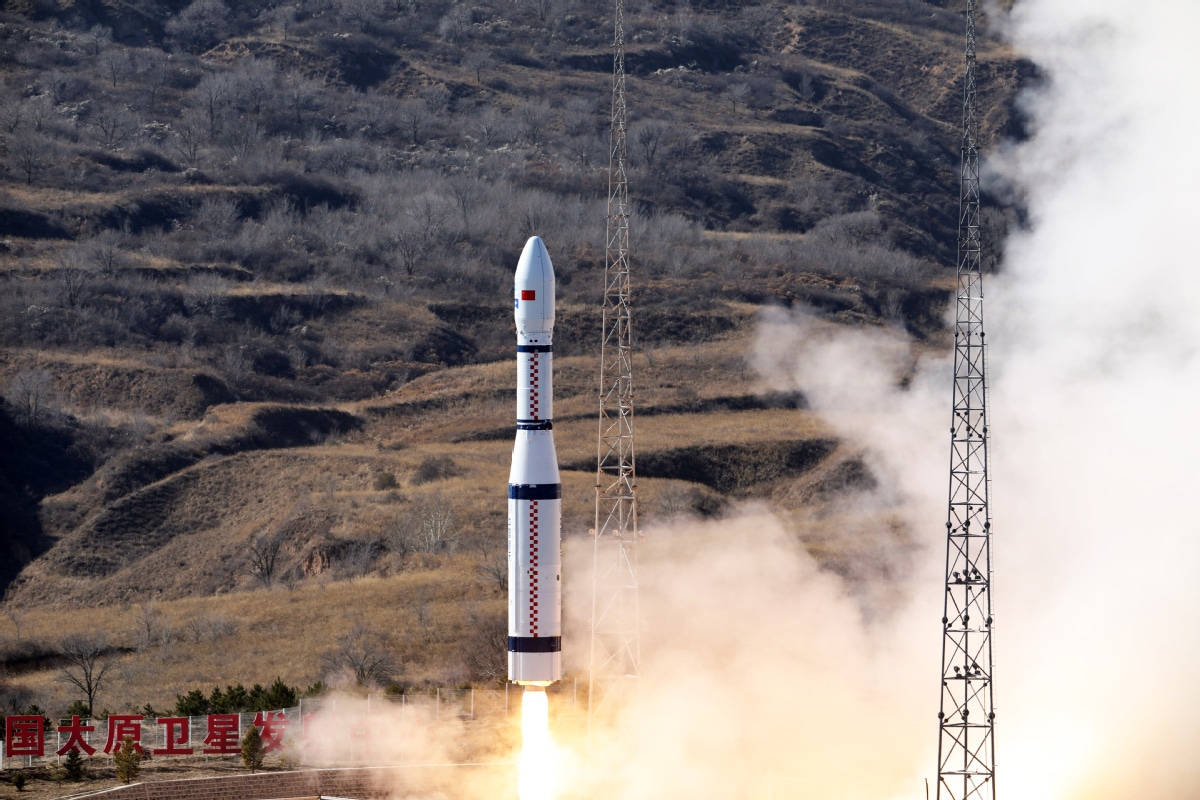
- It is China’s new carrier rocket designed for manned moon landing missions.
- The rocket will be capable of ferrying a crew module along with a lunar lander to Earth-Moon transfer orbit.
- Features:
- It has a modular design, consisting of a service capsule, a return capsule and an escape tower, making it like a miniature space station on its own.
- The command module and living quarters form one half, while the energy and the power modules form the other half.
- The flexible approach allows for components to be reused.
- The crew capsule has been designed for operations in orbit around the Moon, as well as the Earth. The crew module has a capacity of between four and seven humans.
- The vehicle will use liquid hydrogen, liquid oxygen and kerosene as propellants.
- It will have a length of 92 metres, and will be able to deliver a minimum of 27 tonnes to the Earth-Moon transfer orbit.
- There is also a configuration of the vehicle without a booster that can ferry Taikonauts (Chinese word for astronaut) to the Tiangong space station.
Key facts about Tiangong space station:
- Tiangong (Chinese for “Heavenly Palace”) is a modular space station being constructed by the China National Space Administration (CNSA).
- It is the first space station built by China.
- Tiangong is currently in low Earth orbit (LEO), and it is expected to be operational until 2028.
- It is a three-module space station. The core module Tianhe launched in April 2021, followed by the Wentian and Mengtian experiment modules in 2022.
- The station is about the size of the International Space Station (ISS), and it can accommodate up to three astronauts.
- China is only the third country to have put both astronauts into space and to build a space station, after the Soviet Union (now Russia) and the US.
Q1) What is a Low-Earth Orbit?
A low Earth orbit (LEO) is, as the name suggests, an orbit that is relatively close to Earth’s surface. It is normally at an altitude of less than 1000 km but could be as low as 160 km above Earth – which is low compared to other orbits, but still very far above Earth’s surface.Unlike satellites in GEO that must always orbit along Earth’s equator, LEO satellites do not always have to follow a particular path around Earth in the same way – their plane can be tilted. This means there are more available routes for satellites in LEO, which is one of the reasons why LEO is a very commonly used orbit.
Source: China successfully tests high-thrust engine for moon landing


 Last updated on Oct, 2026
→ UPSC 2027 Notification will be released on 13 January 2027 at upsconline.nic.in.
→ Check Nobel Prize 2026 Winners List here.
→ Download PIB PRiSM Monthly Magazine 2026 here.
→ Check UPSC Monthly Current Affairs Magazine The Recitals here.
→ Check out the latest UPSC Syllabus here.
→ Download UPSC Model Answers for Mains 2026
→ UPSC Mains Question Paper 2026 is out now for Essay & GS Paper 1, 2, 3 & 4.
→ UPSC Calendar 2027 has been released.
→ Enroll in Vajiram & Ravi’s UPSC Mains Test Series 2027 for structured answer writing practice, expert evaluation, and exam-oriented feedback.
→ Join Vajiram & Ravi’s UPSC Mentorship Program 2027 for personalized guidance, strategy planning, and one-to-one support from experienced mentors.
→ Go through the UPSC Mains Previous Year Papers to enhance your preparation.
→ UPSC has released UPSC Toppers List 2025 with the Civil Services final result on its official website.
→ Also check Best UPSC Coaching in India