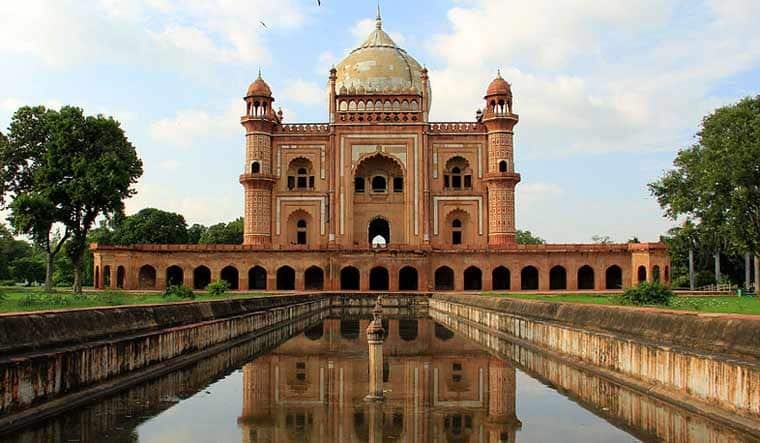
About Safdarjung Tomb:
- Safdarjung Tomb is the last garden tomb constructed in the late Mughal Empire Style.
- Location: At the Intersection of Safdarjung Road and Aurobindo Marg, New Delhi, India.
- It was built in 1753- 54 as a mausoleum of Safdarjung, the viceroy of Awadh under the Mughal Emperor, Mohammed Shah. It was built by his son, Nawab Shujaud Daula.
- Architecture:
- Also known as ‘Safdarjung ka Maqbara,’ the tomb is built on a square plan and has a central dome and is made of marble and sandstone.
- The dome is surrounded by four smaller domes and four minarets.
- The exterior of the tomb is decorated with intricate latticework and calligraphy.
- The interior of the tomb is decorated with marble and gold leaf.
- The tomb is surrounded by lush green gardens. The garden is in the Mughal charbagh garden style, and is a smaller version of the garden of Humayun Tomb.
Who was Safdarjung?
- Safdarjung (1708 – 5 October 1754), whose full name was Mirza Muqim Abul Mansur Khan, was a major figure in the Mughal court during the declining years of the Mughal Empire.
- He became the second Nawab of Awadh when he succeeded Saadat Ali Khan I (his maternal uncle and father-in-law) in 1739.
- In 1739, Safdarjung was appointed the Prime Minister of the Mughal Empire by Emperor Muhammad Shah.
- He served as Prime Minister for five years, during which time he helped to stabilize the Mughal Empire and to improve its relations with other powers in the region.
- After his term as Prime Minister, Safdarjung returned to Awadh, where he ruled as Nawab for the next 15 years.
- He was a capable ruler, and he helped to make Awadh one of the most prosperous provinces in the Mughal Empire.
- He built many mosques, madrasas, and other public buildings in Awadh, and he also supported the arts of music, poetry, and painting.
- He died in 1754, and he was buried in Safdarjung Tomb, Delhi.
Q1) Where is Humayun Tomb located?
Humayun’s Tomb is located in Nizamuddin East, Delhi, India. It is a UNESCO World Heritage Site and is considered to be one of the finest examples of Mughal architecture.
Source: ASI to restore Safdarjung tomb dome in Delhi by July-end


 Last updated on Oct, 2026
→ UPSC 2027 Notification will be released on 13 January 2027 at upsconline.nic.in.
→ Check Nobel Prize 2026 Winners List here.
→ Download PIB PRiSM Monthly Magazine 2026 here.
→ Check UPSC Monthly Current Affairs Magazine The Recitals here.
→ Check out the latest UPSC Syllabus here.
→ Download UPSC Model Answers for Mains 2026
→ UPSC Mains Question Paper 2026 is out now for Essay & GS Paper 1, 2, 3 & 4.
→ UPSC Calendar 2027 has been released.
→ Enroll in Vajiram & Ravi’s UPSC Mains Test Series 2027 for structured answer writing practice, expert evaluation, and exam-oriented feedback.
→ Join Vajiram & Ravi’s UPSC Mentorship Program 2027 for personalized guidance, strategy planning, and one-to-one support from experienced mentors.
→ Go through the UPSC Mains Previous Year Papers to enhance your preparation.
→ UPSC has released UPSC Toppers List 2025 with the Civil Services final result on its official website.
→ Also check Best UPSC Coaching in India