Reservation System in India, Caste Wise and Category Wise

Reservation in India

The reservation system in India was created to provide equal opportunity to marginalised communities such as Scheduled Castes (SC), Scheduled Tribes (ST), and other backward classes. The aim was to eliminate social inequality, discrimination injustices being done to the marginalized community. The reservation system helped disadvantaged groups to hold a place in the education system, the government jobs and legislation. In this article, we will discuss the reservation policy, structure and its impact. 

Reservation System in India Purpose

The Reservation System in India was introduced for the purpose of ensuring justice and inclusive development. The goal was to work towards the upliftment of communities that were having historical disadvantages of caste-hierarchy and systematic exclusion. The purpose of introducing Reservation System in India was: 

  1. Social Equality: Ensure that oppressed communities like SCs, STs, OBCs receive equal access to education, employment and upward mobility. 
  2. Reduce Economic Gaps: The reserved seats at educational institutes and offices ensures that the marginalised group receive economic empowerment and stability. 
  3. Overcome historical injustice: Compensates for the years of injustice, discrimination, exclusion and denial of basic rights to SCs, STs and OBC groups. 
  4. Inclusive Representation: Provide diversity across public services as well as academia. 
  5. Strengthen democratic participation: enables marginalised communities to participate in governance and policymaking, providing a stronger voice in shaping the nation. 

Caste- Based Reservation in India History

The reservation system in India was created to address social inequalities and fair representation. The journey of caste-based reservation can be traced back to the colonial era: 

  • 1882- Early Foundation 

Reformers like William Hunter and Jyotirao Phule are remembered as the very initial people who initiated the need of caste-based reservations to uplift the marginalised groups and ensure social justice is served. 

  • 1933- The Communal Awards

Communal Awards were introduced by British Prime Minister Ramsay Macdonald. Under this, it was proposed that electorates be separated for communities including Muslims, Sikhs, Indian Christians, Anglo-Indians, Dalits and Europeans.

  • 1932- The Poona Pact

Mahatma Gandhi and Dr. B.R Ambedkar negotiated the separate electorates for dalits under the Poona Pact. The pact was concluded with the decision of establishing a common Hindu electorate having reserved seats for dalits in legislatures. 

  • Post- Independence Constitutional Provisions

Dr. Ambedkar and the constituent assembly introduced reservations for SCs and STs in education, employment and legislatures. Initially it was set up for 10 years, but kept on extending due to social disparities. 

  • 1991- Inclusion of OBCs

The Mandal Commission was established for the purpose of submitting a report about the OBCs. Based on this report, the Indian government provided reservation benefits of Other Backward Classes in order to address their historical socio-economic disadvantages. 

What is the Mandal Commission?

The Mandal Commission, established in 1978 under the chairmanship of B.P. Mandal was tasked with identifying socially and educationally backward classes in India. Based on its findings, the Commission recommended 27% reservation in government jobs for Other Backward Classes (OBCs), estimating that they made up around 52% of the population.

It compiled comprehensive lists, identifying 3,743 OBC castes across both Hindu and non-Hindu communities, along with a separate list of 2,108 particularly underprivileged groups.

The Commission’s recommendations played a pivotal role in shaping India’s reservation policy, significantly broadening the scope of affirmative action for marginalized sections of society.

Reservation in India Constitutional Provisions and Amendments

The Reservation in India underwent a number of constitutional provisions and amendments: 

  • Articles 15(4) & 16(4):  The state provides reservation in education and public employment for SCs, STs, and other backward classes.
  • Article 16(4A) (77th Amendment, 1995): Reservation in promotions for SCs and STs.
  • Article 16(4B) (81st Amendment, 2000): Allows the carrying forward of unfilled SC/ST vacancies beyond the 50% limit.
  • Article 335: Balances the claims of SCs/STs in public employment with administrative efficiency.
  • Articles 330 & 332: Provide reservation in Parliament and State Assemblies for SCs and STs.
  • Articles 243D & 243T: Mandate reservations in Panchayats and Municipalities respectively.
  • Article 15(6) & 16(6) (103rd Amendment, 2019): Introduce 10% reservation for Economically Weaker Sections (EWS) in the general category, in addition to the existing 50% cap for SCs, STs, and OBCs.

Reservation Percentage in India for SC/ST/OBC

The current reservation percentages in India are based on caste and other social categories:

Category Reservation Percentage

Scheduled Castes (SC)

15%

Scheduled Tribes (ST)

7.5%

Other Backward Classes (OBC)

27%

Economically Weaker Sections (EWS)

10%

Persons with Benchmark Disabilities

4%

Caste-Based Reservation in Education

In India, both government and select private educational institutions implement reservation policies to promote equitable access to higher education for historically marginalized communities.

  • Government Institutions: Seats are reserved for Scheduled Castes (SC), Scheduled Tribes (ST), and Other Backward Classes (OBC) to bridge educational disparities and ensure representation.
  • Private Institutions: In several states, private colleges—especially those receiving government aid—are also mandated to follow reservation norms for SC, ST, and OBC students.
  • Prestigious Institutes (IITs, NITs, Medical Colleges): Even premier institutions like IITs, NITs, and top medical colleges adhere to reservation policies, fostering diversity and inclusion at the highest levels of academia.

Reservation in India Landmark Cases

India’s reservation framework has evolved through several critical Supreme Court rulings:

  • Indra Sawhney Case (1992):
    Famously known as the Mandal Commission case, it upheld 27% reservation for OBCs while introducing key principles:
    • Capped total reservations at 50%
    • Introduced the "creamy layer" exclusion for OBCs
    • Prohibited reservation in promotions
  • M. Nagaraj Case (2006):
    Upheld reservation in promotions for SCs and STs but laid down constitutional requirements like proving backwardness, inadequate representation, and administrative efficiency.
  • Janhit Abhiyan v. Union of India (2022):
    The Supreme Court upheld the validity of the 103rd Constitutional Amendment Act, 2019, which introduced a 10% reservation for Economically Weaker Sections (EWS), even if it breached the 50% ceiling.

These judgments have played a defining role in balancing affirmative action with constitutional principles of equality.

Reservation in India FAQs

Q1: What is the reservation percentage in India?

Ans: The total reservation in India is currently around 59.5%, including SC (15%), ST (7.5%), OBC (27%), and EWS (10%).

Q2: What is the 33% reservation in India?

Ans: It refers to the proposed reservation of 33% of seats for women in the Lok Sabha and State Legislative Assemblies under the Women's Reservation Bill.

Q3: What is the reservation of SC, ST, and OBC in India?

Ans: SCs have 15%, STs 7.5%, and OBCs 27% reservation in education and government jobs.

Q4: Why was Mandal Commission setup?

Ans: The Mandal Commission was set up in 1979 to identify socially and educationally backward classes and recommend measures for their advancement, including reservations.

Q5: What are Communal Awards?

Ans: The Communal Award of 1932 by the British government provided separate electorates for different religious and social communities in India, including Dalits.

Local Winds in India, Formation, Types, Examples, Importance

Local Winds

Local Winds are winds that blow over short distances and are shaped by geographic features such as mountains, valleys, coastlines, or deserts. Unlike global winds, which circulate over vast regions, local winds are temporary, predictable, and specific to a particular area.

They form due to differences in temperature and air pressure within a localized region, for example, between land and water or between high and low elevations. These Local Winds play an important role in influencing daily weather patterns.

Local Winds

Local Winds occur across the world and differ from global winds such as the trade winds or westerlies. They blow over small areas and usually last for a short period. Their direction and strength are influenced by local landforms, sea temperatures, and prevailing weather conditions.

These winds are especially common in coastal regions, mountain valleys, and deserts. They are generally predictable, often following regular patterns depending on the time of day or season. Farmers, fishermen, and travelers frequently rely on local winds for planning and safety.

Many Local Winds have distinct names and characteristics. Examples include the Loo in India and the Chinook in North America. These winds play a key role in shaping regional climates and daily weather patterns.

Local Winds Formation

Local winds are primarily shaped by temperature-driven pressure differences, terrain features, and surface characteristics such as vegetation and urban areas. These winds develop over specific regions and often follow predictable patterns:

  • Temperature-Driven Pressure Gradients: Land heats and cools faster than water, giving rise to sea breezes during the day, when cool air moves from sea to land, and land breezes at night, when cool air flows from land to sea. Similarly, valleys and mountains produce valley breezes, as warm air rises up slopes during the day, and mountain breezes, when cool air descends at night.
  • Topographic Influence: Slopes and elevation changes generate anabatic winds (upward-moving warm air) and katabatic winds (downward-moving cold air, such as the strong gusts in Antarctica). Mountain ranges can also force air to ascend and cool, producing Foehn winds warm, dry winds on the leeward side of mountains, exemplified by the Chinook in North America.
  • Urban and Vegetation Effects: Cities create urban heat islands, where hot air rises from buildings, generating localized winds. Forested areas can produce katabatic winds as cooled air flows downward into valleys.

Local Winds Types

Local Winds vary based on direction, region, and season. Some of the most common types around the world include:

  • Sea Breeze: Blows from the sea toward the land during the day. It brings cooler air, lowering temperatures in coastal areas.
  • Land Breeze: Moves from land to sea at night. It is cooler and drier compared to the sea breeze.
  • Valley Breeze: Occurs during the day as warm air rises from the valley floor and moves uphill.
  • Mountain Breeze: Happens at night when cool air flows down slopes into the valley.
  • Loo: A hot, dry wind in northern India during summer. It can cause heatstroke and damage crops.
  • Chinook: A warm, dry wind on the eastern slopes of the Rocky Mountains. It quickly melts snow and raises temperatures.

Local Winds Examples

Some of the well-known Local Winds from different regions are:

Local Winds Examples

Name

Nature of Wind

Location/Region

Effects/Impact

Chinook

Hot, dry

Eastern slopes of the Rocky Mountains (North America)

Rapid snowmelt, temperature rise, drying of soil

Foehn

Hot, dry

The Alps (Europe)

Warms the leeward side of mountains, reduces humidity, can trigger avalanches

Mistral

Cold, strong

France and the Alps

Lowers temperature, clears clouds, brings dry conditions

Sirocco

Hot, moist (sometimes dry)

Sahara to the Mediterranean Sea

Causes dust storms, high humidity, and discomfort

Bora

Cold, dry, gusty

Eastern Europe to northeastern Italy, Slovenia, Croatia

Sudden temperature drop, strong gusts, hazardous for shipping

Harmattan

Hot, dry, dusty

West Africa

Reduces humidity, carries dust, affects health and visibility

Santa Ana

Hot, dry

Southern California

Raises wildfire risk, heats the region, dries out vegetation

Khamsin

Hot, dry

Egypt and the eastern Mediterranean

Sandstorms, high temperatures, discomfort, affects agriculture

Loo

Hot, dry

Northern India and Pakistan

Heatwaves, crop damage, health risks like heatstroke

Cape Doctor

Dry, southeasterly

South African coast

Clears air pollution, dries vegetation, influences coastal weather

Local Winds in India

The table below provides an overview of some of the most prominent Local Winds in India, highlighting their nature, regions of occurrence, seasonal patterns, and impacts. These winds play a significant role in shaping local weather and climate, influencing agriculture, daily life, and regional temperature variations.

Local Winds in India

Name

Nature

Region

Season

Impact/Effects

Loo

Hot, dry, dusty

Northern India (Indo-Gangetic plains)

Summer (April–June)

Causes extreme heat, discomfort, health risks like heatstroke

Mango Showers

Pre-monsoon rains, sometimes with thunderstorms

Southern India (Kerala, Karnataka, Tamil Nadu)

Late April–June

Helps ripening of mangoes, signals onset of southwest monsoon

Nor’westers (Kal Baisakhi)

Violent thunderstorms with strong winds and hail

West Bengal, Odisha, Assam, surrounding areas

Pre-monsoon (April–May)

Can damage crops and property; provides relief from summer heat

Sea Breeze / Land Breeze

Gentle winds: sea to land (day) and land to sea (night)

Coastal areas (Mumbai, Chennai, Kolkata)

Throughout the year, pronounced in summer

Moderates coastal temperatures

Aandhi

Dust storms with strong winds

Northern and northwestern India (Rajasthan, Punjab, Haryana, UP)

Pre-monsoon (April–June)

Reduces visibility, respiratory problems, hazardous for travelers

Role of Local Winds in Weather and Climate Patterns

India experiences a diverse range of local winds due to its varied topography, coastline, and climatic zones. These winds are generally short-lived and region-specific, but they have a significant impact on local weather, agriculture, and daily life. From the scorching and dusty Loo of the northern plains to the cooling sea breezes along the coasts, and from pre-monsoon storms like Nor’westers to seasonal showers such as Mango Showers, local winds in India shape temperature, rainfall patterns, and even crop cycles across different regions.

Also Check Other Posts
Geomorphology Major Dams in India
Composition and Structure of Atmosphere Major Ports in India
Types of Forests in India Coastal States of India
Ocean Acidification Migration in India
Deep Ocean Mission Natural Vegetation of India

Local Winds FAQs

Q1: What are the 4 types of local winds?

Ans: Local winds include land and sea breezes, mountain and valley winds, katabatic winds, and foehn/Chinook winds, varying due to topography and temperature differences.

Q2: What are local winds?

Ans: Local winds are winds blowing over short distances, influenced by terrain, temperature, and pressure differences, unlike global winds that follow planetary circulation patterns.

Q3: What are the local winds of India?

Ans: India’s local winds include Loo (summer plains), Mountain and Valley winds (Himalayas), Sea and Land breezes (coasts), and Foehn winds (Himalayan leeward side).

Q4: What are the 4 types of wind?

Ans: Winds are classified as local, seasonal (monsoon), global (trade, westerlies, polar), and periodic winds based on scale, duration, and origin.

Q5: What are category 4 winds?

Ans: Category 4 winds refer to cyclone classification on the Saffir-Simpson scale, with wind speeds 209-251 km/h causing severe damage.

Doctrine of Severability

Doctrine of Severability

Doctrine of Severability Latest News

The Supreme Court clarified that the Doctrine of Severability is applicable in Suits for Specific Performance, but only in exceptional cases.

About Doctrine of Severability

  • It is a fundamental legal principle that plays a crucial role in addressing the constitutionality of laws when some provisions are inconsistent with the Fundamental Rights guaranteed by the Constitution. 
  • In such cases, only the conflicting or repugnant part of the law will be considered void by the courts, not the entire statute. 
  • In simpler terms, if a specific part of a law violates the Constitution but can be separated from the rest of the law without affecting its functionality, only that problematic part will be removed, not the entire law.
  • Another aspect of the doctrine of severability is that if a law combines good and bad provisions using words like ‘and’ or ‘or,’ and the enforcement of the good provision does not depend on the bad one, they are considered severable. 
  • The good provision will be upheld and enforced even if the bad one cannot or does not exist. 
  • On the other hand, if there’s a provision that can be used for both legal and illegal purposes, it is invalid and cannot be allowed even for legal purposes.
  • The court will declare the entire Act as void if the valid and invalid portions are so intertwined that they cannot be separated. 
  • It is also called the doctrine of separability.

Landmark Cases on Doctrine of Severability

  • A.K Gopalan vs State of Madras: The court held that if the preventive detention provision (section 14) was removed, the rest of the Act would remain valid and effective. The violative part was separable from the valid part.
  • Minerva Mills vs Union of India: The court struck down section 4 of 55 of the 42nd Amendment Act, 1976, as it exceeded the amending power of Parliament. However, the remaining provisions of the Act were upheld and considered valid.
  • Kihoto Hollohan vs Zachillhu: The court declared paragraph 7 of the Tenth Schedule (inserted by the 52nd Amendment Act of 1985) unconstitutional. However, the rest of the Tenth Schedule, excluding paragraph 7, was upheld and considered constitutional.

Source: VERD

Doctrine of Severability FAQs

Q1: Under the Doctrine of Severability, which portion of a law is declared void?

Ans: Provisions which are inconsistent with the Fundamental Rights guaranteed by the Constitution.

Q2: The Doctrine of Severability is also known as:

Ans: Doctrine of Separability

Q3: If the valid part of a law can operate independently, what does the court do?

Ans: Saves the valid portion.

Alfvén Waves

Alfvén Waves

Alfvén Waves Latest News

Researchers have made a major advance in solar physics by capturing the first direct evidence of small-scale torsional Alfvén waves in the Sun’s outer atmosphere, known as the corona.

About Alfvén Waves

  • Alfven waves are low-frequency, transverse electromagnetic waves that propagate along the Sun’s magnetic field lines.
  • It occurs in a plasma (or conducting fluid), resulting from the interaction of the magnetic fields and electric currents within it.
    • These waves were first proposed in 1942 by Nobel Prize-winning physicist Hannes Alfvén, are magnetic fluctuations that transfer energy through plasma.
  • Larger and more sporadic Alfven waves linked to solar flares have been detected before.
  • What Researchers have found?
    • The breakthrough was made possible by the unique capabilities of the Daniel K. Inouye Solar Telescope’s Cryogenic Near Infrared Spectropolarimeter (Cryo-NIRSP).
    • This is the first time the subtle, ever-present twisting waves, thought to be powerful enough to heat the corona, have been directly confirmed.
    • The study suggests that Alfven waves may account for at least half of the energy needed to heat the corona.

Source: IE

Alfvén Waves FAQs

Q1: Who predicted the existence of Alfvén Waves?

Ans: Hannes Alfvén

Q2: What is the primary characteristic of Alfvén Waves?

Ans: They are low-frequency waves that propagate through plasmas.

Exercise Milan

Exercise Milan

Exercise MILAN Latest News

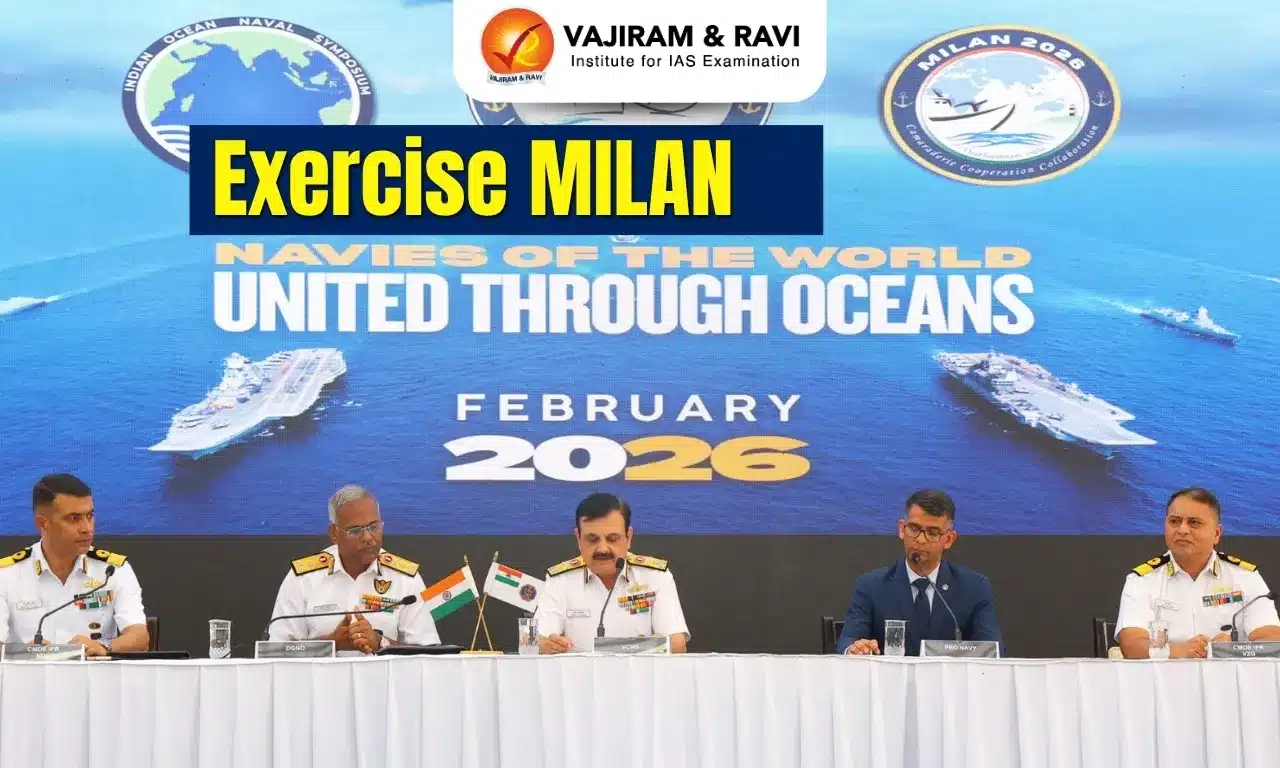
India will host three major international maritime events in Feb 2026 at Visakhapatnam, namely, the International Fleet Review (IFR) 2026, Exercise MILAN 2026, and Indian Ocean Naval Symposium (IONS) Conclave of Chiefs.

About Exercise MILAN

  • It is a biennial multilateral naval exercise which began in 1995.
  • It has since significantly expanded in scope and scale to become the largest exercise held by India.
  • It was started with the participation of only four countries, viz Indonesia, Singapore, Sri Lanka and Thailand, in the 1995 edition, the exercise has since transitioned leaps and bounds in terms of number of participants and complexity of exercises.
  • Originally conceived in consonance with India’s ‘Look East Policy, and later expanded in ensuing years with the Government of India’s ‘Act East Policy’ and Security And Growth for All in the Region (SAGAR) initiative.

Key Features of MILAN 2026

  • Dual-Phase: Exercise MILAN’s Sea and Harbour Phases will focus on interoperability, maritime domain awareness, anti-submarine warfare, air defence, and search-and-rescue operations.
  • International City Parade: It will feature contingents from participating navies, Indian Army, and Indian Air Force marching through Visakhapatnam’s iconic beachfront, the RK Beach, showcasing maritime diplomacy directly to citizens.

Source: PIB

Exercise MILAN FAQs

Q1: When was Exercise MILAN first initiated?

Ans: 1995

Q2: What is Exercise MILAN?

Ans: A multilateral naval exercise hosted by the Indian Navy.

Leprosy

What is Leprosy?

Leprosy Latest News

Recently, the Maharashtra government has officially declared leprosy a “notifiable disease.”

About Leprosy

  • Leprosy is an infectious disease caused by a type of bacteria called Mycobacterium leprae.
  • It is also known as Hansen’s disease.
  • It primarily affects the skin, peripheral nerves, eyes and other organs.
  • It is a neglected tropical disease (NTD) which still occurs in more than 120 countries, with around 200 000 new cases reported every year. 
  • It was declared notifiable in 2005 uniformly under the National Leprosy Eradication Programme (NLEP), Union Ministry of Health and Family Welfare.

Transmission of Leprosy

  • The disease is transmitted through droplets from the nose and mouth of an untreated case of leprosy, containing the causative agent, following prolonged, close contact. 
  • The disease does not spread through casual contact (like shaking hands or hugging, sharing meals or sitting next to each other). 
  • The patient stops transmitting the disease upon initiation of treatment.

Symptoms of Leprosy

  • It usually takes about 3 to 5 years for symptoms to appear after you come into contact with the bacteria that cause leprosy.
  • The main symptom of leprosy is disfiguring skin sores, lumps, or bumps that don’t go away after several weeks or months.
  • In some cases, body parts may lose their sense of touch and pain, increasing the likelihood of injuries such as cuts and burns.

Treatment of Leprosy

  • Leprosy is a curable disease. 
  • The currently recommended treatment regimen consists of three medicines (dapsone, rifampicin and clofazimine) and is referred to as multi-drug therapy (MDT).

Source: IE

Leprosy FAQs

Q1: What is the causative agent of leprosy?

Ans: Mycobacterium leprae

Q2: Which of the following is a characteristic feature of leprosy?

Ans: It causes nerve damage and skin lesions.

Sambhar Lake

Sambhar Lake

Sambhar Lake Latest News

Sambhar Lake is witnessing an extraordinary influx of migratory birds this winter — a rise of nearly 40% compared to last year.

About Sambhar Lake

  • Location: It is the largest saltwater lake located in the districts of Nagaur and Jaipur in Rajasthan.
  • This saline wetland is elliptical in shape, with a length of 35.5 km and a breadth varying between 3 km and 11 km.
  • It covers an area in excess of 200 sq.km., surrounded on all sides by the Aravalli hills.
  • The water from two major ephemeral streams, namely Mendha and Runpangarh, along with numerous rivulets and surface runoff feed the lake.
  • It was designated as a Ramsar site in the year 1990.
  • Salt Production: It is known for the production of brine/salt and also houses one of the largest salt manufacturing units in the country. 
  • Several migrating birds visit the waterbody during the winter. 
  • Fauna: It is the most important wintering area for flamingoes (both Phoniconaias minor and Phoenicopterus roseus) in India outside the Rann of Kachchh.
  • Other migratory species like pelicans, common shelduck, redshank, and common sandpiper, black-winged stilt, Kentish plover, and Ringed plover, Ruff, and Sociable lapwing are also found here.

Source: TOI

Sambhar Lake FAQs

Q1: Where is Sambhar Lake located?

Ans: Rajasthan

Q2: What is a notable characteristic of Sambhar Lake?

Ans: It's a saltwater lake with high salinity

Stabilimenta

Stabilimenta

Stabilimenta Latest News

A new study has revealed that the mysterious silk decorations in some spider webs known as stabilimenta may be sophisticated tuning devices that enhance the spider’s ability to locate its next meal by controlling how vibrations travel through the web.

About Stabilimenta

  • Stabilimenta are highly UV-reflective distinctive silk structures found in multiple spider species’ webs. 
  • These “decorations” may look like zig-zagging threads spanning the gap between two adjacent “spokes,” or threads arranged in a circular “platform” around the web center.
  • The purpose of stabilimenta within the web is unclear
    • They could help collect water, regulate a spider’s body temperature, or even deter predatory wasps or birds to help the arachnids collect more insects. 
    • They also may help the spiders pinpoint where their prey is located by helping vibrations move throughout the web.
  • Not all spiders use stabilimenta, and members of the same species may decorate their webs in different ways.

Source: TH

Stabilimenta FAQs

Q1: What is Stabilimenta?

Ans: Distinctive silk structures found in spider webs.

Q2: What is the primary characteristic of Stabilimenta in spider webs?

Ans: They are highly reflective to ultraviolet (UV) light.

Q3: Which shape can stabilimenta take in spider webs?

Ans: Zigzag or circular

Mahuadanr Wolf Sanctuary

Mahuadanr Wolf Sanctuary

Mahuadanr Wolf Sanctuary Latest News

Hidden deep within the undulating hills of Latehar district in Jharkhand, the Mahuadanr Wolf Sanctuary remains one of India’s most intriguing yet lesser-known wildlife destinations.

About Mahuadanr Wolf Sanctuary

  • It is located in the Latehar district of Jharkhand.
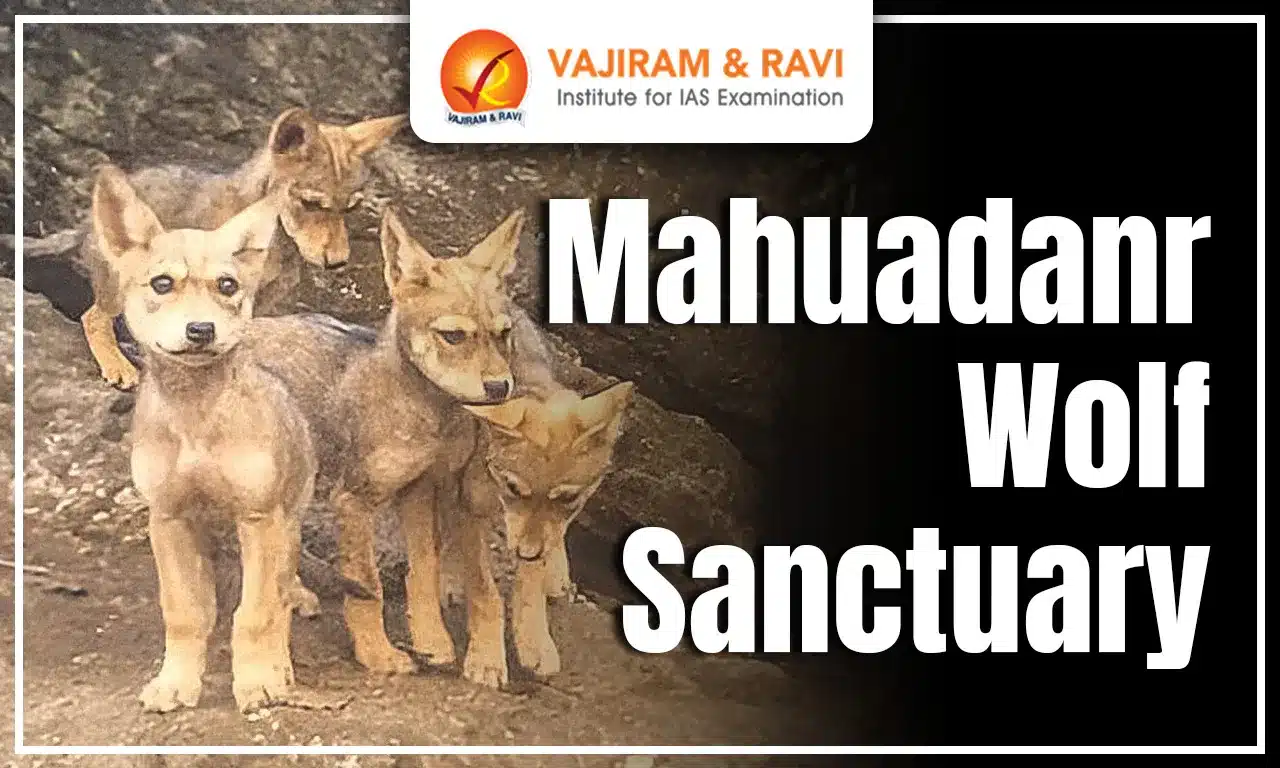
  • It is India’s first and only wolf sanctuary, dedicated to the conservation of the Indian grey wolf (Canis lupus pallipes).
  • The sanctuary, spread over approximately 63 square kilometers, was declared in 1976.
  • It is an integral part of the Palamau Tiger Reserve.
  • It is nestled within a landscape dominated by tribal communities, more than 80 percent of whom follow “Sarna Dharma”, a nature-worshipping religion that venerates forests, rivers, and natural elements.
  • The Mahuadanr landscape is a stunning mosaic of sal forests, rocky plateaus, scrublands, and small river valleys, all vital for the survival of wolves that prefer open and semi-arid habitats for denning and hunting. 
  • The Chechari or Mahuadanr Valley forms the core of this ecosystem. 
  • The sanctuary is drained by the Burha river. The river meets the Aksi River and drains into North Koel near Kujrum. 
  • It is also home to other species like leopards, sloth bears, hyenas, jackals, wild boars, and spotted deer.

Key Facts about Indian Grey Wolf

  • It is one of the smallest wolves in the world. 
  • It is a subspecies of the grey wolf found across Southwest Asia and the Indian subcontinent.
  • It inhabits scrublands, grasslands, and semi-arid agroecosystems and thrives in warmer temperatures.
  • Unlike other wolf subspecies, it lives in smaller packs and is less vocal, being primarily nocturnal and hunting from dusk to dawn.
  • Conservation Status:
    • IUCN Red List: Endangered (the Indian population estimated between 2,000–3,000 individuals).

Source: TOI

Mahuadanr Wolf Sanctuary FAQs

Q1: Mahuadanr Wolf Sanctuary is located in which Indian state?

Ans: Jharkhand

Q2: Mahuadanr Wolf Sanctuary was established in which year?

Ans: 1976

Q3: Mahuadanr Wolf Sanctuary is India’s first and only sanctuary dedicated to which animal?

Ans: Indian grey wolf (Canis lupus pallipes)

Q4: Mahuadanr Wolf Sanctuary is an integral part of which tiger reserve?

Ans: Palamau Tiger Reserve

Bhavani Island

Bhavani Island

Bhavani Island Latest News

Back-to-back floods at the Prakasam Barrage across the Krishna River have become a bane for the tourism department, which has once again been forced to close Bhavani Island and suspend boat operations, severely impacting tourism revenue.

About Bhavani Island

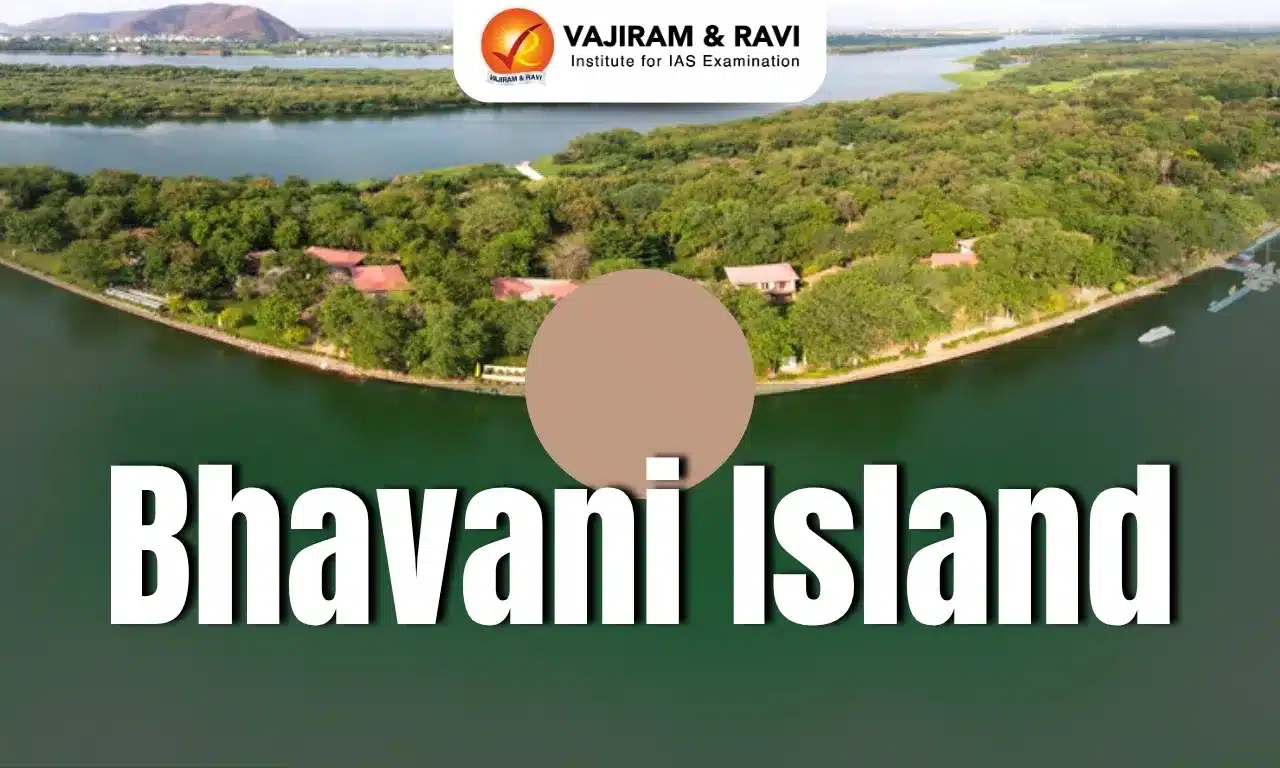
  • It is a river island situated near Vijayawada on the Krishna River in Andhra Pradesh.
  • Spread over an area of 133 acres, it is one of the largest river islands in India. 
  • The island has extensive forest coverage, shimmering ponds and rolling meadows.
  • Initially known more for its natural beauty and abundance of flora and fauna, the island has transformed into a well-equipped tourist spot. 

Key Facts about Krishna River

  • It is a river of south-central India. 
  • One of India’s longest rivers, it has a total length of about 1,400 km.
  • Course
    • The river rises in western Maharashtra state in the Western Ghats range near the town of Mahabaleshwar, not far from the coast of the Arabian Sea. 
    • Krishnabai Temple in Mahabaleshwar is considered to be the starting point of the Krishna River.
    • It passes through the Indian states of Maharashtra, Karnataka, Telangana, and Andhra Pradesh and meets the Bay of Bengal at Hamasaladeevi in Andhra Pradesh, on the east coast.
  • The Krishna River Basin extends over an area of about 258,948 sq. km, which is nearly 8 percent of the total geographical area of the country. 
  • It has the second largest river basin in peninsular India (after the Godavari).
  • It is bounded by the Balaghat range on the north, by the Eastern Ghats on the south and the east, and by the Western Ghats on the west.
  • The principal tributaries joining Krishna are the Ghataprabha, the Malaprabha, the Bhima, the Tungabhadra, and the Musi.
  • The major dams on the Krishna are the Lal Bahadur Shastri Dam (also known as Almatti Dam), the Nagarjuna Sagar, the Srisailam Dam, the Dhom Dam, the Narayanpur Dam, and the Jurala Dam.

Source: TOI

Bhavani Island FAQs

Q1: Bhavani Island is located on which river?

Ans: Krishna River

Q2: Bhavani Island is situated near which city?

Ans: Vijayawada

Q3: In which Indian state is Bhavani Island located?

Ans: Andhra Pradesh

Q4: What is the approximate area of Bhavani Island?

Ans: 133 acres

Dhvani Missile

Dhvani Missile

Dhvani Missile Latest News

India's Defence Research and Development Organisation (DRDO) is on the verge of a historic breakthrough with the upcoming test of Dhvani, a cutting-edge hypersonic missile that promises to catapult the nation into an elite club of military superpowers.

About Dhvani Missile

  • It is an  hypersonic missile being developed by India’s Defence Research and Development Organisation (DRDO).
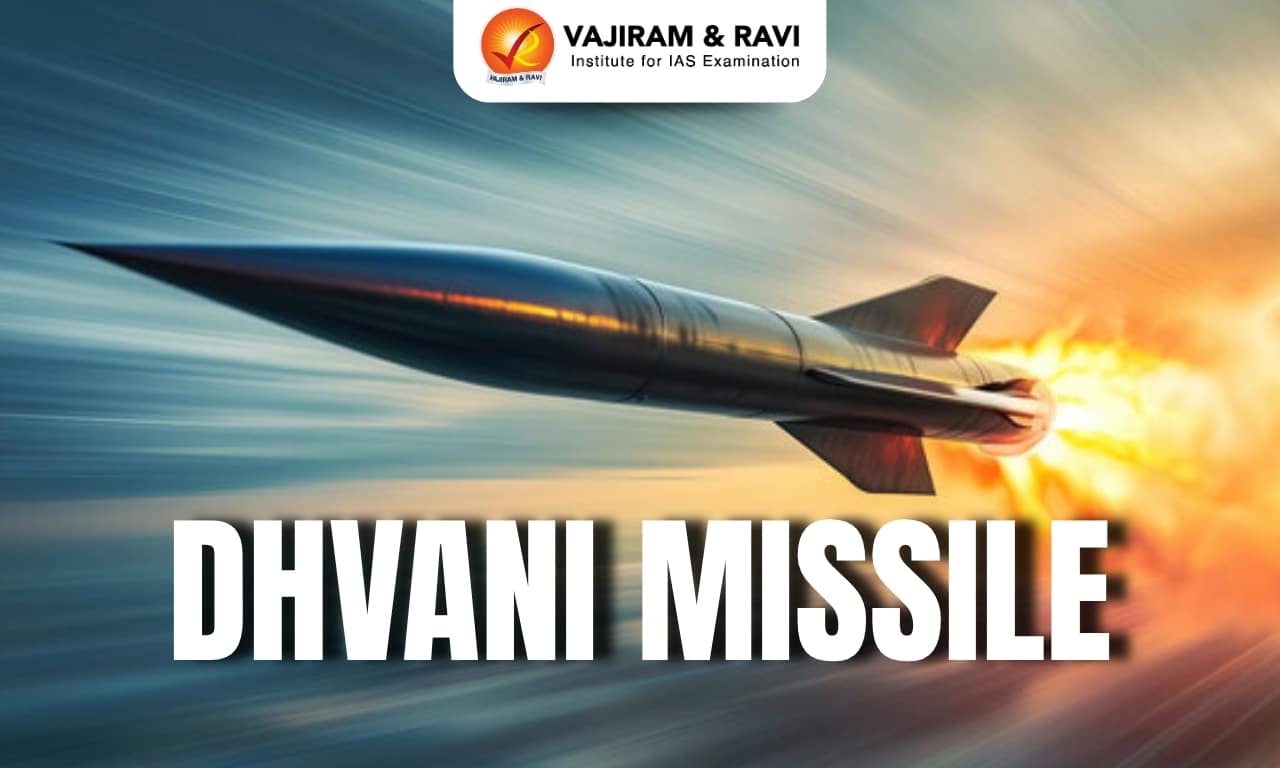
  • The Dhvani is being developed as a Hypersonic Glide Vehicle (HGV), a revolutionary weapon system that combines blistering speed with unprecedented maneuverability. 
    • Unlike conventional cruise missiles that follow predictable flight paths, the Dhvani will be launched to extreme altitudes before gliding toward its target at hypersonic speeds
    • This unique capability makes it nearly impossible to detect and even harder to intercept, rendering most existing missile defense systems obsolete.
    • It will be capable of striking both land-based and maritime targets with pinpoint precision.
  • It can fly at speeds exceeding Mach 5 or 6, nearly 7,400 km per hour.
  • It has estimated ranges between 6,000 to 10,000 kilometers.
  • What sets Dhvani apart is its sophisticated design. 
    • The missile features a blended wing-body configuration measuring approximately 9 meters in length and 2.5 meters in width. 
    • Its advanced heat protection system, utilizing ultra-high-temperature ceramic composites, can withstand temperatures between 2,000-3,000°C generated during atmospheric reentry.
    • The stealth-optimized geometry, including angled surfaces and smooth contours, dramatically reduces its radar cross-section, making it virtually invisible to enemy tracking systems.

Source: WION

Dhvani Missile FAQs

Q1: The Dhvani missile is being developed by which Indian organization?

Ans: Defence Research and Development Organisation (DRDO).

Q2: The Dhvani missile is classified as which type of weapon system?

Ans: Hypersonic Glide Vehicle (HGV)

Q3: What is the maximum estimated speed of the Dhvani missile?

Ans: It can fly at speeds exceeding Mach 5 or 6, nearly 7,400 km per hour.

Q4: What is the estimated range of the Dhvani missile?

Ans: It has estimated ranges between 6,000 to 10,000 kilometers.

List of Governors of RBI from 1935-2025, Tenures, Other Details

List of Governors of RBI from 1935-2025

The Central Bank of India also known as the Reserve Bank of India is responsible for governing the monetary policies of India. Under the RBI Act, of 1934, the Reserve Bank of India was established on 1st April 1935, under the “Hilton - Young Commission” recommendation. During its establishment, the RBI was set up as a private bank and was later nationalized on 1st January 1949 after the independence.

The headquarters was situated in Kolkata during the foundation of RBI but eventually transferred to Mumbai in 1937. The Governor is the head of RBI which the Government Of India appoints. Till today, there have been 25 Governors of RBI. Osborne Smith was the First Governor of RBI in 1935 and Sanjay Malhotra is the Current Governor of RBI holding the office since December 12, 2024.

List of Governors of RBI from 1935-2025

The Governor of RBI is the CEO of the Central Bank of India and the Ex-officio Chairman of the Central Board of Directors. The Reserve Bank of India (RBI) issues the Indian note bearing the signature of the Governor of the Reserve Bank of India. The Government of India appoints the Governors of RBI for a term of three years and can be re-elected for the position. Below is the table we have shared the List of Governors of RBI from 1935-2025:

List of Governors of RBI from 1935-2025

S.N.

Governor Name

Tenure

1. 

Sir Osborne Smith

April 1, 1935 to June 30, 1937

2.

Sir James Braid Taylor

July 1, 1937 to February 17, 1943

3.

Sir C. D. Deshmukh

August 11, 1943 to June 30, 1949

4.

Sir Benegal Rama Rau

July 1, 1949 to 14 January 1957

5.

K. G. Ambegaonkar

January 14, 1957 to 28 February 1957

6.

H. V. R. Iyengar

March 1, 1957 to February 28, 1962

7.

P. C. Bhattacharya

March 1, 1962 to June 30, 1967

8.

L. K. Jha

July 1, 1967 to May 3, 1970

9.

B. N. Adarkar

May 4, 1970 to June 15, 1970

10.

S. Jagannathan

June 16, 1970 to May 19, 1975

11.

N. C. Sen Gupta

May 19, 1975 to August 19, 1975

12.

K. R. Puri

August 20, 1975 to May 2, 1977

13.

M. Narasimhan

May 3, 1977 to November 30, 1977

14.

I.G. Patel

December 1, 1977, to September 15, 1982

15.

Manmohan Singh

September 16, 1982 to January 14, 1985

16.

Amitav Ghosh

January 15, 1985, to February 4, 1985

17.

R. N. Malhotra

February 4, 1985, to December 22, 1990

18.

S. Venkatraman

December 22, 1990 to December 21, 1992

19.

C. Rangarajan

December 22, 1992, to November 21, 1997

20.

Bimal Jalan

November 22, 1997 to September 6, 2003

21.

Y. V. Reddy

September 6, 2003, to September 5, 2008

22.

D. Subbarao

September 5, 2008, to September 4, 2013

23.

Raghuram Rajan

September 4, 2013, to September 4, 2016

24.

Urjit Patel

September 4, 2016, to December 11, 2018

25

Shaktikanta Das

December 12, 2018, to December 12, 2024

26.

Sanjay Malhotra

December 12, 2024 to Present

First Governor of RBI

Sir Osborne Smith was appointed as the First RBI Governor of India. As a professional banker he worked at the Bank of New South Wales for 2 decades and in the Commonwealth Bank of Australia for another decade. He became the Managing Governor at the Imperial Bank of India when he returned back to India and left a great impression. 

His leadership of the Imperial Bank earned him significant recognition within Indian banking circles. However, his policy perspectives on issues such as exchange rates and interest rates often diverged from those of the Government. As a result, he resigned before completing his three-and-a-half-year term. Notably, Sir Osborne did not sign any banknotes during his tenure.

Current Governor of RBI

Sanjay Malhotra is the current RBI Governor, who is an IAS Officer, belonging to the 1990 Rajasthan Cadre. Presently serving as the 26th Governor of RBI. He has played an important role in shaping India's finances. He holds a CS degree from IIT Kanpur and Master’s in Public Policy from Princeton University, USA.

Governor of RBI Eligibility Criteria

The position of RBI Governor is offered to civil servants names like C. D. Deshmukh and Bengal Rama Rao. Over a while, the Governor of RBI Eligibility Criteria elaborated, allowing candidates with diverse backgrounds to be considered. Anyone holding a graduate or postgraduate degree, or qualifications can aspire to become the Governor of RBI.

To be eligible to be a RBI Governor, the following eligibility criteria has to be met: 

  1. Has to be a citizen of India.
  2. Should be in the age group between 40 to 60 years.
  3. Should have at least 20 years of working experience in a banking, finance, economics or related sector. 
  4. Should have held a senior position in a banking or financial institution. 
  5. Should not be connected or associated with any political party or organisation. 

List of Governors of RBI from 1935-2025 FAQs

Q1: What is the salary of an RBI Governor?

Ans: The RBI Governor receives a monthly salary of ₹2.5 lakhs. Before 2016, the basic pay for this position was ₹90,000, but the government implemented two salary hikes in 2017, raising it to the current amount.

Q2: Who was the first Indian Governor of RBI?

Ans: Sir C. D. Deshmukh was the first Indian Governor of RB

Q3: Who is the current RBI Governor?

Ans: Sanjay Malhotra is the current Governor of RBI.

Q4: When was RBI established?

Ans: RBI was established on 1st April 1935 under the RBI Act, of 1934.

Q5: When was RBI Nationalised?

Ans: When was RBI Nationalised?

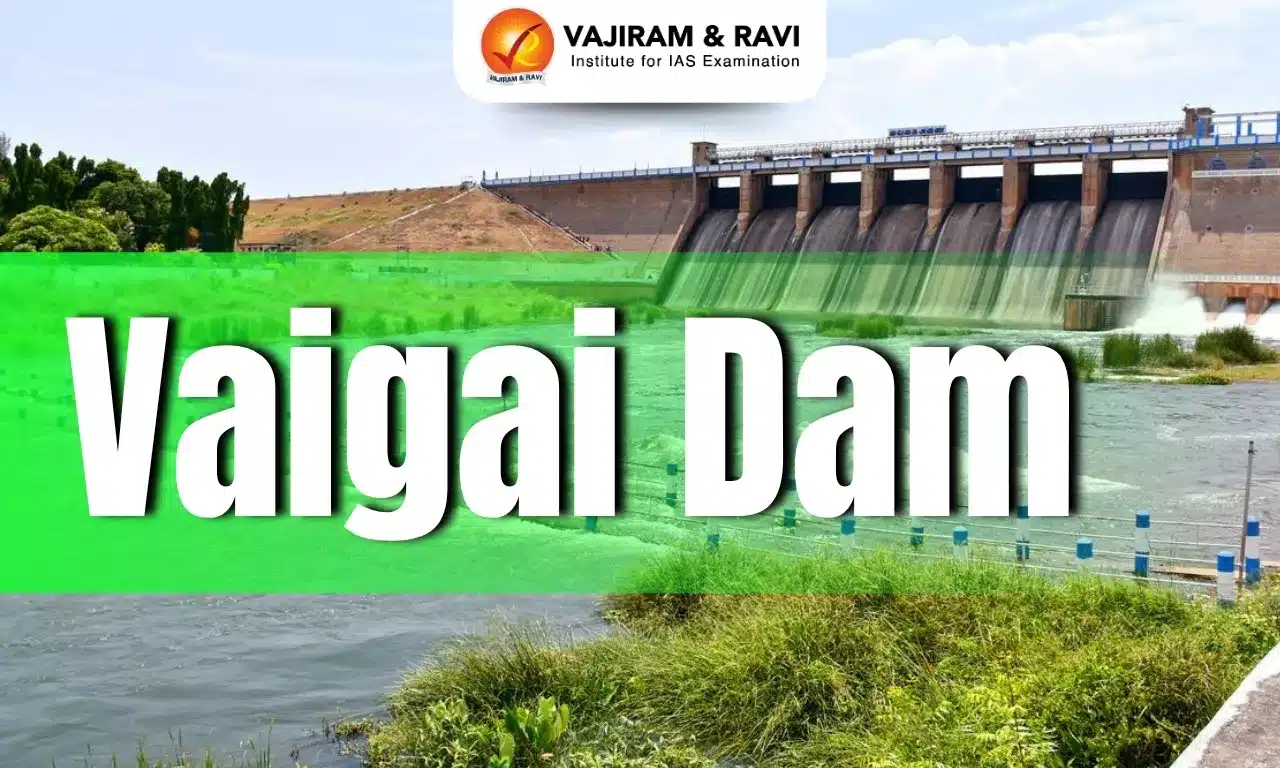
Vaigai Dam

Vaigai Dam

Vaigai Dam Latest News

The timely onset of the northeast monsoon and water release from the Vaigai dam have invigorated Madurai's farming community, prompting a rapid and widespread launch of paddy cultivation across the district's double-crop regions.

About Vaigai Dam

  • It was built in the year 1959 across the Vaigai River. 
  • The dam measures 111 ft in height and the total storage capacity is 6,143 mcft.
  • The dam has been the lifeline of the agricultural lands in the districts of Madurai and Dindigul. It also provides drinking water to Madurai and Andipatti. 
  • The dam also has a hydropower station that generates 6 megawatts of electricity.
  • Near the dam, the Government of Tamil Nadu has constructed an Agricultural Research Station to research on a wide variety of crops including cereals and pulses.
  • There is a small beautiful garden on both sides of the Vaigai Dam called Little Brindavan that is connected by a small bridge. 

Key Facts about Vaigai River

  • It is a river in Tamil Nadu.
  • It is considered to be one of the most sacred and ancient rivers in India, as it is mentioned in several Tamil literary and religious texts, such as the Silappatikaram, the Thiruvilayadal Puranam, and the Thirumurugatruppadai
  • Course:
    • It originates from the Varusanadu and Megamalai hills of the Western Ghats. 
    • It travels through the Pandya Nadu region of Tamil Nadu generally in the south-east direction and rarely causes floods.
    • It drains into the Palk Strait near the Pamban Bridge in Ramanathapuram district.
  • Length: It is 258 kilometres long.
  • It drains an area of 7,741 sq.km, which entirely lies in the state of Tamil Nadu.
  • Vaigai gets major feed from the Periyar Dam in Kerala. Water from the Periyar River in Kerala is diverted into the Vaigai River in Tamil Nadu via a tunnel through the Western Ghats.
  • Tributaries: Its main tributaries are Suruliyaru, Mullaiyaru, Varaganadhi, Manjalaru, Kottagudi, Kridhumaal, and Upparu.
  • It is the major river in the fabled city of Madurai, the capital of the ancient and prosperous Pandya kingdom located in southern Tamil Nadu.

Source: TOI

Vaigai Dam FAQs

Q1: Vaigai Dam is built across which river?

Ans: Vaigai River

Q2: Vaigai Dam is located in which state?

Ans: Tamil Nadu

Q3: Vaigai Dam mainly benefits the agricultural lands of which districts?

Ans: Madurai and Dindigul

Q4: The hydropower station at Vaigai Dam generates how much electricity?

Ans: 6 MW

Kerala Becomes India’s First State to Eradicate Extreme Poverty

Eradicate Extreme Poverty

Eradicate Extreme Poverty Latest News

  • On Kerala Piravi Day or Kerala Day (November 1, 2025), Chief Minister Pinarayi Vijayan declared that Kerala has eradicated extreme poverty, making it the first Indian state to achieve this milestone. 
  • The achievement follows a targeted four-year effort under the Extreme Poverty Eradication Programme (EPEP) led by the Left Democratic Front (LDF) government.
  • This marks a significant development in India’s poverty alleviation journey, offering insights into localized, data-driven, participatory governance models, and aligning with UN Sustainable Development Goal 1 (No Poverty).

Understanding Extreme Poverty

  • Global definition:
    • As per the World Bank’s (June 2025) revision, anyone living on less than $3 per day (2021 PPP) is considered to be in extreme poverty. Earlier, the benchmark was $2.15/day (2017 PPP).
    • The poverty line for:
      • Lower-middle-income countries - $4.20/day
      • Upper-middle-income countries - $8.30/day
  • Difference between poverty and extreme poverty:
    • Those earning below $4.20 but above $3 are poor, not extremely poor.
    • Extreme poverty captures the most deprived segment in terms of basic human needs—food, shelter, health, and education.

India’s Position in the Global Context

  • World Bank estimates (2025):
    • 838 million people globally lived in extreme poverty in 2022 (using $3/day standard).
    • In India:
      • Extreme poverty declined from 16.2% (2011–12) to 2.3% (2022–23).
      • About 171 million people were lifted out of extreme poverty.
  • Drivers of improvement: Rising employment and urbanization. For example, urban unemployment reduced to 6.6% (Q1 FY24/25) — lowest since 2017–18.
  • Persistent challenges:
    • Youth unemployment: 13.3% (29% among graduates).
    • Gender disparity: Female employment rate 31%.
    • Informality: 77% of non-farm jobs and most farm jobs remain informal.
    • Critics argue that official poverty reduction estimates may not fully capture multidimensional deprivations.

Measuring Poverty in India - The Multidimensional Approach

  • NITI Aayog’s Multidimensional Poverty Index (MPI):
    • It is based on Alkire-Foster methodology (Global MPI), and uses 12 indicators across three dimensions -
        • Health: nutrition, child mortality, maternal health.
        • Education: years of schooling, school attendance.
        • Standard of living: housing, sanitation, assets, and cooking fuel.
  • Kerala’s broader poverty reduction journey:
    • NITI Aayog’s 2021 MPI: Kerala’s poverty rate was 0.7% — lowest in India.
    • Poverty declined from 59.8% in the 1970s to near zero due to successive governments’ welfare policies in education, health, and social security.
    • However, Kerala’s extreme poverty identification method differed from the NITI Aayog’s MPI framework.

Kerala’s Model - Extreme Poverty Eradication Programme (EPEP)

  • Launch and implementation:
    • Announced in 2021, soon after the LDF government began its second term.
    • The Local Self-Government Department was the nodal agency.
    • Around 4 lakh personnel—officials, elected representatives, and volunteers—were trained.
  • Identification process:
    • Initial identification: 1.18 lakh families.
    • After verification and migration checks: 59,000 families confirmed.
    • Criteria: Income, health, housing, and food insecurity.
  • Key interventions:
    • Housing: 4,677 homeless families identified; 4,005 provided homes under Life Mission Scheme.
    • Food security: 20,648 families lacking stable food access were given meals by local bodies.
    • Essential documents and services: Under Avakasam Athivegam (Rights Fast) campaign, families were ensured access to - Aadhaar, voter ID, bank accounts, MGNREGS job cards, social pensions, electricity, and LPG connections.
  • Institutional collaboration:
    • Local governance, community participation, and data verification ensured inclusivity.
    • Opposition parties also extended bipartisan support for implementation.

Significance of Kerala’s Achievement

  • Kerala becomes the first Indian state to claim zero extreme poverty.
  • Reflects success of localized planning, micro-level targeting, and welfare convergence.
  • Reinforces Kerala’s legacy in human development, education, and social justice.

Critical Perspectives and Challenges

  • Tribal representation concerns:
    • Adivasi Gothra Mahasabha alleged that only 5% of identified families were Scheduled Tribes, despite high deprivation among Paniya, Adiya, and Kattunaikkar communities in Wayanad and Attappady.
    • Criticism of survey methodology for not ensuring tribal-specific inclusion parameters.
  • Labour and welfare gaps: ASHA workers criticized the government’s poverty claims, demanding better honorarium (₹223/day). The government responded by increasing their pay by ₹1,000/month.
  • Sustainability challenge: LSGD is now planning Phase II to ensure beneficiaries do not relapse into poverty, focusing on long-term livelihood stability.

Way Forward

  • Institutionalise micro-planning: Integrate micro-level data systems within broader State and NITI Aayog MPI frameworks.
  • Tribal and marginal inclusion: Create dedicated tribal sub-plans to ensure fair representation and land rights.
  • Livelihood security: Focus on job creation, skill development, and micro-enterprise financing to prevent relapse into poverty.
  • Sustainability audits: Regular monitoring and impact assessment of rehabilitated families.
  • National replication: Kerala’s model offers a template for other states—combining decentralised governance, data-based targeting, and community-driven execution.

Conclusion

  • Kerala’s EPEP marks a milestone in India’s fight against extreme poverty — showcasing how decentralised governance, human-centric micro-planning, and participatory implementation can transform lives. 
  • While political criticism and inclusivity gaps persist, the model provides a replicable framework for sustainable and equitable poverty eradication in India.
  • By blending welfare delivery with dignity and empowerment, Kerala reaffirms its place as a social development pioneer.

Source: TH | IE

Eradicate Extreme Poverty FAQs

Q1: What is the significance of Kerala’s EPEP in the context of India’s pursuit of SDG 1 (No Poverty)?

Ans: Kerala’s EPEP operationalises SDG 1 through decentralised governance, making it a replicable model for eliminating multidimensional poverty.

Q2: How did Kerala’s decentralised governance structure contribute to the success of the EPEP initiative?

Ans: Empowered local self-governments led surveys, designed micro-plans, coordinated interdepartmental support, etc.

Q3: What distinguishes Kerala’s approach to identifying extreme poverty from national and global frameworks?

Ans: Unlike the World Bank or NITI Aayog’s MPI indices, Kerala used four locally relevant parameters—food, health, income, and housing.

Q4: What is the role of community participation and inter-departmental coordination in the effective implementation of EPEP?

Ans: Collaborations among departments, Kudumbashree collectives, and local citizens facilitated housing, health, and livelihood solutions.

Q5: What are the key criticisms and challenges associated with Kerala’s declaration of being free from extreme poverty?

Ans: Critics cite inadequate tribal inclusion, labour welfare gaps, and political contestation, underscoring the need for sustained monitoring and equitable targeting.

Why Stampedes Keep Repeating in India: Lessons from 2025 Tragedies

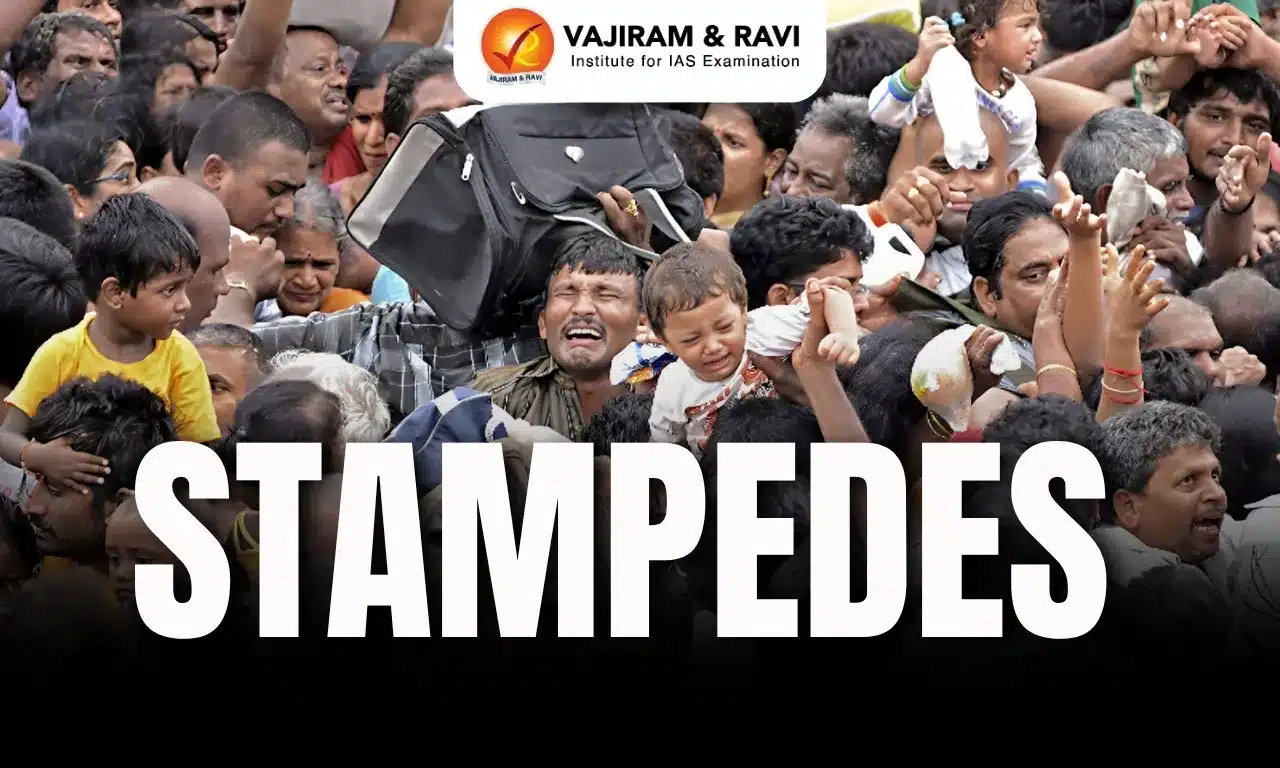
Stampedes

Stampedes Latest News

  • At least nine people, including children, were killed in a stampede at the Venkateswara Swamy temple in Kasibugga, Srikakulam district, on November 1, during Ekadashi celebrations.
  • This marks the third major stampede in Andhra Pradesh this year. Earlier, seven people died in April at Visakhapatnam’s Simhachalam temple after a wall collapse during Akshaya Tritiya, and six were killed in January at Tirupati while queuing for special darshan tickets.
  • Across India, such stampedes at temples, religious festivals, and public gatherings have claimed around 100 lives in 2025 alone, pointing to persistent lapses in crowd management and safety planning.

Stampedes in 2025: From Victory Rallies to Holy Gatherings

  • Bengaluru IPL Victory Parade Turns Fatal - In June 2025, a victory celebration for the Royal Challengers Bangalore (RCB) near Chinnaswamy Stadium turned tragic when a stampede killed at least 12 people.
  • Religious Processions End in Tragedy - In May, a religious yatra at Goa’s Shree Lairai Devi Temple in Shirgaon village saw a stampede that killed several devotees.
    • Similarly, in January, at least 30 pilgrims died and over 60 were injured during the Mauni Amavasya bath at the Kumbh in Prayagraj, where poor crowd control was cited as a key factor.
  • Railway Station Rush Adds to Toll - In February, another major tragedy struck when 18 people died and dozens were injured at the New Delhi Railway Station.
    • The stampede occurred late at night as Kumbh pilgrims tried to board a crowded Prayagraj-bound train.

Understanding Why Stampedes Occur

  • As per the crowd dynamics experts, people in dense crowds often don’t realise danger until it’s too late.
  • Crowd behaviour is shaped by non-verbal cues like body language, and emotions spread through observation rather than panic contagion. 
  • In densely packed spaces, where personal space is limited (as in India), reaction time shortens, increasing the risk of sudden collapses.

The Deadly Domino Effect

  • In most stampedes, the main cause of death is compressive asphyxia — when pressure on the chest and ribs prevents people from breathing.
  • Once someone stumbles and falls, others trip over them, creating a domino effect that leads to pile-ups and trampling.

Why Prevention Fails

  • Stampedes turn deadly when authorities underestimate crowd size, fail to anticipate localised crushes, or lack quick-response protocols.
  • A tightly packed crowd, without controlled entry and exit routes, becomes a ticking time bomb, where one small disturbance can spiral into mass casualties within seconds.

Preventing Stampedes: Lessons India Must Learn

  • According to the National Crime Records Bureau (NCRB) report “Accidental Deaths and Suicides in India,” between 2000 and 2022, 3,074 people lost their lives in stampedes across the country.
  • Over the past three decades, nearly 4,000 stampede incidents have been recorded, with the NCRB systematically collecting such data since 1996.

Global Comparison

  • Stampedes are not unique to India. For instance, in 2022, a Halloween celebration in South Korea turned deadly, and in 2010, Germany’s Love Parade festival saw a similar tragedy.
  • However, unlike in India, such incidents rarely recur abroad because authorities quickly learn lessons and introduce strict safety protocols to prevent repetition.

Why India Fails to Improve

  • India’s large population gatherings, combined with a frequent disregard for safety norms and crowd control rules, make it far more vulnerable.
  • The issue is not just administrative but deeply societal — marked by poor enforcement, lack of accountability, and a casual public attitude toward rules — allowing tragedies to repeat year after year despite mounting casualties.

Source: IE | TH | ToI

Stampedes FAQs

Q1: Why do stampedes occur frequently in India?

Ans: Overcrowding, poor planning, and lack of emergency coordination during religious events or rallies often trigger chaotic, deadly crushes.

Q2: What happened in the Andhra Pradesh temple stampede?

Ans: Nine people died when a railing collapsed at a crowded temple in Kasibugga during Ekadashi, reflecting poor crowd control.

Q3: What are common causes of death in stampedes?

Ans: Most victims die from compressive asphyxia — pressure on the chest prevents breathing — rather than from trampling alone.

Q4: How does India compare with other countries?

Ans: While stampedes occur globally, countries like Germany and South Korea prevent repeats by enforcing strict safety reforms after each incident.

Q5: What reforms are needed to prevent stampedes?

Ans: India must improve event planning, limit entry points, ensure rapid crowd flow monitoring, and instil public respect for safety regulations.

Nobel Prize 2025 in Physics, Winner Name, Contribution

Nobel Physics 2025

The Nobel Prize 2025 in Physics honors three distinguished scientists, John Clarke of the University of California, Berkeley; Michel H. Devoret of Yale University and the University of California, Santa Barbara; and John M. Martinis of the University of California, Santa Barbara, for their groundbreaking discovery of macroscopic quantum mechanical tunnelling and energy quantisation in an electric circuit. Their pioneering experiments demonstrated quantum behavior in an electrical circuit large enough to be seen and held, marking a major milestone in bridging the gap between the microscopic quantum world and macroscopic systems. 

What is the Nobel Prize in Physics?

The Nobel Prize in Physics is awarded annually by the Royal Swedish Academy of Sciences to individuals whose work has had a profound impact on the field of physics. Established in 1901, the prize honors exceptional achievements in areas such as theoretical physics, quantum mechanics, material science, and astrophysics.

Key features of the Nobel Prize in Physics:

  • Celebrates innovative and influential scientific discoveries
  • Recognizes contributions that advance human knowledge and technology
  • Includes a medal, diploma, and cash award

Nobel Prize 2025 in Physics

The Nobel Prize 2025 in Physics has been announced on 7th October 2025 by The Royal Swedish Academy of Sciences in Stockholm. The Nobel Prize 2025 in Physics has been awarded to John Clarke from the University of California, Berkeley, Michel H. Devoret of Yale University and the University of California, Santa Barbara, and John M. Martinis of the University of California, Santa Barbara. They have been recognized for their pioneering work on the macroscopic quantum phenomena in electrical circuits, specifically the demonstration of quantum tunneling and energy quantization on a macroscopic scale. This groundbreaking research has significantly advanced our understanding of quantum mechanics in engineered systems and opened new avenues for quantum technology applications.

Also Check:

Previous Nobel Prize in Physics (2025-2000)

The Nobel Prize in Physics has been awarded annually to recognize scientists whose work has made a profound impact on our understanding of the universe. Over the past two decades, laureates have been honored for discoveries ranging from quantum mechanics and particle physics to astrophysics and AI-related innovations. Here is the detailed list of all Nobel Prize winners from 2000 to 2025.

Previous Nobel Prize in Physics (2025-2000)
Year Laureate(s) Contribution / Achievement

2025

John Clarke, Michel H. Devore, John M. Martinis

macroscopic quantum phenomena in electrical circuits

2024

John J. Hopfield, Geoffrey E. Hinton

Pioneering work in artificial intelligence and neural networks

2023

Pierre Agostini, Ferenc Krausz, Anne L’Huillier

Advancements in attosecond physics, observing electron dynamics

2022

Alain Aspect, John F. Clauser, Anton Zeilinger

Experiments with entangled photons confirming quantum theory

2021

Syukuro Manabe, Klaus Hasselmann, Giorgio Parisi

Physical modeling of climate and disordered systems

2020

Roger Penrose, Reinhard Genzel, Andrea Ghez

Discovery of black hole formation and supermassive black holes

2019

James Peebles, Michel Mayor, Didier Queloz

Theoretical discoveries in cosmology and exoplanets

2018

Arthur Ashkin, Gérard Mourou, Donna Strickland

Optical tweezers and high-intensity laser physics

2017

Rainer Weiss, Barry Barish, Kip Thorne

Detection of gravitational waves

2016

David J. Thouless, F. Duncan M. Haldane, J. Michael Kosterlitz

Theoretical discoveries of topological phase transitions

2015

Takaaki Kajita, Arthur B. McDonald

Discovery of neutrino oscillations

2014

Isamu Akasaki, Hiroshi Amano, Shuji Nakamura

Invention of efficient blue LEDs

2013

François Englert, Peter Higgs

Theoretical discovery of the Higgs boson particle

2012

Serge Haroche, David J. Wineland

Methods for measuring and manipulating quantum systems

2011

Saul Perlmutter, Brian P. Schmidt, Adam G. Riess

Discovery of accelerating expansion of the universe

2010

Andre Geim, Konstantin Novoselov

Discovery of graphene

2009

Charles K. Kao, Willard S. Boyle, George E. Smith

Development of fiber-optic communication and CCD sensors

2008

Yoichiro Nambu, Makoto Kobayashi, Toshihide Maskawa

Discovery of symmetry breaking in subatomic physics

2007

Albert Fert, Peter Grünberg

Discovery of giant magnetoresistance

2006

John C. Mather, George F. Smoot

Cosmic Microwave Background measurements

2005

Roy J. Glauber, John L. Hall, Theodor W. Hänsch

Quantum optics and laser precision spectroscopy

2004

David J. Gross, H. David Politzer, Frank Wilczek

Discovery of asymptotic freedom in strong interactions

2003

Alexei A. Abrikosov, Vitaly L. Ginzburg, Anthony J. Leggett

Work on superconductivity and superfluidity

2002

Raymond Davis Jr., Masatoshi Koshiba, Riccardo Giacconi

Detection of cosmic neutrinos and X-ray astronomy

2001

Eric A. Cornell, Wolfgang Ketterle, Carl E. Wieman

Achievement in Bose-Einstein condensates

2000

Zhores I. Alferov, Herbert Kroemer, Jack S. Kilby

Development of semiconductor heterostructures and integrated circuits

Multiple-Time Nobel Prize Winners in Physics

Receiving the Nobel Prize more than once is a rare and remarkable achievement:

John Bardeen: Only physicist to be awarded the Nobel Prize twice, first in 1956 for the transistor invention and again in 1972 for the BCS theory of superconductivity.

Notable scientists who won in different categories:

  • Marie Curie: Physics (1903) - radioactivity; Chemistry (1911) - radium and polonium discovery
  • Linus Pauling: Chemistry (1954) - chemical bonding; Peace (1962) - anti-nuclear activism

Frederick Sanger: Chemistry (1958) - insulin structure; Chemistry (1980) - nucleic acid sequencing

Nobel Prize 2025 in Physics FAQs

Q1: When was the Nobel Prize in Physics 2025 announced?

Ans: The Nobel Prize in Physics 2025 was officially announced on October 7, 2025, by the Royal Swedish Academy of Sciences in Stockholm, Sweden.

Q2: Who won the Nobel Prize in Physics 2025?

Ans: The Nobel Prize in Physics 2025 was awarded jointly to John Clarke (University of California, Berkeley), Michel H. Devoret (Yale University and University of California, Santa Barbara), and John M. Martinis (University of California, Santa Barbara).

Q3: Has anyone won the Nobel Prize in Physics twice?

Ans: Yes, John Bardeen won it twice, for the transistor invention (1956) and the BCS theory of superconductivity (1972).

Q4: What is the significance of winning the Nobel Prize in Physics?

Ans: It recognizes exceptional contributions to physics, often influencing technology, society, and future scientific research.

Q5: Who were the previous year's winners?

Ans: In 2024, the prize was awarded to John J. Hopfield and Geoffrey E. Hinton for advancements in artificial intelligence and neural networks.

Inside Southeast Asia’s Scam Compounds: How Cybercrime Hubs Trap Victims

Scam Compounds

Scam Compounds Latest News

  • Around 500 Indian citizens who recently escaped the KK Park cybercrime hub in Myawaddy, Myanmar, near the Thailand border, are being repatriated by the Indian government. 
  • The episode underscores the rapidly growing crisis of transnational scam centres in Southeast Asia, where thousands are trafficked or coerced into running online fraud operations across the region.

KK Park: Myanmar’s Infamous Scam Hub on the Thai Border

  • KK Park is one of the most notorious scam centres located in Myawaddy township, Karen State, on the Myanmar–Thailand border
  • It is controlled by the Border Guard Force (BGF) led by warlord Saw Chit Thu, who is closely linked to Myanmar’s junta chief, Min Aung Hlaing.
  • Recently, after reports of illegal Starlink internet use at these scam centres, the Myanmar junta carried out a so-called “raid” at KK Park. 
  • While the raid was mostly symbolic, it caused panic among thousands of low-level workers, many of whom escaped the compound and queued at the border hoping to cross into Thailand. 
  • Locals said the BGF coordinated the operation with the junta, highlighting the deep collusion between military authorities and criminal networks.

Inside the Scam Centre Business Model

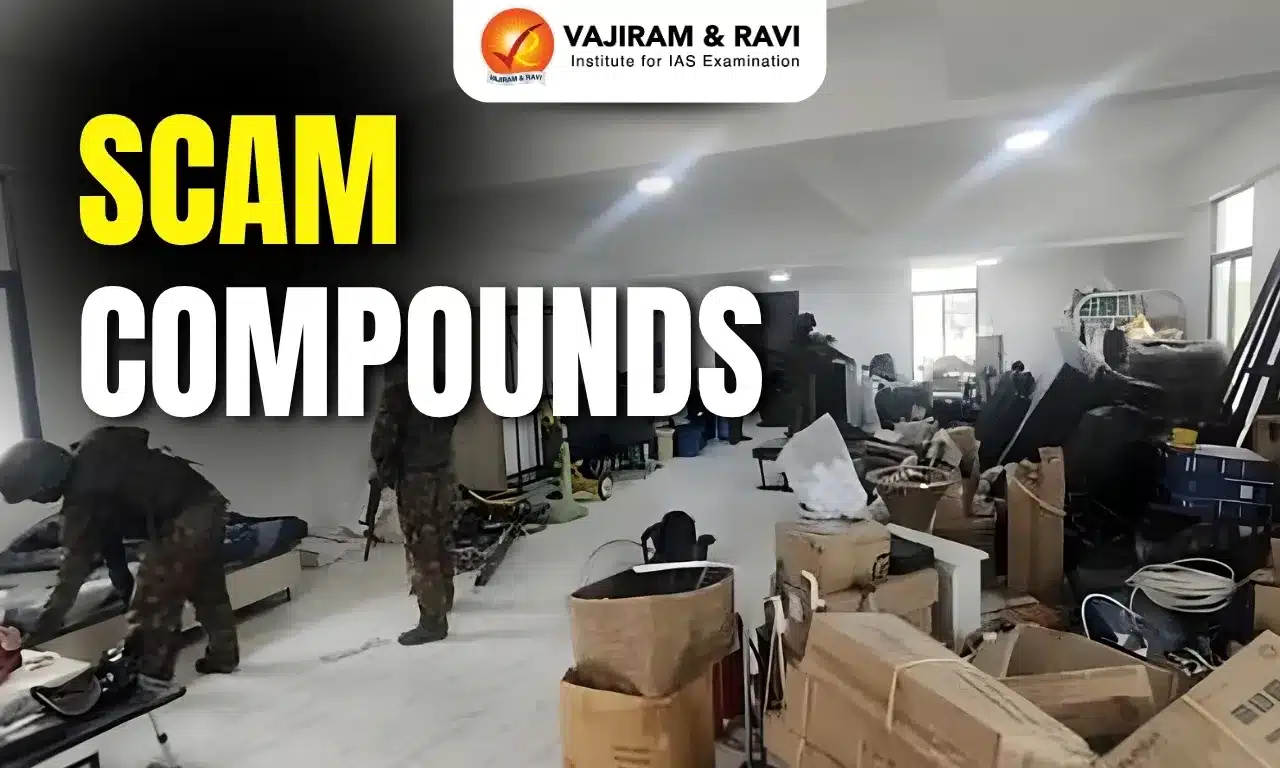
  • According to the Global Initiative Against Transnational Organized Crime (GI-TOC), scam centres are large, jail-like compounds where thousands of people are trafficked and forced to commit cybercrimes. 
  • These facilities operate like factories — highly organised, guarded, and profit-driven.

How Victims Are Trapped

  • Scammers post fake job ads online for high-paying IT or marketing roles. 
  • Victims — mostly from India, China, Vietnam, the Philippines, Africa, and Latin America — are flown to major hubs like Bangkok and then smuggled across borders into Myanmar or Cambodia.
  • Once inside, their passports are seized, and they are told they’ve been “sold” and must work to repay a fake debt. 
  • Under constant watch, they face 12-hour workdays and threats of torture — including beatings, electric shocks, starvation, and solitary confinement — if they resist.

Common Types of Scams

  • The most notorious scheme is “pig butchering”— a mix of romance and investment scams. 
    • Scammers build emotional trust with targets online, pretend to offer profitable crypto investments, and show fake early profits to gain confidence. 
    • Once the victim invests larger sums, the scammers vanish with all the money.
  • Other common frauds include impersonation scams (posing as police or bank officers) and sextortion or blackmail scams.

Myanmar’s Central Role in Southeast Asia’s Scam Network

  • According to the UN Office on Drugs and Crime (UNODC), large-scale online scam centres thrive in lawless border regions and militia-controlled zones across Southeast Asia. 
  • Myanmar has become a key example, where weak governance and armed groups have created “failed state” conditions that allow such operations to flourish.

The Border Guard Force (BGF) System

  • In the mid-2000s, Myanmar’s military created the Border Guard Force (BGF) scheme.
  • It allowed ethnic militias in areas like Kokang (Chinese border) and Karen State (Thai border) to keep their weapons and local control in return for loyalty to the junta.
  • Min Aung Hlaing, the current junta chief who led the 2021 coup, strengthened this arrangement. 
  • He was even photographed conferring ranks on BGF leaders such as Saw Chit Thu, many of whom are deeply involved in scam operations.

The Coup Expanded Criminal Empires

  • After the 2021 coup, the junta’s partners — including the BGF — were given free rein to expand illicit businesses, such as scam compounds and human trafficking networks. 
  • The junta “taxed” these illegal profits to fund its war effort, further embedding corruption and crime in the system.

China’s Reaction and Operation 1027

  • Until 2024, most scam victims were Chinese citizens, making it a domestic issue for Beijing.
  • Frustrated with the junta’s inaction, China quietly supported Operation 1027 in late 2023, where the Three Brotherhood Alliance (ethnic armed groups) launched a major offensive to shut down BGF-run scam centres in northern Shan State
  • The junta lost significant territory, and over 41,000 suspects were handed over to China.

The Shift Southward

  • Despite this crackdown, the scam industry did not end — it moved. 
  • Operations shifted south toward the Thai border, including Myawaddy, Mandalay, and Yangon, and began targeting new victims outside China, including India and other countries.

Indians Trapped and Targeted in Southeast Asia’s Scam Crisis

  • India has been hit both as a victim and a target of the growing scam hub network in Southeast Asia.
  • Hundreds of Indians have been trafficked through fake overseas job offers and forced into cybercrime operations. 
  • In March 2025, the Indian Air Force rescued 283 citizens from Thailand, while over 1,600 Indians have been repatriated from Myanmar’s scam compounds since July 2022. 
  • The 500 who recently escaped KK Park are part of this continuing trend.
  • According to External Affairs Minister S. Jaishankar, India is deeply concerned about these cyber scam centres that have entrapped Indian nationals.
  • At the same time, Indians have also become major targets of “pig butchering” and impersonation scams, turning the issue into both a consular emergency and a domestic cyber security challenge.

Source: TH | UNODC

Scam Compounds FAQs

Q1: What are Southeast Asia’s scam compounds?

Ans: They are heavily guarded complexes where trafficked victims are forced to run online scams like investment, romance, or impersonation frauds under criminal control.

Q2: Where are these scam hubs mainly located?

Ans: Most operate along the Myanmar-Thailand and Cambodia borders, in lawless areas controlled by militias or local armed groups.

Q3: How are victims recruited into scam centres?

Ans: Traffickers lure jobseekers through fake online offers for IT or marketing roles, then seize passports and coerce them into cybercrime.

Q4: What is the “pig butchering” scam?

Ans: It’s a fake romance-investment fraud where victims are tricked into investing in fraudulent crypto schemes before scammers vanish with their money.

Q5: How has India been affected?

Ans: Hundreds of Indians have been trafficked into scam centres, while others have become online fraud victims — turning it into both a consular and security issue.

ISRO to Launch India’s Heaviest Communication Satellite

Communication Satellite

Communication Satellite Latest News

  • The Indian Space Research Organisation (ISRO) is preparing to launch CMS-03, its heaviest communication satellite ever to be launched from Indian soil, on November 2, 2025, aboard the LVM3-M5 (Launch Vehicle Mark-3).

About the CMS-03 Satellite

  • The CMS-03 satellite, weighing 4,410 kg, is designed as a multiband communication satellite that will provide secure and high-bandwidth communication coverage over a wide region, including the Indian subcontinent and surrounding oceanic areas. 
  • It will be placed in a Geosynchronous Transfer Orbit (GTO) of approximately 29,970 km x 170 km from the Earth’s surface.
  • This mission marks the first time ISRO will launch a satellite exceeding 4,000 kg to a GTO from Indian soil. 
  • Previously, India’s heavier communication satellites, such as GSAT-11 (5,854 kg) and GSAT-20 (4,700 kg) were launched by Arianespace or SpaceX due to payload limitations. 
  • With CMS-03, ISRO achieves a new benchmark in self-reliant satellite launches.
  • The satellite will serve critical communication needs, particularly for defence and strategic applications, providing encrypted data relay for the Indian Armed Forces.

LVM3-M5: India’s Most Powerful Rocket

  • The LVM3, also known as GSLV Mk-III, is India’s most powerful and reliable launch vehicle. 
  • The 43.5-meter-tall three-stage rocket is designed to carry up to 4,000 kg payloads to GTO and 8,000 kg to Low Earth Orbit (LEO).
  • Structure and Design
    • First Stage (S200) - Two massive solid rocket boosters provide the initial thrust for lift-off.
    • Second Stage (L110) - A liquid-propellant stage powered by twin Vikas engines.
    • Third Stage (C25 Cryogenic Engine) - The most advanced component, using liquid hydrogen (LH2) and liquid oxygen (LOX) to provide the high thrust needed for orbit insertion.
  • This launch vehicle has been developed using entirely indigenous technologies, including the C25 cryogenic stage, giving India full autonomy in launching heavy satellites. 
  • The LVM3 has had a 100% success rate so far, including the landmark Chandrayaan-3 mission, which made India the first country to land near the lunar south pole in 2023.

Advancements and Future Upgrades

  • ISRO is continuously enhancing the performance of the LVM3. With the C25 cryogenic stage currently providing 20 tonnes of thrust using 28,000 kg of propellant, ISRO plans to replace it with a more powerful C32 cryogenic stage, capable of carrying 32,000 kg of fuel and producing 22 tonnes of thrust.
  • Additionally, ISRO is developing a semi-cryogenic engine, which will replace the L110 liquid stage with a kerosene and liquid oxygen-based engine. 
  • This will increase payload capacity to 10,000 kg in LEO, a crucial requirement for India’s upcoming Gaganyaan human spaceflight programme and the proposed Bharatiya Antariksh Station (India’s space station).

Significance of the Mission

  • Self-Reliance in Heavy Satellite Launches
    • Until now, India has relied on foreign space agencies to launch heavy communication satellites. 
    • The CMS-03 launch demonstrates that India can now independently launch 4-tonne-class satellites, significantly reducing costs and ensuring strategic autonomy.
  • Strategic and Military Capability
    • CMS-03’s secure communication bands will serve as a key enabler for India’s defence communication network, linking naval, air, and ground assets through encrypted signals. 
    • It will enhance situational awareness, real-time data exchange, and maritime domain monitoring across the Indian Ocean Region.
  • Boost to Gaganyaan Mission
    • The same LVM3 vehicle, in its human-rated version (HRLV), will be used for the Gaganyaan mission, which aims to send Indian astronauts into space. This launch thus serves as another validation of the LVM3’s reliability and adaptability.
  • Paving Way for Space Station Missions
    • The upgraded versions of LVM3 will support future missions such as the Bharatiya Antariksh Station and Lunar Module Launch Vehicle (LMLV), which ISRO plans to use for deep-space and lunar missions carrying payloads up to 80,000 kg in LEO.

Track Record of LVM3

  • The LVM3 rocket has completed seven successful missions to date, including the launches of Chandrayaan-2, Chandrayaan-3, and several GSAT satellites. 
  • Compared to its predecessor, GSLV Mk-II, which had multiple failures, LVM3 stands out as ISRO’s most reliable heavy-lift vehicle.
  • This success rate makes it the preferred launch vehicle for both national and international missions, cementing India’s reputation as a global space technology leader.

Source: TH | IE

Communication Satellite FAQs

Q1: What is the CMS-03 satellite?

Ans: CMS-03 is a multiband communication satellite weighing 4,410 kg, designed to provide secure communication services, including for military applications.

Q2: What rocket is being used to launch CMS-03?

Ans: The CMS-03 satellite will be launched aboard ISRO’s LVM3-M5 rocket, also known as GSLV Mk-III.

Q3: Why is the CMS-03 mission significant?

Ans: It marks India’s first launch of a satellite weighing over 4,000 kg to a geosynchronous transfer orbit from Indian soil.

Q4: How does LVM3 differ from ISRO’s PSLV?

Ans: LVM3 is designed for heavy payloads up to 4,000 kg in GTO, whereas PSLV is optimized for lighter payloads to low-Earth orbits.

Q5: What are ISRO’s future plans for the LVM3 rocket?

Ans: ISRO plans to upgrade the LVM3 with a more powerful C32 cryogenic stage and semi-cryogenic engines for future human and deep-space missions.

Nobel Prize 2025 in Literature, Winner Name, Contribution

Nobel Prize in Literature

The Nobel Prize in Literature 2025 is awarded to Hungarian author László Krasznahorkai “for his compelling and visionary oeuvre that, in the midst of apocalyptic terror, reaffirms the power of art.” The 2025 Nobel Prize in Literature continues a legacy that began in 1901, honoring authors whose works profoundly shape global literature. It recognizes outstanding literary achievement, creativity, and the power to illuminate human experiences and cultural values. Awarded by the Swedish Academy, the prize highlights the enduring importance of literature in promoting empathy, knowledge, and social reflection, reaffirming the historical and cultural significance of literature in enriching humanity.

Nobel Prize 2025 in Literature

The Nobel Prize in Literature 2025 is announced on 9 October 2025, honoring Hungarian author László Krasznahorkai for his compelling and visionary body of work, including his acclaimed novel “Satantango.” Presented by the Swedish Academy, the prize recognizes his exceptional literary excellence, creativity, and profound impact on humanity. It celebrates his ability to reflect cultural, social, and human values through deeply philosophical and poetic writing. The laureate receives a medal, diploma, and monetary award, and the official ceremony takes place on 10 December 2025 in Stockholm.

Also Check: Nobel Prize 2025 in Medicine

Nobel Prize in Literature Historical Background

The Nobel Prize 2025 in Literature originated from Alfred Nobel’s 1895 will, aiming to reward those who produced remarkable literary works that uplift humanity. The first award was given in 1901, marking the beginning of a global tradition of honoring literary excellence. Since then, it has recognized writers whose words inspire thought, emotion, and cultural progress.

  • Established through Alfred Nobel’s 1895 will.
  • First awarded in 1901 by the Swedish Academy.
  • Recognizes outstanding literary contributions worldwide.
  • Encourages works promoting human ideals and imagination.
  • Celebrates authors from various languages and traditions.

Also Check: Nobel Prize Winners 2025 in Physics

Nobel Prize in Literature List (2025-1901)

The Nobel Prize in Literature, awarded annually by the Swedish Academy since 1901, honors outstanding authors, poets, and playwrights whose works have deeply influenced global literature and human thought. The detailed list of Nobel Prize Winners in Literature (2024-190) has been shared below.

Nobel Prize in Literature List (2025-1901)
Year Laureate Contribution / Citation

2025

László Krasznahorkai

For his compelling and visionary oeuvre that, in the midst of apocalyptic terror, reaffirms the power of art

2024

Han Kang

For her intense poetic prose that confronts historical traumas and exposes the fragility of human life.

2023

Jon Fosse

For his innovative plays and prose which give voice to the unsayable.

2022

Annie Ernaux

For the courage and clinical acuity with which she uncovers the roots, estrangements and collective restraints of personal memory.

2021

Abdulrazak Gurnah

For his uncompromising and compassionate penetration of the effects of colonialism and the fate of the refugee in the gulf between cultures and continents.

2020

Louise Glück

For her unmistakable poetic voice that with austere beauty makes individual existence universal.

2019

Peter Handke

For an influential work that with linguistic ingenuity has explored the periphery and the specificity of human experience.

2018

Olga Tokarczuk

For a narrative imagination that with encyclopedic passion represents the crossing of boundaries as a form of life.

2017

Kazuo Ishiguro

Who, in novels of great emotional force, has uncovered the abyss beneath our illusory sense of connection with the world.

2016

Bob Dylan

For having created new poetic expressions within the great American song tradition.

2015

Svetlana Alexievich

For her polyphonic writings, a monument to suffering and courage in our time.

2014

Patrick Modiano

For the art of memory with which he has evoked the most ungraspable human destinies and uncovered the life-world of the occupation.

2013

Alice Munro

Master of the contemporary short story.

2012

Mo Yan

Who with hallucinatory realism merges folk tales, history and the contemporary.

2011

Tomas Tranströmer

Because, through his condensed, translucent images, he gives us fresh access to reality.

2010

Mario Vargas Llosa

For his cartography of structures of power and his trenchant images of the individual's resistance, revolt, and defeat.

2009

Herta Müller

Who, with the concentration of poetry and the frankness of prose, depicts the landscape of the dispossessed.

2008

Jean-Marie Gustave Le Clézio

Author of new departures, poetic adventure and sensual ecstasy, explorer of a humanity beyond and below the reigning civilization.

2007

Doris Lessing

That epicist of the female experience, who with scepticism, fire and visionary power has subjected a divided civilisation to scrutiny.

2006

Orhan Pamuk

Who in the quest for the melancholic soul of his native city has discovered new symbols for the clash and interlacing of cultures.

2005

Harold Pinter

Who in his plays uncovers the precipice under everyday prattle and forces entry into oppression's closed rooms.

2004

Elfriede Jelinek

For her musical flow of voices and counter-voices in novels and plays that reveal the absurdity of society's clichés and their subjugating power.

2003

J. M. Coetzee

Who in innumerable guises portrays the surprising involvement of the outsider.

2002

Imre Kertész

For writing that upholds the fragile experience of the individual against the barbaric arbitrariness of history.

2001

V. S. Naipaul

For having united perceptive narrative and incorruptible scrutiny in works that compel us to see the presence of suppressed histories.

2000

Gao Xingjian

For an œuvre of universal validity, bitter insights and linguistic ingenuity, which has opened new paths for the Chinese novel and drama.

1999

Günter Grass

Whose frolicsome black fables portray the forgotten face of history.

1998

José Saramago

Who with parables sustained by imagination, compassion and irony continually enables us once again to apprehend an elusory reality.

1997

Dario Fo

Who emulates the jesters of the Middle Ages in scourging authority and upholding the dignity of the downtrodden.

1996

Wisława Szymborska

For poetry that with ironic precision allows the historical and biological context to come to light in fragments of human reality.

1995

Seamus Heaney

For works of lyrical beauty and ethical depth, which exalt everyday miracles and the living past.

1994

Kenzaburo Oe

Who with poetic force creates an imagined world, where life and myth condense to form a disconcerting picture of the human predicament today.

1993

Toni Morrison

Who in novels characterized by visionary force and poetic import, gives life to an essential aspect of American reality.

1992

Derek Walcott

For a poetic oeuvre of great luminosity, sustained by a historical vision, the outcome of a multicultural commitment.

1991

Nadine Gordimer

Who through her magnificent epic writing has been of very great benefit to humanity.

1990

Octavio Paz

For impassioned writing with wide horizons, characterized by sensuous intelligence and humanistic integrity.

1989

Camilo José Cela

For a rich and intensive prose, which with restrained compassion forms a challenging vision of man's vulnerability.

1988

Naguib Mahfouz

Who, through works rich in nuance, has formed an Arabian narrative art that applies to all mankind.

1987

Joseph Brodsky

For an all-embracing authorship, imbued with clarity of thought and poetic intensity.

1986

Wole Soyinka

Who in a wide cultural perspective and with poetic overtones fashions the drama of existence.

1985

Claude Simon

Who in his novel combines the poet's and the painter's creativeness with a deepened awareness of time in the depiction of the human condition.

1984

Jaroslav Seifert

For his poetry which endowed with freshness, sensuality and rich inventiveness provides a liberating image of the indomitable spirit of man.

1983

William Golding

For his novels which illuminate the human condition in the world of today.

1982

Gabriel García Márquez

For his novels and short stories, in which the fantastic and the realistic are combined in a richly composed world of imagination.

1981

Elias Canetti

For writings marked by a broad outlook, a wealth of ideas and artistic power.

1980

Czesław Miłosz

Who with uncompromising clear-sightedness voices man's exposed condition in a world of severe conflicts.

1979

Odysseus Elytis

For his poetry, which, against the background of Greek tradition, depicts modern man's struggle for freedom and creativity.

1978

Isaac Bashevis Singer

For his impassioned narrative art rooted in Polish-Jewish cultural tradition.

1977

Vicente Aleixandre

For creative poetic writing that represents the renewal of Spanish poetry traditions.

1976

Saul Bellow

For the human understanding and subtle analysis of contemporary culture combined in his work.

1975

Eugenio Montale

For his distinctive poetry interpreting human values under an outlook on life with no illusions.

1974

Eyvind Johnson / Harry Martinson

For narrative art serving freedom / For writings that catch the dewdrop and reflect the cosmos.

1973

Patrick White

For an epic and psychological narrative art introducing a new continent into literature.

1972

Heinrich Böll

For his writing which renews German literature with sensitivity and broad perspective.

1971

Pablo Neruda

For a poetry that brings alive a continent's destiny and dreams.

1970

Aleksandr Solzhenitsyn

For the ethical force with which he pursued indispensable traditions of Russian literature.

1969

Samuel Beckett

For his writing that, in new forms for novel and drama, elevates the destitution of modern man.

1968

Yasunari Kawabata

For his narrative mastery expressing the essence of the Japanese mind.

1967

Miguel Ángel Asturias

For his vivid literary achievement deep-rooted in Latin American Indian traditions.

1966

Shmuel Agnon / Nelly Sachs

For his narrative art with motifs from Jewish life / For lyrical and dramatic writing interpreting Israel's destiny.

1965

Mikhail Sholokhov

For the artistic power and integrity of his epic of the Don.

1964

Jean-Paul Sartre

For his work rich in ideas and filled with the spirit of freedom and truth.

1963

Giorgos Seferis

For his eminent lyrical writing inspired by a deep feeling for the Hellenic world.

1962

John Steinbeck

For his realistic and imaginative writings with sympathetic humour and social perception.

1961

Ivo Andrić

For the epic force with which he depicted human destinies from his country's history.

1960

Saint-John Perse

For the soaring flight and evocative imagery of his visionary poetry.

1959

Salvatore Quasimodo

For his lyrical poetry expressing the tragic experience of life in our time.

1958

Boris Pasternak

For his important achievement in lyrical poetry and the Russian epic tradition.

1957

Albert Camus

For literary production that illuminates the problems of human conscience.

1956

Juan Ramón Jiménez

For his lyrical poetry in Spanish, an example of high spirit and purity.

1955

Halldór Laxness

For his vivid epic power renewing Icelandic narrative art.

1954

Ernest Hemingway

For his mastery of narrative art, especially The Old Man and the Sea.

1953

Winston Churchill

For his mastery of historical and biographical description and brilliant oratory.

1952

François Mauriac

For deep spiritual insight and artistic intensity in his novels.

1951

Pär Lagerkvist

For artistic vigour and independence of mind in seeking eternal answers.

1950

Bertrand Russell

For writings that champion humanitarian ideals and freedom of thought.

1949

William Faulkner

For powerful and unique contribution to the modern American novel.

1948

T. S. Eliot

For his outstanding, pioneer contribution to present-day poetry.

1947

André Gide

For comprehensive and significant writings presenting human problems with fearless truth.

1946

Hermann Hesse

For inspired writings exemplifying humanitarian ideals.

1945

Gabriela Mistral

For her lyric poetry symbolizing the idealistic aspirations of Latin America.

1944

Johannes V. Jensen

For the strength and fertility of poetic imagination and creative style.

1939

Frans Eemil Sillanpää

For deep understanding of peasantry and exquisite art portraying their life.

1938

Pearl S. Buck

For her epic descriptions of peasant life in China and biographical masterpieces.

1937

Roger Martin du Gard

For artistic power and truth in depicting human conflict.

1936

Eugene O'Neill

For the power, honesty and deep emotion of his dramatic works.

1934

Luigi Pirandello

For his bold and ingenious revival of dramatic and scenic art.

1933

Ivan Bunin

For the strict artistry continuing classical Russian prose traditions.

1932

John Galsworthy

For his distinguished art of narration in The Forsyte Saga.

1931

Erik Axel Karlfeldt

The poetry of Erik Axel Karlfeldt.

1930

Sinclair Lewis

For his vigorous and graphic art of description and creation of new character types.

1929

Thomas Mann

For his great novel Buddenbrooks, a classic of contemporary literature.

1928

Sigrid Undset

For powerful descriptions of Northern life during the Middle Ages.

1927

Henri Bergson

For rich and vitalizing ideas and brilliant presentation.

1926

Grazia Deledda

For idealistically inspired writings picturing life on her native island.

1925

George Bernard Shaw

For his work marked by idealism, humanity, and poetic satire.

1924

Władysław Reymont

For his great national epic The Peasants.

1923

William Butler Yeats

For inspired poetry giving expression to the spirit of a nation.

1922

Jacinto Benavente

For continuing the illustrious traditions of Spanish drama.

1921

Anatole France

For brilliant literary achievements characterized by nobility and human sympathy.

1920

Knut Hamsun

For his monumental work Growth of the Soil.

1919

Carl Spitteler

In special appreciation of his epic Olympian Spring.

1917

Karl Gjellerup / Henrik Pontoppidan

For varied poetry inspired by lofty ideals / For authentic descriptions of present-day Danish life.

1916

Verner von Heidenstam

For significance as the leading representative of a new era in literature.

1915

Romain Rolland

For lofty idealism and love of truth in his literary work.

1913

Rabindranath Tagore

For his profoundly sensitive and beautiful verse that made his poetic thought part of world literature.

1912

Gerhart Hauptmann

For fruitful, varied, and outstanding dramatic art.

1911

Maurice Maeterlinck

For his imaginative and poetic dramatic works appealing deeply to readers.

1910

Paul Heyse

For consummate artistry and idealism in poetry and prose.

1909

Selma Lagerlöf

For lofty idealism, vivid imagination, and spiritual perception.

1908

Rudolf Eucken

For vindicating and developing an idealistic philosophy of life.

1907

Rudyard Kipling

For originality, imagination, and remarkable talent for narration.

1906

Giosuè Carducci

For creative energy, freshness of style, and lyrical force.

1905

Henryk Sienkiewicz

Because of his outstanding merits as an epic writer.

1904

Frédéric Mistral / José Echegaray

For fresh originality of poetic production / For brilliant compositions reviving Spanish drama.

1903

Bjørnstjerne Bjørnson

For noble, magnificent, and versatile poetry distinguished by purity and inspiration.

1902

Theodor Mommsen

For his monumental historical work A History of Rome.

1901

Sully Prudhomme

For poetic compositions of lofty idealism and artistic perfection.

Also Check: Nobel Prize 2025 in Chemistry

Nobel Prize 2025 in Literature FAQs

Q1: Who selects the Nobel Literature laureate?

Ans: The Swedish Academy is responsible for choosing the laureate. A Nobel Committee for Literature evaluates nominations, shortlists candidates, reads their works, deliberates, and votes.

Q2: Who can nominate candidates and are nominations public?

Ans: Only qualified persons such as literature professors, members of literary academies, and previous laureates can submit nominations.

Q3: Can the prize be awarded posthumously?

Ans: Generally, the laureate must be alive at the time of the announcement. If a laureate dies after the announcement, they can still receive the prize.

Q4: Can multiple laureates share the prize?

Ans: Up to three individuals can share a single Nobel Prize. Laureates are chosen by vote and must receive more than half of the votes cast.

Q5: What does the laureate receive?

Ans: The laureate receives a medal, a diploma, and a monetary award. The prize money is funded by the Nobel Foundation and may vary over time.

Nobel Prize Winners 2025 in Physiology or Medicine, Name, Contribution

Nobel Prize Winners in Medicine 2025

The Nobel Prize in Physiology or Medicine 2025 was announced on October 6, 2025, by the Nobel Assembly at Karolinska Institutet, Sweden. This year’s award recognizes path-breaking research explaining how the immune system prevents attacks on the body’s own tissues, a concept known as peripheral immune tolerance. The discovery offers new understanding of autoimmune diseases and opens ways for modern immunotherapies.

Nobel Prize 2025 in Medicine

The Nobel Prize 2025 in Medicine was jointly awarded to Mary E. Brunkow, Fred Ramsdell, and Shimon Sakaguchi for their discovery of mechanisms that maintain immune self-tolerance. Their research identified the FOXP3 gene and its role in developing regulatory T cells (Tregs), immune cells that prevent the body from attacking itself. This discovery has transformed immunology, enabling new approaches to treat autoimmune diseases, allergies, and organ rejection. The announcement was made on Monday, 6 October, 11:30 CEST at The Nobel Assembly at Karolinska Institutet, Wallenbergsalen, Nobel Forum, Nobels väg 1, Solna.

Nobel Prize in Physiology or Medicine Historical Background

The Nobel Prize in Physiology or Medicine is one of the most prestigious international awards in medical science. Established in 1901 according to Alfred Nobel’s will, it recognizes discoveries that have “conferred the greatest benefit to humankind.” Awarded annually by the Nobel Assembly at Karolinska Institutet, Sweden, it honors contributions in physiology, medicine, and biomedical research that significantly advance human health and understanding of life sciences.

[youtube url="https://www.youtube.com/watch?v=Ig91d18hdtc" width="560" height="315"]

Nobel Prize Winners 2025 in Physiology or Medicine

The Nobel Prize 2025 continues the legacy by honoring discoveries in immunology, one of the most influential areas of modern medicine.

1. Mary E. Brunkow (USA): Mary E. Brunkow, an American geneticist, identified the FOXP3 gene mutation responsible for immune system imbalance in both humans and mice. Her work showed how a defective FOXP3 gene leads to loss of immune control, causing severe autoimmune disorders such as Type 1 diabetes and IPEX syndrome. This discovery revealed the genetic foundation of immune self-tolerance and opened new directions in molecular immunology.

2. Fred Ramsdell (USA): Fred Ramsdell, an American immunologist, confirmed the functional importance of the FOXP3 gene and its connection to regulatory T cells (Tregs). He demonstrated that FOXP3 acts as a “master control gene” guiding Treg formation. Ramsdell’s contribution bridged genetics and immunology, showing how gene expression regulates immune stability. His findings have helped in developing targeted therapies for autoimmune and inflammatory diseases.

3.  Shimon Sakaguchi (Japan): Shimon Sakaguchi, a Japanese scientist, first discovered regulatory T cells (Tregs) in the early 1990s. His research proved that these cells act as “immune guardians,” preventing harmful attacks on the body’s own tissues. Sakaguchi’s work clarified how the immune system balances defense and tolerance, a key to understanding autoimmune diseases. His pioneering studies formed the foundation that later linked with Brunkow’s and Ramsdell’s findings.

Together, these scientists uncovered the complete mechanism of immune self-control, linking a genetic key (FOXP3) to its cellular regulators (Tregs).

Also Read:

Nobel Prize in Physiology or Medicine Laureates

Earlier Nobel Prizes in Medicine have recognized transformative discoveries across fields such as immunology, genetics, physiology, and virology. Some notable laureates include:

Nobel Prize winners in Physiology or Medicine (1901-2025)

Nobel Prize winners in Physiology or Medicine (1901-2025)
S. No. Year Name Contribution

1

2025

Mary E. Brunkow, Fred Ramsdell, and Shimon Sakaguchi

Discoveries concerning peripheral immune tolerance

2

2024

Victor Ambros, Gary Ruvkun

Discovery of microRNA and its role in post-transcriptional gene regulation

3

2023

Katalin Karikó, Drew Weissman

Discoveries concerning nucleoside base modifications enabling mRNA COVID-19 vaccines

4

2022

Svante Pääbo

Discoveries concerning genomes of extinct hominins and human evolution

5

2021

David Julius, Ardem Patapoutian

Discoveries of receptors for temperature and touch

6

2020

Harvey J. Alter, Michael Houghton, Charles M. Rice

Discovery of Hepatitis C virus

7

2019

William G. Kaelin Jr, Sir Peter J. Ratcliffe, Gregg L. Semenza

Discoveries of how cells sense and adapt to oxygen availability

8

2018

James P. Allison, Tasuku Honjo

Discovery of cancer therapy by inhibition of negative immune regulation

9

2017

Jeffrey C. Hall, Michael Rosbash, Michael W. Young

Discoveries of molecular mechanisms controlling the circadian rhythm

10

2016

Yoshinori Ohsumi

Discoveries of mechanisms for autophagy

11

2015

William C. Campbell, Satoshi Ōmura, Tu Youyou

Discoveries concerning therapies against roundworm infections and Malaria

12

2014

John O'Keefe, May-Britt Moser, Edvard I. Moser

Discoveries of cells constituting a positioning system in the brain

13

2013

James E. Rothman, Randy W. Schekman, Thomas C. Südhof

Discoveries of machinery regulating vesicle traffic

14

2012

Sir John B. Gurdon, Shinya Yamanaka

Discovery that mature cells can be reprogrammed to become pluripotent

15

2011

Bruce A. Beutler, Jules A. Hoffmann, Ralph M. Steinman

Discoveries on activation of innate immunity and dendritic cells' role in adaptive immunity

16

2010

Robert G. Edwards

Development of in vitro fertilization

17

2009

Elizabeth H. Blackburn, Carol W. Greider, Jack W. Szostak

Discovery of how chromosomes are protected by telomeres and telomerase

18

2008

Harald zur Hausen, Françoise Barré-Sinoussi, Luc Montagnier

Discovery of HPV causing cervical cancer and HIV

19

2007

Mario R. Capecchi, Sir Martin J. Evans, Oliver Smithies

Discoveries of principles for gene modifications in mice using embryonic stem cells

20

2006

Andrew Z. Fire, Craig C. Mello

Discovery of RNA interference (gene silencing by double-stranded RNA)

21

2005

Barry J. Marshall, J. Robin Warren

Discovery of Helicobacter pylori and its role in gastritis and peptic ulcer disease

22

2004

Richard Axel, Linda B. Buck

Discoveries of odorant receptors and organization of the olfactory system

23

2003

Paul C. Lauterbur, Sir Peter Mansfield

Discoveries concerning magnetic resonance imaging (MRI)

24

2002

Sydney Brenner, H. Robert Horvitz, John E. Sulston

Discoveries on genetic regulation of organ development and programmed cell death

25

2001

Leland Hartwell, Tim Hunt, Sir Paul Nurse

Discoveries of key regulators of the cell cycle

26

2000

Arvid Carlsson, Paul Greengard, Eric Kandel

Discoveries concerning signal transduction in the nervous system

27

1999

Günter Blobel

Discovery that proteins have intrinsic signals governing transport and localization

28

1998

Robert F. Furchgott, Louis J. Ignarro, Ferid Murad

Discoveries concerning nitric oxide as a signalling molecule in the cardiovascular system

29

1997

Stanley B. Prusiner

Discovery of Prions as a new biological principle of infection

30

1996

Peter C. Doherty, Rolf M. Zinkernagel

Discoveries concerning specificity of cell-mediated immune defence

31

1995

Edward B. Lewis, Christiane Nüsslein-Volhard, Eric F. Wieschaus

Discoveries concerning genetic control of early embryonic development

32

1994

Alfred G. Gilman, Martin Rodbell

Discovery of G-proteins and their role in signal transduction

33

1993

Richard J. Roberts, Phillip A. Sharp

Discoveries of split genes

34

1992

Edmond H. Fischer, Edwin G. Krebs

Discoveries concerning reversible protein phosphorylation

35

1991

Erwin Neher, Bert Sakmann

Discoveries concerning the function of single ion channels in cells

36

1990

Joseph E. Murray, E. Donnall Thomas

Discoveries concerning organ and cell transplantation in treatment of human disease

37

1989

J. Michael Bishop, Harold E. Varmus

Discovery of the cellular origin of retroviral oncogenes

38

1988

Sir James W. Black, Gertrude B. Elion, George H. Hitchings

Discoveries of important principles for drug treatment

39

1987

Susumu Tonegawa

Discovery of the genetic principle for generation of antibody diversity

40

1986

Stanley Cohen, Rita Levi-Montalcini

Discoveries of growth factors

41

1985

Michael S. Brown, Joseph L. Goldstein

Discoveries concerning regulation of cholesterol metabolism

42

1984

Niels K. Jerne, Georges J.F. Köhler, César Milstein

Theories on immune system specificity and monoclonal antibody production

43

1983

Barbara McClintock

Discovery of mobile genetic elements

44

1982

Sune K. Bergström, Bengt I. Samuelsson, John R. Vane

Discoveries concerning prostaglandins and related substances

45

1981

Roger W. Sperry, David H. Hubel, Torsten N. Wiesel

Discoveries on cerebral hemisphere specialization and visual system information processing

46

1980

Baruj Benacerraf, Jean Dausset, George D. Snell

Discoveries concerning genetically determined structures regulating immunological reactions

47

1979

Allan M. Cormack, Godfrey N. Hounsfield

Development of computer-assisted tomography

48

1978

Werner Arber, Daniel Nathans, Hamilton O. Smith

Discovery of restriction enzymes and their application in molecular genetics

49

1977

Roger Guillemin, Andrew V. Schally, Rosalyn Yalow

Discoveries on peptide hormone production and radioimmunoassays

50

1976

Baruch S. Blumberg, D. Carleton Gajdusek

Discoveries on new mechanisms for origin and dissemination of infectious diseases

51

1975

David Baltimore, Renato Dulbecco, Howard M. Temin

Discoveries on interaction between tumor viruses and genetic material

52

1974

Albert Claude, Christian de Duve, George E. Palade

Discoveries on structural and functional organization of the cell

53

1973

Karl von Frisch, Konrad Lorenz, Nikolaas Tinbergen

Discoveries concerning individual and social behaviour patterns

54

1972

Gerald M. Edelman, Rodney R. Porter

Discoveries concerning chemical structure of antibodies

55

1971

Earl W. Sutherland, Jr.

Discoveries on mechanisms of hormone action

56

1970

Sir Bernard Katz, Ulf von Euler, Julius Axelrod

Discoveries on humoral transmitters in nerve terminals

57

1969

Max Delbrück, Alfred D. Hershey, Salvador E. Luria

Discoveries on virus replication mechanism and genetic structure

58

1968

Robert W. Holley, H. Gobind Khorana, Marshall W. Nirenberg

Interpretation of genetic code and its role in protein synthesis

59

1967

Ragnar Granit, Keffer Hartline, George Wald

Discoveries on primary physiological and chemical visual processes

60

1966

Peyton Rous, Charles B. Huggins

Discovery of tumor-inducing viruses and hormonal treatment of prostatic cancer

61

1965

François Jacob, André Lwoff, Jacques Monod

Discoveries concerning genetic control of enzyme and virus synthesis

62

1964

Konrad Bloch, Feodor Lynen

Discoveries concerning mechanism and regulation of cholesterol and fatty acid metabolism

63

1963

Sir John Eccles, Alan Hodgkin, Andrew Huxley

Discoveries concerning ionic mechanisms in excitation and inhibition of nerve cells

64

1962

Francis Crick, James Watson, Maurice Wilkins

Discoveries concerning molecular structure of nucleic acids and its significance for information transfer

65

1961

Georg von Békésy

Discoveries of the physical mechanism of stimulation within the cochlea

66

1960

Sir Frank Macfarlane Burnet, Peter Medawar

Discovery of acquired immunological tolerance

67

1959

Severo Ochoa, Arthur Kornberg

Discovery of mechanisms in the biological synthesis of RNA and DNA

68

1958

George Beadle, Edward Tatum, Joshua Lederberg

Discovery that genes act by regulating chemical events and genetic recombination in bacteria

69

1957

Daniel Bovet

Discoveries relating to synthetic compounds inhibiting certain body substances, especially vascular system and skeletal muscles

70

1956

André F. Cournand, Werner Forssmann, Dickinson W. Richards

Discoveries concerning heart catheterization and circulatory system pathology

71

1955

Hugo Theorell

Discoveries concerning nature and mode of action of oxidation enzymes

72

1954

John F. Enders, Thomas H. Weller, Frederick C. Robbins

Discovery of poliomyelitis virus growth in tissue cultures

73

1953

Hans Krebs, Fritz Lipmann

Discovery of citric acid cycle and co-enzyme A in intermediary metabolism

74

1952

Selman A. Waksman

Discovery of streptomycin, first antibiotic effective against tuberculosis

75

1951

Max Theiler

Discoveries concerning yellow fever and its control

76

1950

Edward C. Kendall, Tadeus Reichstein, Philip S. Hench

Discoveries relating to adrenal cortex hormones, their structure and effects

77

1949

Walter Hess, Egas Moniz

Discovery of functional organization of the interbrain and therapeutic value of leucotomy

78

1948

Paul Müller

Discovery of high efficiency of DDT as contact poison against arthropods

79

1947

Carl Cori, Gerty Cori, Bernardo Houssay

Discovery of catalytic conversion of glycogen and hormone role in sugar metabolism

80

1946

Hermann J. Muller

Discovery of mutation production by X-ray irradiation

81

1945

Sir Alexander Fleming, Ernst B. Chain, Sir Howard Florey

Discovery of penicillin and its curative effect in infectious diseases

82

1944

Joseph Erlanger, Herbert S. Gasser

Discoveries on highly differentiated functions of single nerve fibers

83

1943

Henrik Dam, Edward A. Doisy

Discovery of vitamin K and its chemical nature

84

1942

Not awarded

Prize money allocated to main and special fund

85

1941

Not awarded

Prize money allocated to main and special fund

86

1940

Not awarded

Prize money allocated to main and special fund

87

1939

Gerhard Domagk

Discovery of antibacterial effects of prontosil

88

1938

Corneille Heymans

Discovery of role of sinus and aortic mechanisms in respiration regulation

89

1937

Albert Szent-Györgyi

Discoveries in biological combustion processes, vitamin C, catalysis of fumaric acid

90

1936

Sir Henry Dale, Otto Loewi

Discoveries relating to chemical transmission of nerve impulses

91

1935

Hans Spemann

Discovery of the organizer effect in embryonic development

92

1934

George H. Whipple, George R. Minot, William P. Murphy

Discoveries concerning liver therapy in anemia

93

1933

Thomas H. Morgan

Discoveries concerning chromosome role in heredity

94

1932

Sir Charles Sherrington, Edgar Adrian

Discoveries regarding neuron functions

95

1931

Otto Warburg

Discovery of nature and mode of action of respiratory enzyme

96

1930

Karl Landsteiner

Discovery of human blood groups

97

1929

Christiaan Eijkman, Sir Frederick Hopkins

Discovery of antineuritic vitamin and growth-stimulating vitamins

98

1928

Charles Nicolle

Work on typhus

99

1927

Julius Wagner-Jauregg

Discovery of therapeutic value of malaria inoculation in dementia paralytica

100

1926

Johannes Fibiger

Discovery of Spiroptera carcinoma

101

1925

Not awarded

Prize money allocated to special fund

102

1924

Willem Einthoven

Discovery of electrocardiogram mechanism

103

1923

Frederick G. Banting, John Macleod

Discovery of insulin

104

1922

Archibald V. Hill, Otto Meyerhof

Discoveries relating to heat production in muscle and oxygen-lactic acid metabolism

105

1921

Not awarded

Prize money allocated to special fund

106

1920

August Krogh

Discovery of capillary motor regulating mechanism

107

1919

Jules Bordet

Discoveries relating to immunity

108

1918

Not awarded

Prize money allocated to special fund

109

1917

Not awarded

Prize money allocated to special fund

110

1916

Not awarded

Prize money allocated to special fund

111

1915

Not awarded

Prize money allocated to special fund

112

1914

Robert Bárány

Work on physiology and pathology of vestibular apparatus

113

1913

Charles Richet

Work on anaphylaxis

114

1912

Alexis Carrel

Work on vascular suture and organ transplantation

115

1911

Allvar Gullstrand

Work on dioptrics of the eye

116

1910

Albrecht Kossel

Contributions to cell chemistry through work on proteins and nucleic substances

117

1909

Theodor Kocher

Work on physiology, pathology, and surgery of thyroid gland

118

1908

Ilya Mechnikov, Paul Ehrlich

Work on immunity

119

1907

Alphonse Laveran

Work on role of protozoa in causing diseases

120

1906

Camillo Golgi, Santiago Ramón y Cajal

Work on structure of nervous system

121

1905

Robert Koch

Investigations and discoveries in relation to tuberculosis

122

1904

Ivan Pavlov

Work on physiology of digestion

123

1903

Niels Ryberg Finsen

Contribution to treatment of diseases using concentrated light radiation

124

1902

Ronald Ross

Work on malaria, showing its entry into the organism and methods to combat it

125

1901

Emil von Behring

Work on serum therapy, especially against diphtheria

Nobel Prize Winners 2025 in Physiology or Medicine FAQs

Q1: Who won the Nobel Prize in Physiology or Medicine 2025?

Ans: Mary E. Brunkow, Fred Ramsdell, and Shimon Sakaguchi won for discovering mechanisms maintaining immune self-tolerance in humans.

Q2: What was the 2025 Nobel Prize in Medicine awarded for?

Ans: The prize recognized research explaining peripheral immune tolerance and regulatory T cells preventing the body from attacking itself.

Q3: Which gene was central to the 2025 Nobel-winning discovery?

Ans: The FOXP3 gene, essential for development of regulatory T cells, was identified as key in immune system self-tolerance.

Q4: How has the 2025 discovery impacted medicine?

Ans: It has advanced understanding of autoimmune diseases, allergies, organ rejection, and enabled development of targeted modern immunotherapies.

Q5: Where was the Nobel Prize in Medicine 2025 announced?

Ans: The Nobel Assembly at Karolinska Institutet, Sweden, announced it on 6 October 2025, highlighting breakthroughs in immune regulation.

Cloud Seeding, Meaning, Process, Working, Chemicals, Delhi Experiment

cloud seeding

Cloud Seeding is a technique of weather modification aimed at enhancing rainfall or snowfall by dispersing chemical agents into clouds. It is employed in drought-prone areas, for agriculture support or pollution mitigation when natural precipitation is insufficient. Research indicates that under suitable atmospheric conditions, it may boost precipitation by 5-20 %.

Cloud Seeding Delhi

Delhi’s recurring winter smog and acute episodes of hazardous air quality prompted authorities to explore rapid mitigation. In 2025, the Delhi Cabinet approved a technology demonstration- five cloud-seeding sorties with aircraft operated by IIT-Kanpur (operational partner), budgeted at ₹3.21 crore. The stated objective: induce artificial rain to wash down suspended particulates and provide temporary air-quality relief. The trials were planned during IMD-identified weather windows and required DGCA flight/ airspace clearance. 

  • Cloud Seeding Delhi 2025 Operational Details:
    • Partners: Delhi Government, IIT-Kanpur, IMD coordination, DGCA approvals for aircraft.
    • Mechanism: Aircraft-based release of silver-iodide based seeding flares into targeted cloud decks; ground monitoring of PM2.5/ PM10 and meteorological parameters.
    • Timing: Approved for select windows during monsoon/ post-monsoon 2025 (specific windows announced by IMD).
  • Cloud Seeding Delhi Efficiency:
    • Artificial rain can cause rapid washout of particulates; modelling and earlier experiences suggest immediate PM reductions. However, effects are ephemeral if emission sources remain active. Reuters reported trials launched in late October 2025 with expectation of rainfall within minutes to hours after seeding; authorities cautioned continuation depends on cloud availability.
  • Cloud Seeding Delhi 2025 Reasons for partial failure:
    • Seasonality: Delhi’s worst pollution months (Nov-Jan) often have stable, clear skies and temperature inversion, few target clouds. IMD repeatedly emphasized narrow seeding windows.
    • Source Control Gap: Seeding does not reduce emissions; crop stubble burning, vehicular and industrial emissions continue to replenish PM. 
    • Scientific Uncertainty: GAO and atmospheric scientists caution the evidence base for urban pollution control via seeding is limited.

Cloud Seeding Meaning

Cloud seeding involves injecting substances like silver iodide, potassium iodide, dry ice or salt particles into clouds to serve as cloud condensation or ice‐nucleating nuclei. These particles accelerate droplet or ice crystal formation, increasing the likelihood of precipitation when adequate moisture and cloud structure exist. 

Cloud Seeding How It Works?

Cloud seeding works by introducing specific chemical agents into clouds to enhance precipitation through microphysical changes. These agents, known as cloud condensation nuclei (CCN) or ice nuclei (IN), trigger the formation or enlargement of water droplets or ice crystals. The process can be carried out using aircraft, drones, rockets, or ground generators, depending on weather conditions. Effective cloud seeding requires suitable cloud moisture, temperature, and atmospheric dynamics for success.

Cloud Seeding Process

Cloud seeding is typically executed through the following steps:

  • Cloud Identification
    • Meteorological agencies (e.g., India Meteorological Department, IMD) identify suitable clouds having sufficient liquid/ice water content and vertical development.
    • Assessment of moisture availability, wind conditions, and cloud type ensures the operation is feasible.
  • Selection of Seeding Agent (Cloud Seeding Chemical)
    • Agents such as silver iodide, potassium iodide, dry ice (solid CO₂) or salt particles are chosen- silver iodide mimics ice nuclei in supercooled clouds.
    • Warm-cloud seeding uses hygroscopic salts (e.g., NaCl) to boost droplet growth by collision/ coalescence.
  • Dispersion Mechanism
    • Agents are released via aircraft, rockets, ground-based generators or drones.
    • E.g., in Delhi’s 2025 pilot five aircraft sorties covering ~100 sq km each.
  • Microphysical Interaction and Precipitation
    • The introduced particles act as nuclei; water vapour condenses or freezes around them; droplets/ice crystals grow until they fall as precipitation.
  • Evaluation and Monitoring
    • Pre- and post-seeding rainfall is measured. Studies found 20-24 % increase in rainfall in favourable conditions in India.
    • Pollutant reduction monitoring in urban seeding operations (e.g., Delhi) uses PM2.5/ PM10 sensors.

Cloud Seeding Chemicals

Cloud Seeding Chemicals are the primary agents used to stimulate precipitation by altering microphysical processes within clouds under specific conditions. These substances act as condensation or ice nuclei depending on cloud type and ambient temperature. Key Seeding Agents Used in this process are:

  1. Silver Iodide (AgI): Most commonly used chemical due to its crystalline structure resembling ice; ideal for cold clouds.
  2. Sodium Chloride (NaCl): Used for warm clouds in coastal or tropical regions; encourages droplet formation through hygroscopic growth.
  3. Potassium Iodide (KI): Acts similarly to silver iodide but less toxic; preferred in environmentally sensitive areas.
  4. Dry Ice (Solid CO₂): Used in aircraft-based seeding; rapidly cools cloud moisture, forming ice crystals.
  5. Liquid Propane: Expands into ice nuclei when sprayed in supercooled clouds; used for targeted, short-duration precipitation.
  6. Calcium Chloride (CaCl₂): Promotes droplet coalescence in warm cloud systems; tested in India’s arid regions like Rajasthan.

Cloud Seeding Types

There are multiple cloud seeding types; here are five commonly discussed:

  1. Warm-Cloud Hygroscopic Seeding
    • Method: Disperse hygroscopic salts (e.g., NaCl) into warm clouds (above 0 °C) to enhance droplet growth via collision-coalescence.
    • Agent: Sodium chloride or other salts.
    • Cloud Selection: Warm cumulus clouds with liquid water content > 0.5 g/m³ and vertical thickness > 1 km. Indian experiments in Pune region showed ~24 % increase.
  1. Cold-Cloud Glaciogenic Seeding
    • Method: Release ice-nucleating agents (like silver iodide) into supercooled clouds (<0 °C) so ice crystals form, grow and fall as snow/rain.
    • Agent: Silver iodide (AgI) or potassium iodide.
    • Cloud Selection: Supercooled stratiform/convective clouds; used in mountainous/drought areas.
  1. Hygroscopic Rocket/ Drone Seeding
    • Method: Use rockets or drones to inject agents into target clouds, particularly when aircraft access is limited.
    • Agent: Aerosols or salts dispersed via drone flares.
    • Cloud Selection: Clouds identified by radar/ML systems (e.g., CloudSense model).
  1. Ground-based Generator Seeding
    • Method: Generators at ground emit silver iodide smoke or hygroscopic particles into clouds overhead.
    • Agent: Silver iodide smoke (often from flares) or salts.
    • Cloud Selection: Often used in large catchment areas during monsoon; India’s RCPR programme (1957-66) used ground seeding.
  1. Suppression or Fog/ Frost Mitigation Seeding
    • Method: Release agents to disperse fog or inhibit precipitation in controlled zones; used for flights/ urban air quality.
    • Agent: Hygroscopic aerosols, even use of lasers/ electric charge.
    • Cloud Selection: Shallow fog or low stratus clouds; still experimental.

Negative Effects of Cloud Seeding

Cloud seeding, while beneficial for rainfall enhancement, carries environmental and health-related risks that must be carefully managed through scientific regulation. Major Side Effects of Cloud Seeding:

  1. Environmental Pollution: Excessive silver iodide use may contaminate soil and water, impacting aquatic ecosystems and agriculture.
  2. Health Concerns: Trace silver accumulation may cause skin and organ-related conditions; WHO sets exposure limits to mitigate risks.
  3. Weather Imbalance: Artificial rain in one area may reduce precipitation elsewhere, potentially altering regional climatic equilibrium.
  4. Infrastructure Damage: Sudden heavy rainfall can trigger floods, landslides, and erosion in fragile terrains.
  5. Atmospheric Chemistry Impact: Chemical agents influence ozone and aerosol concentration, affecting long-term atmospheric quality.
  6. Cross-Border Disputes: Altered rainfall patterns can create tensions between neighboring states or countries over shared airspace or river basins.

Cloud Seeding Impact

Cloud seeding’s effects must be viewed across multiple, interconnected dimensions: hydrological, agricultural, environmental, public-health, economic, legal-policy and scientific. Major impact of Cloud Seeding are:

  1. Hydrological and Water-resource Impact: Cloud seeding aims to increase rainfall/snowfall in targeted catchments to boost surface inflows and groundwater recharge. Controlled experiments (including India’s CAIPEEX program) have shown measurable increases under favourable conditions, for example, some Indian warm-cloud studies reported precipitation increases up to ~20-24% in targeted cloud systems. However, results vary by region, cloud type and methodology; increases are conditional (i.e., require pre-existing moisture and cloud vertical development). 
  2. Agricultural Impact: When successful, extra precipitation during critical crop stages improves soil moisture, reduces drought stress and can raise yields or salvage crops during deficit years. Pilot projects in India’s rain-shadow and reservoir catchments reported localized agricultural benefits where seeding coincided with crop water stress periods but robust, long-term yield studies are limited; benefits often remain anecdotal without multi-year controls. 
  3. Environmental & Ecological Impact: Short-term benefits include drought relief and improved river flows. But there are concerns: repeated seeding might alter local microclimates, influence cloud lifecycles, or concentrate seeding agents (e.g., silver iodide) in soils and water bodies. Existing studies (and CAIPEEX guidelines) call for environmental monitoring; long-term ecotoxicology data remain sparse. 
  4. Air-Quality and Public-Health Impact: Artificial rain can temporarily lower particulate pollution (PM2.5/ PM10) by washout. Delhi pilots aimed at pollution mitigation expect rapid PM reductions after rainfall, but reductions are short-lived and do not address emission sources (vehicles, industry, crop fires). Reliance on seeding as a pollution control strategy is therefore limited and must be integrated with emission reduction. 
  5. Economic Impact and Cost-Benefit: Costs include aircraft/drone sorties, seed agents, sensors and personnel, for instance, Delhi’s approved five-trial package was ~₹3.21 crore. Economic returns depend on event success: a well-timed seeding that restores reservoir inflows or saves crops can justify costs, but failed trials have sunk budgets with negligible impact. Hence cost–benefit is context sensitive and requires careful economic appraisal. 
  6. Scientific and Operational Impact: Cloud seeding drives meteorological research- improved radar, cloud models, aerosol-cloud interaction studies (e.g., CAIPEEX), and now ML-based cloud-selection tools. Operational programmes have accelerated development of localized seeding protocols and monitoring frameworks, improving scientific capacity even where precipitation gains are moderate.
  7. Legal, Ethical and Transboundary Impact: Seeding raises ethical and legal questions: who owns the rain, and could inducing precipitation over one region reduce rainfall downwind? Transboundary governance remains underdeveloped. India’s guidelines (IITM/ MoES) stress coordination and environmental assessment, but regional agreements and legal frameworks for cross-border effects are still nascent. 

Cloud Seeding Challenges

Below are the major challenges associated with the process and impact of the Cloud Seeding:

  • Meteorological Uncertainty: Cloud seeding requires specific cloud microphysics (sufficient liquid/ice content, vertical development). Many attempted seeding operations occur with inadequate cloud resources.
    • Way Forward: Invest in high-resolution radar, lidar and satellite monitoring to ensure seeding occurs only with pre-verified favourable clouds; create strict go/no-go meteorological criteria.
  • Inconclusive Efficacy Data: Large, well-controlled randomised studies are rare; attribution of rainfall increases to seeding is difficult.
    • Way Forward: Implement standardized experimental designs (control regions, randomized trials, pre-seeding baselines) and publish open data for independent verification.
  • Environmental and Toxicological Concerns: Long-term accumulation of agents like silver iodide is not fully assessed.
    • Way Forward: Mandatory environmental impact assessments (EIAs) before scale-up; long-term soil/water monitoring and research on lower-risk or biodegradable seeding agents.
  • Cost and Resource Prioritisation: High operational costs may divert funds from structural water projects.
    • Way Forward: Require formal cost–benefit analysis tied to water security plans; use seeding as a complementary tool in well-justified, high-impact catchments.
  • Regulatory and Institutional Gaps: Fragmented approvals (aviation, environment, meteorology) slow or complicate operations.
    • Way Forward: Establish a single-window national cloud-seeding protocol (MoES lead) with clear DGCA, state and environmental clearances and standard operating procedures.
  • Transboundary and Ethical Issues: Potential for downstream rain loss or perceived “stealing” of precipitation.
    • Way Forward: Develop regional agreements and consultative mechanisms for shared basins; require downstream impact assessments before approval.
  • Public Perception and Social Licence: Communities may distrust chemical seeding agents or fear unintended impacts. 
    • Way Forward: Mandatory public consultations, transparent reporting of agents used and monitoring results, and community engagement programmes.
  • Limited Human Capacity and R&D: Operational skillsets (targeting, in-flight seeding, drone operations) are limited.
    • Way Forward: Invest in capacity building at IITs, IMD and state agencies; set up certified cloud-seeding operator courses and simulation facilities.
  • Monitoring and Attribution: Lack of standard post-seeding evaluation metrics undermines credibility. 
    • Way Forward: Mandate pre-defined indicators (mm rainfall, PM reduction, reservoir inflow), deploy automated sensor networks and publish independent audits.
  • Over-reliance on Technology instead of Source Control: Using seeding to “fix” pollution or water scarcity can distract from emission control and conservation.
    • Way Forward: Make seeding explicitly subordinate to emissions reduction and integrated water resource management in policy documents; fund source control concurrently.

Cloud Seeding Applications

The major applications of Cloud Seeding has been listed below:

  • Agriculture and Drought Relief: Boost rainfall in arid zones, extend growing seasons and support crop yield. Indian studies show up to 20 % increase in rainfall in Karnataka’s Linganamakki area.
  • Water Reservoir Top-up: Boost snowfall or rain in catchment areas to ensure reservoir inflows.
  • Hail Suppression: Seeding before hail storms to reduce damage to crops.
  • Air Pollution Mitigation: Inducing rain to remove PM2.5 and PM10 from urban air, e.g., Delhi’s seeding pilot for pollution control.
  • Fog and Aviation Safety: Modify low clouds to reduce fog and improve visibility at airports in Himalayan regions.
  • Climate Adaptation: Emerging use in climate resilience though effect remains uncertain.

Cloud Seeding in India

In India, cloud seeding has been trialled since the 1970s, e.g., experiments by the Indian Institute of Tropical Meteorology (IITM) showed up to 24% rain increase in certain warm-cloud seeding studies in Maharashtra. More recently, states like Delhi (~₹3.21 crore pilot) and Rajasthan (drone-based seeding) have explored artificial rain for pollution control and agricultural yield enhancement. Below is a consolidated, more detailed chronology of India’s major cloud-seeding projects and experiments, with aims and reported outcomes.

  • RCPR and Early Experiments (1957-1966)
    • Conducted by: Early government experiments (various states).
    • Purpose: Proof-of-concept for monsoon augmentation.
    • Methods/ Agents: Aircraft and ground flares (AgI); mixed results documented.
    • Conducted by: IITM / Mumbai area trials.
    • Purpose: Test monsoon enhancement over urban/ western ghats.
    • Outcome: Data added to operational knowledge; effects variable.
  • Karnataka / Linganamakki Catchment (Warm-cloud trials, 1990s-2000s)
    • Conducted by: Regional experiments with IITM involvement.
    • Purpose: Increase reservoir inflow for hydropower/agriculture.
    • Reported Impact: Studies cited localized increases (~20%) under favourable conditions.
  • CAIPEEX (2018-2019 and follow-ons)
    • Conducted by: Indian Institute of Tropical Meteorology (IITM), MoES.
    • Purpose: Scientific evaluation of hygroscopic seeding in convective clouds; derive guidelines for rain-shadow regions.
    • Methods: Specially hired research aircraft, microphysical instrumentation and modelling.
    • Impact: Improved protocols and region-specific guidance; CAIPEEX produced evidence that hygroscopic seeding can be effective in warm convective systems when properly targeted.
  • State Pilot Programs (2024-2025)
    • Delhi (2025): Short pilot focused on pollution mitigation via five seeding trials (IIT-Kanpur/ Delhi Govt). Budget ~₹3.21 crore; trials conditional on IMD-verified windows and DGCA clearance. Early media reporting and government releases document attempts; expert commentary cautions limited winter cloud availability and limited long-term pollution benefit.
    • Rajasthan Drone Project (Aug 2025): First large-scale drone swarm demonstration near Ramgarh Dam, ~60 drones in coordinated operation; objective to revive reservoirs and test drone deployment at scale. Early news coverage highlights operational novelty and aims for drought relief.
  • Other Smaller Projects and Local Trials
    • Several state agriculture departments and water bodies have run limited trials with mixed reporting; many focused on short-term reservoir top-up or hail suppression. Data quality and peer-review documentation vary.

Cloud Seeding Global Aspects

Several countries have sustained cloud-seeding programmes with different objectives and levels of evidence. Below are internationally referenced best-practice examples and lessons:

  1. China- Large-scale Operational Programme (Nationwide)
    • Practice: Massive aircraft and ground generator operations to increase rainfall for agriculture, water security and major events (e.g., Olympics). China invests heavily in seeding as a complement to reservoir management. Reports indicate both large-scale deployment and opaque data release; Chinese programmes demonstrate the scale possible but highlight transparency concerns.
  1. United States- State-level Programs (Colorado, Wyoming, California)
    • Practice: State water managers run long-term alpine/snowpack seeding (silver iodide) to augment snowmelt for reservoirs; operations follow defined seasons and monitoring. The U.S. GAO (2024) concluded data are inconsistent and recommended standardized monitoring, a model for rigorous evaluation.
  1. Thailand- Royal Rainmaking Project
    • Practice: Since 1955, the Royal Rainmaking Project conducts aircraft seeding across agricultural zones; operational experience and institutional continuity are strengths. Thailand’s program is often cited for sustained operational design and integration with agricultural calendars.
  1. Australia- Targeted Drought Relief Trials
    • Practice: Smaller, scientifically monitored trials targeting water catchments; emphasis on peer-reviewed evaluation and limited scale-up unless proven reproducible. Good example for staged R&D-to-operation transition.
  1. UAE/ Oman- Cloud Seeding for Water Security
    • Practice: Gulf states use cloud seeding to increase rainfall over arid zones; operate under data-sharing pacts and deploy advanced monitoring to validate outcomes. Demonstrates application in water-scarce, high-value contexts.

Cloud Seeding UPSC

In late October 2025, the New Delhi government launched its first Cloud Seeding trials to combat winter smog, deploying aircraft from Indian Institute of Technology Kanpur to disperse silver-iodide flares over north-west Delhi. Authorities expect rainfall within “15 minutes to four hours” of seeding, aiming to cut PM2.5 levels by up to 50%. However, meteorologists warned that the programme’s success hinges on suitable cloud conditions, a challenge in Delhi’s winter climate.

Cloud Seeding FAQs

Q1: What is Cloud Seeding?

Ans: Cloud seeding is a weather modification technique that enhances rainfall by dispersing chemicals like silver iodide or sodium chloride into clouds.

Q2: Which agents are used as Cloud Seeding Chemical?

Ans: Common cloud seeding chemicals include silver iodide, potassium iodide, sodium chloride, and liquid propane for stimulating cloud condensation.

Q3: Is Cloud Seeding effective in India?

Ans: Yes, cloud seeding has been tested in Maharashtra, Karnataka, Tamil Nadu, and Delhi, showing mixed results depending on cloud conditions.

Q4: What are the environmental impacts of Cloud Seeding?

Ans: Cloud seeding may cause soil contamination, water pH imbalance, and minor ecological disruptions due to chemical residues.

Q5: Which countries use Cloud Seeding programs?

Ans: The United States, China, UAE, and Israel actively run large-scale cloud seeding programs for water management and drought reduction.

Enquire Now