Viksit Krishi Sankalp Abhiyan, Objectives, Features, Achievements

Viksit Krishi Sankalp Abhiyan

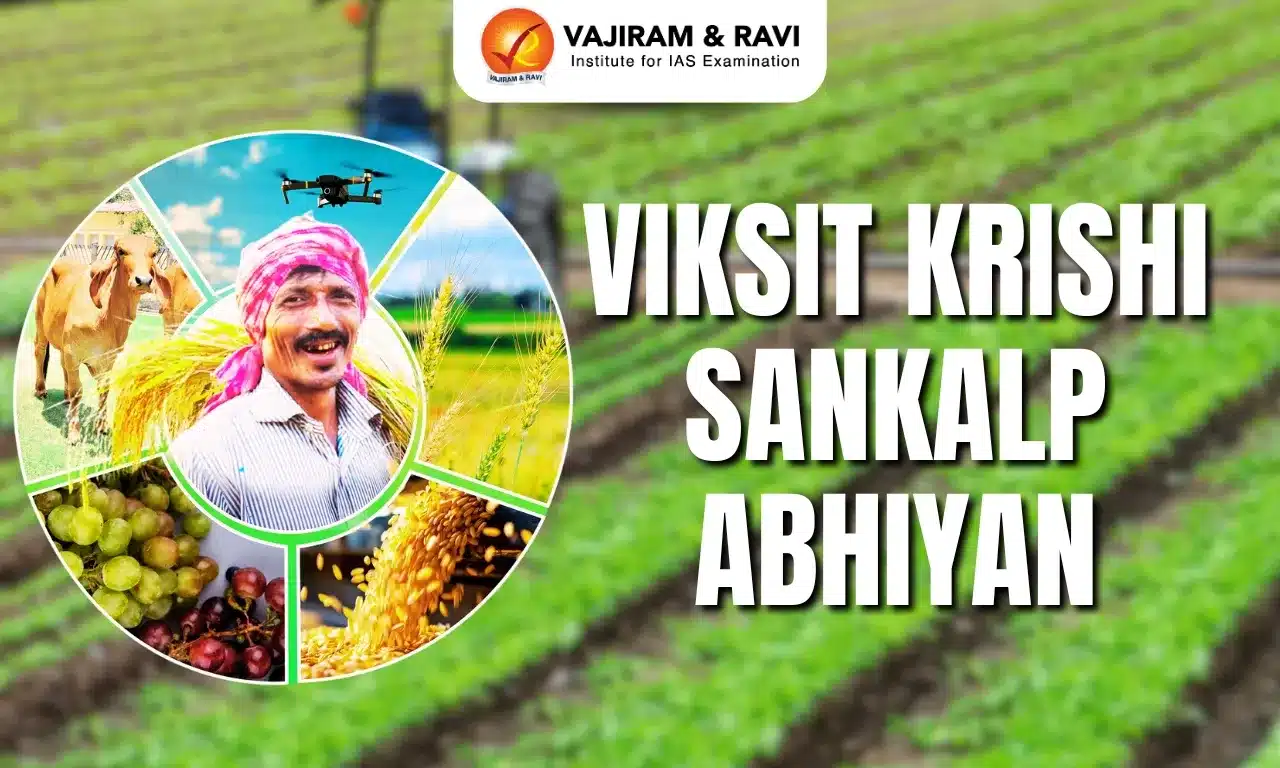
The Viksit Krishi Sankalp Abhiyan (VKSA) is a major government campaign launched to bring scientific farming, modern agri-techniques and policy awareness directly to Indian farmers ahead of critical crop seasons. The aim is to strengthen the link between research and the field, boost productivity and incomes, and push India closer to its vision of a developed agricultural sector. 

Viksit Krishi Sankalp Abhiyan

VKSA is a nationwide outreach initiative by the Indian Council of Agricultural Research (ICAR) and the Ministry of Agriculture & Farmers Welfare, launched from 29 May to 12 June 2025 across all states and Union Territories. During this campaign, thousands of expert teams comprising scientists, KVK officials, state department staff and progressive farmers visit villages, engage with farming communities, demonstrate techniques, share latest crop-varieties, advise on soil health cards, and gather grassroots feedback. The campaign sets out to cover 700+ districts, target outreach of 1 to 1.5 crore farmers and engage with over 65,000 villages. In short, VKSA is about “lab to land” - making sure research reaches real fields, farmers benefit, and agriculture is modernised.

Viksit Krishi Sankalp Abhiyan Objectives

The main objectives of Viksit Krishi Sankalp Abhiyan are:

  • To educate farmers on improved crop varieties, balanced fertiliser use, modern agronomic practices and soil health. 
  • To bring awareness among farmers about government schemes, inputs, agri-insurance and allied-activities so they can benefit from them. 
  • To promote climate-smart, sustainable agriculture, especially for the Kharif season: water-saving, risk-mitigation, diversified crops.
  • To collect feedback from farmers, understand local problems (soil, pest, water) and align research / policy accordingly. 
  • Ultimately, to raise farmer income, ensure food security and position India as a global food basket.

Viksit Krishi Sankalp Abhiyan Features

The key features and campaigns under the Viksit Krishi Sankalp Abhiyan are:

  • Multi-disciplinary teams: Around 2,000+ teams of scientists, field officers and progressive farmers deployed across India.
  • Village-level outreach: Teams visit multiple villages daily, hold demonstrations, group discussions, solve farmer queries and distribute material.
  • Use of Soil Health Cards and local agro-climatic data to tailor cropping advice.
  • Promotion of allied sectors: horticulture, animal husbandry, fisheries and millets- not just major crops.
  • Focus on “science in the field”- research institutes, KVKs, state agencies coordinating to guide farmers.

Viksit Krishi Sankalp Abhiyan Implementation

The implementation of the Viksit Krishi Sankalp Abhiyan Lead by ICAR & Ministry of Agriculture; state agriculture/ horticulture/animal husbandry departments support at state level.

  • Utilises 731 Krishi Vigyan Kendras (KVKs), 113 ICAR institutes, and multiple state-extension agencies.
  • Campaign scheduled just before the Kharif season, so field preparations (land, seeds, inputs) can be timed well.
  • Involvement of Farmer Producer Organisations (FPOs), progressive farmers, extension networks to ensure message reach. 

Viksit Krishi Sankalp Abhiyan Achievements

The major achievements under the Viksit Krishi Sankalp Abhiyan has been listed below. These early numbers show the enormous scale of the campaign and its direct reach to farming communities.

  • In Uttar Pradesh alone, VKSA engaged over 20 lakh progressive farmers in 75 districts, during 10,125 out-reach events.
  • In Sikkim, more than 76,000 farmers were included under the campaign, focusing on organic and climate-smart practices.
  • Across India, more than 8.78 million farmers reached in one phase of VKSA; 46,000+ field visits recorded.

Viksit Krishi Sankalp Abhiyan Challenges

Although Viksit Krishi Sankalp Abhiyan has several advancements and progress, it faces multiple backlashes as:

  • Huge scale means logistical complexity: reaching remote villages, ensuring participation, coordinating teams.
  • Translating scientific advice into local practical action: farmers need hands-on follow-up, not just awareness.
  • Ensuring continuity: a 15-day campaign is helpful, but long-term adoption requires sustained support.
  • Monitoring & evaluation: measuring impact on yields, incomes and sustainability will require systematic data.
  • Reaching marginal and small farmers, women and tribal communities may pose inclusion challenges.

Way Forward:

  • Convert the campaign into continuous farmer-engagement mechanisms, not just a one-time event.
  • Strengthen post-campaign follow-up, deploy cluster-level resource persons, extension visits.
  • Use digital tools (apps, SMS, WhatsApp) for reminders, advisory and feedback loops.
  • Establish robust monitoring frameworks: track yield changes, input use, income patterns across villages.
  • Focus on inclusivity: special drives for women farmers, tribal zones and marginal plots.
  • Link VKSA with livelihood support: credit access, marketing linkages, value-addition so that advised techniques convert into income.

Viksit Krishi Sankalp Abhiyan Significance

The Viksit Krishi Sankalp Abhiyan is important for the agricultural development in the following ways:

  • VKSA supports India’s goal of doubling farmer income and transforming agriculture into a livelihood-based business.
  • It helps align research institutions with field realities, reducing the gap between lab and land.
  • By empowering farmers with modern practices ahead of crop seasons, it boosts food security, productivity and resilience to climate risks.
  • Helps promote diversified agriculture- millets, horticulture, allied sectors- reducing dependence on few crops and improving sustainability.

Viksit Krishi Sankalp Abhiyan UPSC

The Viksit Krishi Sankalp Abhiyan represents a major step in modernising Indian agriculture. Its scale, direct farmer engagement, focus on science-based practices and inclusion of allied farming sectors are well suited for the challenges of the 21st-century agrarian economy. The real success will be measured in how many farmers sustainably change practices, increase incomes, and how the lessons translate into everyday farming across India. With strong follow-up support and monitoring, VKSA has the potential to bring about meaningful transformation in Indian agriculture.

Viksit Krishi Sankalp Abhiyan FAQs

Q1: What is Viksit Krishi Sankalp Abhiyan?

Ans: Viksit Krishi Sankalp Abhiyan is a government initiative launched to modernize Indian agriculture by adopting new technologies, increasing farmer awareness, and promoting sustainable farming practices for better productivity and income.

Q2: Who launched the Viksit Krishi Sankalp Abhiyan?

Ans: The Ministry of Agriculture and Farmers Welfare launched the Viksit Krishi Sankalp Abhiyan under the Government of India as part of its vision to make India’s agriculture sector globally competitive and self-reliant.

Q3: What are the main objectives of the Viksit Krishi Sankalp Abhiyan? The main objectives are to improve agricultural productivity, promote climate-resilient crops, enhance farmer income, and increase the use of digital tools and precision farming in rural areas. How does Viksit Krishi Sankalp Abhiyan help farmers? This scheme helps farmers by organizing awareness camps, providing training on new technologies, promoting organic farming, and connecting farmers with government schemes and digital platforms for better access to resources. What is the future vision of Viksit Krishi Sankalp Abhiyan? The vision of the Abhiyan is to achieve a developed agricultural ecosystem by 2047, ensuring that India’s farmers are empowered, the sector is technology-driven, and agriculture contributes significantly to India’s growth and sustainability.


Ans: What are the main objectives of the Viksit Krishi Sankalp Abhiyan?

Q4: The main objectives are to improve agricultural productivity, promote climate-resilient crops, enhance farmer income, and increase the use of digital tools and precision farming in rural areas.

Ans: How does Viksit Krishi Sankalp Abhiyan help farmers?

Q5: This scheme helps farmers by organizing awareness camps, providing training on new technologies, promoting organic farming, and connecting farmers with government schemes and digital platforms for better access to resources.

Ans: What is the future vision of Viksit Krishi Sankalp Abhiyan? The vision of the Abhiyan is to achieve a developed agricultural ecosystem by 2047, ensuring that India’s farmers are empowered, the sector is technology-driven, and agriculture contributes significantly to India’s growth and sustainability.
National Mineral Policy 2019, Objectives, Features, Implementation

National Mineral Policy 2019

India is rich in natural resources and produces more than 95 different minerals including metallic, non-metallic, atomic, and minor minerals. To manage this vast mineral wealth efficiently, the Government introduced the National Mineral Policy (NMP) 2019. It aims to promote sustainable, transparent, and responsible mining that benefits both the economy and local communities. The policy replaces the National Mineral Policy 2008 and provides a roadmap to modernize India’s mining sector while protecting the environment.

National Mineral Policy 2019

The National Mineral Policy 2019 is a guideline approved by the Union Cabinet to manage exploration, extraction, and use of non-fuel and non-coal minerals. It promotes the idea that minerals are a national resource, and the State acts as a trustee for the people. It aligns with India’s national goals like “Make in India,” import reduction, and sustainable development by focusing on environmental protection, transparency, and social welfare.

National Mineral Policy 2019 Historical Background

The earlier 2008 policy was revised due to several reasons:

  • Changes in mining laws after the MMDR Act amendments (2015) that introduced auction-based mining leases.
  • Supreme Court rulings highlighting the need for sustainable mining.
  • Technological progress such as geospatial mapping and deep-sea exploration.
  • Rising focus on tribal rights, environment, and community participation.
  • The government, after consultation with states, experts, and industries, framed a modern policy suited for current challenges.

National Mineral Policy 2019 Objectives

The major objectives and aim of the National Mineral Policy 2019 has been discussed below:

  • Increase mineral exploration and resource mapping.
  • Promote sustainable and eco-friendly mining.
  • Attract domestic and foreign investments.
  • Reduce import dependence for strategic minerals.
  • Ensure equitable sharing of benefits with mining-affected communities.
  • Improve governance with digital systems and faster clearances.

National Mineral Policy 2019 Features

Key features of the National Mineral Policy 2019 has been listed below:

  • Mining Recognized as an Industry: NMP 2019 gives the mining sector full industry status, allowing easier access to finance, infrastructure support, and mergers & acquisitions.
  • Focus on Exploration and Data: The policy aims to strengthen geological surveys, digital data mapping, and encourages both public and private investment in mineral exploration.
  • Transparent Allocation System: The allocation of mining leases will be done through open auctions to ensure transparency and fair competition.
  • Encouragement for Deep-Sea Mining: India will explore deep-sea mineral resources such as polymetallic nodules using advanced technologies, while ensuring environmental protection.
  • Infrastructure Development for Mining: The policy promotes mineral transport corridors, rail and port connectivity, and use of coastal and inland waterways to reduce logistics costs.
  • Environmental and Social Responsibility
  • Mandatory mine closure plans and land rehabilitation.
  • Use of District Mineral Fund (DMF) for health, education, and livelihood of affected communities.
  • Gender-sensitive and inclusive development.
  • Digital Governance and Single Window System: Introduction of a Mining Tenement System and e-clearances to reduce delays, corruption, and manual paperwork.

National Mineral Policy 2019 Implementation Mechanism

To ensure effective execution, the policy suggests:

  • A National Geoscience Data Repository for real-time data.
  • Strengthening of Geological Survey of India (GSI) and state mining directorates.
  • Setting up a national minerals portal for data sharing and transparency.
  • Using District Mineral Funds (DMFs) for local welfare projects.

National Mineral Policy 2019 Environmental Aspects

National Mineral Policy 2019 balances mining with sustainability through:

  • Strict environmental impact assessments (EIA) and rehabilitation norms.
  • Protection of biodiversity and water resources.
  • Consultation with tribal and local communities before starting mining operations.
  • Adoption of scientific methods to reduce land degradation and pollution.

National Mineral Policy 2019 Economic Importance

The economic significance of the National Mineral Policy 2019 has been listed below:

  • Ensures raw material security for industries like steel, cement, and manufacturing.
  • Generates employment opportunities in rural and mining regions.
  • Encourages domestic value addition and exports through downstream processing.
  • Reduces import bills by improving domestic production of key minerals.

National Mineral Policy 2019 Challenges

Despite several advancements and progress, the National Mineral Policy 2019 faces several backlashes as:

  • Over-reliance on private investment may neglect public welfare.
  • Auction system may favour large players over smaller firms.
  • Weak environmental enforcement in mining zones.
  • Delay in clearances and approvals.
  • Poor utilization of District Mineral Fund (DMF).
  • Lack of skilled manpower in mining governance.
  • Insufficient exploration data.
  • Impact on forest and tribal lands.
  • Lack of value addition within India.
  • Pollution and land degradation.

Way Forward:

  • Maintain a balance between profit and people’s welfare through strong regulation.
  • Include evaluation criteria like local employment and technical capability.
  • Strengthen state-level monitoring and make EIA results public.
  • Use digital single-window clearance systems.
  • Make DMF spending transparent and focus on health and education.
  • Conduct training and capacity-building for officials.
  • Encourage public-private partnerships for geological mapping.
  • Ensure compliance with the Forest Rights Act and community consultation.
  • Promote mineral-based industries and beneficiation units.
  • Adopt green mining technologies and promote land restoration.

National Mineral Policy 2019 UPSC

The National Mineral Policy 2019 aims to create a balanced mining ecosystem where economic growth, social equity, and environmental protection go hand in hand. If implemented effectively, it can make India self-reliant in mineral resources, reduce imports, and ensure fair benefits to local communities. Transparent governance, technology-driven exploration, and sustainable practices are the keys to its long-term success. Recent Developments include:

  • Launch of Mining Tenement System and digital exploration auction portal by the Ministry of Mines.
  • Focus on critical minerals like lithium and cobalt under India’s energy transition goals.
  • Strengthening of District Mineral Funds for community development and local infrastructure.
  • Introduction of deep-sea mining projects under the “Blue Economy” initiative.

National Mineral Policy 2019 FAQs

Q1: What is the main purpose of National Mineral Policy 2019?

Ans: It aims to promote sustainable, transparent, and investment-friendly mining while protecting the environment and local communities.

Q2: Which minerals are covered under NMP 2019?

Ans: The policy covers non-fuel and non-coal minerals like iron, copper, limestone, and bauxite.

Q3: What role does the District Mineral Fund (DMF) play?

Ans: DMF ensures that a portion of mining revenue benefits local and affected communities through welfare and development projects.

Q4: How does NMP 2019 promote sustainable mining?

Ans: It includes environmental safeguards, rehabilitation plans, and rules for land restoration and pollution control.

Q5: Who implements the National Mineral Policy 2019?

Ans: The Ministry of Mines along with State Governments and the Geological Survey of India (GSI) implement and monitor the policy

Wardha Scheme, History, Objectives, Leaders, Curriculum, Achievements

Wardha Scheme 1937

The Wardha Scheme, also known as the “Basic Education Scheme” or “Nai Talim”, was an educational reform proposed in 1937. It aimed to make schooling more useful, affordable, and linked to real-life skills. This plan was shaped by Mahatma Gandhi and his team to promote self-reliance, dignity of labour, and national development through productive education.

Wardha Scheme

The Wardha Scheme of Education was a revolutionary education plan proposed in 1937 under Mahatma Gandhi’s vision for self-reliant India. It focused on integrating productive manual work with learning, moral development, and practical knowledge. The scheme aimed to connect education directly with life, encouraging students to become skilled, independent, and socially responsible citizens. It replaced rote learning with activity-based education, promoting holistic development and social equality through a community-centered approach.

Wardha Scheme Historical Background

The Wardha Scheme emerged during the Indian freedom movement when education was largely influenced by British colonial policies. At that time, education focused more on bookish knowledge and less on practical skills. In 1937, the Congress formed ministries in several provinces, and Mahatma Gandhi saw an opportunity to introduce a new education model. A conference was held in Wardha (Maharashtra) to discuss how education could serve India’s social and economic needs. The recommendations made here later became the Wardha Scheme of Education. Following that conference, the committee chaired by Dr. Zakir Husain drafted the detailed scheme of Basic National Education.

Nai Talim

“Nai Talim”, literally meaning “New Education”, formed the core of the Wardha Scheme. Gandhi believed education should be rooted in manual work and productive craft- not separate from life. Key concepts included:

  • Education through productive craft (spinning, weaving, agriculture) rather than only classroom learning. 
  • Learning in the mother-tongue as medium of instruction. 
  • Free and compulsory schooling for seven years under this model. 
  • Integration of manual work and thinking to build dignity of labour, self-reliance and full personality development. 

Wardha Scheme Objectives

The Wardha Scheme sought to reform education in India with several core aims:

  1. Provide free and compulsory education for all children from about age 7 to 14.
  2. Make learning self-supporting, so schools and students engage in productive work.
  3. Build dignity of labour-linking intellectual and manual work.
  4. Use mother-tongue as primary medium of instruction.
  5. Adapt education to rural life with craft-based teaching suitable to local conditions.
  6. Foster moral, physical and intellectual development, not just academics.

Wardha Scheme Features

Key features that distinguished this education model:

  • Craft-centred curriculum: Each school chooses a craft (weaving, carpentry, agriculture) through which learning is anchored.
  • Self-supporting school model: Student-craft contributions were to help cover running costs.
  • Emphasis on mother-tongue, rural context, and integration with life and community.
  • Free and compulsory nature of basic education up to certain years.
  • Holistic education: Moral values, cooperation, non-violence, manual work integrated. 

Wardha Scheme Leaders

The Wardha Scheme was shaped by several eminent leaders:

  • Mahatma Gandhi- Propounded the idea of Nai Talim and initiated the Wardha Conference.
  • Dr. Zakir Husain- Chaired the committee that formulated the detailed scheme of Basic National Education.
  • Aryanayakam, Kaka Kalelkar, etc.- Influenced by Gandhian philosophy, they supported the craft- and rural-oriented education model.

Wardha Scheme Curriculum

The curriculum under this model was designed to be practical and self-supporting:

  • Manual craft work (weaving, agriculture, carpentry) was to form the basis of instruction.
  • Basic academic learning (reading, writing, arithmetic) integrated through craft activities.
  • Moral and social education emphasising non-violence, community service, dignity of labour.
  • Schools are encouraged to be small, locally managed, and self-reliant. 

Wardha Scheme Constitutional and Legal Provision

The Wardha Scheme of Education laid the foundation for many constitutional and legal principles in independent India’s education system. Its vision of free and compulsory basic education was later enshrined in Article 45 of the Directive Principles of State Policy, which urged the state to provide free education for all children up to 14 years. This goal was further strengthened through the Right to Education Act (2009) under Article 21A, making education a fundamental right.

The scheme’s emphasis on skill development and self-reliance also aligns with modern initiatives such as Skill India and National Education Policy (NEP) 2020, which promote vocational education, experiential learning, and value-based teaching, all rooted in Gandhian philosophy of Nai Talim.

Wardha Scheme Implementation

After the 1937 conference at Wardha, the scheme was adopted as a policy of basic national education. Many experiment-schools began using this system, especially at places like Sevagram Ashram, Wardha in Maharashtra. However, full large-scale national implementation was limited by resource constraints, war-time disruptions and administrative issues.

Wardha Scheme Achievements

Despite challenges, the Wardha Scheme left several notable impacts:

  • Introduced the idea of vocational-craft-based education in India.
  • Promoted mother-tongue instruction and moved away from purely English-medium colonial models.
  • Inspired later education reforms, including the National Education Policy-2020, which echoes many Nai Talim values.
  • Shifted the focus of education away from purely academic toward skill-based and life-linked learning.

Wardha Scheme Challenges

Several obstacles limited the full success of the Wardha Scheme:

  1. Lack of resources and infrastructure for craft-based schools.
    • Way Forward: Governments can allocate dedicated funds for craft training, provide materials and establish craft labs.
  2. Shortage of teachers trained in both academic and manual work pedagogy.
    • Way Forward: Introduce teacher‐training programmes emphasising craft and experiential teaching methodologies.
  3. Social prejudice against manual labour and crafts in educational hierarchy.
    • Way Forward: Awareness campaigns promoting dignity of labour and integrating craft work into mainstream education.
  4. Uneven implementation across states and regions.
    • Way Forward: A national policy framework can ensure uniform adoption, with monitoring and incentives for states.
  5. Financial sustainability of “self-supporting” models was weak.
    • Way Forward: Schools can partner with local enterprises: craft production can create small revenue streams; also public-private partnerships can be explored.

Wardha Scheme Recent Developments

In recent years, the spirit of the Wardha Scheme and Nai Talim has found renewed relevance:

  • Under the National Education Policy 2020, the Government of India emphasised experiential learning, vocational education, mother-tongue as medium of instruction- directly reflecting Gandhi’s principles laid out in 1937.
  • Educational institutions like the Mahatma Gandhi International Hindi University at Wardha held events invoking the Wardha Scheme’s aims and legacy.
  • Research and discussion papers (such as the 2025 article in the International Journal of History) revisited the Wardha Scheme’s relevance in contemporary education debates.

Wardha Scheme UPSC

The Wardha Scheme of Basic Education (Nai Talim) was far ahead of its time, seeking to combine manual-productive work, moral development, mother-tongue instruction and self-reliance. Although full implementation was not achieved, its influence endures. Modern education policies in India echo its aims of experiential learning, vocational skills and inclusive growth. The way forward lies in adapting its timeless principles to today’s context and scaling craft-based, community-linked education across the country.

Wardha Scheme FAQs

Q1: What was the main aim of the Wardha Scheme of Education?

Ans: The main aim of the Wardha Scheme was to make education self-supporting, skill-oriented, and rooted in practical work to develop self-reliant citizens.

Q2: Who introduced the Wardha Scheme of Education?

Ans: The Wardha Scheme was introduced in 1937 by Mahatma Gandhi and later developed by Dr. Zakir Hussain’s committee under the National Education Conference at Wardha.

Q3: What is the concept of Nai Talim in the Wardha Scheme?

Ans: Nai Talim, or Basic Education, emphasized learning through productive manual work, integrating intellectual, physical, and moral development in the education system.

Q4: How did the Wardha Scheme differ from colonial education?

Ans: Unlike British education, which promoted clerical work, the Wardha Scheme focused on dignity of labour, vocational training, and community-based learning for rural upliftment.

Q5: Is the Wardha Scheme relevant in today’s education system?

Ans: Yes, its principles of experiential learning, vocational skills, and holistic education continue to influence India’s National Education Policy (NEP 2020).

List of Mughal Emperors, Rulers, Decline

List of Mughal Emperors

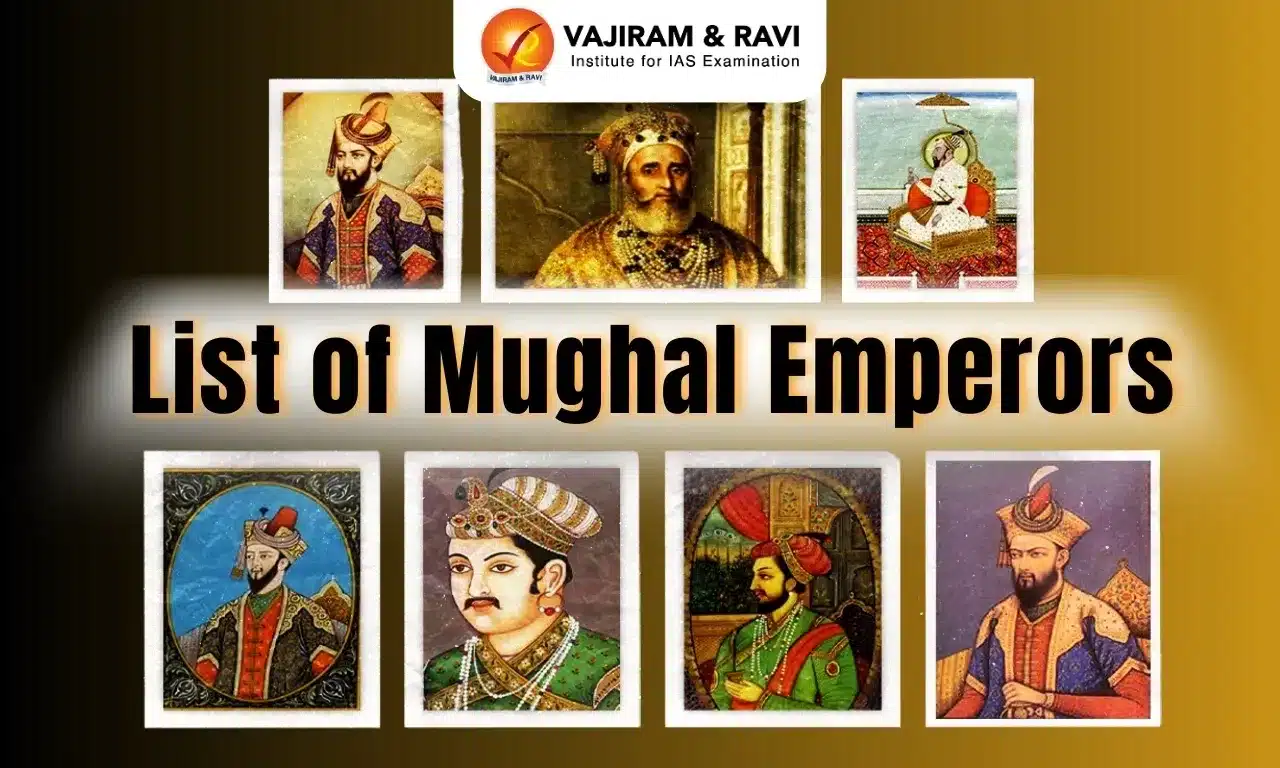
The Mughal Emperors were known to be one of the most powerful emperors who ruled Indian history in between 1526 and 1857. Babur was the first Mughal ruler, who established the Mughal Dynasty after the First Battle of Panipat. This led to the introduction of efficient administration, Grand Architecture, Persian Art, and its impact on India’s culture. In this article, we are going to cover the list of Mughal Emperors from 1526-1857. 

History of Mughal Dynasty 

The Mughal Dynasty was one of the most powerful dynasties in Indian History, founded in 1526 by Babur after winning the First Battle of Panipat against Ibrahim Lodi. Later, rulers like Akbar, Shah Jahan and Aurangzeb contributed in expanding the empire. Eventually after Aurangzab’s death in 1707, the mughal empire started getting weak due to succession struggles, regional revolts, and foreign invasions. This led to British dominance in 1857. 

List of Mughal Emperors

The Mughal Empire lasted from 1526 to 1857. Below is a list of emperors of the Mughal Empire in chronological order:

Emperor

Reign

Death

Known For

Babur

1526-1530

1530, Agra

Founder of the Mughal Empire, known for his military skills and the use of gunpowder.

Humayun

1530-1540, 1555-1556

1556, Delhi

Lost and regained the throne.

Akbar

1556-1605

1605, Agra

Expanded the empire, introduced religious tolerance, and strengthened the administrative system.

Jahangir

1605-1627

1627, Bhimber

Encouraged Persian art and culture, established diplomatic ties with the British

Shah Jahan

1628-1658

1666, Agra

Patron of Mughal architecture; built the Taj Mahal, Red Fort, and Jama Masjid.

Aurangzeb

1658-1707

1707, Ahmednagar

The last major Mughal emperor, expanded the empire to its greatest size. Faced strong resistance from Marathas, Rajputs, and Sikhs.

Bahadur Shah I

1707-1712

1712, Lahore

Known for his weak rule, he was defeated by his brother Farrukhsiyar.

Jahandar Shah

1712-1713

1713, Delhi

Weak ruler, assassinated by the Sayyid Brothers.

Farrukh Siyar

1713-1719

1719, Delhi

Brief reign of 4 months before being overthrown.

Rafi ud-Darajat

1719

1719, Agra

Also a short reign, marked by turbulence.

Shah Jahan II

1719

1719, Agra

A puppet ruler, during the period of political chaos.

Muhammad Shah

1719-1748

1748, Delhi

Witnessed the invasion of Nadir Shah, who plundered Delhi.

Ahmad Shah Bahadur

1748-1754

1775, Delhi

Incompetent ruler, the empire fell under noble control.

Alamgir II

1754-1759

1759, India

Assassinated due to court intrigues.

Shah Jahan III

1759-1760

1772, India

Nominal ruler with no real power.

Shah Alam II

1760-1788, 1788-1806

1806, Delhi

Defeated at the Battle of Buxar, ruled under British influence.

Shah Jahan IV

1788

1790, Delhi

Real name, Bidar Bakht Mahmud Shah Bahadur, was deposed by Ghulam Kadir

Akbar II

1806-1837

1837, Delhi

Reduced to a ceremonial figurehead.

Bahadur Shah II

1837-1857

1862, Rangoon

Last Mughal emperor, exiled after the Revolt of 1857.

Famous Rulers of Mughal Empire

The Mughal emperors played a significant role in shaping India’s history, politics, and culture. Their reigns influenced governance, architecture, and societal structures, leaving a lasting impact on the subcontinent. Here are some of the most influential rulers of the Mughal Empire:

  • Babur (1526–1530)
    A descendant of Timur and Genghis Khan, Babur defeated Ibrahim Lodi in the Battle of Panipat (1526), marking the beginning of Mughal rule in India.
    His key contributions include the introduction of gunpowder warfare and the establishment of a centralized administration with Persian cultural influence. 
  • Akbar (1556–1605)
    Akbar ascended the throne at the age of 13 and significantly expanded the empire through military conquests and diplomacy.
    He is known for advocating religious tolerance, implementing an efficient tax system (Zabt), and introducing important military reforms. His legacy includes the promotion of Hindu-Muslim unity through Din-i-Ilahi, which earned him the reputation of being the greatest Mughal emperor.
  • Shah Jahan (1628–1658)
    Shah Jahan’s reign is often referred to as the golden age of Mughal architecture. He is best known for his contributions to architecture, including the construction of the Taj MahalRed Fort, and Jama Masjid.
  • Aurangzeb (1658–1707)
    Aurangzeb expanded the Mughal Empire to its largest territorial extent but faced significant resistance.
    He strengthened the military but imposed strict religious policies, which led to widespread discontent. His reign saw internal revolts that ultimately weakened the empire and contributed to its decline.

Each of these emperors played a crucial role in shaping India's history, leaving behind a legacy that continues to be studied and debated today.

Reason Behind Decline of the Mughal Empire

After Aurangzeb’s death, the Mughal Empire started declining due to various reasons, including external and internal factors: 

  • After Aurangzeb, the mughal empire didn't see the emergence of any strong ruler leading to instability due to policies of later Mughals. 
  • Corruption, lack of reforms and heavy taxation weakened the economy. 
  • The rising power of rajputs, marathas and sikhs reduced the control of mughals over India. Ahmad Shah Abdali and Nadir Shah constantly invaded and plundered Delhi, further weakening the empire. 
  • The Battle of Buxar (1764) and British diplomacy reduced the Mughal emperor to a mere figurehead. The Revolt of 1857 marked the final collapse of Mughal rule.

The Mughal Empire played a crucial role in shaping Indian history. From Babur to the Later Mughals, their rule saw great achievements and eventual decline. The empire’s influence on art, architecture, and governance remains significant.

List of Mughal Emperors FAQs

Q1: Who were the 7 Mughal emperors?

Ans: The first seven Mughal emperors were Babur, Humayun, Akbar, Jahangir, Shah Jahan, Aurangzeb, and Bahadur Shah I.

Q2: Who was the 19th Mughal emperor?

Ans: Akbar Shah II was the 19th Mughal emperor.

Q3: Who was the 17th Mughal emperor?

Ans: Shah Alam II was the 17th Mughal emperor.

Q4: What is the order of the Mughal emperors?

Ans: Babur → Humayun → Akbar → Jahangir → Shah Jahan → Aurangzeb → Bahadur Shah I → Jahandar Shah → Farrukhsiyar → Rafi ud-Darajat → Shah Jahan II → Muhammad Shah → Ahmad Shah Bahadur → Alamgir II → Shah Jahan III → Shah Alam II → Akbar Shah II → Bahadur Shah II.

Q5: Who is the real father of Akbar?

Ans: Humayun was the real father of Akbar.

UPSC Daily Quiz 12 November 2025

UPSC Daily Quiz

The Daily UPSC Quiz by Vajiram & Ravi is a thoughtfully curated initiative designed to support UPSC aspirants in strengthening their current affairs knowledge and core conceptual understanding. Aligned with the UPSC Syllabus 2025, this daily quiz serves as a revision resource, helping candidates assess their preparation, revise key topics, and stay updated with relevant issues. Whether you are preparing for Prelims or sharpening your revision for Mains, consistent practice with these Daily UPSC Quiz can significantly enhance accuracy, speed, and confidence in solving exam-level questions.

[WpProQuiz 20]

UPSC Daily Quiz FAQs

Q1: What is the Daily UPSC Quiz?

Ans: The Daily UPSC Quiz is a set of practice questions based on current affairs, static subjects, and PYQs that help aspirants enhance retention and test conceptual clarity regularly.

Q2: How is the Daily Quiz useful for UPSC preparation?

Ans: Daily quizzes support learning, help in revision, improve time management, and boost accuracy for both UPSC Prelims and Mains through consistent practice.

Q3: Are the quiz questions based on the UPSC syllabus?

Ans: Yes, all questions are aligned with the UPSC Syllabus 2025, covering key areas like Polity, Economy, Environment, History, Geography, and Current Affairs.

Q4: Are solutions and explanations provided with the quiz?

Ans: Yes, each quiz includes detailed explanations and source references to enhance conceptual understanding and enable self-assessment.

Q5: Is the Daily UPSC Quiz suitable for both Prelims and Mains?

Ans: Primarily focused on Prelims (MCQ format), but it also indirectly helps in Mains by strengthening subject knowledge and factual clarity.

Important Days in October 2025, National & International Days

Important Days in October 2025

Important Days in October 2025 consist of many international and national important days as well as festivals celebrated in India. October is the tenth month of the Gregorian calendar, which consists of 31 days. Historically, it was the eighth month in the Roman calendar until 153 BCE, which explains its name derived from the Latin word “Octo”, meaning eight. Among the Anglo-Saxons, October was known as Winterfylleth, signifying the “fullness of winter.” Today, October is celebrated all over the world with many festivals, observances, and awareness days, covering themes from culture and religion to science, environment, and human welfare. In this article, we are going to cover Important Days in October 2025. 

Important Days in October 2025

The Important Day in October 2025 has the following important national and international days: 

Important Days in October 2025

1 October

International Day for Older Persons, International Coffee Day, World Vegetarian Day

2 October

International Day of Non Violence on occasion of Gandhi Jayanti

3 October

World Animal Welfare Day

5 October

World Teachers’ Day

8 October

Indian Air Force Day

9 October

World Post Day

10 October

World Mental Health Day

11 October

International Day of Girl Child

13 October

International Day for Disaster Risk Reduction

15 October

Global Handwashing Day, World Students’ Day

16 October

World Food Day

17 October

International Day for Eradication of Poverty

20 October

World Statistics Day

24 October

United Nations Day, World Development Information Day

30 October

World Thrift Day

31 October

National UnityDay on Birth Anniversary of Sardar Vallabhbhai Patel

Important Days in October 2025 Explained

Here is a detailed explanation of important days in October 2025: 

  • 1 October – International Day of Older Persons
    Observed annually on 1 October, the International Day of Older Persons discusses the challenges faced by elderly people and promotes the creation of an inclusive society for all ages. The United Nations General Assembly officially designated this day on 14 December 1990.
  • 1 October – International Coffee Day
    International Coffee Day celebrates the people involved in coffee production and service, including farmers, roasters, baristas, and café owners. It is observed all over the world to acknowledge their efforts in bringing this beloved beverage to our cups.
  • 1 October – World Vegetarian Day
    World Vegetarian Day is observed on 1 October each year to promote the vegetarian lifestyle and its benefits for health, the environment, and animal welfare. It was founded in 1977 by the North American Vegetarian Society (NAVS) and endorsed by the International Vegetarian Union in 1978.
  • 2 October – Gandhi Jayanti
    Gandhi Jayanti, celebrated on 2 October, marks the birth anniversary of Mahatma Gandhi, born in 1869 in Porbandar, Gujarat. Known as the “Father of the Nation,” Gandhi’s life and teachings continue to inspire leaders and citizens worldwide.
  • 2 October – International Day of Non-Violence
    The International Day of Non-Violence is observed on Gandhi’s birthday to spread his message of peace and non-violence. The UN General Assembly established this day on 15 June 2007 to raise global awareness about non-violence and conflict resolution.
  • 2 October – Lal Bahadur Shastri Jayanti
    India also commemorates the birth anniversary of Lal Bahadur Shastri, the nation’s second Prime Minister (1964–1966), on 2 October. Shastri is remembered for his leadership, simplicity, and the popular slogan “Jai Jawan Jai Kisan.”
  • 3 October – German Unity Day
    German Unity Day celebrates the reunification of Germany on 3 October 1990, when the Federal Republic of Germany and the Democratic Republic of Germany became one sovereign nation. It is a public holiday in Germany, symbolizing unity and democracy.
  • 4 October – World Animal Welfare Day
    World Animal Welfare Day, observed on 4 October, promotes the well-being and protection of animals globally. This day encourages individuals and organizations to improve standards of animal welfare and prevent cruelty.
  • 5 October – World Teachers’ Day
    World Teachers’ Day, celebrated on 5 October, honours educators worldwide and commemorates the adoption of the UNESCO/ILO Recommendation concerning the Status of Teachers in 1966. This day highlights teachers’ rights, responsibilities, and their pivotal role in shaping society.
  • 7 October – World Cotton Day
    World Cotton Day, observed on 7 October, celebrates the significance of cotton in agriculture, industry, and daily life, promoting fair trade and sustainable production.
  • 7 October (First Monday of October) – World Habitat Day
    World Habitat Day, designated by the UN in December 1985 and first observed in 1986, falls on the first Monday of October. The day draws attention to the state of human settlements and advocates for sustainable urban development and housing policies worldwide.
  • 8 October – Indian Air Force Day
    Indian Air Force Day is celebrated on 8 October to commemorate the founding of the Indian Air Force in 1932. It honours the dedication, courage, and achievements of the air force personnel who safeguard the nation’s skies.
  • 9 October – World Postal Day
    World Postal Day is observed on 9 October to highlight the crucial role of postal services in connecting people and businesses globally. The Universal Postal Union (UPU), established in Bern in 1874, designated this day in 1969.
  • 10 October – National Post Day (India)
    National Post Day recognises the Indian Postal Service’s contributions since its establishment by Lord Dalhousie in 1854. India’s postal network includes nine zones, 23 postal circles, and one Army Post Office, using a six-digit PIN code system introduced in 1972.
  • 10 October – World Mental Health Day
    Observed annually on 10 October, World Mental Health Day raises awareness of mental health issues, including suicide prevention. The World Federation for Mental Health, along with WHO and other global organizations, supports this initiative to encourage education, dialogue, and public awareness.
  • 10 October (Second Thursday of October) – World Sight Day
    World Sight Day, celebrated on the second Thursday of October, aims to focus global attention on vision impairment and blindness, advocating for early detection, treatment, and preventive eye care.
  • 11 October – International Day of the Girl Child
    This day highlights the rights, education, and empowerment of girls worldwide, calling attention to gender equality and access to opportunities.
  • 13 October – International Day for Disaster Risk Reduction
    Observed on 13 October, this day raises awareness about disaster prevention and risk reduction strategies. Established by the UN General Assembly in 1989, it aims to build resilient communities globally.
  • 13 October – Breast Cancer Awareness Day
    Breast Cancer Awareness Day promotes early detection, education, and support for patients. It emphasises regular screening and timely treatment, honouring those affected by the disease.
  • 14 October – World Standards Day
    World Standards Day highlights the importance of standardization in products, services, and processes. Observed on 14 October, it encourages regulators, industries, and consumers to maintain quality, safety, and efficiency.
  • 15 October – World Students’ Day
    World Students’ Day commemorates the birth anniversary of former President and scientist A.P.J. Abdul Kalam, highlighting his contributions to science, technology, and education, and inspiring students worldwide.
  • 16 October – World Food Day
    World Food Day, celebrated on 16 October, raises awareness about global hunger, nutrition, and sustainable food systems. The Food and Agriculture Organization (FAO) of the United Nations established this day in 1945.
  • 17 October – International Day for the Eradication of Poverty
    Observed on 17 October, this day focuses on raising awareness of poverty and its eradication, promoting sustainable development and social inclusion.
  • 17 October – Valmiki Jayanti
    Valmiki Jayanti celebrates the revered sage Valmiki, the author of the epic Ramayana, honouring his literary and spiritual contributions.
  • 20 October – World Statistics Day
    Observed every five years, World Statistics Day celebrates the importance of reliable data for policy-making, research, and sustainable development. The first such day was held in 2010.
  • 21 October – Police Commemoration Day
    This day honours police personnel who sacrificed their lives in the line of duty, commemorating their bravery and dedication.
  • 24 October – United Nations Day
    United Nations Day marks the anniversary of the UN Charter coming into effect in 1948. In 1971, the UN General Assembly recommended its observation as a public holiday by member nations.
  • 24 October – World Development Information Day
    World Development Information Day raises global awareness of development issues and promotes international cooperation to address them effectively.
  • 28 October – International Animation Day
    International Animation Day celebrates the art and creativity of animation, acknowledging its cultural impact and the contributions of animators worldwide.

31 October – Rashtriya Ekta Diwas (National Unity Day)
National Unity Day commemorates the birth anniversary of Sardar Vallabhbhai Patel, who played a pivotal role in unifying India after independence.

Important Days in October 2025 FAQs

Q1: What is the importance of important dates in October 2025?

Ans: Important dates in October 2025 are observed to raise awareness about social, cultural, environmental, and global issues, as well as to celebrate festivals, achievements, and notable personalities.

Q2: When is Valmiki Jayanti celebrated?

Ans: Valmiki Jayanti is celebrated on 17 October 2025.

Q3: When is United Nations Day celebrated?

Ans: United Nations Day is celebrated on 24 October 2025.

Q4: When is Rashtriya Ekta Diwas celebrated?

Ans: Rashtriya Ekta Diwas is celebrated on 31 October 2025.

Great Green Wall Initiative, Countries, Objectives, Achievements

Great Green Wall Initiative

The Great Green Wall Initiative (GGWI) is one of the most ambitious environmental and sustainable development efforts in the world. It was launched in 2007 by the African Union to restore degraded lands across the Sahel region of Africa. The project stretches for 8,000 kilometers across the continent, transforming barren areas into fertile land. Its main goal is to fight desertification, climate change, and poverty, while improving the lives of millions living in the region. The initiative now unites 22 African countries working together for a greener future.

Great Green Wall Initiative

The Great Green Wall aims to combat environmental challenges by restoring degraded landscapes and promoting sustainable livelihoods. It focuses on improving soil health, water availability, and biodiversity. The Great Green Wall is not just about planting trees, it is about creating a mosaic of productive ecosystems, ensuring both environmental and economic growth. Some key facts about the initiative are:

  • It was launched by the African Union in 2007.
  • It covers an 8,000 km stretch across Africa.
  • The project involves 22 African countries.
  • It is implemented under the leadership of the Pan-African Agency of the Great Green Wall (PAAGGW).
  • Over USD 19 billion has been raised for its implementation.
  • The awareness campaign “Growing a World Wonder” is led by the United Nations Convention to Combat Desertification (UNCCD).

Great Green Wall Initiative Objectives

The Great Green Wall was designed to tackle several problems simultaneously, land degradation, food insecurity, poverty, and migration. Its main goals for 2030 are:

  1. To restore 100 million hectares of degraded land.
  2. To sequester 250 million tons of carbon from the atmosphere.
  3. To create 10 million green jobs across rural Africa.

The initiative supports local communities by:

  • Protecting fertile land and increasing crop productivity.
  • Strengthening food and water security.
  • Offering new income opportunities for rural populations.
  • Promoting climate resilience and sustainable living.

Great Green Wall Initiative Countries Participating

The Great Green Wall involves both core and supporting African countries. It directly passes through 11 key nations in the Sahel region, with 22 countries participating in total. The 11 core countries are Burkina Faso, Chad, Djibouti, Eritrea, Ethiopia, Mali, Mauritania, Niger, Nigeria, Senegal, and Sudan. Other participating nations include Benin, Cape Verde, Ghana, Kenya, Somalia, South Sudan, Togo, Uganda, The Gambia, Egypt, and Libya. Together, these countries work with international organizations like the World Bank, UNCCD, and the African Development Bank to achieve the project’s shared goals.

Great Green Wall Initiative Funding and Partnerships

The Great Green Wall Initiative is a joint effort between African nations and global partners. Funding comes from a combination of multilateral, bilateral, and private donors.

Key details include:

  • USD 14.3 billion was pledged at the One Planet Summit in 2021, led by France.
  • Total funding so far exceeds USD 19 billion.
  • Main supporters include the World Bank, African Development Bank, European Commission, and the Irish Government.
  • The UNCCD Global Mechanism plays a key role in managing and coordinating funds.
  • This collaboration ensures that both financial and technical resources are directed effectively to achieve the 2030 targets.

Great Green Wall Accelerator

To speed up the implementation of the project, the Great Green Wall Accelerator was launched in January 2021. It is coordinated by the Pan African Agency of the Great Green Wall (PAAGGW) with assistance from the UNCCD.

The main goals of the Accelerator are to:

  • Improve coordination among donors and implementing agencies.
  • Track and measure progress in real time.
  • Align investments with GGW’s 2030 objectives.

Great Green Wall Accelerator Pillars

The Great Green Wall Initiative focuses on five key pillars. This mechanism helps ensure transparency, accountability, and measurable impact across all GGW activities.

  1. Strengthening small and medium-sized farms and value chains.
  2. Restoring degraded land and managing ecosystems sustainably.
  3. Developing climate-resilient infrastructure and renewable energy access.
  4. Building better governance and institutional support systems.
  5. Enhancing training and capacity building for local communities.

Great Green Wall Accelerator Need

Despite its successes, the Great Green Wall faced several challenges in its early years. A Landmark Report in 2021 identified key issues, such as:

  • Limited attention to national environmental priorities.
  • Weak local institutions and implementation processes.
  • Lack of coordination and communication between countries.
  • Funding shortages and inconsistent data tracking.

To meet the 2030 goals, an estimated USD 33 billion is required. The Accelerator was designed to fill these gaps by promoting cooperation, strengthening systems, and monitoring performance effectively.

Great Green Wall Initiative Impact

The Great Green Wall is built on local ownership and community participation. One of the best examples of this approach is the FLEUVE Initiative (2014-2019), financed by the European Commission and implemented by the UNCCD Global Mechanism. This initiative strengthened the capacity of local communities to manage their land, conserve biodiversity, and generate income while building resilience to drought and climate change.

Key features of the FLEUVE Initiative include:

  • Empowerment of 23 local communities across Burkina Faso, Chad, Mali, Niger, and Senegal.
  • Focus on micro-investment projects for land restoration and sustainable livelihoods.
  • Support for rural women and youth through job creation and training.
  • Development of sustainable value chains for local dryland products.

Great Green Wall Initiative Achievements

Since 2007, the Great Green Wall has achieved significant progress across Africa. As of now, more than 18 million hectares of degraded land have been restored, and around 350,000 green jobs have been created.

Highlights of progress in selected countries:

  • Burkina Faso: Over 29,000 hectares of land restored, 16.6 million seedlings produced, and 45,000 jobs created.
  • Ethiopia: Nearly 1 million hectares of land restored, 5 billion plants grown, and 218,000 jobs created.
  • Nigeria: More than 2,800 hectares reforested, 709 km of windbreaks established, and over 1,300 jobs generated.
  • Senegal: About 850,000 hectares restored and 322,000 residents benefited from agroforestry activities.
  • Sudan: Over 85,000 hectares of land restored, 1.9 million plants produced, and over 1,700 people trained in environmental conservation.

Great Green Wall Initiative Country Case Studies

The progress and impact of the Great Green Wall Initiative in several countries has been discussed below based on the official data released. These examples highlight the measurable social and environmental benefits achieved through national-level implementation.

Ethiopia

The Great Green Wall program in Ethiopia covers 58 woredas across three regions. The country has:

  • Produced 5 billion plants and seeds.
  • Restored over 1 million hectares of land.
  • Developed 893,000 hectares of watershed and forest areas.
  • Created more than 218,000 jobs.

Nigeria

Nigeria’s project includes a 1,359 km shelterbelt stretching from Kebbi State to Borno State. Key outcomes include:

  • Planting of 7.6 million seedlings.
  • Establishment of 709 km windbreaks.
  • Creation of 1,396 jobs for local people.

Senegal

Senegal’s program spans 817,500 hectares and focuses on agroforestry and food security. The country has:

  • Restored 850,000 hectares of land.
  • Reforested 119,000 hectares.
  • Benefited over 322,000 residents through training and community initiatives.

Great Green Wall Initiative Challenges

While the Great Green Wall has achieved remarkable success, several challenges remain. With these steps, the Great Green Wall can achieve its 2030 vision of a restored and sustainable Sahel.

  1. Insufficient funding: Increase global investments through blended climate finance.
  2. Weak local governance: Strengthen institutions and local monitoring systems.
  3. Poor coordination: Establish regional collaboration hubs under PAAGGW.
  4. Impact of climate change: Use renewable energy and drought-resistant crops.
  5. Limited data sharing: Build a real-time GGW digital monitoring platform.
  6. Policy gaps: Integrate GGW into national climate and development policies.
  7. Lack of awareness: Promote school-level and community-based awareness programs.
  8. Land ownership issues: Develop fair legal frameworks to protect local land rights.
  9. Skill shortages: Expand training for youth and women in sustainable land use.
  10. Monitoring inefficiency: Improve digital tracking systems to measure progress.

Great Green Wall Initiative Campaign

The UNCCD launched the “Growing a World Wonder” campaign to inspire people worldwide to support the Great Green Wall. The campaign uses storytelling, films, and public outreach to build awareness.

It emphasizes that the Great Green Wall is a symbol of hope, showing how humanity and nature can work together. Millions of people have already been reached through media, cultural events, and community movements. A documentary film featuring Oscar-nominated filmmaker Fernando Meirelles and Malian singer Inna Modja further promotes this African-led vision to global audiences.

Great Green Wall Initiative UPSC

The Great Green Wall Initiative is Africa’s landmark movement for environmental restoration and sustainable development. Since its launch in 2007, over 18 million hectares of land have been restored, USD 19 billion raised, and 350,000 jobs created.

By 2030, the Great Green Wall aims to stand as a living monument of hope, protecting the Sahel from desertification while improving food security, creating jobs, and combating climate change. It represents a global lesson in resilience, cooperation, and human determination to heal the planet.

Great Green Wall Initiative FAQs

Q1: What is the Great Green Wall Initiative?

Ans: It is an African Union-led project launched in 2007 to restore degraded land, combat desertification, and improve livelihoods across the Sahel region.

Q2: How long is the Great Green Wall?

Ans: The wall stretches for about 8,000 kilometers across 22 African countries, from Senegal in the west to Djibouti in the east.

Q3: How much funding has been raised for the Great Green Wall Initiative?

Ans: So far, more than USD 19 billion has been pledged by international partners, including the World Bank and African Development Bank.

Q4: What are the main goals of the Great Green Wall Initiative by 2030?

Ans: The project aims to restore 100 million hectares of land, capture 250 million tons of carbon, and create 10 million green jobs.

Q5: Which countries have made the most progress in the Great Green Wall Initiative?

Ans: Ethiopia, Senegal, and Burkina Faso have achieved major success in restoring land, creating jobs, and improving community resilience.

Climate Investment Fund

Climate Investment Fund

Climate Investment Fund Latest News

Recently, during COP 30 of UNFCCC, Germany and Spain announced a $100 million commitment for the Climate Investment Fund’s (CIF) new programme called Accelerating Resilience Investments and innovations for Sustainable Economies (ARISE).

About Climate Investment Fund

  • It was launched in 2008.
  • It is a multilateral climate fund that enables climate action in over 70 low and middle income countries.
  • Purpose: The purpose of CIF is to finance comprehensive measures for climate change mitigation and adaptation in developing and emerging economies. 
    • CIF deploys highly concessional finance to empower transformations in clean technology, energy access, climate resilience, nature-based solutions, and other areas.
  • CIF comprises two funds: the Clean Technology Fund (CTF) and the Strategic Climate Fund (SCF).
  • It is the only climate fund working exclusively through six AAA-rated multilateral development banks (MDBs) namely;
    • Asian Development Bank, African Development Bank, European Bank for Reconstruction and Development, Islamic Development Bank International Finance Corporation and World Bank
  • Governance: The Clean Technology Fund (CTF) Trust Fund Committee is the decision-making body responsible for determining and overseeing the operations and activities of the fund.
  • In 2024, CIF became the first multilateral climate fund to list bonds on the capital markets, with the CIF Capital Markets Mechanism (CCMM). 
  • Secretariat: The CIF Secretariat is hosted by the World Bank.

Source: ET

Climate Investment Fund FAQs

Q1: What is the primary objective of the Climate Investment Fund (CIF)?

Ans: To provide financial assistance for climate change mitigation and adaptation projects.

Q2: How many multilateral development banks are involved in the CIF?

Ans: 6

Ethiopia

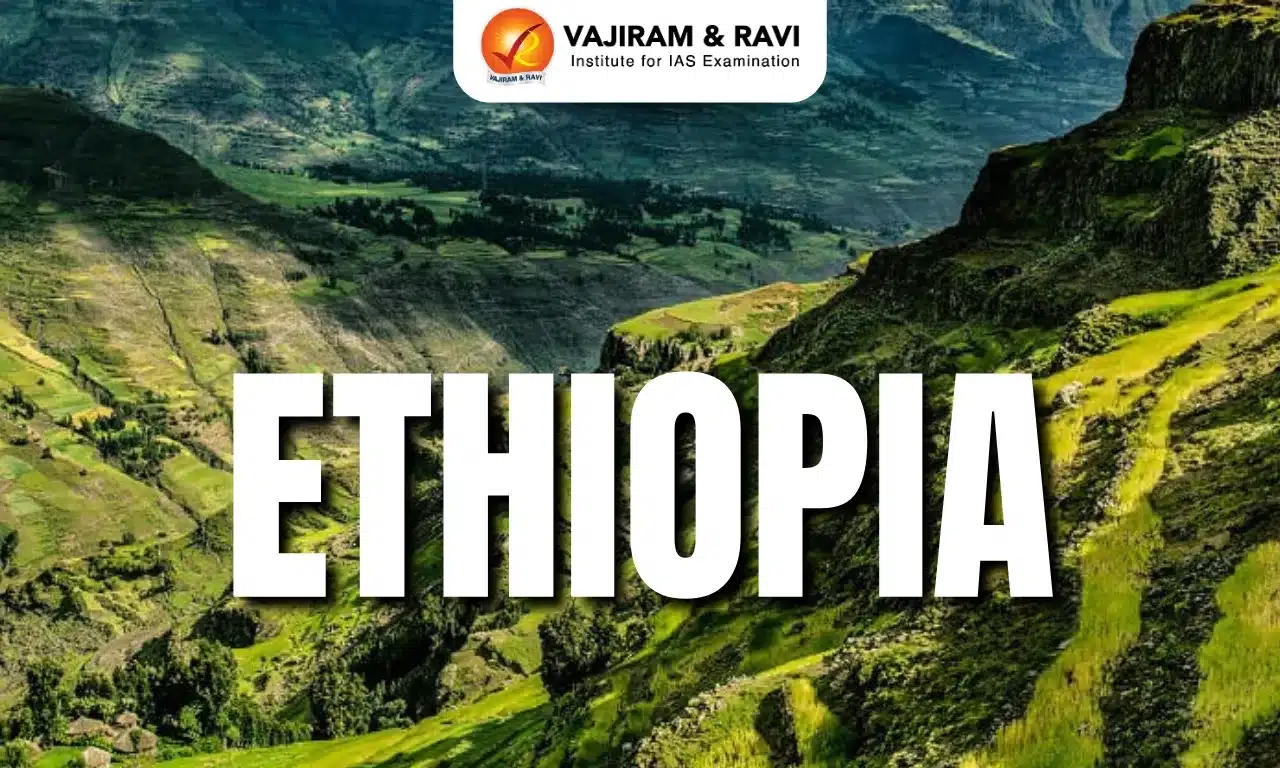
Ethiopia

Ethiopia Latest News

Ethiopia is primed to host the COP32 climate summit in 2027, with official confirmation expected soon.

About Ethiopia

  • It is a landlocked country in East Africa.
  • It occupies an area of 1,104,300 sq.km. 
  • It is the largest and most populated country located in the Horn of Africa.
  • With the 1993 secession of Eritrea, its former province along the Red Sea, Ethiopia became landlocked.
  • It is bordered by six countries. These are Eritrea, Djibouti, Somalia, Kenya, South Sudan, and Sudan to the north, northeast, east, south, west, and northwest, respectively.
  • The political system in Ethiopia is Democratic Republic.
  • Capital: Addis Ababa 
  • Currency: Birr (ETB)
  • Languages: Afar, Amharic, Oromo, Somali, and Tigrinya.
  • The country has one of the most rugged and complex topographies on the continent. 
  • The five major topographic features of the country are the Rift Valley, Western and Eastern Highlands, and Western and Eastern Lowlands.
  • The North Central massifs of the country host the highest point in the country, marked by the yellow upright triangle. It is the 4,533 m high Mount Ras Dejen.
  • The three main rivers in Ethiopia are the Blue Nile, the Omo River, and the Awash River. 
  • Lake Tana, one of Africa's most unique wetland ecosystems and the source of 50% of Ethiopia's freshwater, is located in the northwest of the Ethiopian Highlands.
  • Ethiopia was among the first independent nations to sign the Charter of the United Nations, and it gave moral and material support to the decolonization of Africa and to the growth of Pan-African cooperation.
  • These efforts culminated in the establishment of the Organization of African Unity (since 2002, the African Union) and the United Nations Economic Commission for Africa, both of which have their headquarters in Addis Ababa.

Source: DEVD

Ethiopia FAQs

Q1: What is the capital city of Ethiopia?

Ans: Addis Ababa

Q2: What is the official currency of Ethiopia?

Ans: The Ethiopian birr (ETB) is Ethiopia's official currency.

Q3: How many countries share their borders with Ethiopia?

Ans: It is bordered by six countries.

Q4: What is the political system of Ethiopia?

Ans: The political system in Ethiopia is Democratic Republic.

Q5: Which are the three main rivers flowing through Ethiopia?

Ans: The three main rivers in Ethiopia are the Blue Nile, the Omo River, and the Awash River.

Humboldt Penguin

Humboldt Penguin

Humboldt Penguin Latest News

Recently, Chilean scientists warned of further risks to the world’s shrinking population of Humboldt penguins.

About Humboldt Penguin

  • The Humboldt penguin (Spheniscus humboldti) belongs to a genus that is commonly known as the ‘banded’ group.
  • They are so named because their habitat is located near the Humboldt Current, a large oceanic upwelling characterised by cold waters.
  • Distribution: Humboldt penguins are endemic to the Pacific coasts of Chile and Peru. Chile’s Pacific coast is home to 80% of the world’s remaining Humboldt penguins,
  • Appearance:
    • They have large, bare skin patches around their eyes, an adaptation to help keep them cool, according to the Smithsonian Institute.
    • They are a medium-sized species with an average height of just over 2 ft.
  • Breeding season: Their breeding season in the wild is either March-April or September-October depending on the location of the colony.
  • Humboldt penguins are monogamous and recognize their partner in the colony through distinct vocal cues. 
  • Threats: Competition for food from commercial fishing as well as habitat loss, pollution, bird flu and the worsening impacts of climate change have contributed to declining numbers.

Conservation Status of Humboldt Penguin

  • IUCN: Vulnerable
  • CITES: Appendix I

Source: DD News

Humboldt Penguin FAQs

Q1: What is the scientific name of the Humboldt Penguin?

Ans: Spheniscus humboldti

Q2: Where is the primary habitat of the Humboldt Penguin?

Ans: Coastal regions of South America

Jaechanax kuranganiensis

Jaechanax kuranganiensis

Jaechanax kuranganiensis Latest News

Researchers recently uncovered a previously unknown species of the unique aquatic insect known as the water-penny beetle, named Jaechanax kuranganiensis.

About Jaechanax kuranganiensis

  • It is a new species of water-penny beetle.
  • It was discovered in the fast-flowing Kurangani stream of the Bodi hills, in the Western Ghats of Tamil Nadu.
  • It marks the first-ever record of its genus in Tamil Nadu. The genus was previously known only from three other species found in various Asian countries.
  • The research team identified the new species by examining its distinctive larval form. 
  • Water-penny beetle larvae are famous for their flat, disc-like shape, which allows them to cling tightly to rocks in streams, resembling a tiny coin. 
    • Water-penny beetles play a vital role in the stream ecosystem, serving as an important part of the food chain. 
    • Researchers often use their presence and health as a bioindicator, a natural way to check the overall health and quality of the freshwater environment.
  • The new species has been named kuranganiensis after the Kurangani stream where it was found.
  • It is separated from its closest relatives by several key features on its larval body. 
    • Most notably, it possesses a unique groove, or oblique sulcus, on the shield-like segment behind its head (the pronotum). 
    • Furthermore, the researchers noted that the ninth and final abdominal segment of the larva is subrectangular and approximately 1.2 times wider than it is long, a crucial detail for distinguishing it from other known water-penny beetles.
    • This groove forms a specific triangular structure that is not found in other species of the Jaechanax genus.

Source: RM

Jaechanax kuranganiensis FAQs

Q1: Jaechanax kuranganiensis belongs to which group of insects?

Ans: Water-penny beetles

Q2: The species Jaechanax kuranganiensis was discovered in which location?

Ans: Bodi Hills, Tamil Nadu

Q3: The larval form of water-penny beetles is characterized by which features?

Ans: Flat, disc-like body resembling a coin.

Q4: What is the ecological importance of water-penny beetles?

Ans: They serve as bioindicators of freshwater health.

Intergenerational Equity

Intergenerational Equity

Intergenerational Equity Latest News

Supreme Court judge Justice P.S. Narasimha recently said many of the environmental law principles imported from Western countries, such as ‘inter-generational equity’, are anthropocentric and would hardly be of any assistance to protect an endangered species from extinction.

About Intergenerational Equity

  • Intergenerational equity is a principle that emphasizes the moral obligation of the current generation to ensure that future generations have the same opportunities and resources available to them as the present generation. 
  • It refers to equity between generations, which includes the needs of the future generation in the design and implementation of current policies. 
  • Thus, intergenerational equity simply means a duty of the present generation towards future generations i.e. the present generations of human beings are obliged to take care of the natural resources and ecology so that all future generations shall also have an equal chance to enjoy mother nature and the right to life.
  • It is a recognized principle of International Environmental law which provides for the preservation of natural resources for the benefit of future generations. 
  • The principle is strongly embedded in the United Nations (UN) Framework Convention on Climate Change
  • Historically, it owes its recognition to the Brundtland Report, Our Common Future (1987), which popularized the principle of “development that meets the needs of the present without compromising the ability of future generations to meet their own needs.”
  • The Declaration of Rio on Environment and Development (1992) adds a rights-based perspective to the principle, suggesting that “the right to development must be fulfilled to equitably meet development and environmental needs of present and future generations.”

Source: TH

Intergenerational Equity FAQs

Q1: What does the principle of Intergenerational Equity emphasize?

Ans: Moral obligation of the present generation towards future generations.

Q2: Which international report popularized the idea of Intergenerational Equity?

Ans: Brundtland Report, Our Common Future (1987)

Q3: The Rio Declaration on Environment and Development (1992) adds what dimension to the principle of Intergenerational Equity?

Ans: Rights-based perspective linking development and environment.

PM Internship Scheme 2025, Eligibility, Age Limit

PM Internship Scheme 2025

The PM Internship Scheme 2025 offers participants more than just hands-on experience in leading Indian organizations. It places a strong emphasis on equipping interns with crucial skills that are highly regarded in the corporate sector. One of the core elements of the program is initiating collaboration and teamwork, where interns work in dynamic teams, honing their communication skills and contributing to collective objectives. This hands-on approach allows them to build both technical and soft skills, enhancing their career prospects in a competitive professional environment.

PM Internship Scheme 2025

The Prime Minister's Internship Scheme offers an excellent platform for young professionals to gain firsthand experience in leading Indian companies. Designed for individuals who have recently graduated, this initiative provides an opportunity to enhance skills, build industry knowledge, and establish valuable networks. This scheme is particularly beneficial for those aspiring to enter the corporate sector. However, applicants must meet specific eligibility requirements to participate. These include certain age limits, educational qualifications, and other criteria that ensure the program attracts motivated and capable candidates ready to make the most of this opportunity.

PM Internship Scheme 2025 Overview

The PM Internship Scheme 2025 is an initiative aimed at shaping young talents and preparing them for the dynamic nature of the corporate world. The program emphasizes skill-building and provides participants with hands-on experience to help them excel in their professional journey. Check out the below table for the PM Internship Scheme 2025 Overview.

PM Internship Scheme 2025 Overview

Organization

Ministry of Corporate Affairs

Post

Apprentice

Vacancies

1,25,000

Online Application Starts

12 October 2024

Online Application Ends

31 March 2025

Educational Qualification

10th, 12th, ITI, Polytechnic, Diploma OR Graduates

Age Limit

Minimum Age: 21 Years

Maximum Age: 24 Years

Apprentice Duration

12 Months

Stipend

₹5000/- Per Month with one-time benefit of ₹6,000/-

PM Internship Scheme 2025 Download PDF

The PM Internship Scheme 2025 is designed to equip individuals with the knowledge and skills necessary for excelling in corporate environments. It provides a golden opportunity to learn industry-relevant practices and gain insights into professional workspaces.

For detailed information on PM Internship Eligibility Criteria 2025, the step-by-step application process, and the full range of benefits, you can access the official PM Internship Scheme Notification 2025 PDF. This document serves as a comprehensive guide for aspirants seeking to apply. Simply click on the link provided below to download the PM Internship Scheme Notification 2025 and take the first step toward shaping your career.

PM Internship Scheme 2025 Eligibility Criteria

Before applying for the PM Internship Scheme 2025, candidates must ensure they meet the specific eligibility requirements outlined in the official notification. Below are the key criteria:

Age Limit

Applicants must be aged between 21 and 24 years.

Education Qualifications

  1. Candidates must not be engaged in any full-time employment or educational programs.
  2. Graduates from premier institutions such as IITs, IIMs, or National Law Universities are not eligible.
  3. Holding advanced qualifications like CA, MBA, PhD, or any master’s degree disqualifies the applicant.

Family Income

The applicant’s family income should be below ₹8 lakh for the financial year 2023-24.

No immediate family member should hold a permanent government position.

Apply Online for PM Internship Scheme 2025

To Apply Online for PM Internship Scheme 2025, candidates have to visit the official website. The application form and detailed guidelines are available on the official website. Applicants need to register, fill in their details, upload relevant documents, and submit the form online. Candidates can directly click on the link below and get access to the portal.

Step to Apply Online for PM Internship Scheme 2025

The PM Internship Scheme 2025 is an incredible opportunity for young aspirants to gain valuable work experience. If you are eligible and ready to apply, follow these simple steps to complete your application process successfully:

Step 1: Start by visiting the official portal for the PM Internship Scheme: http://www.pminternship.mca.gov.in. This is the central platform for all application-related activities.

Step 2: Register on the portal by entering your basic details. Ensure that the information provided is accurate to avoid any issues during verification.

Step 3: Fill in the online application form. Double-check the information entered, such as your educational qualifications and personal details, to ensure correctness.

Step 4: Scan and upload all the mandatory documents

Step 5: Before submitting, review your application thoroughly to confirm all details and attachments are accurate. Submit the application before the deadline to ensure consideration.

PM Internship Scheme 2025 Stipend

The PM Internship Scheme 2025 offers aspiring professionals a unique opportunity to gain hands-on experience while receiving a Stipend to manage their basic expenses during the program. Selected candidates will receive a monthly stipend of ₹5,000 throughout the internship duration, amounting to a total of ₹60,000 over the course of the year. In addition to this monthly allowance, interns are also eligible for a one-time benefit of ₹6,000, which can further support their needs during the program. To know more about the eligibility, application process, and benefits of the PM Internship Scheme 2025, visit the official website.

PM Internship Scheme 2025 Participating Companies

The scheme has seen contributions from some of the biggest names in the corporate world. Organizations like Jubilant FoodWorks, Eicher Motor Ltd., Larsen & Toubro Ltd., Tech Mahindra, Mahindra & Mahindra Ltd., Bajaj Finance, and Muthoot Finance are actively participating, providing a wide range of internship opportunities. The following companies have emerged as the leading contributors to the PM Internship Scheme 2025:

  1. Reliance Industries Limited
  2.  Tata Consultancy Services Limited
  3.  HDFC Bank Limited
  4.  Oil And Natural Gas Corporation Limited
  5.  Infosys Limited
  6.  NTPC Limited
  7.  Tata Steel Limited
  8.  ITC Limited
  9.  Indian Oil Corporation Limited
  10.  ICICI Bank Limited
  11.  Power Grid Corporation Of India Limited
  12.  Tata Sons Private Limited
  13.  Wipro Limited
  14.  HCL Technologies Limited
  15.  Hindustan Zinc Limited

PM Internship Scheme 2025 FAQs

Q1: Who is eligible for the PM internship scheme?

Ans: Prime Minister Internship Scheme 2025 will provide internships to young people aged 21 to 24 over five years.

Q2: What is the last date to apply for PM Modi internship?

Ans: The official website of PM Internship at pminternship.mca.gov.in and the last date to register is March 31, 2025.

Q3: What is the PM internship salary?

Ans: The PM Internship Scheme offers eligible Indian citizens (21-24 years) a 12-month internship with a monthly stipend of ₹5,000 and other insurance coverage.

Q4: What is the age limit for PM internship?

Ans: To apply for the PM Internship Scheme 2025, candidates must meet certain eligibility requirements: Age Limit: Applicants must be between the ages of 18 and 30 years as of the start of the internship.

Q5: What is PM Internship Scheme 2025 helpline number?

Ans: PM Internship scheme helpline number is 1800 116090.

Key Facts about Vietnam

Key Facts about Vietnam

Vietnam Latest News

Recently, the 15th India-Vietnam Defence Policy Dialogue was held in Hanoi, Vietnam.

About Vietnam

  • Location: It is located in the eastern portion of mainland Southeast Asia.
  • Bordering Countries: It is bordered by China to the north, and Cambodia and Laos to the west.
  • Maritime Boundaries: It shares a border with South China Sea (East and South), Gulf of Thailand (Southwest). 
  • It is roughly S-shaped, running for a distance of about 1,650 km in the north-to-south directions.

Geographical Features of Vietnam

  • It is a country of tropical lowlands, rolling green hills, and densely forested mountains. 
  • Major Rivers: Red River and Mekong River both drain into the South China Sea.
  • Major Mountain: Vietnam’s principal physiographic features are the Annamese Cordillera which extends generally from northwest to southeast in central Vietnam.
  • Highest Point: Vietnam's highest point is Phan Xi Pang whose summit reaches 3,144 m
  • Climate: It is located in the tropical zone. Its climate is characterized by high temperature and humidity all year round.
  • Natural Resources: It is mainly abundant in antimony, phosphates, coal, manganese, rare earth elements, bauxite, chromate, offshore oil and gas deposits.
  • Capital City: Hanoi

Source: PIB

Vietnam FAQs

Q1: What is the official language of Vietnam?

Ans: Vietnamese

Q2: What is the capital of Vietnam?

Ans: Hanoi

Neodymium

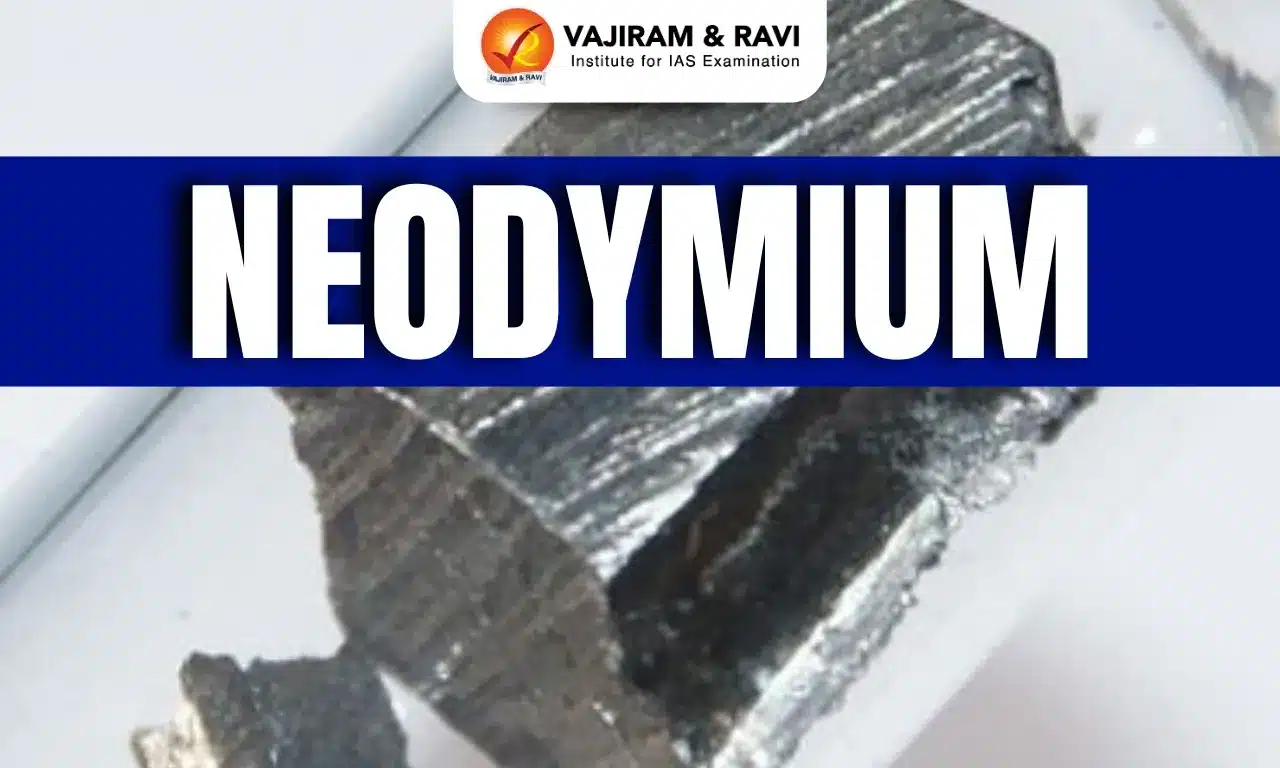
Neodymium

Neodymium Latest News

India is planning to increase its neodymium production by nine times, reaching 500 tons by the end of FY27.

About Neodymium

  • Neodymium is a chemical element with symbol Nd and atomic number 60.
  • It belongs to the lanthanides group, part of the rare earth elements. 
  • It was discovered in Vienna in 1885 by Karl Auer.
  • It is the second most abundant of the rare-earth elements (after cerium).
  • Source: It is found in minerals that include all lanthanide minerals, such as monazite and bastnasite. 
  • Its deposits are mainly in Brazil, China, USA, India, Sri Lanka and Australia.

Properties of Neodymium

  • It is a ductile and malleable silvery white metal.
  • It oxidizes readily in air to form an oxide, Nd2O3, which easily spalls, exposing the metal to further oxidation.
  • The metal must be stored sealed in a plastic covering or kept in vacuum or in an inert atmosphere.
  • It reacts gradually with mineral acids—except hydrofluoric acid (HF), in which it forms a protective layer of trifluoride, NdF3. 

Applications of Neodymium

  • It is a critical element in the global rare-earth magnet industry.
  • It plays a key role in electric vehicles, clean energy technologies, and defense systems.
  • It is suitable for use in optical devices and electrical applications.

Source: BS

Neodymium FAQs

Q1: What is the atomic number of Neodymium?

Ans: 60

Q2: Which group of elements does Neodymium belong to?

Ans: Lanthanides

Greater Flamingo Sanctuary

Greater Flamingo Sanctuary

Greater Flamingo Sanctuary Latest News

Recently, concerns have been raised over a proposed wind farm near Greater Flamingo Sanctuary in Dhanushkodi, Tamil Nadu.

About Greater Flamingo Sanctuary

  • Location: It is located in Dhanushkodi in Ramanathapuram district of Tamil Nadu.
  • It is nestled within the ecologically sensitive Gulf of Mannar Biosphere Reserve.
  • The designated area is home to a variety of ecosystems, including mangroves, sand dunes, mudflats, and marshes.
  • It is a critical stopover point along the Central Asian Flyway for thousands of migratory wetland birds.
  • Fauna: This region supports 128 bird species, including Greater and Lesser Flamingos and provide habitats for marine life, including fish, crustaceans, molluscs, and nesting sea turtles.
  • Flora: It features diverse ecosystems and mangrove forests like Avicennia and Rhizophora, which stabilise the coastline.

Key Facts about Greater Flamingo

  • It is a large wading bird known for its distinctive pink feathers and unique feeding habits.
  • Distribution: Its range spans Africa, western Asia, and southern Europe.
  • Habitat: It is usually found in shallow, saline, alkaline wetlands, such as salt lakes, coastal lagoons, intertidal mudflats, and saltworks during the breeding season.
  • Conservation Status of Greater Flamingo
    • IUCN: Least concern
    • Wild Life Protection Act: Schedule-II

Source: TH

Greater Flamingo Sanctuary FAQs

Q1: Where is the Greater Flamingo Sanctuary located in India?

Ans: Tamil Nadu

Q2: What is the conservation status of the Greater Flamingo?

Ans: Least concern

Supreme Court–Centre Rift Over Tribunals: What the Dispute Is About

Tribunals

Tribunals Latest News

  • The Supreme Court expressed strong displeasure after the Centre sought another adjournment in the case challenging the Tribunals Reforms Act, 2021, highlighting ongoing tensions between the judiciary and the government over tribunal control.

Understanding India’s Tribunal System

  • Tribunals are judicial or quasi-judicial bodies created to handle specific types of disputes that require expertise or faster resolution.
  • Their main goals are to reduce the burden on regular courts and to bring technical expertise in areas such as taxation, administration, and corporate law.

Judicial Independence and Supreme Court’s Directives

  • The Supreme Court has emphasised that tribunals must enjoy the same independence from the executive as the judiciary.
  • Key aspects of independence include the selection process, composition, and tenure of members.
  • The Court recommended that administrative control over tribunals be placed under the Law Ministry, not the ministries they adjudicate against, and later proposed an independent National Tribunals Commission.
    • These reforms, however, have not been implemented.

Constitutional Basis of Tribunals

  • Tribunals were formally established through the 42nd Constitutional Amendment (1976), which introduced Articles 323A and 323B:
    • Article 323A: Allows Parliament to create administrative tribunals for public service matters.
    • Article 323B: Allows Parliament and state legislatures to create tribunals on subjects like taxation, land reforms, and labour.
  • In 2010, the Supreme Court clarified that tribunals could also be formed on other subjects under the Seventh Schedule.

Tribunals Reforms Act Faces Challenge Over Judicial Independence

  • The Tribunals Reforms Act, 2021, has been challenged by the Madras Bar Association (MBA) for allegedly undermining judicial independence and violating the separation of powers.
  • Tribunals, which handle specialised cases in areas like taxation, corporate law, and administration, have been affected nationwide by the ongoing case. 
  • The MBA argued that the Act reintroduced provisions—such as a four-year term for tribunal members and a minimum appointment age of 50—that were part of an earlier ordinance struck down by the Supreme Court in July 2021.
  • By re-enacting the same provisions without addressing the legal flaws identified earlier, the petitioners claim Parliament attempted to override a judicial verdict, amounting to “legislative overruling” and weakening the judiciary’s autonomy.

A Long-Running Power Struggle Over Tribunals

  • The tussle between the Centre and the Supreme Court over control of tribunals began with the Finance Act of 2017, which gave the government the power to make rules for tribunals.
  • However, in 2019, the Supreme Court’s Rojer Mathew judgment struck down these rules, saying they weakened judicial independence.

The 2020 Rules and Supreme Court’s Recommendations

  • When the Centre issued new tribunal rules in 2020, they were again challenged by the Madras Bar Association (MBA).
  • The Supreme Court suggested key changes — including a five-year tenure for tribunal members — to protect independence and attract qualified professionals.

The 2021 Ordinance and Court’s Rejection

  • In April 2021, the Centre passed an ordinance setting a four-year tenure and a minimum age of 50 years for tribunal appointments.
  • By July 2021, the Supreme Court struck down these provisions as “arbitrary” and against the principle of separation of powers.

Parliament’s Defiant Response

  • A month later, Parliament passed the Tribunals Reforms Act, 2021, re-enacting the same struck-down provisions.
  • This move reignited the clash between the judiciary and the executive, with critics calling it a direct challenge to judicial authority.

Key Arguments in the Tribunal Reforms Case

  • The Madras Bar Association (MBA) argued that the four-year tenure for tribunal members makes them vulnerable to government pressure, as they might act cautiously to secure reappointment.
  • They also said the minimum age limit of 50 years unfairly excludes younger, capable lawyers, even though individuals can become High Court judges at a younger age.

Government’s Defence: Experience and Policy Autonomy

  • The Union government defended the provisions, saying the age limit ensures sufficient experience, and the four-year term with reappointment offers enough job security.
  • It argued that the Act represents a policy decision within Parliament’s authority, and that by striking down these rules, the judiciary would overstep its powers and violate the principle of separation of powers.

The Fallout: Vacancies Leave Tribunals Struggling to Function

  • The ongoing standoff between the Centre and the Supreme Court over tribunal appointments and service rules has caused serious delays in filling vacancies across several key tribunals.
  • As of December 2022, government data showed:
    • National Company Law Tribunal (NCLT): 24 vacancies out of 32 posts.
    • Armed Forces Tribunal: 24 vacancies out of 34 posts.
    • Income Tax Appellate Tribunal: 18 of 63 judicial posts vacant.
    • Railway Claims Tribunal: Both vice-chairman (judicial) posts vacant, along with 16 of 20 judicial positions.
    • Labour and Industrial Tribunals: Only 13 presiding officers in place against 22 sanctioned posts.
  • The Supreme Court has noted that these persistent delays have made several tribunals “virtually defunct”, undermining their very purpose of providing speedy and specialised justice.

Source: IE | PRS

Tribunals FAQs

Q1: What triggered the current Supreme Court–Centre rift over tribunals?

Ans: The Centre’s repeated adjournments in the Tribunals Reforms Act case angered the Supreme Court, highlighting long-standing tensions over control and independence of tribunals.

Q2: What is the Tribunals Reforms Act, 2021, about?

Ans: It reorganises tribunals, setting a four-year tenure and a 50-year minimum age for appointments — provisions critics say undermine judicial independence.

Q3: Why did the Madras Bar Association challenge the Act?

Ans: The MBA argued that re-enacting provisions earlier struck down by the Court amounts to “legislative overruling,” violating separation of powers and judicial autonomy.

Q4: What has been the impact of this dispute?

Ans: Delays in tribunal appointments have left many bodies nearly defunct — for example, 24 vacancies in the NCLT and Armed Forces Tribunal each.

Q5: What reforms has the Supreme Court recommended for tribunals?

Ans: The Court urged creation of an independent National Tribunals Commission and administrative control under the Law Ministry, but these reforms remain unimplemented.

Sebi Flags Risks in Digital Gold Investments: What Investors Should Know

Digital Gold

Digital Gold Latest News

  • The Securities and Exchange Board of India (SEBI) has warned the public against investing in digital and e-gold products, which have gained popularity amid rising gold prices and the ease of online ownership. 
  • SEBI cautioned that, despite being marketed as safe alternatives to physical gold, digital gold investments are unregulated and fall outside any legal oversight, exposing investors to significant financial risks.

Digital Gold and its Popularity

  • Digital gold enables investors to buy, sell, and store gold electronically without physically holding it. 
  • Its price is linked to physical gold and transactions are recorded using blockchain technology.
  • It offers easy access, low entry amounts, and no storage hassles, allowing quick liquidation or conversion into coins, bars, or jewellery when needed.
  • The recent 59% surge in gold prices, with MCX spot gold rising from ₹76,577 to ₹1.22 lakh per 10 gm in a year, has significantly boosted investor interest in digital and e-gold products.

Why SEBI Issued a Caution on Digital Gold Investments

  • SEBI noted that many online platforms are promoting digital and e-gold products as easy, convenient alternatives to physical gold. 
  • However, the regulator clarified that these products are not recognised as securities and do not fall under its regulatory framework or commodity derivatives laws.
  • Since digital gold remains unregulated, investors lack legal protection or oversight, making such investments risky and potentially misleading.

Why Digital Gold Is Considered Risky for Investors

  • SEBI warned that digital gold operates outside any regulatory oversight, leaving investors without legal protection or recourse under securities market laws.
  • These products carry counterparty and operational risks, meaning investors could lose money if the platform defaults. 
  • Unlike gold ETFs or commodity derivatives, digital gold doesn’t require demat accounts or margin deposits, making it easy to access but riskier.
  • Offered widely by jewellers and online platforms, digital gold’s popularity—amplified by social media marketing—has grown rapidly, prompting Sebi’s caution against its unregulated and high-risk nature.

Regulated Gold Investment as an Option

  • Experts recommend that investors avoid unregulated digital gold and instead choose Sebi-regulated products to ensure safety and transparency.
  • Sebi allows gold investments through Gold ETFs, exchange-traded commodity derivatives, and Electronic Gold Receipts (EGRs) — all of which are traded on regulated exchanges like MCX and NSE under strict risk management and margin frameworks.
  • These regulated avenues, along with Sovereign Gold Bonds (SGBs), offer secure trading, transparent pricing, and clearing corporation guarantees, significantly reducing counterparty and operational risks compared to unregulated digital gold platforms.

Source: IE | NDTV | IT

Digital Gold FAQs

Q1: What is digital gold?

Ans: Digital gold lets investors buy and store gold online using blockchain technology, offering low-cost access and quick liquidity without physical possession.

Q2: Why did Sebi warn investors about digital gold?

Ans: Sebi found many online platforms offering unregulated digital gold products marketed as safe alternatives, exposing investors to high financial and legal risks.

Q3: What makes digital gold risky?

Ans: Digital gold operates outside regulatory oversight, with no investor protection. It carries counterparty risks — investors could lose funds if platforms default.

Q4: What are safer alternatives to digital gold?

Ans: Experts advise investing in Sebi-regulated instruments like Gold ETFs, Electronic Gold Receipts (EGRs), and Sovereign Gold Bonds (SGBs) for transparency and legal protection.

Q5: How do regulated gold products ensure investor safety?

Ans: Products traded on MCX and NSE are subject to risk management systems, margin frameworks, and clearing corporation guarantees, reducing default and operational risks.

Sunabeda Wildlife Sanctuary

Sunabeda Wildlife Sanctuary

Sunabeda Wildlife Sanctuary Latest News

Eight booths located inside Sunabeda wildlife sanctuaries recorded 70 percent polling in the bypoll to the Nuapada assembly seat.

About Sunabeda Wildlife Sanctuary

  • It is located in the Nuapada district of Odisha, adjoining Chhattisgarh.
  • It is spread over an area of 600 sq.km. It was declared a sanctuary in 1983.
  • It adjoins the Sitanadi and Udanti sanctuaries of Chhattisgarh. 
  • The sanctuary harbors a great diversity of wildlife habitats, with a vast plateau, canyons, and 11 waterfalls.
  • It also forms the catchment area of the Jonk River (tributary of the Mahanadi River), over which a dam has been constructed to facilitate irrigation.
  • Vegetation: The important vegetation of this sanctuary comprises dry deciduous tropical forests.
  • Flora: Bija, Teak, Sisoo, Asan, Dharua, Mahul, Char, Sandalwood, Sidha, etc.
  • Fauna:
    • It is an ideal habitat for the Barasingha (swamp deer).
    • Other important animals found are tigers, Leopards, hyenas, Barking Deer, Chital, Gaur, Sambar, Sloth Bear, Hill Myna, etc.
    • It also works as a migration link for rare wild buffaloes between the states of Odisha and Chhattisgarh.

Source: TOI

Sunabeda Wildlife Sanctuary FAQs

Q1: In which Indian state is the Sunabeda Wildlife Sanctuary located?

Ans: It is located in the Nuapada district of Odisha, adjoining Chhattisgarh.

Q2: The Sunabeda Wildlife Sanctuary adjoins which sanctuaries of Chhattisgarh?

Ans: It adjoins the Sitanadi and Udanti sanctuaries of Chhattisgarh.

Q3: What is the approximate area of the Sunabeda Wildlife Sanctuary?

Ans: 600 sq. km

Q4: Which of the following rivers forms the catchment area of the Sunabeda Wildlife Sanctuary?

Ans: Jonk River

Index of Industrial Production to Undergo Major Changes

Industrial Production

Industrial Production Latest News

  • The Government of India is preparing for a comprehensive overhaul of the Index of Industrial Production.

Understanding the Index of Industrial Production

  • The Index of Industrial Production (IIP) is one of India’s most critical macroeconomic indicators, along with the Consumer Price Index (CPI), which measures retail inflation. 
  • Released monthly by MoSPI, the IIP captures changes in the volume of production in three sectors, mining, manufacturing, and electricity, based on data from 14 source agencies covering 407 items or item groups.
  • The IIP is also classified into six use-based categories:
    • Primary goods, Capital goods, Intermediate goods, Infrastructure or construction goods, Consumer durables, Consumer non-durables
  • Currently, the IIP uses 2011-12 as its base year, but this is set to be updated to 2022-23 to reflect more contemporary industrial structures and output patterns.

Rationale Behind the Overhaul

  • According to MoSPI’s discussion paper released in November 2025, the overhaul was necessitated by a major statistical challenge: the continued inclusion of closed or non-operational factories in the IIP sample.
    • Around 8.9% of the IIP’s factory sample reportedly consists of units that have either shut down permanently or stopped producing the assigned goods.
    • The presence of such inactive units distorts the industrial growth picture by forcing the ministry to rely on imputation or estimation methods, which reduces the accuracy of data.
  • To address this, MoSPI has proposed an automatic substitution mechanism, where factories that remain non-operational or fail to report data for three consecutive months will be replaced with new, active factories of similar scale and output.
  • This move, according to the ministry, will maintain the continuity and robustness of the IIP series, ensuring it reflects actual industrial performance rather than estimates.

How the Substitution Mechanism Will Work

  • Under the proposed framework:
    • A status check will be initiated if a factory reports zero production for three consecutive months.
    • Upon confirmation that the unit is permanently closed or no longer produces the assigned item, it will be removed from the sample.
  • A new factory producing the same or equivalent item will be added, provided:
    • It has been operational for at least 12 months.
    • Its Gross Value Added (GVA) or output value is comparable to the replaced factory, ensuring size consistency.
  • Until overlapping data between the old and new factories is established, temporary ‘nil’ or imputed values may be used, leading to a short lag before substitution is fully reflected in the IIP.
  • This substitution system aligns India’s statistical practices with international standards, as similar procedures are followed by advanced economies to ensure the reliability of industrial indices.

Updating the Base Year to 2022-23

  • The overhaul is also part of a broader review of the IIP, with MoSPI planning to shift the base year from 2011-12 to 2022-23. The last revision took place in 2017, and the decade-long gap has made the index less reflective of the current industrial ecosystem.
  • The updated base year will incorporate:
    • Newly emerging industries such as electric vehicle manufacturing, semiconductors, and green technologies.
    • Changes in product composition and weightage to capture shifts in consumer demand and industrial output.
    • Integration of digital data sources to reduce manual reporting delays.
  • This recalibration will ensure that the IIP remains relevant and aligned with India’s rapidly evolving industrial landscape.

Importance of IIP in Economic Policy

  • The IIP serves as a crucial indicator for policymakers, investors, and analysts to gauge short-term industrial trends. It influences decisions on:
    • Monetary policy: The Reserve Bank of India (RBI) uses IIP data alongside inflation and employment indicators to assess economic health.
    • Fiscal planning: Government agencies rely on IIP trends to forecast tax revenues, employment potential, and infrastructure requirements.
    • Private sector investment: Businesses use IIP data to identify growth sectors and assess market demand.
  • As of September 2025, India’s industrial output grew by 4% year-on-year, while growth for the 1st half of FY2025-26 stood at 3%, slightly lower than the 4.1% recorded in the corresponding period last year.
  • These figures highlight the need for a more responsive and accurate statistical system that reflects real-time industrial performance.

Challenges and the Way Forward

  • While the proposed substitution mechanism promises greater accuracy, it also presents challenges:
    • Timely verification of factory status will require close coordination between state statistical offices and industry bodies.
    • Maintaining comparability between replaced and new units will be crucial to prevent statistical distortions.
    • Data lags may persist during the transition period as overlapping production data is compiled.
  • To ensure a smooth transition, MoSPI has sought public feedback on the proposed methodology by November 25, 2025, aiming for a consensus-driven and technically robust framework.

Source: IE

Industrial Production FAQs

Q1: What is the Index of Industrial Production (IIP)?

Ans: The IIP measures changes in the volume of industrial output across mining, manufacturing, and electricity sectors on a monthly basis.

Q2: Why is the IIP being overhauled?

Ans: To replace non-operational factories in the sample, reduce data distortion, and update the base year to reflect current industrial realities.

Q3: When will the revised IIP series be released?

Ans: The new IIP series, with 2022-23 as the base year, will be launched in May 2026.

Q4: What portion of the current IIP sample includes closed factories?

Ans: About 8.9% of factories in the existing IIP sample are non-operational, affecting data accuracy.

Q5: How does IIP data impact economic policy?

Ans: IIP trends guide monetary, fiscal, and industrial policies, helping assess economic growth, investment, and employment trends.

India-Bhutan Relations – Strengthening Timeless Ties

India-Bhutan Relations

Indian-Bhutan Relations Latest News

  • The Prime Minister of  India’s two-day state visit to Bhutan marks a momentous occasion — the 70th birthday celebrations of the Fourth King, Jigme Singye Wangchuck (K4), father of the current monarch King Jigme Khesar Namgyel Wangchuck. 
  • The visit reaffirms the India-Bhutan special partnership, rooted in mutual trust, shared spiritual heritage, and developmental cooperation under India’s Neighbourhood First Policy.

India-Bhutan Relations - Historical Depth and Enduring Friendship

  • Early foundations:
    • The Fourth King, Jigme Singye Wangchuck, ascended the throne in 1972 at age 16, continuing his father’s policy of close ties with India.
    • Appointed Chairman of Bhutan’s Planning Commission (1971), he coordinated the first Five-Year Plans modeled on India’s planning framework with Indian support since 1961.
    • Pegged Bhutan’s currency (Ngultrum) to the Indian Rupee at a 1:1 rate (1974), ensuring stable bilateral trade and financial integration.
  • Diplomatic and global outreach:
    • Expanded Bhutan’s diplomatic footprint while keeping India informed — joining the UN (1971) and SAARC (1985) as a founding member.
    • Initiated border talks with China (1984) in consultation with Indian leadership, reflecting strategic transparency and coordination.
  • Hydropower cooperation - The economic backbone:
    • Laid the foundation for Bhutan’s hydropower partnership with India — the Chukha (336 MW), Kurichhu (60 MW), and Tala (1,020 MW) projects.
    • These projects, built on a grant-loan model (60:40), became the bedrock of Bhutan’s export revenue and India’s clean energy import.
  • Security cooperation:
    • Spearheaded Operation All Clear (2003) with Indian support to eliminate insurgent camps of ULFA, NDFB, and KLO from Bhutanese soil.
    • Strengthened defence and border cooperation, marking a milestone in regional security synergy.
  • Democratic transition and treaty modernisation:
    • Abdicated the throne in 2006, paving the way for Bhutan’s democratic transformation (2008).
    • Oversaw the India-Bhutan Friendship Treaty (2007), replacing the 1949 provision that Bhutan would be “guided by India” with mutual cooperation and sovereign equality.

Indian PM’s Visit - Renewing Partnership and Vision

  • Key events and significance:
    • He attended the 70th birthday celebrations of K4, recognising his pivotal role in shaping India-Bhutan ties.
    • Inaugurated the 1,020-MW Punatsangchhu-II Hydroelectric Project, a symbol of long-standing energy partnership.
    • Announced a ₹4,000 crore concessional credit line for new energy projects.
    • Reaffirmed India’s ₹10,000 crore assistance under Bhutan’s 12th Five-Year Plan for development across infrastructure, agriculture, finance, and healthcare.
  • New frontiers of cooperation:
    • Expansion of collaboration in fin-tech, innovation, entrepreneurship, and space technology.
    • Boosting rail connectivity — linking Gelephu and Samtse with India’s railway network to enhance trade access.
    • Strengthening border infrastructure and inland waterways for regional integration.
    • Finalisation of three MoUs in renewable energy, healthcare, and mental health services.
  • Cultural and spiritual ties:
    • Indian PM offered prayers at the Tashichhodzong Monastery to the sacred Piprahwa relics of Lord Buddha, underscoring shared Buddhist heritage.
    • Participation in the Global Peace Prayer Festival symbolised India-Bhutan’s shared commitment to peace and harmony.

Bhutan’s Visionary Leadership - The Fourth King’s Legacy

  • Gross National Happiness (GNH):
    • Conceptualised the globally recognised philosophy of GNH, redefining development as human well-being beyond GDP.
    • Advocated balance between economic growth, cultural preservation, environmental sustainability, and good governance.
  • Guiding hand in modern Bhutan:
    • Even post-abdication, K4 continues to be a strategic advisor for both the Bhutanese monarchy and government.
    • His leadership legacy forms the bedrock of India-Bhutan bilateral relations, with continued engagement by both nations’ policymakers.

Way Forward to Further Strengthen India-Bhutan Relations

  • Deepening connectivity: Fast-track the Gelephu-Samtse rail links and border infrastructure to enhance trade and mobility.
  • Energy diversification: Expand cooperation in solar, hydro, and green hydrogen under the India-Bhutan Energy Compact.
  • Digital integration: Implement UPI integration and promote digital public infrastructure in Bhutan.
  • Regional stability: Maintain coordinated security frameworks against trans-border threats.
  • Cultural diplomacy: Use shared Buddhist heritage to promote people-to-people connect and regional soft power.

Conclusion

  • The Indian PM’s visit to Bhutan not only commemorates the visionary leadership of K4 but also rejuvenates the multidimensional India-Bhutan partnership
  • From hydropower and connectivity to innovation and spiritual bonds, the relationship epitomises India’s Neighbourhood First and Act East policies.
  • As both nations embrace new technological and developmental frontiers, their enduring friendship continues to stand as a model of mutual trust, respect, and shared prosperity in South Asia.

Source: ET | IE | IE

India-Bhutan Relations FAQs

Q1: What is the significance of the Indian PM’s 2025 visit to Bhutan in the context of India’s Neighbourhood First Policy?

Ans: His visit further strengthened energy, connectivity, and digital cooperation with Bhutan, while celebrating shared spiritual and historical ties.

Q2: What is the contribution of King Jigme Singye Wangchuck in shaping modern India-Bhutan relations?

Ans: He institutionalised hydropower cooperation, maintained strategic coordination on security, etc.

Q3: What is the importance of the Punatsangchhu-II Hydroelectric Project for India-Bhutan relations?

Ans: The 1,020-MW project symbolises India-Bhutan’s enduring energy partnership, enhancing Bhutan’s export revenue and India’s access to clean energy.

Q4: How has Bhutan’s concept of Gross National Happiness (GNH) influenced global development discourse?

Ans: GNH redefined progress by emphasising holistic well-being over GDP growth, integrating environmental sustainability as pillars of development.

Q5: What are the new areas of cooperation discussed during the Indian PM’s 2025 visit to Bhutan?

Ans: The visit expanded cooperation to emerging domains such as fin-tech, innovation, entrepreneurship, space technology, etc.

Daily Editorial Analysis 12 November 2025

Daily Editorial Analysis

The Infirmities in the SIR of Electoral Rolls

Context

  • The Election Commission of India (ECI), empowered under Article 324 of the Constitution, bears the crucial duty of ensuring free, fair, and credible elections.
  • However, the recent Special Intensive Revision (SIR) of electoral rolls ordered by the ECI in twelve States and Union Territories, including Tamil Nadu, Kerala, and West Bengal, has triggered strong protests and even legal challenges before the Supreme Court of India.
  • Conducted only months before key Assembly elections, the SIR has raised serious questions about timing, legality, and voter citizenship verification.
  • This controversy highlights deeper constitutional tensions between administrative discretion and democratic safeguards.

The Context and Nature of the SIR

  • The SIR represents a comprehensive, door-to-door revision of electoral rolls involving enumeration, verification, and adjudication of claims and objections.
  • The ECI justified this move by citing demographic changes caused by urbanisation, migration, and mortality since the last SIR in 2002–03.
  • However, the Opposition and State governments criticised the haste and timing of the exercise, noting that a summary revision had already been completed in 2024.
  • The Bihar Assembly election, preceded by a similar SIR, became the testing ground for these concerns, with opponents alleging that such massive revisions close to elections could disenfranchise voters and compromise electoral fairness.

The Legal Framework: Section 21 of the Representation of the People Act, 1950

  • The legal foundation for electoral roll revision is laid down in Section 21 of the Representation of the People (RP) Act, 1950, which distinguishes between two types of revisions:
  • Revision before general elections: a summary revision, mandatory before every Lok Sabha or Assembly election.
  • Revision in any year: an intensive revision, undertaken at the ECI’s discretion to ensure the accuracy of rolls.
  • As per Rule 25 of the Registration of Electors Rules, 1960, the former is summary in nature, while the latter is intensive, almost akin to preparing a new electoral roll.
  • Therefore, intensive revisions are ideally delinked from election cycles, to be conducted when no imminent elections are due.

The Question of Timing and Administrative Discretion

  • While the ECI’s authority to revise rolls is undisputed, its decision to conduct an SIR immediately before elections is deeply problematic.
  • Between 2003 and 2024, India witnessed five general elections and numerous State polls, yet no such SIR was ordered.
  • This sudden urgency raises concerns of opacity, haste, and potential bias.
  • An intensive revision requires massive fieldwork, public verification, and time for appeals, all of which may be compromised under electoral deadlines.
  • Such timing risks damaging public trust in the ECI, an institution whose credibility depends on both neutrality and perception of fairness.

The Central Controversy in the SIR: Citizenship Verification and Constitutional Boundaries

  • Under Article 326, only citizens of India can be enrolled as voters.
  • The ECI demanded documentary proof of citizenship but excluded Aadhaar, arguing that it does not establish nationality.
  • However, the Supreme Court’s interim order directed the ECI to accept Aadhaar as a valid proof of identity, if not citizenship, exposing a grey area between identity verification and nationality confirmation.
  • This raises a fundamental constitutional question: Can the ECI independently determine which documents prove citizenship?
    The Constitution (Articles 5–11) and the Citizenship Act, 1955 vest this authority solely in the Ministry of Home Affairs (MHA).
  • Thus, the ECI’s unilateral specification of acceptable documents is ultra vires, beyond its legal authority.
  • Since the MHA has not notified a definitive list of citizenship documents, the ECI’s improvisation creates legal ambiguity and risks arbitrary exclusion.
  • Such action violates Article 14 (equality before law) and Article 21 (right to fair procedure), as it can lead to unjust disenfranchisement.

Judicial Precedent and Democratic and Institutional Implications

  • Judicial Precedent: The Lal Babu Hussein Case (1995)

    • The Supreme Court’s ruling in Lal Babu Hussein & Others v. Electoral Registration Officer & Others (1995) provides crucial precedent.
    • The Court observed that once a voter’s name is included in the roll, it must be presumed that all statutory procedures were followed.
    • Therefore, removal of names without strong legal justification is arbitrary and unconstitutional.
  • Democratic and Institutional Implications

    • The SIR controversy transcends mere legality; it touches the moral and democratic essence of electoral governance.
    • The electoral roll is not just an administrative record; it is the foundation of popular sovereignty.
    • Any process that risks excluding legitimate citizens undermines the inclusiveness and integrity of Indian democracy.
    • The overlapping jurisdictions of the ECI and the MHA, combined with the absence of legislative clarity, create a vacuum of accountability.

Conclusion

  • The Special Intensive Revision of electoral rolls exposes critical tensions between administrative autonomy and constitutional accountability.
  • While the ECI’s intent to maintain accurate voter rolls is legitimate, the timing, scope, and procedural ambiguities of the SIR demand scrutiny.
  • The absence of a defined legal framework for citizenship verification has led to institutional overreach and citizen vulnerability.
  • Moving forward, both the Union Government and the ECI must ensure transparency, coordination, and fairness in electoral roll management.

The Infirmities in the SIR of Electoral Rolls FAQs

 Q1. What is the main controversy surrounding the Special Intensive Revision (SIR) of electoral rolls?
Ans. The main controversy is about the timing and legality of conducting an intensive revision just before elections, which critics say may lead to voter exclusion and constitutional violations.

Q2. Under which law does the Election Commission conduct electoral roll revisions?
Ans. Electoral roll revisions are conducted under Section 21 of the Representation of the People Act, 1950.

Q3. Who has the authority to determine documents proving Indian citizenship?
Ans. The Ministry of Home Affairs, not the Election Commission of India, has the authority to determine documents proving citizenship.

Q4. What did the Supreme Court decide in the Lal Babu Hussein case (1995)?
Ans. The Court held that once a person’s name is entered in the voter roll, it must be presumed valid, and removal without due process is arbitrary and unconstitutional.

Q5. Why is the Special Intensive Revision considered risky for democracy?
Ans. It is considered risky because arbitrary deletions or document demands can disenfranchise legitimate voters, undermining the fairness and inclusiveness of elections.

Source: The Hindu


Exploited workers, A Labour Policy’s Empty Promises

Context

  • An investigation into the seafood industry on India’s east coast revealed severe exploitation of women workers, who labour in unsafe conditions for meagre wages after being stripped of Employees’ State Insurance (ESI) and Provident Fund (PF) benefits through reclassification as “daily wagers.”
  • Despite such widespread abuse—amid an estimated 11 million people living in modern slavery, the highest in the world—the government’s new draft Shram Shakti Niti 2025 claims to be “future-ready” and rooted in ancient Indian ethos.
  • However, critics say it fails to address systemic worker exploitation or strengthen labour protections in today’s harsh employment realities.

A Case of ‘Employer Ease’ in India’s New Labour Policy

  • Across India’s steel, textile, seafood, and quarry industries, millions of workers are hired informally through contractors, without written contracts or benefits.
  • According to the ILO (2024), 90% of India’s workforce is informally employed, often denied legal rights, fair wages, and dignity, violating Articles 14, 16, and 23 of the Constitution.
  • The draft Shram Shakti Niti 2025 rebrands labour reform as “cultural revival,” critics say, prioritising “employer ease” over worker justice.
  • Universal Social Security Without Funding Clarity
    • The policy proposes a Universal Social Security Account, merging schemes like EPFO, ESIC, PMJAY, e-SHRAM, and State boards to ensure lifelong health, pension, maternity, and accident benefits.
    • However, it lacks clarity on funding mechanisms, offering no employer or state contribution mandates, risking tokenistic coverage similar to e-SHRAM’s low payouts.
    • With digital-only access in a country where only 38% of households are literate, the model risks excluding women, elderly, and low-literates, breaching Article 15 on equality.
  • Missing Safeguards for Collective Bargaining
    • The absence of union protections further weakens workers’ bargaining power.
    • Experts recommend offline access, tripartite funding (employer–state–worker), and union inclusion to prevent systemic exclusion and exploitation.
  • Occupational Safety and Health: Lofty Goals, Weak Enforcement
    • The policy pledges to enforce the Occupational Safety, Health and Working Conditions Code, 2020.
    • It does so by the provsions of risk audits and gender-sensitive standards, honouring Directive 42 (state can make provision to secure just and humane conditions of work and for maternity relief) and ILO Convention 155 (women’s care-role risks).
    • However, its “near-zero fatalities by 2047” goal seems unrealistic.
    • Without strong penalties, adequate inspectors, and coverage for informal and gig workers, workplace safety promises risk becoming symbolic.
    • Digital tools exclude informal workers, undermining equality; ignoring gig mental health, while union audits weaken Article 19.

Areas of Concern in the Draft Shram Shakti Niti 2025

  • AI-Driven Job Facilitation Risks Bias

    • The policy envisions the Ministry of Labour and Employment (MoLE) as an employment facilitator, using AI-driven job-matching under the National Career Service (NCS) to align skills and tackle graduate unemployment.
    • However, the absence of AI bias safeguards could lead to caste and gender discrimination, violating Article 15, especially in smaller cities and MSMEs.
  • Gig Economy and Wage Code Gaps

    • The Wages Code’s minimum protections remain ignored for the 12 million gig workers, allowing “flexibility” to mask exploitation.
    • Without ethics audits and union oversight, algorithmic systems could deepen inequality and tech-driven labour abuse.
  • Gender Equity Without Enforcement

    • The policy targets 35% female labour participation by 2030 through childcare, equal pay, flexible gigs, and apprenticeships — aligning with ILO Convention 195 and Article 15.
    • Yet, without quotas, penalties, or maternity protections for informal workers, the goal remains aspirational.
    • The neglect of caste-gender data and mental health issues also masks the barriers faced by Dalit and rural women.
  • Green Transition Without Just Transition

    • The green-tech vision promotes AI-enhanced safety and reskilling for coal workers, aligning with SDG 13 and Article 21 (right to livelihood).
    • However, lacking income support and union inclusion, it risks violating ILO Convention 29.
    • An urban bias in green jobs could marginalise 400 million informal workers, demanding tripartite funding and OECD-standard safeguards.
  • Weak Data and Privacy Governance

    • Plans to integrate labour, education, and digital governance through Labour and Employment Policy Evaluation Index (LEPEI) dashboards and Digital India may advance transparency, but poor enforcement of the Data Protection Act risks worker surveillance and curbs on Article 19 freedoms.
  • Vision vs. Reality

    • The Shram Shakti Niti 2025 presents itself as a “rights-driven, future-ready” framework for Viksit Bharat.
    • However, its gaps — weak oversight, digital exclusion, unenforced penalties, and disregard for ILO standards — could accelerate the decline of unions and deepen inequality in the expanding gig economy.

Restoring Dignity, Rights, and Justice to India’s Workers

  • The Shram Shakti Niti 2025 risks failing without adequate funding and institutional safeguards.
  • For millions in informal and forced labour, the real test lies not in digital dashboards but in whether the policy can restore dignity, rights, and justice to the working poor.
  • The 2025–47 implementation must include pilot projects, rights-based audits, tripartite enforcement, offline accessibility for digitally excluded workers, and transparent grievance systems.
  • Without these, the policy risks becoming symbolic rhetoric rather than a genuine instrument of labour justice in India.

Exploited workers, A Labour Policy’s Empty Promises FAQs

Q1. What issue does the article highlight about India’s seafood industry?

Ans. It exposes exploitation of women workers in unsafe conditions, stripped of benefits and forced into informal labour, reflecting India’s broader modern slavery crisis.

Q2. What is the main criticism of the Shram Shakti Niti 2025?

Ans. Critics argue it prioritises “employer ease” and cultural revival over genuine labour reform, ignoring wage theft, safety, and workers’ constitutional rights.

Q3. How does the policy’s Universal Social Security plan fall short?

Ans. It merges welfare schemes digitally but lacks funding clarity, offline access, and employer contributions, risking exclusion of low-literate and informal workers.

Q4. What concerns exist around AI and job facilitation in the policy?

Ans. AI-based job matching lacks bias safeguards, risking caste and gender discrimination, particularly across MSMEs and smaller cities, violating equality principles.

Q5. What measures are needed to make the policy effective?

Ans. Experts recommend pilot projects, tripartite funding, offline access, rights-based audits, and stronger union participation to ensure genuine worker protection and justice.

Source: TH

Daily Editorial Analysis 12 November 2025 FAQs

Q1: What is editorial analysis?

Ans: Editorial analysis is the critical examination and interpretation of newspaper editorials to extract key insights, arguments, and perspectives relevant to UPSC preparation.

Q2: What is an editorial analyst?

Ans: An editorial analyst is someone who studies and breaks down editorials to highlight their relevance, structure, and usefulness for competitive exams like the UPSC.

Q3: What is an editorial for UPSC?

Ans: For UPSC, an editorial refers to opinion-based articles in reputed newspapers that provide analysis on current affairs, governance, policy, and socio-economic issues.

Q4: What are the sources of UPSC Editorial Analysis?

Ans: Key sources include editorials from The Hindu and Indian Express.

Q5: Can Editorial Analysis help in Mains Answer Writing?

Ans: Yes, editorial analysis enhances content quality, analytical depth, and structure in Mains answer writing.

Neanderthals

Neanderthals

Neanderthals Latest News

A recent study supports the view that Neanderthals were not wiped out in a dramatic extinction, but were instead genetically absorbed into the emerging human population over thousands of years.

About Neanderthals

  • They were an extinct relative of modern humans once found across Europe, extending into Central and Southwest Asia.
  • Species: Homo neanderthalensis
  • The name Neanderthal (or Neandertal) derives from the Neander Valley in Germany, where the fossils were first found.
  • They are the closest extinct relatives of modern humans (Homo sapiens).
  • Scientific evidence suggests our two species shared a common ancestor.
  • Neanderthals were closely related to another group of extinct, little-known human relatives called the Denisovans.
  • Current evidence from both fossils and DNA suggests that Neanderthal and modern human lineages separated at least 500,000 years ago.
  • The last populations of Neanderthals are thought to have died out roughly 40,000 years ago, several thousand years or so after a wave of modern humans migrated deeper into Europe.
  • Although they are long extinct, their genes are still present in modern human DNA. 

Neanderthals Features

  • Some defining features of their skulls include the large middle part of the face, angled cheek bones, and a huge nose for humidifying and warming cold, dry air
  • Their bodies were shorter and stockier than modern humans, another adaptation to living in cold environments.
  • But their brains were just as large as modern humans and often larger-proportional to their brawnier bodies.
  • Their bones reveal that they were extremely muscular and strong, but led hard lives, suffering frequent injuries.
  • Unlike modern humans, Neanderthals didn’t have much of a chin.
  • Neanderthals made and used a diverse set of sophisticated tools, controlled fire, lived in shelters, made and wore clothing, were skilled hunters of large animals, ate plant foods, and occasionally made symbolic or ornamental objects. 
  • Around 300,000 years ago Neanderthals developed an innovative stone technology known as the Levallois technique. 
    • This involved making pre-shaped stone cores that could be finessed into a finished tool at a later time. 
  • There is evidence that Neanderthals deliberately buried their dead and occasionally even marked their graves with offerings, such as flowers.
  • No other primates, and no earlier human species, had ever practiced this sophisticated and symbolic behavior.

Source: IDR

Neanderthals FAQs

Q1: Neanderthals were found across which regions?

Ans: Europe and parts of Central and Southwest Asia.

Q2: Who are considered the closest extinct relatives of modern humans?

Ans: Neanderthals

Q3: Neanderthals and modern humans are believed to have diverged at least how many years ago?

Ans: 500,000 years ago

Q4: What is the scientific name of Neanderthals?

Ans: Homo neanderthalensis

Enquire Now