Unification of Germany (1871), Timeline, Causes, Process, Result

Unification of Germany

The Unification of Germany was a major political transformation of Europe during the late 19th century which led to the creation of a unified German Empire in 1871 under the Prussian leadership. Before unification, the regions included 39 states under the German Confederation (1815)  for which the two dominant powers: Austria and Prussia competed for influence. The process involved wars, diplomatic and economic strategies, treaties, nationalism, etc. that was primarily led by Prussian Chancellor Bismarck, which resulted in the altered European power and shaping Modern Germany’s Territory, Polity, etc.

Unification of Germany

The Unification of Germany refers to the series of political and military steps that consolidated more than 300 German Speaking States (kingdoms, duchies, principalities & free cities) into a unified German Empire under the Prussian Leadership of Emperor Wilhelm I at the Palace of Versailles (1871). The process resulted into the formation of a modern Industrial State, covering an area ~540,000 sq. km with ~41 million population. Historically the structure of the Empire evolved from the Holy Roman Empire (962-1806) to the Confederation of Rhine (1806-1813), the German Confederation (1815-1866) and the North German Confederation (1867-1871) leading to the German Empire (1871 onwards).

Unification of Germany Timeline

The Unification of Germany Timeline has been given below including the series of political and economic events that led to the creation of the German Empire:

  • 1806: Fall of Holy Roman Empire after Napoleon's Victory.
  • 1806-1813: Formation of the Confederation of Rhine
  • 1815: Establishment of German Confederation of 39 States under Austrian Presidency at the Congress of Vienna, after Napoleon's defeat.
  • 1834: Formation of the Zollverein (Customs Union) led by Prussia (25 states by 1842) which integrated economies except Austria.
  • 1848: Frankfurt Parliament attempted to unify the German Empire, but failed after the rejection of its constitution by the Prussian King.
  • 1862: Otto von Bismarck became the Prime Minister of Prussia and promoted unification by “blood and iron” strategy.
  • 1864: Second Schleswig War (Prussia + Austria vs. Denmark), resulting in Danish defeat and annexing Schleswig and Holstein.
  • 1866: Austro-Prussian War (Seven Weeks’ War), resulting- Prussian Victory at the Battle of Königgrätz and dissolution of German Confederation.
  • 1867: North Germany Confederation established under Prussian leadership.
  • 1870-71: Franco-Prussian War resulted in French defeat and joining of southern German states.
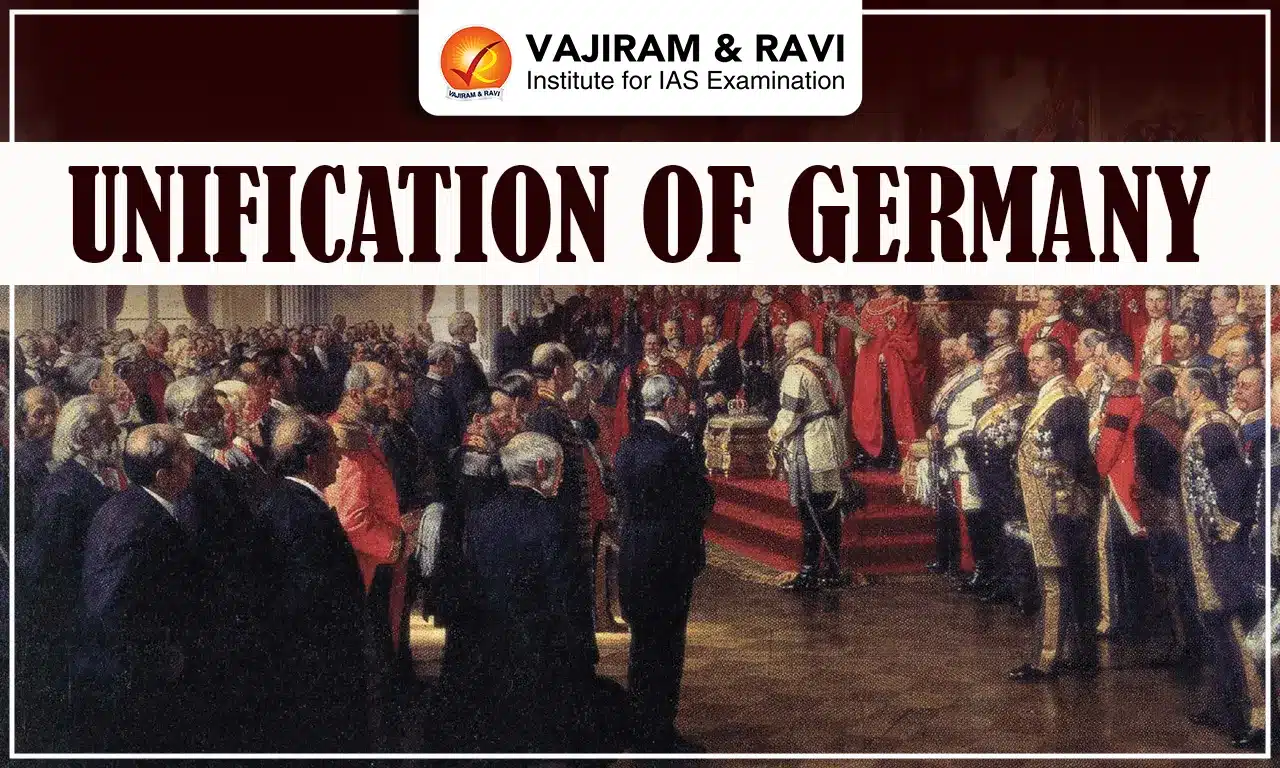
  • Jan 18, 1871: Proclamation of German Empire in the Hall of Mirrors (Versailles) and crowning of Kaiser Wilhelm I.

Unification of Germany Causes

The Unification of Germany was the result of various factors including nationalism, economic needs, rise of Prussia, several wars and strategies of Bismarck, etc. as listed below:

1. Rise of Nationalism

The nationalism rose, inspired by the Napoleonic Occupation which dissolved the Holy Roman Empire, during 1848. It was promoted by thinkers like ‘Fichte’. The Hambach Festival (1832) united 30,000 people. The demand of the revolution was Constitutional Unity but failed after 1848 due to the failure of Frankfurt Parliament because of lack of military support and Austrian opposition.

2. Economic Integration by Zollverein

The Zollverein was formed in 1834 by Prussia which included the large economies but excluded Austria. It was the unified customs system among 25 German States by 1842. It resulted in the increase of trade volume above 80% (1834-50) due to elimination of internal tariffs across German States which eventually boosted the industrial growth by 1860. The Zollverein produced ~60% of Coal and ~55% of Steel in Europe.

3. Role of Otto Von Bismarck

Bismarck was appointed as the Prussian Minister-President (Prime Minister) in 1862. He adopted the strategy of “Blood and Iron” and followed the policy of “Realpolitik” by using diplomacy, manipulation and wars for the German Unification. He strengthened the Prussian Army under the reforms of Helmuth Von Moltke and Albrecht Von Roon. His diplomatic strategy included neutralising Russia by supporting Polish repression (1863) and Italy with secret promises (1866). He manipulated the southern German States to join the Northern Confederation by provoking nationalism through shared German Language and culture.

4. Wars Leading to Unification

The strategic wars provided territorial gains, elimination of rival influences, annexation of the German states under Prussia, which led to the rise of Industrial and Military strength under the House of Hohenzollern. The major wars indirectly paving way for the unification are:

  • Second Schleswig War (1864): In this war, Prussia and Austria together defeated the Danish Army and annexed the territories of Schleswig and Holstein under joint Prussian-Austrian rule.
  • Austro-Prussian War (1866): Also known as Seven Week War as it lasted for the same duration. In this, the Prussian Army won at the Battle of Königgrätz in July 1866. This led to the annexation of Hannover, Nassau and Frankfurt. After the annexation, German Confederation was dissolved and led to the establishment of North German Confederation (1867).
  • Franco-Prussian War (1870-71): The war was sparked by the manipulation of Ems Dispatch. In the Battle of Sedan (Sep 1870) of this war, France was defeated and the territory of Alsace-Lorraine was ceded to Prussia. Along with it, southern states like Bavaria, Württemberg, Baden, etc. joined the empire and eventually triggered the proclamation of the German Empire.

5. Decline of Austrian Power

Austria struggled with several factors including economic, internal revolts, etc. It was excluded from the Zollverein since 1834. Internal ethnic revolts in Hungary, Italy, etc. demolished its strength. The major defeat in the Austro-Prussian War (1866) eliminated Austria dominance under Habsburg.

Unification of Germany Process

The Unification of Germany included multiple aspect processes including diplomatic strategies, military combats, treaties, alliances, etc. The complete process involved in the unification is given below:

1. Modernization of Prussian Army

Prussia modernized its army (1860-62) through Krupp Steel supplied artillery that dominated battle and doubled the rail mobilization capacity to 11000 km by 1870.

2. Diplomatic Strategies

The war with Denmark was eventually for the purpose of gaining territories. Further, Bismarck isolated Austria diplomatically through the alliances (neutralisation) of Russia and Italy. The strategic defeat of France prevented the formation of anti-Prussian coalitions. 

3. Formation of North German Confederation

After defeating Austria (1866), the German Confederation was replaced by North German Confederation (1867), which created federal structures including- Reichstag (universal male suffrage), Bundesrat and federal army. It included 22 states and adopted the constitution with the Prussian King as President.

4. Inclusion of Southern German States

The Southern German States voluntarily joined after the victory in the Franco-Prussian War (1870). The States signed the November Treaties with Prussia while agreeing to unite. It signed Defence Treaties with the states of Bavaria, Baden, Württemberg (1866-67).

5. Proclamation of German Empire (1871)

On Jan 18th, 1871, the Prussian King- Wilhelm I was crowned as the German Emperor (Kaiser) and Bismarck was appointed as the chancellor at Versailles. The new constitution came into force by May 1871 with strong Prussian dominance as 2/3rd of the population and 3/5th of the territory of the new empire was controlled by Prussia. The federal structure retained certain rights to the southern states (eg: postal services, excise duty, etc.).

Unification of Germany Results

The Unification of Germany impacted the geopolitics of Europe. The outcomes of the Unification of Germany can be studied into several aspects as mentioned below:

  • The Unification led to the coverage of ~540,000 sq km area with initial population ~41 million (1871), rising to ~67 million by 1914.
  • It led to the rapid industrial growth of the German Empire, with steel production rose from 0.2 million tons (1871) to over 14 million tonnes by 1913, surpassing Britain. 
  • It became Europe’s most powerful industrial nation by 1890 and the largest economy in Europe by 1910, producing 16 percent of global manufacturing output.
  • Germany became a major continental power, replacing France as dominant land power in Europe; greatly shifted European balance-of-power politics.
  • Increased militarisation ultimately contributed to tensions leading to World War I.

Unification of Germany FAQs

Q1: What is meant by the Unification of Germany?

Ans: The Unification of Germany refers to the political consolidation of numerous German states into the German Empire on 18 January 1871.

Q2: Who led the Unification of Germany?

Ans: Otto von Bismarck, the Prussian Chancellor, led the unification using policies of Realpolitik, military reforms, and strategic wars.

Q3: Which wars contributed to German unification?

Ans: Three key wars contributed: the Danish War (1864), Austro Prussian War (1866), and Franco Prussian War (1870-71).

Q4: When was the German Empire proclaimed?

Ans: The German Empire was proclaimed on 18 January 1871 at the Hall of Mirrors, Palace of Versailles.

Q5: What was the major result of German unification?

Ans: Germany emerged as a major European power with strong industry, centralized authority, and significant geopolitical influence.
North America, Geographical Features, International Relations

North America

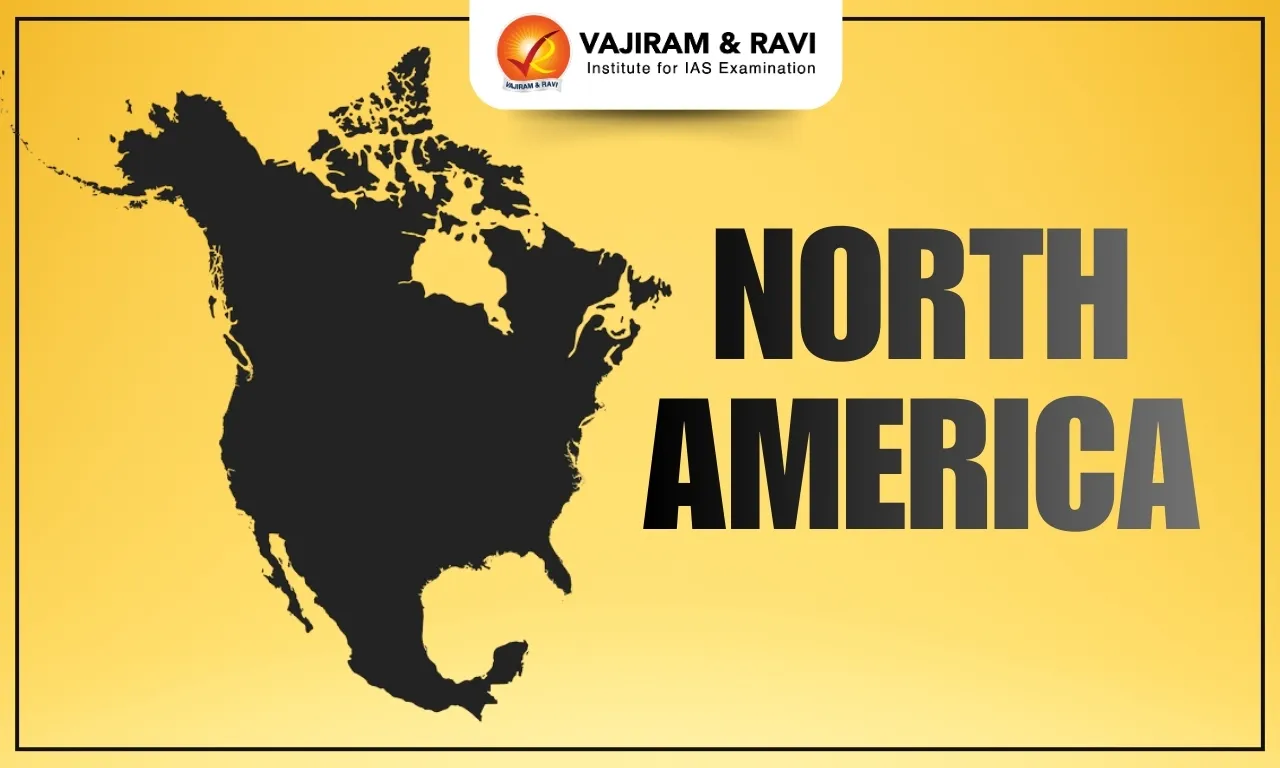
North America is the third largest continent covering about 24.71 million sq. km area. It consists of 23 countries. The continent highlights major global discussions on climate, trade, security alliances, geopolitics, technology, migration, etc. concerns. The continent is located between 7°N to 85°N latitude and 20°W to 179°W longitude, consisting of five time zones. It has the United States, Canada and Mexico as the largest economies, eventually creating a high impact of North America at global level.

North America Geographical Features

The geography of North America includes few of the major physical features of the world that impact the population, climate and resources. Key geographical highlights of North America are:

  • Rocky Mountains: extend from Canada to the US (~4800 km); influence climate and water flow.
  • The Appalachian Mountains: one of the oldest fold mountains of the world.
  • Great Plains: crucial for global grain supply; forms one of the largest agricultural belts.
  • Mississippi-Missouri River System: 4th longest river system globally (6275 km) vital for US agricultural exports.
  • The Great Lakes: largest freshwater lake system on earth (21% of total surface freshwater); Lake Superior is the largest among them, forming the US-Canada Boundary.
  • 49° N: 49th Parallel line forms the US-Canada land border naturally established through the Oregon Treaty of 1846.
  • Arctic Control: Canada, the US (Alaska), and Denmark (Greenland) control North America's Arctic territories and adjacent maritime zones, a highly disputed concern.
  • Tectonic Activity: The San Andreas Fault creates a boundary between Pacific and North American Plate which makes California a major seismic hotspot.

[my_image src="https://vajiramandravi.com/current-affairs/wp-content/uploads/2025/12/North-America-Map.webp" size="full" align="none" width="auto" height="961px" alt="North America Map" title="North-America-Map"]

North America Polity

The Politics of North America shapes the agreements for trade, technology, institutions, security alliances, etc. significantly. The major political trends are highlighted below:

  • The United States: It is the major political, economic and military power globally and has strong influence through NATO, G7 and multilateral bodies.
  • Canada: It is shaped through federal structure with multiculturalism. It focuses majorly on environmental and social policies.
  • Mexico: It is highly concerned for migration, drug trafficking, economic reforms and relations with the US.
  • The US-Mexico Border: It is highly concerned over illegal migration, drug trafficking and security issues.
  • NAFTA: The North American Free Trade Agreement (NAFTA) has been replaced with the United States Mexico Canada Agreement (USMCA) in 2020. It impacted supply chains, digital trade, labour standards, etc.

North America International Relations

North America is the central figure in the International System as it shapes the military, economic and technological developments globally. The major international aspects of North America are:

  • Global Alliances: North America (mainly US, Canada, Mexico) lead global alliances- NATO, NORAD, UN, OAS, USMCA, G7, G20, WTO, IMF, World Bank, etc. that collectively shape the security and trade of the continent.
  • Largest Trade Bloc: the US, Canada and Mexico region through USMCA forms a $28 trillion collective GDP.
  • Tech Leadership: It dominates the global tech leadership by controlling ~35-40% of Cloud Infrastructure and AI research investments.
  • Energy: US is largest producer of Oil and Gas, exports to Europe and Asia.
  • US-China Rivalry: The geopolitical competition has sparked the US CHIPS and Science Act ($ 52 billion) aiming to curb China’s tech and boost domestic supply chains.
  • US-Canada Mineral Strategy: Critical Mineral Strategy (Canada) promotes joint supply of minerals (Lithium, Cobalt, Graphite, etc.) with the US making it crucial for clean energy.
  •  Trade with Asia: IPEF is majorly driven by the US, impacting clean energy, digital trade and supply chain.

India-North America Relations

India and North America share a huge political, economic and technological relations with North American countries. The major areas of engagement are:

  • The trade between India and US reached $132.2 billion (2025) which makes US one of the top trading partners of India.
  • India has collaborated in several sectors including defense agreements, joint military exercises (e.g., YUDH ABHYAS-2024), semiconductor collaboration and space research with North America.
  • Canada hosts one of the largest Indian Diaspora with more than 1.8 million people belonging to India. It influences the bilateral ties between India and Canada.
  • In Latin America, Mexico is India’s second largest trading partner in Pharmaceuticals, IT, machinery, etc.

North America Environment

North America has been facing several environmental challenges linked to climate change, extreme events of weather, biodiversity loss, etc. The major debates in North America related to the climate change is around the following issues:

  • Arctic Melting: The regions of Canada, Alaska and Greenland have accelerated opening of new sea routes, the Northwest Passage ( Canada and Alaska) and the Northern Sea Route ( Russia and Norway), and have spiked geopolitical competition.
  • Extreme Weather Events are often faced by the US including Hurricanes, Wildfires, Tornadoes, Droughts, etc, signify increasing billion dollar disasters.
  • The Wildfire of Canada (2023) has marked a record of burning more than 15 million hectares.
  • Cities like Monterrey (Mexico) face chronic shortage of water, increasing tension around the area.

North America Economy

The economic features of North America are being one of the most advanced and productive. However it faces several structural disparities and sectoral transitions. The major economic insights of North America are:

  • Under USMCA, the United States, Canada and Mexico collectively form one of the largest Economic Regions of the world, accounting ~30% of GDP Globally.
  • The Largest Oil and Gas Producer (US), Major Automobile Exporter (Mexico) and Third Largest Oil Reserve (Canada) makes it a manufacturing and energy hub.
  • The continent accounts for ~25% of maize production globally, with the US as the largest exporter.
  • North America hosts ~50% of the top tech companies of the World including Meta, Microsoft, Apple, Alphabet (Google), IBM, etc. (US leading ~35% share in Global Digital Economy Value).

North America FAQs

Q1: How many countries are there in North America?

Ans: North America has 23 countries including the United States, Canada and Mexico as the leading powers globally.

Q2: Which is the largest economy of North America?

Ans: The United States is the largest Economy of North America that contributes ~$29 trillion GDP.

Q3: Which is the largest physical feature in North America?

Ans: The Rocky Mountains are the largest physical feature of the continent. They stretch over 4800 km from Canada to the United States (Southwestern).

Q4: What are the major Global Alliances of North America?

Ans: North America through the US, Mexico and Canada leads the alliances like NATO, WTO, UN, etc. impacting the image of North America Globally.

Q5: Which is the largest fresh water lake?

Ans: The Largest Surface Freshwater Lake system is- the Great Lakes (Lake Superior largest among them) is in North America.

UPSC Daily Quiz 1 December 2025

UPSC Daily Quiz

The Daily UPSC Quiz by Vajiram & Ravi is a thoughtfully curated initiative designed to support UPSC aspirants in strengthening their current affairs knowledge and core conceptual understanding. Aligned with the UPSC Syllabus 2025, this daily quiz serves as a revision resource, helping candidates assess their preparation, revise key topics, and stay updated with relevant issues. Whether you are preparing for Prelims or sharpening your revision for Mains, consistent practice with these Daily UPSC Quiz can significantly enhance accuracy, speed, and confidence in solving exam-level questions.

[WpProQuiz 34]

UPSC Daily Quiz FAQs

Q1: What is the Daily UPSC Quiz?

Ans: The Daily UPSC Quiz is a set of practice questions based on current affairs, static subjects, and PYQs that help aspirants enhance retention and test conceptual clarity regularly.

Q2: How is the Daily Quiz useful for UPSC preparation?

Ans: Daily quizzes support learning, help in revision, improve time management, and boost accuracy for both UPSC Prelims and Mains through consistent practice.

Q3: Are the quiz questions based on the UPSC syllabus?

Ans: Yes, all questions are aligned with the UPSC Syllabus 2025, covering key areas like Polity, Economy, Environment, History, Geography, and Current Affairs.

Q4: Are solutions and explanations provided with the quiz?

Ans: Yes, each quiz includes detailed explanations and source references to enhance conceptual understanding and enable self-assessment.

Q5: Is the Daily UPSC Quiz suitable for both Prelims and Mains?

Ans: Primarily focused on Prelims (MCQ format), but it also indirectly helps in Mains by strengthening subject knowledge and factual clarity.

Kittur Rani Chennamma, British Conflict, 1824 Revolt, Memorial

Kittur Rani Chennamma

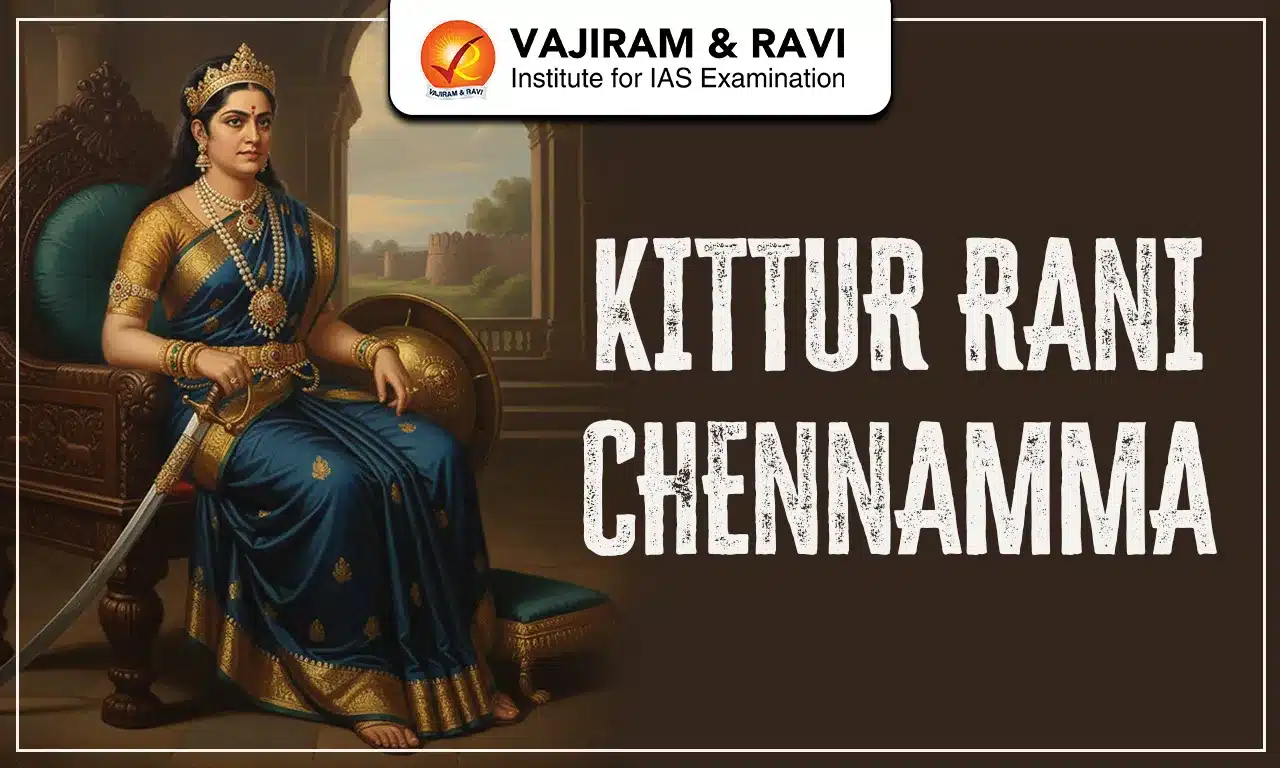
Kittur Rani Chennamma is one of the few early rulers who resisted the expansion of the British before 1857. She launched an armed rebellion in 1824 against the attempt of the East India Company to annex the princely state of Kittur. She opposed the interventionist policies of the British, especially the imposition of Doctrine of Lapse-like succession even before it was formally adopted and articulated by Dalhousie in 1848. 

Kittur Rani Chennamma

Kittur Rani Chennamma was born in 1778 at Kakati Village in present day Belagavi District of Karnataka. She was mastered in horse riding, swordsmanship, and various other skills. Chennamma was married to the ruler of Kittur Mallasarja who later died in 1816. Eventually her son was crowned till his death in 1824. To protect her kingdom from annexation, she adopted Shivalingappa. In response, the East India Company refused to recognize the adoption which led to the conflict between the Rani Chennamma of Kittur and the British.

Kittur Rani Chennamma British Conflict

The conflict between Kittur Rani Chennamma and the British intensified when St. John Thackeray (Collector of Dharwad under British East India Company) attempted to capture the control of Kittur amid the rejection of adoption of Shivalingappa. The reports of the British show the annual revenue of Kittur at that time was above Rs. 3 lakhs, which highlighted it strategically. Chennamma through diplomatic letters sought recognition of her adopted son as ruler but the company rejected and continued administrative takeover of the state of Kittur.

Also Read: Freedom Fighters of India

Kittur Rani Chennamma 1824 Revolt

The tension rose when Thackaray marched toward Kittur with armed forces to enforce the British claim in October 1824. Chennamma set up her army under Sangolli Rayanna and Gurusiddappa (trusted commanders). In the first round of war, Thackaray was killed and the British Forces suffered heavy losses. But in the next course of war, despite strong resistance, Kittur Fort fell and Kittur Rani Chennamma was captured. She was imprisoned at Bailhongal till she died in 1829.

Also Read: Slogans of Freedom Fighters

Kittur Rani Chennamma Memorial

The revolt of 1824 is documented in the Kannada works of M M Kalburgi and Basavaraja Naikar. Kittur Rani Chennamma Samadhi is located at Bailhongal which is now a preserved memorial site under the Archaeology Department of Karnataka. Chennamma’s victory and legacy is commemorated annually at the Kittu Utsav (October 22 to 24) organized by the Karnataka Government each year. The literary works include Kitturu Samsthana Sahitya (Parts I to III), Kalburgi’s academic writings, and Sangamesh Tammanagoudar’s Kitturu Rani Chennamma. The Government has established her Statues at Bengaluru, Belagavi, Hubballi, Kittur, and prominently at Parliament House, New Delhi, unveiled on 11 September 2007 by President Pratibha Patil. Other honours include commissioning of the Ship Kittur Chennamma (1983-2011) by Indian Coast Guard, Rani Chennamma Express by Indian Railway and release of ₹200 commemorative coin in 2025 marking the 200 years anniversary of the Victory of Rani Chennamma.

Kittur Rani Chennamma FAQs

Q1: Who was Kittur Rani Chennamma?

Ans: Kittur Rani Chennamma was the queen of Kittur and an early Indian ruler who resisted British expansion by leading an armed rebellion in 1824.

Q2: Why did Rani Chennamma revolt against the British?

Ans: She revolted after the East India Company rejected her adopted son Shivalingappa’s succession, an action similar to the later Doctrine of Lapse.

Q3: What triggered the 1824 conflict of Kittur Rani Chennamma with the British?

Ans: Collector St. John Thackeray attempted to take over Kittur’s administration, leading to a military confrontation initiated by the British.

Q4: What was the outcome of Kittur Rani Chennamma’s revolt?

Ans: Her forces initially defeated the British and killed Thackeray, but Kittur later fell, and she was imprisoned at Bailhongal until her death in 1829.

Q5: How is Kittur Rani Chennamma remembered today?

Ans: Her legacy is honored through memorials, literary works, annual Kittur Utsav celebrations, statues across Karnataka and Delhi, and national commemorations.

India Brazil South Africa (IBSA), Objectives, Structure, Intiatives

India Brazil South Africa (IBSA)

India Brazil South Africa (IBSA) is a trilateral forum created in 2003 to promote South–South cooperation, democratic governance, and inclusive development. It brings together three large multicultural democracies with similar global interests. IBSA works to strengthen cooperation in trade, technology, culture, defence, and multilateral diplomacy. 

It also plays a crucial role in advocating reforms in global institutions like the UN Security Council and the WTO.

India Brazil South Africa (IBSA) Objectives

  • Contribute to building a new, fair, and inclusive international architecture.
  • Present a unified voice on major global issues and strengthen collective diplomatic influence.
  • Deepen trilateral cooperation across political, economic, technological, and cultural sectors.
  • Implement concrete development projects and partnerships with less developed and least developed countries (LDCs).

IBSA Structure

The IBSA Structure is designed to ensure smooth coordination and implementation of trilateral initiatives across multiple sectors. It doesn’t have a headquarters or a permanent executive secretariat.

  • IBSA Summits: Highest decision-making forum at Heads of State/Government level
  • Ministerial and Senior Officials’ Meetings: Policy coordination and review
  • Sectoral Working Groups: Focus on trade, health, education, energy, defence, etc.
  • Joint Working Group: Monitors implementation and ensures continuity of projects
  • Ensures structured trilateral cooperation across political, economic, and social sectors

IBSA Summit 2025

The India Brazil South Africa (IBSA) Summit 2025 held in Johannesburg emphasised strengthening South–South cooperation, democratic governance, and sustainable development. Key discussions included global governance reforms, digital innovation, counter-terrorism coordination, and expanding the IBSA Fund for development and climate-resilient agriculture.

Key Inititatives

  • Strengthen South–South cooperation and democratic ties
  • Push for UN Security Council and global governance reforms
  • Promote digital innovation and human-centric AI norms
  • Expand IBSA Fund projects in health, education, women's empowerment, and climate-resilient agriculture
  • Cooperation in millets, natural farming, green energy, disaster resilience, and health security
  • Establish an IBSA Digital Innovation Alliance to strengthen trilateral technology cooperation to establish Digital Public Infrastructure (DPI), such as UPI, health platforms like CoWIN, cybersecurity frameworks and women-led tech initiatives among the three countries

IBSA Fund for the Alleviation of Poverty and Hunger

The IBSA Fund, established in 2004, finances development projects in least-developed and developing countries, focusing on poverty alleviation, hunger reduction, education, health, and women empowerment.

  • Established: 2004 under IBSA Trilateral Agreement
  • Focus Areas: Poverty alleviation, hunger reduction, education, health, women empowerment, renewable energy
  • Coverage: With a total contribution of $35 million, the IBSA Fund has supported 26 projects in 19 Global South countries over the past decade, with 62.4% of funds allocated to Least Developed Countries (LDCs).
  • Significance: First trilateral fund exclusively for development cooperation among Global South nations
  • Managed in partnership with UN Office for South-South Cooperation (UNOSSC)

IBSA Initiatives

IBSA undertakes a wide range of initiatives to strengthen trilateral cooperation in trade, technology, security, and sustainable development. Key initiatives includes:

  • IBSA Fund: Established in 2004, operational since 2006; supports development projects in developing nations focusing on poverty and hunger. $53 million allocated to 46 projects in 34 countries.
  • IBSAMAR: Multinational naval exercise to enhance defense cooperation and strategic trust; 8th edition held in October 2024.
  • IBSA Dialogue Forum: Platform for discussing common issues like UN Security Council reform and promoting a collective Global South voice.
  • IBSA Fund for Climate-Resilient Agriculture: Support developing countries in climate-adaptive sustainable agriculture.
  • Renewable Energy & Climate Action: Joint projects and knowledge sharing
  • Digital Governance: Sharing of platforms like UPI and health systems

Future Prospects of IBSA

IBSA has strong potential to become a leading voice for the Global South in global governance and sustainable development. Future priorities includes:

  • Expand trilateral trade, investment, and economic cooperation
  • Strengthen IBSA Fund and climate-resilient development projects
  • Promote digital governance, AI norms, and technology sharing
  • Play a key role in UN reforms and multilateral governance
  • Act as a platform for inclusive growth and Global South solidarity
  • Cooperation in renewable energy, health, agriculture, and disaster resilience

India Brazil South Africa (IBSA) FAQs

Q1: What is IBSA?

Ans: IBSA is a trilateral forum of India, Brazil, and South Africa, established in 2003 to promote South–South cooperation, democratic governance, and sustainable development.

Q2: What is the IBSA Fund?

Ans: A development fund established in 2004 to support projects in developing countries, focusing on poverty, hunger, education, health, women empowerment, and renewable energy.

Q3: What is IBSAMAR?

Ans: A multinational naval exercise to enhance defense collaboration and strategic trust among the navies of the three countries.

Q4: How does IBSA differ from BRICS?

Ans: IBSA focuses on democratic cooperation, South–South development, and inclusive growth, while BRICS is a broader group of emerging economies with geopolitical and economic focus.

Q5: Why is IBSA important for India?

Ans: It strengthens India’s strategic and economic ties with Latin America and Africa, enhances Global South diplomacy.

Important Days in December 2025, National and International Days List

Important Days in December 2025

Many Important Days in December 2025 are celebrated in India and around the world. These days focus on raising awareness, remembering events, and honoring people. From World AIDS Day and Human Rights Day to Christmas and New Year’s Eve, each day is special. Celebrating these days helps people learn, remember, and take part in important causes.

List of Important Days in December 2025

Here is the List of Important Days in December 2025, tabulated below. These days help in spreading knowledge and encourage participation in social, cultural, and global initiatives.

List of Important Days in December 2025
Date Event

1 December

World AIDS Day

2 December

National Pollution Control Day

2 December

International Day for the Abolition of Slavery

2 December

World Computer Literacy Day

3 December

World Day of the Handicapped / International Day of Persons with Disabilities

4 December

Indian Navy Day

5 December

International Volunteer Day

5 December

World Soil Day

6 December

B.R. Ambedkar’s Death Anniversary

6 December

National Microwave Oven Day

7 December

Armed Forces Flag Day

7 December

International Civil Aviation Day

8 December

Bodhi Day

9 December

International Anti-Corruption Day

10 December

Human Rights Day

10 December

Death Anniversary of Alfred Nobel

11 December

International Mountain Day

11 December

UNICEF Day

12 December

Universal Health Coverage Day

13 December

National Horse Day

13 December

U.S. National Guard Birthday

14 December

National Energy Conservation Day

14 December

Hanukkah Beginning

16 December

Vijay Diwas

18 December

Minorities Rights Day in India

18 December

International Migrants Day

19 December

Goa Liberation Day

20 December

International Human Solidarity Day

21 December

Blue Christmas

21 December

December Solstice

22 December

National Mathematics Day

23 December

Kisan Diwas / National Farmers’ Day

24 December

National Consumer Rights Day

24 December

DMRC Foundation Day

25 December

Christmas Day

25 December

Good Governance Day (India)

26 December

Veer Bal Diwas

26 December

Boxing Day

27 December

International Day of Epidemic Preparedness

29 December

International Cello Day

31 December

New Year's Eve

Important Days in December 2025 Details

1 December - World AIDS Day

World AIDS Day is observed every year on 1 December to raise awareness about HIV/AIDS, support people living with HIV, and remember those who have lost their lives to AIDS-related illnesses. It was first celebrated in 1988, and the 2025 theme is “Overcoming disruption, transforming the AIDS response.”

2 December - National Pollution Control Day

National Pollution Control Day is observed every year on 2 December in India to raise awareness about the harmful effects of pollution on the environment and human health. It also honors the memory of those who lost their lives in the Bhopal Gas Tragedy of 1984 and emphasizes the importance of pollution prevention and sustainable environmental practices.

2 December - International Day for the Abolition of Slavery

The International Day for the Abolition of Slavery is observed every year on 2 December to raise awareness about modern forms of slavery, including human trafficking, forced labor, and child marriage. It highlights global efforts to end exploitation and protect human rights. The day also commemorates the adoption of the UN Convention for the Suppression of the Traffic in Persons in 1949.

2 December- World Computer Literacy Day

This day is observed on 2 December each year to promote digital skills and computer literacy worldwide. It aims to bridge the digital divide.

3 December - World Day of the Handicapped / International Day of Persons with Disabilities

World Day of the Handicapped / International Day of Persons with Disabilities is observed every year on 3 December. This day aims to promote awareness, understanding, and support for people with disabilities. It highlights the importance of inclusivity, accessibility, and equal opportunities for persons with disabilities in all aspects of society.

4 December- Indian Navy Day

Every year on 4 December, Navy Day is observed to recognise the achievements of the Indian Navy. This day was chosen as on that day in 1971, during Operation Trident, including the 1971 Indo-Pak war operations.

5 December - International Volunteer Day

International Volunteer Day is observed every year on 5 December to recognise and promote the invaluable contributions of volunteers worldwide. It encourages people to engage in voluntary service, support communities, and foster social development and solidarity.

5 December - World Soil Day

World Soil Day is observed every year on 5 December to emphasise the crucial role of healthy soil in food security, ecosystems, and human well-being. It was proposed by the International Union of Soil Sciences in 2002 and officially adopted by the UN General Assembly in 2014.

6 December - B.R. Ambedkar’s Death Anniversary

December 6, observed as Mahaparinirvan Diwas, commemorates Dr. B.R. Ambedkar, the chief architect of the Indian Constitution. The day honors his contributions as a social reformer and his lifelong advocacy for equality and justice.

6 December- National Microwave Oven Day

National Microwave Oven Day is observed annually on 6 December to celebrate the invention of the microwave oven and its revolutionary impact on modern cooking. The microwave oven, invented by Percy Spencer in 1945, transformed meal preparation.

7 December- Armed Forces Flag Day

Armed Forces Flag Day is observed in India on 7 December to honor the bravery of soldiers and martyrs who protect the nation. Funds are also collected from the public to support ex-servicemen and their families.

7 December - International Civil Aviation Day

Observed worldwide on 7 December, this day highlights the importance of civil aviation in connecting people, boosting economies, and supporting international trade.

8 December - Bodhi Day

Bodhi Day is celebrated on 8 December to honor Gautam Buddha and his teachings. It marks the day Buddha attained enlightenment and is observed in many countries with meditation and reflection.

9 December - International Anti-Corruption Day

This day is observed on 9 December to raise awareness about corruption and its harmful effects on society, governance, development, and equality.

10 December - Human Rights Day

Celebrated on 10 December, Human Rights Day marks the adoption of the Universal Declaration of Human Rights in 1948. It promotes the protection of fundamental rights and freedoms for all people.

10 December - Death Anniversary of Alfred Nobel

Alfred Nobel, inventor of dynamite and founder of the Nobel Prizes, passed away on 10 December 1896. He is remembered for his scientific contributions and the prestigious awards established in his name.

11 December - International Mountain Day

Observed on 11 December, this day educates people about the importance of mountains in providing water, food, clean energy, and recreation.

11 December - UNICEF Day

UNICEF Day is observed on 11 December to recognize the efforts of the United Nations International Children’s Emergency Fund in protecting children worldwide.

12 December - Universal Health Coverage Day

Observed on 12 December, this day promotes awareness about strong health systems and universal health coverage to ensure everyone has access to quality healthcare.

13 December - National Horse Day

In the U.S., 13 December celebrates National Horse Day to honor the contributions of horses to culture, history, and the economy.

13 December - U.S. National Guard Birthday

The U.S. National Guard celebrates its birthday on 13 December to mark its establishment in 1636 and its role in national defense and emergency support.

14 December - National Energy Conservation Day

Observed on 14 December in India, this day promotes awareness about saving energy and using it efficiently in daily life.

14 December - Hanukkah Beginning

Hanukkah, the Jewish festival of lights, begins on 14 December this year. It celebrates the rededication of the Second Temple in Jerusalem with menorah lighting, games, and festive meals.

16 December - Vijay Diwas

Vijay Diwas is observed on 16 December in India to honor the martyrs of the 1971 war and celebrate the country’s victory.

18 December - Minorities Rights Day in India

This day is observed on 18 December to promote the rights and safety of minority communities through campaigns and awareness programs.

18 December - International Migrants Day

International Migrants Day is observed on 18 December to raise awareness about migrant rights and remember those who lost their lives seeking safety.

19 December - Goa Liberation Day

Goa Liberation Day on 19 December marks the end of Portuguese rule in 1961 and celebrates the role of the Indian armed forces in freeing Goa.

20 December - International Human Solidarity Day

Observed on 20 December, this day highlights the importance of unity in diversity and encourages people to fight poverty, hunger, and disease together.

21 December - Blue Christmas

Blue Christmas, observed around 21 December, offers support to people who find the holiday season difficult, especially during the longest night of the year.

21 December - December Solstice

The December Solstice on 21 December marks the start of winter in the Northern Hemisphere and summer in the Southern Hemisphere, with the shortest day and longest night in the north.

21 December - World Saree Day

World Saree Day is celebrated on 21 December to honor the elegance and cultural significance of the traditional Indian saree.

22 December - National Mathematics Day

Observed on 22 December, this day commemorates the birth anniversary of mathematician Srinivasa Ramanujan and his contributions to mathematics.

23 December - Kisan Diwas / National Farmers’ Day

Kisan Diwas is celebrated on 23 December to honor farmers and the birth anniversary of former Prime Minister Chaudhary Charan Singh. Events focus on agriculture and farming education.

24 December - National Consumer Rights Day

Observed on 24 December, this day raises awareness about consumer rights and the importance of protecting them under the Consumer Protection Act.

24 December - DMRC Foundation Day

DMRC Foundation Day on 24 December commemorates the inauguration of the Delhi Metro’s Red Line in 2002, marking a milestone in India’s urban transport.

24 December - Christmas Eve

Christmas Eve, on 24 December, is the evening before Christmas Day, celebrated with family gatherings, prayers, and festive traditions.

25 December - Christmas Day

Christmas Day celebrates the birth of Jesus Christ on 25 December, observed worldwide with joy, gifts, and religious ceremonies.

25 December - Good Governance Day (India)

Observed on 25 December, Good Governance Day honors the birth anniversary of Atal Bihari Vajpayee and promotes accountability and transparency in governance.

26 December - Veer Bal Diwas

Veer Bal Diwas on 26 December pays tribute to the courage of Guru Gobind Singh Ji’s four sons who sacrificed their lives for their faith.

26 December - Boxing Day

Boxing Day, on 26 December, is traditionally a day to give gifts and money to service workers and celebrate post-Christmas generosity.

27 December - International Day of Epidemic Preparedness

Observed on 27 December, this day raises awareness about epidemic preparedness, sharing scientific knowledge, and improving global health response.

28 December - Ratan Tata Birthday

Ratan Tata, the renowned Indian industrialist and philanthropist, is celebrated on 28 December for his contributions to industry, entrepreneurship, and society.

29 December - International Cello Day

International Cello Day on 29 December honors the legacy of cellist Pablo Casals and celebrates the music and artistry of the cello.

31 December - New Year’s Eve

New Year’s Eve, on 31 December, marks the last day of the year according to the Gregorian calendar. People celebrate with parties, music, and festivities to welcome the New Year.

Important Days in December 2025 FAQs

Q1: When is World AIDS Day observed?

Ans: World AIDS Day is observed on 1 December every year to raise awareness about HIV/AIDS and support people living with it.

Q2: What is National Pollution Control Day?

Ans: National Pollution Control Day is observed on 2 December in India to honor the victims of the Bhopal Gas Tragedy and raise awareness about pollution prevention.

Q3: When is International Day for the Abolition of Slavery?

Ans: It is observed on 2 December to highlight efforts against modern slavery, human trafficking, and child labor.

Q4: When is Bodhi Day celebrated?

Ans: Bodhi Day is celebrated on 8 December to honor Gautam Buddha and his enlightenment.

Q5: What is Human Rights Day?

Ans: Human Rights Day is on 10 December, marking the adoption of the Universal Declaration of Human Rights in 1948.

Protosticta sooryaprakashi

Protosticta sooryaprakashi

Protosticta sooryaprakashi Latest News

A  new species of damselfly named, Protosticta sooryaprakashi, sporting vibrant sky-blue markings, has been recently discovered in the biodiversity hotspots of India’s Western Ghats.

About Protosticta sooryaprakashi

  • It is a new species of damselfly.
  • Named the Kodagu Shadowdamsel, it was discovered in Karnataka’s Kodagu district.
  • The species has been named in honour of the late Dr. Sooryaprakash Shenoy, a renowned botanist.
  • Sporting striking sky-blue markings, the Kodagu Shadowdamsel thrives in low-light habitats and requires pristine environmental conditions to breed. 
  • Entomologists say its presence is a strong indicator of a healthy ecosystem with minimal pollution. 
  • Despite its resemblance to its close relatives, its slender build makes it the thinnest member of the damselfly family. 
  • Its distinguishing features include a unique blue spot on its neck and at the tip of its body.
  • Unlike dragonflies, which inhabit bright, sunny spaces, damselflies like the Kodagu Shadowdamsel favour cool, shaded areas, making sightings rare and significant.

Source: RM

Protosticta sooryaprakashi FAQs

Q1: What is Protosticta sooryaprakashi?

Ans: It is a new species of damselfly.

Q2: Where was Protosticta sooryaprakashi?

Ans: It was discovered in Karnataka’s Kodagu district.

Q3: In whose honour has the species Protosticta sooryaprakashi been named?

Ans: The species has been named in honour of the late Dr. Sooryaprakash Shenoy, a renowned botanist.

Q4: Why is the presence of the Kodagu Shadowdamsel considered ecologically significant?

Ans: It reflects a clean, minimally polluted ecosystem.

Ramban Sulai Honey

Ramban Sulai Honey

Ramban Sulai Honey Latest News

The Prime Minister, during the 128th episode of his radio programme ‘Mann Ki Baat’ noted that Ramban Sulai honey from Jammu and Kashmir, made from wild basil, gained wider recognition after receiving a GI tag.

About Ramban Sulai Honey

  • Ramban Sulai Honey, produced in the Ramban District of Jammu and Kashmir, is known for its rich taste, aromatic floral undertones, and high nutritional value. 
  • Extracted from Sulai plants growing in the Himalayas, it is prized for its medicinal properties and purity. 
  • The bees forage on the nectar of snow-white blossoms of Sulai during the months of August to October to produce this well-rounded, naturally sweet honey with floral undertones.
  • This crystal-clear honey, ranging from white to amber, contains essential minerals, enzymes, and vitamins that enhance its health benefits. 
  • Due to superior bee strains and favourable climatic conditions, the honey yield in Ramban is significantly higher than in other regions.
  • It earned a Geographical Indication (GI) tag in 2021.
  • The Government of India declared Ramban Sulai Honey as the district’s “One District, One Product.” 

What is a Geographical Indication (GI) Tag?

  • A geographical indication, or GI, is a sign used on products that have a specific geographical origin and possess qualities or a reputation that are due to that origin.
  • It highlights the unique qualities, reputation, or characteristics that are tied to that region.
  • GIs are recognized as an aspect of intellectual property rights (IPRs) under the Paris Convention for the Protection of Industrial Property and the Trade-Related Aspects of Intellectual Property Rights (TRIPS) Agreement.
  • The Geographical Indications of Goods (Registration and Protection) Act, 1999, is the main law in India that oversees the registration and protection of geographical indications.
    • This act prohibits the use of GI-tagged products and their names without authorization.
    • GIs are protected for 10 years and can be renewed forever.
  • Examples of GI-tagged items in India include Darjeeling Tea, Mysore Silk, and Kashmiri Saffron.

Source: DDN

Ramban Sulai Honey FAQs

Q1: Ramban Sulai Honey is primarily produced in which region of India?

Ans: Ramban District, Jammu & Kashmir.

Q2: From which plant do bees collect nectar to produce Ramban Sulai Honey?

Ans: It is extracted from Sulai plants growing in the Himalayas

Q3: Ramban Sulai Honey earned the Geographical Indication (GI) tag in which year?

Ans: 2021

Q4: During which months do Sulai plants bloom, enabling honey production in the Ramban region?

Ans: August to October

Khiamniungan Tribe

Khiamniungan Tribe

Khiamniungan Tribe Latest News

Recently, the Prime Minister of India mentioned about the Khiamniungan tribe in his ‘Mann Ki Baat’ episode.

About Khiamniungan Tribe

  • The Khiamniungan tribe is one of the major tribes among the Nagas, with habitation both in India and Myanmar.
  • Geographically, the land of Khiamniungans is located in the Eastern part of Nagaland and in the North-Western part of Myanmar.
  • The meaning of the term Khiamniungan is ‘source of great water or river’.
  • Social Structure: The traditional social structure was based on the clan system.
  • Language: They speak Khiamniugan, one of the Naga languages which belongs to the Sino- Tibetan language.
  • Festivals
    • They celebrate Tsokum Sumai in the month of September or in the first past of October to invoke blessing for a rich harvest.
    • They also celebrate Khaotzao Sey Hok-ah sumai which marks the end of all agricultural activities for the year.
  • Economy: Farming is one of the primary occupations of the people of this region. They traditionally practised jhum cultivation.
  • They have been practicing cliff-honey hunting for centuries.

Source: PIB

Khiamniungan Tribe FAQs

Q1: Where is the Khiamniungan Tribe primarily located?

Ans: Nagaland

Q2: What is the language spoken by the Khiamniungan Tribe?

Ans: Khiamniungan

Darjeeling Mandarin Orange

Darjeeling Mandarin Orange

Darjeeling Mandarin Orange Latest News

Recently, the Darjeeling Mandarin orange received the Geographical Indication status.

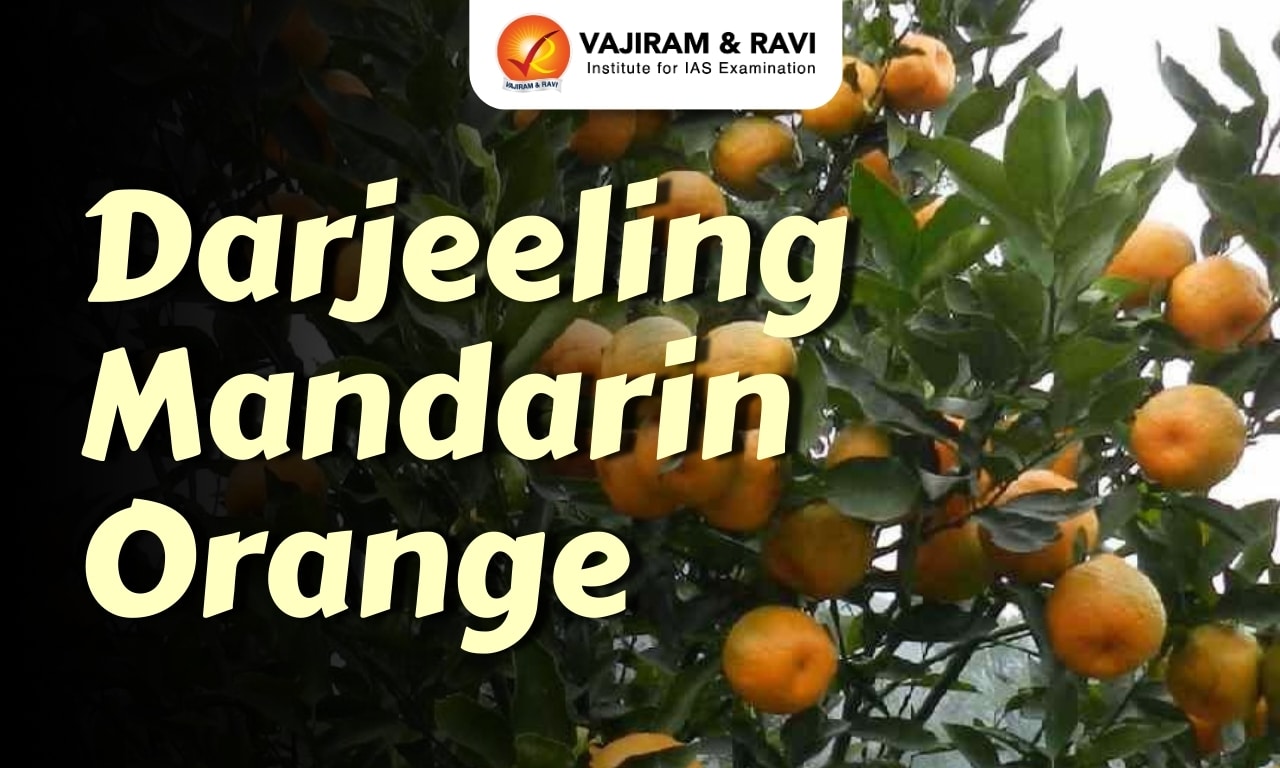
About Darjeeling Mandarin Orange

  • It is grown in the hills of Darjeeling in West Bengal.
  • The Mandarin Orange (Citrus reticulata Blanco) is a major cash crop of the Darjeeling Hills.
    It is the third product from the region, after Darjeeling Tea and Dalley Khursani chilli, to get the tag.
  • It is commonly known as “suntala” is the pride of Darjeeling hills due to its delightful aroma and flavour.

Required Climatic Conditions for Darjeeling Mandarin Orange

  • It is cultivated at elevations ranging from 600 to 1500 meters above sea level,
  • Mandarins grow successfully in all frost free tropical and sub-tropical regions upto 1,500 m. above  mean sea level.
  • Annual rainfall: 100-120 cm.
  • Temperature: Ranging from 10–35°C is suitable for cultivation of the crop.
  • Soil: It requires medium or light loamy soils.

What is a Geographical Indication Tag?

  • It is a sign used on products with a specific geographical origin, possessing unique qualities or reputation due to that origin.
  • This is typically used for agricultural products, foodstuffs, wine and spirit drinks, handicrafts and industrial products.
  • The Geographical Indications of Goods (Registration and Protection) Act, 1999 seeks to provide for the registration and better protection of geographical indications relating to goods in India.
  • This GI tag is valid for 10 years following which it can be renewed.

Source: HT

Darjeeling Mandarin Orange FAQs

Q1: What is the variety of the Darjeeling Mandarin Orange?

Ans: Khasi Mandarin

Q2: When is the harvest season for Darjeeling Mandarin Orange?

Ans: November to February

Booth Level Officer

Booth Level Officer

Booth Level Officer Latest News

Recently, concerns have been raised with several Booth Level Officers (BLOs) deaths have been reported from the states undergoing Special Intensive Revision (SIR) of electoral rolls.

About Booth Level Officer

  • A BLO is a representative of the Election Commission of India (ECI) at the grass-root level who assists in updating the roll using his local knowledge.
  • They are local government/semi-government officials who are familiar with the local electors and enrolled as voters in the same polling area.
    • Teachers, Anganwadi workers, Panchayat Secretary, Village Level Workers, Electricity Bill Readers, etc are mainly appointed as BLOs.
  • BLOs are not full-time electoral officials
    • Section 13B (2) of the Representation of People Act, 1950 provision paved the way for the introduction of appointing a BLO for the first time in August 2006.

Roles of Booth Level Officer

  • They play a significant role in the process of roll revision and collecting actual field information with regard to the roll corresponding to the polling area assigned to them.
  • They maintain accuracy and fidelity of the electoral roll at the polling booth level.
  • Distribution of Voter Slips: An important role of the BLO is the distribution of Voter Slips to the voters’ households before the poll day. 
  • Informing eligible voters for Postal Ballot: BLOs inform the eligible Electors (senior citizens above 85 years & PwDs with benchmark certificate) about availing Home Voting Facility and Postal Ballot Facility by filling Form 12D.
  • Promote use of Election Commission’s IT applications:  BLOs to promote applications launched by the ECI to facilitate voting and ensure an accurate electoral roll. 
    • The popular voter oriented apps like Voter Helpline App, eVIGIL app, Know you candidate app, Saksham-ECI.

Source: IE

Booth Level Officer FAQs

Q1: What is the role of a Booth Level Officer (BLO)?

Ans: Assisting in voter registration and verification

Q2: Under which act are BLOs appointed?

Ans: Representation of the People Act, 1950

High Courts in India, List, High Court Judge Qualifications, Salary

High Courts in India

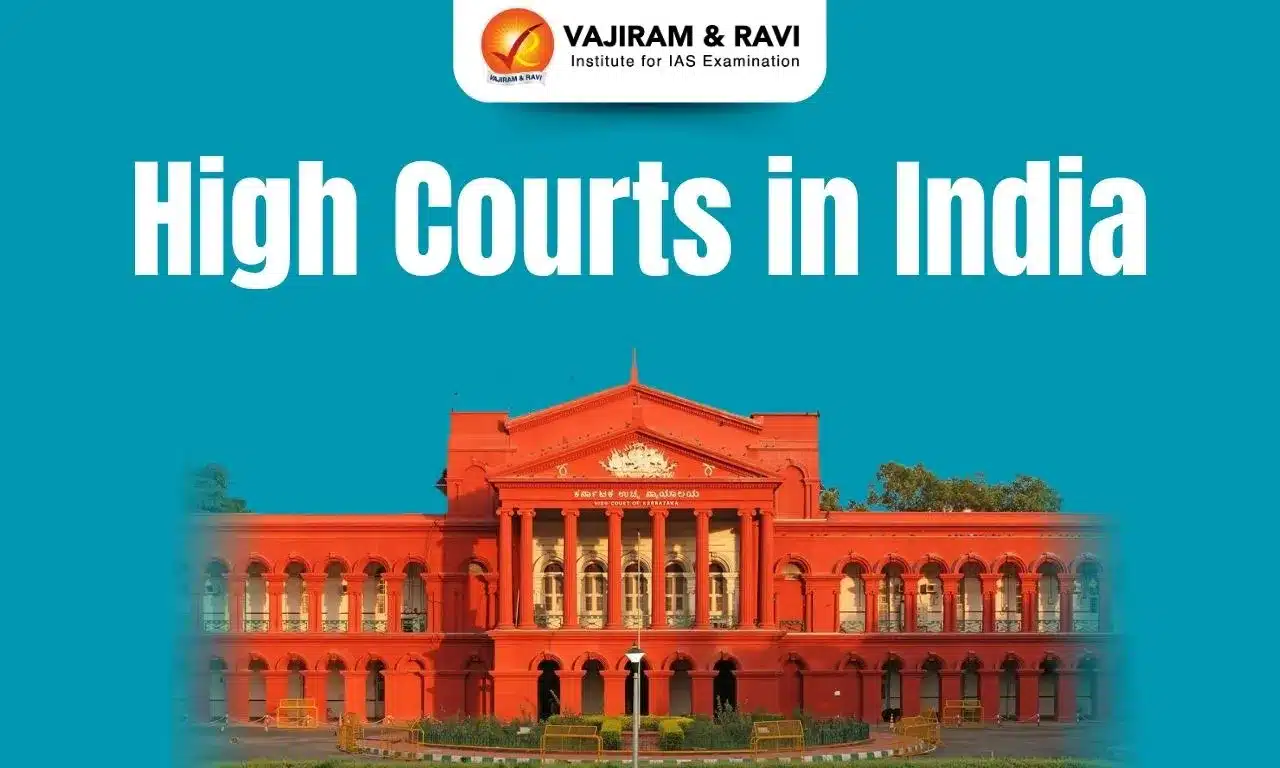
High Courts in India: In India’s legal framework, High Courts hold a prominent position as the highest courts of appeal for the states and Union Territories they serve. As per Article 214 of the Constitution, every state or Union Territory is mandated to establish at least one High Court, ensuring access to justice across the country. Additionally, Article 231 allows for the creation of a single High Court that serves multiple states, offering a more streamlined approach to legal proceedings. As of now, there are 25 High Courts in India, each contributing to the nation’s judicial integrity.

High Courts in India

High Courts in India are the highest judicial authority in each state or Union Territory, overseeing subordinate courts. According to Article 231 of the Constitution, while each state generally has its own High Court, some states share a single court. India has 25 High Courts, with the Calcutta High Court, established in 1862, being the oldest, alongside Bombay and Madras High Courts.

The Telangana and Andhra Pradesh High Courts were established in 2019. Each High Court is headed by a Chief Justice, with additional judges appointed by the President of India. The Madras Law Journal, started in 1891, reports judicial decisions.

Also Read: List of Education Ministers

List of High Courts in India

Below is a List of High Courts in India, along with their respective years of establishment:

List of High Courts in India
Name Year Territorial Jurisdiction Seat

Kolkata

1862

West Bengal, Andaman & Nicobar Islands

Kolkata ( Bench of port Blair)

Bombay

1862

Maharashtra, Dadar, & Nagar Haveli. Goa, Daman  Diu

Mumbai (Bench at Panaji, Aurangabad and Nagpur)

Chennai

1862

Tamil Nadu & Pondicherry

Chennai (Bench at Madurai)

Allahabad

1866

Uttar Pradesh

Allahabad (Bench at Lucknow)

Karnataka

1884

Karnataka

Bengaluru (Bench at Dharwad and Gulbarga)

Patna

1916

Bihar

Patna

Jammu & Kashmir

1928

Jammu & Kashmir

SriNagar & Jammu

Punjab & Haryana

1947

Punjab, Haryana, Chandigarh

Chandigarh

Guwahati

1948

Assam, Nagaland, Mizoram and Arunachal Pradesh

Guwahati (Bench at Kohima, Aizawl and Itanagar

Orissa

1948

Orissa

Cuttack

Rajasthan

1949

Rajasthan

Jodhpur ( Bench – Jaipur)

Madhya Pradesh

1956

Madhya Pradesh

Jabalpur (Bench –Indore , Gwalior)

Kerala

1958

Kerala & Lakshadweep

Ernakulam

Gujarat

1960

Gujarat

Ahmedabad

Delhi

1966

Delhi

Delhi

Himachal Pradesh

1966

Himachal Pradesh

Shimla

Sikkim

1975

Sikkim

Gangtok

Chhattisgarh

2000

Chhattisgarh

Bilaspur

Uttarakhand

2000

Uttarakhand

Nainital

Jharkhand

2000

Jharkhand

Ranchi

Tripura

2013

Tripura

Agartala

Manipur

2013

Manipur

Imphal

Meghalaya

2013

Meghalaya

Shillong

Andhra Pradesh

2019

Andhra Pradesh

Amravati

Telangana

2019

Telangana

Hyderabad

Appointment of Judges in High Courts

The process of appointing judges to a High Court in India involves a multi-step procedure, ensuring that the most qualified individuals are selected. The Chief Justice of a High Court is appointed by the President of India, who consults both the Chief Justice of the Supreme Court and the Governor of the respective state.

Other judges are appointed based on consultations between the President, the Governor, and the Chief Justice of the High Court. This collaboration ensures that judicial appointments are both transparent and uphold the integrity of the judicial system.

Qualifications for High Court Judges

To qualify for a judge's position in a High Court, an individual must meet the following criteria:

  1. Citizenship: The candidate must be an Indian citizen.
  2. Experience: The candidate should have served as an advocate in one or more High Courts in India or held the position of a judge in subordinate courts in India for a minimum of 10 years.

These requirements ensure that only highly experienced legal professionals are considered for the esteemed position of High Court judge.

Tenure of High Court Judges

Initially, the retirement age for High Court judges was set at 60 years. However, this was extended to 62 years in 1963 through the 15th Amendment to the Constitution, recognizing the value of experience in the judiciary.

Removal of High Court Judges

A High Court judge may vacate their office under several circumstances. If a judge wishes to resign, they submit their resignation letter to the President of India. Additionally, a judge's office will be considered vacated if they are appointed to the Supreme Court or transferred to a different High Court.

In rare cases, a High Court judge can be removed from office. This can happen if both Houses of Parliament pass a motion against the judge with an absolute majority and a two-thirds majority of the members present and voting, when sitting separately. The final decision is made by the President of India.

Salary of High Court Judges

Judges of the High Court receive a substantial salary in recognition of their important roles. The Chief Justice of a High Court is entitled to a salary of ₹280,000 per month, while other judges earn ₹250,000 per month. 

Jurisdiction and Powers of the High Court

The High Court of India holds a range of key powers and jurisdictions, as outlined below:

  • Issuance of Writs: Each High Court is empowered to issue writs such as habeas corpus, mandamus, prohibition, quo warranto, and certiorari. These writs are vital tools for safeguarding fundamental rights and addressing other legal matters.
  • Supervisory Authority: High Courts maintain supervisory authority over all lower courts and tribunals within their jurisdiction. This power ensures proper administration of justice and accountability at the state level.
  • Case Transfer Power: If a High Court determines that a case pending in a subordinate court involves a significant constitutional question, it can withdraw the case. The High Court may either directly resolve the case or provide a ruling on the constitutional issue, allowing the lower court to continue with the case in line with the High Court's judgment.
  • Role in Judicial Appointments: The High Court plays a crucial role in the judicial appointment process. The Governor consults the High Court regarding the appointment, posting, and promotion of District Judges, as well as the recruitment of other members of the State Judicial Service.
  • Control Over Subordinate Courts: The High Court exercises control over district courts and their subordinates, including authority over promotions, transfers, and granting leave for judicial officers below the rank of District Judge.

High Courts in India FAQs

Q1: How many high courts are there in India 2023?

Ans: There are 25 High Courts in India now.

Q2: Which is the newly constituted High Court in India?

Ans: Telangana and Andhra Pradesh High Courts were established in 2019.

Q3: Which state of India does not have its own High Court?

Ans: Goa, Arunachal Pradesh, Mizoram and Nagaland do not have their own high court.

Q4: Which is the biggest High Court in India?

Ans: Allahabad High Court is one of the biggest High Court in India.

Azim Premji Scholarship 2025, Eligibility, Last Date, Apply Online

Azim Premji Scholarship 2025

The Azim Premji Scholarship 2025, offered by the Azim Premji Foundation, is a significant initiative aimed at supporting girl students from economically weaker backgrounds. The scholarship provides financial assistance directly to beneficiaries, ensuring that deserving students continue their higher education without financial hurdles.

Azim Premji Scholarship 2025

The Azim Premji Scholarship 2025 has been designed to encourage higher education among girl students in India. Eligible candidates who have cleared Class 10th and 12th as regular students and are now enrolled in the first year of Graduation or Diploma courses can apply. The scholarship provides an annual financial assistance of ₹30,000, which is directly credited to the Aadhaar-linked bank accounts of beneficiaries. The last date to apply is 30 September 2025, and applications must be submitted through the official portal at azimpremjifoundation.org.

Azim Premji Foundation Scholarship 2025

The following table presents a quick overview of the scholarship scheme for easy understanding:

Azim Premji Scholarship 2025 Overview
Aspect Description

Scholarship

Azim Premji Scholarship 2025

Organization

Azim Premji Foundation

Beneficiaries

Girl students from financially weaker backgrounds

Eligibility

Passed Class 10th and 12th as regular students; enrolled in 1st year of graduation or diploma course

Scholarship Amount

₹30,000 annually

Mode of Transfer

Direct Benefit Transfer (DBT) into Aadhaar-linked bank accounts

Last Date to Apply

30 September 2025

Official Website

azimpremjifoundation.org

Azim Premji Scholarship Eligibility Criteria

To ensure the scholarship reaches the most deserving candidates, the Azim Premji Foundation has defined strict eligibility conditions. These conditions highlight the scheme’s focus on inclusive education for women, a priority under India’s social development agenda. Students must meet the following Azim Premji Scholarship Eligibility Criteria:

Azim Premji Scholarship Eligibility Criteria 2025
Aspect Description

Gender

Only Female students are eligible to Apply

Educational Qualification

Must have passed Class 10th and 12th as regular students from recognized boards

Admission Criteria

Must be enrolled in the first year of a graduation degree or diploma course (2 to 5 years) in a government-recognized or bonafide private institution in India

Economic Background

The scheme is targeted at economically weaker sections, ensuring inclusion and equity

Azim Premji Scholarship Amount 2025

The Azim Premji Scholarship 2025 provides direct financial aid to the selected students. The details regarding Scholarship amount and other benefits are listed below:

  • Each beneficiary receives ₹30,000 per year.
  • The amount is credited to the Aadhaar-linked bank account through Direct Benefit Transfer (DBT).
  • The scholarship can be used to cover tuition fees, examination fees, books, and other academic requirements.
  • The scheme reduces the financial burden on families and motivates young women to continue higher studies.

Azim Premji Scholarship Apply Online 2025

The last date to submit applications for the Azim Premji Scholarship 2025 is 30 September 2025. Candidates are advised not to wait until the deadline, as last-minute technical issues may create hurdles. Applying early also allows candidates to correct errors, if any, before final submission. Candidates can go through the link given below to apply for this scholarship:

Click Here to Apply for Azim Premji Scholarship 2025

Steps to Apply Online for Azim Premji Scholarship 2025

The application process for the scholarship is simple and student-friendly. Candidates can follow these steps:

  1. Visit the official website: azimpremjifoundation.org.
  2. On the homepage, click on the “What We Do” section and select “Education”.
  3. For new users, complete the registration process first.
  4. If already registered, use the Login (Already Registered Applicants) option.
  5. Enter username and password to access the portal.
  6. Fill in the scholarship application form carefully with all required details.
  7. Preview the form before final submission to avoid mistakes.
  8. Submit the application and save a copy for future reference.

Azim Premji Scholarship 2025 Benefits

The Azim Premji Scholarship holds immense importance not just for students but also for India’s education system:

  • Encourages Higher Education: Motivates girl students to pursue degrees and diplomas.
  • Promotes Gender Equality: Targets women’s education, aligning with government initiatives like Beti Bachao, Beti Padhao.
  • Financial Support for Weaker Sections: Provides relief to economically disadvantaged families.
  • Boosts Human Capital: Helps in creating a skilled and educated workforce for India’s growth.

Azim Premji Scholarship 2025 UPSC

The Azim Premji Scholarship 2025 is a progressive initiative that focuses on women’s education and empowerment. By providing ₹30,000 annually to deserving girl students, it ensures financial constraints do not stop them from pursuing higher education. As the last date of application is 30 September 2025, eligible students should apply immediately through the official portal at azimpremjifoundation.org.

Azim Premji Scholarship 2025 FAQs

Q1: Who is eligible for the Azim Premji Scholarship 2025?

Ans: Only girl students who passed Class 10th and 12th as regular students and enrolled in the first year of graduation or diploma courses are eligible.

Q2: How much financial aid is given under the Azim Premji Scholarship?

Ans: Each beneficiary receives ₹30,000 annually directly into their Aadhaar-linked bank account.

Q3: What is the last date to apply for the Azim Premji Foundation Scholarship 2025?

Ans: The last date for online applications is 30 September 2025.

Q4: Where can students apply for the Azim Premji Scholarship?

Ans: Students must apply online through the official website: azimpremjifoundation.org.

Q5: Can students from private colleges apply for the Azim Premji Foundation Scholarship 2025?

Ans: Yes, students enrolled in a bonafide private or government-recognized institution can apply if provided other eligibility conditions are met.

Bamboo Shrimp

Bamboo Shrimp

Bamboo Shrimp Latest News

A team of researchers rediscovered Indian populations of the bamboo shrimp in Karnataka and Odisha after 72 years.

About Bamboo Shrimp

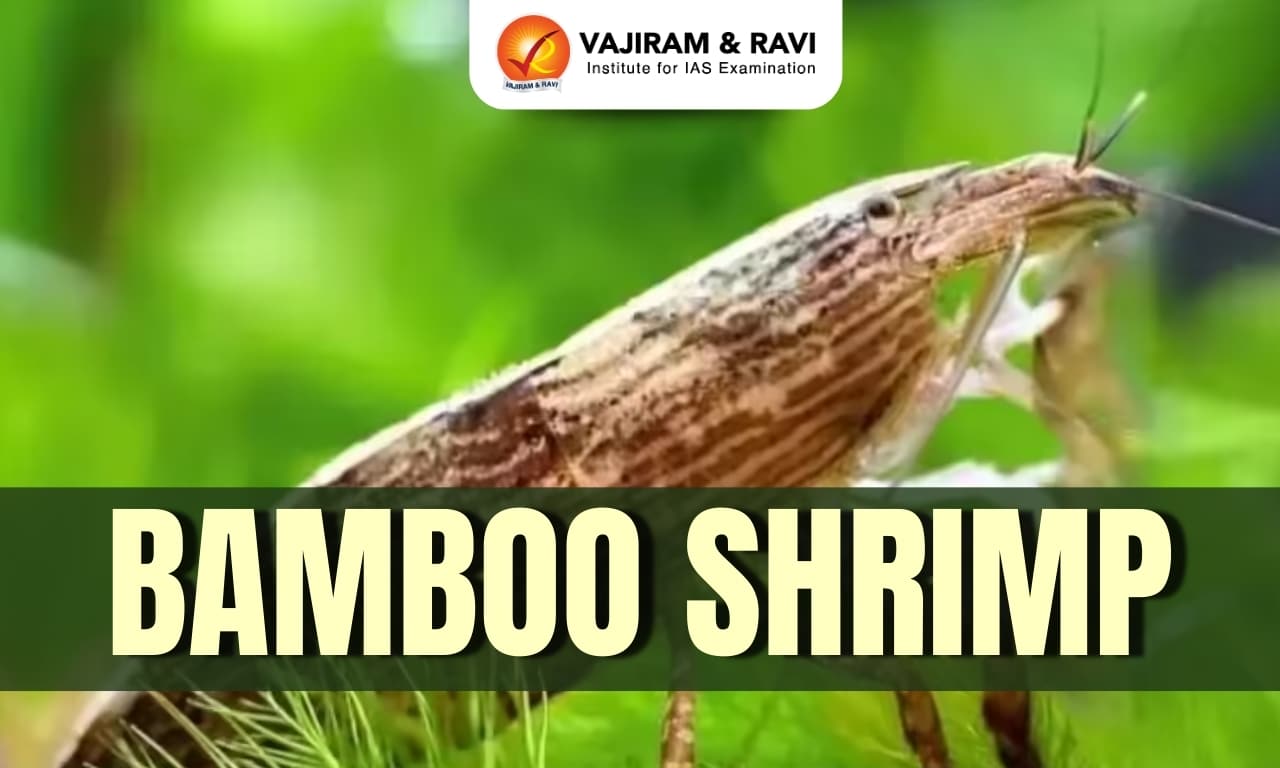
  • It is a medium-sized freshwater shrimp native to Southeast Asia.
  • Common names: Wood Shrimp, Flower Shrimp, Singapore Wood, Marble Shrimp and Asian Fan Shrimp.
  • Characteristics
    • The color of their body changes according to their mood. It becomes brighter when they are happy, while it fades when they are in a bad mood.
    • It is an amphidromous species i.e the larvae develop in brackish water before returning to freshwater.
    • They are primarily nocturnal, spending daylight hours sheltering under rocks or driftwood.
    • They are adapted to live in fast-moving streams and rivers, using their strong legs to cling to rocks and other surfaces.
  • Distribution: These shrimps are found in various countries of Southeast Asia. Their distribution range includes Malaysia, Singapore and Thailand.
  • Habitat: It is a social invertebrate commonly found in fast-flowing streams and rivers.
  • Diet: This omnivorous filter feeder shrimp species feeds on water algae and microscopic organisms.
  • Adaptation: It is distinctive within their genus due to their specialised feeding technique.
  • These shrimp are filter feeders, using fan-like structures on their limbs to filter out particles of edible material from flowing water.

Source: IE

Bamboo Shrimp FAQs

Q1: What is the primary diet of Bamboo Shrimp?

Ans: Algae and plankton

Q2: How do Bamboo Shrimp feed?

Ans: Using their fan-like appendages to filter food

List of Waterfalls in India, Highest Waterfalls with Location, Height

Waterfalls in India

List of Waterfalls in India: India is home to a stunning variety of waterfalls, each showcasing the country's diverse natural beauty. From the majestic heights of the Himalayas to the lush, beautiful landscapes of the Western Ghats, these waterfalls captivate visitors from around the globe. Below is a List of Waterfalls in India, along with key details about each:

Waterfalls in India

A waterfall is formed when river water falls steeply down from higher ground. Typically, waterfalls are found in the upper reaches of rivers, where the terrain is mountainous and steep. Due to the specific geographical conditions, many waterfalls are located over solid bedrock and are often fed by small tributaries, making them seasonal. As a result, these waterfalls are usually temporary and are most visible during heavy rainfalls. In this article, we have shared the List of Major Waterfalls in India for general awareness.

List of Waterfalls in India

India is renowned for its waterfalls, each possessing its own unique beauty and charm. The following List of Waterfalls in India, offering a brief into the stunning waterfalls that can be found across the nation.

List of Waterfalls in India

Waterfalls in India

Location

Height Metre/Feet

Kunchikal Falls

Shimoga district, Karnataka

455 metres (1,493 ft)

Barehipani Falls

Mayurbhanj district, Odisha

399 metres (1,309 ft)

Nohkalikai Falls

East Khasi Hills district, Meghalaya

340m (1115 feet)

Nohsngithiang Falls or Mawsmai Falls

East Khasi Hills district, Meghalaya

315 metres (1,033 ft)

Dudhsagar Falls

Karnataka and Goa

310 m(1017 feet)

Kynrem Falls

East Khasi Hills district, Meghalaya

305 metres (1,001 ft)

Meenmutty Falls

Wayanad district, Kerala

300 metres (984 feet)

Thalaiyar Falls

Batlagundu, Dindigul district, Tamil Nadu

297 metres (974 ft)

Barkana Falls

Shimoga district, Karnataka

259 metres (850 ft)

Jog Falls

Shimoga district, Karnataka

253 meters (830ft)

Top 10 Highest Waterfalls in India

India, known for its diverse landscapes and rich natural beauty, is home to stunning waterfalls. Below are the Top 10 Highest Waterfalls in India, along with their locations and impressive heights. These waterfalls not only add to the natural charm of their regions but also provide a vital source of livelihood for the local communities. For those who love nature and adventure, exploring these waterfalls is an unforgettable experience.

Kunchikal Falls

Kunchikal Falls is the highest waterfall in India and the second tallest in Asia, standing at an impressive height of 1,493 feet. Located near Agumbe in Shimoga district, Karnataka, the falls are nestled in one of the rainiest areas of India, Agumbe Valley. This area is also home to India’s only permanent rainforest research station. 

Barehipani Falls

Barehipani Falls, located in Simlipal National Park in Mayurbhanj district, Odisha, is the second tallest waterfall in India at 712 feet. The waterfall, nestled in dense forests, is known for its two distinct drops, with the taller one falling from a height of 259 meters (850 feet).

Nohkalikai Falls

Situated near Cherrapunji in the East Khasi Hills district of Meghalaya, Nohkalikai Falls is one of India’s tallest waterfalls, measuring 1,120 feet. It is also the highest plunge waterfall in the country. The falls are located in one of the wettest places on Earth and offer a breathtaking view of the surrounding hills and valleys. 

Nohsngithiang Falls (Seven Sisters Falls)

Nohsngithiang Falls, also known as the Seven Sisters Falls, is located in the East Khasi Hills of Meghalaya. The waterfall drops from a height of 1,033 feet and is segmented into seven distinct sections, creating a stunning visual. The falls are a seasonal phenomenon, flowing during the monsoon, and are symbolic of the seven sister states of Northeast India.

Dudhsagar Falls

Known as the "Sea of Milk," Dudhsagar Falls is one of the most famous Waterfalls in India, located on the Goa-Karnataka border. This majestic waterfall stands at 1,020 feet and is a popular tourist attraction due to its grandeur and the surrounding scenic beauty of the Western Ghats. It’s an excellent spot for a day trip for nature lovers and adventurers.

Kynrem Falls

Located in Thangkharang Park in Cherrapunji, Meghalaya, Kynrem Falls is a beautiful three-tiered waterfall. It falls from a height of 1,000 feet, making it one of the Highest Waterfalls in India. The waterfall is part of the park's natural splendor and adds to the beauty of Cherrapunji’s landscape.

Meenmutty Falls

Meenmutty Falls, situated in Wayanad district, Kerala, is the tallest waterfall in the state, falling from a height of 980 feet. The falls are a major tourist attraction in South India and are surrounded by lush forests. The waterfall is divided into three tiers, making it a spectacular sight, especially during the monsoon when it is at its most powerful.

Thalaiyar Falls (Rat Tail Falls)

Thalaiyar Falls, also known as Rat Tail Falls, is located in the Dindigul district of Tamil Nadu. Standing at 974 feet, it is one of the tallest waterfalls in India. The waterfall is difficult to access, as there are no roads leading to the site, but its stunning drop and the surrounding dark caves make it a unique and adventurous spot for those who can reach it.

Barkana Falls

Barkana Falls, located in the Shimoga district of Karnataka, is one of the ten tallest waterfalls in India, with a height of 850 feet. The waterfall, which forms from the Seetha River, is primarily known for its role in hydroelectric power generation in Karnataka. It’s an ideal spot for those visiting Agumbe, often referred to as the "Cherrapunji of the South."

Jog Falls

Jog Falls, created by the Sharavathi River in the Shimoga district of Karnataka, is one of the most impressive plunge waterfalls in India. With a height of 829 feet, it ranks as the second-tallest waterfall in India. The falls are a significant tourist attraction and are associated with the nearby Linganamakki Dam, which harnesses the power of the Sharavathi River.

Waterfalls in India FAQs

Q1: Which is the highest waterfall in India?

Ans: Kunchikal falls is the highest waterfall in India with a height of 455 meters.

Q2: What is the height of Kunchikal falls?

Ans: The height of Kunchikal falls is 1493 feet.

Q3: Which place is known as Cherrapunji of South India?

Ans: Western Ghats is known as the Cherrapunji of South India.

Q4: Where is the Kunchikal Fall?

Ans: The Kunchikal Fall is in Shimoga District of Karnataka.

Q5: Where is Jog Fall?

Ans: Jog falls is in Shimoga District Karnataka.

Article 16 of Indian Constitution, Interpretation, Key Aspects

Article 16 of Indian Constitution

Article 16 of the Constitution of India comes under Part III of the Constitution. The article guarantees equality in matters of public employment and makes sure that citizens don't face any discrimination in government appointments based on religion, caste, sex, descent, place of birth or residence. The goal is to uphold the fundamental right to equality, create a fair and just society and ensure employment opportunities. In this article, we are going to cover Article 16 of the Indian Constitution, its interpretation and significance. 

Article 16 of the Constitution of India

The Constitution of India interprets Article 16 in the following manner: 

Equality of opportunity in matters of public employment

  • There shall be equality of opportunity for all citizens in matters relating to employment or appointment to any office under the State.
  • No citizen shall, on grounds only of religion, race, caste, sex, descent, place of birth, residence, or any of them, be ineligible for, or discriminated against in respect of, any employment or office under the State.
  • Nothing in this article shall prevent Parliament from making any law prescribing, in regard to a class or classes of employment or appointment to an office under the Government of, or any local or other authority within, a State or Union territory, any requirement as to residence within that State or Union territory prior to such employment or appointment.
  • Nothing in this article shall prevent the State from making any provision for the reservation of appointments or posts in favor of any backward class of citizens which, in the opinion of the State, is not adequately represented in the services under the State.
  • 4A. Nothing in this article shall prevent the State from making any provision for reservation in matters of promotion, with consequential seniority, to any class or classes of posts in the services under the State in favor of Scheduled Castes and the Scheduled Tribes which, in the opinion of the State, are not adequately represented in the services under the State.
  • 4B. Nothing in this article shall prevent the State from considering any unfilled vacancies of a year which are reserved for being filled up in that year in accordance with any provision for reservation made under clause (4) or clause (4A) as a separate class of vacancies to be filled up in any succeeding year or years and such class of vacancies shall not be considered together with the vacancies of the year in which they are being filled up for determining the ceiling of fifty percent reservation on the total number of vacancies of that year.
  • Nothing in this article shall affect the operation of any law which provides that the incumbent of an office in connection with the affairs of any religious or denominational institution or any member of the governing body thereof shall be a person professing a particular religion or belonging to a particular denomination.
  • Nothing in this article shall prevent the State from making any provision for the reservation of appointments or posts in favor of any economically weaker sections of citizens other than the classes mentioned in clause (4), in addition to the existing reservation and subject to a maximum of ten percent of the posts in each category.

Article 16 of the Indian Constitution Interpretation

  • Article 16(1): Ensures equal opportunity for all citizens in public employment or appointments under the State.

  • Article 16(2): Prohibits discrimination in government jobs based on religion, race, caste, sex, descent, place of birth, or residence.

  • Article 16(3): Empowers Parliament to make laws allowing residence-based criteria for certain public jobs, promoting local representation.

  • Article 16(4): Allows the State to reserve posts for backward classes that are inadequately represented in public services.

  • Article 16(4A): Provides for reservation in promotions for SCs and STs if they are underrepresented in higher posts.

  • Article 16(4B): Permits the carry-forward of unfilled reserved vacancies without breaching the 50% reservation cap.

  • Article 16(5): Exempts religious or denominational institutions from general equality provisions, allowing them to appoint persons of their faith for religious roles.

  • Article 16(6): Introduced by the 103rd Constitutional Amendment, it enables up to 10% reservation for Economically Weaker Sections (EWS) in addition to existing quotas.

Article 16 of Indian Constitution: Key Aspects

  • Equality of Opportunity: Article 16(1) ensures equal opportunity for all citizens in matters of public employment and appointments under the State.
  • Ban on Discrimination: Article 16(2) prohibits discrimination in public employment on grounds of religion, race, caste, sex, descent, place of birth, or residence.
  • Provision for Reservation: The State is empowered to make reservations in government jobs for backward classes that are underrepresented.
  • Coverage of Reserved Categories: Reservations apply to Scheduled Castes (SCs), Scheduled Tribes (STs), and Economically Weaker Sections (EWS).
  • Legislative Authority: Parliament can make laws to regulate and define reservation policies in public employment.
  • Consequential Seniority: Reserved category candidates promoted earlier retain seniority over general candidates, a practice upheld as constitutionally valid.

Article 16 Landmark Cases  

Several pivotal Supreme Court rulings have influenced the interpretation and application of Article 16. Key judgments include:

  • State of Madras v. Champakam Dorairajan (1951):
    The Court struck down caste-based reservations in educational institutions, prompting the First Constitutional Amendment, which added Article 15(4) to enable such reservations.

  • Indra Sawhney v. Union of India (1992):
    Popularly known as the Mandal Commission case, the Court upheld 27% reservations for OBCs but introduced the 'creamy layer' concept to exclude the more advanced sections within OBCs from availing reservation benefits.

  • M. Nagaraj v. Union of India (2006):
    The Court upheld constitutional amendments allowing reservation in promotions for SCs and STs but made it conditional upon the State proving backwardness, inadequate representation, and maintaining administrative efficiency.

  • Jarnail Singh v. Lachhmi Narain Gupta (2018):
    The Court extended the 'creamy layer' principle to SCs and STs in promotions, ensuring that only truly disadvantaged individuals benefit from reservation in advancement.
Also Check Related Articles
Article 295 of Indian Constitution Article 194 of Indian Constitution
Article 39 of Indian Constitution Article 191 of Indian Constitution
Article 20 of Indian Constitution Article 16 of Indian Constitution
Article 67 of Indian Constitution Article 40 of Indian Constitution
Article 78 of Indian Constitution

Article 16 of Indian Constitution FAQs

Q1: What is the Article 16 of the Constitution of India?

Ans: Article 16 guarantees equal opportunity for all citizens in matters of public employment under the State.

Q2: What is Article 16 and Article 17?

Ans: Article 16 ensures equal opportunity in public employment, while Article 17 abolishes untouchability and forbids its practice in any form.

Q3: What is Indra Sawhney vs. Union of India case?

Ans: The Indra Sawhney case (1992) upheld 27% OBC reservations and introduced the 'creamy layer' concept to exclude the advanced sections of OBCs.

Q4: What is Right to Equality in Indian Constitution?

Ans: The Right to Equality (Articles 14–18) ensures equal treatment before the law and prohibits discrimination on various grounds.

World AIDS Day 2025, Theme, NACP, Steps Taken by Government

World AIDS Day 2025

World AIDS Day is observed every year on 1 December, and the 2025 theme is “Overcoming disruption, transforming the AIDS response.” India’s National AIDS Control Programme (NACP) has strengthened HIV prevention, testing, treatment, and support through its multi-phase approach. Under NACP V, the government is expanding awareness campaigns, ART services, targeted interventions, and anti-discrimination measures. Together, these efforts aim to accelerate progress toward ending HIV/AIDS as a public health threat by 2030.

What is AIDS/HIV?

HIV (Human Immunodeficiency Virus) is a virus that weakens the body’s immune system by attacking CD4 cells. If not treated, it progresses to AIDS (Acquired Immunodeficiency Syndrome), the most advanced stage of HIV, where the body becomes highly vulnerable to infections. 

With timely testing and ART treatment, HIV can be controlled, and AIDS can be prevented.

How HIV Spreads?

  • Unprotected sexual contact with an infected person.
  • Sharing contaminated needles or syringes.
  • From mother to child during pregnancy, childbirth, or breastfeeding.
  • Transfusion of infected blood (now extremely rare due to screening).

World AIDS Day 2025 Theme

The theme for World AIDS Day 2025 is “Overcoming disruption, transforming the AIDS response.” It focuses on transforming the HIV services to make them more resilient, equitable, and community-driven. The theme also highlights the need to address disruptions caused by pandemics, conflicts, and inequalities that limit access to care.

National AIDS Control Programme

India’s National AIDS Control Programme (NACP) has evolved over five distinct phases, transitioning from basic awareness initiatives to a robust, integrated framework focused on prevention, testing, treatment, and long-term sustainability.

NACP I (1992-1999)

  • Marked India’s first nationwide HIV/AIDS prevention and control initiative.
  • Aim: To slow the spread of HIV and reduce associated morbidity, mortality, and overall social and economic impact.

NACP II (1999-2006)

  • Strengthened and expanded the initial response with two key objectives:
  • Reduce the transmission of HIV across the country.
  • Build long-term national capacity to tackle the HIV/AIDS challenge effectively.

NACP III (2007-2012)

Goal: To halt and reverse the HIV epidemic by 2012.

Strategy:

  • Scale up targeted prevention among High-Risk Groups (HRGs) and the general population.
  • Integrate prevention with care, support, and treatment services.

Key addition: Establishment of District AIDS Prevention and Control Units (DAPCUs) to strengthen district-level monitoring, coordination, and reporting of stigma and discrimination cases.

NACP IV (2012-2017)

Goal: Accelerate epidemic reversal and deliver an integrated HIV response.

Objectives:

  • Achieve a 50% reduction in new infections (compared to 2007 levels).
  • Ensure universal access to comprehensive care, support, and treatment for all PLHIV.

Extension (2017–2021): Continued progress toward achieving the target of Ending AIDS by 2030.

Major initiatives during the extension:

  • HIV/AIDS (Prevention and Control) Act, 2017: Prohibited discrimination against PLHIV, ensured confidentiality, and mandated informed consent for testing and treatment.
  • Mission Sampark: Reconnected PLHIV who had discontinued ART by tracing and re-engaging those lost to follow-up.
  • ‘Test and Treat’ policy: Initiated ART for all diagnosed individuals irrespective of CD4 count.
  • Routine Universal Viral Load Monitoring to improve treatment outcomes.

NACP V (2021-2026)

  • Implemented as a Central Sector Scheme with an outlay of ₹15,471.94 crore.
  • Focuses on consolidating previous gains and addressing emerging challenges.
  • Aims to support SDG 3.3 by working toward ending HIV/AIDS as a public health threat by 2030 through strengthened prevention, testing, treatment, and community-led interventions.

Steps Taken by the Government for HIV/AIDS Awareness

  • NACO runs nationwide multimedia and digital awareness campaigns to reach wider and younger audiences.
  • Outdoor outreach expanded through hoardings, bus panels, IEC vans, kiosks, and folk performances.
  • Community awareness strengthened by training SHGs, Anganwadi Workers, ASHAs, and Panchayati Raj members.
  • 1,587 Targeted Intervention projects (as of Oct 2025) ensure prevention, testing, treatment, and care access for High-Risk Groups.
  • Thematic campaigns launched nationwide to combat stigma and promote inclusion of PLHIV in workplaces, institutions, and communities.
  • Ombudsmen appointed in 34 States/UTs under the HIV and AIDS Act, 2017, to address discrimination complaints and protect PLHIV rights.

World AIDS Day 2025 FAQs

Q1: What is World AIDS Day?

Ans: World AIDS Day is observed every year on 1st December to raise awareness about HIV/AIDS, support people living with HIV, and remember those who lost their lives to AIDS-related illnesses.

Q2: What is the theme for World AIDS Day 2025?

Ans: The theme for 2025 is “Overcoming disruption, transforming the AIDS response.”

Q3: Why is World AIDS Day important?

Ans: It highlights the ongoing fight against HIV/AIDS, promotes prevention and testing, combats stigma, and encourages global solidarity to achieve the goal of ending AIDS by 2030.

Q4: What is HIV?

Ans: HIV (Human Immunodeficiency Virus) attacks the body's immune system, weakening its ability to fight infections.

Q5: What is AIDS?

Ans: AIDS (Acquired Immunodeficiency Syndrome) is the advanced stage of untreated HIV, where the immune system becomes severely damaged.

BIMSTEC Countries 2025, Area of Cooperation, Significance, Challenges

Bimstec Countries

The Bay of Bengal Initiative for Multi-Sectoral Technical and Economic Cooperation (BIMSTEC) is a regional organisation that brings together countries from South Asia and Southeast Asia, united by the Bay of Bengal. Formed in 1997, it was envisioned as an alternative to SAARC, with a focus on promoting collaboration across key sectors such as trade, transport, energy, and security.

By 2025, BIMSTEC has gained strategic importance, especially in the context of shifting global alliances and rising tensions in the Indo-Pacific. In this evolving landscape, BIMSTEC is positioning itself as an important forum for enhancing regional connectivity, promoting economic integration, and maintaining geopolitical balance.

The headquarters for the Bay of Bengal Initiative for Multi-Sectoral Technical and Economic Cooperation (BIMSTEC) is located in Dhaka, Bangladesh.

BIMSTEC Countries 2025

BIMSTEC is a multilateral regional organisation that brings together countries located along the coastlines and surrounding regions of the Bay of Bengal. It serves as a bridge between South and Southeast Asia, while also being surrounded by the ecological diversity of both the Himalayan region and the Bay of Bengal basin. 

BIMSTEC Countries 2025

Full Form

Bay of Bengal Initiative for Multi-Sectoral Technical and Economic Cooperation

Established

1997 (as BIST-EC); Renamed BIMSTEC in 2004

Headquarters

Dhaka, Bangladesh

Total Members

7

Member Countries

Bangladesh, Bhutan, India, Nepal, Myanmar, Sri Lanka, Thailand

Regions Covered

South Asia & Southeast Asia

Population (2025)

Over 1.7 billion (~22% of the global population)

Combined GDP (2025)

Approx. $4 trillion

Key Waterbody

Bay of Bengal (connects the Indian Ocean to Southeast Asia)

Official Language

English

BIMSTEC Charter Signed

March 2022 (at the 5th Summit in Sri Lanka)

BIMSTEC History

The table below includes the BIMSTEC History from its establishment till the present day scenario.

BIMSTEC History

Year

Milestone

1997

Formation as BIST-EC (Bangladesh, India, Sri Lanka, Thailand Economic Cooperation).

1998

Renamed to BIMST-EC with the addition of Myanmar.

2004

Fully transformed into BIMSTEC (Bay of Bengal Initiative for Multi-Sectoral Technical and Economic Cooperation).

2022

BIMSTEC Charter signed at the 5th Summit in Sri Lanka, formally institutionalizing the organization.

2025

BIMSTEC enhances sectoral cooperation, with each member state leading specific areas of collaboration.

BIMSTEC Objectives

The BIMSTEC Objectives are to strengthen technical and economic cooperation among its seven member nations situated around the Bay of Bengal. By leveraging shared resources and regional strengths, the organisation aims to deepen integration across key sectors. Its broader mission is to advance peace, prosperity, and sustainable development throughout South and Southeast Asia, promoting collaboration in areas such as trade, connectivity, energy, environment, and security.

BIMSTEC Objectives

Objective

Explanation

Accelerated Economic Growth

Promote regional prosperity by enhancing trade, investment, and technology-sharing to uplift socio-economic conditions.

Regional Connectivity

Strengthen links via roads, railways, ports, and energy grids to enable smoother trade and people-to-people movement.

Multisectoral Cooperation

Deepen collaboration across 14 sectors such as trade, transport, energy, agriculture, health, and security.

Poverty Alleviation

Reduce poverty through inclusive growth strategies, joint projects, and economic reforms.

Bridge Between South & Southeast Asia

Serve as a strategic connector between SAARC and ASEAN, fostering deeper regional integration.

Sustainable Development

Work together on climate action, disaster resilience, environmental protection, and marine sustainability.

Peace and Security

Address terrorism, cross-border crimes, and cyber threats via intelligence-sharing and joint capacity-building efforts.

People-to-People Contact

Promote cultural ties, tourism, academic exchange, and local diplomacy to foster mutual trust and understanding.

BIMSTEC Countries Origin

BIMSTEC was originally established as BIST-EC (Bangladesh, India, Sri Lanka, and Thailand Economic Cooperation) through the Bangkok Declaration in June 1997. Later that year, with the inclusion of Myanmar, the group was renamed BIMST-EC. In 2004, the entry of Nepal and Bhutan expanded the organisation further, and it officially became the Bay of Bengal Initiative for Multi-Sectoral Technical and Economic Cooperation (BIMSTEC). As of 2025, BIMSTEC consists of the following seven member countries:

  • Bangladesh
  • India
  • Bhutan
  • Nepal
  • Myanmar
  • Sri Lanka
  • Thailand

BIMSTEC Full Form

BIMSTEC stands for the Bay of Bengal Initiative for Multi-Sectoral Technical and Economic Cooperation. The organisation was initially formed as BIST-EC in 1997. It was officially renamed to BIMSTEC during the First BIMSTEC Summit held in Bangkok on 31 July 2004, marking the formal inclusion of all seven member countries and expanding the group's vision to cover a broader multi-sectoral agenda.

BIMSTEC Countries List with Capital City

BIMSTEC comprises a total of seven member countries, strategically located around the Bay of Bengal. Among them, five nations belong to South Asia, The remaining two countries are from Southeast Asia:

BIMSTEC Countries List with Capital City

S. No.

Name of BIMSTEC Countries

Capital City

1.

Bangladesh

Dhaka/Dacca

2.

Bhutan

Thimphu

3.

India

New Delhi

4.

Nepal

Kathmandu

5.

Sri Lanka

Colombo (Executive and Judicial);

Sri Jayewardenepura Kotte (Legislative)

6.

Myanmar

Naypyidaw

7.

Thailand

Bangkok

BIMSTEC Countries Map

BIMSTEC Countries Map highlights the seven member nations across South and Southeast Asia, all linked through the Bay of Bengal region. This map helps illustrate BIMSTEC’s strategic position as a bridge between the two subregions.


Area of Cooperation in BIMSTEC

BIMSTEC operates as a sector-driven organisation, with each member country taking the lead in specific areas of cooperation. Initially, in 1997, collaboration focused on six core sectors: trade, technology, energy, transport, tourism, and fisheries. As the organisation evolved, its scope broadened. In 2008, new sectors were added, including agriculture, public health, poverty alleviation, counterterrorism, environment, culture, people-to-people contact, and climate change.

Area of Cooperation in BIMSTEC

Member Country

Sectors

Bangladesh

Trade, Investment and Development

Bhutan

Environment & Climate Change

India

Security: Counter-Terrorism and Transnational Crime, Energy and Disaster Management

Nepal

People-to-People Contact: Tourism, Culture, (forums of think tanks, media etc.)

Sri Lanka

Science, Technology & Innovation (Human Resource Development, Health, Technology)

Myanmar

Agriculture and Food Security (Agriculture, Livestock, Fisheries)

Thailand

Connectivity

BIMSTEC Working Mechanism

Policy-Making in BIMSTEC is structured through a tiered system of regular meetings that ensure coordination, decision-making, and implementation across all sectors:

  • Summit Meetings: These are held every two years at the level of Heads of State or Government. They provide overall direction and make key strategic decisions for the grouping.
  • Ministerial Meetings: Foreign Ministers and Commerce Ministers convene annually to review progress, set priorities, and address major policy and economic matters.
  • Senior Official’s Meetings: These are held twice a year, bringing together high-level bureaucrats from each member country to monitor, evaluate, and coordinate the implementation of BIMSTEC’s initiatives.

Institutional Mechanisms of BIMSTEC

  • BIMSTEC Summit
  • Ministerial Meeting
  • Senior Officials’ Meeting
  • BIMSTEC Working Group
  • Business Forum & Economic Forum

BIMSTEC for India Significance

  • Facilitates Key Foreign Policy Objectives: BIMSTEC supports India in advancing three major foreign policy strategies-
    • Act East Policy: Strengthens economic and strategic ties with Southeast Asia.
    • Neighborhood First Policy: Reinforces cooperation with India’s immediate neighbours.
    • Development of the Northeast Region: Enhances connectivity of northeastern states to the Bay of Bengal through Bangladesh and Myanmar.
  • Alternative to SAARC: With SAARC’s functionality weakening due to political friction, particularly the India-Pakistan divide-BIMSTEC serves as a more practical and cooperation-oriented regional platform.
  • Counterbalancing China: The grouping allows India to counter China’s growing influence in the Bay of Bengal littoral states, especially in light of the Belt and Road Initiative’s expanding footprint in the region.

Challenges in India - BIMSTEC Relations

India have faced various challenges while being a part of BIMSTEC which are discussed in the table below:

Challenges in India - BIMSTEC Relations

Challenge

Description

Example

Economic Disparities

Wide gap between member economies makes equitable implementation of projects difficult.

India has far more economic resources than Bhutan or Nepal, leading to funding and implementation issues.

Infrastructure & Connectivity

Poor roads, ports, and communication systems limit regional trade and collaboration.

Kaladan project between India and Myanmar delayed due to weak infrastructure and coordination problems.

Institutional Weaknesses

BIMSTEC’s Secretariat lacks adequate staff and resources, reducing efficiency.

Dhaka-based Secretariat struggles to coordinate initiatives due to capacity constraints.

Political Instability

Frequent regime changes and internal conflicts disrupt cooperation.

Political unrest in Myanmar hinders regional projects and policy alignment.

Security Concerns

Maritime threats like piracy, trafficking, and illegal fishing affect trade and stability.

Piracy and unregulated fishing in Bay of Bengal require better joint maritime security efforts.

Environmental Issues

Climate risks like cyclones and sea-level rise demand regional disaster response.

Coastal nations like Bangladesh and Sri Lanka frequently suffer cyclone damage, affecting regional planning.

Geopolitical Challenges

China's growing influence undercuts India’s regional position and leadership ambitions.

China’s investments in Myanmar and Bangladesh challenge India’s strategic leverage.

Uneven Member Engagement

Some countries show more interest in ASEAN or SAARC, weakening BIMSTEC’s unity.

Inconsistent participation affects policy follow-through and trust in BIMSTEC’s effectiveness.

BIMSTEC Countries 2025 FAQs

Q1: What is BIMSTEC?

Ans: BIMSTEC is the Bay of Bengal Initiative for Multi-Sectoral Technical and Economic Cooperation, a regional organization for cooperation among South and Southeast Asian countries.

Q2: How many countries are in BIMSTEC?

Ans: There are 7 member countries in BIMSTEC.

Q3: Which countries are members of BIMSTEC?

Ans: Bangladesh, Bhutan, India, Myanmar, Nepal, Sri Lanka, and Thailand are BIMSTEC members.

Q4: When was BIMSTEC established?

Ans: BIMSTEC was established on June 6, 1997.

Q5: Where is the BIMSTEC headquarters?

Ans: BIMSTEC headquarters is located in Dhaka, Bangladesh.

Svalbard

Svalbard

Svalbard Latest News

A significant new discovery recently emerged in the Arctic, with scientists spotting an unexpected gathering of walruses on the remote shores of Svalbard, a wild stretch of land nestled between mainland Norway and the North Pole.

About Svalbard

  • It is a Norwegian archipelago that is situated in the Arctic Ocean, to the north of the European mainland. 
  • It is located about halfway between the North Pole and the northern part of Norway.
  • It is the northernmost place in the world with a permanent population.
  • Discovery: It was discovered by the Dutch explorer Willem Barentsz in 1596.
  • The 1920 Svalbard Treaty established Norwegian sovereignty over the Svalbard Islands.
  • It covers a total area of about 61,022 sq.km.
  • Approximately 60% of the archipelago is covered with glaciers, and the islands feature many mountains and fjords.
  • It is composed of several islands such as Spitsbergen, Nordaustlandet, Edgeøya, Barentsøya, Kvitøya, Kong Karls Land, Prins Karls Forland, Bjørnøya, and Hopen.
  • Spitsbergen is the largest and most populous island.
    • The island is bounded by the Arctic Ocean, the Greenland Sea, and the Norwegian Sea.
    • The Svalbard Global Seed Vault is also located on Spitsbergen. It is the largest backup facility for the world’s crop diversity.
  • Climate: The archipelago features an Arctic climate, although with significantly higher temperatures than other areas at the same latitude. 
  • Due to its location in the northern part of the Arctic Circle, the Svalbard Islands experience the midnight sun during the summer months and polar night during the winter months.
  • Vegetation consists mostly of lichens and mosses; the only trees are the tiny polar willow and the dwarf birch. 
  • Svalbard is a breeding ground for many seabirds, and also features polar bears, reindeer, the arctic fox, and certain marine mammals. 

Key Facts about Walrus

  • It is a large mammal that lives in the cold Arctic seas of Europe, Asia, and North America. 
  • It is closely related to the seals. 
  • The walrus can be told apart from seals by the two large upper teeth, called tusks, that stick down from its mouth. The tusks can be 3 feet (1 meter) long. 
  • Scientific Name: Odobenus rosmarus.
  • There are two subspecies: the Atlantic walrus (Odobenus rosmarus rosmarus) and the Pacific walrus (O. rosmarus divergens). 
  • Features:
  • The walrus has a stocky body and a rounded head. 
  • It has flippers instead of legs. Its mouth is covered with stiff whiskers. 
  • The skin is wrinkled and grayish brown. A thick layer of fat below the skin, called blubber, keeps the walrus warm.
  • Walruses can be 13.7 meters long and weigh more than 1,200 kilograms.
  • Conservation Status: Vulnerable.

Source: IDR

Svalbard FAQs

Q1: Where is Svalbard located?

Ans: It is situated in the Arctic Ocean, to the north of the European mainland.

Q2: Which treaty established Norwegian sovereignty over Svalbard?

Ans: The 1920 Svalbard Treaty established Norwegian sovereignty over the Svalbard Islands.

Q3: Which is the largest and most populous island of the Svalbard archipelago?

Ans: Spitsbergen is the largest and most populous island.

List of Countries With the Most Time Zones, Country Wise Time zone

List of Countries With the Most Time Zones

Time Zones play a crucial role in maintaining global synchronisation, affecting everything from international trade to travel and communication. While most countries operate within one or two time zones, some nations span vast geographic areas or possess overseas territories, necessitating the management of multiple time zones. 

France leads the world with 12 Time Zones, primarily due to its numerous overseas departments and territories. Russia and the United States follow closely, each encompassing 11 Time Zones owing to their expansive mainland regions and distant holdings.

Why Time Zones Matter

A Time Zone is a geographic region that observes a uniform standard time for legal, commercial, and social purposes. Most time zones are defined by their offset from Coordinated Universal Time (UTC), such as UTC+5:30 for India. The global system of time zones ensures synchronisation across countries and continents, especially in sectors like aviation, international trade, and broadcasting.

Several factors contribute to a country having multiple time zones:

  • Large east-west landmass (e.g., Russia, USA)
  • Overseas territories scattered across the globe (e.g., France, UK)
  • Seasonal changes due to Daylight Saving Time (DST)
  • Administrative and political divisions

List of Countries With Most Time Zones 2025

Time Zones are established based on one or more deviations from Coordinated Universal Time (UTC). In certain regions, these deviations vary according to specific dates due to the implementation of daylight saving time (DST). As a result, such regions may alternate between time offsets throughout the year. The range of UTC offsets extends from UTC−12:00 to UTC+14:00, commonly measured in full-hour increments. However, a few regions, such as India (UTC+5:30), South Australia (UTC+9:30), and Nepal (UTC+5:45), follow non-standard offsets of 30 or 45 minutes.

The table below includes the List of Countries With Most Time Zones 2025:

List of Countries With Most Time Zones 2025
S. No. Countries No. of time zones Time zone

1

France

12

UTC−10:00 — Society Islands, Tuamotus, Austral Islands

UTC−09:30 — Marquesas Islands

UTC−09:00 — Gambier Islands

UTC−08:00 — Clipperton Island

UTC−04:00 (AST) — Guadeloupe, Martinique, Saint Barthélemy, Saint Martin

UTC−03:00 (PMST)— French Guiana, Saint Pierre and Miquelon

UTC+01:00 (CET) — metropolitan France

UTC+03:00 — Mayotte, Scattered Islands in the Indian Ocean

UTC+04:00 — Réunion, Crozet Islands

UTC+05:00 — Kerguelen Islands, Saint Paul and Amsterdam Islands

UTC+11:00 — New Caledonia

UTC+12:00 — Wallis and Futuna

2

Russia

11

UTC+02:00 (Kaliningrad Time) — Kaliningrad Oblast

UTC+03:00 (Moscow Time) — Most of European Russia

UTC+04:00 (Samara Time) — Astrakhan Oblast, Samara Oblast, Saratov Oblast, Udmurtia, and Ulyanovsk Oblast

UTC+05:00 (Yekaterinburg Time) — Bashkortostan, Chelyabinsk Oblast, Khanty–Mansia, Kurgan Oblast, Orenburg Oblast, Perm Krai, Sverdlovsk Oblast, Tyumen Oblast, and Yamalia

UTC+06:00 (Omsk Time) — Omsk Oblast

UTC+07:00 (Krasnoyarsk Time) — Altai Krai, Altai Republic, Kemerovo Oblast, Khakassia, Krasnoyarsk Krai, Novosibirsk Oblast, Tomsk Oblast, and Tuva

UTC+08:00 (Irkutsk Time) — Buryatia and Irkutsk Oblast

UTC+09:00 (Yakutsk Time) — Amur Oblast, western Sakha Republic, and Zabaykalsky Krai

UTC+10:00 (Vladivostok Time) — Jewish Autonomous Oblast, Khabarovsk Krai, Primorsky Krai, and central Sakha Republic

UTC+11:00 (Magadan Time) — Magadan Oblast, eastern Sakha, and Sakhalin Oblast

UTC+12:00 (Kamchatka Time) — Chukotka and Kamchatka Krai

3

United States

11

UTC−12:00 (AoE) — Baker Island and Howland Island

UTC−11:00 (ST) — American Samoa, Jarvis Island, Kingman Reef, Midway Atoll and Palmyra Atoll

UTC−10:00 (HT) — Hawaii, most of the Aleutian Islands, and Johnston Atoll

UTC−09:00 (AKT) — most of the state of Alaska

UTC−08:00 (PT) — Pacific Time zone: the Pacific coast states, the Idaho Panhandle and most of Nevada and Oregon

UTC−07:00 (MT) — Mountain Time zone: most of Idaho, part of Oregon, and the Mountain states plus western parts of some adjacent states

UTC−06:00 (CT) — Central Time zone: a large area spanning from the Gulf Coast to the Great Lakes

UTC−05:00 (ET) — Eastern Time zone: roughly a triangle covering all the states from the Great Lakes down to Florida and east to the Atlantic coast

UTC−04:00 (AST) — Puerto Rico, the U.S. Virgin Islands

UTC+10:00 (ChT) — Guam and the Northern Mariana Islands

UTC+12:00 (WAKT) — Wake Island

4

Antarctica

9

UTC−03:00 (ART) — Palmer Station, Rothera Station

UTC±00:00 (GMT) — Troll Station

UTC+03:00 — Syowa Station

UTC+05:00 — Mawson Station

UTC+06:00 — Vostok Station

UTC+07:00 — Davis Station

UTC+10:00 — Dumont-d'Urville Station

UTC+11:00 — Casey Station

UTC+12:00 — McMurdo Station, Amundsen–Scott South Pole Station

5

Australia

9

UTC+05:00 — Heard and McDonald Islands

UTC+06:30 — Cocos (Keeling) Islands

UTC+07:00 (CXT) — Christmas Island

UTC+08:00 (AWST) — Western Australia, Indian Pacific railway when travelling between Port Augusta, South Australia and Kalgoorlie, Western Australia)

UTC+08:45 (CWT) – South Australia (Border Village), Western Australia (Caiguna, Cocklebiddy, Eucla, Madura, Mundrabilla)

UTC+09:30 (ACST) — South Australia, Northern Territory, New South Wales (Yancowinna County)

UTC+10:00 (AEST) — Queensland, New South Wales, Australian Capital Territory, Victoria, Tasmania

UTC+10:30 — Lord Howe Island

UTC+11:00 (NFT) — Norfolk Island

6

United Kingdom

9

UTC−08:00 — Pitcairn Islands

UTC−05:00 — Cayman Islands, Turks and Caicos Islands

UTC−04:00 (AST) — Anguilla, Bermuda, British Virgin Islands, Montserrat

UTC−03:00 (FKST) — Falkland Islands

UTC−02:00 — South Georgia and the South Sandwich Islands

UTC±00:00 (GMT in winter/BST in summer) — main territory of the United Kingdom, Saint Helena, Ascension and Tristan da Cunha, Guernsey, Isle of Man, Jersey

UTC+01:00 (CET) — Gibraltar

UTC+02:00 (EET) — Akrotiri and Dhekelia

UTC+06:00 — British Indian Ocean Territory

7

Canada

6

UTC−08:00 (PT) — larger western part of British Columbia, Tungsten and the associated Cantung Mine in Northwest Territories, Yukon

UTC−07:00 (MT) — Alberta, some eastern parts of British Columbia, most of Northwest Territories, Nunavut (west of 102°W and all communities in the Kitikmeot Region), Lloydminster and the surrounding area in Saskatchewan

UTC−06:00 (CT)— Manitoba, Nunavut (between 85° West and 102°W except for western Southampton Island), Ontario (Northwestern Ontario west of 90°W with some exceptions and Big Trout Lake area east of 90°W), Saskatchewan except Lloydminster

UTC−05:00 (ET) — Nunavut east of 85°W and entire Southampton Island, Ontario east of 90°W (except Big Trout Lake area) plus several more western areas, Quebec (most of the province)

UTC−04:00 (AT) — Labrador (all but southeastern tip), New Brunswick, Nova Scotia, Prince Edward Island, eastern part of Quebec

UTC−03:30 (NT) — Labrador (southeastern), Newfoundland

8

Denmark

5

UTC−04:00 — Pituffik Space Base in Greenland

UTC−03:00 — most of Greenland, including inhabited south coast and west coast

UTC−01:00 — Ittoqqortoormiit and the surrounding area in Greenland's Tunu county

UTC±00:00 — Danmarkshavn weather station and surrounding area in Greenland's Tunu county, Faroe Islands

UTC+01:00 (CET) — main territory of Denmark

9

New Zealand

5

UTC−11:00 — Niue

UTC−10:00 — Cook Islands

UTC+12:00 — main territory of New Zealand

UTC+12:45 — Chatham Islands

UTC+13:00 — Tokelau

10

Brazil

4

UTC−05:00 (Brasília time −2) — Acre and Southwestern Amazonas

UTC−04:00 (Brasília time −1) — Most part of the Amazonas State, Mato Grosso, Mato Grosso do Sul, Rondônia, Roraima

UTC−03:00 (Brasília time) — the Southeast Region, the South Region, the Northeast Region (except some islands), Goiás, Distrito Federal, Tocantins, Pará, Amapá

UTC−02:00 (Brasília time +1) — A few islands on the east coast of Brazil (Fernando de Noronha, Trindade and Martim Vaz, Rocas Atoll, Saint Peter and Saint Paul Archipelago)

11

Mexico

4

UTC−08:00 (Zone 4 or Northwest Zone) — the state of Baja California

UTC−07:00 (Zone 3 or Pacific Zone) — the states of Baja California Sur, Chihuahua, Nayarit, Sinaloa and Sonora

UTC−06:00 (Zone 2 or Central Zone) — most of Mexico

UTC−05:00 (Zone 1 or Southeast Zone) — the state of Quintana Roo

12

Chile

3

UTC−06:00 — Easter Island

UTC−04:00 — main territory of Chile

UTC−03:00 — Magallanes and Chilean Antarctica

13

Indonesia

3

UTC+07:00 (Western Indonesian Standard Time) — islands of Sumatra, Java, Madura, provinces of Bangka Belitung Islands, Riau Islands, West Kalimantan and Central Kalimantan

UTC+08:00 (Central Indonesian Standard Time) — islands of Sulawesi, Bali, provinces of East Nusa Tenggara, West Nusa Tenggara, East Kalimantan, North Kalimantan and South Kalimantan

UTC+09:00 (Eastern Indonesian Standard Time) — islands of the Maluku Islands and Western New Guinea

14

Kiribati

3

UTC+12:00 — Gilbert Islands

UTC+13:00 — Phoenix Islands

UTC+14:00 — Line Islands

15

Democratic Republic of the Congo

2

UTC+01:00 (WAT) — provinces of Équateur, Kinshasa, Kongo Central, Kwango, Kwilu, Mai-Ndombe, Mongala, Nord-Ubangi, Sud-Ubangi and Tshuapa

UTC+02:00 (CAT) — provinces of Bas-Uele, Haut-Katanga, Haut-Lomami, Haut-Uele, Kasaï, Kasaï-Central, Kasaï Oriental, Lomami, Lualaba, Maniema, Nord-Kivu, Sankuru, Sud-Kivu, Tanganyika, Tshopo and Ituri Interim Administration

16

Ecuador

2

UTC−06:00 (GALT) — Galápagos Province

UTC−05:00 (Ecuador Time) — main territory of Ecuador

17

Federated States of Micronesia

2

UTC+10:00 — the states of Chuuk and Yap

UTC+11:00 — the states of Kosrae and Pohnpei

18

Kazakhstan

2

UTC+05:00 — western Kazakhstan (Aktobe, Atyrau, Kyzylorda, Mangystau and West Kazakhstan)

UTC+06:00 — eastern Kazakhstan

19

Kingdom of the Netherlands

2

UTC−04:00 (AST) — Caribbean municipalities and constituent countries

UTC+01:00 (CET) — main territory of the Netherlands

20

Mongolia

2

UTC+07:00 — the provinces of Khovd, Uvs and Bayan-Ölgii

UTC+08:00 — most of the country

21

Papua New Guinea

2

UTC+10:00 — most of the country

UTC+11:00 — Autonomous Region of Bougainville (Bougainville Standard Time)

22

Portugal

2

UTC−01:00 — Azores

UTC±00:00 (WET) — Madeira and the main territory of Portugal

23

South Africa

2

UTC+02:00 (South African Standard Time) — main territory of South Africa

UTC+03:00 — Prince Edward Islands

24

Spain

2

UTC±00:00 (WET) — Canary Islands

UTC+01:00 (CET) — main territory of Spain

Top Countries With the Most Time Zones (2025)

  • France - 12 Time Zones: France surprisingly tops the list, not due to the size of its mainland, but because of its numerous overseas departments and territories spread across the globe. These include territories in the Caribbean, Indian Ocean, Pacific Ocean, and even Antarctica.
  • Time zones: UTC−10:00 to UTC+12:00
  • Russia - 11 Time Zones: As the largest country in the world by area, Russia spans 11 time zones from its western exclave of Kaliningrad to the eastern edge of Kamchatka. Unlike France, all of Russia’s time zones exist within its mainland territory.
  • Time zones: UTC+02:00 to UTC+12:00
  • United States - 11 Time Zones: The United States covers a significant expanse and includes several unincorporated territories, which contribute to its 11 time zones.
  • Time zones: UTC−12:00 to UTC+12:00
  • Antarctica - 9 Time Zones: Antarctica is unique because it doesn't have a permanent population, yet hosts various research stations operated by different countries. Each station uses the time zone of the country that runs it or the supply base it connects with.
  • Time zones: UTC−03:00 to UTC+12:00
  • United Kingdom - 9 Time Zones: Despite being relatively small in size, the UK has numerous overseas territories that contribute to its broad time zone coverage.
  • Time zones: UTC−08:00 to UTC+06:00
  • Australia - 9 Time Zones: Australia itself covers three official time zones, but when its external territories are considered, the count rises to nine.
  • Time zones: UTC+05:00 to UTC+11:00
  • Canada - 6 Time Zones: Canada spans from the Atlantic Ocean to the Pacific, resulting in six different time zones. Unlike France or the UK, Canada does not have overseas territories, so all time zones are domestic.
  • Time zones: UTC−08:00 to UTC−03:30
  • Denmark - 5 Time Zones: Denmark's mainland may follow just one time zone, but its autonomous territories, including Greenland and the Faroe Islands, span several others.
  • Time zones: UTC−04:00 to UTC+01:00
  • New Zealand - 5 Time Zones: New Zealand includes several island dependencies, which extend its time zone reach.
  • Time zones: UTC−11:00 to UTC+13:00
  • Brazil - 4 Time Zones: Brazil spans four time zones across its continental mass and distant islands. It’s the largest country in South America and follows Brasília Time as the standard.

Time zones: UTC−05:00 to UTC−02:00

List of Countries With the Most Time Zones FAQs

Q1: Which country has the highest number of time zones in 2025?

Ans: France has the most with 12 official time zones, due to its widespread overseas territories.

Q2: How many time zones does India have?

Ans: India has only one official time zone (IST - UTC+5:30) despite spanning over 29 degrees longitude.

Q3: Why does Russia have so many time zones?

Ans: Due to its east-west expanse, Russia requires 11 time zones to align local time with the solar position.

Q4: Does the US observe all its time zones equally?

Ans: No, most mainland operations follow four time zones, while others apply to territories like Guam and Samoa.

Q5: Is there a country with UTC+14:00?

Ans: Yes, Kiribati’s Line Islands use UTC+14:00, making them among the first places to see each new day.

Sariska Tiger Reserve

Sariska Tiger Reserve

Sariska Tiger Reserve Latest News

The administration of the Sariska Tiger Reserve in eastern Rajasthan is adopting new technology like drones to monitor its steadily increasing tiger population.

About Sariska Tiger Reserve

  • Location: It is located in the Alwar district, Rajasthan.
  • It is a part of the Aravali Range and the Kathiawar-Gir dry deciduous forests ecoregion. 
  • It stretches over an area of 881 sq.km.
  • It was once a hunting ground of the Maharaja of Alwar before being proclaimed a natural reserve in 1955 and a national park in 1979.
  • It became a Tiger Reserve under Project Tiger in 1979.
  • It holds the distinction of being the world's first reserve to successfully relocate tigers after local extinction due to poaching in 2004. 
  • It is also famous for old temples, palaces, and lakes such as Pandu Pol, Bhangarh Fort, Ajabgarh, Pratapgarh, Siliserh Lake, and Jai Samand Lake.
  • Topography: It possesses a rocky landscape, scrub thorn arid forests, grasses, hilly cliffs, and semi-deciduous wood. 
  • Vegetation: The vegetation of Sariska corresponds to Northern Tropical Dry Deciduous Forests and Northern Tropical Thorn Forest.
  • Flora
    • The area of this reserve is covered with dhok trees. 
    • Other species found include salar, kadaya, gol, ber, Banyan, gugal, bamboo, kair, adusta, etc.
  • Fauna: A variety of other wild animals, like the leopard, sambhar, chital, nilgai, four-horned antelope, wild boar etc are found in the reserve apart from the tiger.

Source: ETVB

Sariska Tiger Reserve FAQs

Q1: Sariska Tiger Reserve is located in which Indian state?

Ans: Rajasthan

Q2: Sariska Tiger Reserve is part of which mountain range?

Ans: Aravali Range

Q3: What is the approximate area covered by Sariska Tiger Reserve?

Ans: It stretches over an area of 881 sq.km.

Q4: Which forest types dominate Sariska Tiger Reserve?

Ans: Northern Tropical Dry Deciduous and Thorn Forests

Venezuela

Venezuela

Venezuela Latest News

Recently, US President Donald Trump said his administration would “close the airspace above and surrounding Venezuela in its entirety.”

About Venezuela

  • Location: It is located on the northern coast of South America.
  • Bordering Countries: It is bounded by Guyana to the east, Brazil to the south, and Colombia to the southwest and west. 
  • Maritime boundaries: It shares a border with the Caribbean Sea and the Atlantic Ocean to the north.
  • Capital: Caracas.

Geographical Features of Venezuela

  • Terrain: Andes Mountains and Maracaibo Lowlands in northwest; central plains (llanos); Guiana Highlands in southeast
  • Major Rivers: Rio Negro (shared with Colombia and Brazil) and Orinoco (shared with Colombia).
  • Major Lakes:  Lake Guri and Lake Maracaibo (the largest lake in South America).
  • Highest Point: Pico Bolivar 
  • The world’s highest waterfall – the Andes Mountains Angel Falls is located in the Guiana Highlands.
  • Natural Resources: It is home to the world’s largest oil reserves as well as huge quantities of coal, iron ore, bauxite, and gold.

Source: IE

Venezuela FAQs

Q1: Where is Venezuela located?

Ans: South America

Q2: What is the capital of Venezuela?

Ans: Caracas

Citizenship Scrutiny – EC Outlines Its Constitutional Powers

Citizenship Scrutiny

Citizenship Scrutiny Latest News

  • The Election Commission of India (ECI) has informed the Supreme Court that the Union Government’s citizenship-related powers are “limited’’ and do not override the Commission’s constitutional authority to verify citizenship for the purposes of electoral roll maintenance. 
  • This clarification came amid challenges by Opposition parties to the Special Intensive Revision (SIR) process. 

Background

  • Opposition parties in Tamil Nadu, Kerala and West Bengal have argued that the ECI is effectively conducting a citizenship screening exercise akin to a “de novo National Register of Citizens”, alleging that only the Centre has exclusive authority to determine citizenship. 
  • The ECI, however, has strongly refuted these claims in its 184-page affidavit. 
  • The heart of the dispute revolves around the constitutional and statutory overlap between the Citizenship Act, 1955 and the Representation of the People Act (ROPA), 1950, especially in the context of voter eligibility under Article 326.

The ECI’s Clarification on the Limits of Central Authority

  • Section 9 of the Citizenship Act and the Centre’s “Limited Role’’
    • The ECI’s affidavit references Section 9 of the Citizenship Act, 1955, which deals with the termination of citizenship when an Indian citizen voluntarily acquires foreign citizenship. 
    • According to the ECI, this section grants the Centre the power to determine “when or how” an individual acquired foreign citizenship, and only for this purpose. 
    • In other words, the Centre’s jurisdiction is confined to assessing foreign citizenship acquisition and deciding whether Indian citizenship should be terminated. 
    • This does not bar other authorities, including the ECI, from examining other citizenship-related aspects for electoral roll purposes.
    • ECI’s Constitutional Mandate to Assess Citizenship
  • Powers under Articles 324 and 326
    • The ECI asserts that its authority to assess citizenship arises directly from Article 324, which vests the Commission with plenary powers of “superintendence, direction, and control” over elections, and from Article 326, which specifies Indian citizenship as a prerequisite for voter registration. 
    • The Commission also argued that even Parliament’s authority to enact laws on elections under Article 327 cannot curtail the Commission’s constitutional mandate.
  • Role of ROPA, 1950
    • Section 16 explicitly disqualifies non-citizens from being included in the electoral rolls.
    • Section 19 requires electors to be ordinarily resident in the constituency where they seek registration.
  • Therefore, evaluating citizenship status is an intrinsic duty of the ECI when updating electoral rolls.

Understanding the Special Intensive Revision (SIR)

  • Purpose and Legal Basis
    • The SIR exercise is carried out under Section 21(3) of ROPA, which mandates an “intense” revision whenever “felt necessities’’ arise, such as concerns over inaccurate or inflated rolls. 
    • The ECI clarified that the SIR is not a citizenship determination exercise but a voter list purification exercise, essential to ensuring the integrity of electoral rolls, considered a Basic Feature of the Constitution linked to free and fair elections.
  • Process of Verification
    • The Commission stated that electors are only required to sign pre-filled enumeration forms (EFs) delivered to their homes by Booth Level Officers, a minimal and voter-friendly requirement. 
    • The burden is not being shifted to electors, as alleged; rather, the process ensures that voters who cannot be traced to previous revisions (such as the 2002 SIR) can confirm their eligibility. 

ECI’s Rationale for Conducting SIR

  • The ECI emphasised the need for accurate electoral rolls not just for enrolment but for ensuring that voters are able to reach polling stations and cast votes.
  • Thus, the following must be removed from voter lists:
    • Dead persons
    • Those who have permanently shifted
    • Non-citizens
  • This ensures that the electoral roll reflects only eligible, traceable voters. 

Opposition’s Concerns and ECI’s Response

  • Opposition parties have claimed that SIR is unconstitutional and duplicates functions reserved for the Union Government. 
  • They have also criticised the requirement of filling out or signing forms as burdensome.
  • The ECI rejected these arguments, maintaining that:
    • SIR is constitutional and necessary,
    • Proof sought from electors is limited to ensuring eligibility for voter lists.
    • It is not an NRC-like exercise nor an attempt to determine citizenship status beyond electoral purposes. 

Source: TH

Citizenship Scrutiny FAQs

Q1: What did the ECI clarify regarding the Centre’s citizenship powers?

Ans: The ECI stated that the Centre’s powers are limited to reviewing voluntary foreign citizenship acquisition.

Q2: Why is the ECI allowed to check citizenship?

Ans: Citizenship verification is essential under Articles 324 and 326 for voter roll inclusion.

Q3: Is the SIR an NRC-type exercise?

Ans: No, the ECI maintains SIR is only for voter list accuracy, not citizenship determination.

Q4: What legal provision governs the SIR process?

Ans: SIR is conducted under Section 21(3) of ROPA 1950.

Q5: Why must voters sign enumeration forms?

Ans: To confirm eligibility and ensure their continued inclusion in updated electoral rolls.

Parliamentary Decline in India – Shrinking Deliberation and Rising Executive Dominance

Parliamentary Decline in India

Parliamentary Decline in India Latest News

  • The Winter Session of Parliament begins amid a potential deadlock over the Special Intensive Revision (SIR) of electoral rolls.
  • There are persistent concerns about legislative dysfunction, erosion of parliamentary deliberation, and the growing imbalance between the executive and the legislature.
  • This highlights a structural decline in productivity and oversight functions of Parliament across several Lok Sabhas.

Declining Health of Parliament

  • Routine disruptions and falling productivity: According to the PRS Legislative Research’s monsoon session data (between July 21 and August 21) - 
    • The Lok Sabha (LS) functioned just 29% of its scheduled time and the Rajya Sabha (RS) for 34%. 
    • Question Hour, the institution's core mechanisms of accountability, were also badly hit (LS completing only 23% while the RS managed only 6% of its scheduled Question Hour time).
  • Bills passed with minimal debate:
    • Regulation of Online Gaming Bill: Cleared in one day, with 6 minutes (LS) and 23 minutes (RS) of discussion.
    • Merchant Shipping Bill 2024: 20 minutes (LS), 10 minutes (RS).
    • Operation Sindoor: 50% of LS time spent on it alone.

Institutional Concerns Raised

  • Warnings from constitutional experts:
    • P. D. T. Achary: Declining deliberation undermines the “very purpose of Parliament”. Passage of Bills without debate is a “mockery of legislative business” under Article 107. He advocates dialogue between the PM and Leader of Opposition.
  • Views from MPs:
    • Manish Tewari (Congress): Parliament became a rubber-stamp legislature. Standing Committees becoming redundant. Presiding officers’ neutrality diminishing.
    • Syed Naseer Husain (Congress): The government holds primary responsibility for enabling debate. Opposition protests when discussions are denied.
  • Government’s position: Opposition blamed for disruptions, driven by “failed leaders”.

What the Number Indicate

  • Short-term variability:
    • Exceptionally high productivity in Budget Sessions 2023 and 2024 (111% LS, 112% RS).
    • Sharp drop again in Winter Session 2024 (52% LS, 39% RS).
  • Long-term structural decline - 17th Lok Sabha (2019–2024):
    • The Lok Sabha functioned for 88% of its scheduled time and the Rajya Sabha 73%. 
    • However, this came with the fewest sittings of any full-term Lok Sabha since 1952 due to Covid-19 (met only 33 days in 2020).
    • 11 of its 15 sessions were adjourned early, and it became the first Lok Sabha without a Deputy Speaker (absent even in the 18th LS). 
  • Historical decline in sittings:
    • 1952–1970: 121 days/year (1st LS - 135 days/year)
    • Since 2000: 68 days/year
    • 17th Lok Sabha: 55 days/year
  • Committee scrutiny weakened: Bills referred to committees - Over 60% in the 14th and 15th LS, around 20% in the 16th and 17th LS.
  • Cross-government trend:
    • Decline is not limited to one party or era.
    • Example: 15th Lok Sabha (UPA-2) performed poorly (61% LS; 66% RS). The 13th and 14th Lok Sabha performed significantly better (91% and 87%).

Deeper Causes of Institutional Erosion

  • Anti-Defection Law:
    • From stability to suppression: Intended to curb defections, the law now erodes independence of MPs. MPs function as subjects of party whip, not representatives of people.
    • It affects power of the purse (the foundational principle that no tax can be levied), impeachment of a president or a judge (when members are expected to act as jurors, weighing evidence with impartiality), and legislative autonomy.
  • Executive dominance over legislature: Parliament becoming an approval body rather than a deliberative body. Opposition’s notices, adjournment motions often dismissed; question hour and zero hour frequently disrupted; committees weakened, reducing expert scrutiny.
  • Erosion of constitutional offices’ neutrality: Presiding officers perceived as partisan. Constitutional conventions not upheld resulting in institutional imbalance.

Comparative Perspective - Westminster Model vs India

  • Historical roots:
    • Oxford Parliament of 1258: Established executive accountability to the legislature.
  • UK and Commonwealth nations:
    • PM’s Questions ensure that the head of government is held to account on a direct, weekly and public basis.
    • Strong committee oversight.
    • Mandatory testimony by executive officials.
  • India’s divergence:
    • Reversal of the Westminster model’s spirit.
    • Decline in oversight, lack of routine accountability from executives.

Challenges and Way Forward

  • Breakdown in government–Opposition communication: Dialogue mechanisms between PM, LoP, and House leaders.
  • Declining sittings and productivity: Mandatory minimum sittings (e.g., 120 days/year) to prevent rushed legislation without debate.
  • Weakening of Standing Committees: Make committee referral mandatory for all major Bills. Enhance transparency and expert consultation.
  • Absence of Deputy Speaker (Constitutional requirement under Article 93): Strengthen conventions on Deputy Speaker election.
  • Dominance of party whip due to anti-defection law: Limit whips to confidence motions and money bills. Restore legislative independence and conscience vote.
  • Partisanship of presiding officers: Clear norms for impartial conduct of Speaker and Chairperson.
  • Marginalisation of Question Hour and Zero Hour: Ensure full Question Hour and functioning of Zero Hour.
  • Institutional imbalance favouring the executive:  Institutionalise Prime Minister’s Question Hour (weekly). Require executive testimony before committees.

Conclusion

  • The decline of parliamentary functioning in India is not a partisan or episodic problem but a structural erosion decades in the making. This has hollowed out the legislature’s constitutional role as the grand inquest of the nation.
  • Reforms are essential to revive the institutional spirit envisioned by the Constitution, without which, India risks reducing Parliament to a symbolic edifice—standing tall, but silent in its duty to hold power accountable to the people.

Source: IE | IE

Parliamentary Decline in India FAQs

Q1: What factors are responsible for the declining deliberative functioning of the Indian Parliament?

Ans: Decline stems from reduced sittings, routine disruptions, rushed legislation, weakened committee scrutiny, anti-defection constraints, etc.

Q2: How has the anti-defection law contributed to the erosion of parliamentary autonomy in India?

Ans: By binding MPs to party whips on most issues, the anti-defection law suppresses individual legislative judgment.

Q3: What is the significance of Parliamentary Standing Committees in legislative oversight?

Ans: They enhance expert scrutiny and bipartisan deliberation, but their relevance is eroding due to fewer Bills being referred.

Q4: What are the trends in parliamentary productivity over recent Lok Sabhas?

Ans: Productivity has steadily fallen with declining sittings and early adjournments, weakening accountability mechanisms like Question Hour.

Q5: What reforms are needed to restore the balance between the executive and the legislature?

Ans: Reforms include revisiting the anti-defection law, ensuring minimum sittings, mandatory committee referral, restoring neutrality of presiding officers, etc.

New Seeds Bill 2025: Mandatory Registration, Stricter Penalties & Key Farmer Concerns

Seeds Bill 2025

Seeds Bill 2025 Latest News

  • The Centre has introduced a new Seeds Bill that mandates compulsory registration of all seed varieties and imposes stricter penalties for violations. 
  • Released by the Ministry of Agriculture and Farmers Welfare recently, the draft legislation aims to modernise and strengthen seed regulation in India, and will replace the existing Seeds Act, 1966 once enacted.

Why India Needs a New Seeds Bill

  • The current Seeds Act regulates only notified seed varieties, and registration is not mandatory. 
  • Several categories — including green manure seeds, commercial crops, and plantation crops — fall outside its scope. 
  • Penalties are outdated and minimal, limited to six months’ imprisonment and a ₹1,000 fine.
  • These regulatory gaps have driven longstanding demand for an updated law. 
  • An earlier attempt in 2004, when a new Seeds Bill was introduced and sent to a Parliamentary committee, did not progress into legislation.

Problem of Spurious and Substandard Seeds in India

  • Complaints about low-quality and fake seeds are frequent, and the Agriculture Ministry has repeatedly highlighted the issue. 
  • Between 2022 and 2025, 43,001 seed samples were found non-standard out of nearly 6 lakh samples tested.
    • West Bengal accounted for the highest share at 62%, followed by Tamil Nadu and Madhya Pradesh.
  • During the same period, authorities also took extensive action: 12,287 warnings, 12,915 stop-sale orders, 1,914 FIRs/cases, and 164 forfeitures, underscoring the scale of the problem.

India’s Annual Seed Requirement and Market Size

  • For 2024–25, India required 48.20 lakh tonnes of seeds, while 53.15 lakh tonnes were available, indicating adequate supply. 
  • The country’s seed market is worth around ₹40,000 crore.
  • Between May 2014 and August 2025, 3,053 new seed varieties were released, with the public sector accounting for 85% of them and the private sector contributing 15%.

Key Features of the New Seeds Bill, 2025

  • The Draft Seeds Bill, 2025 aims to overhaul India’s seed laws by replacing the Seeds Act, 1966 and Seeds Control Order, 1983
  • The government says it will improve seed quality, curb counterfeits, and protect farmers.

Mandatory Registration of Seed Varieties

  • All seed varieties (except traditional farmers’ varieties and export-only seeds) must be registered.
  • Varieties must undergo Value for Cultivation and Use (VCU) testing at multiple locations.
  • Only seeds meeting minimum germination and purity standards can be sold.

Stronger Market Controls and Traceability

  • Seed dealers must obtain a state registration certificate for selling, importing or exporting seeds.
  • Each seed container must carry a QR code generated through the central Seed Traceability Portal.

Easier Compliance for Large Companies

  • A new Central Accreditation System allows nationally accredited firms to operate across states without additional approvals — a move critics say benefits big agribusinesses.

Higher Penalties

  • Minor offences attract fines starting at ₹1 lakh.
  • Major offences, including selling spurious or unregistered seeds, carry penalties of up to ₹30 lakh and three years’ imprisonment.

Farmers’ Rights

  • Farmers may grow, save, exchange, share and sell farm-saved seeds (but not under a brand name).
  • New central and state seeds committees will oversee implementation.

Major Concerns Raised by Critics

  • No Easy Compensation for Farmers - Crop failure due to faulty seeds still requires farmers to seek compensation through courts — an expensive, time-consuming process. Critics say the Bill lacks a farmer-friendly grievance mechanism.
  • Community Seed Keepers Excluded - Collectives like FPOs, women’s seed groups, and traditional seed networks will be treated as commercial entities, subject to heavy compliance burdens. Experts warn this may open doors to biopiracy of India’s genetic resources.
  • Corporate Bias and Digital Burden - VCU trials favour uniform hybrid seeds from big companies, making it harder for indigenous, diverse, climate-resilient varieties to qualify. Mandatory digital reporting, QR tracking and online submissions are difficult for small rural seed keepers with low digital access.
  • Risk of Foreign Seed Entry - Foreign organisations may be recognised for VCU testing. Critics fear this could allow genetically modified or patented seeds into India without strong domestic evaluation. Some warn this could worsen farmer distress and lead to severe social consequences, including higher farmer suicides.

Source: IE | DTE

Seeds Bill 2025 FAQs

Q1: Why does India need a new Seeds Bill?

Ans: The old Seeds Act covers only notified varieties, excludes major crops, and has outdated penalties. Rising cases of fake seeds created urgency for stronger legislation.

Q2: How serious is the issue of substandard seeds in India?

Ans: Between 2022 and 2025, 43,001 seed samples failed quality tests. States issued thousands of warnings and FIRs, showing widespread concerns about seed quality and farmer losses.

Q3: What are the key features of the Seeds Bill 2025?

Ans: Mandatory registration, VCU testing, QR-based traceability, stricter penalties, accreditation for large firms, and explicit recognition of farmers’ rights to save and exchange seeds.

Q4: Why are farmer groups critical of the Bill?

Ans: They argue it favours big companies, burdens small seed keepers with digital compliance, excludes community seed networks, and lacks an easy compensation mechanism for crop losses.

Q5: What market context does the Bill address?

Ans: India requires over 48 lakh tonnes of seeds annually, with a ₹40,000-crore seed market and thousands of new varieties released—demanding stronger regulation and oversight.

Norovirus

Norovirus

Norovirus Latest News

Cases of norovirus, commonly known as the "winter vomiting disease," have been rising in the United States in recent weeks.

About Norovirus

  • It is a common and highly contagious virus that causes inflammation in the stomach and intestines, a condition known as gastroenteritis.
  • It is also sometimes referred to as the ‘stomach flu’ or the ‘winter vomiting bug’.
  • Norovirus outbreaks usually happen seasonally in colder months. 
  • People of all ages can get infected and sick with norovirus, which spreads very easily and quickly.
  • These viruses are responsible for about 90% of viral gastroenteritis outbreaks and close to 50% of cases across the world.
  • You can get norovirus illness many times in your life because there are many different types of noroviruses.
  • Transmission
    • You can get norovirus from an infected person, contaminated food or water, or by touching contaminated surfaces.
    • Norovirus infection occurs most frequently in closed and crowded environments. 
    • People infected with norovirus are contagious from the moment they begin feeling ill to at least 3 days after recovery. 
  • Symptoms:
    • Symptoms may include vomiting, diarrhoea, stomach cramps, nausea, fever, and tiredness.
    • In extreme cases, loss of fluids could lead to dehydration.
  • Treatment:
    • Most people recover completely without treatment. 
    • No vaccines are currently available to prevent norovirus. Treatment for the infection focuses on relieving your symptoms.
    • It is important to maintain hydration in the acute phase.
    • In extreme cases, patients have to be administered rehydration fluids intravenously.

What is the Difference Between Norovirus and the Stomach Flu?

  • Norovirus causes gastroenteritis, which some people may call the “stomach flu.” 
  • The influenza virus causes respiratory flu, not gastroenteritis.

Source: NDT

Norovirus FAQs

Q1: What is Norovirus?

Ans: It is a common and highly contagious virus that causes inflammation in the stomach and intestines.

Q2: Norovirus outbreaks most commonly occur during which time of the year?

Ans: Norovirus outbreaks usually happen seasonally in colder months.

Q3: How does norovirus spread from one person to another?

Ans: You can get norovirus from an infected person, contaminated food or water, or by touching contaminated surfaces.

IMF C-Grade for India’s GDP Data: What It Means and What Comes Next

IMF Rating on India’s GDP Data

IMF Rating on India’s GDP Data Latest News

  • The IMF’s 2025 annual staff report for India has once again given the country’s national accounts, including GDP data, a C-grade, indicating that the statistics have “some shortcomings” that hinder effective economic surveillance.
  • This assessment comes even as India’s GDP growth unexpectedly rose to 8.2% in July–September, the highest in six quarters and above the 7.8% recorded in April–June. 
  • The stronger-than-expected data has revived familiar questions about the reliability and interpretation of India’s GDP numbers.
  • With the IMF highlighting concerns over statistical quality and economists surprised by the sharp growth, the debate on the credibility and meaning of India’s GDP figures has resurfaced.

Why the IMF Evaluates India’s Data

  • The IMF assesses India’s economic statistics as part of its annual Article IV consultations, during which an IMF team visits the country, reviews economic developments, and prepares a detailed report. 
  • This includes a Data Adequacy Assessment to judge whether India’s data is sufficient for effective economic surveillance.

What the IMF Said in Its 2025 Assessment

  • The IMF stated that India would benefit from better quality, availability, and timeliness of macroeconomic and financial statistics to support policymaking.
  • While acknowledging India’s efforts to update GDP and CPI series, the IMF recommended:
    • Regular revisions of national accounts and price indices
    • Conducting the overdue population census on priority
    • Timely publication of combined Centre–State fiscal data
    • Improvements in coverage and consistency of key statistics
  • India responded that improvements were underway, with new GDP and CPI series expected in February 2026, and argued that this warranted higher ratings.

Ratings Given by IMF

  • Despite India’s submissions, the IMF retained the same ratings as in 2024:
    • National accounts: C grade
    • All other categories: B grade
    • Overall rating: B

What the IMF Grades Mean

  • IMF ratings run from A to D:
    • A – Data fully adequate for surveillance
    • B – Data broadly adequate, with some shortcomings
    • C – Data has shortcomings that somewhat hamper surveillance
    • D – Data has serious shortcomings that significantly hamper surveillance
  • India’s C rating for national accounts means the IMF sees notable issues in GDP data coverage, granularity, or methodology that limit robust analysis, even though other datasets are broadly acceptable.

IMF Ratings Before 2024: How India’s Data Was Seen

  • The IMF introduced its four-tier data adequacy rating system only in 2024. India received a B overall rating that year for the first time.
  • Before this system, India’s data was described as:
    • “Broadly adequate” from 2017 to 2023
    • “Adequate for surveillance” in 2016
    • This shows a gradual decline in confidence over time.

Why 2015 Became a Turning Point

  • India last updated its GDP base year in 2015, shifting to the 2011–12 series.
  • The new numbers surprised economists and even IMF staff, who noted:
    • Large revisions to historical data
    • Short time span of the new series
    • Major discrepancies between GDP by activity and GDP by expenditure
  • These issues complicated economic interpretation and contributed to growing concerns about data reliability.

Reasons Behind the IMF’s Gradual Downgrade

  • In 2023, IMF staff said the 2011–12 base year is outdated and should be updated urgently. This had been a repeated recommendation.
  • A persistent criticism has been India’s use of the Wholesale Price Index (WPI) instead of a Producer Price Index (PPI) to deflate nominal GDP.
  • This affects the accuracy of real GDP calculations, since WPI is not fully representative of producer-level prices.

What Comes Next for India’s Official Statistics

  • New GDP Series Launch in February 2026
    • MoSPI will release the new GDP series with 2022–23 as the base year on February 27, 2026.
    • This series is expected to include methodological improvements and new data sources.
    • The first numbers released will be:
      • Q3 2025–26 GDP (Oct–Dec 2025)
      • Second advance estimate for FY 2025–26
  • Updated CPI Inflation Series
    • A revised CPI series will be introduced earlier, on February 12, 2026, based on:
      • The 2023–24 Household Consumption Expenditure Survey
      • 2024 as the new base year
    • This will replace the current CPI series based on the 2011–12 survey.
  • Other Major Statistical Updates
    • Additional updates planned under the statistical overhaul include:
      • A new Index of Industrial Production (IIP) with 2022–23 as the base year
      • Expanded and modernised datasets across sectors to align with current economic structure
  • More Frequent Balance of Payments Data
    • The Reserve Bank of India plans to publish monthly Balance of Payments (BoP) statistics, including the crucial current account balance, instead of only quarterly updates.
    • This will improve the timeliness and granularity of external sector monitoring.

Source: IE | MC

IMF Rating on India’s GDP Data FAQs

Q1: Why did the IMF give India’s GDP data a C-grade in 2025?

Ans: The IMF said India’s national accounts have shortcomings in coverage, timeliness, and methodology, which somewhat hamper economic surveillance despite improvements in other statistical areas.

Q2: What concerns did the IMF raise about India’s data quality?

Ans: IMF highlighted outdated base years, need for regular revisions, delayed census data, and gaps in Centre–State fiscal statistics, suggesting improvements for better policymaking.

Q3: How was India’s data rated before the new four-tier system?

Ans: Before 2024, IMF described India’s data as “broadly adequate,” and in 2016 even “adequate for surveillance,” showing a gradual decline in confidence over time.

Q4: What caused IMF concerns after India updated GDP series in 2015?

Ans: Large revisions, short historical series, and inconsistencies between GDP-by-activity and GDP-by-expenditure complicated analysis and raised questions about data reliability.

Q5: What major changes to India’s statistical system are coming next?

Ans: India will release a new GDP series (base 2022–23), updated CPI, revised IIP, and monthly Balance of Payments data starting February 2026 to improve statistical robustness.

Daily Editorial Analysis 1 December 2025

Daily Editorial Analysis

Institutionalising Animal Representation

Context

  • Modern political thought rests on a deep anthropocentric assumption: that politics is an exclusively human sphere defined by rationality, speech, and agency.
  • Animals are positioned outside this domain as beings of mere life, excluded not only from protection but from consideration as political subjects.
  • This division is not a neutral boundary; it is the structural foundation enabling their exploitation.
  • Addressing animal representation therefore requires transforming the architecture of democracy

The Artificial Boundary of the Animal

  • The rigid human–animal divide collapses a plurality of non-human lives into a single category designed to affirm human superiority.
  • This erasure enables political systems to treat animals as objects, property, or resources, with no institutional mechanisms to express or protect their interests.
  • The absence of representation is not due to a lack of compassion but a structural flaw within democratic institutions that renders animals invisible.
  • Challenging this boundary requires recognising animals as heterogeneous beings with morally significant lives.
  • Their vulnerability and dependency impose direct obligations on the political community, making humans accountable for the consequences of decisions involving land use, food systems, environment, and public safety.

Rethinking Representation: From Rights to Fiduciary Stewardship

  • Representation for animals is not about extending anthropocentric rights such as voting.
  • It requires a shift from expecting animals to prove likeness to humans to acknowledging sentience, embodiment, and vulnerability as the relevant moral criteria.
  • Standards grounded in human abilities are inherently biased and exclude most life forms.
  • A more just model frames humans as fiduciary stewards: trustees who protect animal interests with care, loyalty, and prudence.
  • This mirrors existing institutions created for groups who cannot represent themselves, children, the environment, data subjects, or future generations.
  • The same logic must apply to animals through non-majoritarian institutions empowered to participate in legislative and administrative processes.

Why Majoritarian Democracy Fails Animals

  • Majoritarian democracy systematically fails animals because they have no votes, no lobbying influence, and no economic leverage.
  • Their interests are routinely overridden by powerful stakeholders, particularly those benefiting from animal exploitation.
  • Welfare measures tend to be reactive, addressing harms after they occur rather than preventing them.
  • Even when fiduciary bodies exist, they often lack independence or authority.
  • Committees designed to protect animals can succumb to bureaucratic inertia, political pressure, or industry capture, demonstrating the need for institutions with constitutional protection, operational autonomy, and scientific expertise in ethology and welfare science.

The Path Forward Toward Effective Representation of Animal Rights

  • Designing Democratic Institutions for Animal Representation

    • Effective representation requires institutional design across multiple branches of government.
    • Executive level: Advisory councils should review regulations for animal welfare impacts.
    • Legislative level: Dedicated committees or expert delegates should examine bills affecting animals, propose amendments, and require animal-impact assessments.
    • Administrative level: Agencies must integrate animal welfare into routine policymaking through standardised scientific metrics and transparent procedures.
    • These institutions must be operationally independent, with transparent appointments, fixed terms, and ring-fenced budgets to prevent political or economic capture.
    • Independence ensures that representation is not reduced to advocacy but becomes a predictable, rule-based component of democratic governance.
  • Accountability, Transparency, and Gradual Reform

    • Strong accountability mechanisms are essential. Independent audits should evaluate performance using measurable welfare benchmarks such as reductions in preventable harm.
    • Transparency is central: decisions, impact assessments, and reasoning should be published for public scrutiny.
    • To avoid elite capture, fiduciary bodies must systematically consult diverse stakeholders, including scientists, ethicists, civil society organisations, and affected communities.
    • Public education can build support for a political culture that recognises animal stewardship as a democratic responsibility.
    • Reform should proceed gradually, beginning with pilot projects such as animal-impact reviews in urban planning.
    • These pilots can refine data systems, protocols, and evaluation tools. Funding can come from redirecting harmful subsidies or dedicating ring-fenced public budgets.

Conclusion

  • Institutionalising animal representation is a practical expansion of democratic justice.
  • Democracies that account only for powerful human interests remain incomplete.
  • Vulnerable beings profoundly affected by human decisions deserve formal, independent, and accountable representation.
  • Recognising animals as political subjects reframes humans as trustees responsible for the lives they shape, deepening democracy by ensuring that the silent and the vulnerable are not excluded simply because they cannot speak.

Institutionalising Animal Representation FAQs

 Q1. Why does the human–animal divide undermine animal protection?
Ans. It undermines animal protection because it treats animals as non-subjects whose interests do not need to be represented in political decision-making.

Q2. What moral criteria justify political representation for animals?
Ans. Sentience, embodiment, vulnerability, and dependency justify political representation for animals.

Q3. Why can majoritarian democracy not represent animals effectively?
Ans. Majoritarian democracy cannot represent animals because they have no electoral power, lobbying influence, or economic leverage.

Q4. What is the role of fiduciary institutions in animal representation?
Ans. Fiduciary institutions act as independent trustees who protect and articulate animal interests within legislative and administrative processes.

Q5. How can accountability be ensured in animal-representation bodies?
Ans. Accountability can be ensured through independent audits, transparent decision-making, and regular public reporting of welfare outcomes.

Source: The Hindu


India Needs Research Pipelines

Context

  • India’s ambition to become a global innovation leader cannot rest on public funding alone.
  • Countries that turned scientific capability into industrial strength aligned predictable private R&D spending with university excellence through long-term partnerships.
  • India now faces the task of shifting corporate research from episodic CSR activities to structured, multi-year commitments that support laboratories, doctoral cohorts, and pilot-scale experimentation.

Global Models of Industrial-Scale R&D

  • Leading global firms invest in research at industrial scale. In 2024, Meta spent about $44 billion on R&D, nearly one-third of its revenue.
  • Alphabet, Amazon, Apple, IBM, and Microsoft also operate multibillion-dollar research programmes. In the United States, enterprises spent roughly $692 billion on domestic R&D in 2022, close to 5% of net sales.
  • Programmes such as the National Science Foundation’s Industry-University Cooperative Research Centres and the Semiconductor Research Corporation convert this investment into university partnerships that generate talent, pre-competitive research, and long-horizon consortia.
  • China’s major firms show similar commitments. Huawei invested 179.7 billion yuan in R&D in 2024, amounting to 8% of revenue, with more than half its workforce in research roles.
  • BYD spent 54.2 billion yuan, an intensity of nearly 7%, reflecting deep integration of corporate research with universities through shared laboratories, joint centres, and structured talent pipelines.

India’s R&D Landscape: Strengths and Gaps

  • India’s GERD remains around 0.65% of GDP, with industry contributing about two-fifths, below levels in advanced economies.
  • Yet several Indian firms demonstrate strong research commitments.
  • Tata Motors invested 6.7% of FY24 revenue in R&D, comparable to global automotive leaders.
  • Sun Pharma allocated 6.7% and Dr. Reddy’s 8.2% of revenues.
  • Bharat Electronics spent 6.24%, signalling the strategic value of R&D in defence electronics.
  • Reliance Industries recorded more than ₹4,100 crore in R&D expenditure for FY2024–25.
  • The IIT Madras Research Park brings more than 200 companies into daily proximity with faculty and student teams.
  • The iDEX initiative fosters defence innovation by linking startups with military R&D units.
  • The India Semiconductor Mission integrates industry investments with academic partnerships and skill pipelines, as demonstrated by the Micron ATMP facility at Sanand.
  • These examples show that India has functional models of collaboration, though they remain limited in scale.

Scaling the System: Policy Pathways for India

  • Set sector-specific R&D intensity targets

    • India should establish three-year R&D-to-sales benchmarks for key sectors, automotive, pharmaceuticals, electronics, defence, space, and energy, with targets that rise steadily.
    • Shared IP frameworks must reward both publication and commercialisation.
  • Strengthen co-funded research and shared infrastructure

    • Government should reward co-funded projects, where industry contributions flow through higher education institutions.
    • Multi-year projects must specify open-data deliverables, industry-relevant KPIs, and a commitment to collaborative use of university resources.
    • India should create university-managed pilot lines and testbeds that firms can access on a pay-per-use basis, and invest in multi-university centres built around portfolios of problems rather than isolated grants.
  • Modernise Tax Incentives

    • Weighted R&D deductions should be linked to clear outputs such as patents, standards contributions, clinical milestones, or field trials.
    • Incentives must encourage collaboration with accredited HEIs and the hiring of graduate researchers into industry roles.
  • Build collaborative capacity within campuses

    • Universities need programmes that train faculty and PhD scholars in industry collaboration, IP negotiation, and the management of translational research.
    • Policies should support dual-track roles, adjunct positions, and doctoral cohorts aligned with corporate technology roadmaps.
  • Increase transparency and public accountability

    • Listed firms should report total R&D expenditure and the share directed to Indian HEIs.
    • Publishing these results in Indian languages and practitioner-friendly formats can build public recognition for research careers and encourage boards to treat R&D as a strategic priority.

Conclusion

  • India possesses world-class laboratories, skilled talent, and dynamic markets.
  • To convert these strengths into global competitiveness, firms must set clear R&D targets, invest in real laboratory engagement, and collaborate consistently with academic partners.
  • Universities, in turn, must deliver measurable value, embrace industry problem statements, and demonstrate evidence of impact.
  • Achieving this alignment can transform research into a national supply chain, predictable, coordinated, and central to India’s economic future.

India Needs Research Pipelines FAQs

 Q1. Why does India need stronger private-sector R&D investment?

Ans. India needs stronger private-sector R&D investment because public funding alone cannot support the scale of innovation required for global competitiveness.

Q2. What common trait do global innovation leaders share?

Ans. Global innovation leaders share the trait of building long-term, predictable partnerships between companies and universities.

Q3. Which Indian sectors already show strong R&D intensity?

Ans. Indian sectors such as automotive, pharmaceuticals, and defence electronics already show strong R&D intensity with companies investing 6–8% of revenue.

Q4. How can universities strengthen collaboration with industry?

Ans. Universities can strengthen collaboration with industry by training faculty and researchers in translational work, managing shared facilities, and aligning PhD cohorts with corporate roadmaps.

Q5. What role should transparency play in India’s R&D ecosystem?

Ans. Transparency should play a central role by ensuring that listed companies publicly report their R&D spending and contributions to Indian higher education institutions.

Source: The Hindu

Daily Editorial Analysis 1 December 2025 FAQs

Q1: What is editorial analysis?

Ans: Editorial analysis is the critical examination and interpretation of newspaper editorials to extract key insights, arguments, and perspectives relevant to UPSC preparation.

Q2: What is an editorial analyst?

Ans: An editorial analyst is someone who studies and breaks down editorials to highlight their relevance, structure, and usefulness for competitive exams like the UPSC.

Q3: What is an editorial for UPSC?

Ans: For UPSC, an editorial refers to opinion-based articles in reputed newspapers that provide analysis on current affairs, governance, policy, and socio-economic issues.

Q4: What are the sources of UPSC Editorial Analysis?

Ans: Key sources include editorials from The Hindu and Indian Express.

Q5: Can Editorial Analysis help in Mains Answer Writing?

Ans: Yes, editorial analysis enhances content quality, analytical depth, and structure in Mains answer writing.

Economic Survey 2025, Highlights, Key Figures, Download PDF

Economic Survey 2025

The Economic Survey is an important document that is prepared for the country’s economic performance analysis over the past financial year and offers policy recommendations for the upcoming fiscal year. In India, the Economic Survey is released one day before the Union Budget. The Economic Survey 2025 was published on January 31, 2025. It is prepared by the Department of Economic Affairs (DEA) under the Ministry of Finance, and serves as a resource for policymakers, economists and researchers.

Economic Survey 2025

Economic Survey 2024-25 provides an elaborated analysis of the economic performance of the country over the previous year (2024-2025) and includes key policy recommendations for the upcoming fiscal year (2025-2026).

Structure of the Economic Survey 2025

The Economic Survey 2025 is divided into two parts:

  • Part A: Focuses on economic trends, key challenges, and policy recommendations that shape the government's approach to economic management.
  • Part B: Provides detailed statistical analysis of various sectors, including agriculture, industry, services, infrastructure, healthcare, and environmental concerns.

Economic Survey 2025 History

The Economic Survey was first presented in 1950-51 as part of the Union Budget and since 1964, it has been presented as a stand-alone document. This change was made to ensure an elaborated review of economic developments in the previous year before budget release This year the Economic Survey 2025 is released on 31st January 2025 whereas the Union Budget is released on 1st February 2025.

Economic Survey 2025 Highlights

The Economic Survey 2025 was released on January 31, 2025. It includes in-depth analysis of the economic performance of India in the previous year. Here are the Economic Survey 2025 Key Highlights:

  1. India’s real GDP growth is projected at 6.4% for FY25, The real GVA (Gross Value Added) is also expected to grow at 6.4% in FY25. GDP growth for FY26 is forecasted between 6.3% and 6.8%.
  2. All the sectors are functioning as expected. The Agriculture Sector continues to operate above trend levels. Industrial Sector rebounded strongly post-pandemic whereas Service Sector has stabilized its growth at pre-pandemic levels.
  3. Retail inflation has reduced from 5.4% (FY24) to 4.9% (April-December 2024) due to government interventions. Consumer price inflation is expected to align around 4% in FY26.
  4. Gross NPAs (Non-Performing Assets) of banks dropped to a record low of 2.6% (as of Sept 2024). Credit-GDP gap reduced from -10.3% (Q1FY23) to -0.3% (Q1FY25). Insurance market has grown 7.7% year-over-year, reaching ₹11.2 lakh crore in FY24.
  5. Foreign Direct Investment has increased by 17.9% year-over-year, reaching $55.6 billion in FY25. Overall exports (merchandise + services) grew 6% year-over-year, in the first nine months of FY25.
  6. The Union Government’s capital expenditure (capex) on infrastructure increased by 38.8% (FY20-FY24).
  7. Industrial sector grew by 6.2% in FY25 (as per first GDP advance estimates). Steel production grew by 4.6%, while automobile domestic sales increased by 12.5% in FY24. 
  8. Electronics production grew at a CAGR of 17.5% (FY15-FY24). Textiles, apparel, pharmaceuticals, and steel industries witnessed steady growth.
  9. Service sector contributes 55.3% to total GVA in FY25 (up from 50.6% in FY14) majorly focusing on the Skill development for workforce and simplifying grassroots-level regulations.
  10. Agriculture & other related activities contribute 16% to GDP (FY24).

Economic Survey 2025 PDF

The Economic Survey 2025 offers a detailed analysis of India’s economic performance and projections for the upcoming year. Download the Economic Survey 2025 PDF.

Economic Survey 2025 PDF

Why is the Economic Survey Released Before the Budget?

The Economic Survey is released a day before the Union Budget to ensure transparency and build the foundation for budget decisions. It offers an economic overview by analyzing growth trends, challenges, and opportunities while highlighting key issues such as inflation, fiscal deficit, unemployment, and sectoral performance. 

The Economic Survey helps to shape policy direction, influencing budget allocations and reforms. Understanding the linkage between the Economic Survey and the Union Budget 2025 is important, as it reflects the government’s economic strategy, policy priorities, and governance approach.

Economic Survey 2025 FAQs

Q1: Who publishes the Economic Survey?

Ans: The Ministry of Finance publishes the Economic Survey every year.

Q2: When is the economic survey 2025 released?

Ans: The Economic Survey is typically tabled a day before the budget speech, so it is mostly presented on January 31.

List of Government Schemes in India, Objectives, Impacts

Important Government Schemes

Government Schemes are a foundational element of UPSC CSE Exam 2025 preparation, as they play a major role in the nation’s developmental priorities and the execution of public policy. Spanning across various sectors such as health, education, agriculture, and the economy, these Important Government Schemes provide insights into governance frameworks, social inclusion, and public service delivery framework. Questions related to government initiatives are frequently asked across the Prelims, Mains, and Interview stages of the UPSC Exam 2025.

Government Schemes for UPSC CSE Exam 2025 Prelims

In Prelims, UPSC often has factual questions about the Important Government Scheme. Aspirants must know the launch year, objectives, implementing ministry, beneficiaries, and key features of Important Government Schemes. Focus should be on those featured in the Union Budget, Economic Survey, and PIB updates from the past two years. Schemes like PM-KISAN, Ayushman Bharat, or PM Gati Shakti have often appeared. 

Government Schemes for UPSC CSE Exam 2025 Mains

In Mains, especially in GS Paper II (Governance, Social Justice) and GS Paper III (Economy, Environment), Important Government Schemes are used to support arguments and showcase awareness. Topics like rural development, women empowerment, MSMEs, and health require references to relevant schemes. Writing answers with examples like MGNREGA, Beti Bachao Beti Padhao, or Jal Jeevan Mission adds credibility. 

Government Schemes for UPSC CSE Exam 2025 Interview

In Interview stage, during the UPSC CSE Exam 2025 often evaluates the understanding of ongoing government initiatives and their real-world impact. Questions may be asked about schemes related to home states, optional subjects, or academic background. Knowledge of schemes like Aspirational Districts Programme or Ayushman Bharat helps form informed opinions. Referring to Government Schemes also reflects your awareness of national development issues and policy implementation, which can leave a strong impression on the board.

Government Schemes for UPSC Importance

  1. Important Government Schemes are directly linked to topics in GS Paper II (Governance, Social Justice) and GS Paper III (Economy, Environment, Agriculture, Infrastructure).
  2. UPSC regularly asks factual questions about schemes, launch year, objectives, ministry, and features making them important areas for Prelims.
  3. Citing Important Government Schemes in Mains answers adds credibility, relevance, and depth to your arguments, especially in topics like rural development, health, and employment.
  4. Important Government Schemes reflect governance values like transparency, accountability, and social justice making them valuable in Ethics and Essay papers.
  5. Government Schemes are frequently covered in PIB, Yojana, Budget, and Economic Survey, making them an essential part of dynamic preparation.
  6. Understanding Important Government Schemes shows your awareness of real-world policy implementation, especially during discussions on your home state or optional subject.
  7. The Important Government Schemes provide insights into how the government tackles national challenges such as poverty, education, health, infrastructure, etc. through targeted interventions.

How to Study Government Schemes for UPSC

To study Government Schemes for UPSC effectively, first categorize them under GS Papers, e.g., health under GS II, economy under GS III. Refer to authentic sources such as PIB, Yojana, Kurukshetra, and the official portals of relevant ministries. Focus on the objectives, launch year, key features, budgetary allocation, challenges, and impact. Create mind maps, flowcharts, and comparative tables for revision. Practice MCQs and answer writing based on schemes for better elaboration.

Important Government Schemes List for UPSC

Below in the table including newly launched and strategically Important Government Schemes relevant for UPSC Exam 2025:

Important Government Schemes for UPSC

Scheme Name

Launch Date

Department

Key Features

Budget

Beneficiaries

Completion Date

PM Awas Yojana

2015

Ministry of Housing & Urban Affairs

Affordable housing for all by 2022

₹6.85 lakh crore

Urban and rural poor

2022

Model Skill Loan Scheme

2015

Ministry of Skill Development

Provides loans for skill development courses

N/A

Students pursuing skill development

Ongoing

Mudra Yojana

2015

Ministry of Finance

Financial support to small businesses

₹3 lakh crore

Small entrepreneurs

Ongoing

PMGSY (Pradhan Mantri Gram Sadak Yojana)

2000

Ministry of Rural Development

Rural road connectivity

₹1.8 lakh crore

Rural population

Ongoing

Urban 2.0 Initiative

2021

Ministry of Housing & Urban Affairs

Urban renewal and smart city development

₹2.05 lakh crore

Urban residents

Ongoing

PM Vishwakarma Scheme

2023

Ministry of MSME

Skill enhancement for traditional artisans

₹13,000 crore

Traditional artisans

Ongoing

Amrit Bharat Station Scheme

2023

Ministry of Railways

Redevelopment of railway stations

₹10,000 crore

Railway passengers

2025

Mission LiFE (Lifestyle for Environment)

2022

Ministry of Environment

Promoting sustainable living practices

N/A

General public

Ongoing

National Logistics Policy (NLP)

2022

Ministry of Commerce & Industry

Improve efficiency in logistics sector

N/A

Logistics companies

Ongoing

PM Gati Shakti National Master Plan

2021

Ministry of Commerce & Industry

Integrated infrastructure planning

₹100 lakh crore

Infrastructure sector

2025

PM Schools for Rising India (PM SHRI)

2022

Ministry of Education

Strengthen schools with modern facilities

₹27,360 crore

Students and educators

2026-27

Rashtriya Udyamita Vikas Pariyojana

2024

Ministry of Skill Development

Entrepreneurship development for youth

N/A

Young entrepreneurs

Ongoing

Pradhan Mantri Janjatiya Unnat Gram Abhiyan

2024

Ministry of Tribal Affairs

Development of tribal villages

₹7,000 crore

Tribal communities

2026

Vatsalya Scheme

2024

Ministry of Women & Child Development

Child welfare and protection

N/A

Children in need

Ongoing

Purvodaya

2024

Ministry of Steel

Boosting Eastern India's steel sector

N/A

Steel industry

2030

Pradhan Mantri Surya Ghar Yojana

2024

Ministry of New & Renewable Energy

Solar energy adoption in households

₹75,000 crore

Residential households

2027

Electric Mobility Promotion Scheme

2024

Ministry of Heavy Industries

Promotion of electric vehicles

₹10,000 crore

EV manufacturers and buyers

2030

Pradhan Mantri Swasthya Suraksha Nidhi

2021

Ministry of Health & Family Welfare

Health infrastructure funding

₹64,180 crore

Health institutions

Ongoing

Ayushman Bharat Pradhan Mantri Jan Aarogya Yojana

2018

Ministry of Health & Family Welfare

Health insurance for the poor

₹64,180 crore

Low-income families

Ongoing

National Digital Health Mission

2020

Ministry of Health & Family Welfare

Digital health records for all citizens

₹1,600 crore

General public

Ongoing

Pradhan Mantri Swasthya Suraksha Yojna

2006

Ministry of Health & Family Welfare

Establish AIIMS-like institutions across India

₹14,970 crore

Medical students, patients

Ongoing

Intensified Mission Indradhanush 3.0

2021

Ministry of Health & Family Welfare

Immunization drive for children and pregnant women

N/A

Children and pregnant women

Ongoing

STARS Project

2020

Ministry of Education

Strengthening teaching-learning outcomes

$500 million (World Bank)

School students

2025

Institutions of Eminence Scheme

2018

Ministry of Education

Promote world-class higher education institutions

₹10,000 crore

Universities

Ongoing

Mid-Day Meal

1995

Ministry of Education

Free meals to school children

₹11,000 crore

School students

Ongoing

Swach Vidyalaya Abhiyan

2014

Ministry of Education

Build separate toilets for boys and girls in schools

N/A

School students

Completed 2019

Kala Utsav

2015

Ministry of Education

Promote art and cultural activities in schools

N/A

School students

Ongoing

Shikshav Parv Initiative

2020

Ministry of Education

Discuss and implement NEP 2020

N/A

Educators, students

Ongoing

Scheme for Promotion of Academic and Research Collaboration (SPARC)

2018

Ministry of Education

Promote research collaboration between Indian and foreign institutions

₹418 crore

Researchers

Ongoing

Higher Education Financing Agency (HEFA)

2017

Ministry of Education

Finance infrastructure projects in higher education

₹1 lakh crore

Educational institutions

Ongoing

Pradhan Mantri Matru Vandana Yojna

2017

Ministry of Women & Child Development

Maternity benefit scheme for pregnant and lactating women

₹12,661 crore

Pregnant women

Ongoing

Poshan Abhiyan

2018

Ministry of Women & Child Development

Improve nutritional outcomes for children, pregnant women, and lactating mothers

₹9,046 crore

Women and children

Ongoing

Rashtriya Poshan Maah

2018

Ministry of Women & Child Development

Nutrition awareness campaign

N/A

General public

Annual event

Pradhan Mantri Kaushal Vikas Yojna

2015

Ministry of Skill Development

Skill development and certification

₹12,000 crore

Youth

Ongoing

Unique Land Parcel Identification Number (ULPIN) Scheme

2021

Ministry of Rural Development

Assign unique IDs to land parcels

N/A

Landowners

Ongoing

National Social Assistance Programme (NSAP)

1995

Ministry of Rural Development

Social pensions for elderly, widows, and disabled persons

₹9,200 crore

Vulnerable groups

Ongoing

Mahatma Gandhi National Rural Employment Guarantee Scheme (MGNREGS)

2006

Ministry of Rural Development

Guarantee 100 days of wage employment to rural households

₹1.11 lakh crore

Rural workers

Ongoing

Rashtriya Aajivika Mission

2011

Ministry of Rural Development

Promote self-employment and skilled wage employment

₹5,000 crore

Rural poor

Ongoing

Gram Panchayat Development Plans

2015

Ministry of Panchayati Raj

Bottom-up planning at Gram Panchayat level

N/A

Rural population

Ongoing

Startup Village Entrepreneurship Programme

2016

Ministry of Rural Development

Promote entrepreneurship in rural areas

₹700 crore

Rural entrepreneurs

Ongoing

DDU Grameen Kaushalya Yojna

2014

Ministry of Rural Development

Skill training for rural youth

₹1,500 crore

Rural youth

Ongoing

Global Housing Technology Challenge

2019

Ministry of Housing & Urban Affairs

Promote innovative construction technologies

N/A

Construction sector

Ongoing

Safaimitra Suraksha Challenge

2020

Ministry of Housing & Urban Affairs

Promote mechanized cleaning of sewers

N/A

Sanitation workers

Ongoing

PM SVANIDI

2020

Ministry of Housing & Urban Affairs

Micro-credit scheme for street vendors

₹10,000 crore

Street vendors

Ongoing

Climate-Smart City Assessment Framework

2021

Ministry of Housing & Urban Affairs

Evaluate climate actions in cities

N/A

Urban residents

Ongoing

Swachh Sarvekshan

2016

Ministry of Housing & Urban Affairs

Annual cleanliness survey

N/A

Urban population

Annual event

Rashtriya Swachhta Kendra

2020

Ministry of Housing & Urban Affairs

National center for cleanliness awareness

N/A

General public

Ongoing

Grand ICT Challenge

2020

Ministry of Electronics & IT

Promote innovative ICT solutions

N/A

Tech startups

Ongoing

Ambekar Social Innovation & Incubation Mission

2019

Ministry of Social Justice & Empowerment

Promote social entrepreneurship

N/A

Social entrepreneurs

Ongoing

Saral Jeevan Bima

2021

IRDAI

Standard term life insurance policy

N/A

Insurance buyers

Ongoing

One District One Product Scheme

2018

Ministry of Commerce & Industry

Promote district-specific products

₹6,000 crore

Local entrepreneurs

Ongoing

PRARAMBH: Startup India International Summit

2021

Ministry of Commerce & Industry

Global platform for startups

N/A

Startups

Annual event

Merchandise Export From India Scheme

2015

Ministry of Commerce & Industry

Incentives for goods exporters

₹40,000 crore

Exporters

Ongoing

SAMARTH Scheme

2017

Ministry of Textiles

Skill development in textile sector

₹1,300 crore

Textile workers

Ongoing

National Technical Textile Mission

2020

Ministry of Textiles

Promote technical textiles

₹1,480 crore

Textile industry

2024

Sagarmala Sea Plane Services

2020

Ministry of Ports, Shipping & Waterways

Enhance coastal and inland water connectivity

N/A

Tourists, travelers

Ongoing

Atal Beemit Vyakti Kalyan Yojna

2018

Ministry of Labour & Employment

Provide financial support to unemployed insured persons

₹6,500 crore

Unemployed persons

Ongoing

Nation Career Service Project

2015

Ministry of Labour & Employment

Employment services and career counseling

₹1,000 crore

Job seekers

Ongoing

Vision 2035

2020

NITI Aayog

Long-term policy vision for India

N/A

Policy makers

2035

NPMPF (‘National Program and Project Management Policy Framework’)

2020

NITI Aayog

Improve project management practices

N/A

Government agencies

Ongoing

Aatmanirbhar Bharat ARISE-Atal New India Challenge

2020

Atal Innovation Mission

Support startups with innovative solutions

₹500 crore

Startups

Ongoing

Startup India Seed Fund Scheme (SISFS)

2021

Department for Promotion of Industry & Internal Trade

Financial support to early-stage startups

₹945 crore

Startups

2025

Important Government Schemes FAQs

Q1: How many government schemes should I study for UPSC 2025?

Ans: Focus on 80–100 current and flagship schemes, especially those mentioned in PIB, Budget, and Economic Survey.

Q2: Which government source is best for reading about schemes?

Ans: Use PIB, Yojana magazine, Kurukshetra, and ministry websites. Avoid relying solely on coaching material.

Q3: How to remember so many schemes effectively?

Ans: Use short notes, categorization (GS Paper-wise), and visual tools like flowcharts or tables for memory retention.

Q4: Should I quote schemes in Ethics and Essay papers?

Ans: Yes, referring to schemes in Ethics case studies or Essay themes like social justice enhances answer quality.

Q5: Are schemes relevant for all UPSC stages?

Ans: Absolutely. Schemes play a key role in Prelims (MCQs), Mains (GS, Essay, Ethics), and even in Interview discussions.

Cyclone Montha, Location, Formation, Vulnerable Zones, Impact

Cyclone Montha

Cyclone Montha is a cyclonic system forming over the southeast Bay of Bengal in late October 2025, which is expected to make landfall on the east coast of India. The storm is raising significant concern for states such as Andhra Pradesh, Odisha and parts of Tamil Nadu. As preparations intensify and weather alerts are issued, understanding its trajectory, potential impact and the response measures is critical.

Cyclone Montha

Cyclone Montha emerged from a well-marked low-pressure area over the southeast Bay of Bengal on about 24 October 2025, according to the India Meteorological Department (IMD). By 26 October, it had intensified into a deep depression, with wind speeds rising to 80-100 km/h and the likelihood of developing into a severe cyclonic storm by 28 October. The IMD forecast it would make landfall near the coastal area between Machilipatnam and Kalingapatnam, close to Kakinada in Andhra Pradesh, possibly on the evening or night of 28 October. Wind gusts may reach up to about 110 km/h, while sea conditions are labelled “very rough to high”, with storm-surge risk along low-lying zones.

Cyclone Montha Location

As of 27 October 2025, Cyclone Montha is located over the west-central Bay of Bengal, approximately 350 km southeast of Kakinada, Andhra Pradesh. It is moving in a north-northwest direction at nearly 14 km/h and is expected to make landfall between Machilipatnam and Kalingapatnam, close to Kakinada, by the evening of 28 October. Its influence extends to Tamil Nadu, Odisha, and coastal Telangana, bringing widespread rainfall and gusty winds to these regions.

Cyclone Montha Formation

Cyclone Montha developed from a well-marked low-pressure area that formed over the southeast Bay of Bengal around 24 October 2025. The system gradually intensified into a deep depression by 26 October and further strengthened into a cyclonic storm under favourable conditions- warm sea surface temperatures above 28 °C, low vertical wind shear, and sufficient moisture inflow. IMD forecasts show the storm’s intensity could reach the Severe Cyclonic Storm category before landfall.

Cyclone Montha Naming

The name “Montha” was contributed by Thailand to the list of cyclones prepared by the World Meteorological Organization’s (WMO) regional committee. It means “a fragrant flower” or “beautiful flower” in Thai. Each member country in the region suggests cyclone names sequentially for future systems. This naming practice helps easy public identification, improves communication during warnings, and avoids confusion among multiple active storms in the same season.

Cyclone Montha Response Measures

Authorities are mobilising in full readiness to minimise loss of life and damage:

  • The government of Andhra Pradesh has activated a detailed action plan: stock-piling essential supplies, positioning Public Distribution System (PDS) items, monitoring power and telecom, evacuating pregnant women and preparing temporary shelters.
  • The IMD along with the National Disaster Response Force (NDRF), the Indian Coast Guard, Army and other agencies are on high alert; more than 900 fishing vessels have been shepherded ashore.
  • Coastal districts of Andhra Pradesh (including Kakinada, Konaseema, West Godavari, Krishna, Bapatla, Prakasam and Nellore) are under red alerts, while Tamil Nadu, Odisha and others are under orange/yellow alerts based on intensity forecasts.
  • Schools in high-risk districts have been closed till 31 October to restrict movement and ensure safety.
  • The public has been advised not to travel unnecessarily, fishing activities suspended, and constant updates issued via IMD bulletins and state disaster management cells.

Cyclone Montha Vulnerable Zones

The coastal region of Andhra Pradesh including the Godavari delta, interior Rayalaseema and adjoining districts are highly vulnerable due to:

  • Dense population in low-lying areas prone to inundation
  • Agricultural land and fishing communities that depend on sea/ coastal ecosystem
  • Limited local infrastructure in remote mandals, making evacuation and relief logistics challenging
  • Past storms indicate that even moderate cyclonic storms can trigger heavy rainfall and flash-floods in Rayalaseema (>210 mm in 24 hrs forecast) leading to landslips and distress.
  • The fisheries sector is deeply affected: the weather advisory for fishermen and sea-return indicates the concern for livelihood, as 985 fishing boats have been guided to safety.
  • In neighbouring states like Odisha, 30 districts have been alerted, emphasizing regional inter-state cooperation in disaster management.

Cyclone Montha Significance

Cyclone Montha is notable for the reasons listed below:

  • It is the first major land-falling cyclone of 2025 on the Indian mainland after earlier systems moved away.
    The event underscores the need for improved early warning, community preparedness, and resilient coastal infrastructure as India faces increasing frequency of extreme weather events due to climate change.
  • It tests the implementation of the national disaster management framework - from central agencies (NDMA) to state/ district disaster committees - and indicates the increasing role of military and paramilitary readiness in natural disasters.
  • It highlights the vulnerability of coastal ecology, agriculture and fisheries; and reminds of the importance of ecosystem-based adaptation and resilient infrastructure.

Cyclone Montha Impacts

The threat posed by Cyclone Montha is multi-dimensional. The Cyclone is expected to impact in below mentioned ways:

  • Heavy rainfall: The IMD has warned of heavy to extremely heavy rain (≥21 cm in 24 hrs) in isolated places, especially along coastal Andhra Pradesh, south Odisha and nearby states.
  • Strong winds: Sustained winds of 90-100 km/h with gusts up to 110 km/h are predicted during landfall, which could lead to uprooting of trees, damage to buildings and disruption of power/communication.
  • Storm surge and coastal flooding: Low-lying coastal pockets around the landfall zone face the risk of storm-surge inundation of about 1 metre above astronomical tide, as per the IMD advisory.
  • Marine hazards: Fishing communities are especially at risk; advisories have been issued to avoid venturing into the sea between 26 - 29 October off Tamil Nadu, Andhra and Odisha coastlines
  • Wider weather effects: Rain and thunderstorms may also affect adjoining states such as Telangana, Chhattisgarh and parts of West Bengal, delaying relief and transportation.

Cyclone Montha FAQs

Q1: What is Cyclone Montha?

Ans: Cyclone Montha is a tropical cyclone formed over the southeast Bay of Bengal in October 2025, affecting India’s east coast.

Q2: Which country named the Cyclone Montha?

Ans: The name “Montha” was given by Thailand under the World Meteorological Organization’s regional cyclone naming system.

Q3: Where will Cyclone Montha make landfall?

Ans: IMD predicts Cyclone Montha will make landfall near Kakinada, Andhra Pradesh, between Machilipatnam and Kalingapatnam on 28 October 2025.

Q4: What are the expected wind speeds during Cyclone Montha?

Ans: According to IMD, Cyclone Montha may bring winds of 100-110 km/h with very heavy rainfall in coastal Andhra Pradesh and Odisha.

Q5: What measures has the government taken for Cyclone Montha?

Ans: NDRF teams, evacuation plans, and relief shelters have been deployed in Andhra Pradesh and Odisha for cyclone preparedness and safety.

ASEAN Full Form, Association of Southeast Asian Nations

ASEAN Full Form

ASEAN Full Form is the Association of Southeast Asian Nations. It is a regional organisation that provides economic, political and security cooperation along with 11 members: Brunei, Cambodia, Indonesia, Laos, Malaysia, Myanmar, the Philippines, Singapore, Thailand, Timor-Leste and Vietnam. The ASEAN Group has a combined GDP of $2.8 trillion. The organisation has been the support behind Asian economic integration, spearheading negotiations to form one of the biggest free trade blocs and signing six free trade agreements along with other Asian economies. 

The organisation was formed on 8 August, 1967 by five founding members namely Indonesia, Malaysia, Philippines, Singapore and Thailand. Brunei Darussalam joined on January 8, 1984, followed by Vietnam on July 28, 1995, Laos and Myanmar on July 23, 1997, and Cambodia on April 30, 1999.

ASEAN Principles 

The first ASEAN Summit was signed on 24 February, 1976 by the Treaty of Amity and Cooperation in Southeast Asia. It stated a few important principles that could govern the High Contracting Parties in dealing with each other: 

  • All nations must respect each other’s independence, sovereignty, equality, territorial integrity, and national identity
  • Every state has the right to exist independently of foreign intervention, subversion, or force
  • Non-interference in one another’s private lives
  • Disputes or misunderstandings are resolved in a peaceful manner
  • Refusal to use or threaten to use force
  • They can work together effectively

ASEAN Objectives

The ASEAN Declaration lays down the following objectives: 

  • Establish a peaceful and happy community for the southeast Asian nations to support regional and economic growth, social advancement and cultural improvement in collaborative activities in spirit of collaborations and equality. 
  • Respecting justice and law in relationships among Southeast Asian nations by promoting regional stability and harmony. In 1995, the ASEAN Heads of State and government reaffirmed “Cooperative peace and shared prosperity be the core aim of ASEAN.” 

ASEAN-India Relationship 

India has always looked to build a strong and multi-faceted partnership with ASEAN. India was looking for an opportunity to develop economic space and hence came up with the “Look East Policy”. Over the years, the Look East Policy has evolved into an action oriented “Act East Policy”. The collaboration between ASEAN and India is extremely important for India’s Foreign Policy and the bedrock of our Act East Policy. The relationship’s upgrade to a Strategic Partnership in 2012 was a natural evolution from India’s status as an ASEAN Sectoral Partner in 1992, Dialogue Partner in 1996, and Summit Level Partner in 2002. There are 30 Dialogue Mechanisms between India and ASEAN, which cover a wide range of topics.

ASEAN-India Centre

The ASEAN-India Centre (AIC) was established following the recommendation of the Heads of Government at the 2012 Commemorative Summit to strengthen the ASEAN-India Strategic Partnership. Launched in 2013, AIC serves as a resource hub, fostering policy research, advocacy, and collaboration between India and ASEAN. It facilitates engagement through seminars, roundtables, and workshops, offering valuable insights to policymakers on implementing ASEAN-India connectivity initiatives. Additionally, AIC actively networks with public and private agencies, organizations, and think tanks across India, ASEAN, and EAS countries, ensuring access to updated information and promoting sustained collaboration in key strategic areas.

Conclusion

ASEAN is a community for maintaining peace and security. Brunei Darussalam, Cambodia, Indonesia, Lao DPR, Malaysia, Myanmar, Philippines, Singapore, Thailand, and Vietnam are among the ten countries that make up the organization. The peace and stability that we currently enjoy result from ASEAN’s tight political and security cooperation. Internal and intra-regional economic development is made feasible by peace and stability. As a result, economic progress and expansion mean more money in our pockets as a whole.

ASEAN Full Form FAQs

Q1: What are the 11 ASEAN countries?

Ans: The 11 ASEAN countries are Brunei, Cambodia, Indonesia, Laos, Malaysia, Myanmar, the Philippines, Singapore, Thailand, Vietnam, and Timor-Leste (set to become the 11th member).

Q2: Is India an ASEAN member?

Ans: No, India is not an ASEAN member but a key dialogue partner.

Q3: What are the 11 states of Southeast Asia?

Ans: The 11 states of Southeast Asia include Brunei, Cambodia, Indonesia, Laos, Malaysia, Myanmar, the Philippines, Singapore, Thailand, Vietnam, and Timor-Leste.

Q4: What is the purpose of ASEAN?

Ans: ASEAN aims to promote regional stability, economic growth, and social progress among its member states.

Q5: Where is ASEAN headquarters?

Ans: The ASEAN headquarters is in Jakarta, Indonesia.

Lord Macaulay Minute, Objectives, Features, Historical Background

Lord Macaulay Minute

Lord Macaulay Minute was an important document in colonial India’s educational history as it advocated the introduction and promotion of English education for Indians. British historian and politician Thomas Babington Macaulay introduced this document on 2 February 1835. Macaulay’s vision was to create a class of Indians who could act as intermediaries between the British rulers and the Indian masses. He aimed to develop individuals who would be “Indian in blood and colour, but English in tastes, opinions, morals, and intellect.” Macaulay dismissed the worth of traditional Indian learning, claiming that European knowledge especially in science and social thought was way above. In this article, we are going to cover Lord Macaulay minute, its historical background, features and objectives. 

Lord Macaulay Minute Historical Background

  • In the beginning, the British East India Company showed little interest in education, focusing solely on trade and profit.
  • Over the period, they realized the strategic importance of education and began setting up limited institutions of higher learning.
  • Early efforts promoted Indian classical learning in languages such as Sanskrit, Arabic, and Persian (the court language at the time).
  • The Charter Act of 1813 was the first concrete step, allocating ₹1 lakh annually for education. However, missionary efforts largely focused on religious and moral instruction, aiming to Christianize Indians.
  • A major debate emerged between:
    • Orientalists : who supported traditional Indian learning in native languages.
    • Anglicists:  who advocated for English education and Western sciences.
  • To resolve this, Macaulay arrived in India in 1834 as the President of the General Committee of Public Instruction (GCPI). His Minute finally tilted the balance in favour of the Anglicists.

Macaulay’s Minute Features 

Following were the features of Macaulay’s Minutes: 

  1. Education funds should be used exclusively for promoting European literature and science in English.
  2. Stipends for students already enrolled in traditional institutions would continue, but no new grants would be provided for Oriental studies.
  3. No government support for printing Oriental works.
  4. All resources were to be diverted towards English education, with the belief that it would serve as the gateway to modern knowledge.

Lord Macaulay’s Minute Objectives

Following are the objectives of Lord Macaulay’s Minute: 

  • Prioritization of Western Education: Funds should be spent only on Western sciences and literature.
  • Closure of Oriental Colleges: Institutions teaching only Eastern philosophy and classics were to be discontinued.
  • Downward Filtration Theory:  Only a small group of elites would be educated, who in turn were expected to spread knowledge to the masses.
  • Cultural Assimilation: Creating a loyal class of Indians aligned with British values and interests.

Lord Macaulay

  • Thomas Babington Macaulay (1800-1859) was a politician, historian, and essayist.
  • He is known as the architect of India’s modern education system under British rule.
  • Lord Macaulay advocated the superiority of Western knowledge, famously stating that “a single shelf of a good European library was worth the whole native literature of India and Arabia.”
  • He was a strong believer in liberal progress and European traditions, while dismissing Indian and Arabic learning as inferior.

Downward Filtration Theory

  • Downward Filtration Theory was proposed in Macaulay’s Minute of 1835.
  • The theory suggested providing education only to a small upper-class elite, who would act as agents of knowledge diffusion for the wider population.
  • It is based on the belief that education would “trickle down” from elites to the masses.
  • In practice, it led to a social and educational divide, benefiting the upper classes while leaving the majority uneducated.

Lord Macaulay Minute FAQs

Q1: What was introduced following Macaulay's Minute of 1835?

Ans: Macaulay’s minute introduced English education and promotion of Western literature and science were officially introduced in India.

Q2: What were the main features of Lord Macaulay's recommendations?

Ans: Lord Macaulay recommended promotion of English education, closure of Oriental institutions, focus on Western sciences, and the Downward Filtration Theory.

Q3: Who was the Governor-General of India during Macaulay's Minute?

Ans: Lord William Bentinck was the governor general of India during Macaulay’s minute.

Q4: What is the difference between Macaulay Minute and Wood's Despatch?

Ans: Macaulay’s Minute (1835) emphasized English education for elites, while Wood’s Despatch (1854) laid down a comprehensive plan for mass education and institutions at all levels.

Q5: What was Macaulay's Minute?

Ans: Macaulay’s Minute is a policy document of 1835 recommending English as the medium of instruction and Western knowledge for Indian education.

International Awards List 2025, Category, Winners

International Awards List 2025

International Awards 2025 are conducted to highlight the contributions of people and organisations in fields of science, peace, literature, journalism and film. Awards like Pulitzer Prize, Nobel prize and others show the global excellence of human development. In this article, we are going to cover these international awards, their importance and the winners. Here is the list of Top 10 Awards and Honours List.

Top 10 Awards in the World

The international awards include a huge range of categories like peace, literature, science and arts and many more. The top 10 international awards include:

1. Oscar Awards 2025

The Oscar Awards 2025 also known as academy awards, recognises the film industry. Introduced in 1929 for the first time by the Academy of Motion Picture Arts and Sciences,  

97th Oscar Awards 

Award Category 

Winner 

Best Picture 

Anora

Best Actor in a Leading Role 

Adrien Brody (The Brutalist)

Best Actress in a Leading Role 

Mikey Madison (Anora)

Best Directing 

Sean Baker (Anora)

Best Animated Feature Film 

Flow

Best Cinematography 

Lol Crawley (The Brutalist)

Best Documentary Feature Film 

No Other Land

Best International Feature Film 

I’m Still Here

2. Nobel Prize 

The Nobel Prize is considered as the highest most prestigious international award established in 1901 by Alfred Nobel, a Swedish engineer, chemist and inventor. The prize is awarded for six categories: Literature, Physics, Economic science,Chemistry, Medicine and Peace. Here is a list of Nobel Prize winners of 2024:

Nobel Prize Winners 2024

Prize Category 

Laureates 

Contribution Description 

Physiology/Medicine 

Victor Ambros and Gary Ruvkun 

Discovery of microRNA and its role in post-transcriptional gene regulation. 

Physics 

John J. Hopfield and Geoffrey E. Hinton

Foundational discoveries and inventions that enable machine learning with artificial neural networks.

Chemistry 

David Baker, Demis Hassabis, and John Jumper

Baker was recognized for his work in computational protein design, while Hassabis and Jumper were honored for protein structure prediction.

Literature 

Han Kang

Intense poetic prose that confronts historical traumas and exposes the fragility of human life.

Peace 

Nihon Hidankyo

Efforts to achieve a world free of nuclear weapons and for demonstrating through witness testimony that nuclear weapons must never be used again.

Economic Sciences 

Daron Acemoglu, Simon Johnson, and James Robinson

Studies of how institutions are formed and affect prosperity

3. Magsaysay Awards 

Established in 1957, Magsaysay Award is Asia's version of nobel prize, that demonstrates the integrity of government, the service to the people and idealism within a democratic society. The list of Magsaysay Awards is given below:

Ramon Magsaysay Awards 2024 

Awardee 

Country 

Contribution Description 

Karma Phuntsho 

Bhutan 

Harmonizing Bhutan's past with its present; inspiring pride in heritage. 

Miyazaki Hayao 

Japan 

Using animation to illuminate the human condition and nurture children's imagination. 

Rural Doctors Movement 

Thailand 

Advocating for rural health and rights; ensuring no one is left behind in progress. 

Nguyen Thi Ngoc Phuong 

Vietnam 

Promoting public service and hope; warning against the repercussions of war. 

Farwiza Farhan 

Indonesia 

Connecting nature and humanity; advancing social justice and environmental awareness. 

4. The International Booker Prize 

The International Booker Prize, awarded every year since 2004, honors the best translated fiction published in the UK or Ireland. The 2024 winner is Kairos by Jenny Erpenbeck, translated by Michael Hofmann. This novel, set in 1980s East Berlin, explores a turbulent romance and raises deep questions about freedom and love. The £50,000 prize is shared equally between the author and translator.

The Booker Prize 2024 was awarded on November 12 to British author Samantha Harvey for Orbital, a novel set aboard the International Space Station. Described as a "space pastoral," it delves into human fragility and Earth's beauty, following six astronauts experiencing 16 sunrises and sunsets in a single day. Harvey began writing it during the COVID-19 lockdowns, drawing parallels between space isolation and life on Earth. Her lyrical prose and profound reflections earned her the £50,000 ($64,000) prize.

5. Grammy Awards 

The Grammy Awards established in 1959, honors the achievements across various genres of pop, rock and classical. Introduced by the Recording academy, grammy awards are given to the artists and technical merits of the music industry.

Grammy Awards Winners 

Award 

Winner 

Album of the Year 

Taylor Swift - Midnights 

Record of the Year 

Miley Cyrus - Flowers 

Song of the Year 

Billie Eilish - What Was I Made For? 

Producer of the Year 

Non-Classical - Jack Antonoff 

6. Pulitzer Prize 

Started in 1917, the Pulitzer Prize was initiated by Joseph Pulitzer, who was an american-hungarian journalist. The award recognises the excellence of musical composition, literature and journalism. Awarded for 21 categories, here is a list of Pulitzer award winners: 

Top Pulitzer Prize Winners 2024 

Category 

Winner 

Public Service 

ProPublica (Joshua Kaplan et al.) 

Investigative Reporting 

Hannah Dreier,   The New York Times 

Editorial Writing 

David E. Hoffman,   The Washington Post 

Breaking News Photography 

Photography Staff of Reuters 

7. UN Human Rights Award 

The UN Human Rights awards were established in 1966 by the United Nations to honor individuals and organisations for their contributions towards promoting human rights. Presented every five years, the award winners include name likes Human Rights Center “Viasna”, Ms. Julienne Lusenge (DR Congo), the Amman Centre for Human Rights Studies (Jordan) and a global coalition for the right to a clean environment. 

8. Goldman Environmental Prize 

The Goldman Environmental Prize established in 1989, is awarded to environmental activists around the world every year. The award recognises the efforts of environmentalists towards protecting and improving the natural environment. The Goldman Environmental Prize, also known as “Green Nobel Prize” is awarded to six activists around the six continents.  

Goldman Environmental Prize 

Winner 

Country 

Contribution 

Alok Shukla 

India 

Protected a forest from coal mining. 

Andrea Vidaurre 

U.S. 

Changed California’s transportation regulations. 

Marcel Gomes 

Brazil 

Exposed links between beef and deforestation. 

Murrawah Maroochy Johnson 

Australia 

Blocked the development of a coal mine. 

Teresa Vicente 

Spain 

Led a campaign for legal rights to an ecosystem. 

Nonhle Mbuthuma and Sinegugu Zukulu 

South Africa 

Stopped destructive seismic testing for oil and gas. 

9. The Booker Prize 

Established in 1969, the Booker Prize is a literary award awarded to authors who write original fiction novels in English, irrespective of nationality.  In 2023, Paul Lynch’s Prophet Song was awarded the Booker Prize that awarded him  £50,000.

10. The International Gandhi Peace Prize 

Established by India in 1995, the International Gandhi Peace Prize honors individuals and institutions for their contributions to social change through non-violence, reflecting Mahatma Gandhi’s ideals. The award includes ₹1 crore (approximately $130,000), a plaque, and a citation. The 2021 Gandhi Peace Prize has been awarded to Gita Press, Gorakhpur for its remarkable contributions.

International Awards Categories 

International awards honor excellence in diverse fields such as science, peace, literature, journalism, and films. Here’s a breakdown of key awards and their significance:

Science Awards

  • Nobel Prize (Physics, Chemistry, Medicine) – The highest recognition for groundbreaking discoveries in these fields.
  • Breakthrough Prize – Dubbed the "Oscars of Science," it celebrates advances in fundamental physics, life sciences, and mathematics.

Peace Awards

  • Nobel Peace Prize – The most prestigious global award recognizing efforts toward peace and conflict resolution.
  • International Gandhi Peace Prize – Awarded by the Government of India for contributions to non-violent social, economic, and political transformation.
  • Indira Gandhi Peace Prize – Honors efforts in peace, disarmament, and development.
  • World Peace Prize – Acknowledges significant contributions to global peace.

Literature Awards

  • Nobel Prize in Literature – The highest global honor for literary excellence.
  • Pulitzer Prize – Recognizes achievements in literature, journalism, and musical composition in the U.S.
  • Booker Prize – One of the most prestigious awards for novels written in English.
  • Man Booker International Prize – Celebrates translated works of literary excellence.

Journalism Awards

  • Pulitzer Prize for Journalism – The top honor for outstanding journalistic work in the U.S.
  • George Polk Awards – Recognizes journalists who risk their lives to uncover crucial stories.
  • International Press Freedom Awards – Celebrates courageous defenders of press freedom.

Film Awards

  • Academy Awards (Oscars) – The highest recognition in global cinema, honoring excellence in acting, directing, and production.
  • BAFTA Film Awards – The British counterpart of the Oscars, celebrating outstanding films worldwide.
  • International Film Awards (IFAs) – Recognizes exceptional achievements in global cinema.

International Awards 2025 FAQs

Q1: Who are the Oscar winners in 2025?

Ans: "Anora" won Best Picture; Adrien Brody and Mikey Madison secured Best Actor and Best Actress, respectively.

Q2: Which is the number one award in the world?

Ans: The Nobel Prize is widely regarded as the world's most prestigious award.

Q3: Who won the leading actress award in 2025?

Ans: Mikey Madison won Best Actress for her role in "Anora."

Q4: Who won the best song in the Oscars in 2025?

Ans: Specific information about the Best Original Song winner at the 2025 Oscars is not available in the provided sources.

Q5: Who is hosting the Oscars in 2025?

Ans: Conan O'Brien hosted the 2025 Oscars.

PM Yasasvi Scholarship Scheme 2025, Eligibility, Application Process

PM Yasasvi Scholarship Scheme 2025

PM Yasasvi Scholarship Scheme also known as the PM Young Achievers Scholarship Award Scheme for Vibrant India, abbreviated as YASASVI was launched by the Ministry of Social Justice and Empowerment of the Government of India. The goal is to give scholarships to students belonging to the Other Backward Classes (OBC), Economically Backward Classes (EBC), and Nomadic and Semi-Nomadic Tribes, including Denotified Tribes. The registration form is open till 31 August 2025. In order to avail the scheme, the annual income of the student's parents or guardians should not exceed Rs. 2.5 Lakhs. The students will be selected on the basis of merit. In this article, we are going to cover the PM YASASVI Scholarship Scheme, its eligibility criteria, exam date and application process. 

PM Yasasvi Scholarship Scheme 2025

PM Yasasvi Scholarship Scheme is an important initiative adopted by the government to help students belonging to the OBC community by providing them with financial aid to support their education at pre-matriculation or secondary stage of education. The scheme can only be availed to study in India and is funded by the State/Union Territory to which the students belongs. 

PM Yasasvi Scholarship 2025 Eligibility

To qualify for the PM Yasasvi Scholarship, applicants must fulfill the following conditions:

  • They must belong to one of the following categories: Other Backward Class (OBC), Economically Backward Class (EBC), or Denotified, Nomadic, and Semi-Nomadic Tribes (DNT).
  • The combined annual income of parents or guardians should not exceed ₹2.5 lakhs.
  • The applicant must be currently studying in Class IX or Class XI in a government-recognized school.
  • Enrollment in a government school is mandatory.
  • For students pursuing professional courses, the institution must be registered with a valid UDISE (Unified District Information System for Education) or AISHE (All India Survey on Higher Education) code.

PM Yasasvi Scholarship 2025 Application Last Date 

To apply for the PM Yasasvi Scholarship 2025, students can visit scholarships.gov.in website. The last date to apply online is 

Events Dates

Application start date

June 2, 2025

Last day to apply

August 31, 2025

Defective Application Verification open till

September 15, 2025

Institute Verification open till

September 15, 2025

DNO/SNO/MNO Verification open till

September 30, 2025

PM Yasasvi Scholarship 2025 Exam Date 

As per latest updates, the entrance test for PM Yasasvi Scholarship 2025 was cancelled and now students will be selected on the basis of merit. Students studying in Top Class Schools private and government both and securing 100% pass percentage in class 10th and 12th exams, will be eligible to be selected under this yojana. 

YASASVI offers scholarships at two educational levels: Pre-matriculation (Class 9th) and Secondary (Class 11th). 

PM Yasasvi Scholarship 2025 Selection Process

The selection of candidates under the PM Yasasvi Scholarship Scheme is based on merit, determined by the marks secured in the final examinations of Class 9, 11, or 12 (as applicable).

Previously, the National Testing Agency (NTA) conducted the YASASVI Entrance Test (YET) to identify eligible candidates. However, as per the latest update, the entrance test has been discontinued. Now, selection will be made purely on the basis of academic performance in the previous final examination.

How to Apply for the PM Yasasvi Scholarship Scheme 2025

To apply for the PM Yasasvi Scholarship online, follow these steps:

  1. Visit the official application portals: yet.nta.ac.in or scholarships.gov.in.

  2. Register by providing the required details to create a login.

  3. Fill out the application form carefully with accurate academic and personal information.

  4. Upload all necessary documents as per the guidelines.

  5. Review your application thoroughly before final submission.

PM Yasasvi Scholarship Scheme 2025 FAQs

Q1: Who is eligible for Yashasvi scholarship 2025?

Ans: Students from OBC, EBC, or DNT categories currently enrolled in Class IX or Class XI in government schools, with parental/guardian income below ₹2.5 lakhs, are eligible.

Q2: What is the PM Scholarship 2025?

Ans: The PM Yasasvi Scholarship 2025 is a merit-based scholarship awarded to eligible students from specified communities, based on their Class IX/XI/XII exam performance.

Q3: Who is eligible for PM scholarship?

Ans: Eligibility requires belonging to OBC, EBC, or DNT categories, studying in government schools or recognized institutes (with UDISE/AISHE codes), and having a family income under ₹2.5 lakhs annually.

Q4: How much scholarship can I get from PM Yasasvi?

Ans: The scholarship amount varies based on academic performance and level of study, with specific details provided in the official scheme documentation.

Q5: Who is eligible for PM Modi scholarship?

Ans: Assuming the reference is to the same PM Yasasvi Scholarship, eligibility aligns with OBC, EBC, or DNT students in Class IX/XI from government institutions with parental income under ₹2.5 lakhs.

Salient Features of Indian Constitution, List, Complete Details

Salient Features of Indian Constitution

The Indian Constitution is the lengthiest in the world which includes various provisions that, in many other countries, would typically be addressed through ordinary legislation or administrative measures. The framers of the Constitution intentionally incorporated such details to avoid ambiguity, legal uncertainty, or future controversies.

In contrast to the United States where a federal Constitution exists alongside individual state constitutions, India adopted a single, unified Constitution to address the country’s vast size, social and cultural diversity, and administrative complexity. This also led to the inclusion of several temporary and special provisions to modify the unique needs of different regions and communities. This article discusses the Salient Features of Indian Constitution.

List of Salient Features of Indian Constitution

The Indian Constitution was drafted after a comprehensive study of various constitutions across the globe. While it incorporates several provisions from these sources, it has evolved into a unique and enduring document that reflects socio-political diversity of India. The Salient Features of Indian Constitution are:

Lengthiest Written Constitution

There are two primary types of constitutions: written, such as that of the United States, and unwritten, as seen in the United Kingdom. The Constitution of India is widely regarded as the longest and most detailed written constitution in the world. The influence of the Government of India Act, 1935 significantly shaped its structure. India follows a single constitutional framework that governs both the Union and the states, adding to its complexity. 

Drawn from Various Sources

A significant portion of the Indian Constitution draws upon the constitutions of various other nations, as well as the Government of India Act of 1935, which contributed nearly 250 provisions. Dr. B. R. Ambedkar acknowledged that the framers had thoroughly studied several global constitutions to shape India’s own which are discussed in the table below:

Drawn from Various Sources
Source Borrowed

Government of India Act, 1935

Federal Scheme, Office of Governor, Judiciary, Public Service Commissions, Emergency Provisions, Administrative Details

British Constitution

Parliamentary Government, Rule of Law, Legislative Procedure, Single Citizenship, Cabinet System, Prerogative Writs, Parliamentary Privileges, Bicameralism

US Constitution

Fundamental Rights, Independence of Judiciary, Judicial Review, Impeachment of President, Removal of Supreme Court and High Court Judges, Post of Vice-President

Irish Constitution

Directive Principles of State Policy, Nomination of Members to Rajya Sabha, Method of Election of President

Canadian Constitution

Federation with a Strong Centre, Vesting of Residuary Powers in the Centre, Appointment of State Governors by the Centre, Advisory Jurisdiction of Supreme Court

Australian Constitution

Concurrent List, Freedom of Trade, Commerce, and Inter-course, Joint Sitting of Two Houses of Parliament

Weimar Constitution of Germany

Suspension of Fundamental Rights During Emergency

Soviet Constitution (USSR, now Russia)

Fundamental Duties, Ideal of Justice (Social, Economic, and Political) in Preamble

French Constitution

Republic and Ideals of Liberty, Equality, and Fraternity in Preamble

South African Constitution

Procedure for Amendment of Constitution, Election of Members of Rajya Sabha

Japanese Constitution

Procedure Established by Law

Blend of Rigidity and Flexibility

There are broadly two types of constitutions: rigid and flexible. A rigid constitution, such as that of the United States, requires a special and often complex procedure for amendment. On the other hand, a flexible constitution, like that of the United Kingdom, can be amended through the ordinary legislative process. The Indian Constitution represents a blend of both types. Its amendment procedure includes elements that are both strict and adaptable, reflecting a balance between rigidity and flexibility. The nature of its amendment process is what determines this dual character.

Federal System with Unitary Bias

The Constitution of India lays the foundation for a federal system of governance. It incorporates essential characteristics of a federation, including a dual government structure, a clear division of powers, a written and supreme constitution, an independent judiciary, and a bicameral legislature.

Parliamentary Form of Government

The Constitution of India adopts the British Parliamentary System of Government rather than the American Presidential model. This system operates at both the central and state levels. Key features of the Indian parliamentary framework include the presence of a nominal and a real executive, governance by the majority party, collective responsibility of the executive to the legislature, ministers being part of the legislature, leadership by the Prime Minister or Chief Minister, and the authority to dissolve the lower house (Lok Sabha or State Legislative Assembly).

Although the Indian parliamentary system is largely inspired by the British model, it differs in significant ways. The Indian Parliament is not a sovereign body as the British Parliament is. Furthermore, India functions as a republic with an elected head of state, whereas the United Kingdom remains a monarchy with a hereditary head of state.

Synthesis of Parliamentary Sovereignty & Judicial Supremacy

The British Parliament operates on the principle of parliamentary sovereignty, whereas the American system upholds the doctrine of judicial supremacy through its Supreme Court. In contrast, the Indian Supreme Court holds more limited powers of judicial review compared to its American counterpart. This distinction aligns with the differing constitutional philosophies: the Indian Constitution adheres to the principle of “procedure established by law” under Article 21, while the US Constitution guarantees “due process of law.” These differences reflect broader divergences in how legislative and judicial powers are balanced within each system.

Rule of Law

The idea rests on a simple truth: people aren't perfect, so a society must be governed by laws, not by the whims of individuals. This principle is the backbone of any democracy. But more than just having laws, it's the belief in the supremacy of law that no one is above it that truly defines a just system. At its roots, law grows out of long-standing customs, the collective habits and beliefs shaped over generations. In that sense, the rule of law isn’t just a legal idea, it’s the distilled wisdom of society itself.

Integrated and Independent Judiciary

India follows a single, integrated judicial system. The Constitution of India ensures the independence of the judiciary by keeping it free from interference by the legislature and the executive. At the apex of this system stands the Supreme Court, which functions as the highest judicial authority in the country.

Below the Supreme Court are the High Courts at the state level, which in turn oversee subordinate courts, including district and other lower courts. The Supreme Court serves multiple roles: it is the final court of appeal, the guardian of fundamental rights, and the interpreter and protector of the Constitution. To uphold its autonomy, the Constitution provides several institutional safeguards ensuring the judiciary’s independence.

Fundamental Rights

The Constitution of India includes six Fundamental Rights to all citizens under Part III. These rights form the core of the Constitution, reflecting its commitment to individual liberty and democratic values. These rights are not subject to revocation by popular opinion or legislative action. Their purpose is to uphold the ideals of constitutional democracy and ensure that the dignity and autonomy of each citizen are protected.

Fundamental Rights
Right Articles

Right to Equality

14-18

Right to Freedom

19-22

Right against Exploitation

23-24

Right to Freedom of Religion

25-28

Cultural and Educational Rights

29-30

Right to Constitutional Remedies

32

Directive Principles of State Policy

The Directive Principles of State Policy, described by Dr. BR Ambedkar as a “new aspect” of the Indian Constitution, are enshrined in Part IV. They were incorporated to promote social and economic justice for all citizens and to guide the State in establishing a welfare society. These principles aim to prevent the concentration of wealth in the hands of a few and ensure equitable distribution of resources.

Although they are non-justiciable and not legally enforceable in a court of law, their significance is foundational. In the landmark Minerva Mills case (1980), the Supreme Court emphasized that the Constitution rests on a harmonious balance between Fundamental Rights and Directive Principles.

Fundamental Duties

The original Constitution did not include a section on the fundamental obligations of citizens. Based on the recommendations of the Swaran Singh Committee, the 42nd Constitutional Amendment Act of 1976 introduced Fundamental Duties into the Constitution. This amendment added ten duties that every Indian citizen is expected to observe. Subsequently, the 86th Constitutional Amendment Act of 2002 added an eleventh duty. While Fundamental Rights are guaranteed entitlements provided to individuals, Fundamental Duties represent moral and civic responsibilities expected of every citizen.

Indian Secularism

The Constitution of India guarantees a secular government, meaning the state does not endorse or promote any particular religion. But that doesn’t mean the government is anti-religion. What it really ensures is equal respect and protection for all faiths. This idea of secularism in India is about neutrality not indifference and equal treatment, not preference.

Universal Adult Franchise

Universal Adult Franchise is allowing every citizen who is above 18 years to cast their votes in the Lok Sabha and state assemblies regardless of their caste, race, religion, gender or wealth. The age was lowered from 21 to 18 in 1989, under 61st Constitutional Amendment Act.

Single Citizenship

The Indian Constitution establishes a federal structure with a division of powers between the central and state governments. However, it provides for only a single citizenship, Indian citizenship. This implies that every individual, regardless of the state or territory in which they are born or reside, enjoys the same political and civil rights across the country, without any form of discrimination.

Independent Bodies

The Constitution of India has established various independent bodies other than legislative, executive and judicial of the state and federal governments which are essential for the democratic system of India.

Emergency Provisions

The framers of the Indian Constitution predicted the situations where normal governance might become unjustified. To address such scenarios, the Constitution includes detailed emergency provisions. In times of national crisis, these provisions empower the central government with overriding authority, effectively placing the functioning of state governments under its direct control.

Three-Tier Government

The Indian Constitution originally established a two-tier system of governance, describing the powers and responsibilities of the central and state governments. However, the 73rd and 74th Constitutional Amendment Acts of 1992 introduced a third tier local government which is a rare feature in most other constitutions. The 73rd Amendment added Part IX and the Eleventh Schedule, thereby granting constitutional status to panchayats (rural local bodies). Similarly, the 74th Amendment incorporated Part IX-A and the Twelfth Schedule, formally recognizing municipalities as urban local bodies within the constitutional framework.

Co-operative Societies

The 97th Constitutional Amendment Act, passed in 2011, gave cooperative societies constitutional status and protection. It empowered Parliament to make laws for multi-state cooperatives, while state legislatures were given the authority to regulate those operating within their own states.

Salient Features of Indian Constitution Criticism

The Indian Constitution is widely regarded as one of the most comprehensive drafted constitutions in the world, yet there are various criticism along which are discussed below:

  • Length and Complexity: With over 450 articles spread across numerous parts, schedules, and amendments, the Indian Constitution is among the longest in the world. Its size and intricate structure often make it difficult for the average citizen to fully grasp its contents and implications.
  • Rigidity and Flexibility: While certain parts of the Constitution particularly those related to federal structure and fundamental rights are difficult to amend and require a special majority in Parliament, the Constitution has nonetheless been amended over a hundred times. 
  • Federalism with a Unitary Bias: Although the Constitution establishes a federal system of government, the distribution of powers heavily favors the central government. Provisions such as the power to dismiss state governments under Article 356 and control over the All-India Services have led many to argue that India’s federalism is largely nominal and unitary in practice.
  • Parliamentary System of Government: India’s adoption of the Westminster-style parliamentary system means that the executive is drawn from and accountable to the legislature. Critics argue that this system has led to political instability, coalition governments, and frequent changes in leadership, particularly at the central level during certain periods.
  • Fundamental Rights: The Constitution guarantees six fundamental rights to all citizens. However, critics point out that these rights are subject to various reasonable restrictions, and the scope of certain rights such as the right to equality or freedom of expression has often been narrowed by judicial interpretation or legislative action.
  • Directive Principles of State Policy (DPSPs): While the DPSPs aim to guide the state toward ensuring social and economic justice, they are non-justiciable meaning they cannot be enforced in a court of law. As a result, their practical impact is often seen as limited, leading to concerns about their effectiveness.

Emergency Provisions: The Constitution empowers the central government to assume extraordinary powers during national emergencies, including the suspension of fundamental rights and the imposition of President’s Rule in states. These provisions have been criticized for their potential for misuse, as seen during the Emergency of 1975–77, when civil liberties were significantly curtailed.

Other Related Posts
Directive Principles of State Policy Federalism in Indian Polity
Uniform Civil Code Sarkaria Commission
Fundamental Duties Punchhi Commission
Ordinance Making Power of President Inter State Council
Prime Minister of India Fiscal Federalism
Fundamental Rights Rule of Law
Citizenship Emergency in India

Salient Features of Indian Constitution FAQs

Q1: What are the salient features of the Indian Constitution?

Ans: The Indian Constitution is federal in structure, parliamentary in nature, with a written document, fundamental rights, directive principles, secularism, and an independent judiciary.

Q2: Who is considered the chief architect of the Indian Constitution?

Ans: Dr. B.R. Ambedkar, the Chairman of the Drafting Committee, is regarded as the chief architect of the Indian Constitution.

Q3: Is the Indian Constitution rigid or flexible?

Ans: It is a blend of rigidity and flexibility some parts require a special majority for amendment, while others can be changed by a simple majority.

Q4: How is the Indian Constitution federal in nature?

Ans: It divides powers between the Centre and States through three lists in the Seventh Schedule, ensuring a federal system with a strong central government.

Q5: Why is India called a secular country under the Constitution?

Ans: India has no official state religion, and the Constitution guarantees equal treatment of all religions by the state, promoting religious freedom and harmony.

Mountain Passes in India, State Wise List, Significance

Mountain Passes in India

Mountain Passes in India is a natural route through or across a mountain range, often formed by geological activity, glacial movement, or erosion from rain and snow. At lower elevations, such routes are commonly referred to as hill passes. Mountain Passes in India may range from narrow high-altitude mountains to wide valleys stretching across several miles. They are commonly located near rivers fed by precipitation and snowmelt. While a Mountain Passes in India need not be entirely flat, it is characteristically much lower in elevation compared to the surrounding peaks, providing a navigable pathway through otherwise difficult terrain.

Mountain Passes in India

Mountain Passes in India are navigable routes through mountainous terrain formed due to natural gaps or breaks. These serve as vital connectors between regions separated by mountain ranges. In India, passes such as Khardung La, Nathu La, and Rohtang Pass hold strategic, commercial, and touristic significance. Many of these are located in geopolitically sensitive areas, influencing defense strategy and international diplomacy. Mountain Passes in India are also crucial for supply chains and emergency access. Their accessibility often depends on weather, especially in snow-bound regions.

Mountain Passes in India Overview

Mountain Passes in India act as vital links between geographically isolated regions. Many are located in the Himalayas, connecting India to countries like China, Nepal, and Pakistan. These passes support military logistics, border management, and trade. Some like Rohtang and Zoji La also serve as popular tourist routes. The below table includes the Mountain Passes in India Overview:

Mountain Passes in India Overview

Key Aspect

Details

Geopolitical Importance

Mountain passes such as Nathu La and Khardung La connect India to neighbouring countries and act as strategic international borders. These passes are crucial for maintaining diplomatic and military relations, especially with countries like China, Nepal, and Pakistan.

Tourism and Adventure

Passes like Rohtang and Zojila attract tourists for their beauty and adventure activities like trekking, biking, and snow sports. These passes are major for tourism, especially in the Himalayan regions, promoting the local economy.

Weather Conditions

Mountain passes experience extreme weather with heavy snowfall and frequent landslides, especially during winter. Passes like Baralacha La and Zoji La often become unreachable due to harsh conditions, requiring road closures.

Military Significance

Passes such as Karakoram Pass and Bomdi-La are critical for military operations and supply chains. These high-altitude passes are vital for army movements and maintaining defence strategies along India’s borders.

Cultural Exchange

Historically, passes like Shipki La facilitated trade and cultural exchanges through routes such as the ancient Silk Route. These routes played a key role in the movement of goods, ideas, and cultures between India and its neighbours.

Environmental Challenges

High-altitude passes are prone to climate extremes, and their accessibility is often limited by changing weather patterns. Passes also face environmental concerns like glacial melts and landslides, impacting transportation and local communities.

List of Mountain Passes in India

There are various Mountain Passes in India across the Himalayas, Western Ghats, and Eastern Ghats. Some of the most prominent ones include Khardung La (Ladakh), Zoji La (Jammu & Kashmir), Nathu La (Sikkim), and Rohtang Pass (Himachal Pradesh). The passes have historically enabled the movement of armies, traders, and pilgrims across the subcontinent.

List of Mountain Passes in India

State

Mountain Pass

Description

Leh-Ladakh

Chang La

One of the highest motorable passes (17,590 ft), connecting Leh to Pangong Lake. Known for its extreme cold and low oxygen; DRDO center is nearby.


Bara-Lacha La

Connects Lahaul (Himachal) with Leh; considered the “Gateway to Ladakh.” Once a vital trade route.


Khardung La

Among the world’s highest motorable roads. Managed by BRO, it provides access to Nubra Valley and supports Siachen supply.


Imis La

Connects Ladakh with Tibet; opens into the historic and spiritually significant Hanle Valley.


Tanglang La

At 17,480 ft, it's one of the highest passes, linking Debring and Gya. Offers stunning Himalayan views.


Zoji La

Connects Kashmir Valley with Ladakh. Faces heavy snowfall; Zoji La Tunnel construction is underway to ease access.

Jammu & Kashmir

Karakoram Pass

Located in the Karakoram range, it links India and China. Once a major trade route, it's now a high-altitude barren corridor.


Pir Panjal Pass

Connects Kashmir Valley to Rajouri. Part of the Mughal Road. Significant for India-Pakistan connectivity.


Banihal Pass

Located in the Pir Panjal range. Once a key route from Jammu to Srinagar; now bypassed by Jawahar Tunnel.


Burzail Pass

Connects Astore Valley (Kashmir) with Deosai Plains (Ladakh); strategically important and scenic.


Pensi La

Connects Kashmir to Kargil through the Zanskar Range; vital route for transportation and tourism.

Himachal Pradesh

Rohtang Pass

Connects Kullu Valley with Lahaul-Spiti; heavily congested due to short open period (May–Oct).


Shipki La

On the India–Tibet border in Kinnaur; mostly used for Indo-Tibetan trade. Entry restricted for civilians.


Bara-Lacha La

Also lies partly in Himachal; important for connecting Manali to Leh via Zanskar Range.


Debsa Pass

Discovered in 1995 by Joydeep Sircar’s team; links Kullu to Spiti, offering trekking potential.

Uttarakhand

Mana Pass

At 18,478 ft, it connects Uttarakhand to Tibet; part of Nanda Devi Biosphere Reserve. Very strategic.


Niti Pass

Historic Indo-Tibet route closed since 1962. Lies in Chamoli district.


Lipu Lekh

A tri-junction between India, Tibet, and Nepal. Crucial for the Kailash Mansarovar Yatra and India-China trade.


Traill’s Pass

Located at the Pindari Glacier's end. Links Pindari and Milam valleys; difficult and steep trek.


Mangsha Dhura

Strategic Himalayan pass connecting India and Tibet; relevant during Kailash Yatra.


Muling La

Seasonal pass north of Gangotri at 5669m. Snow-covered in winter; links Uttarakhand and Tibet.

North-Eastern States

Nathu La (Sikkim)

Connects Sikkim with Tibet. Important for Indo-China trade and military communication; requires permit for civilians.


Jelep La (Sikkim)

Historic Indo-Tibet trade route, now closed since 1962. Offers smoother terrain.


Bom Di La (Arunachal)

Connects Arunachal Pradesh to Tibet. Located at 8,556 ft; key military post.


Diphu Pass (Arunachal)

Located on tri-junction of India, China, and Myanmar. Important strategic and trade route.


Dihang La (Arunachal)

Connects Arunachal with Burma; lies at 4000 m. Less used, but geopolitically important.


Pangsau Pass (Arunachal)

Connects Arunachal with Myanmar; offers direct access to Burma from Assam plains. Also called "Hell’s Pass" during WWII.

Western Ghats

Bhor Ghat (Maharashtra)

Important rail-road link between Palasdari and Khandala; vital for Mumbai-Pune route.


Thal Ghat (Maharashtra)

On the Mumbai–Nashik highway. Noted for steep gradient and scenic train route.


Palakkad Gap (Kerala-TN)

A low mountain pass at 460 ft that links Tamil Nadu and Kerala through the Nilgiri range.


Shencottah Gap (TN-Kerala)

Connects Madurai (TN) with Kottayam (Kerala). Second-largest pass in Western Ghats.

Mountain Passes in India Importance

  1. Mountain Passes in India are the most convenient routes for crossing difficult mountainous terrain, aiding human movement and migration.
  2. Historically, they played a crucial role in trade, cultural exchange, and settlement between regions separated by mountains.
  3. Mountain Passes in India often provide the only flat or gentle terrain in mountainous regions, making them ideal for building villages or defensive outposts.
  4. Their strategic locations made them easier to defend, often serving as military checkpoints or fortified locations in ancient and modern conflicts.
  5. Mountain Passes in India act as vital links between different civilizations and cultures, promoting socio-economic interaction.
  6. Example: Khyber Pass has connected Central and South Asia for thousands of years, linking modern-day Kabul and Peshawar and serving as a critical trade and invasion route.

List of Mountain Passes in India State Wise

List of Mountain Passes in India - State Wise helps understand their geographical distribution. For instance, Ladakh has Khardung La and Chang La; Sikkim has Nathu La and Jelep La; Himachal Pradesh hosts Baralacha La and Rohtang Pass. In the Western Ghats, Maharashtra has Thal Ghat and Bhor Ghat, while Kerala and Tamil Nadu share the Palakkad and Shenkottai Passes. Eastern Ghats include passes like Panchpatmali (Odisha) and Ganjikunta (Andhra Pradesh).

List of Mountain Passes in India State Wise List

Mountain Pass

State/Region

Height (m)

Area

Significance

Aghil Pass

Jammu and Kashmir

4,885

Karakoram Range

Links Ladakh with Xinjiang, China

Auden’s Col

Uttarakhand

5,490

Garhwal Himalayas

Popular trekking route, but difficult to access

Banihal Pass

Jammu and Kashmir

2,832

Pir Panjal Range

Links Jammu with Srinagar

Bara-lacha-la

Himachal Pradesh

4,890

Zanskar Range

Connects Lahaul district in Himachal to Ladakh

Bilafond La

Jammu and Kashmir

5,450

Siachen Glacier

Critical pass in the India-Pakistan border conflict zone

Bomdila

Arunachal Pradesh

2,217

Eastern Himalayas

Strategic military pass linking Tawang with the rest of India

Changla Pass

Ladakh

5,360

Ladakh Range

Links Leh to Pangong Lake

Chankan Pass

Jammu and Kashmir

4,900

Ladakh

Important route towards China’s border

Chanshal Pass

Himachal Pradesh

4,520

Shimla

Connects Rohru with Dodra Kwar

Dehra Compass

Uttarakhand

N/A

Garhwal Himalayas

Trekking route

Debsa Pass

Himachal Pradesh

5,360

Spiti Valley

High-altitude trekking pass

Dihang Pass

Arunachal Pradesh

4,049

Eastern Himalayas

Connects India with Tibet

Diphu Pass (Dipher Pass)

Arunachal Pradesh

4,587

Indo-Myanmar-China tri-junction

Tri-junction of India, Myanmar, and China

Dongkhala

Sikkim

4,880

Himalayas

Strategic importance near Indo-China border

Fotu La

Ladakh

4,108

Zanskar Range

The highest point on the Srinagar-Leh highway

Goecha La

Sikkim

4,940

Himalayas

Gateway to Kanchenjunga Base Camp

Gyong La

Jammu and Kashmir

5,680

Siachen Glacier

Critical in the India-Pakistan border conflict

Haldighati Pass

Rajasthan

607

Aravalli Range

Historical battlefield between Maharana Pratap and the Mughals

Hpungan Pass

Arunachal Pradesh

4,488

Eastern Himalayas

Links India with Myanmar

Imis La

Jammu and Kashmir

5,350

Karakoram Range

Located near the Siachen Glacier

Indrahar Pass

Himachal Pradesh

4,342

Dhauladhar Range

Popular trekking pass between Kangra and Chamba

Jalori Pass

Himachal Pradesh

3,120

Kullu Valley

The scenic route connecting Kullu to Shimla

Jelep La

Sikkim

4,267

Indo-China border

Ancient Indo-Tibet trade route

Kalindi Pass

Uttarakhand

5,950

Garhwal Himalayas

High-altitude trekking route

Karakoram Pass (Qara Tagh La)

Jammu and Kashmir

5,540

Karakoram Range

Strategic Indo-China trade route

Khardung La

Ladakh

5,359

Ladakh Range

World’s highest motorable road

Khunjerab Pass

Jammu and Kashmir

4,693

Karakoram Range

Connects Gilgit-Baltistan with China

Kongka Pass

Jammu and Kashmir

5,171

Aksai Chin

The disputed region between India and China

Kumjawng Pass

Arunachal Pradesh

N/A

Eastern Himalayas

Close to Indo-China border

Kaldang Kildang La

Himachal Pradesh

5,300

Zanskar Range

Trekking route

Kunzum Pass

Himachal Pradesh

4,590

Lahaul and Spiti

Links Lahaul to Spiti Valley

Lamkhaga Pass

Uttarakhand

5,282

Garhwal Himalayas

High-altitude trekking pass connecting Uttarakhand and Himachal

Lanak Pass

Jammu and Kashmir

5,409

Aksai Chin

The disputed area between India and China

Lekhapani Pass

Arunachal Pradesh

N/A

Indo-Myanmar border

Entry point to the Stilwell Road

Lipulekh Pass

Uttarakhand

5,334

Indo-China-Nepal tri-junction

The trade route to Tibet

Lungalacha La

Himachal Pradesh

5,059

Zanskar Range

Part of the Leh-Manali highway

Mana Pass

Uttarakhand

5,545

Indo-Tibet border

Highest vehicle-accessible pass in India

Mangsha Dhura

Uttarakhand

N/A

Garhwal Himalayas

Trekking route

Marsimik La

Ladakh

5,582

Ladakh Range

Higher than Khardung La, important for defence

Mayodia Pass

Arunachal Pradesh

2,655

Eastern Himalayas

Known for snowfall and strategic military importance

Mintaka Pass

Jammu and Kashmir

4,709

Karakoram Range

Old Silk Route link

Muling La

Himachal Pradesh

5,700

Zanskar Range

Trekking route

Nama Pass

Uttarakhand

N/A

Kumaon Range

Historical trade route

Namika La

Ladakh

3,700

Zanskar Range

Part of the Srinagar-Leh highway

Nathu La

Sikkim

4,310

Indo-China border

Trade route between India and China

Niti Pass

Uttarakhand

5,070

Indo-Tibet border

Important for defence and trade

Palakkad Gap

Kerala-Tamil Nadu

300

Western Ghats

The widest gap in the Western Ghats connects Kerala and Tamil Nadu

Pangsau Pass

Arunachal Pradesh

1,136

Indo-Myanmar border

Part of the Stilwell Road

Parpik Pass

Jammu and Kashmir

N/A

Karakoram Range

Important for trekking

Pensi La

Ladakh

4,400

Zanskar Range

Connects the Zanskar Valley with the Suru Valley

Pir-Panjal Pass

Jammu and Kashmir

3,490

Pir Panjal Range

Historic route linking Jammu with the Kashmir Valley

Rezang La

Jammu and Kashmir

5,500

Ladakh Range

Site of a famous battle in the 1962 Indo-China war

Rohtang Pass

Himachal Pradesh

3,978

Pir Panjal Range

Links Manali to Lahaul and Spiti

Sasser Pass

Jammu and Kashmir

5,411

Karakoram Range

Part of the route to the Siachen Glacier

Sela Pass

Arunachal Pradesh

4,170

Eastern Himalayas

Connects Tawang to the rest of Arunachal Pradesh

Sengottai

Tamil Nadu-Kerala

1,300

Western Ghats

Important transport route between Tamil Nadu and Kerala

Shashi La

Jammu and Kashmir

4,900

Karakoram Range

Strategic pass near Siachen

Shingo La

Himachal Pradesh

5,091

Zanskar Range

Important for trekking and border patrols

Shipki La

Himachal Pradesh

4,722

Indo-Tibet border

The trade route between India and Tibet

Sia La

Jammu and Kashmir

5,490

Siachen Glacier

Part of the Siachen conflict zone

Sin La

Uttarakhand

5,495

Garhwal Himalayas

Trekking route

Spangur Gap

Jammu and Kashmir

5,230

Indo-China border

Strategic military importance

Tanglang La (Thang La)

Ladakh

5,328

Ladakh Range

Second-highest motorable pass in India

Thamarassery

Kerala

900

Western Ghats

The scenic route connecting Kozhikode with Wayanad

Traill’s Pass

Uttarakhand

5,200

Kumaon Himalayas

High-altitude trekking pass

Umling La

Ladakh

5,882

Ladakh Range

Highest motorable road in the world

Yonggyap Pass

Himachal Pradesh

5,090

Zanskar Range

Remote trekking route

Zojila Pass

Jammu and Kashmir

3,528

Zanskar Range

Connects the Kashmir Valley to Ladakh

Mountain Passes in India FAQs

Q1: How many mountain passes are there in India?

Ans: India has over 100 mountain passes, spanning the Himalayas, Western and Eastern Ghats, and other ranges, serving vital roles in trade, defense, and connectivity.

Q2: What are the 7 mountain ranges of India?

Ans: The seven major mountain ranges in India are the Himalayas, Aravalli, Western Ghats, Eastern Ghats, Satpura, Vindhya, and Purvanchal ranges, each holding geographical and ecological significance.

Q3: Which is the highest pass in India?

Ans: Khardung La in Ladakh is considered the highest motorable pass in India, at around 5,359 meters, crucial for strategic defense and access to Nubra Valley.

Q4: What are the passes of India?

Ans: India’s famous passes include Khardung La, Zoji La, Nathu La, Shipki La, and Rohtang Pass, enabling transport across mountain ranges and linking various cultural regions.

Q5: What is a mountain pass called?

Ans: A mountain pass is often called a "La" in Tibetan regions or simply a "ghati" in local languages; it’s a navigable route through mountain terrain.

World Organisations and Their Headquarters, List, Established Date

World Organisations and Their Headquarters

A World Organisation is a grouping composed of member states from multiple countries. These organisations serve as catalysts for collaboration, incorporating cooperation among their member nations. Their primary role is to promote the welfare and development of these nations, often by offering financial support to countries in need. 

List of World Organisations and Their Headquarters is an important General Knowledge topic. The question from this topic can be asked in the General Awareness section. Candidates preparing for UPSC must learn the list given in this article. 

World Organisations and Their Headquarters

In today’s world, creating unity in the world to maintain peace, the International Organisation came into existence and has functioned since then. One of the key objectives of such organisations is to ensure peace among the member countries while contributing to their economic and social progress. These organisations tackle the conflicts where more than one country is being affected and the diversity is being hampered. 

List of World Organisations and Their Headquarters

In recent days where there are conflicts going on in various nations,these organisations are the incharge to maintaining the peace and improving the quality of lives of the citizens of that country. Below in the table we have shared the List of World Organisations and Their Headquarters to know which organisations work for which concern and are there any similar common goals to address.

List of World Organisations and Their Headquarters

Organisation 

Headquarters

Established

United Nations Development Programme (UNDP)

New York City, USA

1965

United Nations Environment Programme (UNEP)

Nairobi, Kenya

1972

United Nations Population Fund (UNPF)

New York City, USA

1969

United Nations Human Settlement Programme (UN-Habitat)

Nairobi, Kenya

1978

United Nations Children's Fund (UNICEF)

New York City, USA

1946

World Food Programme (WFP)

Rome, Italy

1961

Food and Agriculture Organization (FAO)

Rome, Italy

1945

International Civil Aviation Organization (ICAO)

Montreal, Canada

1947

International Fund for Agricultural Development (IFAD)

Rome, Italy

1977

International Labour Organization (ILO)

Geneva, Switzerland

1919

International Monetary Fund (IMF)

Washington, DC, USA

1944

International Maritime Organization (IMO)

London, United Kingdom

1948

International Telecommunication Union (ITU)

Geneva, Switzerland

1865

United Nations Educational, Scientific and Cultural Organization (UNESCO)

Paris, France

1945

United Nations Industrial Development Organization (UNIDO)

Vienna, Austria

1966

World Tourism Organization (UNWTO)

Madrid, Spain

1974

Universal Postal Union (UPU)

Bern, Switzerland

1874

World Health Organization (WHO)

Geneva, Switzerland

1948

World Intellectual Property Organization (WIPO)

Geneva, Switzerland

1967

World Meteorological Organization (WMO)

Geneva, Switzerland

1950

World Bank

Washington, DC, USA

1944

Joint United Nations Programme on HIV/AIDS (UNAIDS)

Geneva, Switzerland

1994

United Nations High Commissioner for Refugees (UNHCR)

Geneva, Switzerland

1950

United Nations Institute for Disarmament Research (UNIDIR)

Geneva, Switzerland

1980

United Nations Institute for Training and Research (UNITAR)

Geneva, Switzerland

1963

United Nations Office for Project Services (UNOPS)

Copenhagen, Denmark

1973

United Nations Relief and Works Agency for Palestine Refugees (UNRWA)

Amman, Jordan

1949

United Nations System Staff College (UNSSC)

Turin, Italy

2002

United Nations University (UNU)

Tokyo, Japan

1973

UN Women

New York City, USA

2010

International Atomic Energy Agency (IAEA)

Vienna, Austria

1957

International Organization for Migration (IOM)

Geneva, Switzerland

1951

Organization for the Prohibition of Chemical Weapons (OPCW)

The Hague, Netherlands

1997

United Nations Framework Convention on Climate Change (UNFCCC)

Bonn, Germany

1994 (Signed in 1993)

World Trade Organization (WTO)

Geneva, Switzerland

1995

International Trade Centre (ITC)

Geneva, Switzerland

1964

African Development Bank Group

Abidjan, Cote d'Ivoire

1964

African Union (AU)

Addis Abab, Ethiopia

2002

Amnesty International (AI)

London, United Kingdom

1961

Andean Community 

Lima, Peru

1969

Arctic Council

Tromso, Norway

1996

Asia-Pacific Economic Cooperation (APEC)

Queenstown, Singapore

1989

Asian Development Bank (ADB)

Mandaluyong, Philippines

1966

Association of Caribbean States (ACS)

Port of Spain, Trinidad, Tobago

1994

Association of Southeast Asian Nations (ASEAN)

Jakarta, Indonesia

1967

Bank for International Settlements (BIS)

Basel, Switzerland

1930

Black Sea Economic Cooperation (BSEC)

Istanbul, Turkey

1992

Caribbean Community (CARICOM)

Georgetown, Guyana

1973

Central American Bank for Economic Integration 

Tegucigalpa, Honduras

1960

Common Market for Eastern and Southern Africa (COMESA)

Lusaka, Zambia

1994

Commonwealth Secretariat

London, United Kingdom

1965

Council of Europe

Strasbourg, France

1949

Council of European Municipalities and Regions (CEMR)

Geneva, Switzerland

1951

Council of the Baltic Sea States (CBSS)

Stockholm, Switzerland

1992

Economic Community of West African States (ECOWAS)

Federal Capital Territory, Nigeria

1975

European Bank for Reconstruction and Development (EBRD)

London, United Kingdom

1991

European Central Bank (ECB)

Frankfurt, Germany

1998

European Free Trade Association (EFTA)

Geneva, Switzerland

1960

Association of European Parliamentarians with Africa (AWEPA)

Amsterdam, Netherlands

1984

European Space Agency (ESA)

Paris, France

1975

European Union (EU)

Brussels, Belgium

1993

Group of Eight (G8)

New York, USA

1975

G-15 Summit

Geneva, Switzerland

1990

Inter-American Development Bank (IDB)

Washington, DC, USA

1959

Intergovernmental Authority on Development (IGAD)

Djibouti, Djibouti

1986

International Atomic Energy Agency (IAEA)

Vienna, Austria

1957

International Civil Aviation Organization (ICAO)

Montreal, Canada

1947

International Chamber of Commerce (ICC)

Paris, France

1919

International Committee of the Red Cross (ICRC)

Geneva, Switzerland

1863

International Court of Justice (ICJ)

The Hague, Netherlands

1945

International Development Association (IDA)

Washington, DC, USA

1960

International Federation of Red Cross and Red Crescent Societies (IFRC)

Geneva, Switzerland

1919

International Finance Corporation (IFC)

Washington, DC, USA

1956

International Labour Organization (ILO)

Geneva, Switzerland

1919

International Olympic Committee (IOC)

Lausanne, Switzerland

1894

International Organization for Standardization (ISO)

Geneva, Switzerland

1947

International Peace Bureau (IPB)

Geneva, Switzerland

1891

International Seabed Authority (ISA)

Kingston, Jamaica

1994

International Service for Human Rights (ISHR)

Geneva, Switzerland

1984

Inter-Parliamentary Union

Geneva, Switzerland

1889

League of Arab States

Cairo, Egypt

1945

Multilateral Investment Guarantee Agency (MIGA)

Washington, DC, USA

1988

The Non-Aligned Movement (NAM)

Central Jakarta, Indonesia

1961

Nordic Council of Ministers

Copenhagen, Denmark

1971

North Atlantic Treaty Organization (NATO)

Washington, DC, USA

1949

Organisation for Economic Co-operation and Development (OECD)

Paris, France

1961

Organisation for Security and Co-operation in Europe (OSCE)

Vienna, Austria

1975

Organization of Arab Petroleum Exporting Countries (OAPEC)

Kuwait, Middle East

1968

Organization of the Islamic Conference (OIC)

Jeddah, Saudi Arabia

1969

Organization of the Petroleum Exporting Countries (OPEC)

Vienna, Austria

1960

Secretariat of the Pacific Community (SPC)

Noumea, New Caledonia

1947

South Asian Association for Regional Cooperation (SAARC)

Kathmandu, Nepal

1985

Unión Latina

Paris, France

1954

United Cities & Local Governments (UCLG)

Barcelona, Spain

2004

United Nations Economic and Social Commission for Asia and the Pacific (ESCAP)

Bangkok, Thailand

1947

United Nations Economic and Social Commission for Western Asia (ESCWA)

Beirut, Lebanon

1973

United Nations Environmental Program (UNEP)

Nairobi, Kenya

1972

United Nations Food and Agriculture Organization (FAO)

Rome, Italy

1945

United Nations High Commissioner for Human Rights (UNHCHR)

Geneva, Switzerland and New York City, USA

1993

United Nations Office on Drugs and Crime (UNODC)

Vienna, Austria

1997

United Nations International Research and Training Institute for the Advancement of Women (INSTRAW)

Santo Domingo, Dominican Republic

1975

United Nations Office for the Coordination of Humanitarian Affairs (OCHA)

Geneva, Switzerland and New York City, USA

1991

United Nations Relief and Works Agency for Palestine Refugees in the Near East (UNRWA)

Amman, Jordan

1949

Western European Union (WEU)

Paris, France

1954

World Federation of United Nations Associations (WFUNA)

Geneva, Switzerland and New York City, USA

1946

World Organization Against Torture (OMCT)

Geneva, Switzerland

1985

World Wide Fund for Nature (WWF)

Gland, Switzerland

1961

List of International Organizations where India is Member

India's membership in various international organisations plays an important role in its development and global standing. Although the United States has re-classified India from a developing nation to a developed one. These international organisations offer crucial aid, making it essential to acknowledge the key global bodies to which India belongs.

List of International Organizations where India is Member

International Organization

Headquarters

Year of Foundation

AALCO - Asian-African Legal Consultative Organization

New Delhi

1956

ADB - Asian Development Bank

Manila, Philippines 

1956

AfDB - African Development Bank (non-regional members)

Tunis, Tunisia

1964

AG - Australia Group

Brussels, Belgium

1985

ASEAN Regional Forum - The Association of Southeast Asian Nations

Jakarta, Indonesia

1967

BIMSTEC - Bay of Bengal Initiative for Multi-Sectoral Technical and Economic Cooperation

Dhaka, Bangladesh

1997

BIS - Bank for International Settlements

Basel, Switzerland

1930

BRICS - Brazil, Russia, India, China, and South Africa

Shanghai, China

2006

CoN - Commonwealth of Nations

London, UK

1931

CERN - European Organization for Nuclear Research 

Geneva, Switzerland

1954

CP - Colombo Plan

Colombo, Srilanka

1950

EAS - East Asia Summit

Colombo, Sri Lanka

1950

FAO - Food and Agriculture Organization of the United Nations

Rome, Itlay

1945

G-15 - Group of 15

Geneva, Switzerland

1989

G-20 - Group of 20

Cancun, Mexico

1999

G-77 - Group of 77

New York

1964

IAEA - International Atomic Energy Agency

Vienna, Austria

1957

IBRD - International Bank for Reconstruction and Development (World Bank)

Washington DC, US

1944

ICAO - International Civil Aviation Organization

Montreal, Canada

1944

ICC - International Chamber of Commerce

Paris, France

1919

IDA - International Development Association

Washington DC

1950

IEA - International Energy Agency

Paris, France

1974

IFAD - International Fund for Agricultural Development

Rome, Italy

1977

IFC - International Finance Corporation

Washington DC, US

1956

ILO - International Labour Organization

Geneva, Switzerland

1919

IMF - International Monetary Fund

Washington DC, US

1945

IMO - International Maritime Organization

London, UK

1948

IMSO - International Mobile Satellite Organization

London, UK

1999

Interpol - International Criminal Police Organization

Lyon, France

1923

IOC - International Olympic Committee

Lausanne, Switzerland

1894

IPEEC - International Partnership for Energy Efficiency Cooperation

Paris, France

2009

ISO - International Organization for Standardization

Geneva, Switzerland

1947

ITSO - International Telecommunications Satellite Organization

Washington DC

1964

ITU - International Telecommunication Union

Geneva, Switzerland

1864

ITUC - International Trade Union Confederation (the successor to ICFTU (International Confederation of Free Trade Unions) and the WCL (World Confederation of Labour))

Brussels, Belgium

2006

MTCR Missile Technology Control Regime

Japan

1987

NAM - Non-Aligned Movement

Jakarta, Indonesia

1961

OPCW - Organisation for the Prohibition of Chemical Weapons

Hague, Netherland

1997

PCA - Permanent Court of Arbitration

Hague, Netherland

1899

PIF - Pacific Islands Forum (partner)

Suva, Fiji

1971

SAARC - South Asian Association for Regional Cooperation

Kathmandu, Nepal

1985

SACEP  - South Asia Co-operative Environment Programme

Colombo, Sri Lanka

1982

SCO - Shanghai Cooperation Organisation (member)

Beijing, China

1996

UN - United Nations

New York

1945

UNAIDS  - United Nations Programme on HIV/AIDS

New York

1994

UNESCO - United Nations Educational, Scientific and Cultural Organisation

London, Uk

1946

WHO- World Health Organization

Geneva, Switzerland

1948

International Organization and Their Headquarters Types

  • Intergovernmental Organizations (IGOs):

IGOs are formed through agreements between sovereign nations to address common global or regional concerns. They play a vital role in fostering international cooperation on matters such as health, development, trade, and security. Notable examples include the United Nations (UN), World Health Organization (WHO), International Monetary Fund (IMF), World Bank, and World Trade Organization (WTO).

  • Non-Governmental Organizations (NGOs):

NGOs are independent, non-state entities that operate across borders to advocate for social, humanitarian, and environmental causes. Though not affiliated with governments, their influence in shaping policy and delivering aid is significant. Prominent examples include Amnesty International, Greenpeace, and Médecins Sans Frontières (Doctors Without Borders).

  • Regional Organizations:

These organizations focus on strengthening political, economic, and cultural ties within a specific geographic area. They are designed to address regional challenges through dialogue and cooperation among member states. Examples include the European Union (EU), African Union (AU), and the Association of Southeast Asian Nations (ASEAN).

International Organization and Their Headquarters Characteristics

  1. International Organizations are established through multilateral agreements among sovereign states, allowing member countries to collaborate on shared interests and global challenges. Participation is voluntary, and cooperation is based on mutually agreed principles.
  2. While International Organizations promote collective decision-making, member states maintain their sovereign authority. Most decisions are made through consensus or voting systems to ensure fair representation and respect for each nation’s autonomy.
  3. Each organization operates under clearly defined objectives and mandates, as outlined in its founding charter. These goals shape the organization’s strategies, programs, and areas of engagement.
  4. Most international Organizations have permanent headquarters in key global cities. Their governance structures typically include bodies such as a General Assembly, Executive Council, Secretariat, and specialized agencies tailored to their operational needs.
  5. International Organizations are funded through contributions from member states, as well as grants and voluntary donations. The financial contribution from each country is usually determined by its economic capacity or agreed-upon criteria.

International Organizations and Their Headquarters Roles

  1. International Organizations such as the United Nations play a vital role in promoting peace and stability across the globe. Through peacekeeping missions, diplomatic interventions, and mediation efforts, they help manage and resolve political and armed conflicts.
  2. In times of natural disasters, armed conflicts, or humanitarian crises, international bodies provide essential relief, including food, shelter, medical care, and logistical support, to affected populations.
  3. Institutions like the World Bank and the International Monetary Fund (IMF) assist developing nations by offering financial aid, policy advice, and infrastructure development programs aimed at promoting sustainable economic growth.
  4. Organizations such as the World Health Organization (WHO) and the United Nations Environment Programme (UNEP) address cross-border health challenges and environmental concerns, promoting global public health standards and environmental sustainability.
  5. The World Trade Organization (WTO) and similar institutions work to streamline international trade, reduce barriers, and ensure fair and equitable trade practices among member countries.

Tricks to remember World Organisations and Their Headquarters

Memorising the names of World Organisations and Their Headquarters can be challenging, but we’ve got you covered. Below, you'll find some simple tricks to help you recall them effortlessly.

Tricks to remember World Organisations and Their Headquarters

Headquarters

Organisations

The organisation which Starts with World and ends with Organization has its headquarters in Geneva

World Health Organisation

World Meteorological Organization

World Intellectual Property Organization

Organisations having money associated with them usually have Headquarters in Washington DC

International Monetary Fund (IMF)

World Bank

Organisations connected to Industrial development, Petroleum, and atomic research have their headquarters in Vienna

United Nations Industrial Development Organization (UNIDO)

International Atomic Energy Agency

Organization of Petroleum Exporting Countries (OPEC)

Organisations which are related to the Economy or Education usually have headquarters in Paris

International Council on Monuments and Sites (ICOMOS)

United Nations Educational Scientific and Cultural Organisation (UNESCO)

Organisation for Economic Cooperation and Development (OECD)

World Organisations and Their Headquarters FAQs

Q1: How many international organisations and their headquarters are there?

Ans: There are 107 international organisations.

Q2: How many organisations are there in the world?

Ans: There are more than 300 intergovernmental organisations around the world.

Q3: What is the world's largest organisation?

Ans: The United Nations is the largest organisation having 193 member states and 2 observer states.

Q4: What is the world No 1 organisation?

Ans: The United Nations (UN) is considered as the world’s no. 1 organisation.

Q5: What are the 8 agencies of the UN and their headquarters?

Ans: FAO. Headquarters: Rome, Italy ICAO. Headquarters: Montreal, Canada IFAD. Headquarters: Rome, Italy ILO. Headquarters: Geneva, Switzerland IMF. Headquarters: Washington, DC, USA IMO. Headquarters: London, United Kingdom ITU. Headquarters: Geneva, Switzerland UNESCO. Headquarters: Paris, France

New Labour Codes 2025, Download PDF, Changes, Benefits, Impact

New Labour Codes

The New Labour Codes 2025 represent a historic transformation in India’s labour governance framework, consolidating 29 outdated and fragmented labour laws into four new labour codes: the Code on Wages, 2019, the Industrial Relations Code, 2020, the Code on Social Security, 2020 and the Occupational Safety, Health and Working Conditions Code, 2020 which are modern, progressive and worker-centric Codes. These reforms significantly improve wage protection, workplace safety, social security access, and ease of compliance for industries. With their implementation starting 21 November 2025, India’s labour ecosystem now reflects global standards and supports the vision of a future-ready workforce and a resilient, competitive economy.

Together, the Codes lay the foundation for Aatmanirbhar Bharat, ensuring that workers, especially women, youth, gig, migrant, and unorganised workers, receive stronger rights and welfare protection.

What Are the Four New Labour Codes?

The Four New Labour Codes, notified by the Government, streamline decades-old laws into a simpler, efficient structure designed for modern economies.

Four New Labour Codes
Labour Code Key Focus Area Major Benefit

Code on Wages, 2019

Wages, minimum wages, payment of wages

Ensures statutory minimum wages for all workers

Industrial Relations Code, 2020

Hiring, firing, dispute resolution, unions

Faster dispute resolution, flexibility in employment

Code on Social Security, 2020

PF, ESIC, maternity, gig workers, unorganised workers

Universal social security coverage

Occupational Safety, Health, and Working Conditions Code, 2020

Occupational safety, health, working conditions

Safer workplaces across all industries

New Labour Codes PDF

The New Labour Codes consolidate 29 existing labour laws into 4 comprehensive codes to simplify and modernise India’s labour regulations. These codes aim to improve the ease of doing business, ensure better social security, and strengthen workers’ rights in a unified framework. The link to download the New Labour Codes has been shared below.

New Labour Codes PDF Download

Why India Needed the New Labour Codes

For decades, India operated under labour laws designed during the 1930s-1950s, a period when the nature of employment, technology and work structures were drastically different. Many provisions became outdated and ineffective for today’s gig economy, digital workforce, MSMEs, and large-scale industries. The Codes solve this by modernising regulations, improving legal clarity, and providing equitable protection across all forms of employment.

Reasons for Reform

  • The old laws were fragmented across 29 Acts with inconsistent definitions and processes.
  • New forms of work, gig, platform, and contractual work need legal recognition.
  • Labour dispute resolution was slow and unpredictable.
  • Social security coverage was extremely limited, excluding gig and informal workers.
  • Women’s participation in night shifts and high-paying sectors was restricted by outdated norms.

[youtube url="https://www.youtube.com/watch?v=nMpr5BYtBbo" width="560" height="315"]

Changes Under New Labour Codes

The transition highlights how the New Labour Codes bring India closer to global labour practices. Workers benefit through formalisation, financial stability and access to social protection, while businesses enjoy simplified compliance and operational flexibility. The Codes strike a balance between worker welfare and industry growth, ensuring that reforms support both productivity and protection.

Changes Under New Labour Codes
Area Pre-Labour Codes Post-Labour Codes (2025)

Formalisation

No mandatory appointment letter

Mandatory appointment letters for all

Social Security

Limited coverage

Universal PF, ESIC, insurance for all workers

Minimum Wages

Only for scheduled employments

Statutory minimum wage for every worker

Healthcare

No annual check-up requirement

Free annual health check-up for workers 40+

Timely Wages

No strict enforcement

Mandatory timely wage payment

Women’s Employment

Restrictions in night shifts

Women allowed in all jobs with safety measures

ESIC Coverage

Only notified areas

PAN-India ESIC coverage, including small units

Compliance

Multiple returns and licences

Single registration, single licence, single return

New Labour Codes Benefits

  1. Fixed-Term Employees (FTE): FTEs get equal pay, benefits and gratuity after one year, reducing excessive contractual hiring.
  2. Gig & Platform Workers: Gig workers receive legal recognition, aggregator-funded welfare, and fully portable Aadhaar-linked benefits.
  3. Contract Workers: Contract workers get equal benefits as permanent staff with gratuity after one year and free annual health check-ups.
  4. Women Workers: Women get equal pay, legal protection, night-shift options with safety and mandatory committee representation.
  5. Youth Workers: Youth receive guaranteed minimum wages, formal appointment letters and mandatory paid leave protection.
  6. MSME Workers: MSME employees gain social security coverage, standard working hours and assured timely wage payment.
  7. Beedi & Cigar Workers: Workers get minimum wages, capped working hours and double overtime rates with bonus eligibility.
  8. Plantation Workers: Plantation workers receive safety training, protective gear and full ESI coverage for families.
  9. Audio-Visual & Digital Media Workers: AV and digital media workers get appointment letters, timely wages and double overtime pay.
  10. Mine Workers: Mine workers receive accident-related coverage, free health check-ups and regulated 8–12 hour work shifts.
  11. Hazardous Industry Workers: Hazardous industry workers get annual health check-ups, national safety standards and gender-inclusive job access.
  12. Textile Workers: Textile workers get equal wages, migrant benefits, longer claim periods and double overtime rates.
  13. IT & ITES Workers: IT workers are assured salary by the 7th, anti-harassment protections and mandatory social

security coverage.

  1. Dock Workers: Dock workers receive legal recognition, PF/pension/insurance benefits and employer-funded health check-ups.
  2. Export Sector Workers: Export workers get gratuity, timely wages, annual leave after 180 days and safe, consent-based night-shift options.

Impact of New Labour Codes on India’s Labour Landscape

India has rapidly expanded social security coverage from 19% in 2015 to 64% in 2025, and the New Labour Codes accelerate this trajectory by making benefits portable, inclusive and technology-driven. They empower workers while easing compliance for industries, creating a balanced and future-ready labour ecosystem that aligns with global standards.

  • Formalisation of the workforce
  • Expanded ESIC and PF coverage
  • Increased women’s participation
  • Better safety and health standards
  • Boost to employment and industry growth

New Labour Codes FAQs

Q1: What are the four new Labour Codes?

Ans: They are the Code on Wages, Industrial Relations Code, Social Security Code, and Occupational Safety, Health & Working Conditions (OSH) Code.

Q2: What is the main objective of Labour Codes?

Ans: To simplify 29 labour laws into 4 codes for ease of compliance, transparency, and worker welfare.

Q3: Are the Labour Codes implemented in India?

Ans: They are notified but not yet fully implemented as states must frame corresponding rules.

Q4: How will the new Labour Codes affect salaries?

Ans: They may reduce take-home pay but increase social security contributions due to a 50% cap on allowances.

Q5: What is the ‘floor wage’ under the Wage Code?

Ans: It is a nationally fixed minimum wage benchmark set by the Centre for all states.

Multidimensional Poverty Index (MPI), Report 2025, Indicator, Calculation

Multidimensional Poverty Index

The Multidimensional Poverty Index (MPI) goes beyond traditional income-based measures to evaluate poverty through various deprivations that people face in their daily lives. It includes factors like education, health, and living standards to capture the real extent of hardship. The 2025 Global MPI, released on October 17, 2025, marks a significant milestone by combining climate hazard data with poverty measures, highlighting how environmental risks and poverty are deeply connected across the world.

Multidimensional Poverty Index

The Multidimensional Poverty Index (MPI) is an international measure of poverty developed by the United Nations Development Programme (UNDP) and the Oxford Poverty and Human Development Initiative (OPHI). Unlike monetary poverty, which measures income alone, MPI identifies people who are deprived in multiple aspects of life such as education, health, and standard of living. 

Each of these three dimensions carries several specific indicators. A household is considered multidimensionally poor when it is deprived in at least one-third of the weighted indicators. The MPI value ranges from 0 to 1, where a lower value indicates better performance. It serves as a crucial policy tool for governments to monitor and address poverty more effectively.

Multidimensional Poverty Index 2025

The Global MPI Report 2025, titled “Overlapping Hardships: Poverty and Climate Hazards”, presents an in-depth look at how poverty and environmental vulnerability overlap. It evaluates data from 109 countries, with subnational estimates for 1,359 regions across 101 nations. Key Findings from MPI 2025 Report:

  1. 1.1 billion people out of 6.3 billion live in acute multidimensional poverty.
  2. More than 50% of the poor are children, highlighting generational vulnerability.
  3. Around 740 million poor people, approximately 64.5%, live in middle-income countries.
  4. 887 million poor individuals are exposed to at least one of four major climate hazards: high heat, drought, floods, and air pollution.
  5. Among these, 309 million face three or four concurrent hazards, intensifying their hardship.
  6. Common deprivations include lack of clean cooking fuel, housing, sanitation, nutrition, and electricity.
  7. India’s MPI value stands at 0.069, indicating significant progress compared to past years.

Multidimensional Poverty Index Indicators

The Multidimensional Poverty Index measures deprivation through three key dimensions, each containing specific indicators. Every indicator is assigned a particular weight, contributing to the overall MPI score.

Multidimensional Poverty Index Indicators

  1. Health (1/3 Total Weight)
    • Nutrition (1/6): A person is deprived if any adult or child in the household is undernourished.
    • Child Mortality (1/6): A family is deprived if any child under 18 has died in the past five years.
  1. Education (1/3 Total Weight)
    • Years of Schooling (1/6): Deprivation occurs if no household member above school entrance age + six years has completed six years of schooling.
    • School Attendance (1/6): A household is deprived if any school-aged child is not attending school up to class eight.
  1. Standard of Living (1/3 Total Weight)
    • Cooking Fuel (1/18): Using wood, charcoal, dung, or coal counts as deprivation.
    • Sanitation (1/18): Sanitation is considered deprived if facilities are unimproved or shared with other households.
    • Drinking Water (1/18): If improved water is unavailable or over a 30-minute round trip away, it is deprived.
    • Electricity (1/18): Absence of electricity is a deprivation.
    • Housing (1/18): If walls, roof, or floor are made from natural or rudimentary materials, it is deprived.
    • Assets (1/18): If the household owns fewer than one asset such as a radio, TV, or bicycle, and no vehicle, it is deprived.

Multidimensional Poverty Index Calculation

The Multidimensional Poverty Index is calculated using a systematic and data-driven process. It includes the following steps:

  1. Identification of Deprivations: Each household is assessed across the ten indicators.
  2. Scoring: Each indicator is given a specific weight, and households are assigned scores based on their deprivation status.
  3. Cut-off Point: If the cumulative deprivation score is 33% or more, the household is identified as multidimensionally poor.
  4. Headcount Ratio (H): This represents the proportion of people identified as poor.
  5. Intensity (A): It measures the average proportion of indicators in which poor people are deprived.
  6. MPI Value (H × A): The final MPI score is obtained by multiplying the Headcount Ratio and Intensity.

Multidimensional Poverty Index India 

India’s multidimensional poverty reduction has been a global success story. Between 2015-16 and 2019-21, around 135 million people escaped multidimensional poverty according to earlier MPI findings.

Multidimensional Poverty Index

The national MPI value of 0.069 reflects a headcount ratio of 16.4%, meaning that about 16 out of every 100 Indians experience multidimensional poverty. The intensity of deprivation stands at 42%, which is the average proportion of indicators in which poor people are deprived. Breakdown by major dimensions:

  • Health deprivation: 32.2%
  • Education deprivation: 28.2%
  • Standard of living: 39.7%

States like Bihar, Jharkhand, Uttar Pradesh, and Madhya Pradesh still have higher MPI values, showing deeper deprivations. In contrast, states such as Kerala, Tamil Nadu, and Goa perform far better, with very low poverty intensity and higher educational attainments.

Kerala to Announce Extreme Poverty Free Status

On November 1, 2025, Kerala will become the first Indian state officially declared free from extreme poverty. The Extreme Poverty Eradication Programme, launched in 2021, identified 64,006 extremely poor families through detailed surveys assessing deprivation in food, health, livelihood, and shelter. Following this, micro-plans were prepared for each family, ensuring access to essentials like housing, land, and documents. As of 2025, 59,277 families have been successfully uplifted. Kerala’s poverty rate, just 0.7% (NITI Aayog, 2021), is the lowest in India. The official declaration will be made by Chief Minister Pinarayi Vijayan in Thiruvananthapuram, marking a historic milestone.

Multidimensional Poverty Index Challenges

Despite global progress, multidimensional poverty remains a critical challenge. The intertwining of poverty and climate vulnerability is one of the biggest threats of the 21st century. The 2025 report highlights several ongoing challenges that demand urgent global attention.

  1. Climate and Environmental Risks: Nearly 887 million poor people live in regions facing at least one major climate hazard, and 309 million face multiple hazards. Droughts, floods, and extreme heat directly impact livelihoods, food security, and health, pushing millions back into poverty.
  2. Unequal Access to Resources: Inequality persists both within and between countries. Rural areas continue to lag behind in sanitation, drinking water, and energy access, showing that infrastructure development remains incomplete.
  3. Child Poverty: Children constitute more than half of the global multidimensionally poor population. Malnutrition, low school attendance, and poor living standards threaten their long-term development.
  4. Data Gaps and Measurement Challenges: Many low-income countries lack regular data collection, making it difficult to monitor poverty reduction accurately. Reliable and timely data are essential for effective policy interventions.
  5. Policy Fragmentation: Policies addressing poverty often operate in silos, missing the interconnected nature of deprivations. Integrating environmental and social policies is key to sustainable poverty alleviation.

Way Forward:

  1. Integrated Development Approach: Governments must combine poverty reduction with climate adaptation strategies.
  2. Focus on Education and Skill Development: Education remains a critical tool for breaking poverty cycles.
  3. Inclusive Growth Policies: Ensuring equitable access to healthcare, housing, and sanitation can accelerate progress.
  4. Community Participation: Local empowerment and decentralized planning can enhance efficiency in poverty eradication.
  5. Data-Driven Decision Making: Expanding data collection and sharing across regions will improve monitoring and accountability.
  6. International Cooperation: Richer nations and global institutions must provide financial and technical assistance to developing countries.

Multidimensional Poverty Index UPSC

The 2025 Global Multidimensional Poverty Index reminds the world that poverty is not just about income, it is about overlapping hardships that affect human dignity and opportunity. India’s progress, especially the success of states like Kerala, shows that strategic investment in health, education, and social protection can yield powerful results. However, the growing link between poverty and climate hazards calls for renewed global commitment to building a poverty-free and climate-resilient future.

This year’s report provides valuable insight into how climate change and poverty interact, stressing that countries facing the steepest temperature rises are often those already struggling with high poverty rates.

Multidimensional Poverty Index FAQs

Q1: What is the Multidimensional Poverty Index (MPI)?

Ans: The MPI measures poverty using multiple indicators beyond income, including health, education, and living standards, developed by UNDP and Oxford University.

Q2: What is India’s MPI value in 2025?

Ans: As per the 2025 Global MPI Report, India’s MPI value is 0.069, reflecting a steady improvement in multidimensional poverty reduction.

Q3: How many people live in multidimensional poverty globally in 2025?

Ans: According to the UNDP Global MPI 2025, around 1.1 billion people across 109 countries live in acute multidimensional poverty.

Q4: Which states in India have the lowest multidimensional poverty?

Ans: Kerala, Tamil Nadu, and Himachal Pradesh have the lowest multidimensional poverty levels, due to better education, health, and infrastructure outcomes.

Q5: How is the MPI different from income-based poverty?

Ans: Unlike income measures, the MPI considers ten indicators across three dimensions, health, education, and standard of living, to capture holistic poverty levels.

Bharat Ratna Award Winners List from 1954 to 2025, Recipients Name

Bharat Ratna Award Winners

The Bharat Ratna is India’s most prestigious civilian honour award which was established in 1954. This award recognizes individuals who have made extraordinary contributions to the nation, whether through public service or exceptional achievements in literature, science, art, or other fields. Each year, a maximum of 3 individuals may be honoured with this title. Below, we present a Bharat Ratna Award Winners List from 1954 to 2025, along with their important contribution in the history of the nation.

Bharat Ratna Award Winners

The recommendation for the most prestigious Bharat Ratna Award is given by the Prime Minister of India and is presented by the President of India. Till 2025, 48 aspiring personalities have been awarded with the Bharat Ratna Award, including 14 posthumously.

As per Article 18(1) of the Indian Constitution, no titles related to the award can be used as prefixes or suffixes to a person’s name. This rule also applies to the Bharat Ratna, meaning awardees cannot add the award to their names officially. The award doesn’t hold any monetary rewards. Recipients are given a certificate (Sanad) signed by the President and a peepal-leaf-shaped medal. This medal displays the state emblem of India and the national motto, “Satyamev Jayate” (Truth Alone Triumphs).

Bharat Ratna Award Winners List from 1954 to 2025

The Bharat Ratna, India’s highest civilian honour, has a rich history associated with its recipients and nominations. For instance, in 1992, the Government of India decided to present the award posthumously to Netaji Subhas Chandra Bose. However, his family and supporters opposed it, questioning the circumstances surrounding his death. Similarly, the legendary hockey player Major Dhyan Chand’s name has frequently surfaced for this honour, yet he has not been awarded to date.

No Bharat Ratna awards were presented in 2021 or 2022. Below is a year-wise Bharat Ratna Award Winners List from 1954 to 2025, with posthumous recipients marked by an asterisk (*).

Bharat Ratna Award Winners List from 1954 to 2025

Recipients (State/UT)

Year    

Key Notes

C. Rajagopalachari/ Rajaji 

(Tamil Nadu)

1954

He was the last Governor General of India and also founder of the Swatantra Party. He was the conscience keeper of MK Gandhi.

Sarvapalli Radhakrishnan 

(Tamil Nadu)

1954

He was the first Vice President of India and the country's second President. 

C. V. Raman 

(Tamil Nadu)

1954

He became the first Asian scientist to receive a Nobel Prize in any branch of science, also famous for his discoveries in physics like Raman Scattering.

Bhagwan Das 

(Uttar Pradesh)

1955

He co-founded the Mahatma Gandhi Kashi Vidyapith, also contributed to the foundation of Banaras Hindu University. 

M. Visvesvaraya 

(Karnataka)

1955

He was a civil engineer who contributed much to the country's dam development.

Jawaharlal Nehru 

(Uttar Pradesh)

1955

Jawaharlal Nehru became the first and longest tenure Prime Minister (PM) of India, He was PM at the time of receiving this award.

Govind Ballabh Pant 

(Uttarakhand)

1957

He was elected to be the first chief minister of the state of Uttar Pradesh who was a huge supporter of making Hindi a national language.

Dhondo Keshav Karve 

(Maharashtra)

1958

Dhondo Keshav Karve was a great social reformer and was famous for women's education, and widow remarriage also founded the Widow Marriage Association.

Bidhan Chandra Roy 

(West Bengal)

1961

Bidhan Chandra Roy is recognized as the Maker of Modern West Bengal. 

Purushottam Das Tandon 

(Uttar Pradesh)

1961

Purushottam Das Tandon was titled Rajarshi. He became the speaker in Uttar Pradesh Legislative Assembly. 

He supported the Hindi language making it the official language.

Rajendra Prasad 

(Bihar)

1962

Rajendra Prasad swore as the first President of India. 

He was actively involved in the non-cooperation movement with Mahatma Gandhi Ji. 

Zakir Husain 

(Andhra Pradesh)

1963

Zakir Husain was elected to be the second Vice President and third President of India. 

He became the Vice Chancellor of Aligarh Muslim University.

Pandurang Vaman Kane 

(Maharashtra)

1963

He was a great Indologist and Sanskrit scholar who was well known for his works like ‘History of Dharmasastra: Ancient and Mediaeval Religious and Civil Laws in India’.

Lal Bahadur Shastri 

(Uttar Pradesh) *

1966

Lal Bahadur Shastri became the first posthumous recipient of the Bharat Ratna Award, He was elected to be the second PM of India. He is popular in the country for his slogan ‘Jai Jawan Jai Kisan’.

Indira Gandhi 

(Uttar Pradesh)

1971

Indira Gandhi was the first female recipient of the Bharat Ratna Award, She was PM during the Indo-Pak War of 1971.

V. V. Giri 

(Odisha)

1975

V. V. Giri, 4th President of India, was a trade union leader and freedom fighter championing workers' rights and democracy.

K. Kamaraj 

(Tamil Nadu) *

1976

K. Kamaraj, "Kingmaker," played a pivotal role in Indian politics by supporting Lal Bahadur Shastri and Indira Gandhi as Prime Ministers.

Mother Teresa 

(West Bengal, born in North Macedonia)

1980

Mother Teresa, a Bharat Ratna recipient and Nobel Laureate, founded the Missionaries of Charity, dedicating her life to humanitarian service.

Vinoba Bhave 

(Maharashtra) *

1983

Vinoba Bhave, a Gandhian, is renowned for the Bhoodan Movement and received the Ramon Magsaysay Award for his humanitarian efforts.

Khan Abdul Ghaffar Khan 

(Pakistan) 

1987

Khan Abdul Ghaffar Khan, "Frontier Gandhi," founded the Red Shirt Movement and was the first non-citizen Bharat Ratna recipient.

M. G. Ramachandran 

(Tamil Nadu) *

1988

M. G. Ramachandran, the first actor to receive Bharat Ratna, founded AIADMK and became the first actor-turned-Chief Minister.

B.R. Ambedkar 

(Maharashtra) 

1990

B.R. Ambedkar, chief architect of the Indian Constitution and first Law Minister, strongly opposed the caste system in Hinduism.

B.R. Ambedkar 

(South Africa)

1990

B.R. Ambedkar, known as the "Gandhi of South Africa," was the second non-citizen Bharat Ratna recipient and Nobel laureate.

Rajiv Gandhi 

(Uttar Pradesh) 

1991

Rajiv Gandhi, India’s youngest PM at 40, passed landmark laws like the Anti-defection Law during his tenure from 1984.

Vallabhbhai Patel 

(Gujarat) 

1991

Vallabhbhai Patel, the "Iron Man of India," served as Deputy Prime Minister and led the Bardoli Satyagraha and All India Services.

Morarji Desai (Gujarat)

1991

Morarji Desai, India's first non-Congress PM and oldest PM, is the only Indian awarded Pakistan's Nishan-e-Pakistan honour.

Abul Kalam Azad 

(West Bengal) 

1992

Maulana Abul Kalam Azad, India's first Education Minister, is honoured on his birth anniversary (11th November) as National Education Day.

J. R. D. Tata 

(Maharashtra)

1992

J. R. D. Tata, an industrialist and aviation pioneer, founded Air India and established institutes like TIFR, TCS, and Tata Motors.

Satyajit Ray 

(West Bengal)

1992

Satyajit Ray, renowned for bringing Indian cinema global recognition, directed Pather Panchali and received the Dadasaheb Phalke Award.

Gulzarilal Nanda 

(Punjab)

1997

Gulzarilal Nanda served twice as interim PM and deputy chairman of the Planning Commission, advocating labor issues nationally.

Aruna Asaf Ali 

(West Bengal) 

1997

Aruna Asaf Ali, the first post-independence Mayor of Delhi, played a key role in the Quit India Movement of 1942.

A.P.J Abdul Kalam 

(Tamil Nadu)

1997

A.P.J. Abdul Kalam, the "Missile Man of India," advanced missile technology, served as 11th President, and authored notable works.

M. S. Subbulakshmi 

(Tamil Nadu)

1998

M. S. Subbulakshmi, the Queen of Songs, was India's first musician awarded the Ramon Magsaysay for her charity work.

Chidambaram Subramaniam 

(Tamil Nadu)

1998

Chidambaram Subramaniam contributed to the Green Revolution in India and the International Rice Research Institute of Manila, Philippines. 

Jayaprakash Narayan 

(Bihar) 

1999

Jayaprakash Narayan, known as Loknayak, led the Total Revolution Movement against the Congress government, advocating for political and social reforms.

Amartya Sen 

(West Bengal)

1999

Amartya Sen, Nobel Laureate in Economics, contributed to welfare economics, social justice, and social choice theory, influencing global policies.

Gopinath Bordoloi 

(Assam) 

1999

Gopinath Bordoloi, Assam's first chief minister, is honored as Lokapriya for his dedication to Assam's development and progress.

Ravi Shankar 

(Uttar Pradesh)

1999

Ravi Shankar, the world’s leading Hindustani classical musician, is renowned for his mastery and received a Grammy Award for his work.

Lata Mangeshkar 

(Maharashtra)

2001

Lata Mangeshkar, the Nightingale of India, honoured with the Dadasaheb Phalke Award, is celebrated as the Queen of Melody.

Bismillah Khan 

(Uttar Pradesh)

2001

Bismillah Khan, a renowned shehnai virtuoso, popularised the instrument in Indian music and became the third classical musician honoured with Bharat Ratna.

Bhimsen Joshi 

(Karnataka)

2009

Bhimsen Joshi, a renowned Hindustani classical singer from Kirana Gharana, was celebrated for his mastery in the Khyal genre.

C. N. R. Rao 

(Karnataka)

2014

C. N. R. Rao, an eminent chemist, contributed to solid-state chemistry and received numerous prestigious awards, including the Marlow Medal.

Sachin Tendulkar 

(Maharashtra)

2014

Sachin Tendulkar is known as the Master Blaster in cricket history. He is the only batsman to score more than 30,000 runs in entire forms of international cricket matches. 

Madan Mohan Malaviya 

(Uttar Pradesh) 

2015

Madan Mohan Malaviya was the founder of the Banaras Hindu University and Akhil Bharatiya Hindu Mahasabha. 

Atal Bihari Bajpayee 

(Madhya Pradesh)

2015

Atal Bihari Vajpayee, a three-time PM and 1994 Best Parliamentarian, was also a renowned poet and statesman.

Pranab Mukherjee 

(West Bengal)

2019

Pranab Mukherjee, the 13th President of India and former Lok Sabha leader, passed away in 2020 due to COVID-19.

Nanaji Deshmukh 

(Maharashtra) 

2019

Nanaji Deshmukh, also known as Chandikadas Deshmukh, contributed to education, rural development, health, and led Bharatiya Jana Sangh.

Bhupen Hazarika 

(Assam) 

2019

Bhupen Hazarika, known as Sudhakantha, was an influential filmmaker, poet, lyricist, playback singer, and musician in India.

Karpoori Thakur

(Bihar)*

2024

Karpoori Thakur, Bihar's former CM and Jan Nayak, passed away on 17th February 1988; award recognized 35 years later.

Lal Krishna Advani

2024

He served as Home Minister and later Deputy Prime Minister in Atal Bihari Vajpayee's cabinet from 1999 to 2004.

MS Swaminathan

(Thiruvananthapuram)

2024

Conferred with the Bharat Ratna - the country's highest civilian honour.

Chaudhary Charan Singh

(Uttar Pradesh)*

2024

He dedicated his life to farmers' welfare, opposed the Emergency, and inspired through his unwavering commitment to farmers.

PV Narasimha Rao

(Andhra Pradesh)

2024

Narasimha Rao led major economic reforms in the 1990s, transforming India's economy while heading a Congress government at Centre.

First Three Bharat Ratna Award Winners

The Bharat Ratna, India’s highest civilian honour, was first awarded in 1954. Among the inaugural recipients were C. Rajagopalachari, C.V. Raman, and Dr. Sarvepalli Radhakrishnan, all from Tamil Nadu. 

  1. Rajagopalachari, a multifaceted leader, was a prominent activist, statesman, and lawyer. 
  2. Dr. Radhakrishnan, renowned for his contributions to education, served as India's first Vice-President and later became its second President. 
  3. C.V. Raman, a distinguished physicist and mathematician, is celebrated for his groundbreaking work in the field of physics, particularly for the discovery of Raman Scattering. His remarkable achievements led him to become the first Asian scientist to win a Nobel Prize in a scientific field.

Bharat Ratna Award Winner Indian Presidents

Between 1954 and 2025, several Indian Presidents have been honoured with the Bharat Ratna Award. Out of the 48 individuals who have received this esteemed recognition, six of them have served as Presidents of India. Below is a table listing the names of these Presidents and the years they were awarded the Bharat Ratna.

Bharat Ratna Award Winner Indian Presidents

Presidents of India

Year of Award

Sarvapalli Radhakrishnan

1954

Rajendra Prasad

1962

Zakir Hussain

1963

A. P. J. Abdul Kalam

1997

Dr. V V Giri

1975

Pranab Mukherjee

2019

What Are The Benefits For Bharat Ratna Award

  1. Bharat Ratna awardees are placed at Position 7A in the Table of Precedence, alongside top dignitaries like Governors, Former Presidents, and the Deputy Prime Minister, ensuring high-level recognition during official events.
  2. Awardees receive a diplomatic passport, granting them access to separate immigration counters, VIP lounges at airports, and other privileges reserved for top government officials.
  3. Recipients enjoy lifetime free air travel in executive class across domestic routes, sponsored by the Government of India.
  4. They receive the same treatment as senior government dignitaries during official travels, including protocol services and access to government guest houses.
  5. The Bharat Ratna Award includes a bronze medallion shaped like a peepal leaf, a miniature replica, and a certificate signed by the President of India.
  6. Any financial rewards or accompanying honors received by Bharat Ratna Awardees are exempt from income tax under Indian tax laws.
  7. Bharat Ratna recipients are revered across the country. Their names are often associated with public institutions, and they hold a permanent place of respect in Indian history and society.

Youngest Recipient of Bharat Ratna Award

The Youngest Recipient of Bharat Ratna Award is Sachin Tendulkar, who received the honour in 2014 at the age of 40. He made history not only as the youngest awardee but also as the first sportsperson to receive India’s highest civilian honour. Tendulkar was recognised for his exceptional contribution to Indian cricket, having inspired millions through his sporting achievements and discipline.

Oldest Recipient of Bharat Ratna Award

The Oldest Recipient of Bharat Ratna Award is Dhondo Keshav Karve, who was honoured in 1958 at the age of 100. A renowned social reformer and educator, Karve played a crucial role in women’s education and widow remarriage in India during the early 20th century. His lifetime of service to society earned him this prestigious recognition at a remarkably advanced age.

Bharat Ratna Award Winners FAQs

Q1: Who became the first Bharat Ratna Award winner?

Ans: The first recipients of the Bharat Ratna Award were C Rajagopalachari, CV Raman, and S Radhakrishnan in 1954. Interestingly all first recipients were from the state of Tamil Nadu.

Q2: Who became the youngest Bharat Ratna Awardee?

Ans: The youngest recipient of the Bharat Ratna award is Sachin Tendulkar who was awarded in 2014.

Q3: Who were the first three recipients of Bharat Ratna?

Ans: The first three recipients of Bharat Ratna were C Rajagopalachari, CV Raman, and S Radhakrishnan. All three were awarded with the Bharat Ratna award in 1954.

Q4: Who are the recipients of the Bharat Ratna Award 2019?

Ans: The latest recipients of the Bharat Ratna Award are Pranab Mukherjee, Nanaji Deshmukh, and Bhupen Hazarika who were awarded in 2019.

Q5: How many people have received the Bharat Ratna Award till now?

Ans: The total number of recipients of the Bharat Ratna Award is 48 as of now.

Amphan Cyclone, Formation, Causes, Location, Impact, History

Amphan Cyclone

Amphan Cyclone was one of the most destructive natural disasters ever recorded in the North Indian Ocean. It hit parts of Eastern India and Bangladesh in May 2020 and caused massive destruction to life, property and environment. As a super cyclonic storm, it brought extremely strong winds, heavy rainfall and flooding across coastal districts. This cyclone is remembered for its speed, intensity and the challenges it created during the COVID-19 pandemic. It became the costliest cyclone in the region’s history and affected millions of people living near the Bay of Bengal.

Amphan Cyclone

Amphan Cyclone 2020 was declared a Super Cyclonic Storm by the India Meteorological Department (IMD). It developed over the Bay of Bengal and reached peak intensity on 18 May 2020, with Amphan Cyclone Speed of Winds touching 240 km/h. Amphan was the first super cyclone in the Bay of Bengal since 1999 and was the strongest storm to hit the Ganges Delta. The cyclone caused widespread damage in West Bengal, Odisha and Bangladesh. Its impact included uprooted trees, damaged crops, severe flooding and destruction of homes. Amphan also caused heavy losses in mango-producing regions of Bangladesh.

Amphan Cyclone Formation

Amphan Cyclone formed from a low-pressure area that appeared over the Southeast Bay of Bengal on 13 May 2020. The system developed quickly because the sea surface temperature was very warm, between 32 and 34°C, and wind conditions were favourable for growth. By 15–16 May, the disturbance became a depression and then a cyclonic storm. On 17 May, Amphan strengthened rapidly because of strong outflow and low wind shear. Within hours, it transformed into an extremely severe cyclonic storm. On 18 May, it became a super cyclone with a well-defined eye.

Amphan Cyclone Location

Amphan mainly developed over the Bay of Bengal and affected coastal regions of India and Bangladesh. The areas most affected in India were West Bengal, Odisha, and the Andaman and Nicobar Islands. In Bangladesh, the cyclone caused damage in Khulna, Barisal, Satkhira, and several coastal districts. The cyclone also influenced weather conditions in Sri Lanka, Bhutan, and Thailand. Its pathway remained close to the eastern coastline before making landfall near Bakkhali in West Bengal on 20 May 2020.

Amphan Cyclone History

Amphan Cyclone occurred during the 2020 North Indian Ocean cyclone season. It was the first cyclone of that season and one of the strongest in history. After forming on 16 May, it intensified rapidly and became a super cyclone within two days. The highest wind speed recorded by IMD was 240 km/h, while JTWC estimated 270 km/h. Amphan was compared to major historical cyclones, including the 1999 Odisha super cyclone. After crossing the coast on 20 May, it weakened quickly and dissipated on 21 May 2020 over Bangladesh.

Amphan Cyclone Pathway

The cyclone started southeast of Sri Lanka, moved northward and then northeastward across the Bay of Bengal. As it intensified, it travelled parallel to the eastern coast of India. On 20 May, around 2:30 PM IST, Amphan made landfall near Bakkhali, close to the Sundarbans in West Bengal. The storm then moved inland across North and South 24 Parganas, Kolkata, Howrah and Hooghly. After crossing into Bangladesh, it weakened but continued to cause heavy rainfall in Rajshahi, Rangpur and nearby regions. Finally, it weakened into a low-pressure area on 21 May.

Amphan Cyclone

Amphan Cyclone Naming

The name Amphan was suggested by Thailand. The word means “sky” in the Thai language. Each country in the North Indian Ocean region contributes cyclone names to a common list used by meteorological agencies. Amphan’s name was selected long before the cyclone developed. Since the storm was extremely destructive, the name “Amphan” was retired and will not be used for future cyclones in the region.

Amphan Cyclone Causes

Several natural factors helped Amphan Cyclone grow into a very strong storm. These combined factors made Amphan intensify faster than normal cyclones in the Bay of Bengal.

  • Very warm sea surface temperatures (32-34°C), the main energy source for cyclones.
  • Low vertical wind shear, which allowed the system to remain stable.
  • Strong outflow at upper levels, helping clouds expand and intensify.
  • High moisture in the atmosphere, supporting rapid intensification.
  • Favourable monsoon winds, which added strength to the developing system.

Amphan Cyclone Preparation

Governments of India and Bangladesh took large-scale steps to reduce casualties. A total of 4.2 million people were evacuated from vulnerable areas of both countries. Shelters were prepared with social-distancing measures because of the COVID-19 pandemic. Fishing activities were suspended across the coast, and ports were closed. Trains and flights were cancelled.

Rescue teams from NDRF, Navy, Coast Guard and state disaster forces were deployed. Myanmar, Sri Lanka and Thailand also issued alerts. Thousands of relief volunteers helped prepare shelters, supply kits and medical support.

Amphan Cyclone Impact

Amphan Cyclone caused massive destruction in India and Bangladesh. Key impacts include:

  • 133 total deaths, mostly from electrocution and collapsed structures.
  • US$15.5 billion in total damage, making it the costliest cyclone in the North Indian Ocean.
  • West Bengal suffered ₹1.02 trillion in losses, with 70 percent population affected.
  • Over 88,000 hectares of farmland were damaged.
  • Kolkata experienced winds of 110-130 km/h and heavy rainfall of about 236 mm.
  • Large sections of the Sundarbans were flooded after embankments broke.
  • Bangladesh lost more than 220,000 homes, and thousands of families were displaced.

Amphan Cyclone Aftermath

After the cyclone passed, millions were left without electricity, drinking water and shelter. Restoring power in Kolkata and nearby districts took several days. Thousands of trees blocked roads, delaying rescue work. Agricultural losses were severe, especially in rice fields, vegetable farms and mango orchards.

Both India and Bangladesh started massive relief operations to provide food, medicine and temporary housing. International agencies like the United Nations and Red Crescent also supported rehabilitation. The coastal ecosystem, especially the Sundarbans mangrove forest, faced long-term damage.

Amphan Cyclone UPSC

Cyclone Amphan was an exceptionally powerful tropical cyclone in the Bay of Bengal that caused severe destruction across India and Bangladesh.

  • Strongest Cyclone in Bay of Bengal Since 1999: Amphan became the first Super Cyclonic Storm in the Bay of Bengal since the 1999 Odisha Super Cyclone, reaching Category-5 intensity with wind speeds touching 240-260 km/h over the sea.
  • Rapid Intensification Recorded by IMD and NASA: It underwent rapid intensification within 24 hours, transforming from a severe cyclonic storm to a super cyclone due to warm sea surface temperatures of above 30°C and high ocean heat content.
  • Landfall and Affected Regions: Amphan made landfall on 20 May 2020 near Sagar Island (West Bengal) and Hatiya Island (Bangladesh), causing extensive flooding, embankment breaches, and infrastructure damage in South 24 Parganas, North 24 Parganas, Kolkata, and coastal Bangladesh.
  • Human and Economic Losses: It caused over 90 deaths in India and displaced millions in coastal districts. West Bengal alone reported losses of around USD 13 billion, making it one of the costliest cyclones in the North Indian Ocean.
  • Evacuation and Disaster Management Measures: The Indian government and NDRF conducted one of India’s largest cyclone evacuations, shifting over 3 lakh people to cyclone shelters while maintaining COVID-19 protocols. International agencies praised India’s early-warning systems and coordinated response.

Amphan Cyclone FAQs

Q1: What was Amphan Cyclone?

Ans: Amphan Cyclone was a super cyclonic storm that hit parts of India and Bangladesh in May 2020 and became one of the strongest and costliest cyclones recorded in the North Indian Ocean.

Q2: Amphan Cyclone Name was given by which Country?

Ans: Amphan Cyclone name was coined by Thailand which means “Sky”.

Q3: Which areas were affected the most by Amphan Cyclone?

Ans: The most affected regions were West Bengal (especially Kolkata and the Sundarbans), Odisha, and southern Bangladesh, including Khulna and Satkhira.

Q4: Why did Amphan Cyclone intensify so quickly?

Ans: Very warm sea temperatures, low wind shear, and strong atmospheric support helped the storm intensify rapidly into a super cyclone.

Q5: How much damage did Amphan Cyclone cause?

Ans: Amphan caused an estimated US$15.5 billion in total damage, making it the costliest cyclone in North Indian Ocean history.

National Song of India, Vande Mataram, Lyrics, Significance

National Song of India

The national song of India, Vande Mataram, holds a deeply rooted place in the country’s history and cultural heritage. Written by Bankim Chandra Chattopadhyay, it became a rallying cry in the freedom struggle. On 24 January 1950, the Constituent Assembly of India officially adopted it as the national song, giving it enduring significance.

National Song of India Why in News? 

Prime Minister Narendra Modi will inaugurate the year-long commemoration of 150 years of the National Song “Vande Mataram” on 7th November 2025 at the Indira Gandhi Indoor Stadium, New Delhi. Written by Bankim Chandra Chatterjee on Akshaya Navami in 1875, Vande Mataram symbolizes India’s unity and patriotism. The event features mass singing of the full version nationwide at 9:50 AM and the release of a commemorative stamp and coin, marking the beginning of celebrations that will continue until 7th November 2026 across the country.

National Song of India

A national song serves as a symbol of national pride, unity and cultural identity. In India, Vande Mataram represents devotion to the mother-land and the spirit of selfless service. Composed in a mix of Sanskrit and Bengali, it reflects India’s plurality and storied past.

National Song of India Historical Background

The key milestones related to the historical background of the National Song of India has been listed below:

  • Origin (1875): Bankim Chandra Chattopadhyay wrote the poem Vande Mataram on November 07, 1885.
  • 1882: Publication of Anandamath including Vande Mataram
  • First public rendition (1896): It was sung at the 1896 session of the Indian National Congress, evoking patriotic fervour.
  • 1905: Surge of popularity during the Swadeshi Movement
  • Adoption as National Song: On 24 January 1950, the Constituent Assembly declared Vande Mataram as the national song; President Rajendra Prasad emphasised its status equal to the national anthem. 
  • 2025: Celebration of 150 years of the song’s composition.

National Song of India Lyrics

The opening lines of the National Song of India is mentioned below:

“Vande Mataram!

Sujalam, suphalam, malayaja shitalam,

Shasyashyamalam, Mataram!

Vande Mataram!

Shubhrajyotsna pulakitayaminim,

Phullakusumita drumadala shobhinim,

Suhasinim sumadhura bhashinim,

Sukhadam varadam, Mataram!

Vande Mataram, Vande Mataram!”

The meaning of the refrain “Vande Mataram” is “I bow to thee, Mother.” It captures both reverence and devotion.

National Song of India during the Freedom Struggle

National Song of India- “Vande Mataram” became a beacon of resistance against colonial rule.

  • It inspired freedom fighters to embrace national service despite repression.
  • The British government at one point banned its public singing in Bengal, which only amplified its symbolic power.
  • The song unified diverse communities under the shared aspiration of independence.
  • Many of the freedom fighters sacrificed their life while chanting “Vande Mataram” including Shirish Kumar, Babu Genu, etc.

National Song of India Significance

Even today, National Song of India Vande Mataram is sung at national events, schools and flag hoist ceremonies. It stands as:

  • A tribute to India’s cultural heritage and freedom legacy.
  • A symbol of patriotism and collective identity.
  • A reminder of service and sacrifice for the nation.
  • Although the Constitution does not explicitly mention a “national song,” the Indian government’s official portal affirms its unique status.
  • It highlights unity in diversity, written in a mixed language form and sung across communities.
  • It embodies service to the nation and respect for freedom fighters’ sacrifice.
  • It enriches India’s national identity, alongside other national symbols like the flag and anthem.

National Song of India Code of Conduct

While the National Anthem of India has formal guidelines and a legally mandated duration (52 seconds) under the Prevention of Insults to National Honour Act, 1971, the National Song of India- “Vande Mataram” does not carry mandatory legal etiquette. However, it is deeply respected and has been accorded equal honour by the President.

National Song of India UPSC

Vande Mataram, the national song of India, is more than a melody, it’s a living legacy of the struggle for freedom, cultural pride and national unity. Its words echo the aspirations of a young nation and continue to stir hearts across generations. Its equal status with the national anthem underlines the importance of remembering where we came from, even as we look ahead.

National Song of India FAQs

Q1: Who wrote the National Song of India?

Ans: Bankim Chandra Chatterjee wrote Vande Mataram in 1875, originally appearing in his novel Anandamath.

Q2: When is the 150th anniversary of Vande Mataram being celebrated?

Ans: It will be celebrated from 7th November 2025 to 7th November 2026.

Q3: What special events are planned for the commemoration of National Song of India?

Ans: The events include a mass singing of Vande Mataram, and the release of a commemorative stamp and coin by the Prime Minister.

Q4: What does the National Song of India- Vande Mataram symbolize?

Ans: It symbolizes India’s strength, unity, and devotion to the motherland.

Q5: When was the National Song of India Vande Mataram first published?

Ans: It was first published in the literary journal Bangadarshan as part of the novel Anandamath in 1882.

Sex Ratio in India, NFHS-5 Survey, Current Status, Projected 2036 Estimate

Sex Ratio in India

The sex ratio in India is one of the key demographic indicators used to measure gender balance within the population. It represents the number of females per 1,000 males and reflects the country’s socio-economic and cultural dynamics. A balanced sex ratio is vital for equitable development, social stability, and sustainable population growth. However, India has long struggled with gender disparities rooted in deep-seated social and cultural preferences.

Sex Ratio in India

The sex ratio serves as a mirror to gender equity, social progress, and health conditions. As per Census 2011, India’s overall sex ratio stood at 943 females per 1,000 males, marking an improvement from 933 in 2001. The Sample Registration System (SRS) Statistical Report 2023 estimated India’s sex ratio at 1,020 females per 1,000 males, showing gradual improvement, especially in southern states. However, the child sex ratio (0-6 years) remains a concern, declining from 927 in 2001 to 919 in 2011, indicating persistent issues like sex-selective abortions and gender bias

Read About: Neighbouring Countries of India

Sex Ratio in India Historical Background

India’s sex ratio has witnessed significant fluctuations since the early 20th century. In 1901, the sex ratio was 972 females per 1,000 males. It declined to 933 by 2001, before slightly improving in 2011. The fall was mainly due to gender discrimination, preference for male children, and unequal healthcare access. The NFHS-5 (2019-21) data later revealed a positive trend, showing 1,020 females per 1,000 males, indicating gradual social transformation and better health outcomes for women.

Sex Ratio in India State-Wise

According to Census 2011, states like Kerala (1084) and Puducherry (1037) recorded the highest sex ratios, while Haryana (879), Delhi (868), and Chandigarh (818) had the lowest. Key highlights include:

  • Kerala: 1084 females per 1000 males
  • Puducherry: 1037
  • Tamil Nadu: 996
  • Uttar Pradesh: 912
  • Haryana: 879
  • Punjab: 895
  • Delhi: 868

Child Sex Ratio in India

The Child Sex Ratio (CSR), which measures the number of girls per 1,000 boys aged 0–6 years, is a crucial indicator of gender bias at birth. As per Census 2011, the child sex ratio in India stood at 919, down from 927 in 2001. The SRS Statistical Report 2023 shows improvement in CSR to around 935, supported by schemes like Beti Bachao Beti Padhao and awareness against prenatal sex selection.

States such as Chhattisgarh (969) and Kerala (964) show balanced ratios, while Haryana (834) and Punjab (846) remain among the lowest, though improving in recent years.

Factors Influencing Sex Ratio in India

Various factors that influence the Sex Ratio in India are:

  1. Socio-Cultural Preference for Sons: Historical patriarchal beliefs and inheritance patterns favor male children for economic and social reasons.
  2. Female Foeticide and Infanticide: Widespread use of sex determination tests in past decades led to declining birth rates of girls.
  3. Migration Patterns: Male-dominated labor migration from rural to urban areas skews the ratio in certain states.
  4. Health Inequalities: Poor nutrition, limited access to maternal healthcare, and early marriages impact female survival rates.
  5. Educational and Economic Gaps: Lower education and employment levels among women often translate to less empowerment and autonomy.

Read About: Highest Peak in India

Sex Ratio in India Government Initiatives to Improve

The Government of India has prevailed several initiatives and policies to improve the Sex Ratio in India as given below:

  1. Beti Bachao Beti Padhao (2015): Launched in Panipat, Haryana, this flagship scheme aims to prevent gender-biased sex selection and promote the education and survival of girl children. It helped improve the child sex ratio in Haryana from 834 (2011) to 923 (2022).
  2. Sukanya Samriddhi Yojana (2015): A savings scheme for the girl child that provides financial security and encourages families to value female education and empowerment.
  3. Janani Suraksha Yojana: Promotes institutional deliveries and maternal healthcare, reducing female infant mortality.
  4. Poshan Abhiyan (2018): Addresses malnutrition and anemia among adolescent girls and women, improving overall health indicators contributing to sex ratio balance.
  5. National Girl Child Day: Celebrated every year on January 24, it promotes gender equality and awareness about rights of the girl child.

Sex Ratio in India Regional Variation

The southern and northeastern states such as Kerala, Tamil Nadu, and Meghalaya consistently report higher sex ratios due to better female literacy, healthcare access, and matrilineal traditions. In contrast, northern states like Haryana, Punjab, and Delhi lag behind due to stronger patriarchal structures and lower participation of women in workforce and decision-making.

Sex Ratio in India Impact

The skewed Sex Ratio in India has several impacts on the social, cultural, developmental and other aspects as mentioned here:

  1. Marriage Squeeze: Shortage of women in northern states leads to delayed marriages and rise in trafficking.
  2. Social Instability: Gender imbalance increases violence against women.
  3. Labor Market Effects: Reduced female participation affects economic growth.
  4. Population Aging: Declining female birth rates impact demographic stability in the long term.
  5. Health Burden: Poor reproductive health and stress among women in male-dominated societies.

Sex Ratio in India Challenges

The challenges faced in the balancing of the Gender disparities are:

  1. Persistent Gender Bias: Deep-rooted son preference in rural and semi-urban India continues. Way Forward: Gender sensitization programs in schools and local governance reforms are vital.
  2. Economic Dependence of Women: Limited job opportunities restrict women’s empowerment. Way Forward: Promote skill-based employment and financial inclusion.
  3. Incomplete Enforcement of Laws: Laws like PCPNDT Act often face poor implementation. Way Forward: Strengthen monitoring and impose strict penalties for violations.
  4. Health Disparities: Maternal and infant health services remain inadequate in some regions. Way Forward: Expand healthcare outreach and nutritional programs.
  5. Cultural Resistance: Traditions favoring dowry and son preference still prevail. Way Forward: Promote awareness campaigns and incentivize girl child education.

Sex Ratio in India International Comparison

According to World Bank Data and UN, the global average sex ratio is 984 females per 1,000 males, while India’s ratio stands around 1,020 as per NFHS-5 (2019-20), indicating notable improvement but still facing child sex ratio concerns. Countries like China (926) continue to struggle with similar issues, showing that socio-cultural bias remains a global challenge.

Sex Ratio in India SDG

Balanced sex ratio directly contributes to achieving SDG 5 (Gender Equality) and SDG 3 (Good Health and Well-being). Ensuring equal survival, education, and employment opportunities for women forms the foundation for inclusive development in India.

Sex Ratio in India Status of Women

Today, India is witnessing gradual improvement in gender parity, reflected in higher political participation, rising education levels, and workforce inclusion. Women now hold 33% of Parliament seats and increasingly occupy leadership positions. The narrowing gender gap is reshaping India’s social fabric and contributing to its human capital growth.

NFHS-5 Survey on Sex Ratio in India (2019-21)

The National Family Health Survey (NFHS-5) conducted in 2019-21 provided updated demographic insights into India’s population and gender balance. It reported a total sex ratio of 1,020 females per 1,000 males, a significant rise from 991 in NFHS-4 (2015-16), showing gradual improvement. However, the sex ratio at birth remained low at 929, below the natural level of 950-970, due to continued sex-selective practices. The child sex ratio also stood at 929, reflecting regional variations and modest progress in reducing gender imbalance.

Projected Sex Ratio in India by 2036

By 2036, India’s population is projected to reach 152.2 crore, with women forming 48.8% of the total, up from 48.5% in 2011. The overall sex ratio is expected to improve to 952 females per 1,000 males, reflecting a more balanced demographic structure. With declining fertility rates, enhanced maternal healthcare, and rising female literacy and workforce participation, India’s demographic future looks more gender equitable. The emphasis on women’s education, entrepreneurship, and participation in policymaking will further shape a progressive and inclusive Vision 2036.

Sex Ratio in India UPSC

The journey of India’s sex ratio, from 933 (2001) to over 1,020 (2019-20), represents progress driven by awareness, legal reforms, and policy interventions. However, regional disparities, cultural prejudices, and child sex ratio decline remain pressing concerns. Strengthening gender-sensitive education, enforcing anti-discrimination laws, and promoting economic independence for women are crucial to achieving a balanced and equitable demographic future.

As per the recent estimates, India’s overall sex ratio has reached 1,020 females per 1,000 males, marking a significant milestone. This improvement is attributed to better maternal health, rising female literacy (77.70% in 2021-2022, according to the National Family Health Survey (NFHS-5) and the National Statistical Office), and government-led welfare programs focusing on girl child education and protection.

  • NFHS-5 (2019-20) reported 1,020 females per 1,000 males, for the first time showing a slightly higher number of females.
  • Maternal Mortality Ratio (MMR) dropped from 556 (1990) to 97 (2020) per 100,000 live births (WHO data).
  • Female Literacy improved to 77.70% in 2021 from 54.16% in 2001 (Census).
  • Government interventions and legal bans on sex selection have curbed female foeticide significantly.

Sex Ratio in India FAQs

Q1: What is the Sex Ratio in India as per Census 2011?

Ans: The sex ratio of India in 2011 was 943 females per 1,000 males, an increase from 933 in 2001.

Q2: Which state has the highest Sex Ratio in India?

Ans: According to Census 2011, Kerala recorded the highest sex ratio of 1084 females per 1,000 males.

Q3: What is India’s current sex ratio as per NFHS-5 (2019-20)?

Ans: India’s sex ratio improved to 1,020 females per 1,000 males, reflecting progress toward gender balance.

Q4: Which states have the lowest Sex Ratio in India?

Ans: Haryana (879), Punjab (895), and Delhi (868) recorded the lowest sex ratios in 2011, though improving in recent years.

Q5: What measures has the government taken to improve the Sex Ratio in India?

Ans: Key schemes include Beti Bachao Beti Padhao, Sukanya Samriddhi Yojana, and strict enforcement of the PCPNDT Act (1994) to prevent sex-selective practices

7th Schedule of Indian Constitution, Provisions, States, Articles

7th Schedule of Indian Constitution

The Constitution of India establishes a clear framework for the distribution of legislative powers between the Union and the States, reinforcing the Federal System of India. A key component of this framework is the 7th Schedule of Indian Constitution, which discusses the division of subjects into three lists: the Union List, the State List, and the Concurrent List. Each list defines the areas in which the respective governments can legislate, ensuring clarity and preventing overlap in responsibilities. This structured division plays an important role in governance, policy formulation, and legal interpretation, making it an essential feature of India’s constitutional design.

7th Schedule of Indian Constitution History

The concept of the 7th Schedule of Indian Constitution has its discussion in the Government of India Act, 1935, which introduced a three-fold division of legislative subjects into:

  • Federal List
  • Provincial List
  • Concurrent List

This model was later adopted and modified by the Constitution of India in 1950. While drafting the Constitution, the Constituent Assembly took into account India’s complex realities such as its cultural diversity, need for unity, and uneven levels of development.

Hence, the Seventh Schedule was included to maintain a functional balance between the powers of the Centre and the States. India is a quasi-federal country with a strong unitary bias, unlike classical federations like the United States. The Constitution allows the Centre to step into State affairs under specific conditions, a provision that became especially important in the early post-Independence period, when ensuring national integration was critical.

Article 246

Article 246 of the Indian Constitution discusses the division of legislative powers between the Union and State governments based on the Seventh Schedule. It establishes a hierarchical structure among the three lists:

  • Clause (1): Parliament has exclusive authority to legislate on subjects listed in the Union List.
  • Clause (2): Both Parliament and State Legislatures can legislate on matters in the Concurrent List.
  • Clause (3): State Legislatures have exclusive powers over subjects in the State List.
  • Clause (4): Parliament holds the right to legislate on State List matters for Union Territories.

In case of conflict or overlap, the lists follow a priority order: Union List > Concurrent List > State List. If there’s any inconsistency between Central and State law on Concurrent subjects, the Parliament’s law exists.

7th Schedule of Indian Constitution Structure

The 7th Schedule of Indian Constitution plays a central role in defining the federal structure of governance. It clearly defines the areas of legislation between the Union and State governments through three distinct lists. The below table includes 7th Schedule of Indian Constitution Structure:

7th Schedule of Indian Constitution Structure
List Subject Count Examples Significance Special Provisions

Union List (List I)

Originally 97, now ~100

Defence, Atomic Energy, Foreign Affairs, Railways, Banking, Insurance, Citizenship, Currency, Interstate Trade

  • Centralizes control of key national areas
  • Maintains national unity
  • Ensures uniform foreign policy and economic strategy

Parliament has exclusive authority

State List (List II)

Originally 66, now 61

Police, Public Order, Local Government, Public Health, Land, Agriculture, Fisheries, Betting and Gambling

  • Strengthens state autonomy
  • Encourages decentralised governance
  • Reflects regional priorities and diversity

Parliament can legislate during:• National Emergency (Art. 250)• Rajya Sabha Resolution (Art. 249)• States' Consent (Art. 252)• To implement International Agreements (Art. 253)

Concurrent List (List III)

Originally 47, now ~52

Criminal Law, Marriage & Divorce, Education, Forests, Economic and Social Planning, Trade Unions, Bankruptcy

  • Balances national interest with state flexibility
  • Support Centre-State coordination
  • Encourages cooperative federalism

If State law conflicts with Union law, Union law prevails unless State law has Presidential assent (Art. 254)

Union List (List I)

The Union List contains subjects on which only the Parliament of India can make laws. These matters are of national importance such as defense, foreign affairs, atomic energy, and railways. It currently includes 100 subjects under the Seventh Schedule of the Indian Constitution.

Key Subjects under Union List Description
Defence and Armed Forces Management and control of India’s defense system.
Foreign Affairs Diplomatic relations, treaties, and international organizations.
Atomic Energy Regulation of nuclear power and research.
Railways Development and operation of the national railway network.
Currency and Banking Control over the Reserve Bank of India and monetary policy.
Citizenship and Naturalization Rules governing Indian citizenship and immigration.

State List (List II)

The State List includes subjects on which state legislatures have the exclusive power to make laws. These topics primarily concern local or regional governance and welfare. The list contains 61 subjects, such as police, public health, and agriculture.

Key Subjects under State List Description
Police and Public Order Maintenance of law, order, and internal security within the state.
Public Health and Sanitation Regulation of hospitals, healthcare, and sanitation systems.
Agriculture Policies related to farming, irrigation, and crop management.
Local Government Administration of municipalities and panchayats.
State Taxes Collection of taxes on land, electricity, and goods within the state.
Prisons and Reformatories Management of jails and correctional facilities.

Concurrent List (List III)

The Concurrent List contains subjects on which both Parliament and state legislatures can make laws. In case of a conflict, the Central law prevails. It includes 52 subjects, focusing on areas requiring cooperative federalism such as education, forests, and labor welfare.

Key Subjects under Concurrent List Description
Education Policies for schools, universities, and technical education.
Forests and Wildlife Conservation and regulation of natural resources.
Marriage and Divorce Uniform laws governing marriage, divorce, and succession.
Criminal Law and Procedure Penal codes and criminal justice administration.
Labor Welfare Working conditions, trade unions, and industrial disputes.
Social Security Welfare schemes for workers, women, and children.

Article 248

The Constitution gives Parliament the exclusive power to make laws on subjects not covered in any of the three lists. These are called residuary subjects. This setup tilts power toward the Centre and ensures it can step in to handle new, evolving issues as they arise.

Examples: Cyber laws, space exploration, digital currencies, artificial intelligence.

7th Schedule of Indian Constitution Major Amendments

The Federal System of India has undergone significant transformation through constitutional amendments. Among them, the 42nd and 101st Amendment Acts stand out for their deep impact on Centre-State relations. While the 42nd Amendment expanded the Centre’s legislative domain by shifting key subjects to the Concurrent List, the 101st Amendment reshaped India’s fiscal landscape through the introduction of the Goods and Services Tax (GST). The table below highlights the 7th Schedule of Indian Constitution Major Amendments.

7th Schedule of Indian Constitution Major Amendments
Amendment Key Provisions Impact

42nd Amendment Act, 1976

Shifted 5 subjects from State List to Concurrent List: 

  • Education
  • Forests
  • Weights & Measures
  • Administration of Justice
  • Protection of Wild Animals & Birds
  • Enhanced Centre’s legislative power
  • Triggered debates on State autonomy erosion

101st Amendment Act, 2016 (GST)

Introduced GST; added Article 246A for concurrent taxation powers; removed State List sales tax entries

  • Unified indirect tax regime
  • Reduced State’s fiscal autonomy
  • Established GST Council

7th Schedule of Indian Constitution FAQs

Q1: What is the 7th Schedule in the Constitution?

Ans: It defines subjects for Union, State, and both governments via Union List, State List, and Concurrent List.

Q2: How many subjects are in the Union List?

Ans: There are 97 subjects in the Union List.

Q3: How many subjects are in the State List?

Ans: There are 66 subjects under the State List.

Q4: What is the Concurrent List?

Ans: It contains 47 subjects where both Union and State governments can make laws.

Q5: Who can amend the 7th Schedule?

Ans: Parliament can amend it through a constitutional amendment under Article 368.

106th Constitutional Amendment Act, Provisions, Concerns

106th Constitutional Amendment Act

The 106th Amendment Act, 2023 provided for one-third reservation of seats in the Lok Sabha and State assemblies. The goal was to increase women participation in politics and work on overcoming the challenges associated with the patriarchal political landscape. In this article, we are going to cover the 106th Constitutional Amendment Act, 2023. 

106th Constitutional Amendment Act 2023

  • The Women’s reservation bill has faced many challenges since its introduction. 
  • The bill was introduced multiple times in both the parliament as well as the state assembly in 1996, 1998, 1999 and 2008. 
  • The bill lapsed the first three times due to dissolution of assemblies in the Lok Sabha
  • The bill finally got passed in 2008 in the Rajya Sabha but again got lapsed in the Lok Sabha due to dissolution. 
  • In 2023, the Women Reservation Bill, also known as the Nari Shakti Vandan Adhiniyam bill got strong support from both the Lok Sabha as well as the Rajya Sabha.
  • The bill makes sure that women receive one-third reservation in the Lok Sabha, state assemblies and the Legislative Assembly of Delhi. 
  • However, the bill will only be implemented after the completion of the decennial census and delimitation of seats.

Women Reservation Act 2023

The Women Reservation Act was introduced for the first time in 1996 in the Lok Sabha. The Bill can be traced on the following timeline: 

  • The bill has passed by the Parliament in India to provide one-third reservation for women in the Lok Sabha, State Assemblies and the Legislative Assembly of Delhi. 
  • The bill will be implemented after the delimitation has been conducted.  

106th Amendment Act Key Provisions

The 106th Constitutional Amendment has the following key provisions: 

  • Article 239AA – One-third reservation for women in Delhi Legislative Assembly.
  • Article 330A – One-third reservation for women in Lok Sabha, including SC/ST seats.
  • Article 332A – One-third reservation for women in State Assemblies, including SC/ST seats.
  • Article 334A – Implementation post-delimitation, 15-year sunset clause, with provisions for extension and rotation.

106th Constitutional Amendment Act Concerns

There have been a few concerns related to 106th constitutional amendment act: 

  • Equality vs. Reservation: Some critics argue that reserving seats for women may conflict with the principle of merit-based competition and equality, as enshrined in the Constitution.
  • Restriction on Voter Choice: By mandating the reservation of certain seats for women, the Act may limit the voters’ ability to choose candidates freely from the entire pool of eligible contestants.
  • Lack of Homogeneity: Women, unlike caste groups, do not form a homogeneous category. Therefore, a uniform reservation policy may not address the diverse challenges faced by women from different socio-economic backgrounds.
  • Risk of Proxy Representation: Without deeper political reforms, there is a possibility that women representatives might act as nominal heads, with real political power being exercised by male relatives, as seen in the Sarpanch Pati phenomenon at the Panchayat level.
  • Uneven State Impact: The rotation of reserved seats and differences in state-wise implementation could lead to uneven representation and unpredictable political outcomes.
  • Exclusion of Upper Houses: The Act does not provide for any reservation in the Rajya Sabha (Upper House of Parliament) or in State Legislative Councils, which means women’s representation will remain limited to directly elected lower houses.

106th Constitutional Amendment Act FAQs

Q1: What is the 106th amendment of the Indian Constitution?

Ans: It is the Constitutional (106th Amendment) Act, 2023, providing one-third reservation for women in the Lok Sabha, State Assemblies, and the Delhi Legislative Assembly.

Q2: What is the 107th Constitutional Amendment?

Ans: The 107th Amendment to the Constitution of India pertains to reorganization of the northeastern states, specifically Arunachal Pradesh, Nagaland, and Mizoram (enacted in 2003).

Q3: What is the 106th amendment Nari Shakti?

Ans: It refers to the Nari Shakti Vandan Adhiniyam, 2023, which reserves one-third of seats for women in Parliament and State Assemblies.

Q4: When was the 106th Constitutional Amendment Act implemented?

Ans: It was passed in September 2023, but will be implemented after the next delimitation exercise following a census.

Q5: What is the Women’s Reservation Bill 2023?

Ans: It is the bill that became the 106th Constitutional Amendment, ensuring one-third reservation for women in Parliament and State Assemblies.

National Parks in India 2025, State Wise List, Map, Facts

National Parks in India

National Parks in India: India is home to a diversity of National Parks and Wildlife Sanctuaries, each serving as a hub for biodiversity conservation. These government-protected areas are established to safeguard native wildlife, conserve plant and animal species, and help restore ecological balance. Currently, there are 107 National Parks in India and 544 Wildlife Sanctuaries across the country, with Madhya Pradesh and the Andaman & Nicobar Islands leading in numbers, each hosting nine National Parks.

National Parks in India

National Parks in India play a vital role in protecting wildlife and their natural habitats. These areas have strict rules that ban hunting, poaching, industrial activities, and farming to keep the environment undisturbed. With secure boundaries, no outside activities are allowed near or within these parks. The main purpose of National Parks in India is to conserve India’s diverse wildlife. Below is a List of National Parks in India 2025, which is useful for competitive exams and general knowledge.

List of National Parks in India 2025 State-wise

India proudly hosts around 107 national parks, each dedicated to preserving its remarkable biodiversity and distinctive landscapes. Here’s a List of National Parks in India 2025 State-wise, for easy reference.

List of National Parks in India 2025 State-wise

State/Union Territory

Total Parks

National Parks Name

Establishment Year

Andaman & Nicobar Islands

9

Campbell Bay National Park

1992

Galathea Bay National Park

1992

Mahatama Gandhi Marine (Wandoor) National Park

1982

Middle Button Island National Park

1987

Mount Harriett National Park

1987

North Button Island National Park

1987

Rani Jhansi Marine National Park

1996

Saddle Peak National Park

1987

South Button Island National Park

1987

Andhra Pradesh

3

Papikonda National Park

2008

Rajiv Gandhi (Rameswaram) National Park

2005

Sri Venkateswara National Park

1989

Arunachal Pradesh

2

Mouling National Park

1986

Namdapha National Park

1983

Assam

5

Dibru-Saikhowa National Park

1999

Kaziranga National Park

1974

Manas National Park

1990

Nameri National Park

1998

Rajiv Gandhi Orang National Park

1999

Bihar

1

Valmiki National Park

1989

Chhattisgarh

3

Guru Ghasidas (Sanjay) National Park

1981

Indravati (Kutru) National Park

1982

Kanger Valley National Park

1982

Goa

1

Mollem National Park

1992

Gujarat

4

Vansda National Park

1979

Blackbuck (Velavadar) National Park

1976

Gir National Park

1975

Marine (Gulf of Kachchh) National Park

1982

Haryana

2

Kalesar National Park

2003

Sultanpur National Park

1989

Himachal Pradesh

5

Great Himalayan National Park

1984

Inderkilla National Park

2010

Khirganga National Park

2010

Pin Valley National Park

1987

Simbalbara National Park

2010

Jammu and Kashmir

4

City Forest (Salim Ali) National Park

1992

Dachigam National Park

1981

Kishtwar National Park

1981

Jharkhand

1

Betla National Park

1986

Karnataka

5

Anshi National Park

1987

Bandipur National Park

1974

Bannerghatta National Park

1974

Kudremukh National Park

1987

Nagarhole National Park

1988

Kerala

6

Anamudi Shola National Park

2003

Eravikulam National Park

1978

Mathikettan Shola National Park

2003

Pambadum Shola National Park

2003

Periyar National Park

1982

Silent Valley National Park

1984

Madhya Pradesh

9

Bandhavgarh National Park

1968

Fossil National Park

1983

Pench National Park

1975

Kanha National Park

1955

Madhav National Park

1959

Panna National Park

1981

Sanjay National Park

1981

Satpura National Park

1981

Van Vihar National Park

1979

Maharashtra

6

Chandoli National Park

2004

Gugamal National Park

1975

Nawegaon National Park

1975

Pench (Jawaharlal Nehru) National Park

1975

Sanjay Gandhi (Borivali) National Park

1983

Tadoba Andhari National Park

1955

Manipur

1

Keibul-Lamjao National Park

1977

Meghalaya

2

Balphakram National Park

1985

Nokrek Ridge National Park

1986

Mizoram

2

Murlen National Park

1991

Phawngpui Blue Mountain National Park

1992

Nagaland

1

Intanki National Park

1993

Odisha

2

Bhitarkanika National Park

1988

Simlipal National Park

1980

Rajasthan

5

Mukundra Hills National Park

2006

Desert National Park

1992

Keoladeo Ghana National Park

1981

Ranthambhore National Park

1980

Sariska National Park

1992

Sikkim

1

Khangchendzonga National Park

1977

Tamil Nadu

5

Guindy National Park

1976

Gulf of Mannar Marine National Park

1980

Indira Gandhi (Annamalai) National Park

1989

Mudumalai National Park

1990

Mukurthi National Park

1990

Ladakh

1

Hemis National Park

1981

Telangana

3

Kasu Brahmananda Reddy National Park

1994

Mahaveer Harina Vanasthali National Park

1994

Mrugavani National Park

1994

Tripura

2

Clouded Leopard National Park

2007

Bison (Rajbari) National Park

2007

Uttar Pradesh

1

Dudhwa National Park

1977

Uttarakhand

6

Corbett National Park

1936

Gangotri National Park

1989

Govind National Park

1990

Nanda Devi National Park

1982

Rajaji National Park

1983

Valley of Flowers National Park

1982

West Bengal

6

Buxa National Park

1992

Gorumara National Park

1992

Jaldapara National Park

2014

Neora Valley National Park

1986

Singalila National Park

1986

Sunderban National Park

1984

National Parks in India Map

National Parks in India Map

There are 107 National Parks in India as of 2025 covering around 44,403 km2 covering the diverse including the Himalayas to coastal regions. The First National Park in India is Jim Corbett National Park which was initially known as Hailey National Park established in 1936 in Uttarakhand where as South Button Island NP in the Andaman & Nicobar Islands, which is referred as the Smallest National Park in India about 5 km². Below we have provided the National Park of India Map for the reference.

What is a National Park?

A National Park is a protected area established by the government under the Wildlife Protection Act, 1972 to conserve wildlife, flora, and natural ecosystems. These parks aim to safeguard biodiversity and provide a secure habitat for endangered species. Human activities like hunting, poaching, and commercial use of resources are strictly prohibited within their boundaries. National Parks also promote eco-tourism, environmental education, and scientific research to maintain ecological balance and awareness.

National Park in India Features

  • Legal Protection: National Parks are legally protected; activities like hunting, grazing, and forestry are prohibited.
  • Wildlife Conservation: They serve as safe habitats for endangered and native species of animals and birds.
  • Ecological Balance: Helps in preserving ecosystems, biodiversity, and natural landscapes.
  • Public Access: Generally open to visitors for education and eco-tourism under strict rules.
  • Scientific Research: Provide opportunities for research, wildlife monitoring, and conservation studies.

Oldest National Parks in India

Corbett National Park, established in 1936, is the Oldest National Parks in India. Located in the Himalayas in Uttarakhand, it was initially named Hailey National Park. Renowned for its rich biodiversity, the park is especially famous for being the first area to come under the Project Tiger initiative in 1973. Jim Corbett Tiger Reserve is home to Bengal tigers, elephants, leopards, and hundreds of bird species, making it one of the most prominent wildlife sanctuaries in India.

Oldest National Parks in India

S.No

National Parks in India

Location

Year

1

Corbett National Park

Uttrakhand

1936

2

Kanha National Park

Madhya Pradesh

1955

3

Tadoba National Park

Maharashtra

1955

Smallest National Parks in India

South Button Island National Park is the Smallest National Parks in India covering an area of just 5 sq.km. It is located in the Andaman and Nicobar Islands, off the southeastern coast of the Indian mainland. Despite its small size, the park is rich in marine biodiversity, offering vibrant coral reefs, sea turtles, and exotic fish species. It forms part of the Rani Jhansi Marine National Park and is a popular site for scuba diving.

Smallest National Parks in India

Rank

National Park

Location

Area (km^2)

1

South Button Island NP

Andaman and Nicobar Islands

0.03

2

Fossil National Park

Madhya Pradesh

0.3

4

North Button Island National Park

Andaman and Nicobar Islands

0.4

5

Middle Button Island National Park

Andaman and Nicobar Islands

0.9

7

Dinosaur Fossils National Park

Madhya Pradesh

1.4

8

Pambadum Shola National Park

Tamil Nadu

1.4

Newest National Parks in India

Dihing Patkai National Park is the Newest National Parks in India, established in June 2021. It is located in the Dibrugarh and Tinsukia districts of Assam and spans an area of 231.65km2. Known as the "Amazon of the East," the park is rich in biodiversity and forms part of the largest stretch of lowland rainforest in India. It is home to rare and endangered species like the clouded leopard, hoolock gibbon, and several species of hornbills.

Newest National Parks in India

Rank

National Parks 

Location

Year

1

Dihing Patkai National Park

Assam

2021

2

Raimona National Park

Assam

2021

3

Jaldapara National Park

West Bengal

2014

Largest National Parks in India

Hemis National Park is the Largest National Parks in India in India by area. It is located in the eastern part of Ladakh (previously part of Jammu and Kashmir) in northern India and spans an area of approximately 4,400 square kilometers. Nestled in the trans-Himalayan region, this park is renowned for being the highest altitude national park in the country and serves as a vital sanctuary for the elusive snow leopard, along with other rare wildlife like the Tibetan wolf, red fox, and bharal (blue sheep).

Largest National Parks in India

Rank

National Park

Location (State/UT)

Area (km²)

1

Hemis National Park

Ladakh

3,350

2

Desert National Park

Rajasthan

3,162

3

Gangotri National Park

Uttarakhand

2,390

4

Namdapha National Park

Arunachal Pradesh

1,808

5

Khangchendzonga National Park

Sikkim

1,784

6

Guru Ghasidas (Sanjay) National Park

Chhattisgarh

1,441

7

Sundarbans National Park

West Bengal

1,330

8

Indravati (Kutru) National Park

Chhattisgarh

1,258

9

Papikonda National Park

Andhra Pradesh

1,013

10

Kanha National Park

Madhya Pradesh

940

11

Bandipur National Park

Karnataka

874

12

Kaziranga National Park

Assam

859

13

Simlipal National Park

Odisha

846

14

Rajaji National Park

Uttarakhand

820

15

Great Himalayan National Park

Himachal Pradesh

754

16

Khirganga National Park

Himachal Pradesh

710

17

Pin Valley National Park

Himachal Pradesh

675

18

Nagarahole National Park

Karnataka

643

19

Nanda Devi National Park

Uttarakhand

625

20

Kudremukh National Park

Karnataka

600

21

Satpura National Park

Madhya Pradesh

585

22

Panna National Park

Madhya Pradesh

543

23

Corbett National Park

Uttarakhand

521

24

Manas National Park

Assam

500

25

Dudhwa National Park

Uttar Pradesh

490

26

Mouling National Park

Arunachal Pradesh

483

27

Govind National Park

Uttarakhand

472

28

Sanjay National Park

Madhya Pradesh

467

29

Bandhavgarh National Park

Madhya Pradesh

449

30

Campbell Bay National Park

Andaman & Nicobar Islands

426

National Parks in India 2025 Facts

  1. Hemis National Park (Jammu & Kashmir): The largest national park in India, famous for its snow leopard population.
  2. South Button Island National Park (Andaman & Nicobar Islands): The smallest national park in India, known for its coral reefs and marine life.
  3. Rann of Kutch (Gujarat): The largest wildlife sanctuary in India, home to the Indian wild ass and migratory birds.
  4. Bor Tiger Reserve (Maharashtra): The smallest wildlife sanctuary in India, critical for tiger conservation.

National Parks in India FAQs

Q1: How many National Parks are there in India?

Ans: There are a total of 107 National Parks in India.

Q2: Which is the largest national park in India?

Ans: Hemis National Park, situated in the Leh district of Jammu and Kashmir, holds the distinction of being India's largest national park, covering an expansive area of approximately 4,400 square kilometers.

Q3: Which state has the maximum number of national parks?

Ans: Madhya Pradesh and Andaman and Nicobar Islands are the leaders in India when it comes to the number of National Parks, each boasting a total of nine parks.

Q4: Which is the first national park in India?

Ans: India's inaugural national park was Hailey National Park, established in 1936. It is currently known as Jim Corbett National Park.

European Countries Name, List, Capital, Area, Population

European Countries

Europe consists of 50 countries, although only 44 of them have their capital cities located on the European continent. The largest country in Europe is Russia, followed by Ukraine and France in terms of land area. On the other end of the scale, the smallest country in Europe is Vatican City, covering an area of just 0.44 square kilometres (0.17 square miles).

European Countries

Europe is the second-smallest continent among the seven continents, covering approximately 10.18 million km² (3.93 million sq mi), which is about 2% of Earth's surface. The continent comprises 50 European Countries and, as of 2021, had a population of around 745 million people, making up nearly 10% of the global population. Europe has played a major role in shaping Western civilization, with its cultural and historical influence since many centuries.

European Countries Interesting Facts

  • Europe is the second smallest continent after Australia.
  • Vatican City, the world’s smallest country, is located in Europe.
  • The continent comprises 50 countries.
  • Russia has the largest population among European nations.
  • St. Peter’s Basilica in Vatican City is the world’s largest church.
  • Christianity is the most widely practiced religion in Europe.

List of European Countries

According to the United Nations, Europe consists of 44 recognized countries, while around 50 states are often considered part of the continent. Below is a List of European Countries along with their capitals.

List of European Countries
European Countries Capital

Denmark 

Copenhagen

Sweden 

Stockholm

Finland 

Helsinki

Norway 

Oslo

Iceland 

Reykjavik

Kosovo 

Pristina

Slovenia 

Ljubljana

Albania

Tirana

Croatia

Zagreb

North Macedonia 

Skopje

Bulgaria 

Sofia

Bosnia and Herzegovina 

Sarajevo

Montenegro 

Podgorica

Serbia

Belgrade

Andorra 

Andorra la Vella

Austria 

Vienna

Germany 

Berlin

Belgium 

Brussels

France 

Paris

Italy 

Rome

Greece 

Athens

Ireland 

Dublin

Malta 

Valletta

Liechtenstein 

Vaduz

Luxembourg 

Luxembourg

Portugal 

Lisbon

Monaco

No official capital

Netherlands 

Amsterdam

Switzerland

Bern

San Marino 

San Marino

Spain 

Madrid

United Kingdom

London

Turkey 

Ankara

Azerbaijan 

Baku

Belarus 

Minsk

Serbia 

Belgrade

Slovakia 

Bratislava

Ukraine

Kiev

Poland 

Warsaw

Republic of Moldova 

Chișinău

Russia 

Moscow

Czech Republic 

Prague

Estonia

Tallinn

Georgia 

Tbilisi

Hungary 

Budapest

Latvia 

Riga

Lithuania

Vilnius

Armenia 

Yerevan

List of Top 10 European Countries by Area

Covering a total area of 10,186,000 km², it is one of the most densely populated regions and consists of around 50 countries, along with several dependent territories. Below is a List of Top 10 European Countries by Area.

List of Top 10 European Countries by Area
European Countries Area Covered

Russia

17,098,246 km² 

Ukraine 

603,500 km²

France 

543,940 km² 

Spain 

505,992 km² 

Sweden 

450,295 km²

Germany 

357,114 km²

Finland 

338,425 km²

Norway

323,802 km² 

Poland

312,696 km² 

Italy

301,339 km² 

List of Top 10 European Countries by Population

Below mention is the List of Top 10 European Countries by Population as of 2023, along with their estimated populations:

List of Top 10 European Countries by Population
European Countries Population

Russia 

144,373,540

Germany 

83,132,800

France  

67,059,890

United Kingdom 

66,834,400

Italy 

60,297,400

Spain 

47,076,780

Ukraine 

44,385,150

Poland 

37,970,870

Romania  

19,356,540

The Netherlands 

17,332,850

European Countries FAQs

Q1: What is the 44 country in Europe?

Ans: Holy See is the 44th country of Europe.

Q2: How many countries are in Europe?

Ans: The continent comprises 50 countries.

Q3: Are there 55 countries in Europe?

Ans: This list of European countries by population comprises the 51 countries and 5 territories.

Q4: Are the USA bigger than Europe?

Ans: Europe is only slightly larger than the United States.

Q5: Which country has 48 countries?

Ans: Asia is an incredibly diverse continent of 48 countries.

Top 10 Most Populated Country in the World, Rank Wise List

Top 10 Most Populated Country in the World

As of 2025, the global population is estimated at approximately 8.16 billion. Over half of humanity resides in just ten countries. The Top 10 Most Populated Country in the World include India, China, the United States, Indonesia, Pakistan, Nigeria, Brazil, Bangladesh, Russia, and Ethiopia. Together, they account for nearly 46% of the world’s population. Understanding demographic trends related to global governance, developmental economics, migration, environment, and geopolitical strategy.

Top 10 Most Populated Country in the World

As per the latest data from the World Population Review, India holds the top position in the term of population size, with over 1.46 billion people. China is at the second position with 1.42 billion. The projections suggest that India will not only maintain its lead but is also expected to witness continued population growth, reaching an estimated peak of 1.65 billion by around 2060.

While the global population continues to rise, the annual growth rate is gradually slowing. In 2025, the global population growth rate stands at approximately 0.85%, down from 0.97% in 2020 and 1.25% in 2015. Currently, the world population is about 8.2 billion, increasing by roughly 70 million people each year. If trends continue, the global population is projected to reach 9 billion by the year 2037.

Top 10 Most Populated Country in the World
Rank Country Population (2025) Yearly Change Net Change World Share

1

India

1,463,865,525

0.89%

12,929,734

17.78%

2

China

1,416,096,094

-0.23%

-3,225,184

17.20%

3

United States

347,275,807

0.54%

1,849,236

4.22%

4

Indonesia

285,721,236

0.79%

2,233,305

3.47%

5

Pakistan

255,219,554

1.57%

3,950,390

3.10%

6

Nigeria

237,527,782

2.08%

4,848,304

2.89%

7

Brazil

212,812,405

0.38%

813,832

2.59%

8

Bangladesh

175,686,899

1.22%

2,124,535

2.13%

9

Russia

143,997,393

-0.57%

-823,030

1.75%

10

Ethiopia

135,472,051

2.58%

3,412,284

1.65%

India

  1. Population (2025): ~1.464 billion; share ~17.8%.
  2. Growth Rate: ~0.89% annually, adding ~13 million people .
  3. Median Age: ~28.8 years; ~37% urban.
  4. Positioned to become the world’s most populous nation by 2030, according to UN projections.
  5. Expected to peak at ~1.68 billion by 2050 and around 1.65 billion by 2060 .
  6. The demographic dividend is strong, yet urbanisation, food security, and ageing pose multifaceted challenges ahead.

China

  1. Population (2025): ~1.416 billion; ~17.2% global share.
  2. Growth Rate: Slight decline of -0.23%, losing ~3 million people .
  3. Median Age: ~40.1 years; ~67.5% urban.
  4. Faces demographic ageing and low fertility, with the UN projecting a peak by 2035, followed by a sustained decline.
  5. Key global issues include ageing population, workforce constraints, and regional economic impact due to population decline.

United States

  1. Population (2025): ~347.3 million; ~4.22% of world total.
  2. Growth Rate: ~0.54%, fueled by migration and natural growth.
  3. Median Age: ~38.5 years; ~82.8% urban.
  4. Recognised as a migration-driven society with diverse demographics; projected to remain steadily populous (~380 million by 2050).
  5. Demographic stability will support continuous economic strength, but ageing and healthcare strain remain major concerns.

Indonesia

  1. Population (2025): ~285.7 million; ~3.5% share.
  2. Growth Rate: ~0.79% annually .
  3. Median Age: ~30.4 years; ~59.6% urban .
  4. Fertility rate around 2.1; population projected at ~320 million by 2050 .
  5. As the world’s largest archipelagic country, Indonesia’s challenges include urban planning, climate resilience, and youth employment.

Pakistan

  • Population (2025): ~255.2 million; ~3.10% share.
  • Growth Rate: ~1.57%; ~3.95 million annual increase.
  • Median Age: ~20.6 years; ~34.4% urban .
  • Fertility rate ~3.5; projected population ~372 million by 2050 .
  • Pakistan sees both potential demographic dividend and challenges including education and healthcare delivery.

Nigeria

  1. Population (2025): ~237.5 million; ~2.89% share .
  2. Growth Rate: ~2.08%; ~4.85 million rise annually .
  3. Median Age: ~18.1 years; ~54.9% urban.
  4. Fertility rate ~4.3; forecasted ~359 million by 2050, overtaking Indonesia by growth terms.
  5. Nigeria leads Africa in demographic growth, facing infrastructure, unemployment, and educational expansion challenges.

Brazil

  1. Population (2025): ~212.8 million; ~2.59% share.
  2. Growth Rate: ~0.38% annually .
  3. Median Age: ~34.8 years; ~91.4% urban.
  4. Population projected ~217 million by 2050 .
  5. While relatively stable, Brazil grapples with urban inequality, environmental sustainability in the Amazon region, and demographic ageing.

Bangladesh

  1. Population (2025): ~175.7 million; ~2.13% share.
  2. Growth Rate: ~1.22% annually .
  3. Median Age: ~26 years; ~42.6% urban .
  4. Fertility ~2.11; population to reach ~214 million by 2050 .
  5. Governance, cyclone resilience, urbanisation, rural poverty, and Rohingya refugee issues are critical policy areas.

Russia

  1. Population (2025): ~144.0 million; ~1.75% share .
  2. Growth Rate: -0.57%, shrinking by ~823,000 people .
  3. Median Age: ~40.3 years; ~75% urban .
  4. Projected at ~136 million by 2050 .
  5. Confronts serious demographic decline, ageing, health challenges, and low fertility with migration offsetting some decline.

Ethiopia

  1. Population (2025): ~135.5 million; ~1.65% share .
  2. Growth Rate: ~2.58% annually .
  3. Median Age: ~19.1 years; ~22.5% urban .
  4. Fertility ~3.81; estimated ~225 million by 2050 .
  5. Rapid demographic expansion brings challenges in food security, infrastructure, and governance, but also a potential for future workforce gains.

Most Populous Countries in 2050

By 2050, the global population landscape is expected to shift significantly. Projections indicate that India and China will continue to lead as the most populous countries, together comprising more than 30% of the world’s total population. 

Much of the population growth is anticipated to occur in developing nations across Asia and Africa, driven by higher fertility rates and younger demographics. Meanwhile, notable changes in the rankings of the top 20 most populous countries are expected, reflecting broader demographic trends such as urbanization, aging populations, and migration patterns.

Most Populous Countries in 2050 (Projections)
Rank Country Population (2050) World Share 2050 Rank

1

India

1,679,589,259

17.38%

(1)

2

China

1,260,289,093

13.04%

(2)

3

United States

380,846,910

3.94%

(3)

4

Pakistan

371,863,793

3.85%

(5)

5

Nigeria

359,185,556

3.72%

(6)

6

Indonesia

320,712,949

3.32%

(4)

7

Ethiopia

225,021,875

2.33%

(10)

8

DR Congo

218,246,072

2.26%

(15)

9

Brazil

217,489,299

2.25%

(7)

10

Bangladesh

214,709,097

2.22%

(8)

11

Egypt

161,630,192

1.67%

(13)

12

Mexico

148,946,274

1.54%

(11)

13

Russia

136,132,775

1.41%

(9)

14

Philippines

134,373,439

1.39%

(14)

15

Tanzania

129,621,102

1.34%

(21)

16

Vietnam

110,008,908

1.14%

(16)

17

Japan

105,123,167

1.09%

(12)

18

Iran

101,861,993

1.05%

(17)

19

Turkey

91,258,061

0.94%

(18)

20

Uganda

85,431,202

0.88%

(31)

Top 10 Most Populated Country in the World FAQs

Q1: Which country has the largest population in 2025?

Ans: India: ~1.464 billion, leading the world in population share (~17.8%).

Q2: Is China’s population still growing?

Ans: No, China’s population is declining slightly, with a negative growth rate (~-0.23%) and projected future decrease after peaking around 2035.

Q3: Which African country is most populous?

Ans: Nigeria, with nearly 237.5 million people, is the most populous in Africa and sixth globally.

Q4: How does the US population growth compare?

Ans: The US grows at a modest 0.54% annually, primarily driven by immigration; projected to reach ~381 million by 2050.

Q5: Which countries are rising in rankings by 2050?

Ans: Pakistan (4th), Nigeria (5th), Ethiopia (7th), and DR Congo (8th) are expected to climb, driven by high fertility and youthful populations.

National Scholarship Portal (NSP) 2025, Eligibility, Features, Objectives

National Scholarship Portal (NSP) 2025

The National Scholarship Portal (NSP) 2025 is India’s flagship digital scholarship platform, streamlining financial aid for students from school to doctoral levels. It simplifies application, verification, and fund transfer, promoting transparency and inclusion through a unified system. It uses Direct Benefit Transfer (DBT), the portal ensures that scholarship funds are transferred directly into the bank accounts seeded with Aadhaar, reducing intermediaries and potential leakage.

National Scholarship Portal (NSP) 2025

The National Scholarship Portal (NSP) 2025 is an integrated online portal operated by the Government of India that brings together more than 140 scholarship schemes under one roof. Designed for students from Class 1 to Ph.D., NSP 2025 aims to provide a one-stop, transparent, and efficient way to apply for government scholarships.

National Scholarship Portal (NSP) 2025 Objectives

The National Scholarship Portal (NSP) 2025 has several well-defined objectives:

  1. Centralization: To unify multiple central, state, UGC, and AICTE scholarship schemes in a single online platform, avoiding fragmentation.
  2. Efficiency: To make the application-to-disbursal process smoother, faster, and less dependent on paperwork.
  3. Transparency: To maintain a clear audit trail by integrating with systems like PFMS (Public Financial Management System) and DBT.
  4. Accountability: To track applications at multiple verification stages (institute, district, state) and reduce fraud.
  5. Inclusivity: To ensure students from marginalized backgrounds (SC/ ST/ OBC/ Minorities/ PwD) have easier access to scholarships.
  6. Real-time Monitoring: To provide live dashboards and status updates for both students and administrators.
  7. Simplified User Experience: To provide a single application form, auto-matching of eligible scholarship schemes, and status tracking.
  8. Prevent Duplication: To avoid the same student applying for or receiving multiple scholarships for the same period.
  9. Secure Fund Transfer: To leverage Aadhaar-seeded bank accounts for DBT, minimizing risk of misdirection.
  10. Policy Support: To provide data-driven insights for policy makers based on application trends and disbursal statistics.

National Scholarship Portal (NSP) 2025 Purpose

The purpose of National Scholarship Portal (NSP) 2025 can be understood through its social, economic, and governance motivations:

  • Promoting Social Equity: By enabling scholarships for historically marginalized communities (SC/ ST/ OBC, minorities, PwD), NSP 2025 helps reduce financial barriers to education.
  • Reducing Dropout Rates: Financial assistance encourages students from low-income families to complete school, college, and higher studies.
  • Ease of Access: The portal replaces complex, paper-based scholarship systems with a single, user-friendly digital interface.
  • Direct Benefit Transfer (DBT): By channeling funds directly into students’ bank accounts, NSP 2025 minimizes delays and corruption.
  • Accountable Governance: With two-level verification (Institute Nodal Officer and District Nodal Officer), NSP reinforces accountability in scholarship awarding.
  • Data-Driven Planning: Aggregated data on scholarship demand and distribution can guide government policy and budget allocation.
  • Administrative Efficiency: NSP reduces the administrative burden on ministries, states, and educational institutions by consolidating processes.

National Scholarship Portal (NSP) 2025 Eligibility

Eligibility for scholarships on National Scholarship Portal (NSP) 2025 depends on the individual scheme, but there are common criteria across many programs:

  1. Educational Level: Students from Class 1 to Ph.D. are eligible, depending on scheme. 
  2. Income Ceiling:
    • For many schemes, family income must be below a threshold (e.g., ≤ ₹ 2.5 lakh per annum for some pre-matric and disability scholarships).
    • For the National Means-cum-Merit Scholarship (NMMSS), parental income must not exceed ₹ 3.50 lakh per annum according to the Ministry of Education.
  3. Academic Performance:
    • Minimum marks requirement (for instance, 55% or equivalent in certain schemes like NMMSS).
    • For selection test schemes, students may need to pass eligibility exams.
  4. Category: Eligibility may be reserved for specific social categories (SC, ST, OBC, Minorities, PwD) depending on the scholarship.
  5. Aadhaar / Bank Account: Students generally need an Aadhaar-linked bank account for DBT.
  6. Institution: Enrollment in recognized school, college, or university may be required per the scheme guidelines.
  7. Renewal Criteria: For renewal, students often need to meet academic progress criteria and have received the scholarship in the prior year.
  8. Nationality: Indian citizenship is typically required for most NSP-administered scholarships.
  9. Other Documents: Income certificate, caste/domicile certificate, and student’s previous mark sheets are commonly required.

Types of Scholarships under NSP 2025

The National Scholarship Portal (NSP) 2025 consolidates a wide range of scholarships, categorized roughly into the following types:

  • Central Government Scholarships:
    • Schemes offered by ministries like Minority Affairs, Higher Education, Tribal Affairs, Home Affairs, etc.
    • Examples: Pre-Matric and Post-Matric Minority Scholarships, Merit-cum-Means Scholarship (professional/technical), Central Sector Scholarship Scheme (CSS) for college students.
  • State Government Scholarships:
    • State-level scholarship schemes for students belonging to their respective states or UTs.
  • UGC / AICTE Schemes:
    • Scholarships for higher education and technical studies.
    • Examples: AICTE Pragati Scholarship for girl students, AICTE Saksham Scholarship for students with disabilities.
  • Pre-Matric Scholarships:
    • Financial aid for school-level students (classes 1–10) under various socio-economic and special categories.
  • Post-Matric Scholarships:
    • For students in class 11, 12, college, and higher education under reserved or economically backward categories.
  • Merit-cum-Means Scholarships:
    • Based on both merit and family income, commonly for professional and technical courses.
  • Special Scholarships:
    • For persons with disabilities (PwD), tribal students (ST), minority students, etc.
  • National Means-cum-Merit Scholarship (NMMSS):
    • For students in class 8 (or other class, depending on the scheme) from low-income families to continue education through class 12

Steps to Apply for National Scholarship Portal (NSP) 2025

Applying for scholarships on NSP 2025 involves several systematic steps:

  1. Visit NSP Portal: Go to the official website: scholarships.gov.in.
  2. New Registration / OTR:
    • Click “New Registration” and fill in personal details, Aadhaar number, mobile number, bank account details.
    • A One-Time Registration (OTR) ID is generated after face-authentication, which is valid for all future applications.
  3. Receive Credentials: Upon registration, you receive a Temporary ID and password via SMS, which becomes a Permanent Registration ID after final submission.
  4. Login: Use your registration credentials to log in. The portal might ask you to change the default password.
  5. Fill Application Form:
    • Enter academic details, contact information, and choose the scholarship scheme(s) you want to apply for.
    • The system automatically filters eligible schemes based on your data.
  6. Upload Documents:
    • Required documents: income certificate, caste certificate (if applicable), mark sheets, Aadhaar, bank passbook.
    • Some schemes (e.g., NEC) may ask for additional documentation like PRC (Permanent Residential Certificate) for NE states.
  7. Review & Final Submission:
    • Check all the entries carefully before final submission, because once “Final Submit” is clicked, no edits are allowed.
  8. Institute Verification:
    • After submission, your application is forwarded to the Institute Nodal Officer (INO) for first-level verification.
    • Then, it goes to District Nodal Officer (DNO) or State Nodal Officer (SNO) for second-level verification.
  9. Ministry Approval: Once verified by institute and district/state, the application is reviewed by the concerned ministry or department.
  10. Fund Disbursal: Approved scholarships are disbursed via DBT directly into the student’s bank account, tracked via PFMS.
  11. Status Tracking:
    • Students can log in any time to check their application status (“Under Review,” “Verified,” etc.).
    • Payment status can also be tracked via PFMS using NSP ID.

National Scholarship Portal (NSP) 2025 Features

The National Scholarship Portal (NSP) 2025 incorporates several important provisions to make the system robust, transparent, and inclusive:

  • DBT and PFMS Integration: Scholarship amounts are disbursed via Direct Benefit Transfer, tracked through the Public Financial Management System, ensuring funds reach beneficiaries.
  • Two-Level Verification: Institute-level verification (INO) followed by District or State-level verification (DNO/SNO) ensures checks and balances.
  • Eligibility Matching: The portal suggests relevant scholarship schemes based on students’ profile (category, income, course, institution).
  • One-Time Registration (OTR): Students register once (with face authentication), and the same ID can apply for multiple scholarships over the years. 
  • Real-Time Status Tracking: Applicants can monitor the progress of their application and payment status in real time. 
  • Secure and Transparent Process: Use of Aadhaar-linked bank accounts, verified institutes, and electronic documentation minimizes chances of fraud.
  • Inclusive Reach: Schemes cover various social categories (SC, ST, OBC, Minorities, PwD) and all educational levels. 
  • Policy Feedback: The portal’s backend provides data analytics for policymakers on scheme uptake, demographic outreach, and fund utilization.
  • Extensions & Flexibility: For academic year 2025-26, certain deadlines were extended (e.g., institute verification) to ensure more students can benefit.
  • Helpdesk Support: NSP offers a helpdesk (e.g., contact number 0120-6619540) to resolve applicant queries.

National Scholarship Portal (NSP) 2025 Challenges

Ensuring the National Scholarship Portal remains effective involves tackling a number of challenges and proposing strategic solutions.

Challenges:

The NSP 2025 faces several operational and systemic hurdles:

  1. Digital Divide: Many students in rural or remote areas may lack reliable internet or digital literacy.
  2. Delayed Verification: Institute-level and district-level verification can be slow, delaying fund disbursal.
  3. Income Certificate Authenticity: Verifying income certificates is complex, leading to misuse or exclusion of deserving students.
  4. Aadhaar and Bank Linking Issues: Not all students have Aadhaar-seeded bank accounts, or there may be mismatches, creating disbursal failures.
  5. Over-Dependence on Self-Reported Data: Students’ data entry errors (marks, income) may lead to misallocation or rejection.
  6. Capacity Constraints in Nodal Offices: District or state nodal officers may be overburdened with large application volumes.
  7. Fraudulent Applications: Risk of fake institutes or misrepresentation by students.
  8. Lack of Awareness: Many eligible students may be unaware of NSP or specific scholarship schemes.
  9. Technical Glitches: Portal downtime, bugs, or slowness during peak application periods.
  10. Delayed Payments: Even after approval, disbursal through DBT via PFMS might be delayed due to bureaucratic or technical issues.

Way Forward: 

To strengthen NSP 2025, the following strategic measures can be considered:

  1. Digital Outreach Programs: Conduct camps in rural areas, schools, and colleges to educate students about NSP and assist with registration.
  2. Capacity Building: Train institute nodal officers (INOs) and district nodal officers (DNOs) to manage verification efficiently and quickly.
  3. Robust Income Verification: Leverage data integration (e.g., income tax or social welfare databases) to validate income certificates.
  4. Aadhaar-Bank Integration Campaign: Facilitate linking of Aadhaar with bank accounts via banking partners to ensure smooth DBT.
  5. Form Validation: Add error-checking and auto-validation features in the application form to reduce data entry mistakes.
  6. Incentivize Verification: Provide performance-based incentives to nodal officers for timely verification.
  7. Anti-Fraud Measures: Use data analytics to flag suspicious applications and conduct spot checks on institutes.
  8. Awareness Drives: Use social media, school outreach, and radio/print media to raise awareness about NSP schemes.
  9. Technical Upgrades: Scale up the portal infrastructure to handle high traffic, and offer mobile app support for better accessibility.
  10. Faster Disbursal Cycle: Streamline the DBT-PFMS pipeline and set strict internal SLAs (Service-Level Agreements) for payment after approval.

National Scholarship Portal (NSP) 2025 UPSC

The National Scholarship Portal (NSP) 2025 represents a major step forward in India’s efforts to democratize educational access. By consolidating diverse scholarship schemes into a single, transparent, and efficient digital platform, NSP 2025 empowers students, particularly from marginalized backgrounds, to pursue their academic goals with financial support. Its design, built on DBT, two-level verification, and centralized data tracking, not only improves trust but also reduces systemic leakages. However, to fully realize its potential, the portal must address issues like delayed verification, digital divide, and technical challenges. With strategic reforms, NSP 2025 can become a truly inclusive and efficient tool in India’s educational and social justice architecture.

National Scholarship Portal (NSP) 2025 FAQs

Q1: What is the National Scholarship Portal (NSP) 2025?

Ans: It is a unified online platform for applying to over 140 government scholarship schemes, covering students from Class 1 to Ph.D.

Q2: How do I apply on the National Scholarship Portal (NSP) 2025?

Ans: Register on scholarships.gov.in, complete one-time registration (OTR), fill in application form, upload documents, and submit for verification.

Q3: What is the eligibility for National Scholarship Portal (NSP) 2025?

Ans: Eligibility depends on the scheme, but common criteria include income ceiling (e.g., ≤ ₹ 2.5-3.5 lakh), minimum academic marks, and category (SC/ ST/ OBC/ Minority/ PwD).

Q4: What is the official website of the National Scholarship Portal (NSP) 2025?

Ans: The official website of the National Scholarship Portal (NSP) 2025 is www.scholarships.gov.in.

Q5: How are payments done via National Scholarship Portal (NSP) 2025?

Ans: Approved scholarships are disbursed via Direct Benefit Transfer (DBT) into the student’s Aadhaar-seeded bank account, tracked on PFMS.

National Constitution Day of India 2025, History, Significance, Timeline

National Constitution Day of India

National Constitution Day of India, also known as Samvidhan Divas, is observed every year on 26 November to commemorate the adoption of the Indian Constitution. The day honours the vision of the Constituent Assembly and reinforces the role of constitutional values in shaping India’s democracy. It also aims to promote constitutional literacy among citizens, especially students and public servants. The detailed article on the Constitution Day of India has been shared below.

National Constitution Day of India

National Constitution Day of India, observed on 26 November, commemorates the adoption of the Indian Constitution in 1949 and honours the work of the Constituent Assembly. The Constitution’s drafting was an extensive process that lasted 2 years, 11 months, and 18 days, from 9 December 1946 to 26 November 1949. The day highlights the vision of Dr. B.R. Ambedkar and other framers who shaped India’s democratic foundations. It also promotes awareness of constitutional values, rights, duties, and the importance of safeguarding democratic principles.

National Constitution Day of India History

National Constitution Day was officially designated on 19 November 2015, when the Government of India decided to commemorate 26 November 1949, the date on which the Constitution was adopted. Prior to 2015, the day was observed informally as Law Day by legal institutions. The renaming highlighted the need to recognise the Constitution’s transformative impact on India’s socio-political fabric. The celebration pays tribute to Dr. B.R. Ambedkar and the Constituent Assembly for laying India’s democratic foundation.

  • Adopted by the Constituent Assembly on 26 November 1949.
  • Enforced fully on 26 January 1950, marking the birth of the Republic.
  • Declared officially as Constitution Day in 2015 to honour Dr. B.R. Ambedkar’s 125th birth anniversary year.
  • Earlier known as Law Day, celebrated primarily by legal bodies.

National Constitution Day of India Significance

National Constitution Day holds deep symbolic and educational importance, as it reaffirms India's commitment to democracy, liberty, equality, justice, and fraternity. It encourages citizens to understand the Constitution not as a legal document alone but as a living guide shaping governance and rights.

Why Constitution Day Matters

  • Raises awareness about Fundamental Rights, Duties, and Directive Principles.
  • Reinforces commitment to constitutional supremacy and democratic governance.
  • Pays homage to Dr. B.R. Ambedkar, the principal architect of the Constitution.
  • Encourages study of key values like secularism, federalism, equality, and rule of law.

National Constitution Day of India Drafting Timeline

The drafting of the Indian Constitution was a monumental process that spanned 2 years, 11 months, and 18 days, beginning with the Constituent Assembly’s first meeting on 9 December 1946 and culminating in its adoption on 26 November 1949. A major milestone was the creation of the Drafting Committee under the chairmanship of Dr. B.R. Ambedkar on 29 August 1947, which prepared the foundational text of the Constitution. The final draft was placed before the Assembly for detailed debate and scrutiny on 4 November 1948, marking the beginning of intensive discussions. The Constitution was finally adopted on 26 November 1949 and came into full effect on 26 January 1950, celebrated today as Republic Day.

National Constitution Day of India Drafting Timeline
Event Date

Formation of Constituent Assembly

9 December 1946

First meeting of the Constituent Assembly

9 December 1946

Dr. Rajendra Prasad elected as President of the Assembly

11 December 1946

Formation of Drafting Committee under Dr. B.R. Ambedkar

29 August 1947

Presentation of Draft Constitution

4 November 1948

Adoption of Constitution by the Constituent Assembly

26 November 1949

Enforcement of Constitution / Republic Day

26 January 1950

Constitutional Values Highlighted on Constitution Day of India

Constitution Day serves as a reminder of the core values enshrined in the Preamble, which guide India’s democratic, ethical, and governance framework. These values shape the relationship between the State and the citizen while promoting justice, equality, liberty, and national unity.

  • Justice - Ensuring social, economic, and political fairness for all citizens.
  • Liberty - Protecting freedom of thought, expression, belief, faith, and worship.
  • Equality - Guaranteeing equal rights, opportunities, and dignity for every individual.
  • Fraternity - Promoting national unity, integrity, and brotherhood across communities.
  • Secularism - Upholding religious neutrality and respect for all faiths.
  • Democracy - Ensuring participation, representation, and accountability in governance.
  • Rule of Law - Establishing supremacy of law over arbitrary power.

National Constitution Day & Republic Day Differences

National Constitution Day marks the adoption of the Indian Constitution on 26 November 1949, focusing on awareness of constitutional values and citizen duties. In contrast, Republic Day on 26 January 1950 celebrates the enforcement of the Constitution, symbolising India’s transition to a sovereign republic with a public holiday and national celebrations. The detailed key differences between Constitution Day & Republic Day have been shared below in the table.

National Constitution Day & Republic Day Difference
Feature Constitution Day (26 Nov) Republic Day (26 Jan)

Purpose

Marks adoption of the Constitution

Marks enforcement of the Constitution

Declared as

Constitution Day (2015)

National Festival

Focus

Awareness of constitutional values

Celebration of India becoming a Republic

Type of Holiday

Not a public holiday

National public holiday

Activities

Preamble reading, debates, lectures

Parade, awards, cultural displays

National Constitution Day of India FAQs

Q1: Why is National Constitution Day celebrated on 26 November?

Ans: It is celebrated to mark the adoption of the Indian Constitution by the Constituent Assembly on 26 November 1949.

Q2: Who announced Constitution Day in India?

Ans: The Government of India declared it in 2015, during Dr. B.R. Ambedkar’s 125th birth anniversary year.

Q3: What is the difference between Law Day and Constitution Day?

Ans: Earlier, 26 November was observed informally as Law Day by legal institutions; after 2015, it became Constitution Day to promote broader constitutional awareness.

Q4: Is Constitution Day a public holiday?

Ans: No, Constitution Day is not a public holiday but is widely observed in government institutions and educational establishments.

Q5: What activities are conducted on Constitution Day?

Ans: Activities include Preamble reading, essay competitions, seminars, judicial workshops, pledge ceremonies, and awareness campaigns on rights and duties.

Special Intensive Revision (SIR) by Election Commission, Significance, Challenges

Special Intensive Revision (SIR)

The Special Intensive Revision (SIR) of electoral rolls is a strategic exercise by the Election Commission of India (ECI) aimed at thoroughly updating, verifying and correcting the voter lists across India. While routine roll updates happen annually, SIR is a far more comprehensive, time-bound house-to-house verification drive, often preceding major elections. Its goal is to ensure that the electoral roll is accurate, inclusive and free from errors such as duplicates, deceased voters, or ineligible entries.

Special Intensive Revision (SIR)

SIR refers to a large-scale, intensive revision of electoral rolls by the Election Commission of India under its constitutional and statutory powers. Usually triggered in anticipation of high-stakes elections or when the rolls have remained largely unchanged for years, the SIR involves steps such as fresh enumeration forms, house-to-house verification by Booth Level Officers (BLOs), document verification of voters, deletion of ineligible entries, and inclusion of those omitted. The SIR 2025 in Bihar, where more than 8 crore voters were to be re-verified, is the latest example. Key facts:

  • The legal basis lies in Article 324 of the Constitution (superintendence, direction and control of elections) and Section 21(3) of the Representation of the People Act, 1950, which allows the Commission to carry out “special revision of the electoral roll.”
  • The objective is to include every eligible citizen (18+ years) and to remove duplicates, deceased persons, ineligible entries and correct errors like wrong names or addresses.
  • It is not simply a summary revision but combines features of a full enumeration (intensive revision) and summary updates, hence the nomenclature “Special Intensive”.

Special Intensive Revision Significance

The SIR exercise offers multiple benefits for democracy and electoral integrity:

  • Reduces ghost voters and multiple registrations: By removing duplicate entries, the fairness of elections improves.
  • Reflects demographic changes: Large-scale migration, new elector entrants, and urbanization distort old rolls; SIR addresses this.
  • Improves inclusion of marginalised groups: Young voters, internal migrants, disabled voters get properly registered.
  • Strengthens transparency and trust: When voters feel the list is updated and inclusive, public confidence in the system increases.
  • Facilitates efficient polling logistics: Clean rolls help better planning: fewer spoiled ballots, accurate polling station allocation (as seen in Jaipur creation of new booths).

Special Intensive Revision Objectives

The major objectives of conducting a Special Intensive Revision are:

  • Accuracy: To update and correct the electoral roll so that duplicate names, deceased voters, and ineligible persons are removed.
  • Inclusion: To ensure that all eligible citizens, including first-time voters, migrants, and those omitted earlier, are included in the voter list.
  • Legitimacy: To strengthen public trust in elections by cleansing rolls and thereby reinforcing the “one person, one vote” principle.
  • Demographic adjustment: With increasing migration (rural→urban), changing residencies, newly eligible voters (18+), SIR helps the roll reflect ground realities.
  • Pre-election readiness: Especially before major Assembly or Lok Sabha elections, a clean roll reduces litigations and helps smooth polling operations.

Special Intensive Revision Legal Framework

The legal and constitutional basis for SIR is critical for understanding its authority and challenges:

  • Article 324 (1): Grants the ECI superintendence, direction and control of elections to Parliament and State Legislatures.
  • Article 326: Guarantees adult suffrage to all citizens aged 18+ for elections to Lok Sabha and State Assemblies.
  • Representation of the People Act, 1950, Section 16 and 19: Sets out criteria for voter eligibility (citizen, 18+, ordinary resident). Section 21(3) empowers the ECI to order special roll revision.
  • Registration of Electors Rules, 1960: Specifies procedures for enrolment, revision, etc. Some legal commentators note that the term “Special Intensive Revision” itself is not explicitly present in the Rulebook, raising questions of nomenclature and procedural clarity.

Special Intensive Revision Process

The SIR process involves several distinct phases and features which differentiate it from routine roll updates:

  1. Notification & Planning: The ECI issues notification specifying qualifying date (e.g., July 1, 2025 in Bihar).
  2. House-to-House Enumeration: BLOs visit every house in assigned polling booth area and distribute pre-filled “Enumeration Forms” to existing electors and new eligible persons.
  3. Submission of Documents: For voters enrolled after a certain past date (e.g., Jan 2003 in Bihar SIR) proof of date/place of birth and parentage is required. This is stricter than earlier frameworks.
  4. Verification & Deletions/ Additions: EROs scrutinise the submissions, identify deaths, duplicates, migration, ineligible voters and remove them; simultaneously new inclusions are processed. For example in Jaipur, 741 new polling booths were to be created under SIR to accommodate changes.
  5. Draft Publication & Objections: A draft roll is published, objections entertained, grievance redressal mechanism applied. The Supreme Court directed ECI to publish details of deleted names in the Bihar SIR litigation.
  6. Final Roll & Freeze: The final roll is constituted and frozen for ensuing election. Additions/deletions after that are restricted to special cases.

Special Intensive Revision Features

The key features of the Special Intensive Revision (SIR) has been listed below:

  • Focus on every household rather than selective updates.
  • Time-bound completion preceding major elections.
  • Special emphasis on migrants, youth, and excluded electorates.
  • Integration of digital tools, SMS alerts, online enumeration portals.
  • Stronger document verification for entries added post last intensive revision.

Bihar SIR 2025

The SIR exercise launched in Bihar in mid-2025 offers concrete insights and lessons. This case underlines both the scale and complexity of SIR. It also highlights the balancing act between thoroughness of revision and inclusivity of electoral participation.

  • The ECI notified SIR with the qualifying date 1 July 2025, marking all citizens turning 18 by 1 October 2025 as eligible for inclusion.
  • More than 8 crore voters were subject to enumeration; BLOs and 4 lakh volunteers were mobilised.
  • The process required voters registered after Jan 2003 to provide proof of their name, birth date and parent’s details. This was stricter than past editions of intensive revision.
  • The Supreme Court directed the ECI to publish details of deletions and make it widely known via websites and media.
  • Civil society organisations like Association for Democratic Reforms (ADR) flagged deviations from 2003 norms and alleged risk of large-scale exclusion.
  • As part of booth rationalisation, districts such as Jaipur created hundreds of new polling stations under SIR to avoid over-crowding.

Special Intensive Revision Challenges

While SIR is conceptually sound, its implementation has raised serious concerns:

  • Risk of disenfranchisement: The demand for additional documents (especially for post-2003 entries) may exclude legitimate voters lacking birth or parentage proof. Critics argue that this risks excluding the poor, migrants and marginalised groups.
  • Timing before elections: Conducting a full-scale revision just before a major election may create confusion, logistic issues, and allegations of bias. For example, state parties asked for clarity that SIR is not a citizenship verification exercise.
  • Terminology & procedural clarity: The term “Special Intensive Revision” is not explicitly mentioned in existing rules, leading to questions about legal basis and consistency.
  • Resource and staffing constraints: House-to-house enumeration at scale demands huge human and technological resources, field officials have flagged shortages.
  • Digital divide and accessibility: Rural, remote, migrant or low-literate citizens may be disadvantaged in online enumeration or document submission.
  • Political objections and litigations: Some opposition parties allege SIR may be used to manipulate voter lists for favourable outcomes. For example, the Supreme Court is hearing a PIL (Association for Democratic Reforms vs ECI) challenging the 2025 Bihar SIR.

Way Forward:

Given the importance and complexity of SIR, a set of reforms can help strengthen its outcomes:

  • Define clear legal guidelines: While Section 21(3) of RP Act provides power, transparent guidelines on document requirements, timeline and inclusion criteria can reduce disputes and litigations.
  • Ensure minimal documentation barrier: Maintain presumption of validity for earlier registered voters; avoid blanket demands of new proof unless probable cause exists.
  • Use technology to streamline the process: Mobile apps for enumeration, GIS mapping of premises, online grievance portals for exclusion/delayed enrolment can enhance efficiency and reduce errors.
  • Inclusion focus: Special camps for migrants, disabled, first-time voters; mass awareness campaigns in multiple languages; mobile verification vehicles in remote areas.
  • Stakeholder consultation: Political parties, civil society organisations, tribal and migrant groups must be consulted to detect potential exclusion and build confidence in the exercise.
  • Real-time monitoring & public disclosure: Publishing lists of deleted/included names, reasons for deletion, leveraging transparency to reduce fear of disenfranchisement.
  • Post-roll audit & feedback mechanism: Conduct sample audits after the roll is finalised to verify inclusion of marginalised groups, and correct omissions before polling.
  • Synchronise with delimitation and polling station rationalisation: Changes in constituency boundaries, migration flows, and new polling station creation (as seen in Jaipur) must be integrated into SIR design.

SIR Election Commission

The Election Commission of India (ECI) plays a central role in planning and executing the Special Intensive Revision (SIR). It issues formal notifications specifying the schedule, qualifying date, and procedures for enumeration. The ECI also supervises the house-to-house verification, document scrutiny, and final roll publication. Through its constitutional authority under Article 324, the Commission ensures that every eligible citizen is included and every error or duplicate is eliminated from the voter roll.

Chief Electoral Officer

The Chief Electoral Officer (CEO) of each state or union territory is responsible for implementing SIR on the ground. Acting under the guidance of the Election Commission, the CEO coordinates with District Election Officers, Electoral Registration Officers, and Booth Level Officers. The CEO ensures timely data collection, field verification, training of staff, public awareness drives, and transparent grievance redressal during the revision. Their reports form the basis for ECI’s final electoral roll approval.

Special Intensive Revision UPSC

The Election Commission of India (ECI) has launched the next phase of the Special Intensive Revision (SIR) of electoral rolls across 12 states and Union Territories, including Tamil Nadu, Kerala, West Bengal, and Puducherry, ahead of upcoming Assembly elections. The process begins on November 4, 2025, covering over 51 crore voters, with the final roll to be released on February 7, 2026. Voters must prove eligibility using one of 13 documents, including the Aadhaar card, a provision introduced after procedural reforms during the Bihar SIR. States like Tamil Nadu and Kerala have sought clarifications, citing concerns over large-scale voter verification. Meanwhile, Assam has been excluded due to the ongoing NRC exercise, making this one of India’s largest voter verification drives since 2002.

Special Intensive Revision (SIR) FAQs

Q1: What is Special Intensive Revision (SIR)?

Ans: SIR is a large-scale voter roll verification process conducted by the Election Commission to update and correct the electoral list.

Q2: Why is Special Intensive Revision important before elections?

Ans: It ensures fair and accurate elections by removing duplicate or ineligible entries and adding newly eligible voters to the list.

Q3: Who conducts Special Intensive Revision in each state?

Ans: The Chief Electoral Officer and local election officers conduct SIR under the supervision of the Election Commission of India.

Q4: What documents are required for SIR verification?

Ans: Voters may need to provide proof of age, address, and parentage, especially for registrations after 2003.

Q5: What are the major challenges in Special Intensive Revision?

Ans: Challenges include risk of voter exclusion, documentation barriers, limited staff, and digital accessibility issues in remote areas.

List of National Symbols of India with Names, Significance

National Symbols of India

National Symbols of India are an essential part of any nation's identity, reflecting its cultural values and historical significance. For Indians, these 17 national symbols are not only a source of pride but also a representation of India's diverse heritage. These symbols are integral to the country's identity and are significant in the context of national importance, making it essential for every citizen to be familiar with them. In competitive exams such as UPSC, questions related to these 17 National Symbols of India are frequently asked. This article will include each of these symbols and explore their cultural and national relevance.

National Symbols of India

National Symbols of India serve as an important representation of our country’s values, history, and identity. India, with its rich cultural heritage and diverse traditions, has a set of national symbols that evoke pride, patriotism, and a deep sense of unity among its citizens. These symbols go beyond representations; they embody the collective spirit and heritage of the nation.

List of National Symbols of India

Check out the List of National Symbols of India below, which includes key symbols like the National Flag, Emblem, Anthem, along with the Bengal Tiger, Lotus, and the Ganges River. These symbols embody India's cultural heritage, evoking patriotism, pride, and unity, while reflecting the country's rich diversity and identity.

List of National Symbols of India

1

National Flag

Tiranga

2

National Emblem

National Emblem of India

3

National Currency

Indian Rupees

4

National Calendar

Saka Calendar

5

Oath of Allegiance

National Pledge

6

National River

Ganga

7

National Heritage Animal

Indian Elephant

8

National Animal

Royal Bengal Tiger

9

National Bird

Indian Peacock

10

National Tree

Indian Banyan

11

National Song

Vande Mataram

12

National Anthem

Jana Gana Mana

13

National Reptile

King Cobra

14

National Aquatic Animal

Ganges River Dolphin

15

National Vegetable

Pumpkin

16

National Fruit

Mango

17

National Flower

Lotus

National Symbols of India with Names List

Check below the Name List of National Symbols of India with a brief description.

Indian National Flag

The National Flag of India, known as the Tiranga, was designed by Pingali Venkayya and was officially adopted on 22nd July 1947. Its three colors, saffron, white, and green which symbolize the sacrifice of freedom fighters, peace, and prosperity respectively. The flag is a symbol of India's unity, diversity, and pride.

National Flower of India

The National Flower of India is the Lotus, symbolizing purity, beauty, and spiritual enlightenment. It holds great cultural and religious significance in Indian traditions, often associated with gods and goddesses like Lakshmi and Saraswati. The lotus represents the idea of rising above challenges, just as it blooms beautifully even in muddy waters.

National Emblem

India's National Emblem, derived from the Ashoka Chakra at Sarnath, reflects the nation's history and cultural significance. The emblem carries the motto ‘Satyameva Jayate’, which means “Truth Alone Triumphs”, symbolizing India's commitment to justice and righteousness.

National Currency

The currency of India is the Indian Rupee (INR), which is regulated by the Reserve Bank of India. Designed by Udayakumar Dharmalingam, the rupee symbol reflects India’s economic strength and heritage.

National Calendar

The Saka Calendar serves as India’s national calendar. With deep historical roots, it represents the golden period of Indian civilization and has been in use for official purposes since 1957.

Oath of Allegiance

The National Pledge of India is a declaration of allegiance to the nation, emphasizing unity, peace, and national integrity. This pledge is recited across schools and institutions to promote patriotism and a sense of belonging.

National Fruit of India

The mango holds the title of the National Fruit of India. Loved across the nation, it is a symbol of summer and prosperity. Known for its sweetness, the mango is a cultural icon in India.

National Animal of India

The Royal Bengal Tiger is India’s National Animal. Recognized for its strength and grace, the tiger is also a symbol of the nation’s commitment to conservation, as it faces the threat of extinction.

National Bird of India

The peacock is India’s National Bird, chosen for its beauty and significance in Indian culture. The bird was adopted in 1963, representing vibrancy, national pride, and cultural heritage.

National Anthem

India’s National Anthem, ‘Jana Gana Mana’, was composed by Rabindranath Tagore in Bengali and later translated into Hindi. It was officially adopted as the anthem in 1950, and its stirring lyrics reflect India’s diversity and unity.

National Song of India

‘Vande Mataram’, written by Bankim Chandra Chatterjee, is India’s National Song. Adopted in 1950, it celebrates the country’s freedom struggle and pays homage to India as a motherland.

National Tree of India

The banyan tree is India’s National Tree. Known for its vast canopy, the banyan is a symbol of immortality and spiritual significance in Hinduism, representing resilience and longevity.

National Vegetable of India

Pumpkin is the National Vegetable of India, chosen for its widespread cultivation and the vital role it plays in Indian diets. This versatile vegetable is grown across the country with minimal resources.

National Heritage Animal

The Indian Elephant is declared the National Heritage Animal of India. Revered in Indian culture, the elephant symbolizes strength and wisdom. Efforts are underway to protect this majestic animal as its population dwindles.

National Aquatic Animal of India

The Ganges River Dolphin is India’s National Aquatic Animal. This species, found in the Ganges River, is endangered, and its declaration as a national symbol aims to raise awareness for its conservation.

National River of India

In 2008, the Ganges was declared India’s National River, underscoring its deep cultural and spiritual significance. The Ganga Action Plan was initiated to protect and preserve this sacred river.

Significance of National Symbols of India

National symbols are essential to a country’s identity, values, and history, and they foster unity and pride. In India, symbols like the national flag, emblem, flower, bird, animal, and tree represent the country’s rich cultural heritage. These symbols not only evoke patriotism but also serve practical purposes—such as the national flag identifying Indian ships and aircraft, and the emblem appearing on official government documents.

The lotus, India’s national flower, symbolizes purity and spirituality, while the Bengal tiger, the national animal, represents strength and bravery. The peacock, recognized as the national bird, reflects grace and beauty, and the banyan tree, India’s national tree, signifies immortality.

Together, these symbols help unite the Indian people, promote cultural pride, and reinforce the country’s values both within India and internationally. They are more than just emblems—they inspire respect and celebrate the country’s unique identity.

National Symbols of India 2025 FAQs

Q1: What are the 17 National Symbols of India?

Ans: There are 17 national symbols of India namely Tiranga, Jana Gana Mana, Saka Calendar, Vande Mataram, National Emblem of India, Mango, Ganga, Royal Bengal Tiger, Indian Banyan, Ganges River Dolphin, Indian Peacock, Indian Rupee, King Cobra, Indian Elephant, Lotus, Pumpkin and National Pledge.

Q2: What is the name of the National Symbol?

Ans: India's National Symbols, such as the lotus (spirituality and purity), the tiger (strength and courage), the peacock (grace and beauty), the banyan tree (immortality), and the mango (tropical climate), were chosen to reflect the nation's rich heritage, cultural values, and natural beauty.

Q3: What do the National Symbols of India represent?

Ans: The national animal, Tiger symbolizes power; the national flower, Lotus symbolizes purity; the national tree, Banyan symbolizes immortality, the national bird, the Peacock symbolizes elegance and the national fruit, Mango symbolizes the tropical climate of India.

Q4: What are the names of 5 of the National Symbols?

Ans: The five symbols include King Protea, Real Yellowwoods, Springbok, Galjoen Fish, and Blue Crane. In addition, is the meaning of each symbol.

Q5: Which is the National Tree?

Ans: Ficus bengalensis, an Indian fig tree, spreads its branches out like young trees across a wide region. The roots then give rise to more trunks and branches. Because of this characteristic and its longevity, this tree is considered immortal and is an integral part of the myths and legends of India.

Prime Ministers of India, List from 1947-2025, Tenure

Prime Ministers of India

The Prime Minister of India is the head of the government and plays a crucial role in shaping the nation’s policies, governance, and international relations. They lead the Council of Ministers, make key decisions, and ensure the smooth functioning of the administration. Narendra Modi is the current Prime Minister of India, serving since 2014. He took the oath for his third term on June 9, 2024, making him the second longest-serving Prime Minister after Jawaharlal Nehru. This article provides a List of Prime Ministers of India from 1947-2025 highlighting their contributions and leadership.

Prime Ministers of India

India has seen 15 Prime Ministers since independence, each shaping the nation’s progress. Narendra Modi, currently serving his third term in 2024, began his leadership in 2014 and has introduced transformative reforms like GST, Make in India, and Swachh Bharat Abhiyan. His tenure also witnessed major decisions, including the revocation of Article 370, digital advancements, and a push for self-reliance (Atmanirbhar Bharat).

List of Prime Ministers of India from 1947-2025

Jawaharlal Nehru, India’s first Prime Minister, took office on 15th August 1947. Currently, Narendra Modi serves as India’s 15th Prime Minister. Below is a detailed List of Prime Ministers of India from 1947-2025 along with their tenure and key contributions.

List of Prime Ministers of India from 1947-2025
No. Name Start of Term End of Term Duration in years and days Party

1

Jawaharlal Nehru (1889–1964)

15 August 1947 

27 May 1964

16 years, 286 days

Indian National Congress

2

Gulzarilal Nanda (1898–1998)

27 May 1964 

9 June 1964

13 days

3

Lal Bahadur Shastri (1904–1966)

9 June 1964

11 January 1966

1 year, 216 days

4

Indira Gandhi (1917–1984)

24 January 1966

24 March 1977

11 years, 59 days

Indian National Congress (R)

5

Morarji Desai (1896–1995)

24 March 1977

28 July 1979

2 years, 126 days

Janata Party

6

Charan Singh (1902–1987)

28 July 1979 

14 January 1980

170 days

Janata Party (Secular)

7

Indira Gandhi (1917–1984)

14 January 1980

31 October 1984

4 years, 291 days

Indian National Congress (I)

8

Rajiv Gandhi (1944–1991)

31 October 1984

2 December 1989

5 years, 32 days

Indian National Congress

9

Vishwanath Pratap Singh (1931–2008)

2 December 1989

10 November 1990

343 days

Janata Dal

10

Chandra Shekhar (1927–2007)

10 November 1990 

21 June 1991

223 days

Samajwadi Janata Party (Rashtriya)

11

P. V. Narasimha Rao (1921–2004)

21 June 1991

16 May 1996

4 years, 330 days

Indian National Congress (I)

12

Atal Bihari Vajpayee (1924–2018)

16 May 1996

1 June 1996

16 days

Bharatiya Janata Party

13

H. D. Deve Gowda (born 1933)

1 June 1996 

21 April 1997

324 days

Janata Dal

14

Inder Kumar Gujral (1919–2012)

21 April 1997 

19 March 1998

332 days

15

Atal Bihari Vajpayee (1924–2018)

19 March 1998 

22 May 2004

6 years, 64 days

Bharatiya Janata Party (NDA)

16

Manmohan Singh (1932-2024)

22 May 2004

26 May 2014

10 years, 4 days

Indian National Congress (UPA)

17

Narendra Modi (born 1950)

26 May 2014

May 30, 2019

10 years, 192 days

Bharatiya Janata Party (NDA)

May 30, 2019

June 9, 2024

June 9, 2024

Incumbent

Prime Ministers of India from 1947-2025

From Jawaharlal Nehru’s vision for a modern India to Narendra Modi’s digital and economic transformation, each leader has played a significant role in nation-building. Check out the contribution of each leader in shaping the independent India:

Narendra Modi (2014 - Present)

Narendra Modi became India’s 14th Prime Minister in 2014 and has served three consecutive terms. His tenure has been marked by bold economic and policy reforms such as GST (Goods and Services Tax), Digital India, Make in India, and Swachh Bharat Abhiyan. He also played a crucial role in revoking Article 370 in Jammu & Kashmir, the implementation of the CAA.

Dr. Manmohan Singh (2004-2014)

Dr. Manmohan Singh served as India’s 13th Prime Minister and was a respected economist. He is known for introducing economic liberalization in 1991 as Finance Minister. As Prime Minister, he launched schemes like MNREGA, Right to Information (RTI), and the Indo-US Nuclear Deal. His tenure saw significant economic growth, but it was also affected by corruption scandals such as 2G, Commonwealth Games, and Coalgate.

Atal Bihari Vajpayee (1996, 1998-99, 1999-2004)

Atal Bihari Vajpayee was the 10th Prime Minister of India and served three terms. He is remembered for Pokhran-II nuclear tests (1998), the Kargil War (1999), and the Golden Quadrilateral highway project. His tenure strengthened India's defense and infrastructure. In 2014, he was honored with the Bharat Ratna, India’s highest civilian award.

Inder Kumar Gujral (1997-1998)

Inder Kumar Gujral, the 12th Prime Minister of India, is best known for his Gujral Doctrine, which promoted good relations with India's neighbors. His tenure was short-lived, but his diplomatic initiatives aimed at improving relations with Pakistan, Nepal, and Bangladesh had a long-term impact.

H.D. Deve Gowda (1996-1997)

H.D. Deve Gowda served as India’s 11th Prime Minister and was a leader from Karnataka. He focused on agriculture and irrigation projects, benefiting farmers across the country. His tenure was part of a coalition government formed by the United Front.

P.V. Narasimha Rao (1991-1996)

P.V. Narasimha Rao was the 10th Prime Minister of India and is regarded as the architect of India’s economic liberalization. His government introduced Liberalization, Privatization, and Globalization (LPG) reforms, which transformed India into a free-market economy. His leadership helped India recover from an economic crisis and improved foreign relations.

Chandra Shekhar (1990-1991)

Chandra Shekhar served as the 8th Prime Minister of India for a brief period. His government struggled with a weak coalition, leading to political instability. His tenure was marked by the 1991 economic crisis and the assassination of Rajiv Gandhi.

V.P. Singh (1989-1990)

V.P. Singh was the 7th Prime Minister of India and is most remembered for implementing the Mandal Commission Report, which introduced reservations for OBCs in government jobs and educational institutions. His tenure also saw political turbulence due to caste-based reservations and protests.

Rajiv Gandhi (1984-1989)

Rajiv Gandhi, the 6th Prime Minister of India, was the youngest to hold office at 40 years old. His tenure focused on modernizing India’s technology and telecom sector. He introduced computerization, reduced the voting age to 18, and initiated the Panchayati Raj system. However, his term was marred by the Bofors scandal, Shah Bano case, and Bhopal Gas Tragedy. He was assassinated by an LTTE suicide bomber in 1991.

Chaudhary Charan Singh (1979-1980)

Chaudhary Charan Singh served as the 5th Prime Minister of India. Coming from a farmer’s background, he championed agricultural and land reforms. His tenure was short-lived due to lack of parliamentary support.

Morarji Desai (1977-1979)

Morarji Desai, the 4th Prime Minister of India, was the first non-Congress Prime Minister. He led the Janata Party government after Indira Gandhi’s Emergency. He worked on dismantling the Emergency laws and improving India’s foreign relations, including with Pakistan and China.

Indira Gandhi (1966-1977, 1980-1984)

Indira Gandhi was India’s 3rd and first woman Prime Minister. She is best known for leading India during the 1971 Bangladesh Liberation War and implementing the Green Revolution to achieve self-sufficiency in food production. However, her decision to impose Emergency (1975-1977) remains controversial. She was assassinated in 1984 following Operation Blue Star.

Gulzarilal Nanda (1964, 1966 - Interim PM)

Gulzarilal Nanda served as interim Prime Minister twice (1964, 1966) after the deaths of Jawaharlal Nehru and Lal Bahadur Shastri. His tenure lasted only 13 days each time, but he played a role in ensuring political stability.

Lal Bahadur Shastri (1964-1966)

Lal Bahadur Shastri was the 2nd Prime Minister of India. He is famous for the slogan "Jai Jawan, Jai Kisan", which honored soldiers and farmers. He led India during the 1965 Indo-Pakistan War. His tenure ended abruptly due to his mysterious death in Tashkent after signing a peace agreement.

Jawaharlal Nehru (1947-1964)

Jawaharlal Nehru was India’s first and longest-serving Prime Minister. A key figure in the Indian independence movement, he played a major role in shaping modern India. His contributions include establishing IITs, AIIMS, the Planning Commission, and a non-aligned foreign policy. He was popularly called "Chacha Nehru" for his love for children.

Current Prime Minister of India

The current Prime Minister of India is Shri Narendra Modi, serving his third consecutive term after winning the 2024 general elections. He first took office on May 26, 2014, and has continued to lead the nation with a focus on development, digital transformation, and global diplomacy. His leadership marks one of the longest continuous tenures in independent India’s history.

First Prime Minister of India

Pandit Jawaharlal Nehru was the first Prime Minister of India, serving from 1947 to 1964. He played a pivotal role in shaping modern India through his vision of democracy, secularism, and industrial development. Under his leadership, India laid the foundation for progress in science, education, and international diplomacy.

Second Prime Minister of India

Shri Gulzarilal Nanda served as the Second Prime Minister of India, holding office for two brief terms. He played a key role in the establishment and organization of the Indian National Trade Union Congress (INTUC). In recognition of his remarkable contributions to the nation, he was honoured with the Bharat Ratna, India’s highest civilian award, in 1997.

Prime Ministers of India Important Facts

  1. Jawaharlal Nehru is recognized as the architect of modern India and holds the longest tenure as Prime Minister, serving 16 years and 286 days.
  2. Indira Gandhi was India’s first and only female Prime Minister, holding office for 15 years and 350 days across two terms.
  3. Rajiv Gandhi became India’s youngest Prime Minister at age 40, assuming office on October 31, 1984.
  4. Morarji Desai was India’s first non-Congress Prime Minister, serving from March 24, 1977, to July 28, 1979.
  5. Atal Bihari Vajpayee had the shortest tenure of 16 days during his first term in 1996.
  6. Manmohan Singh was India’s first Sikh Prime Minister, serving from May 22, 2004, to May 26, 2014.
  7. P. V. Narasimha Rao was the first Prime Minister from South India, serving from June 21, 1991, to May 16, 1996.
  8. Gulzarilal Nanda served as acting Prime Minister twice, each time for just 13 days.
  9. Narendra Modi has been in office since May 26, 2014, and is currently serving his third consecutive term after being re-elected in June 2024.
Also Check Related Post
Vice Presidents of India Education Ministers of India
Foreign Ministers of India Finance Ministers of India
Cabinet Ministers of India Prime Ministers of India
Deputy Prime Minister of India Presidents of India
Ministry of External Affairs

Prime Ministers of India FAQs

Q1: Who is PM 2025 in India?

Ans: Narendra Modi, currently serving his third term in 2025.

Q2: Who was the first CM of India?

Ans: The first chief minister in India was Pandit Govind Ballabh Pant.

Q3: Who is the longest serving PM?

Ans: The longest-serving prime minister was Jawaharlal Nehru, also the first prime minister, whose tenure lasted 16 years and 286 days.

Q4: Who is the first lady Prime Minister of India?

Ans: Indira Gandhi was the first woman Prime Minister of India and served the nation for two terms.

Q5: Who is the 12th Prime Minister of India?

Ans: Shri Inder Kumar Gujral was sworn in as the 12th Prime Minister of India on 21st April, 1997.

Nobel Prize 2025 Winners List, All Category-wise Winners List

Nobel Prize 2025 Winners List

The Nobel Prize 2025 stands as one of the most prestigious honors in the world, awarded annually to individuals and organizations who have made exceptional contributions to the advancement of humanity. These prizes are presented in six major fields: Medicine (Physiology), Physics, Chemistry, Literature, Peace, and Economic Sciences, and represent the highest recognition of excellence, innovation, and service to society.

The Nobel Prize Winners 2025 announcements were made between 6th October and 13th October 2025, honoring extraordinary work that has transformed scientific understanding, promoted global peace, and enriched human culture.

What are the Nobel Prizes?

The Nobel Prizes are a set of international awards given every year to people or organizations that have made remarkable contributions to humanity. These prizes were established as per the will of Alfred Nobel, a Swedish chemist, engineer, and inventor who wanted his fortune to be used to reward those who bring the “greatest benefit to mankind.”

The awards were first presented in 1901, and since then, they have become a global symbol of excellence and humanitarian achievement.

Each Nobel Prize laureate receives:

  • A gold medal symbolizes their honor and achievement.
  • A diploma, personally signed by the awarding institution.
  • A cash award, which varies each year depending on the funds of the Nobel Foundation (in 2023, it was approximately 11 million Swedish kronor, equal to over 1 million USD).

Nobel Prize 2025 Categories

The Nobel Prizes originally began with five categories, as outlined in Nobel’s will. In 1968, a sixth category as Economic Sciences, was added by Sweden’s central bank, bringing the total to six.

Categories of the Nobel Prize 2025
Category Purpose Awarded By

Physics

For groundbreaking discoveries explaining the laws of nature and the universe.

The Royal Swedish Academy of Sciences

Chemistry

For advancements in chemical science and discoveries that improve human life.

The Royal Swedish Academy of Sciences

Physiology or Medicine

For discoveries that advance medical knowledge and improve human health.

The Nobel Assembly at Karolinska Institutet

Literature

For exceptional works of fiction, poetry, or writing that enrich global literature.

The Swedish Academy

Peace

For efforts in promoting peace, resolving conflicts, and improving global relations.

The Norwegian Nobel Committee

Economic Sciences

Added in 1968; honors contributions to economics and financial science.

The Royal Swedish Academy of Sciences

Nobel Prize Winners List 2025

The Nobel Prize 2025 awards were announced from 6th to 13th October 2025. Each day corresponds to a specific field, with announcements made by the respective awarding committees in Stockholm and Oslo. The Nobel Prize Winners 2025 list has been shared below based on the category.

Nobel Prize 2025 Winners List
Category Date of Announcement Awarded By Nobel Prize Winners 2025 Contribution

Physiology or Medicine

6th October 2025

The Nobel Assembly at Karolinska Institutet, Wallenbergsalen, Solna

Mary E. Brunkow, Fred Ramsdell, and Shimon Sakaguchi

Discoveries concerning peripheral immune tolerance.

Physics

7th October 2025

The Royal Swedish Academy of Sciences, Stockholm

John Clarke, Michel H. Devoret and John M. Martinis

Discovery of macroscopic quantum mechanical tunnelling and energy quantisation in an electric circuit

Chemistry

8th October 2025

The Royal Swedish Academy of Sciences, Stockholm

Susumu Kitagawa, Richard Robson and Omar Yaghi

For the development of metal-organic frameworks

Literature

9th October 2025

The Swedish Academy, Börssalen, Stockholm

László Krasznahorkai

for his compelling and visionary oeuvre that, in the midst of apocalyptic terror, reaffirms the power of art

Peace

10th October 2025

The Norwegian Nobel Committee, Oslo

Maria Corina Machado

for her tireless work promoting democratic rights for the people of Venezuela and for her struggle to achieve a just and peaceful transition from dictatorship to democracy

Economic Sciences

13th October 2025

The Royal Swedish Academy of Sciences, Stockholm

Joel Mokyr; Philippe Aghion and Peter Howitt

for having explained innovation-driven economic growth

  • One half to Joel Mokyr “for having identified the prerequisites for sustained growth through technological progress”
  • Other half jointly to Philippe Aghion and Peter Howitt “for the theory of sustained growth through creative destruction.”

Also Read: Nobel Prize 2024 Winners

Nobel Peace Prize 2025

The Nobel Peace Prize 2025 has been announced on 10th October 2025 by The Norwegian Nobel Committee at the Norwegian Nobel Institute in Oslo. The Nobel Peace Prize Winner 2025 is Maria Corina Machado for her tireless efforts in promoting democratic rights in Venezuela. Recognized as a courageous leader, she has united a divided political opposition to peacefully strive for free elections and a just transition from dictatorship to democracy. Her work highlights the power of ballots over bullets and sets an inspiring example of civilian courage and commitment to democracy.

Nobel Peace Prize 2025 Winner Maria Corina Machado

Nobel Prize Winners 2025 Physiology or Medicine

The Nobel Prize Winners 2025 in Medicine have been awarded to Mary E. Brunkow, Fred Ramsdell, and Shimon Sakaguchi for their groundbreaking discoveries in the field of immunology. Their research revealed the crucial role of regulatory T cells (Tregs) in maintaining immune system balance and preventing autoimmune diseases. This discovery has paved the way for new treatments for conditions such as multiple sclerosis, type 1 diabetes, and rheumatoid arthritis, making a lasting impact on medical science and human health.

Nobel Prize Winners 2025 Physiology or Medicine

Nobel Prize Winners 2025 Physics

The Nobel Prize Winners 2025 in Physics has been announced on 7th October 2025 by The Royal Swedish Academy of Sciences in Stockholm. The Nobel Prize has been awarded to John Clarke, Michel H. Devoret, and John M. Martinis for their discovery of macroscopic quantum mechanical tunnelling and energy quantisation in an electric circuit. Their groundbreaking experiments proved that quantum effects can occur in large, hand-held systems, showing how superconducting circuits can tunnel between states and absorb or emit energy in specific, measurable quantities.

Nobel Prize in Physics 2025

Nobel Prize Winners 2025 Chemistry

The Nobel Prize in Chemistry 2025 has been awarded to Scientists Susumu Kitagawa, Richard Robson, and Omar Yaghi for the development of metal-organic frameworks (MOFs), the Royal Swedish Academy of Sciences announced in Stockholm on 8th October 2025. Their pioneering work on MOFs porous materials with vast surface areas has revolutionized applications in gas storage, catalysis, and environmental sustainability. The discovery represents a transformative advancement in chemical sciences, with potential benefits for medicine, clean energy, and climate solutions.

Nobel Prize 2025 Chemistry

Nobel Prize Winners 2025 Literature

The Nobel Prize in Literature 2025 has been awarded to László Krasznahorkai, the Hungarian novelist and screenwriter renowned for his dense, apocalyptic prose and profound philosophical insight. Often called the “writer of the apocalypse,” Krasznahorkai’s work explores humanity on the edge of collapse, transcendence, and revelation.

The announcement was made on 9th October 2025 by The Swedish Academy at Börssalen, Stockholm. This prestigious award honors an author whose writings demonstrate exceptional creativity, depth, and a profound understanding of the human experience, continuing the Nobel tradition of celebrating literary excellence that inspires readers across generations.

Nobel Prize Winners 2025 Literature

Nobel Prize Winners 2025 Economic Sciences

The Nobel Prize 2025 in Economic Sciences has been announced on 13th October 2025 by The Royal Swedish Academy of Sciences in Stockholm. The Sveriges Riksbank Prize in Economic Sciences 2025 has been awarded to Joel Mokyr, Philippe Aghion, and Peter Howitt for their groundbreaking work on innovation-driven economic growth. Mokyr explored historical conditions necessary for sustained technological progress, while Aghion and Howitt developed the theory of creative destruction, showing how new innovations replace old products to drive long-term growth. Their combined research provides deep insight into the forces shaping modern economic development. 

Nobel Prize Winners 2025 Economic Sciences

Nobel Prize Winners from India

India has produced several Nobel laureates who have made outstanding contributions to science, literature, peace, and economics. Their achievements have brought international recognition and have inspired generations across the country. Here is the list of all the Nobel Prize Winners from India along with the category and their contribution in various fields.

Nobel Prize Winners from India
Year Laureate Category Contribution / Work

1913

Rabindranath Tagore

Literature

Recognized for his profoundly sensitive, poetic, and humanistic writings

1930

C.V. Raman

Physics

Discovery of the Raman Effect, explaining the scattering of light

1968

Har Gobind Khorana

Medicine

Research on genetic code and protein synthesis

1979

Mother Teresa

Peace

Selfless work with the poor and sick in Kolkata, founded Missionaries of Charity

1983

Subrahmanyan Chandrasekhar

Physics

Theoretical studies on the structure and evolution of stars, especially white dwarfs

1998

Amartya Sen

Economic Sciences

Contributions to welfare economics, social choice theory, and development

2009

Venkatraman Ramakrishnan

Chemistry

Studies on the structure and function of the ribosome

2014

Kailash Satyarthi

Peace

Advocacy for children’s rights and fight against child labor

2019

Abhijit Banerjee

Economic Sciences

Experimental approaches to reducing global poverty

How the Nobel Laureates Are Chosen

The selection process for the Nobel Prizes is one of the most rigorous in the world. It involves months of confidential research, nominations, and evaluation by committees of leading experts.

Step-by-Step Selection Process:

  1. Nominations: Qualified individuals, including previous laureates, university professors, and selected institutions, nominate candidates.
  2. Evaluation: The Nobel Committees study the nominations, review research, and consult with experts.
  3. Decision: The respective academies or committees vote to determine the winner(s).
  4. Announcement: The results are made public in early October.
  5. Award Ceremony: The prizes are formally presented on 10th December, the anniversary of Alfred Nobel’s death.

Significance of the Nobel Prize

The Nobel Prize is not merely an award; it is a symbol of human progress, compassion, and creativity. Its significance lies in its power to:

  • Encourage innovation: It motivates scientists, thinkers, and peacebuilders to continue pushing boundaries.
  • Recognize global impact: It honors efforts that have made lasting positive changes in the world.
  • Inspire future generations: Young researchers and writers often see laureates as role models.

Promote peace and cooperation: The Peace Prize especially plays a crucial role in acknowledging movements and individuals striving for global harmony.

Nobel Prize 2025 Winners List FAQs

Q1: Who founded the Nobel Prize?

Ans: The Nobel Prize was founded by Alfred Nobel, a Swedish chemist, engineer, and inventor, through his will in 1895.

Q2: When will the Nobel Prize 2025 winners be announced?

Ans: The Nobel Prize 2025 winners were announced between 6th and 13th October 2025.

Q3: How many Nobel Prizes are awarded each year?

Ans: Six Nobel Prizes are awarded annually, in Physics, Chemistry, Physiology or Medicine, Literature, Peace, and Economic Sciences.

Q4: Who won the first Nobel Prize?

Ans: The first Nobel Prizes were awarded in 1901. For example, Wilhelm Conrad Röntgen won the first Physics Nobel for discovering X-rays.

Q5: What is the prize money for Nobel Prize winners?

Ans: In recent years, the Nobel Prize amount has been around 11 million Swedish kronor, equivalent to over $1 million USD.

List of Wars Between India and Pakistan, Year, Cause, Outcome

List of Wars Between India and Pakistan

The partition of British India in 1947 gave birth to two nations, India and Pakistan. The division, grounded in religious and political differences, led to widespread violence, displacement, and a bitter legacy. Since independence, India and Pakistan have fought four major wars, engaged in numerous military standoffs, and have experienced countless border conflicts and terrorist attacks. The article below includes the List of Wars Between India and Pakistan from the First Kashmir War of 1947 to the recent Operation Sindoor of 2025 including key facts, triggers, outcomes, and their broader implications.

List of Wars Between India and Pakistan

Since 1947, India and Pakistan have experienced several military confrontations, most of them rooted in the long-standing Kashmir dispute and cross-border tensions. These clashes have ranged from full-scale wars to limited strikes and standoffs, each with its own background, trigger, and outcome. The table below offers a List of Wars Between India and Pakistan over the years.

List of Wars Between India and Pakistan
Conflict / War Year Cause / Trigger Outcome

First Kashmir War

1947-1948

Accession of J&K, tribal invasion

LoC established, Kashmir dispute unresolved

Second Indo-Pak War

1965

Pakistan’s Operation Gibraltar

Tashkent Agreement, status quo restored

Indo-Pak War / Bangladesh

1971

Bengali independence movement

Creation of Bangladesh

Kargil War

1999

Pakistani intrusion in Kargil

Indian victory, global condemnation of Pak

Siachen Conflict

1984-2003

Control of Siachen Glacier

India holds key positions

Military Standoff

2001-2002

Indian Parliament attack

De-escalated via diplomacy

Surgical Strikes

2016

Uri attack

Terror camps destroyed

Balakot Airstrike

2019

Pulwama attack

First IAF strike on Pak territory since 1971

Operation Sindoor

2025

Pahalgam terror attack

Massive punitive retaliation, ceasefire

Major Wars Between India and Pakistan

First Indo-Pak War (1947–1948): First Kashmir War

  • Duration: October 22, 1947 – January 1, 1949
  • Cause: Accession of Jammu & Kashmir
  • Outcome: Ceasefire brokered by UN, establishment of the Line of Control (LoC)

Background:
Following independence, princely states were given three choices: accede to India, join Pakistan, or remain independent. Maharaja Hari Singh, the ruler of Jammu and Kashmir, initially chose to remain independent. However, when Pakistani tribal militias invaded in October 1947, he sought help from India and signed the Instrument of Accession, making Jammu & Kashmir a part of India.

Course of War:
The Indian Army was airlifted into Srinagar and successfully pushed back the infiltrators. Key battles were fought in Uri, Baramulla, and Jammu. However, Pakistan retained control over a portion of the territory now known as Pakistan-occupied Kashmir (PoK).

Result:
A UN-mediated ceasefire came into effect on January 1, 1949. It led to the establishment of the LoC, dividing Jammu and Kashmir between the two nations. The Kashmir issue, however, remained unresolved and a perpetual flashpoint.

Second Indo-Pak War (1965)

  • Duration: August-September 1965
  • Cause: Dispute over Kashmir, Pakistani Operation Gibraltar
  • Outcome: Tashkent Agreement (January 1966) - Status quo ante bellum

Background:
Pakistan initiated Operation Gibraltar, sending soldiers disguised as locals into Jammu and Kashmir to incite rebellion. The plan backfired as locals did not support the intruders, and the Indian Army responded with full-scale retaliation.

Course of War:
The conflict spread across the International Border. Major battles were fought in Lahore, Sialkot, and the Rann of Kutch. The Indian Army made significant gains, and both sides suffered heavy casualties.

Result:
After intense fighting lasting 17 days, a UN-mandated ceasefire was declared. The Tashkent Agreement, brokered by the USSR, restored pre-war positions. However, the war did not resolve the Kashmir dispute, and both nations claimed victory.

Indo-Pak War of 1971: Bangladesh Liberation War

  • Duration: December 3-16, 1971
  • Cause: Political crisis in East Pakistan; support for Bengali independence movement
  • Outcome: Creation of Bangladesh, Decisive Indian victory

Background:
East Pakistan (present-day Bangladesh) had been agitating for autonomy. Following the denial of electoral victory to Sheikh Mujibur Rahman’s Awami League and subsequent military crackdown by West Pakistan, a refugee crisis emerged with over 10 million people fleeing to India.

Course of War:
India supported the Mukhti Bahini (freedom fighters) and launched military operations on both the eastern and western fronts. The Battle of Longewala in Rajasthan and naval blockade of Karachi were strategic successes.

Result:
On December 16, 1971, Pakistan’s Eastern Command surrendered in Dhaka with over 90,000 troops taken as prisoners of war. The war led to the birth of Bangladesh. The Shimla Agreement (1972) was signed, where India returned captured territory in the west in exchange for peace commitments from Pakistan.

Kargil War (1999)

  • Duration: May-July 1999
  • Cause: Pakistani infiltration into Kargil sector
  • Outcome: India regained all lost territory, diplomatic victory

Background:
Pakistani troops and militants infiltrated into Indian positions along the LoC in the Kargil region. Their aim was to cut off National Highway 1A, thereby disrupting Indian logistics in Siachen and Kashmir.

Course of War:
India launched Operation Vijay, combining infantry assaults, artillery bombardments, and air strikes. Major battles took place at Tololing, Tiger Hill, and Batalik.

Result:
Indian forces successfully recaptured all the occupied positions. International pressure, especially from the United States, forced Pakistan to withdraw. The war exposed Pakistan Army's duplicity, as then-Prime Minister Nawaz Sharif was kept unaware of the operation by the military leadership.

Other Major Conflicts and Military Engagements

India and Pakistan have experienced a series of high-stakes military confrontations since their independence in 1947, with several conflicts emerging even in the post-Kargil era. While full-scale wars have been largely avoided since 1999, tensions have remained high due to terrorism, border conflicts, and strategic rivalries. The table below summarizes key India-Pakistan military engagements and operations from 1984 onwards, highlighting their causes, actions taken by India, and their outcomes.

Other Major Conflicts and Military Engagements
Event Period/Date Trigger/Cause Action Taken Outcome

Siachen Conflict

1984-2003

Strategic control over Siachen Glacier

India launched Operation Meghdoot

India gained and maintained control over key heights on the glacier

2001-2002 Military Standoff

Dec 2001 - Oct 2002

Indian Parliament attack (Dec 13, 2001)

India initiated Operation Parakram (massive troop mobilization)

Full-scale war was averted; high tension persisted for months

Surgical Strikes

Sept 29, 2016

Uri attack (19 Indian soldiers killed by Pakistani terrorists)

Cross-LoC surgical strikes on terror launch pads

Marked a proactive shift in India’s counter-terror strategy; received wide domestic support

Balakot Airstrikes

Feb 26, 2019

Pulwama attack (40 CRPF personnel martyred)

IAF conducted airstrikes on terror camps in Balakot, Pakistan

Escalated into air combat; Wing Commander Abhinandan captured and returned by Pakistan

Operation Sindoor (2025)

Operation Sindoor 2025 was launched in direct response to the tragic Pahalgam terror attack on April 22, 2025, which claimed the lives of 26 innocent civilians. India initiated a swift and coordinated military offensive on May 7, 2025. The operation spanned approximately four days and concluded on May 10, 2025. The primary objectives of this mission were to dismantle terror infrastructure across the border, and deliver a strong message of deterrence to hostile elements.

Operation Sindoor (2025)
Phase Details

Phase 1: Precision Strikes

Targets: Terrorist camps of LeT, JeM, Hizbul in PoJK and across Pakistan Weapons Used: SCALP missiles, BrahMos, HAMMER bombs, loitering munitions Notable Platforms: Rafale, Su-30 MKI, drones

Phase 2: Pakistani Retaliation

Pakistan launched drones and missiles at Indian military bases India’s air defense systems intercepted many threats India responded with deep strikes targeting airbases and radars inside Pakistan

Phase 3: Escalation & Ceasefire

India struck major Pakistani airbases like Sargodha, Rahim Yar Khan, Bholari Destruction of 6+ fighter jets, 2 surveillance aircraft, 10+ drones, and missile systems Pakistan requested a ceasefire within 88 hours

List of Wars Between India and Pakistan FAQs

Q1: How many wars have India and Pakistan fought since independence?

Ans: India and Pakistan have fought four major wars in 1947, 1965, 1971, and 1999 along with several military standoffs and counter-terror operations.

Q2: What was the main reason for the First Indo-Pak War in 1947–48?

Ans: The first war was triggered by Pakistan-backed tribal invasion in Jammu and Kashmir after the Maharaja signed the Instrument of Accession to join India.

Q3: What was the outcome of the 1971 Indo-Pak War?

Ans: The 1971 war led to the creation of Bangladesh, with India securing a decisive victory and capturing over 90,000 Pakistani soldiers.

Q4: What was the significance of the Kargil War in 1999?

Ans: The Kargil War was fought in high-altitude terrain where India successfully pushed back infiltrators and reclaimed lost territory. It was seen as a diplomatic and military win for India.

Q5: What is the Line of Control (LoC)?

Ans: The LoC is the de facto border between India and Pakistan in the region of Jammu and Kashmir, established after the 1948 ceasefire.

Election Commission of India (ECI), Structure, Framework, Composition

Election Commission of India

The Election Commission of India (ECI) is an autonomous constitutional authority responsible for administering elections to the Parliament, state legislatures, and the offices of the President and Vice-President of India. Established on 25 January 1950, the Commission ensures that elections are conducted freely, fairly, and transparently across the country. Its work upholds the democratic principle of universal adult suffrage guaranteed by the Constitution under Article 326. The ECI’s independence and credibility are vital to maintaining India’s democratic integrity.

Election Commission of India

The Election Commission of India derives its powers and responsibilities from Article 324 of the Indian Constitution. It is a constitutional body, independent of government influence, tasked with supervising the entire electoral process. Initially a single-member body, it became a multi-member Commission in 1993, consisting of the Chief Election Commissioner (CEC) and two Election Commissioners. The ECI manages over 97 crore registered voters (as per 2024 data) and conducts elections in more than 10 lakh polling stations nationwide.

Election Commission of India Structure

The Election Commission of India (ECI) is a constitutional body established under Article 324 of the Indian Constitution. It is a multi-member commission responsible for supervising elections to Parliament, State Legislatures, and the offices of the President and Vice-President. Originally, it had only one Chief Election Commissioner (CEC), but since October 1993, it became a three-member body. The Commission operates as a collegiate body, ensuring collective decision-making. It has a permanent secretariat at Nirvachan Sadan, New Delhi, and functions independently of government control. Its structure ensures autonomy, impartiality, and accountability in the electoral process as mandated by the Constitution.

Election Commission of India Composition

The ECI comprises the Chief Election Commissioner (CEC) and two Election Commissioners (ECs), as provided under Article 324(2) of the Constitution. The President of India determines the number of Commissioners from time to time. All three members enjoy equal powers, salaries, and status, and decisions are taken collectively through majority vote. The Chief Election Commissioner acts as the head of the institution, ensuring smooth coordination. The administrative staff is drawn from central and state government services. This composition aims to maintain checks and balances within the Commission, upholding transparency and non-partisanship in the conduct of elections.

As of 2025 the members of Election Commission of India are:

  • Chief Election Commissioner (CEC): Shri Gyanesh Kumar
  • Election Commissioners: Dr. Sukhbir Singh Sandhu and Dr. Vivek Joshi

Chief Election Commissioner (CEC)

The Chief Election Commissioner is the head of the Election Commission of India and ensures the independence and integrity of the electoral process.

  • The CEC is appointed by the President of India under Article 324(2) of the Constitution.
  • The CEC’s role is crucial in enforcing the Model Code of Conduct (MCC), supervising voter rolls, and ensuring impartial conduct of elections.
  • The Supreme Court in T.N. Seshan vs Union of India (1995) upheld that all Election Commissioners are equal in power and status, ensuring collective functioning.
  • The CEC is considered the guardian of India’s electoral democracy, accountable only to Parliament and the Constitution.

Election Commissioners Appointment

The Chief Election Commissioner and other Election Commissioners are appointed by the President of India under Article 324(2). Though the Constitution does not specify a detailed procedure, the appointment is made on the advice of the Council of Ministers. However, several legal experts and the Supreme Court (in March 2023) have recommended a collegium system involving the Prime Minister, Leader of Opposition, and Chief Justice of India to ensure transparency until Parliament enacts law. Their appointment order is issued by the President, and their terms, conditions, and service benefits are defined under the Election Commission (Conditions of Service) Rules, 1992.

Election Commissioners Tenure

Under the Election Commission (Conditions of Service of Election Commissioners and Transaction of Business) Act, 1991, each Election Commissioner, including the CEC, holds office for six years or until attaining the age of 65 years, whichever is earlier. This fixed tenure provides functional independence and stability. Their salaries and allowances are equivalent to those of Judges of the Supreme Court, ensuring parity with other high constitutional offices. Article 324(5) protects their tenure by stating that their service cannot be varied to their disadvantage after appointment. Such constitutional safeguards ensure autonomy and prevent arbitrary interference by the executive branch.

Election Commissioners Resignation and Removal

Election Commissioners may resign from office by submitting a written resignation to the President of India. However, the Chief Election Commissioner (CEC) enjoys stronger constitutional protection. Under Article 324(5), the CEC can be removed only in the same manner and on the same grounds as a Judge of the Supreme Court, that is, by a special majority of both Houses of Parliament on proven misbehavior or incapacity. Other Election Commissioners can be removed only on the recommendation of the CEC. This system ensures the Commission’s independence, preventing misuse of executive power and preserving the institution’s credibility and neutrality in elections.

Election Commission of India Powers

The Commission enjoys wide-ranging powers to ensure the integrity, neutrality, and transparency of the electoral process across India.Key Powers:

  • Administrative Powers: Control over election schedules, polling arrangements, and the deployment of polling staff.
  • Advisory Powers: Advises the President and Governors on matters related to disqualification of members.
  • Quasi-Judicial Powers: Decides disputes regarding political party recognition and symbols under the Election Symbols (Reservation and Allotment) Order, 1968.
  • Regulatory Powers: Enforces the Model Code of Conduct (MCC) and monitors election expenditure.
  • Disciplinary Powers: Can direct transfers or suspension of officials for election-related misconduct.

Election Commission of India Functions

The ECI performs multiple functions to ensure free, fair, and periodic elections in accordance with democratic principles. Major Functions:

  • Conduct of Elections: Supervises, directs, and controls elections to Parliament, State Legislatures, and high offices.
  • Delimitation: The Election Commission of India (ECI) does not directly have delimitation powers; instead, it oversees the process, which is conducted by a separate, temporary Delimitation Commission established by the Central Government.
  • Electoral Rolls: Prepares, revises, and updates voter lists through continuous revision and SIR (Special Intensive Revision).
  • Registration of Political Parties: Recognizes parties and allots election symbols.
  • Voter Education: Promotes awareness under the Systematic Voters’ Education and Electoral Participation (SVEEP) program.
  • Monitoring Expenditure: Ensures transparency through election expenditure audits and monitoring teams.

Election Commission of India Constitutional Provisions

The Election Commission of India is established under Article 324 of the Constitution to ensure free and fair elections in India. Key Constitutional Provisions:

  • Article 324(1): Grants the ECI the power to conduct elections to Parliament, State Legislatures, and the offices of President and Vice-President.
  • Article 324(2): Empowers the President to appoint the Chief Election Commissioner and other Election Commissioners.
  • Article 324(5): Provides protection to the tenure and service conditions of the CEC, ensuring independence.
  • These provisions ensure the ECI acts as an autonomous constitutional authority, not subordinate to any executive or legislature.

Election Commission of India Legal Safeguards

The legal framework guarantees the Commission’s independence and shields it from executive or political influence during elections. Major Legal Provisions:

  • Article 324(5): Protects the CEC’s tenure and prevents arbitrary removal.
  • Election Commission (Conditions of Service of Election Commissioners and Transaction of Business) Act, 1991: Defines tenure, salaries, and conditions of service.
  • Representation of the People Acts (1950 & 1951): Provide detailed election procedures, voter eligibility, and dispute resolution.
  • Indian Penal Code & Conduct of Election Rules, 1961: Penalize malpractices like bribery, booth capturing, and false nominations.
  • These legal safeguards collectively ensure institutional autonomy and operational transparency.

Election Commission of India Government Policies

To strengthen electoral integrity, several policy measures and reforms have been introduced by the government in consultation with the ECI. Key Policies and Their Impact:

  • Electoral Bond Scheme (2018): Introduced to improve transparency in political funding, though under judicial scrutiny.
  • One Nation, One Election (Proposal): Aims to synchronize national and state elections, reducing expenditure and administrative burden.
  • Voter ID-Aadhaar Linking Drive (Proposal): Ensures cleaner voter rolls by removing duplicate entries.
  • Remote Voting Prototype (Proposal): Designed to allow migrant workers to vote from other locations.
  • Awareness Campaigns (SVEEP): Promotes voter education and participation, increasing turnout rates to over 67% in 2019 Lok Sabha polls.

Election Commission of India Independence

The independence of the Election Commission is fundamental to Indian democracy. The Constitution grants it autonomy, but its accountability mechanisms ensure transparency.

Accountability Measures:

  • Judicial review of Commission decisions.
  • Parliamentary oversight through questions and debates.
  • Media transparency and publication of detailed election reports.

Measures Ensuring Independence:

  • Fixed Tenure: CEC and ECs hold office for six years or till the age of 65.
  • Security of Tenure: CEC can be removed only by parliamentary impeachment similar to a Supreme Court judge.
  • Equal Status: All commissioners enjoy equal decision-making power.
  • Financial Autonomy: ECI’s budget is charged on the Consolidated Fund of India, ensuring executive non-interference.
  • Neutrality in Appointments: Recent Supreme Court directives advocate a collegium-based selection process for transparency.

Election Commission of India Case Laws

Several judicial decisions have strengthened the constitutional position and functioning of the ECI:

  1. S. Subramaniam Balaji v. State of Tamil Nadu (2013): Directed the ECI to enforce the Model Code of Conduct more stringently.
  2. Union of India v. Association for Democratic Reforms (2002): Mandated disclosure of candidates’ criminal, educational, and financial backgrounds.
  3. PUCL v. Union of India (2003): Recognized the Right to Vote as part of the freedom of expression under Article 19(1)(a).
  4. A.C. Jose v. Sivan Pillai (1984): Affirmed that the ECI has plenary powers under Article 324 to ensure free elections.
  5. ADR vs. Election Commission (2024): The Supreme Court emphasized transparency in voter list revisions under SIR, ensuring uniform procedures across states.

Election Commission of India Challenges

Despite its achievements, the ECI faces several operational and institutional challenges:

  1. Political Pressure and Allegations of Bias: Increasing accusations of partisanship affect its credibility.
  2. Voter Exclusion: Issues in electoral roll verification, especially during Special Intensive Revisions (SIR), lead to disenfranchisement.
  3. Election Expenditure: Unchecked campaign spending and unaccounted political donations undermine transparency.
  4. Fake News and Electoral Manipulation: Social media misinformation impacts voter behavior.
  5. Digital Divide: Limited accessibility of digital services in rural areas hinders full participation.

Way Forward:

  • Establish a collegium system for appointment of Election Commissioners.
  • Provide statutory backing for the Model Code of Conduct.
  • Expand voter education programs in marginalized communities.
  • Enhance cyber resilience through AI-based monitoring.
  • Strengthen coordination with social media platforms to curb misinformation.

Election Commission of India Technology Integration

The ECI has significantly integrated technology into election management, ensuring faster, more secure, and transparent processes. Key Digital Initiatives:

  • EVMs and VVPATs: Ensure tamper-proof voting and verifiable paper trails.
  • cVIGIL App: Allows citizens to report Model Code violations in real time.
  • ERONet and NVSP Portal: Facilitate online voter registration and roll management.
  • Suvidha and Samadhan Portals: Streamline candidate permissions and grievance redressal.
  • Garuda App: Enables Booth Level Officers (BLOs) to conduct door-to-door verification digitally.

Election Commission of India Significance

The Election Commission acts as the foundation of India’s democracy, ensuring the people’s mandate is exercised freely, fairly, and periodically.

  • Democratic Legitimacy: Upholds citizens’ right to vote under Article 326, maintaining public confidence in electoral outcomes.
  • Institutional Stability: Ensures smooth transitions of power without conflict, protecting the essence of parliamentary democracy.
  • Inclusivity: Implements initiatives like SVEEP and Accessible Elections Project to include marginalized groups, PwDs, and senior citizens.
  • Technological Reforms: Adoption of EVMs, VVPAT, and digital voter roll systems enhances transparency and reduces human error.
  • Global Recognition: India’s ECI is often cited as a model for electoral management by international organizations like the UNDP and International IDEA.

Election Commission of India UPSC

The Election Commission of India (ECI) has announced Phase 2 of its nationwide “Special Intensive Revision” (SIR) of electoral rolls, covering 12 states and Union Territories from November 4, 2025.

  • The exercise will affect around 51 crore electors, aiming for a final roll publication on February 7, 2026.
  • States involved include major poll-bound regions such as Tamil Nadu, Kerala, West Bengal and Puducherry. 
  • The ECI clarified that Aadhaar card and 13 other documents may be used for identity proof, though concerns over potential disenfranchisement have been raised by opposition parties. 
  • The revision follows the earlier SIR pilot in Bihar, where the ECI reported zero appeals or complaints relating to deletions. 
  • Some states have questioned the timeline and scope of the exercise, arguing that it should not proceed in a short span of 2-3 months given migration and administrative challenges.

Election Commission of India FAQs

Q1: What is the Election Commission of India?

Ans: It is a constitutional body established under Article 324 to supervise elections in India.

Q2: Who appoints the Chief Election Commissioner?

Ans: The President of India appoints the Chief Election Commissioner and other Election Commissioners.

Q3: What is the tenure of Election Commissioners?

Ans: They hold office for six years or until the age of 65, whichever is earlier.

Q4: What are the major powers of the Election Commission of India?

Ans: The ECI conducts elections, enforces the Model Code, and regulates political parties and expenditure.

Q5: How does the Election Commission of India ensure free and fair elections?

Ans: Through technology use, strict monitoring, legal powers, and transparent processes under constitutional safeguards.

Viksit Bharat Buildathon 2025, Registration, Eligibility, Theme

Viksit Bharat Buildathon 2025

The Viksit Bharat Buildathon 2025 is India’s largest student innovation movement, launched by the Ministry of Education in collaboration with the Atal Innovation Mission (AIM), NITI Aayog, and AICTE. It aims to inspire school students of Classes 6-12 to ideate, innovate, and solve real-life challenges through creativity and teamwork. The initiative aligns with the national vision of Viksit Bharat @2047, promoting a culture of innovation and self-reliance from the grassroots level.

Viksit Bharat Buildathon 2025

Launched on 23 September 2025 by Union Minister for Education Shri Dharmendra Pradhan, the Buildathon will engage over 1 crore students from 1.5 lakh+ schools across India. The initiative encourages innovation in four core areas- Atmanirbhar Bharat, Swadeshi, Vocal for Local, and Samriddhi. It is not just a contest but a nationwide innovation platform that nurtures critical thinking, problem-solving, and entrepreneurial skills in students.

Viksit Bharat Buildathon 2025 Overview

The Buildathon embodies India’s vision to transform its education system into a creator-driven model.

Viksit Bharat Buildathon 2025 Overview

Aspect

Desccription

Launched By

Ministry of Education, AIM (NITI Aayog), AICTE

Launch Date

23 September 2025

Target Group

Students of Classes VI to XII

Schools Involved

1.5 lakh+

Students Engaged

1 crore+

Core Themes

Atmanirbhar Bharat, Swadeshi, Vocal for Local, Samriddhi

Culmination

January 2026 (Results & Felicitation)

Mode

Hybrid (School & Online Activities)

Participation Focus

Aspirational Districts, Tribal & Remote Regions

Viksit Bharat Buildathon 2025 Theme

The four key themes reflect India’s long-term development goals and provide a broad framework for students’ ideas and innovations.

  1. Atmanirbhar Bharat: Building indigenous and self-reliant technological solutions.
  2. Swadeshi: Reviving and modernizing traditional knowledge systems.
  3. Vocal for Local: Promoting local crafts, products, and industries.
  4. Samriddhi: Ensuring sustainable prosperity and inclusive development.

Apply Online for Viksit Bharat Buildathon 2025

Students from Classes VI to XII can apply online through their schools. The registration process is entirely digital and free of cost. Last Date to Apply is 6 October 2025. All participating teams will receive digital Participation Certificates from the Ministry of Education. Schools are required to register the team of students.

Click Here to Register for Viksit Bharat Buildathon 2025 [Active]

Steps to Apply Online for Viksit Bharat Buildathon 2025

  1. Visit the official website vbb.mic.gov.in.
  2. Schools must register themselves and create student teams of 5-7 members.
  3. Upload project ideas, concepts, or prototype plans.
  4. Submit entries in the form of photos and videos before the last date.
  5. Save confirmation for participation and certificates.

Viksit Bharat Buildathon 2025 Important Dates

The Buildathon follows a structured timeline, ensuring synchronized participation across India. The Live Innovation Event on 13 October 2025 will witness simultaneous participation of 1 crore students, making it one of the world’s largest synchronized innovation activities.

Viksit Bharat Buildathon 2025 Timeline
Phase Activity Dates

Phase 1

Launch by Union Education Minister

23 September 2025

Phase 2

Registration Window

23 September - 6 October 2025

Phase 3

Preparation & Mentoring Period

6 - 12 October 2025

Phase 4

Nationwide Live Buildathon

13 October 2025

Phase 5

Entry Submission

14 - 31 October 2025

Phase 6

Evaluation of Entries

November 2025

Phase 7

Results & Felicitation Ceremony

January 2026

Viksit Bharat Buildathon Eligibility Criteria 2025

To ensure fairness and inclusivity, the Ministry has laid down uniform participation rules.

  • Teams must consist of 5-7 students from the same school.
  • Each school can register multiple teams.
  • Entries can be in prototype, concept, or working model format.
  • Mentors (teachers) will guide teams during the preparation period.
  • Entries will be evaluated by a national panel of experts based on innovation, feasibility, and social impact.

Viksit Bharat Buildathon Objectives

The Viksit Bharat Buildathon 2025 is more than an educational activity- it is a nation-building exercise. It seeks to ignite innovation among young minds and prepare them to lead India’s technological and developmental journey.

  • Foster innovation culture in schools through experiential learning.
  • Strengthen India’s position as a global innovation hub.
  • Align school-level education with the goals of Viksit Bharat @2047.
  • Encourage local problem-solving and sustainable entrepreneurship.
  • Empower students from marginalized and rural communities.

Viksit Bharat Buildathon Challenges

The Buildathon has created an unprecedented wave of creativity and innovation. However, challenges such as digital divide, lack of resources, and mentor availability remain. India must now ensure sustainability and scalability of this movement.

Way Forward

These steps can turn the Buildathon into a continuous innovation ecosystem shaping India’s young innovators:

  • Expand Innovation Infrastructure: Establish Atal Tinkering Labs in every district.
  • Teacher Training: Conduct regular capacity-building programs for school mentors.
  • Public-Private Partnerships: Encourage industry mentoring and CSR participation.
  • Digital Access: Strengthen ICT infrastructure in rural and tribal schools.
  • Continuous Engagement: Integrate Buildathon outcomes into long-term innovation programs.
  • Recognition and Patenting: Support winning ideas with incubation and patent filing assistance.
Also Check Related Links
PM Vishwakarma Scheme Poshan Abhiyan
SAMARTH Scheme Atal Innovation Mission

Viksit Bharat Buildathon 2025 FAQs

Q1: Who launched the Viksit Bharat Buildathon 2025?

Ans: It was launched by Union Education Minister Shri Dharmendra Pradhan on 23 September 2025.

Q2: What is the eligibility for participation for Viksit Bharat Buildathon 2025?

Ans: Students from Classes VI to XII can participate in teams of 5-7 members through their schools.

Q3: What are the four main themes of the Viksit Bharat Buildathon 2025?

Ans: Atmanirbhar Bharat, Swadeshi, Vocal for Local, and Samriddhi.

Q4: What is the official registration link for Viksit Bharat Buildathon 2025?

Ans: Schools can apply online at https://vbb.mic.gov.in.

Q5: When will the results of the Viksit Bharat Buildathon 2025 be declared?

Ans: Results will be announced in January 2026, followed by a national felicitation event.

Important Constitutional Amendments in India, Types, Procedures

Constitutional Amendments in India

The Constitution of India, adopted on 26th January 1950, is a dynamic document that has continuously evolved to meet the changing needs of society, politics, and governance. To adapt to shifting social, political, and economic conditions, Constitutional Amendments have been introduced periodically. These amendments reflect the growth of Indian democracy, highlight policy priorities, and mark shifts in power structures. Some amendments have made minor procedural changes, while others like the 42nd and 44th Amendments have fundamentally reshaped the Constitution's spirit and framework.

Constitutional Amendments in India

The Constitutional Amendments in India are formal changes to the text of the Constitution. These changes may modify, add, or remove provisions to adapt to new circumstances. Article 368 of the Indian Constitution grants Parliament the power to amend the Constitution while safeguarding the basic structure.

Dr. B.R. Ambedkar once said, “The Constitution is a dynamic document. It must be capable of growth and change.”

Constitutional Amendments in India Types

According to Article 368, there are three types of constitutional amendments which are discussed in the table below:

Constitutional Amendments in India Types
Type of Amendment Majority Required Examples

By Simple Majority of Parliament

More than 50% of members present and voting (Not under Article 368)

  • Admission or establishment of new states (Article 2)
  • Alteration of state boundaries or names

By Special Majority of Parliament

Majority of total membership + 2/3 of members present and voting in each House

  • Amendment to Fundamental Rights
  • Directive Principles
  • Election of President

By Special Majority + State Ratification

Special majority + Approval by half of the state legislatures

  • Changes in federal structure
  • Representation of states in Parliament
  • Distribution of powers

Important Constitutional Amendments in India

The Constitution of India, as a living document, has evolved over the decades through a series of significant amendments. These constitutional amendments reflect the dynamic needs of governance, societal transformation, and legal reform in a developing democracy. The following table includes the Important Constitutional Amendments in India:

Important Amendments in the Indian Constitution
Constitution Amendment Changes Introduced

1st Amendment Act, 1951

  • Provided for the saving of laws, providing for the acquisition of estates, etc. 
  • Addition of the Ninth Schedule to protect the land reform and other laws included in it from judicial review. 
  • Empowerment of the state to make special provisions for the advancement of socially and economically backward classes. 
  • Added three more grounds of restrictions on freedom of speech and expression, public order, friendly relations with foreign states, and incitement to an offence. Also, it made the restrictions “reasonable” and thus justiciable in nature.
  • The act also provided that state trading and nationalisation of any trade or business by the state is not invalid on the grounds such as violation of the right to trade or business. 
  • Insertion of 31A and 31 B.

2nd Amendment Act, 1952

  • Readjustment of the scale of representation in the Lok Sabha by providing that one member could represent even more than 7,50,000 persons. 

7th Amendment Act, 1956

  • Abolition of the existing classification of states into four categories, i.e., Part A, Part B, Part C, and Part D state, and reorganised them into 14 states and 6 union territories. 
  • Extension of the jurisdiction of high courts to union territories and establishment of a common high court for two or more states. 
  • Provided for the appointment of additional and acting judges of the high court. 
  • Amendment of Second Schedule.
  • Modifications to the lists relating to the acquisition and requisition of property in the seventh schedule of the Constitution.

10th Amendment Act, 1961

  • Incorporation of Dadra and Nagar Haveli in the Indian Union in order to enable the President to make regulations for the peace, progress, and good government of the territory.

15th Amendment Act, 1963 

  • The High Courts were enabled to issue writs to any person or authority, even outside its territorial jurisdiction, if the cause of action arose within its territorial limits. Increase in the retirement age of high court judges from 60 to 62 years. 
  • Amendment in articles 297, 311, and 316.
  • Provision for appointment of retired judges of the high courts as acting judges of the same court.
  • Provided compensatory allowance to judges who are transferred from one high court to another. 
  • Enabling the retired judge of a high court to act as an ad-hoc judge of the Supreme Court. 

24th Amendment Act, 1971

  • Affirmation of the power of Parliament to amend any part of the Constitution, including fundamental rights.
  • It was made compulsory for the president to give his assent to a Constitutional Amendment Bill.
  • The act seeks to amend article 13 of the Constitution to make it inapplicable to any amendment of the Constitution under article 368.

25th Amendment Act, 1971

  • Introduction of new Article 31C.
  • The amendment act aims to overcome the obstacles that stand in the way of putting the Directive Principles of State Policy into action.
  • The act limited the fundamental right to property. 

26th Amendment Act, 1971

  • Omission of Articles 291 and 362 and insertion of new article 363A that states recognition granted to Rulers of Indian States to cease and privy purses to be abolished.

34th Amendment Act, 1974

  • This amendment act proposed to amend the Ninth Schedule to the Constitution to include the revised ceiling laws. 
  • The act also included twenty more land tenure and land reform acts of various states in the Ninth Schedule.

38th Amendment Act, 1975

  • The 38th amendment act of the Constitution seeks to amend articles 123, 213, 239B, 352, 356, 359, and 360 of the Constitution.
  • The emergency was declared as non-justiciable by the president of India. 
  • The promulgation of ordinances by the president, governors, and administrators of union territories was made non-justiciable. 
  • Empowerment of the president to declare different proclamations of national emergency on different grounds simultaneously.

42nd Amendment Act, 1976 (Mini Constitution)

  • Three new words were added in the 42nd Amendment Act, i.e., socialist, secular, and integrity, which were added in the Preamble. 
  • Fundamental Duties were added by the citizens (new Part IV A). 
  • President shall act in accordance with the advice of the Council of Ministers in the discharge of his functions under Article 74.
  • Provided provision for administrative tribunals and tribunals for other matters (Added Part XIV A). 
  • Maintenance of seats in the Lok Sabha and state legislative assemblies on the basis of the 1971 census till 2001. 
  • Constitutional amendments were made beyond judicial scrutiny. 
  • The tenure of Lok Sabha and state legislative assemblies was raised from 5 to 6 years. 
  • As long as certain Fundamental Rights are not violated, laws enacted to implement Directive Principles cannot be deemed invalid by the courts.
  • Added three new Directive Principles of state policy, viz., equal justice and free legal aid, participation of workers in the management of industries, and protection of the environment, forests, and wildlife. 
  • Facilitating the proclamation of national emergency in a part of the territory of India.
  • Extension of the one-time duration of the President’s rule in a state from 6 months to one year. 
  • Five subjects, including education, forests, wild animal and bird protection, weights and measures and administration of justice, Constitution, and organisation of all courts aside from the Supreme Court and the high courts, were moved from the state list to the concurrent list.
  • Establishment of All-India Judicial Service. 

44th Amendment Act, 1978

  • In the 44th Amendment Act, some of the powers of the Supreme Court and high courts were restored.
  • Replacement of the term “internal disturbance” with “armed rebellion” in respect of national emergency. 
  • Made the President declare a national emergency only on the written recommendation of the cabinet.
  • Deletion of the right to property from the list of Fundamental Rights, making it a legal right.
  • Provided that the fundamental rights guaranteed by Articles 20 and 21 cannot be suspended during a national emergency. 

51st Amendment Act, 1984

  • Provision of the reservation of seats in the Lok Sabha for Scheduled Tribes in Meghalaya, Arunachal Pradesh, Nagaland, and Mizoram, as well as in the Legislative Assemblies of Meghalaya and Nagaland.

52nd Amendment Act, 1985

  • This amendment act is also known as Anti Defection Law
  • The act provided for the disqualification of members of Parliament and state legislatures on the grounds of defection
  • Addition of a new Tenth Schedule containing the details in this regard.

61st Amendment Act, 1989

  • Reduced the voting age from 21 years to 18 years for the Lok Sabha and Assembly elections.

65th Amendment Act, 1990

  • Provision for the establishment of a National Commission for Scheduled Castes and Scheduled Tribes in the place of a Special Officer or SCs and STs.

69th Amendment Act, 1991

  • Made Delhi the ‘National Capital Territory of Delhi’ along with the provision of a 70-member assembly and a 7-member Council of Ministers for Delhi.

73rd Amendment Act, 1992

  • Panchayati Raj Institutions were included under the Eleventh Schedule that enumerated the powers and functions of Panchayati Raj Institutions.
  • Provisions for a three-tier model of Panchayati Raj, reservation of seats for SCs and STs in proportion to their population, and one-third reservation of seats for women were granted.

74th Amendment Act, 1992

  • This act granted Constitutional status and protection to the urban local bodies. 
  • For this purpose, the Amendment has added a new Part IX-A entitled “the municipalities.” 
  • A new Twelfth Schedule was added containing 18 functional items of the municipalities.

76th Amendment Act, 1994

  • The act included the Tamil Nadu Reservation Act of 1994, which provides for 69 percent reservation of seats in educational institutions and posts in state services in the Ninth Schedule in order to protect it from judicial review. 
  • In 1992, the Supreme Court ruled that the total reservation should not exceed 50 percent.

77th Amendment Act, 1995

  • The Scheduled Castes and the Scheduled Tribes have been enjoying the reservation in the promotion since 1955.
  • This act provided for reservation in promotions in government jobs for SCs and STs. 
  • Nullification of the Supreme Court ruling with regard to reservation in promotions.

80th Amendment Act, 2000

  • An alternative scheme of devolution of revenue for sharing taxes between the Union and the State was enacted. 

85th Amendment Act, 2001

  • Provided provision for “consequential seniority” in the case of promotion by virtue of the rule of reservation for the government servants belonging to the Scheduled Castes and Scheduled Tribes.

86th Amendment Act, 2002

  • Elementary education was made a fundamental right
  • The newly-added Article 21-A declares that “the State shall provide free and compulsory education to all children of the age of six to fourteen years in such manner as the State may determine.”
  • Changed the subject matter of Article 45 in Directive Principles.
  • Addition of a new fundamental duty under Article 51-A, which reads – It shall be the duty of every citizen of India who is a parent or guardian to provide opportunities for education to his child or ward between the age of six and fourteen years.

91st Amendment Act, 2003

  • Limited the size of the Council of Ministers at the Center and in the States to debar defectors from holding public offices and to strengthen the anti-defection law.

93rd Amendment Act, 2005

  • Reservation for the socially and educationally backward classes in private unaided educational institutions except for the minority educational institutions

97th Amendment Act, 2012

  • This act gave Constitutional status and protection to co-operative societies.

99th Amendment Act, 2014

  • Replacement of the collegium system of appointing judges to the Supreme Court and High Courts with a new body called the National Judicial Appointments Commission (NJAC). 
  • However, in 2015, the Supreme Court declared this amendment act unconstitutional and void. Consequently, the earlier collegium system became operational.

100th Amendment Act, 2015

  • This act amended the Constitution of India to give effect to the acquiring of territories by India and the transfer of certain territories to Bangladesh in pursuance of the agreement and its protocol entered into between the Governments of India and Bangladesh.

101st  Amendment Act, 2016

  • It introduced the Goods and Services Tax (GST) in India.
  • This amendment was passed by the Parliament and the states, and came into effect on July 1, 2017. 

102nd Amendment Act, 2018

  • Provided Constitutional status to the National Commission for Backward Classes.
  • This act relieved the National Commission for Scheduled Castes from its functions with regard to the backward classes. 
  • It also empowered the President to specify the socially and educationally backward classes in relation to a state or union territory. 

103rd Amendment Act, 2019

  • Empowered the state to make any special provision for the advancement of any economically weaker sections (EWS) of citizens. 
  • An EWS Certificate is needed in order to avail benefits of the EWS category. 
  • The state was permitted to set aside up to 10% of seats for certain sections when it came to admission to educational institutions, including private educational institutions that were either assisted or unassisted by the state, with the exception of minority educational institutions. This additional reservation of up to 10% would be made in addition to the ones already made.

104th Amendment Act, 2020

  • Extension of deadline for the cessation of seats for SCs and STs in the Lok Sabha and state assemblies from 70 to 80 years.
  • Removal of the reserved seats for the Anglo-Indian community in the Lok Sabha and state assemblies.

105th Amendment Act, 2020

  • It restored the power of state governments and union territories to identify and recognize Socially and Educationally Backward Classes (SEBCs).
  • The amendment came into effect on August 15, 2021. 

106th Amendment Act, 2020

  • Also known as the Women's Reservation Act.
  • It reserves one-third of seats in the Lok Sabha and state assemblies for women.
  • The amendment was passed in September 2023 and received the President's assent on September 28, 2023. 

Scope of Amenability of the Indian Constitution

The Indian Constitution is designed with enough flexibility to adapt to changing needs while ensuring the preservation of its foundational principles. The scope of Parliament's power to amend the Constitution is broad, yet it is subject to important limitations to safeguard the democratic ethos and integrity of the Constitution.

One of the most significant limitations arises from the doctrine of the “Basic Structure,” which was propounded by the Supreme Court in the landmark Kesavananda Bharati case (1973). According to this doctrine, Parliament cannot amend those elements of the Constitution that form its basic structure.

Key Features of the Basic Structure Include:

  • Sovereignty of the people
  • Rule of law
  • Separation of powers
  • Judicial review
  • Federalism
  • Republican form of government
  • Secularism
  • Equality
  • Liberty
  • Justice

Additional Restrictions on Parliamentary Amendments:

  • Parliament cannot pass an amendment that seeks to extend or curtail its own term of office.
  • The Constitution cannot be amended to abolish key democratic institutions such as the office of the President or the Supreme Court.
  • Amendments that affect federal provisions such as the representation of states in Parliament or the powers of the states, require ratification by at least half of the state legislatures.

Procedure for Making Constitutional Amendments in India

The Procedure for Making Constitutional Amendments in India is provided under Article 368. It ensures that amendments reflect a balance between flexibility and rigidity, preserving the core framework of the Constitution while allowing necessary changes.

The amendment process involves the following steps:

  1. Initiation of the Bill: An amendment bill can be introduced in either House of Parliament Lok Sabha or Rajya Sabha. It can be proposed by a minister or any private member. However, it cannot be introduced in any of the state legislatures.
  2. Parliamentary Approval: The bill must be passed in each House of Parliament by a special majority. This means:
    • A majority of the total membership of the House, and
    • A majority of not less than two-thirds of the members present and voting.
  3. State Ratification (if required): In the case of amendments affecting federal provisions such as the distribution of powers between the Centre and the states, or representation of states in Parliament, the bill must be ratified by at least half of the state legislatures through a simple majority.
  4. Presidential Assent: Once passed by Parliament and ratified by states (if required), the bill is sent to the President. The President is constitutionally obligated to give assent and cannot withhold or return the bill.

Enactment: Upon receiving the President’s assent, the bill becomes a Constitutional Amendment Act. It is then formally incorporated into the Constitution.

Constitutional Amendments in India FAQs

Q1: How many constitutional amendments have been made in India till 2025?

Ans: A total of 106 amendments have been enacted as of 2025.

Q2: What is the most significant constitutional amendment?

Ans: The 42nd Amendment Act (1976) is considered the most comprehensive, often called the Mini Constitution.

Q3: Which amendment introduced Fundamental Duties?

Ans: The 42nd Amendment Act inserted Article 51A, introducing Fundamental Duties.

Q4: Which amendment granted constitutional status to Panchayati Raj?

Ans: The 73rd Amendment Act, 1992.

Q5: What is the 103rd Amendment Act?

Ans: It provides 10% reservation to Economically Weaker Sections (EWS) in educational institutions and government jobs.

Indian National Movement (1857-1947), Phases, Leaders, Timeline

Indian National Movement

The Indian National Movement was a long struggle by Indians to gain independence from British colonial rule. Beginning in the late 19th century and culminating in 1947, it involved political, social, and economic efforts to challenge foreign dominance. Leaders like Mahatma Gandhi, Jawaharlal Nehru, Subhas Chandra Bose, Bal Gangadhar Tilak, and others played crucial roles. The movement combined constitutional reforms, mass mobilization, revolutionary activities, and civil disobedience, shaping modern India

Indian National Movement

The movement evolved in phases, reflecting the changing strategies of Indians against British rule. Early leaders emphasized moderate political reforms, while later generations adopted more radical approaches. Mass movements, including the Non-Cooperation Movement, Civil Disobedience Movement, and Quit India Movement, mobilized millions. It also integrated social reform, women’s participation, and youth activism, marking a nationwide awakening. Regional movements in Bengal, Punjab, Maharashtra, and the South complemented the national struggle for freedom.

Revolt of 1857

The 1857 Revolt, also called the First War of Indian Independence, marked the beginning of modern nationalist sentiment. Triggered by sepoy grievances, economic exploitation, and religious fears, it began in Meerut and spread to Delhi, Kanpur, Lucknow, and Jhansi. Key leaders included Mangal Pandey, Rani Lakshmibai, Nana Sahib, and Bahadur Shah Zafar. Though suppressed, it inspired future organized nationalist movements.

Indian National Movement Phases

The Historians have distributed the timeline of Indian National Movement into three major Phases:

  1. Moderate Phase (1885 - 1905)
  2. Extremist Phase (1905 - 1919)
  3. Gandhian Era (1919 - 1947)

Moderate Phase (1885-1905)

Focused on petitions, reforms, and dialogue with the British. Leaders like Dadabhai Naoroji emphasized economic critique (Drain Theory).

  • Leaders: Dadabhai Naoroji, Gopal Krishna Gokhale, Pherozeshah Mehta, Surendranath Banerjee, W.C. Bonnerjee. Advocated constitutional reforms, petitions, and economic critique.
  • Objective: Gain political rights through constitutional methods through “Dominion Status”, including participation in legislative councils, economic justice, and social reform.

Major Events & Movements:

Events of Moderate Phase (1885-1905)
Event / Movement Year

Formation of INC

1885

Regional Associations

1885-1900

Early Protests against Bengal Partition

1905

  • Important Locations: Bombay, Calcutta, Madras, Allahabad- hubs of political activity and education.
  • Outcome: Laid the foundation for organized nationalism, political awareness, and petitioning the British for reform.
  • Other Contemporary British Events:
  • Indian Councils Act (1892) increased council participation but limited powers.
  • Censorship laws to curb nationalist press.
  • Regional Uprisings: Peasant agitations in Bengal and Madras, Santhal and Munda tribal revolts.

Extremist Phase (1905-1919)

Advocated direct action, boycott, and assertive nationalism.

  • Leaders: Bal Gangadhar Tilak, Lala Lajpat Rai, Bipin Chandra Pal. Advocated direct action, boycotts, and assertive nationalism.
  • Objective: Achieve “Swaraj” (self-rule) and assert Indian authority against British policies.

Major Movements & Events:

Events of Extremist Phase (1905-1919)
Movement / Event Year Objective Outcome

Swadeshi Movement

1905

Boycott British goods

Strengthened nationalist sentiment

Partition of Bengal Protests

1905

Political and economic resistance

Mass mobilization

  • Important Locations: Bengal (Calcutta), Maharashtra (Bombay), Punjab, United Provinces- major centres of agitation.
  • Regional Uprisings: Localized protests against taxes and British policies in Bengal, Punjab, and Maharashtra.

Gandhian Era/ Mass Movements Phase (1919-1947)

Non-violent protests, civil disobedience, and Satyagraha led by Mahatma Gandhi mobilized millions.

  • Leaders: Mahatma Gandhi, Jawaharlal Nehru, Subhas Chandra Bose, Sarojini Naidu, Kasturba Gandhi, Aruna Asaf Ali.
  • Objective: Achieve Sampoorna Swaraj (complete independence) through non-violent resistance and mass mobilization.

Major Movements & Events:

Events of Gandhian Era/ Mass Movements Phase (1919-1947)
Movement Year Leaders Method Outcome

Non-Cooperation

1920-22

Gandhi

Boycott institutions, resignations

Suspended after Chauri Chaura

Civil Disobedience

1930-34

Gandhi

Salt March, non-payment of taxes

International attention

Quit India

1942

Gandhi, Nehru

Mass protests, strikes

Suppressed but united India

  • Important Locations: Champaran, Kheda, Dandi, Bombay, Delhi- centres of mass Satyagraha.
  • Regional Uprisings: Champaran Satyagraha (1917), Kheda Satyagraha (1918), tribal and peasant revolts integrated into national struggle.
  • Other Contemporary British Events: Rowlatt Act (1919), Jallianwala Bagh Massacre (1919), Simon Commission (1927).

Factors Responsible for National Uprising

The Indian National Movements were the results of the various events that occurred against Policies and Actions of the British. Few of the major causes are:

Factors Responsible for National Uprising
Factor Details

Political

Exclusion from governance, British monopoly

Economic

Heavy taxation, drain of wealth, deindustrialization

Social

Famines, caste discrimination, low education

Events

Partition of Bengal (1905), World Wars I & II

Repressive Policies

Rowlatt Act, Jallianwala Bagh Massacre, Simon Commission

Indian National Movement (1857-1947) Timeline

The chronological order of the key events and list of major Indian National Movements is tabulated below:

Timeline of Indian National Movement (1857-1947)
Year Event / Movement Leader(s) / Organisation Location / Centre Outcome / Significance

1857

Revolt of 1857

Mangal Pandey, Rani Lakshmibai, Nana Sahib, Bahadur Shah Zafar

Meerut, Delhi, Jhansi, Kanpur

First War of Indian Independence; inspired nationalist sentiment

1885

Formation of INC

Allan Octavian Hume, Dadabhai Naoroji, W.C. Bonnerjee

Bombay

Platform for political dialogue and reforms

1885-1905

Moderate Phase activities

Dadabhai Naoroji, Gopal Krishna Gokhale, Pherozeshah Mehta

Bombay, Calcutta, Madras, Allahabad

Constitutional petitions, economic critique (Drain Theory), foundation for nationalism

1905

Partition of Bengal

Lord Curzon, local leaders

Bengal

Triggered Swadeshi Movement; early mass protests

1905-1919

Extremist Phase

Bal Gangadhar Tilak, Bipin Chandra Pal, Lala Lajpat Rai

Bengal, Maharashtra, Punjab

Assertive nationalism, boycott of British goods, regional mobilization

1917

Champaran Satyagraha

Mahatma Gandhi

Champaran, Bihar

First major non-violent protest addressing rural grievances

1918

Kheda Satyagraha

Mahatma Gandhi

Kheda, Gujarat

Non-payment of revenue; success in obtaining concessions from British

1919

Jallianwala Bagh Massacre

British colonial authority

Amritsar, Punjab

Sparked nationwide outrage; led to Non-Cooperation Movement

1920-22

Non-Cooperation Movement

Gandhi, C.R. Das

Nationwide

Boycott of British institutions; suspended after Chauri Chaura incident

1930

Salt March / Civil Disobedience

Mahatma Gandhi

Dandi, Gujarat

Protest against salt tax; widespread civil disobedience

1935

Government of India Act

British Parliament

India-wide

Provincial autonomy; partial self-rule; step toward independence

1942

Quit India Movement

Gandhi, Nehru

Nationwide

Mass uprising demanding immediate independence; suppressed but politically significant

1942

Formation of Indian National Army (INA)

Subhas Chandra Bose

Singapore (initially), Burma

Armed resistance against British; mobilized Indian soldiers and expatriates

1943

Provisional Government of Free India (Azad Hind)

Subhas Chandra Bose

Singapore

Parallel government in exile; diplomatic recognition sought; symbol of sovereign India

1944

INA campaigns: Imphal & Kohima

Subhas Chandra Bose

Assam-Nagaland border

Pushed into India but eventually retreated; inspired nationalist sentiment

1944

Arakan Campaign

INA + Japanese forces

Burma

Coordinated offensive; strengthened INA’s strategic role

1947

Indian Independence

Indian National Congress

India-wide

End of British rule; establishment of a sovereign nation

Kheda Satyagraha (1918)

In 1918, Gandhi led Kheda Satyagraha in Gujarat, supporting farmers facing crop failure and high taxes through non-violent protest.

Salt March/ Civil Disobedience Movement (1930)

Gandhi’s 1930 Salt March protested the salt tax, inspiring mass civil disobedience, boycotts, and nationwide anti-British mobilization.

Non-Cooperation Movement (1920)

Launched in 1920-22, Gandhi promoted boycotts of British institutions, resignations, and social unity, paused after Chauri Chaura violence.

Bardoli Satyagraha (1928)

In 1928, Sardar Vallabhbhai Patel led Bardoli Satyagraha, achieving concessions from the British against oppressive land taxes through non-violent methods.

Indigo Rebellion / Nil Bidroha (1859)

In 1859-60, Bengal peasants revolted against forced indigo cultivation, gaining temporary concessions and inspiring later nationalist and agrarian movements.

Quit India Movement (1942)

Launched in 1942 by Gandhi, the Quit India Movement demanded immediate British withdrawal, mass protests, strikes, and national unity.

Home Rule Movement (1916)

Led by Tilak and Annie Besant (1916), it aimed for self-governance within the British Empire, mobilizing people politically and socially.

Newspaper and Press Rebellion

The press played a vital role in mobilizing public opinion, spreading nationalist ideas, and documenting British injustices. Newspapers and journals became platforms for protest, awareness, and political critique. Press activism was often suppressed by the British, with censorship laws, fines, and imprisonment of editors, but it continued to strengthen nationalist consciousness across India

Newspaper and Press Rebellion

Newspaper / Journal

Year

Leader / Editor

Significance

Kesari

1881

Bal Gangadhar Tilak

Advocated extremism and Swadeshi; inspired mass mobilization

The Hindu

1878

G. Subramania Iyer

Constitutional criticism and political awareness

Indian National Herald

1938

Jawaharlal Nehru

Promoted Gandhian policies and Quit India Movement

Bengalee

1879

Surendranath Banerjee

Supported early nationalist policies; anti-partition stance

Amrita Bazar Patrika

1868

Sisir Kumar Ghosh

Highlighted colonial exploitation; mass influence

Contribution of Women to the Indian National Movement

Women played a critical role in India’s struggle for freedom, participating in protests, leadership, and social reform campaigns. Key contributions include:

Contribution of Women to the National Movement
Leader Region Contribution

Sarojini Naidu

Andhra / Maharashtra

Led Civil Disobedience and Quit India campaigns; first woman president of INC

Kasturba Gandhi

Gujarat

Participated in non-violent protests and Satyagraha

Aruna Asaf Ali

Delhi

Hoisted Indian flag during Quit India Movement; underground activist

Annie Besant

All India

Home Rule League; political awareness and reform

Begum Rokeya

Bengal

Promoted women’s education; participated in social reform

Tribal Uprisings

Tribal communities in India resisted British colonial policies that exploited their lands, resources, and autonomy. Tribal uprisings often preceded mainstream nationalist movements and highlighted local grievances against land revenue systems, forest laws, and forced labor.

Tribal Uprisings
Tribal Uprising Year Leader(s) Region Significance

Santhal Rebellion

1855-56

Sidhu & Kanhu Murmu

Bihar / West Bengal

Revolt against zamindari exploitation and revenue demands

Munda Rebellion

1899-1900

Birsa Munda

Jharkhand

Resistance to British land revenue policies; assertion of tribal rights

Kol Rebellion

1831-32

Tribal Chiefs

Chotanagpur

Early tribal revolt against British revenue and administrative interference

Paika Rebellion

1817

Bakshi Jagabandhu

Odisha

Armed resistance against British land policies; precursor to nationalist movement

Bhils & Gonds Revolts

18th-19th Century

Local Chiefs

Central India / Madhya Pradesh

Sustained resistance against revenue collection and forest exploitation

Peasant Movements

Indian peasants led agrarian movements against excessive taxation, forced cultivation, and oppressive policies. They were crucial in linking local grievances to national awareness.

Peasant Movements
Movement Year Region Leader(s) Cause Outcome

Indigo Rebellion / Nil Bidroha

1859-60

Bengal

Local peasants

Forced indigo cultivation for European planters

Temporary concessions; British attempted reforms; inspired political activism

Deccan Riots

1875

Maharashtra

Peasants

High debt, oppressive moneylenders

Limited relief via colonial reforms

Kheda Satyagraha

1918

Gujarat

Mahatma Gandhi

Failure of crops; high taxes

Successful non-payment of revenue; model for non-violent protest

Bardoli Satyagraha

1928

Gujarat

Sardar Vallabhbhai Patel

Increased land revenue

Government concession; strengthened civil disobedience strategies

Telangana Peasant Revolt

1946-51

Hyderabad State

Communist leaders

Zamindari exploitation, forced labour

Integrated into larger post-independence land reforms

Punjab Peasant Agitation

Early 20th century

Punjab

Local leaders

High taxes, colonial revenue policies

Contributed to anti-British sentiment

Formation of Indian National Army (INA)

Leader: Subhas Chandra Bose, 1942.
Objective: Overthrow British rule militarily and inspire Indian soldiers and expatriates to join the freedom struggle.

Structure of Azad Hind Government (Provisional Government of Free India, 1943):

Structure of Azad Hind Government 1943
Department Head Responsibility

Defence

Subhas Chandra Bose

Led INA operations

Foreign Affairs

Abid Hasan

Diplomacy, international recognition

Interior

Syed Mahmud

Administration of territories

Finance

Lakshmi Swaminathan

Funding INA and government operations

Impact: Boosted morale, inspired Indian soldiers, pressured British administration, and influenced post-war independence.

Causes of Indian National Movements

Various factors responsible for the National Uprising and Indian National Movements involve roles of various section of society along with major activities and policies laid by the British Rulers as discussed below:

  1. Role of British Reforms and Acts

The British passed various reforms to manage Indian dissent. These reforms often fueled further nationalist demand for complete independence, as incremental concessions were deemed insufficient.

Role of British Reforms and Acts in Indian National Movements
Act/ Reform Year Significance

Indian Councils Act

1892

Expanded legislative participation; limited powers

Morley-Minto Reforms

1909

Introduced separate electorates for Muslims

Montagu-Chelmsford Reforms

1919

Dyarchy in provinces; partial self-government

Government of India Act

1935

Provincial autonomy; federal structure

  1. Political Organizations in the Indian National Movement

Besides the Indian National Congress, regional and communal organizations influenced the movement:

  • All India Muslim League (1906): Initially sought Muslim interests, later called for Pakistan.
  • Hindu Mahasabha (1915): Promoted Hindu nationalist agenda.
  • Ghadar Party (1913): Revolutionary activities abroad, especially in the US and Canada.
  • Socialist and Labour groups: Focused on workers’ rights and peasant welfare.
  1. Role of Media and Literature

Newspapers, journals, and literature played a vital role in spreading nationalist ideas:

  • The Indian Spectator, The Hindu, Kesari promoted political awareness.
  • Writings of Bankim Chandra Chatterjee, Rabindranath Tagore, and revolutionary poetry inspired youth and common people.
  • Print media helped unite diverse linguistic and cultural groups under common goals.
  1. Role of Youth in the Movement

Youth played a critical role, often participating in revolutionary activities and protests:

  • Members of HSRA and Jugantar took part in armed resistance.
  • Student movements in colleges across India engaged in boycotts and civil disobedience.
  • Young leaders, including Bhagat Singh and Chandrashekhar Azad, became icons of courage and patriotism.
  1. Socio-Religious Movements

Social reform movements complemented political struggle:

  • Brahmo Samaj (Raja Ram Mohan Roy)- eradication of Sati, widow remarriage.
  • Arya Samaj (Dayananda Saraswati)- revivalist movement, education, anti-caste practices.
  • Aligarh Movement (Sir Syed Ahmed Khan)- Muslim education, modern institutions.
  • Prarthana Samaj- reform in Maharashtra.
  1. Secret Societies and Underground Activities

Secret revolutionary organizations worked alongside moderate and extremist movements:

  • Anushilan Samiti- Bengal, revolutionary planning, training.
  • Jugantar Party- Bengal, political assassinations.
  • Ghadar Party- North America, Indian expatriates, armed struggle during WWI.
  • Abhinav Bharat Society- Maharashtra, revolutionary activities.
  1. Split in INC and Revolutionary Rivalry

The INC split into Moderates and Extremists (1905-1919) due to differences in approach:

Split of Indian National Congress
Faction Leaders Method Objective

Moderates

Gokhale, Naoroji

Dialogue, petitions

Constitutional reforms

Extremists

Tilak, Lajpat Rai

Boycotts, protests

Assertive Swaraj

Revolutionary leaders like Bhagat Singh, Surya Sen, Chandrasekhar Azad carried out targeted attacks on British officials, inspiring youth and public support.

  1. Role of Working Class

Urban industrial workers participated in strikes and labor protests:

  • Bombay Textile Strike (1920s-1930s)
  • Bengal jute mill strikes
  • Formation of All India Trade Union Congress (AITUC, 1920)
  • Highlighted link between industrial grievances and nationalist struggle
  1. Role of Capitalists

Indian business community supported nationalism through:

  • Funding Swadeshi movement
  • Establishing indigenous industries to reduce dependence on British goods
  • Leaders: G.D. Birla, Jamnalal Bajaj, Ghanshyam Das Birla
  1. Communalism and Its Impact
  • Communal divisions emerged in the late 19th and early 20th century.
  • Muslim League (1906) advocated separate representation.
  • Hindu Mahasabha formed in 1915.
  • Impact: Led to political negotiations, partition debates, and influenced nationalist strategies
  1. Princely States and Their Struggle

During the Indian National Movement, princely states often participated in protests, strikes, and local uprisings to demand reforms and align with the broader struggle for independence.

Struggle of Princely States
Princely State Leader / Key Figure Contribution / Significance

Mysore

Maharaja Krishna Raja Wadiyar IV

Supported reforms; some administrative autonomy; allowed nationalist activities in education and society

Travancore

Local leaders, Diwan Sir C.P. Ramaswami Iyer

Mobilization in civil protests; participated in Quit India Movement indirectly

Hyderabad

People & local activists

Regional uprisings; demanded democratic reforms; resisted Nizam’s autocratic policies

Rajasthan (Mewar, Jaipur, Jodhpur)

Princes & commoners

Organized regional protests; collaborated with INC and peasant movements

Gwalior

People & local leaders

Participated in Quit India protests; provided shelter to nationalist leaders

Indian National Movement Outcomes

The result of the Indian National Movement was eventually Freedom in 1947. Although various aspects of impacts created through these movements are discussed below:

  • Political: End of British rule, foundation of democracy.
  • Social: Women and marginalized groups participated in politics.
  • Economic: Awareness of exploitation; promotion of indigenous industries.
  • Cultural: Revival of Indian identity and national unity.

International: Inspired anti-colonial movements worldwide.

Indian National Movement FAQs

Q1: When did the Indian National Movement start?

Ans: The Indian National Movement began with the Revolt of 1857, marking India’s first large-scale struggle against British rule.

Q2: Who were the key leaders of the Indian National Movement?

Ans: Leaders like Mahatma Gandhi, Jawaharlal Nehru, Subhas Chandra Bose, Bal Gangadhar Tilak, and Sarojini Naidu played crucial roles.

Q3: What were the main phases of the Indian National Movement?

Ans: The movement had three phases: Moderate (1885-1905), Extremist (1905-1919), and Gandhian Era (1919-1947).

Q4: How did women contribute to the Indian National Movement?

Ans: Women leaders like Sarojini Naidu, Kasturba Gandhi, Aruna Asaf Ali, and Annie Besant actively participated in protests, Satyagraha, and leadership roles.

Q5: What was the role of the Indian National Army (INA)?

Ans: Formed by Subhas Chandra Bose in 1942, the INA inspired armed resistance against British rule and boosted nationalist morale.

NATO Countries List 2025, Members, Objectives, Capital City

NATO Countries List 2025

The North Atlantic Treaty Organization (NATO) is a political and military alliance uniting countries from North America and Europe to ensure collective security and stability. Established in 1949, NATO has continuously evolved to address global challenges. As of 2025, the NATO Countries List 2025 remains dynamic, with ongoing expansions and strategic adaptations. This article presents NATO Countries List 2025, details for the member nations.

North Atlantic Treaty Organization (NATO)

The North Atlantic Treaty Organization (NATO) is an intergovernmental military alliance dedicated to promoting peace and security among its member states. It operates under the principle of collective defense, as discussed in Article 5 of the NATO Treaty, which states that an attack on one member is considered an attack on all.

NATO Full Form

The full form of NATO is North Atlantic Treaty Organization. It is a military alliance established on April 4, 1949, with the signing of the North Atlantic Treaty (also known as the Washington Treaty). NATO’s main purpose is to ensure the collective defense and security of its member countries, meaning an attack against one member is considered an attack against all. The organization’s headquarters is located in Brussels, Belgium.

NATO Countries Objectives

  1. The major objective of NATO Countries is to provide safety to the members against external threats.
  2. NATO Countries focus on crisis Management using diplomatic and military strategies.
  3. The member strengthens partnerships with non-member countries for global stability.
  4. Ensures military readiness through modernization and strategic planning.

NATO Members 2025

As of 2025, the North Atlantic Treaty Organization (NATO) has expanded to 32 member countries, growing from the original 12 founding nations that signed the North Atlantic Treaty on April 4, 1949. The founding members of NATO are Belgium, Canada, Denmark, France, Iceland, Italy, Luxembourg, Netherlands, Norway, Portugal, the United Kingdom, and the United States.

NATO Countries List 2025

NATO Countries List 2025 comprises 32 member countries, expanding from its original 12 founding nations. Below is a table listing the 32 NATO Countries along with their capitals:

NATO Countries List 2025
Country Year Joined NATO
Belgium 1949 (Founding Member)
Canada 1949 (Founding Member)
Denmark 1949 (Founding Member)
France 1949 (Founding Member)
Iceland 1949 (Founding Member)
Italy 1949 (Founding Member)
Luxembourg 1949 (Founding Member)
Netherlands 1949 (Founding Member)
Norway 1949 (Founding Member)
Portugal 1949 (Founding Member)
United Kingdom 1949 (Founding Member)
United States 1949 (Founding Member)
Greece 1952
Turkey 1952
Germany (West Germany at accession) 1955
Spain 1982
Czechia (Czech Republic) 1999
Hungary 1999
Poland 1999
Bulgaria 2004
Estonia 2004
Latvia 2004
Lithuania 2004
Romania 2004
Slovakia 2004
Slovenia 2004
Albania 2009
Croatia 2009
Montenegro 2017
North Macedonia 2020
Finland 2023
Sweden 2024

NATO Countries Population

NATO Countries have diverse regions and demographics, strengthening the alliance’s cooperative efforts under the North Atlantic Treaty Organization. With a shared commitment to mutual defense and security, NATO Members work together to tackle global challenges, promote stability, and enhance international collaboration. The vast population showcases the diverse cultures, backgrounds, and contributions of its member nations, strengthening the role of NATO as a unified and interconnected security community.

NATO Countries Bordering Russia

The border between NATO Countries and Russia spans approximately 2,300 miles (3,700 kilometers). The Norway-Russia border is the longest, exceeding 1,200 miles (1,900 kilometers), while the Azerbaijan-Russia border is the shortest, at just over 20 miles (30 kilometers). As of February 2025, 6 NATO countries share a border with Russia.

  1. Norway
  2. Finland
  3. Estonia
  4. Latvia
  5. Lithuania
  6. Poland

NATO Countries Bordering Ukraine

NATO Countries bordering Ukraine play a crucial role in the ongoing conflict, providing help  in defense efforts and supporting diplomatic solutions. These nations help counter Russian aggression while working toward peace.

  1. Poland
  2. Romania
  3. Slovakia

NATO Founder Countries

The North Atlantic Treaty, NATO's founding agreement, was signed in Washington, D.C., on April 4, 1949. These nations formed NATO to promote collective defense and security in response to post-World War II geopolitical challenges. The alliance initially comprised 12 founding members:

Belgium, Canada, Denmark, France, Iceland, Italy, Luxembourg, the Netherlands, Norway, Portugal, the United Kingdom, and the United States.

Finland Joined NATO

Finland Joined NATO as 31st member marks a significant shift in the security landscape of northeastern Europe. With an 832-mile border with Russia, Finland’s membership not only strengthens its own security but also extends NATO’s direct frontier with Russia, altering regional dynamics.

This expansion challenges Russia’s influence, potentially escalating tensions between Moscow and the West. Finland’s inclusion supports NATO’s strategic presence in the Baltic Sea region, reshaping the balance of power. Beyond Europe, it also impacts Arctic geopolitics, as Finland's military capabilities strengthen Western influence in the Nordic region. Given India’s observer role in the Arctic Council, this development could have implications for global governance in the polar north.

Sweden Joined NATO

Sweden officially joined NATO on March 7, 2024, becoming the 32nd member of the alliance. This marked a historic shift in Sweden’s long-standing policy of military neutrality, which it had maintained for over 200 years. The decision to join NATO was largely influenced by the changing security landscape in Europe following Russia’s invasion of Ukraine in 2022. Sweden’s membership aims to strengthen regional security in Northern Europe and enhance cooperation with other NATO countries, especially neighboring Finland, which joined the alliance in 2023.

NATO Expansion

In response to NATO, the Soviet Union formed the Warsaw Pact in 1955, a military alliance with seven other Eastern European communist states. After the Soviet Union collapsed in 1991, several former Warsaw Pact members, including Hungary, Poland, Bulgaria, Estonia, and Latvia, later joined NATO. The alliance has continued to expand, with North Macedonia joining in 2020, Finland in 2023, and Sweden in 2025, bringing the total number of NATO member states to 32.

NATO Countries Partnerships

NATO Countries work closely with 40 non-member countries on political and security-related issues, promoting cooperation through joint operations and missions. These partner nations engage in dialogue and practical collaboration with the alliance but do not have decision-making authority like full NATO members. The members also maintain partnerships with various international organizations to enhance global security and stability.

NATO Membership Requirements

As discussed in Article 10 of the North Atlantic Treaty, a country seeking NATO Membership must meet the following criteria:

  1. The nation be democratic nation which promotes tolerance and diversity.
  2. It should be moving toward a market-based economy.
  3. Armed forces must operate under the authority of a civilian government.
  4. The country must maintain good relations with neighbors and respect national borders.
  5. It should work toward integrating its forces with NATO’s defense systems.

Is India Part of NATO?

No, India is not a NATO Member; it maintains a close partnership with the alliance. India has contributed to NATO-led missions, including the International Security Assistance Force (ISAF) in Afghanistan. In recent years, there have been growing assumptions about India potentially joining NATO, but the Indian government has not expressed any intent to seek membership but remains open to strengthening cooperation.

In 2021, India and NATO signed a “Framework for Enhanced Cooperation”, which was a  collaboration on various security issues. While the future of India’s NATO relationship remains uncertain, both sides are expected to continue working together on global security challenges. 

NATO Countries UPSC

  1. NATO Countries collectively have a population of over 960 million, making it the largest military alliance in terms of population. 
  2. With a combined GDP exceeding $38 trillion, NATO is also the most economically powerful military coalition globally. 
  3. The alliance promotes a military force of over 3 million troops, strengthening its position as the strongest military alliance in the world.
  4. The United States is NATO’s largest and most influential member, possessing the biggest defense budget and the most advanced military technology, solidifying its leadership within the alliance.

NATO Countries List 2025 FAQs

Q1: How many countries are in the NATO Treaty?

Ans: 32 countries are in the NATO Treaty.

Q2: What is the full meaning of NATO?

Ans: North Atlantic Treaty Organization is the full form of NATO.

Q3: What countries are in NATO in 2024?

Ans: Sweden joined NATO in 2024.

Q4: Is India a member of NATO?

Ans: India is not a member of NATO.

Q5: How many countries are in BRICS?

Ans: BRICS is an intergovernmental organization consisting of ten countries.

7 Wonders of the World 2025, Names, Location, Old & New List

7 Wonders of the World

7 Wonders of the World: Across the globe, there are countless architecture that leave us in amaze, some crafted by human hands and others formed by nature itself. From grand churches and temples to monumental tombs, mosques, and entire cities, these creations have endured for centuries, constantly reminding us of human artistry. While the world is filled with incredible landmarks, there are seven in particular that are celebrated for their exceptional design and craftsmanship. These 7 Wonders of the World include the Great Wall of China, Petra, the Colosseum, Chichen Itza, Machu Picchu, the Taj Mahal, and Christ the Redeemer-each a testament to the brilliant minds and skills of their creators.

7 Wonders of the World

In 2000, the Swiss Foundation started a campaign to select the 7 Wonders of the World from the existing collection of 200 monuments. Out of the 200 monuments and landmarks under consideration, seven were chosen to be recognized as the New 7 Wonders of the World. These include the Giza Pyramid, the Great Wall of China, Petra, the Colosseum, Chichen Itza, Machu Picchu, the Taj Mahal, and Christ the Redeemer. Although the Great Pyramid of Giza is an iconic monument, it was not included in the official list of the Seven Wonders of the World, being recognized more as a historic landmark. Below, we provide a table showcasing the New Seven Wonders of the World.

7 Wonders of the World

So.

Name

Location

Year

1

The Great Wall of China

China

700 BC

2

The Petra

ma’an, Jordan

312 BC

3

The Colosseum

Rome, Italy

AD 80

4

The Chichen Itza

Yucatan, Mexico

AD 600

5

The Machu Picchu

Cusco Region, Peru

AD 1450

6

The Taj Mahal

Agra, India

AD 1643

7

Christ the Redeemer

Rio de Janeiro

AD 1931

List of 7 Wonders of the World

Below we have shared some facts related to each of the 7 Wonders of the World For a better understanding and to stay updated with the unknown facts.

The Great Wall of China

The Great Wall of China

The Great Wall of China stands as one of the most massive construction projects in history. It is often referred to as a "wall" due to its dual structure, consisting of parallel walls spanning vast distances. This extensive network of fortifications was designed to safeguard the Chinese empires and their borders. Throughout history, various sections of the wall were built, starting as early as the 7th century BC, but the most iconic parts were constructed during the Ming dynasty (1368–1644). The entire system, including its branches, stretches over 21,196 kilometres. In 1987, it earned a UNESCO World Heritage status, drawing tourists from across the globe.

Petra, Jordan

Petra

Located in a secluded valley in between sandstone mountains, Petra is a historical and archaeological wonder in southern Jordan. Originally known as Raqmu, Petra became the capital of the Nabataean Kingdom, an Arab tribe that made remarkable advancements in trade, architecture, and water management. The city flourished as a trade hub, particularly for spices. The rock-cut structures, which change hues under different sunlight, earned it the nickname "Rose City." Petra's complex water system and stunning architecture continue to captivate tourists.

The Colosseum, Italy

The Colosseum

Located in Rome, the Colosseum (also called the Flavian Amphitheater) is an architectural marvel from the first century AD. Commissioned by Emperor Vespasian in AD 72 and completed by his son Titus in AD 80, this oval-shaped arena was designed for large-scale public spectacles. Made primarily from concrete and sand, the Colosseum features a series of intricate vaults and remains the largest amphitheater ever built. Today, it stands as an enduring symbol of Imperial Rome, attracting millions of visitors annually.

Chichen Itza, Mexico

Chichen Itza

Chichen Itza, located in Mexico's Yucatan Peninsula, was once a thriving city of the Maya civilization. At its peak in the 9th and 10th centuries CE, the city served as a center for trade and culture. The city’s most famous structure, the El Castillo pyramid, is a testament to the Mayans' astronomical knowledge, with 365 steps representing the days of the year. Chichen Itza, a UNESCO World Heritage site since 1988, attracts tourists from around the world to explore its ancient temples and ball courts.

Machu Picchu, Peru

Machu Picchu

Machu Picchu is a 15th-century Inca citadel built 7,970 feet above sea level in the Andes Mountains of Peru. Believed to have been built for the Inca emperor Pachacuti, the site was abandoned by the 16th century but remained hidden from the outside world until American explorer Hiram Bingham rediscovered it in 1911. Known for its sophisticated dry-stone construction, agricultural terraces, and sacred temples, Machu Picchu remains one of the most well-preserved pre-Columbian sites in the world. It became a UNESCO World Heritage site in 1983 and continues to draw explorers and history enthusiasts.

The Taj Mahal, India

The Taj Mahal, India

The Taj Mahal, located in Agra, India, is an architectural masterpiece and symbol of eternal love. Built by Mughal Emperor Shah Jahan in memory of his wife Mumtaz Mahal, the Taj Mahal is renowned for its stunning white marble dome and intricate design. The Taj Mahal took 22 years to complete and employed 20,000 workers, also features a vast garden and reflecting pool. It houses the tombs of both Mumtaz and Shah Jahan. Designated a UNESCO World Heritage site in 1983, the Taj Mahal remains one of the most popular tourist destinations in the world, attracting millions each year.

Christ the Redeemer, Brazil

Christ the Redeemer

Christ the Redeemer, a monument statue of Jesus Christ, stands at the top of Mount Corcovado in Rio de Janeiro, Brazil. This Art Deco statue, designed by Brazilian engineer Heitor da Silva Costa and sculpted by French artist Paul Landowski, was completed in 1931. The 30-meter (98-foot) tall statue, with outstretched arms measuring 28 meters (92 feet), is made of reinforced concrete and covered in mosaic tiles. It overlooks the city of Rio and is the largest Art Deco sculpture in the world. In 2007, Christ the Redeemer was named one of the New 7 Wonders of the World.

Original 7 Wonders of the World

Of the Original 7 Wonders of the World, only the Great Pyramid of Giza remains intact today. The others were lost to history, destroyed over time by natural disasters such as earthquakes and fires. Among them, the famed Hanging Gardens of Babylon are believed to have been built near the Euphrates River, in present-day Iraq, by King Nebuchadnezzar II around 600 B.C. Ancient Greek poets described the gardens as a marvel, reportedly rising to a height of 75 feet atop a large, square, brick structure. The complete list of the Original 7 Wonders of the World includes:

  1. Great Pyramid of Giza - Egypt
  2. Hanging Gardens of Babylon - Ancient Mesopotamia (modern-day Iraq)
  3. Statue of Zeus at Olympia - Greece
  4. Temple of Artemis at Ephesus - Turkey
  5. Mausoleum at Halicarnassus - Turkey
  6. Colossus of Rhodes - Greece
  7. Lighthouse of Alexandria - Egypt

7 Wonders of the World Selection Process

The concept of the 7 Wonders of the World dates back to the 5th century BCE, when Greek historian Herodotus first made a list of the most remarkable man-made structures he encountered during his travels. These wonders reflected the inspiring achievements of ancient civilizations in architecture and engineering.

In contrast, a modern list, known as the New 7 Wonders of the World was finalized in 2007 through a global public voting campaign initiated by the New7Wonders Foundation. Millions of people from around the world participated, selecting monuments they believed best represented human creativity and heritage.

While there were no rigid criteria for selection, the chosen wonders typically stood out for their historical significance, architectural brilliance, cultural impact, and visual amazement.

7 Wonders of the World FAQs

Q1: Which are the official 7 Wonders of the World?

Ans: The 7 wonders of the world are The Great wall of China, Petra, Colosseum, Chichen Itza, Machu Picchu, Taj Mahal, Christ the Redeemer.

Q2: What is the Speciality of 7 wonders of the world?

Ans: All these Sculptures represent the man made architectural works of the modern era representing the diversity and history of each landmark where these seven wonders exist.

Q3: When was Taj Mahal constructed?

Ans: Taj Mahal was constructed in AD 1643.

Q4: Where is The Great Wall of China situated?

Ans: The Great Wall of China is situated in China.

Q5: Is the Giza pyramid counted among 7 wonders of the world?

Ans: No, the Giza pyramid is just considered as an honorary.

Freedom Fighters of India (1857-1947), List, Contributions

Freedom Fighters of India

The Freedom of India was the result of the sacrifices of great freedom fighters who played a major role in its independence. Prominent leaders like Bhagat Singh, Mahatma Gandhi, Subhash Chandra Bose, Jawaharlal Nehru, Dr. Rajendra Prasad, Lala Lajpat Rai, Lal Bahadur Shastri, and Bal Gangadhar Tilak united the nation. Alongside them, countless patriots also contributed to India’s struggle against British rule. All the important freedom fighters' names have been shared below in the article.

Freedom Fighters of India

India became an independent and a democratic state on 15th August 1947, marking the freedom struggle by the Freedom Fighters of India who led the great revolutions. The 78th Independence Day will be celebrated on 15th August 2024 across the nation.

Freedom Fighters of India fought various struggles, movements, battles, and uprisings, with many of them sacrificing their lives for the nation's sovereignty. Keep reading the article to know about the Freedom Fighters of India from 1857 to 1947 and their Contributions. 

List of Freedom Fighters of India from 1857 to 1947

India’s struggle for independence was shaped by legendary leaders like Mahatma Gandhi, Bhagat Singh, Subhas Chandra Bose, Jawaharlal Nehru, and Chandra Shekhar Azad, among others. Each freedom fighter played an important role in the Freedom Fight of India. Check out the List of Freedom Fighters of India from 1857 to 1947 below in the table:

List of Freedom Fighters of India from 1857 to 1947
Freedom Fighters Name Contributions and Roles

Bal Gangadhar Tilak

The Maker of Modern India, Swadeshi Movement

Dr.Rajendra Prasad

First President of the Republic of India

Lal Bahadur Shastri

White Revolution

Green Revolution

Second Prime Minister of India

Sardar Vallabhbhai Bhai Patel 

Civil Disobedience Movement and Quit India Movement

Unification of India

Bhagat Singh

One of the Most Influential Revolutionary

Subhas Chandra Bose

World War II

Indian National Congress

Mahatma Gandhi

Father of the Nation,

Civil Rights Activists in South Africa,

Satyagraha,

Civil Disobedience Movement

Quit India Movement

Jawaharlal Nehru

First Prime Minister of India

Gopal Krishna Gokhale

Political guru of Mahatma Gandhi

Chandra Shekhar Azad

Reorganized the Hindustan Republican Association (HRA) under 

 the new name of the Hindustan Socialist Republican Association(HSRA)

Dadabhai Naoroji

Unofficial Ambassador of India

Tantia Tope

Indian Rebellion of 1857

Bipin Chandra Pal

Father of Revolutionary Thoughts

Swadeshi Movement

Lala Lajpat Rai

Punjab Kesari

Against Simon Commission

Ashfaqullah Khan

Member of Hindustan Republican Association

Nana Sahib

Indian Rebellion of 1857

Sukhdev

Chief of Punjab unit of HSRA(Hindustan Socialist Republican Association)

Kunwar Singh

Indian Rebellion of 1857

Mangal Pandey

Sepoy mutiny of the Revolt of 1857

Vinayak Damodar Savarkar

Leading figures of Hindu Mahasabha and formulators of Hindu Nationalist Philosophy

Rani Lakshmi Bai

Leading women in the rebellion of 1857

Begum Hazrat Mahal

First female freedom fighter

Kasturba Gandhi

Quit India movement

Kamla Nehru

Non-cooperation Movement,

Protested against foreign liquors

Vijay Laxmi Pandit

First Indian women ambassador at UN.

Sarojini Naidu

First  Indian woman who acted as governor (UP)

Aruna Asaf Ali

Inquilab (Monthly journal)

Madam Bhikaji Cama

First  Indian to hoist the Indian Non-cooperation flag on foreign soil,

Mother India’s first cultural representative of USA’

Kamla Chattopadhyay

The first woman to be elected to a legislative seat in India(madras province)

Sucheta Kriplani

First women Chief minister (UP)

Annie Besant

First woman president of INC, Home rule league.

Kittur Chennamma

First female ruler to rebel against the British

Savitribai Phule

First lady teacher in India

Usha Mehta

Organized Congress Radio popularly the Secret Congress Radio

Lakshmi Sahgal

India Democratic Women Association(IDWA)(1981 )

Dr. B.R Ambedkar

He is known as the father of the Constitution

He was the First Law Minister of India

Rani Gaidinliu

She was Naga spiritual and political leader

Prafulla Chaki

Involved in the Muzaffarpur killing

Chittaranjan Das

Leader in the Non-cooperation Movement from Bengal and Founder of the Swaraj party

Bhavabhushan Mitra

Involved in Ghadar Mutiny

Alluri Sitarama Raju

Rampa Rebellion 1922-1924

Kanneganti Hanumanthu

Palnadu Rebellion

Parbati Giri

She is also known as mother Teresa of Western Orissa.

Tirupur Kumaran

He was the founder of the DesaBandhu Youth Association

Kanaiyalal Maneklal Munshi

He was the founder of Bharatiya Vidya Bhavan

Senapati Bapat

He was the leader of the Mulshi Satyagraha

Basawon Singh (Sinha)

Lahore Conspiracy Case

Kartar Singh Sarabha

Lahore conspiracy

Bagha Jatin

The Howrah-Shibpur conspiracy case

Jogesh Chandra Chatterjee

Kakori Conspiracy

Roshan Singh

Kakori conspiracy

Pingali Venkayya

He was the designer of the flag on which our National Flag is based

Veerapandiya Kattabomman

He was an 18th-century Tamil chieftain.

He refused to accept the sovereignty of the British East India Company and raised war against them.

He was captured by the British and was hanged to death on 16 October 1799

Sachindra Bakshi

Kakori conspiracy

Rajendra Lahiri

Kakori conspiracy

Manmath Nath Gupta

Kakori conspiracy

Bahadur Shah Zafar

Indian Rebellion of 1857

Chetram Jatav

Indian Rebellion of 1857

Bakht Khan

Indian Rebellion of 1857

Famous Freedom fighters of India

Here’s a brief overview of some of the Famous Freedom fighters of India and their contributions to the struggle for independence:

Mahatma Gandhi

Mahatma Gandhi

Mahatma Gandhi, born on 2nd October 1869 in Porbandar, Gujarat, is honored as the Father of the Nation. His birthday is celebrated as Gandhi Jayanti in India and recognized globally as the International Day of Non-Violence by the UNO. He was the son of Karamchand Gandhi and Putlibai, was mentored by Gopal Krishna Gokhale. His notable publications include Indian Opinion, Harijan, and Young India. Known as ‘Bapu’ and ‘Gandhiji’, his principles of non-violence and truth shaped India's freedom struggle.

Bal Gangadhar Tilak

Bal Gangadhar Tilak

Bal Gangadhar Tilak was known as Lokmanya Tilak, he was a teacher, nationalist, and activist, and part of the Lal-Bal-Pal trio. As the first leader of the independence movement, he was titled “The Maker of Modern India” by Mahatma Gandhi. His famous slogan, "Swaraj is my birthright, and I shall have it!", became a rallying cry for freedom.

Dr. Rajendra Prasad

Dr. Rajendra Prasad

India’s first President (1950-1962), Dr. Rajendra Prasad was a lawyer, politician, and activist. A close associate of Mahatma Gandhi, he was jailed during the Satyagraha (1931) and Quit India Movement (1942). He also served as India’s Food and Agriculture Minister. Revered as “Ajata Shatru” (one with no enemies), he played a key role in shaping the nation.

Lal Bahadur Shastri

Lal Bahadur Shastri

India’s 2nd Prime Minister and 6th Home Minister, Lal Bahadur Shastri is known for leading the White Revolution, increasing the milk production, and initiating the Green Revolution to enhance food security. He was known for his simplicity and dedication to the nation.

Sardar Vallabhbhai Bhai Patel

Sardar Vallabhbhai Bhai Patel

Sardar Vallabhbhai Patel (1875–1950), known as the "Iron Man of India", was India's first Deputy Prime Minister and Home Minister. A lawyer and statesman, he played a key role in integrating 562 princely states into India. His leadership in uniting the nation earned him the title "Unifier of India".

Bhagat Singh

Bhagat Singh

Bhagat Singh (1907-1931) became a national icon through his bravery and sacrifice. He sentenced to death of Lala Lajpat Rai by mistakenly killing a British officer and later threw bombs in the Central Legislative Assembly as a protest. His hunger strike in jail and martyrdom at 23 made him a legendary figure in India's independence movement.

Subhas Chandra Bose

Subhas Chandra Bose

Famously called "Netaji", Subhas Chandra Bose (1897-1945) was a nationalist known for his militant approach toward independence. He founded Azad Hind Fauj (Indian National Army) and inspired millions with slogans like "Tum Mujhe Khoon Do, Main Tumhe Aazadi Dunga" and "Delhi Chalo". His socialist policies and strategic alliances aimed at ending British rule.

Jawaharlal Nehru

Jawaharlal Nehru

India’s first Prime Minister, Pt. Jawaharlal Nehru (1889-1964) played a key role in shaping modern India. Educated at Cambridge and London, he returned to India in 1912 and joined the freedom struggle. His love for children earned him the title "Chacha Nehru", and his birth anniversary (14th November) is celebrated as Children’s Day in India.

Gopal Krishna Gokhale

Gopal Krishna Gokhale

A moderate nationalist and social reformer, Gopal Krishna Gokhale (1866-1915) was instrumental in promoting education, economic reforms, and self-rule. He mentored Mahatma Gandhi, shaping his early political views. His dedication to social justice and gradualist approach made him a respected leader in India's fight for freedom.

Chandra Shekhar Azad

Chandra Shekhar Azad

Chandra Shekhar Azad reorganized the Hindustan Republican Association (HRA) after Ramprasad Bismil's death. At 15, he was arrested for joining Gandhi’s Non-Cooperation Movement, famously declaring “Azad” (free) as his name.

Dadabhai Naoroji

Known as the "Grand Old Man of India," Dadabhai Naoroji was a founding member of the Indian National Congress (INC) and introduced the Drain of Wealth theory in his book Poverty and Un-British Rule in India.

Tantia Tope

Tantia Tope

A commander in the 1857 Revolt, Tantia Tope fought the British alongside Rani Lakshmibai and Nana Saheb. Though lacking formal military training, he became one of India's most skilled rebel leaders.

Bipin Chandra Pal

Bipin Chandra Pal

A member of the Lal-Bal-Pal trio, Bipin Chandra Pal was known as the "Father of Revolutionary Thoughts" and advocated Swaraj (self-rule). His works include Indian Nationalism and The Soul of India.

Lala Lajpat Rai

Lala Lajpat Rai

Nicknamed “Punjab Kesari” (Lion of Punjab), Lala Lajpat Rai was a social reformer and nationalist. He led the Simon Commission protest and surrender to injuries from police brutality.

Ashfaqullah Khan

Ashfaqullah Khan

A revolutionary involved in the Kakori Train Robbery (1925), Ashfaqullah Khan was sentenced to death for challenging British rule alongside Ram Prasad Bismil.

Nana Saheb Peshwa II

Nana Saheb Peshwa II

A leader of the 1857 Revolt, Nana Saheb fought against British injustice after being denied the pension of his adoptive father, Peshwa Baji Rao II.

Sukhdev Thapar

Sukhdev Thapar

Born on 15 May 1907 in Ludhiana, Punjab, Sukhdev Thapar was a senior member of the Hindustan Socialist Republican Association (HSRA). He played a crucial role in India's freedom struggle alongside Bhagat Singh and Rajguru. At just 23 years old, he was hanged on 23 March 1931 by the British.

Kunwar Singh

Kunwar Singh

Also known as Veer Kunwar Singh, he was a chief organizer of the 1857 Revolt in Bihar. He belonged to the Ujjainiya clan in Bhojpur, Bihar, and fought bravely against British forces despite being in his 80s.

Mangal Pandey

Mangal Pandey

A soldier in the 34th Bengal Native Infantry, Mangal Pandey played a pivotal role in sparking the 1857 Revolt. His attack on British officers is considered the first major incident of the Sepoy Mutiny. In 1984, the Indian government issued a postage stamp in his honor.

Vinayak Damodar Savarkar

Vinayak Damodar Savarkar

A revolutionary, writer, and activist, Vinayak Damodar Savarkar was a leading face of the Hindu Mahasabha. His book, The War of Independence, was banned by the British for promoting nationalist sentiments. Despite being an atheist, he advocated Hindu philosophy as a pragmatic nationalist.

Freedom Fighters of India FAQs

Q1: Who is the legend of the freedom fighter?

Ans: Mahatma Gandhi

Q2: Who is the freedom fighter queen?

Ans: Rani Lakshmibai, the Queen of Jhansi, stands as a prominent figure among female Indian freedom fighters.

Q3: Who is the brave woman in India?

Ans: Prominent brave women in India’s freedom struggle include Rani Lakshmibai, Rani Abbakka, Kittur Chennamma, Aruna Asaf Ali, and Sarojini Naidu.

Q4: Who is the best female fighter in India?

Ans: Rani Lakshmibai is often regarded as one of the bravest and most iconic women in India’s freedom struggle.

Enquire Now